阅读视图

Interview Series: In Conversation with BiblioTech Hackathon Participants

作者Sam Goven

The following interview was conducted by Sam Goven, a master’s student in Journalism at KU Leuven, with Andreas Ketele, BiblioTech Hackathon participant. Andreas is a master’s student in Digital Humanities and works as legal counsel for the Agency Opgroeien. Andreas’ team, Inked and Stamped, worked with the postcards collection. You can learn more about the team’s work by having a look at their project poster in the BiblioTech Zenodo community and by visiting their project website.

The BiblioTech Hackathon is a 10-day event organized by KU Leuven Libraries and the Faculty of Arts. Students, researchers, and staff members of KU Leuven worked in multidisciplinary teams with digitized collections from KU Leuven Libraries. The theme of the 2026 edition was travel, which was reflected in the selected datasets: historical postcards and historical travelogues. More information about the hackathon and its results can be found on the BiblioTech 2026 website.

Team_InkedandStamped
Members of team inked and stamped with their project poster during the closing event of the BiblioTech Hackathon

To start off, could you tell us a bit about your academic background? Had you participated in a hackathon before, and what drew you to this one?

I have a degree in law and have been working for a few years now. At the same time, I’ve always been very interested in IT and programming, so I was really happy when I discovered that there is an advanced master’s program in Digital Humanities. The program is a collaboration between the Faculty of Engineering Science and the Faculty of Arts, and it is specifically designed for people with a humanities background who want to learn how to program and how to use computational methods to strengthen their own field. For me, that felt like a perfect match, and I really enjoy it.

During the program, we learned about the hackathon and were encouraged to participate. What interested me most was the chance to apply what we were learning and really put it into practice. The program does include practical components, of course, but there is still so much more to learn when you can actually work with a large and complex dataset like the one we received during the hackathon.

This was also my first hackathon. I had done some programming before, but I had never participated in a hackathon.

Your team won the prize for best enrichment. Could you briefly describe your project?

We worked with the postcard dataset. One of the first things we did was index the postcards based on their use of color. From that, we were able to derive several insights, for example, who was printing in color, when this happened, and how that evolved over time. In addition, we made the collection searchable by the places depicted on the postcards. Finally, we extracted a number of postage stamps, allowing users to explore those in more detail as well. This part of the project was still in progress: we had several additional features in the pipeline, but they were not fully completed yet, so we weren’t able to deliver everything we had initially envisioned.

The final outcome is a website where users can explore both the postcards and the postage stamps, combined with a poster presenting our research findings.

Did you have a clear idea of what a hackathon actually is? What were your expectations, and did you feel that, with your background in Digital Humanities, you had the skills needed to get started?

Yes and no, let’s put it that way. In general, I try not to have too many expectations and to step into things with an open mind. As for having the necessary skills, yes, to some extent. In the sense that I had already done a bit of programming.

But for me, having the necessary skills often sounds like you’re expected to know everything already and be able to build a complete project in five minutes. And what I really liked about this hackathon was that this wasn’t the case at all. It was very explicitly communicated that this was also a space to learn, and that’s exactly what we did. We learned a lot along the way, which made the whole experience even more enjoyable.

At the ‘Meet the Data, Meet the People’ event, you were introduced to the data for the first time. What was the brainstorming process like? Did you feel overwhelmed with ideas, or was it clear early on which direction you wanted to take?

It was mainly a lot of different ideas coming together at first. Michiel, our team leader, did a great job of getting the conversation going, and from there we continued brainstorming and gradually exploring the data in more depth. The dataset itself was enormous, around 200 gigabytes, which is not something you can fully grasp in just a few hours. So we took time to really dig into it after the event and see what was possible.

What I really enjoyed was that process of exploration. We reflected on our ideas and experimented a lot, and that’s exactly what a hackathon is about for me: discovering possibilities along the way. If you already know everything in advance and the only thing left is implementation, you might actually miss interesting directions.

As we explored the data together, we also discovered each other’s strengths, which is one of the nicest aspects of working in a group like this. Everyone in the team was genuinely motivated, and there was a strong sense of what can we create together. That kind of shared energy is really the magic of a hackathon.

Could you describe your role in the project? Was it in line with what you were expecting?

I mainly contributed by programming and working on the content. I supported others whenever I could and asked for help myself when I needed it. Overall, it was very much a team effort: we shared tasks and built on each other’s strengths.

How would you describe the entire process from start to finish? What was your own experience like?

It was a fantastic experience. I’m usually not someone who uses very strong words, but this really was fantastic. Programming on your own can be enjoyable too, you can build interesting things that way, but here we were working as a group of highly motivated people. We collaborated very well and benefited enormously from all the support we received along the way.

That support was really essential: the infrastructure, the help, the tips, and the exchange of ideas. It made a huge difference, because you learn so much and can really move forward. A concrete example of that support is my experience with an AI model. At one point, I was working on a specific task, and the first steps went well. But when I reached a stage involving dimensionality reduction, the process ran for five minutes and then crashed with an error saying it was trying to allocate 40 gigabytes of RAM. Having access to a supercomputer where you can offload that workload is incredibly valuable, and frankly, also really exciting.

What I also loved was, on the one hand, building something ourselves, and on the other hand, seeing the final presentations from the other teams. I was genuinely impressed by what the other teams had created.

As an outsider, I also had the feeling that there was a lot of support around the hackathon, and that the people from the organizing team put a great deal of passion into it. That really stood out to me, whenever I spoke with them, you could hear how genuinely enthusiastic they were.

That’s actually something I’d really like to add as well, because I’m very grateful for it. I’ve also told them this directly: for me, this has been the best experience of my entire KU Leuven education so far, and I’ve studied in Leuven for several years. Being encouraged to explore, and being in such a positive environment where you can really feel that everyone wants to move forward, was incredibly special. It felt almost magical.

You’ve mentioned several times that you learned a lot during the hackathon. Which specific skills or aspects do you think you’ll be able to apply in the future?

Well, I’m already working on projects using the tips and techniques I picked up during the hackathon. I also received additional advice from some of the participants during the final presentations that I want to look into. So I do already have a few ideas I’d like to explore in the future.

The only downside, and I say this partly as a joke, is that now I’ll have to do it on my own (laughs).

Were there any roadblocks during the process? Did you run into things that didn’t go as expected, and how did you deal with them?

Of course, everyone in the team ran into obstacles at some point. And how did we deal with that? Partly by doing our own research, partly through trial and error, and partly by asking for help. Looking back, we probably could have asked for help even more often. Once you realize that something really isn’t working after a while, it’s important to look for a different approach.

That’s also one of the things I really like about a hackathon: you’re allowed to hack, not in the sense of breaking into things, of course, but in the original sense of creatively finding ways to make things work.

Another challenge was combining the hackathon with my situation as a working student. It was made very clear in advance that participation was possible for working students as well, and that the duration of the hackathon was designed with that in mind. Still, it was quite intense, and I ended up putting in a lot of hours. That was definitely challenging, but then again, if everything went perfectly smoothly, it wouldn’t really be a hackathon. I learned a lot from that experience too, and I’m very grateful to all my teammates for the great collaboration.

As a final question, what advice would you give to future teams taking part in a hackathon?

First of all, I would say: enjoy the experience, and make sure you set aside enough time. That’s really important. We had the incredible luxury of being able to ask questions and get support. We did make use of that, but looking back, I think I could have done so even more, so I would definitely encourage future teams to take full advantage of that opportunity.

It’s also crucial to communicate well within your group, so that everyone is working towards the same goal and pulling in the same direction. That’s not always easy, but it really makes a difference.

And finally, don’t be afraid to experiment. A hackathon is exactly the right place to try things out and explore ideas!

  •  

Story from the Research Trenches: Bonnie Varlet on Transforming Research Workflows with Zotero

As part of our blog series, “Stories from the Research Trenches,” we often invite researchers and colleagues to share their personal experiences. For this post, we are delighted to hand the floor to Bonnie Varlet from the KU Leuven Cultural Studies Research Group, who offers a closer look at how she integrates Zotero into her research workflow.

Written by Bonnie Varlet

New technology, like machine learning systems, are being deployed across a wide range of institutional backgrounds. Hospitals use it to flag diagnoses, and archives use it to catalog their collections. Modern machine learning has made great leaps in its capabilities. However, these tools do not exist in a vacuum.

My research looks at what governs the relation between institutions and the technology they use. For example, when a machine learning system is introduced into a new operational environment, it changes workflows, changes what skills are required, and creates new dependencies that did not previously exist. Validation processes that were designed for human-scale output volumes become inadequate when a system can produce ten times more at the same time. Accountability structures built around individual judgment become harder to maintain when outputs are generated algorithmically. At the same time, organizations also change technology. Institutional priorities shape which systems get acquired and how they are used, and informal workarounds created by staff can become de facto operating procedures. The system produced by this process is often meaningfully different from the system initially deployed.

These processes do not happen independently. They influence each other; it is iterative, and it compounds. There is currently no widely adopted methodology for tracking this relationship in a way that is observable in comparable and replicable terms. Most existing research either examines technology deployment in isolation or analyzes governance structures without tracing their operational consequences. This remains largely unmapped, which makes it difficult for organizations, regulators, and researchers to fully understand how technology and institutions interact in practice. My work aims to help develop a way of systematically observing these interactions as they take shape in real operational contexts.

Tackling a project like this, especially my first one done independently during my Fulbright, was also a lesson in how small logistical problems can get you off course. Over the course of the project, I collected tens of papers, books, website links, and other sources. At the start, when it was only a couple of papers, it was manageable, but as the project matured, it became increasingly difficult to stay organized. This became particularly challenging given the breadth of the topic, which required me to move between technical material, governance literature, and case-based examples.

At that point, I was lucky to have resources available through KU Leuven, such as the Artes Research team, where I was introduced to tools that could help manage my workflow. I decided to try Zotero, which was easy to set up and start using immediately. What changed right away was that I stopped getting lost in my sea of sources. All my papers, books, and links were kept in one place dedicated to my project, and I did not have to go back and look up publication details because the browser extension stored that information when I saved a new source.

As I explored Zotero further, I also shifted how I organized my work. Because it makes it easy to tag and sort sources, I grouped them in the manner in which I used them. Sources used for case studies were given a case study tag, while sources that provided foundational knowledge were grouped separately. Since my project is broken up into different parts, this made it easier to see where I was pulling information from and how it influenced my analysis. In a project that tries to trace relationships between governance decisions and technical systems, being able to clearly track how different types of sources contributed to different parts of the argument was particularly useful.

I also began annotating and brainstorming directly within the same program, instead of splitting my workflow across multiple tools. For example, I would highlight a quote in a source, save it, and add a note explaining how or why it was useful. This made it easier to trace my thought process and how I arrived at certain conclusions, both for myself and in the final project.

Looking back, I wish I had reached out for help managing my workflow sooner. Not only with this specific software, but also with the more general question of how to structure a research project of this scope. I spent a significant amount of time at the start recreating approaches to organizing my work, rather than focusing on the project itself.

I would not treat exploring research management tools as a last resort. No matter the field, the people around you have likely encountered similar challenges and found better ways to address them. Trying something new partway through a project should not feel like a disruption. In my case, it was what allowed the second half of the project to go substantially better than the first, and made it easier to carry out research that depends on systematically tracing complex relationships between institutions and technology. It also made it possible to more clearly trace how different sources, ideas, and cases connect—something that is central to my research itself, which focuses on understanding how relationships between institutions and technology take shape over time.

  •  

Interview Series: In Conversation with BiblioTech Hackathon Participants

作者Sam Goven

The following interview was conducted by Sam Goven, a master’s student in Journalism at KU Leuven, with Luisa Ripoll-Alberola, team leader of the BiblioTech Hackathon project Captacats. Luisa is a PhD candidate at Leipzig University working on the Horizon Europe funded MECANO project. Luisa’s team, Captacats, worked with the travelogues collection. You can learn more about the team’s work by having a look at their project poster in the BiblioTech Zenodo community and by visiting their project website.

The BiblioTech Hackathon is a 10-day event organized by KU Leuven Libraries and the Faculty of Arts. Students, researchers, and staff members of KU Leuven worked in multidisciplinary teams with digitized collections from KU Leuven Libraries. The theme of the 2026 edition was travel, which was reflected in the selected datasets: historical postcards and historical travelogues. More information about the hackathon and its results can be found on the BiblioTech 2026 website.

Team_Captacats
Team captacats with their project poster during the closing event of the BiblioTech Hackathon.

Congratulations again on your team winning the prize for most original project! To start, could you tell us a bit about your background, what first interested you in the hackathon, and whether you had participated in one before?

I’m currently a PhD student in Digital Humanities, working on the MECANO project. I had never participated in a hackathon before, but I knew that I wanted to take part in one at some point. There’s a very large Digital Humanities hackathon in Helsinki every year, with five or six different datasets, but participating there can be quite expensive.

While I was doing a research stay here in Leuven, I learned about the BiblioTech Hackathon. It really felt like the stars were aligning, because it was the perfect situation. As I mentioned, I was already thinking about joining a hackathon, and having the opportunity not only to participate but also to be a team leader was exactly what I was looking for. It allowed me to take part in a Digital Humanities activity in a more informal setting, which I really liked.

Could you describe your project and your output in a nutshell?

We created a prototype web visualization called ShipAdvisor, which is loosely inspired by modern platforms like TripAdvisor, but focused on historical Mediterranean travel routes. Using travelogues from the eighteenth and nineteenth centuries, the tool allows users to navigate different routes and see how travelers at the time rated places and journeys.

Through the visualization, users can explore which routes were most popular and how perceptions of safety and danger varied across regions. These perceptions were shaped not only by environmental factors such as weather, but also by historical phenomena like Mediterranean piracy. In terms of design and approach, we drew inspiration from digital humanities platforms such as ArcGIS StoryMaps and Itiner‑e.

You mentioned that you were the team leader in your group. What did that role involve, and was it in line with what you expected? Did you find it difficult to lead the team throughout the project?

I have to say it was actually super easy. I was very, very lucky with my team, they were all extremely motivated. Supporting them felt very natural and light. We had quite a lot of meetings during the process, but it never felt forced; everything just happened quite organically.

As a team leader, I didn’t want to take up too much space. I really wanted the group to feel horizontal and collaborative. However, in the first few days, when people were still a bit shy, I think it helped for the team leader to propose ideas, bring different ideas together, and guide things slightly in that sense. Beyond that, my role was more about offering support, often acting as a bridge between the participants and the experts. Before reaching out to the experts, I was there to help where I could.

Overall, it was, as I said, very easy, and it never felt like an artificial hierarchy or like I was in a superior position. It really felt like teamwork.

At the ‘Meet the Data, Meet the People’ event, you were introduced to the data for the first time. How did the brainstorming process go?

At the beginning, we had four or five main ideas. Our approach was to take some time after the first day to reflect on them individually, and then meet again the following Monday to make a decision. During that meeting, we decided to go with the idea of ShipAdvisor, mainly because it allowed us to integrate many different elements.

For example, we could look at which routes were more affected by piracy, which was a particular interest for some of the team members, while others wanted to work with illustrations. The concept really allowed for different approaches to come together within the same interface.

At first, it can feel a bit overwhelming, you think, I need to produce something, but I’m not yet sure what that will be. But because everyone in the team was so motivated, we ended up arriving at a solid idea quite naturally.

What kind of audience did you have in mind when working on your project and the website? Who should be able to use it?

We mainly had the general public in mind. We didn’t want the website to require any specific background knowledge, whether technical or academic. The idea was that anyone could use it, people who are simply curious and want to explore the corpus in a different way.

Did you run into any problems during the hackathon, and how did you tackle them?

File coordination was probably the trickiest part. At the beginning, we planned to use all the infrastructure the library was offering, such as the computing cluster. In the end, though, we didn’t really use it. One reason was that the team had different levels of technical expertise, and for some people the computing cluster felt like too much to handle. As a result, everyone ended up working in their own way and sharing files through the Teams group instead.

That approach worked, but it wasn’t always ideal. At times it felt a bit overwhelming to navigate, because we had many documents and different versions circulating. Sometimes people were working in parallel, and you had to wait for the latest version from a teammate before you could continue your own work. Our file‑sharing setup certainly wasn’t the most structured solution, but in the end it worked for us.

You mentioned that this was the first hackathon you participated in. Do you feel you picked up any new skills along the way, and how might you use them in future research?

As a PhD student in Digital Humanities, I mainly work with text analysis. My thesis focuses on the reception of ancient authors in academic prose and academic discourse, so my work is very text‑based. Before this hackathon, I had never really worked with geographical data.

That made this project especially interesting for me, because in my own research I don’t often have the opportunity to work with spatial data. The hackathon gave me the chance to explore that a bit, experiment with different tools, and see how geographical data could be integrated into a digital humanities project.

What kind of advice would you give to someone who might be hesitant to participate in their first hackathon?

I think one of the biggest insecurities people often have is feeling that they don’t have enough technical skills to participate. What I would say is that the support provided by the library and the pool of experts was truly incredible, you were never really on your own. You were always supported, both by the experts and by your teammates.

People with less technical experience found other important roles within the team. That could be doing more close reading, contributing to the final analysis, or working on the design of the poster. I would definitely encourage anyone who feels insecure about their technical background to take part. First of all, you learn a lot. Second, as I’ve said, you’re never alone, you’re very well supported by both the experts and the team. And finally, even if you don’t feel fully comfortable at first, you will definitely find meaningful ways to contribute to the group.

And what kind of advice would you give to a future team leader of a hackathon team?

I would say: don’t stress too much. I remember feeling quite insecure at times about our final outcome, but in the end, whatever you produce is going to be fine. In reality, the hackathon is meant to be fun, and not a competition.

What really matters is not the end product, but the process: working together, learning new things, and enjoying the experience. That’s what makes it valuable.

  •  

Interview Series: In Conversation with BiblioTech Hackathon Participants

作者Sam Goven

The following interview was conducted by Sam Goven, a master’s student in Journalism at KU Leuven, with Dawn Zhuang, BiblioTech Hackathon participant. Dawn is currently the project manager and data coordinator for the research project RegInfra (Regionalizing Infrastructures in Chinese History). Dawn’s team, W@nder, worked with the travelogues collection. You can learn more about the team’s work by having a look at their project poster in the BiblioTech Zenodo community and by visiting their project website.

The BiblioTech Hackathon is a 10-day event organized by KU Leuven Libraries and the Faculty of Arts. Students, researchers, and staff members of KU Leuven worked in multidisciplinary teams with digitized collections from KU Leuven Libraries. The theme of the 2026 edition was travel, which was reflected in the selected datasets: historical postcards and historical travelogues. More information about the hackathon and its results can be found on the BiblioTech 2026 website.

Team_Wander
members of team w@nder with their project poster during the closing event of the BiblioTech Hackathon.

To start off, could you tell us a bit about your academic background? Had you participated in a hackathon before, and what drew you to this one?

I’m currently working as a project manager and data specialist in the research group Regionalizing Infrastructures in Chinese History (RegInfra). My role combines digital methods with humanities research. I graduated from the Master in Digital Humanities three years ago, and that’s when I participated in the first edition of the BiblioTech Hackathon, in 2023.

That experience was a lot of fun, and I learned many new skills. It helped me see how the digital methods I learned during the program could be applied in a real project setting. On top of that, I made new friends throughout the hackathon, which is one of the main reasons I wanted to participate again this time.

On a more personal note, during the previous hackathon I worked with the postcard collection, and I noticed that the dataset was reused this year. I was curious to see how other groups would approach it. This time, I chose to work with the travelogue dataset, since it relates to the same overall theme. In a way, it felt like a continuation of an ongoing project.

Your team won the prize for best visualisation. Could you briefly describe your project?

We chose a small‑data approach and built an interactive map based on it. Starting from the travelogues dataset, we selected a small part of the larger corpus, specifically three volumes of The Book and the Land. We then visualized and mapped the routes described in those texts, as well as the stories that unfold along the way.

The result is an interactive map where users can click on nodes and routes to explore the journeys. Through this interface, they can see extracted illustrations along with their contextual information, which helps connect the visual material to the narratives in the travelogues.

As you mentioned, you had already participated in the first edition of the BiblioTech Hackathon. What were your expectations at the start of this one, and did you feel well equipped for the project?

Because techniques and AI have developed so much in recent years, I expected to learn even more this time, especially since the methodologies have evolved as well. I was also working with a different dataset, so overall I was really looking forward to trying out new approaches and learning new things with a different group of teammates.

At the same time, I did feel well equipped. During the first hackathon, I was still a student and everything felt very new to me. Now I already have some working experience with digital projects, and I can really see how my skill set has grown. I felt more confident this time and was happy to realize that I was able to take on more complex tasks.

At the ‘Meet the Data, Meet the People’ event, you were introduced to the data for the first time. What was the brainstorming process like? Did you feel overwhelmed with ideas, or was it clear early on which direction you wanted to take?

I’d say that during brainstorming you always get little sparks of ideas here and there. In our team, we had people from very different backgrounds, linguists, historians, and AI experts, and everyone just shared what they were thinking. At our first meeting, we didn’t go through the entire dataset yet, and some of the initial ideas turned out to be a bit too ambitious or not very practical in the end.

Still, I think the general direction was already quite clear early on. During the brainstorming phase, we decided fairly quickly that we wanted to work with an interactive map, and in the end that’s exactly what we managed to accomplish. After the weekend and one of the training sessions, we had an in‑person discussion where we exchanged our observations about the dataset and then pinned down a more practical pipeline and timeline to work with.

What’s interesting is that during the brainstorming itself, none of us really knew yet how we were going to do it. And somehow, through discussion and experimentation, it all came together. It’s a bit of a magical experience.

Could you describe your role in the project? Was it in line with what you were expecting?

I’d say it pretty much aligned with my expectations. I see myself as a digital humanities enthusiast, and through my experience I’ve become familiar with a range of tools and platforms that can help achieve different kinds of results. Within the team, I mainly took on a supportive role, contributing from the early exploration of the dataset to deciding which direction we should take.

I also have some experience with web design, so I ended up putting most of my effort into building the final webpage. Overall, I like working on different aspects of a project: trying out new techniques, moving between tasks, and supporting my teammates wherever needed.

Did you face any problems or roadblocks that you had to overcome during the project?

I think the most challenging part was moving from the initial idea to something concrete and practical. Before this project, none of us had experience linking data to a map and making it fully interactive. So while the concept was clear, the question was how we could actually realize it, what tools or platforms we could use, and how to build everything within the limited time we had.

We spent quite a bit of time and energy figuring out how to translate our idea into a realistic workflow and deciding what was feasible within the time constraints. I’d say that phase, moving from the blueprint to an actual work plan, was definitely the toughest part of the project.

Did you face any technical problems along the way, situations where things didn’t work as you had expected?

Initially, we wanted to retrieve the dataset directly from the ManGO platform. I tried running the code within the HPC environment, but I ran into a few issues. I then posted my question to the expert pool in MS Teams, and I received a lot of help.

The support was also very timely, I posted my question in the morning, and by the afternoon there was already a working solution. The expert team really provided solid support, which made a big difference in helping us move forward.

You already mentioned that during your first hackathon you picked up a lot of new skills. Did you have the same experience this time, and how might you use those skills in future projects?

Yes, definitely. I learned a lot from this project as well. For me, working with geo‑referencing and data conversion was completely new, and it’s actually quite relevant to my current work. I can definitely see myself using these skills in future research projects or for creating other visualizations.

Although our project didn’t ultimately rely on the HPC environment, I did participate in the training sessions and did some exploration on my own. I really appreciated the opportunity to work within that environment, especially because future projects I’m involved in will likely have some connection with the HPC. So for me, it was very good practice and a valuable learning experience.

What kind of advice would you give someone who is participating in their first hackathon?

I would say: think bold. There’s a lot of support available, and you’re surrounded by a great team of experts who are there to help you. If you allow yourself to think ambitiously and take a few risks, you’ll be surprised by how much you can accomplish by the end.

Lastly, how would you describe your overall experience?

For me, it was truly inspiring and very enjoyable. And something I didn’t mention earlier is that I really made good friends through the hackathon and learned a great deal from my teammates, as well as from the other groups. That’s a very precious takeaway for me.

  •  

Developing a Sustainable Summer Writing Practice

On June 2nd I’ll be giving a workshop for the PHD+ program here on how to develop a sustainable summer writing practice. This session will be one of the opening discussions for a daylong event that asks PhD students to take their research topic and transform it across a range of different formats: podcasts, websites, and zines. The goal for my part is to collect a number of different writing activities to show examples for how one might experiment with writing practice. For me, sustainable writing can be found through regular work, joy, and playing with constraints. To get there, I suggest students do the following:

  • Experiment with different formats for writing. For this I discuss otter.ai.
  • Distinguish between the different phases of the writing process and sit down with a clear goal in mind.
  • Scale up to a daily practice rather than experimenting to start with tons of words each day.
  • Incorporate free writing (hat tip to Sean Michael Morris here for his beautiful approach to the craft).
  • Incorporate stochastic practice as a means to jolt your creativity. I’ll use Peter Schmidt and Brian Eno’s Oblique Strategies deck here.

I then close with a short activity that asks students to brainstorm the different components for a practice of their own: format, location, frequency, amount, and method. After jotting a few ideas each for each category, I’ll guide them through a discussion of how to remix these components into something that works for them. Slides follow below. The particular deck theme I used was food themed, which felt appropriate.

Developing a Sustainable Summer Writing Practice What sustains you? My answer - Sustainable writing can be found through regular work, joy, and playing with constraints. Five verbs for sustainable practice - reformat, distinguish, scale, free, randomize Reformat - Experiment with different formats. Image of otter.ai interface Table of contents showing a book that was mostly dictated Distinguish - Separate the components of the writing process. Over image of bottles. Know your goal: brainstorming, drafting, revising, proofing, finalizing. Over image of bottles. Several different statuses a piece of writing might have. Over image of bottles. Scale - design a daily writing practice that grows. Over image of measuring cups. Describes a writing program that grows each week - one sentence daily, then two, then three. Over image of measuring cups. Free - practice free writing to get past barriers. Over image of a field. Over image of a field. Over image of miscellaneous food. Over image of miscellaneous food. Slide reiterates the discussion so far. What sustains you? Activity that asks participants to mix and match various components to develop a sustainable writing practice

  •  

Task Lists - Physical to Digital

A quick one today on how I manage my task list each day and the tools I use for doing so.

For years I have used Slack to manage my working life. If you click a single message you can select “remind me later” and select a date and time. I use this religiously, scheduling out reminders for particular times and dates. If I need to follow up on a thing, it gets a date. If I need more time to reply to a message, it gets a date. You can also schedule reminders for yourself separate from messages. So, if I have an overarching task, it gets a date and reminder. It’s not uncommon for me to open slack and get 10 notifications at 9:00 AM that tell me what I am supposed to be doing for the day. Here’s a glimpse at my reminders for today:

task list in slack as conveyed through a series of reminders.

This system has worked well for years. I rarely let anything slip, because I just file everything away as a reminder and snooze if necessary. But Slack recently changed how their reminders work. DISASTER. I can’t fully grasp how to reset the way it manages this system, but now it seems to be giving me double alerts for these notifications in a way that collapses them with DMs. It’s deeply irritating. While I’m sure I could figure a workaround, I decided it was time to disentangle this particular tool from my daily task management.

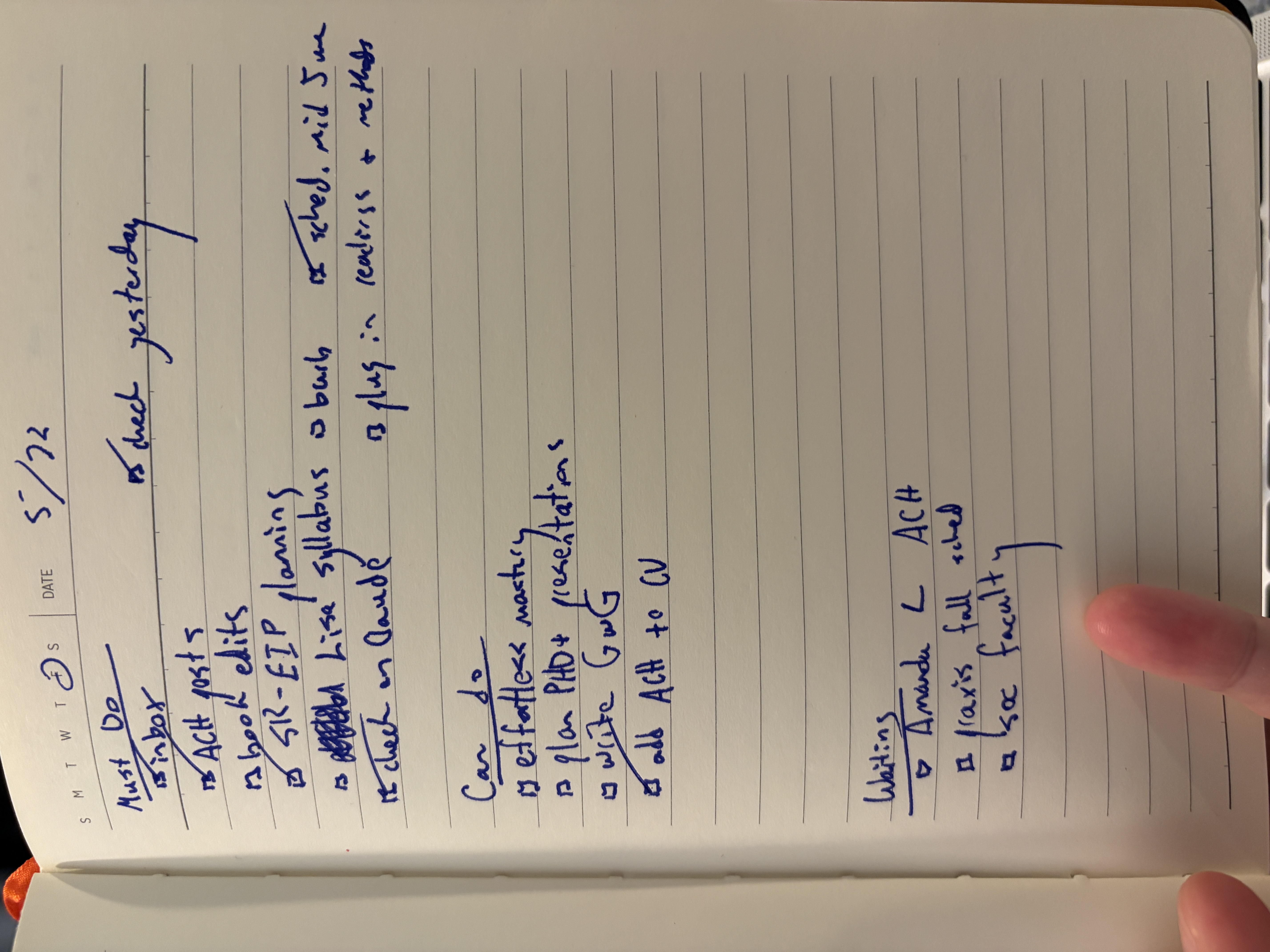
So, I’m experimenting with a physical notebook for the first time in at least a decade. Here’s my daily notebook for today:

task list in a notebook with separate sections for "can do," "must do," and "waiting."

I’ve tried such things in the past but never stuck with them for long, but this run seems to be sticking. In part, I think this is because of how I’ve made working with the notebook part of a daily ritual. Each day’s page is broken into three segments: must do, can do, and waiting. I start each day by looking at the previous day by looking at the previous page to see what needs to be moved over. I’ll then check my inbox and shuffle things around based on how answering email goes. This process gives me a sense of things that are urgent and those tasks that require actions from other people. I typically close out each work day by referring to the page once more and updating things. This process is helped along by the fact that I have found a particular set of pens that are deeply, unironically joyful to use. Working with them provides a meditative tactile sensation that grounds my start and end to each day.

Sharing all this is a tad embarrassing. I have discovered writing in a journal! I have terrible handwriting! Pens are nice! But I can’t emphasize enough what a shift this has been for my working life. It’s brought an embodied ritual to each day that I didn’t have before, and I’ve found it surprising how much energy can come from shifting this foundational part of my working rhythm. So, if you’re feeling stuck, it’s never too late to change. Your process can always find new shape if you give it new tools.

  •  

Betreuungskompetenz gezielt stärken: Chancen und Herausforderungen in den digitalen Geistes- und Kulturwissenschaften

Diese dreiteilige HERMES-Veranstaltungsreihe richtet sich an Betreuende von Qualifikationsarbeiten (Bachelor, Master, Promotion) im Bereich der digitalen Geistes- und Kulturwissenschaften. Die Reihe ist modular aufgebaut und jede Veranstaltung kann unabhängig besucht werden – ideal für eine gezielte, flexible und praxisnahe Weiterbildung im Alltag im Austausch mit Expert*innen.

Den Auftakt der Reihe bildet eine Veranstaltung zum Thema „Hochleistungsrechnen“, gefolgt von zwei Podiumsdiskussionen zu den Themen „GLAM“ und „Interdisziplinarität“. Hierbei kommen Vertreter*innen von Hochschulen und dem GLAM-Bereich (Galleries, Libraries, Archives, Museums) in unterschiedlicher Zusammensetzung miteinander ins Gespräch, diskutieren verschiedene Thesen und eröffnen Reflexionsräume. Die Teilnehmer*innen gewinnen durch den Besuch der Veranstaltungen neue  Perspektiven zu aktuellen Themen, die sie in die Betreuung und Beratung ihrer Studierenden und Promovierenden einbringen können. Raum für Fragen und eine offene Diskussion wird bei allen Veranstaltungen gegeben.

Die Veranstaltungen finden online statt, eine Registrierung ist über die einzelnen Veranstaltungsseiten möglich.

High Performance Computing (HPC) nutzen: Anja Gerbes und Dr. Sabine Bartsch

08.06.2026, 18-20 Uhr

Nach einer Roadshow von Anja Gerbes zu High Performance Computing des NHR, berichtet Dr. Sabine Bartsch von ihren Erfahrungen des Dienstes in Forschung und Lehre.

https://hermes-hub.de/aktuelles/events/betreuenden-ws-hpc-2026-06-08.html 

GLAM als Partner der Wissenschaft verstehen: Prof. Dr. Felix Schäfer, Konstantin Freybe, N.N.

16.07.2026, 18-19:30 Uhr

In der Podiumsdiskussion sprechen Vertreter*innen des GLAM-Sektors und Hochschullehrende über Angebote und Forschung an GLAM-Einrichtungen  sowie der gemeinsamen Betreuung von Qualifiaktionsarbeiten.

https://hermes-hub.de/aktuelles/events/betreuenden-ws-glam-als-partner-2026-07-16.html

Interdisziplinäre Qualifikationsarbeiten betreuen: Prof. Dr. Anna Neovesky, Dr. Shumon T. Hussain, Dr. Anna Froese

17.09.2026, 18-19:30 Uhr

Die eingeladenen Vertreter*innen aus der Wissenschaft diskutieren ihre Erfahrungen in Hinblick auf interdisziplinäres Arbeiten und deren  Betreuung.

https://hermes-hub.de/aktuelles/events/betreuenden-ws-interdisziplinarit%C3%A4t-2026-09-17.html 

  •  

Interview Series: In Conversation with BiblioTech Hackathon Participants

作者Sam Goven

The following interview was conducted by Sam Goven, a master’s student in Journalism at KU Leuven, with Roberta Pireddu, team leader of the BiblioTech Hackathon project PostScript. Roberta provides academic support for the Master in Digital Humanities at KU Leuven. Roberta’s team worked with the postcard collection. You can learn more about the team’s work by having a look at their project poster in the BiblioTech Zenodo community and by visiting their project website.

The BiblioTech Hackathon is a 10-day event organized by KU Leuven Libraries and the Faculty of Arts. Students, researchers, and staff members of KU Leuven worked in multidisciplinary teams with digitized collections from KU Leuven Libraries. The theme of the 2026 edition was travel, which was reflected in the selected datasets: historical postcards and historical travelogues. More information about the hackathon and its results can be found on the BiblioTech 2026 website.

Team PostScript with their project poster during the closing event of the BiblioTech Hackathon.

Congratulations on winning both the first prize and the public’s favorite! Can you tell me a bit about what first drew you to the hackathon, and have you participated in one before?

I hadn’t participated in a hackathon before, but I had organized a small one myself. It was for a project on Artificial Intelligence and its application in the cultural heritage sector. I knew a lot about the organizational aspects, but not much about how to actually participate in a hackathon. What I mainly did then was observe the other groups: what they were doing and how they came up with their projects. So I was mostly involved from the sidelines.

As for why I participated: I’m currently praktijkassistant and teaching assistant for the Master in Digital Humanities, and digital humanities students are an important target group for the BiblioTech hackathon. Taking part myself allowed me to work on a project together with the students. I also already knew the postcard collection, as I had worked with it in the past, and I thought it would be nice to create something new using that material.

And your own background is in Digital Humanities as well?

Yes, that’s right. I studied Digital Humanities in Leuven, and before that I studied history, more specifically medieval history, so my background is very much in the humanities. I’ve mainly worked with heritage collections, like the ones that were used for this hackathon.

I already mentioned you won the first prize with your project. Could you describe it in a nutshell?

Our team worked with the postcard collection, which is a very large one, and visually very attractive. It’s rich in information, with a lot of detail in the metadata, but because of its size it can be quite difficult to really explore all of those details.

What we wanted to create was a kind of website or digital space where people could explore the collection more easily and from different perspectives. We chose three main perspectives. One of them, for example, is a map, where users can see the locations represented in the collection and then zoom in on the details. On the website, users can also explore specific elements, like all the trains in the collection, all the cars, parks, and so on.

In addition, we created a crowdsourcing section. We wanted to include user participation so that the collection could be enriched with additional information. For example, on the back of the postcards there are greetings, and we wanted to allow users to transcribe or translate those messages so they could be added to the metadata.

You were the team leader of your group. Was this role in line with what you had expected?

I expected that I would need to give structure to the team: define the focus of the project, set concrete steps, and remind everyone of deadlines. In the end, though, everything developed very organically and smoothly, and I was really happy with how it worked out.

At the ‘Meet the Data, Meet the People’ event, you were introduced to the data for the first time. How did the brainstorming process go?

At first, it wasn’t very clear what specific skills everyone could bring to the project, or how we should approach such a large collection. That led to a lot of questions: what do we actually want to do with this collection, and what do we want to highlight?

In the beginning, we had many different ideas. We thought about working with the colors of the postcards, or focusing on locations, and that’s when the idea of using a map came up. There were a lot of possibilities. At a certain point, though, we decided that we really needed to look more closely at the dataset, see what was actually there, and then make a decision. That happened a couple of days after the opening event. We had some time to reflect, explore the data, and then settle on a clear approach.

Was it difficult to decide in which direction you wanted to go?

A bit, yes. But in the end, the direction really emerged from what we actually found in the data. As I mentioned before, we initially wanted to work with color, but when we started thinking about the kind of results that would produce, we realized it wasn’t the direction that appealed to us the most. So at some point we had to make a clear decision: okay, let’s go in this direction and really commit to it.

That said, it was still a bit challenging, because along the way new ideas kept popping up. For example, we considered adding a gamification aspect to the crowdsourcing section, where participants could earn points based on how much they contributed. In the end, we had to leave that out because of time constraints. At some point we realized, there are only three days left, how can we realistically make this work? It’s important at that stage to be realistic and say, okay, this is something we can do, and this is something we can’t.

During your final presentation at the closing event, you mentioned the educational goal of the project and its collaborative aspect. What kind of audience did you have in mind? Who should be able to use the website you developed?

We definitely had researchers in mind. The idea was to help them shape their research by giving them access to all these additional details in the collection. Because the postcard collection is so broad, it’s not immediately obvious what kind of research questions you could explore with it, and we wanted to make that easier.

At the same time, we wanted to reach a wider audience, people who are curious about Belgium’s history, about tourist places, and what they looked like in the past. Some might be interested in comparing then and now, others in seeing how streets and cities have changed, or just browsing the collection and feeling a bit nostalgic.

One thing I found very appealing was how user‑friendly the website was, it really looked like something anyone could use.

Yes, absolutely. I think a lot of people would love the idea of being able to see how a place looked in the past and compare it to how it looks now, seeing how much it has changed, or sometimes how it no longer exists at all.

The end result was a success, but did you face any roadblocks during the hackathon?

There was one issue at the beginning related to the locations of the postcards. We wanted to create a map and link each image directly to a specific place, but the coordinates were missing in the collection. So we first had to retrieve that information, and that took some time. At one point, we even thought it wouldn’t be possible. In the end, though, one of the team members managed to clean the dataset and recover the exact coordinates for each location, which allowed us to move forward.

You mentioned that this was the first hackathon you participated in. Do you feel you picked up any new skills along the way, and how might you use them in future research?

The crowdsourcing concept was particularly interesting for me. It’s something I had already worked with in earlier projects where we involved the public. For example, we showed people images, often of places in cities, and asked them to share additional information about what they saw.

What was new for me in this project was the specific crowdsourcing tool that we embedded in the website. I think that’s something I’ll definitely use again in the future. It’s very user‑friendly and easy to integrate, and the fact that it automatically produces a file with all the participants’ responses is very useful.

What advice would you give to someone who might be hesitant to participate in a hackathon because of their background?

I really think everyone can participate, because there’s a place for everyone in a hackathon, even if you don’t have strong technical skills. Whatever your background or skills, there’s always a way to contribute and find your role within the group. That might be through creative ideas, working on the poster, or helping shape the concept of the project. There’s always something meaningful you can bring to the team.

Last question: what advice would you give a team leader?

I would say don’t be too strict at the beginning. It’s important to give everyone enough space to be creative and to let people explore ideas, so that everyone’s skills can really emerge. I think the brainstorming phase is especially important, because that’s when you start to understand what each team member can do and how everyone can contribute to the project.

Congratulations one more time! It’s amazing how much each team accomplished in such a short period of time. For me, it almost felt unreal, this looked like a year’s worth of work.

Yes, exactly. For me, this could have been a thesis, the kind of results you would expect from a master’s thesis. That’s really what made it so remarkable to me.

  •  

Escuela de otoño 2026

Escuela de otoño 2026

Este curso propone un espacio de formación y reflexión orientado a comprender cómo se investiga en el espacio digital desde las HD, abordando tanto sus fundamentos epistemológicos como sus metodologías y herramientas prácticas

Continue reading Escuela de otoño 2026 at Red de Humanidades Digitales.

  •  

Where Humanities and Data Meet: The BiblioTech Hackathon 2026

作者Sam Goven

The following post was written by Sam Goven, a master’s student in Journalism at KU Leuven. It offers a participant’s perspective on the BiblioTech Hackathon, reflecting on the experience, the creative process, and collaborative spirit that shaped the event.

hackathon_participants
Participants of the BiblioTech Hackathon 2026 proudly pose on the steps of the University Library in Leuven.

Libraries are often seen as places of preservation rather than experimentation, but the BiblioTech Hackathon turns KU Leuven Libraries into a digital playground. Drawing on rich library datasets, students, researchers, and staff from diverse backgrounds work in interdisciplinary teams to reimagine historical collections through digital tools and collaboration.

The second edition of the hackathon culminated on 26 March in the University Library in Leuven, where seven teams presented their final projects to a jury. Over the course of ten days, materials from the library collection were transformed into innovative digital outputs, ranging from interactive maps and searchable databases to experimental interfaces, which can be explored via the project websites. Team PostScript ultimately claimed both the jury prize and the audience award with an interactive digital archive of Belgian postcards.

By combining technical support, curated library collections, and an emphasis on experimentation rather than competition, the BiblioTech Hackathon demonstrates that digital humanities can be accessible, creative, and collaborative, even for those new to computational approaches.

What is a Hackathon?

During a hackathon, a blend of “hacking” and “marathon”, participants work together in teams on a project against a tight deadline. These projects often have a digital component and can be developed over one or several days, resulting in a website, database, or another form of digital output.

The first edition of the BiblioTech Hackathon took place in 2023, organized by KU Leuven Libraries and the Faculty of Arts. Participants could choose from seven datasets, including the Bible of Anjou and wartime posters. The focus was on exploring documentary heritage from a fresh perspective by transforming it into computational data. The hackathon proved to be a success and led to a second edition in 2026.

Meet the Data, Meet the People

The second edition kicked off on 12 March in Agora Learning Centre in Leuven. As the smell of pizza filled the space, the perfect brain food for sharp minds, the seven teams discovered both the datasets and each other for the first time. In total, 39 enthusiastic participants from a wide range of backgrounds took on the challenge. The hackathon attracted not only master’s students, but also PhD candidates, postdoctoral researchers, and KU Leuven staff. Participants represented a broad variety of disciplines and research fields, including Computer Science, Egyptology, Law, and Economics.

To make the most of this diversity, teams were formed in advance based on digital skills and areas of expertise, ensuring a balanced mix. Each team was supported by a designated team leader to keep the project on track, while technical experts were readily available throughout the hackathon to answer questions and provide assistance. To ensure everyone could get started smoothly, an additional training session on the technical infrastructure and tools was organized the next day.

Following an introduction to the datasets and the available support network, the teams dove into the material. This year’s hackathon offered two datasets: well over 35.000 historical postcards from Belgium and around 300 travel accounts written by European authors describing the destinations they visited. Once again, these historical sources provided ample opportunities for innovative perspectives. Four teams chose to work with the travelogues, while the remaining three focused on the postcards.

The brainstorming phase reflected the exploratory nature of the hackathon. Faced with rich datasets and a wide range of ideas and ambitions, teams took time to explore different directions before narrowing their focus. Working within a limited timeframe required careful consideration of what was both innovative and feasible. This process not only helped shape the projects but also allowed participants to recognize and build on each other’s strengths. Andreas Ketele, a member of the Inked and Stamped team, reflected afterwards: “What I really enjoyed was that process of exploration. We reflected on our ideas and experimented a lot, and that’s exactly what a hackathon is about: discovering possibilities along the way.(full interview)

Team_JulieVerne
Team Julie Verne getting to know each other, and the data, over pizza.

The Final Projects

On 26 March, participants, jury members, and guests gathered in the University Library for the final presentations accompanied by a poster exhibition, marking the culmination of the hackathon and an opportunity for teams to present their work. The evening opened with welcoming words from the organizing team, Demmy Verbeke (Head of KU Leuven Libraries Artes), and Geert Brône (Vice Dean for Research at the Faculty of Arts), who praised the creativity and commitment shown throughout the hackathon.

The presentations were opened by team CaptaCats with their project ShipAdvisor. Loosely inspired by the travel website TripAdvisor, the team developed a web platform that maps maritime routes in the Mediterranean during the 18th and 19th centuries, based on historical travel accounts.

Next, team DH.xml presented their analysis of the postcard dataset. They argued that historical postcards functioned as a form of social media avant la lettre, and used the collection to identify recurring visual trends and patterns.

All Reads Lead to Leuven focused on how 19th-century French travel writers wrote about African languages. Their project resulted in a website featuring Instagram-inspired posts that reveal the vocabulary and framing these authors used when describing linguistic encounters.

Using the postcard dataset, Inked and Stamped built a searchable digital database. Its intuitive interface allows users to explore the collection by location, date, and even the color of the postcards.

Team PostScript adopted a similar approach, but with a specific focus on postcards from Antwerp. In addition to a searchable database, they introduced interactive features such as maps that contrast contemporary photographs with historical images from the collection.

The penultimate presentation came from Team W@nder. Drawing on The Land and the Book, a 19th-century publication by W. M. Thompson, they visualized the author’s travels in the Levant. As with other projects, historical illustrations were juxtaposed with present-day photographs to highlight continuity and change.

The evening concluded with a presentation by Team Julie Verne. They developed an oracle-like search tool based on the travelogues dataset. Through their website, users can query the texts and receive the most relevant responses generated from the corpus.

After a brief deliberation by the jury and a public vote, the awards were announced. The jury consisted of experts in data and digital research: Julie Birkholz (Coordinator CLARIAH VL+), Geert Brône (Vice Dean for Research of the Faculty of Arts), Jo Rademakers, (Head of LIBIS), Fred Truyen (Head of CS Digital), and Katrien Verbert (Program director of the POC Digital Humanities). Team PostScript was awarded both the jury prize and the audience award. As in the 2023 edition, however, each team received recognition, including awards such as Best Research Potential and Best Visualization. The evening concluded with a reception, where teams presented their project posters over food and drinks. To share the creativity and impact of the hackathon with a wider audience, the posters are currently touring across KU Leuven.

Team PostScript with their project poster during the closing event of the BiblioTech Hackathon.
Team PostScript poses with their poster at the reception.

A Community Built Through Collaboration

Not only were the results of the hackathon impressive, participants also praised the atmosphere and strong sense of community that developed throughout the event. In post-hackathon interviews, several participants reflected on the collaborative environment that emerged over the course of the ten days. Andreas Ketele described the experience as particularly rewarding: “I’m usually not someone who uses very strong words, but this really was fantastic. […] We were working as a group of highly motivated people. We collaborated very well and benefited enormously from all the support we received along the way.” (full interview)

The diversity of backgrounds and skill levels did not prove to be a challenge, but rather one of the hackathon’s greatest strengths. By bringing together participants with different perspectives, expertise, and levels of technical experience, the hackathon created space for learning from one another. As Roberta Pireddu, team leader of PostScript, explained: “I really think everyone can participate, because there’s a place for everyone in a hackathon, even if you don’t have strong technical skills. Whatever your background or skills, there’s always a way to contribute and find your role within the group.” (full interview)

For many participants, this emphasis on collaboration rather than competition was key. As advice for future participants, Luisa Ripoll Alberola, team leader of CaptaCats, encouraged newcomers not to focus too heavily on the final outcome: “What really matters is not the end product, but the process: working together, learning new things, and enjoying the experience. That’s what makes it valuable.” (full interview)

The second edition of the BiblioTech Hackathon proved once again how working with library data can foster meaningful collaboration across disciplines. By bringing together diverse participants, the hackathon strengthened connections within the academic community and opened up new ways of engaging with humanities collections.

More information about the hackathon, its datasets, and the final projects can be found on the BiblioTech 2026 website. We encourage you to have a look at the project posters and websites to explore the teams’ outputs and discover the creative ways in which KU Leuven’s library collections continue to inspire digital humanities research. We also invite you to explore interviews with participants, offering a personal insight into their experiences during the event.

  •  

Neues Whitepaper zum Thema Fuzzyness & Wobbliness im NFDI4Objects Community Hub

Die NFDI4Objects TWG Community-Standards for modelling fuzziness & wobbliness in research data using Semantic Web technologies and formalisms (FuzzyWobblySW) hat ein neues Whitepaper veröffentlicht, das die Begriffe Unsicherheit, Vagheit und „Fuzzyness & Wobbliness” aus Sicht der Arbeitsgruppe definiert.

Das Dokument vergleicht und fasst gemeinschaftlich entwickelte Arbeitsdefinitionen der TWG  zusammen. Ziel ist ein gemeinsamer begrifflicher und modellierungstechnischer Rahmen. Durch Klärung der Konzepte und Darstellung von Modellierungsstrategien (z. B. probabilistische Ansätze, graduelle semantische Abbildungen, Wikibase-Implementierungen) trägt die Arbeit zu transparenteren, interoperableren und FAIR-konformen Lösungen für unsichere, unpräzise oder mehrdeutige Informationen in Kulturerbe-Wissensgraphen bei.

Das Whitepaper kann im Rahmen des NFDI4Objects-Commons-Prozess bis 28. Mai 2026 kommentiert werden! Wir freuen uns auf Euer Feedback!

  •  

When the Algorithm Disagrees With Your Eyes

Digital images are in constant motion. They traverse various platforms, feeds, databases, and archives, often reappearing in modified forms. Through my research on digital art, I have recognized this phenomenon as more than a mere feature of online dissemination. It constitutes both a methodological challenge and a perceptual issue.

What appears to be a single image may, in actuality, exist as a collection of various versions: cropped, compressed, recoloured, or reposted without proper attribution. Although these differences may seem insignificant at first glance, they give rise to a question that is more complex to answer than it initially appears.

      Under what circumstances can two images be considered identical?

That question became the basis of my assignment for the CodeLab course in my ongoing Praxis Fellowship Program. Using Python with the ImageHash and Pillow libraries in VS Code, I built a small tool to test how visual similarity might be measured across images that have changed through circulation. What started as an exercise became a way of thinking through something larger: what does it mean for a computer to recognize an image, and does that match what we mean when we say two images are the same?

The approach

The tool uses the imagehash library to compute perceptual hashes and compare images by visual similarity.1 Unlike cryptographic hashing, which changes entirely if even a single byte changes, perceptual hashing captures how an image looks. Two visually similar images should produce similar hashes; unrelated images should not.

After generating the comparison data, I modified the script to export results as JSON and render them as an HTML page. Instead of raw values, the interface ranked each image against the reference, displayed a distance score, and grouped results into categories from “nearly identical” to “different from the original.” The script processed files in the images/ folder, saved results to version_results.json, and generated output in results.html.

Image variant comparison

Figure 1. HTML interface showing ranked comparison of image variants against the reference image. See https://jimgaconcept.github.io/image-versioning-demo/

The dataset

The reference image is a digitized hand-drawn cartoon illustration made with pen and ink and watercolor on paper. This detail turned out to matter a great deal. I compared it to two modified copies (resized and compressed), one digitally recreated version, and three visually unrelated images, to test whether the tool could distinguish genuine variants from unrelated works.2

Results

The two modified versions, resized and compressed, both scored between zero and two, confirming their close relationship to the reference. The three unrelated images all scored above 20, well outside any similarity range. The digitally recreated version (Fig. 1) scored 18, placing it in the category that the interface labeled as different from the original.

That score of 18 was the result I did not expect, and the one worth thinking about most carefully.

What the computer sees, and what we see

The recreated image and the original share the same subject, composition, and color palette. A human viewer encountering both would almost certainly recognize them as versions of the same thing. The algorithm did not. Scoring 18, it placed the recreation closer to the unrelated images than to the two modified copies, which scored between 0 and 2.

The reason lies in what each image actually is at the data level. The original is a scan of a physical drawing, and its pixel data carries the texture of its medium: the grain of the paper, the way ink spreads at the edges of marks, the tonal variation of pigment on a physical surface. The digital recreation was built entirely within Photoshop and saved as a JPEG. Even a faithful digital reconstruction is made from digital brushes and algorithmically generated marks. There is no paper grain, no ink bleed. The two images look the same to us, but their underlying data structures are built from entirely different material.

This is a version of what computer vision researchers call the cross-depiction problem: the gap between human visual recognition, which operates on meaning and composition, and machine recognition, which operates on statistical patterns in pixel data. My experiment gave that abstract problem a specific, personal form. What appears identical to the human eye may share almost nothing in common at the data level. The computer is not seeing the image. It is reading a numerical structure, and two images that represent the same thing visually can be built from entirely different data, depending on how and where they were made.

This relates to a broader discourse within the field of digital humanities. As Drucker (2013) has articulated, digitization constitutes not merely a neutral representation but rather a form of interpretation. Factors such as resolution, lighting conditions, and the medium of capture all influence the transformation of an image into data.3 My findings exemplify this argument concretely. The scanned watercolor and the Photoshop recreation are not simply two variants of the same image; rather, they represent two distinct interpretations, which the algorithm processes accordingly.

If we are building archival systems or image databases that rely on computational similarity to group and relate works, we need to ask whose sense of “the same image” is being encoded. A tool trained on pixel-level data will consistently separate a scanned physical artwork from its digital recreation, not because they are different images in any humanistic sense, but because they are different kinds of data.

Limitations and what comes next

Perceptual hashing assesses visual similarity at the data level. It does not establish authorship, confirm provenance, nor consider contextual factors. Outcomes may also differ based on the specific hashing algorithm employed, as various implementations assign different weights to visual features. This tool serves as one component within a broader interpretive framework, rather than substituting human judgment.

This assignment illuminated a perception that is both straightforward and profound. It is evident that the computer and the human eye do not observe the same aspects, even when examining the same image. The disparity between data and meaning represents the realm where the most compelling inquiries within digital art history reside. As Burdick et al. (2012) suggest, the significance of computational tools in the humanities lies not in their capacity to resolve questions, but rather in their ability to render certain questions newly answerable.4 This experience has prompted a question I was previously unaware of having.

The live output and ranked visualization are at the project web interface. Full code is on GitHub.


  1. The imagehash library was developed by Johannes Buchner: https://github.com/JohannesBuchner/imagehash. Distance between hashes is computed using Hamming distance. See Hamming, R.W. (1950). Error detecting and error correcting codes. Bell System Technical Journal, 29(2), 147–160. doi:10.1002/j.1538-7305.1950.tb00463.x 

  2. The distance thresholds used (0 for near-identical, 1–5 for minor modification, 6–10 for significant transformation, above 10 for visually distinct) are derived from standard imagehash benchmarks and calibrated through iterative testing against the dataset. 

  3. Drucker, J. (2013). Is there a “digital” art history? Visual Resources, 29(1–2), 5–13. doi:10.1080/01973762.2013.761106. The argument that digitisation is interpretive rather than neutral runs throughout the article and is developed across pp. 5–8. 

  4. Burdick, A., Drucker, J., Lunenfeld, P., Presner, T., and Schnapp, J. (2012). Digital_Humanities. MIT Press. The claim is consistent with the book’s central thesis; p. 14 is the closest anchor. 

  •  

Nine things for nine years

I blinked and realized that Amanda Wyatt Visconti and I have been at the Scholars’ Lab for nine years as of April 24, 2026. Time flies. We typically celebrate by eating or drinking something sweet in the Lab (I’m still vibrating from the cream soda we had half a decade ago). We weren’t able to do so this year, so I thought I would share a quick post to mark the last nine years.

Nine things I’ve learned

  1. Drink a glass of water and put both feet on the ground.
  2. Don’t over-engineer things.
  3. Slow down and appreciate.
  4. Some things get easier. Some will not.
  5. Write it down. It will be helpful for someone. That someone might be you.
  6. Snacks always help.
  7. Be explicit about what you need and what you don’t.
  8. There are limits.
  9. Structures give shape. Structures can be changed.

Nine memories to hold onto

  1. Amanda biting into a lemon after eating miraculin.
  2. The moment when each student steps into their own expertise.
  3. Shane saying, “agenda item: be better friends.”
  4. When I cried at the Afton overlook because I wouldn’t have to commute for work anymore.
  5. Biscuit baking lessons on zoom with Jeremy and Amanda.
  6. The support each colleague gave when I needed it.
  7. The satisfaction that comes from seeing a student graduate as a DH practitioner, especially when you met them as a prospective student.
  8. Those who are gone. Ryan. Leigh. Scott. Rebecca. Effie. Stéfan. So many others for different reasons.
  9. All the unjust things. All the people working to make it better.

Nine things I’m grateful for

  1. Our students. They’re the best.
  2. Our colleagues. They keep me coming back.
  3. To still be here, doing this.
  4. Everyone who has taught me.
  5. Those who are still here.
  6. Those who made space for me when I burnt out.
  7. Eliza, Ben, Ava.
  8. That I was given a chance.
  9. Every accident that brought me here.

It’s not lost on me that so many others deserve to be in stable employment who are not. I’m very lucky to have a job in this world on fire. So, I will close with gratitude and a determination to pay it forward to the next folks in line.

  •  

Teaching with the DH Awards

It’s that time of the year when the DH Awards goes public with the results of their annual cycle. The process is, of course, only a snapshot of the field and limited in all those expected ways. But I am astonished each year, chronically online as I am, to find that there are so many projects out there that are new to me. Each season is a delight as I page through the many different links offering new work, unknown-to-me scholars, and fresh ideas. Reading this year, I thought that the list could make for a useful way of constructing a DH teaching activity. Here are a few ideas for how you might use the DH Awards to teach your students:

  • Take five; pick one. Students pick five projects to examine in detail, using a rubric you provide in advance. In session, they each quickly present on one topic to the group. You follow up with a general discussion to which the students can bring all five pieces they examined.
  • Dig into a year. It’s not uncommon for scholars to designate particular years as uniquely important for their fields of study. In this activity, students pick one year and examine the projects showcased in the DH Awards closely. What was distinctive about this year? What trends do they see? What seems curious?
  • Look over time. Ask students to consider how representation of the field has changed over time as articulated in the DH Awards. Probably easiest to narrow their focus to a single category for this one. Does anything rise up? Fall away? Remain steady?
  • Consider what’s left out. Invite students to look critically at the awards process. Can they think of any topics or kinds of scholars who are consistently left out?
  • Design your own. Encourage students to speculate on their own award cycle. What kind of work would they want to promote? What do they value? How could they design a shoestring award process to help facilitate that every year? What kind of collaborators would they need to implement it? How much labor would it entail?

For extra flavor, I might offer analogous or contrasting exercises with Reviews in DH or Digital Pedagogy in the Humanities. Maybe that’s a future post. Endless thanks to those who provide volunteer labor to keep DH Awards going. I always appreciate the project as a service to the community. I always learn something each awards season, and hopefully the above activities give some ideas for how they can teach your students as well.

  •  

Forschungsdaten im Zentrum: Ewig währt am längsten

Ein partizipativer Workshop der Initiative „Datenzentrum – wissenschaftliche Konzeption und Ausgestaltung“ der Berlin-Brandenburgischen Akademie der Wissenschaften (BBAW)

Berlin, 25. und 26. Juni 2026; Akademiegebäude am Gendarmenmarkt; Einstein-Saal


Der Wert geisteswissenschaftlicher Forschungsdaten für Wissenschaft und Gesellschaft ist nicht zuletzt durch den laufenden Aufbau der Nationalen Forschungsdateninfrastruktur (NFDI) offensichtlich geworden. Zentrale Fragen nach dem dauerhaften Betrieb vertrauenswürdiger Datenrepositorien und der langfristigen Verfügbarkeit der aggregierten Inhalte sind jedoch weiterhin offen.

Vor diesem Hintergrund lädt die Initiative „Datenzentrum – wissenschaftliche Konzeption und Ausgestaltung“ der BBAW zu einem zweitägigen Lunch-to-Lunch-Workshop ein. Diese 2025 eingerichtete Initiative erarbeitet ein Konzept für die organisatorischen und technischen Grundlagen für ein leistungsfähiges, zertifiziertes Repositorium und dessen infrastrukturelle Einbindung innerhalb der BBAW. Darauf aufbauend wird die Akademie ab 2028 ein eigenes Datenzentrum betreiben. Dessen Hauptaufgaben werden die Aggregation, Verfügbarhaltung und Archivierung von Forschungsdaten, Software und Diensten aus den Vorhaben und Projekten der Akademie sein. Darüber hinaus ist eine Öffnung des Repositoriums für externe Datengeber:innen vorgesehen.

Im Workshop werden anhand von Impulsvorträgen die unterschiedlichen Perspektiven aus Sicht von Forschung, Bibliothek, Archiv und IT reflektiert. Anschließend bieten verschiedene Thementische die Möglichkeit zu einer intensiven Auseinandersetzung mit spezifischen Fragen, von der technischen Einrichtung nachhaltiger Infrastrukturen zwischen quelloffenen und kommerziellen Lösungen bis hin zum Einsatz sog. Künstlicher Intelligenz samt deren ethischen Herausforderungen.


Um Anmeldung wird gebeten unter: www.bbaw.de/veranstaltungen/veranstaltung-workshop-datenzentrum-2026

Nähere Informationen zum Programm: https://datenzentrum.bbaw.de/veranstaltungen/workshop-2026. Die Seite befindet sich im Aufbau und wird fortlaufend aktualisiert.

  •  

Breath in DH

Winnie E. Pérez Martínez’s post on the Scholars’ Lab blog this week got me thinking. In “Breadth and Depth, a Self-Centered Dialectic,” she revisits how we discuss breadth and depth as two approaches to digital humanities professional development. In this framing, one that I have put forward myself, we can think of careers in DH as operating on two axes. On the one, we are expected to know a little about a lot of things. On the other, we are directed more towards narrow, specialist-level knowledge about a smaller subset of methods. Breadth vs. depth. Few careers really ask us to go entirely in both directions. More practically, we tend to specialize in a couple areas within DH and develop passing familiarity with many more.

For me, the dichotomy between breadth and depth was a way to help students map their career plans onto the different skills they might acquire. I thought of it as a way to free yourself from the need to be expert in everything. In her post, Pérez Martínez expertly shows how breadth and depth actually inform and lead to one another. There can be no one right way in. If you start deep, you might find yourself broadening, and starting wide can help you to focus in. What most resonated about Pérez Martínez’s post, though, was the way in which you can see an exceptional scholar and practitioner wrestling over whether they are enough, over whether they could ever develop the necessary skills they need to feel complete. Those anxieties never really go away. I feel them too. I recognized myself in Pérez Martínez’s post, and I couldn’t help but sense that the breadth against depth framing seemed to be having the opposite effect I would want, heightening anxiety rather than mitigating it.

Pérez Martínez proposes a broadening of the axes I had envisioned. Breadth and depth move beyond just X and Y, curling in upon themselves until they start to push outwards. The moment reminded me of the age-old dichotomy of “hack” vs. “yack” in DH work and how Laura Braunstein offered “stack” as an important third term. In addition to coding and technological critique as key parts of DH work, Braunstein’s intervention elevates “the often invisible technological, social, and physical structures within which scholarship is produced and disseminated.” For Braunstein, DH work is more than just the sum of what we do, it also consists of the structures we put in place to enable that work. In the same spirit and inspired by Pérez Martínez, I have been wondering what breadth and depth leave out, what they gesture towards within and beyond the teaching that we do.

Put another way, what is education if not just content? One point of comparison here is L. Dee Fink, whose Taxonomy of Significant Learning illuminates the various components of teaching.

L. Dee Fink's Taxonomy of Significant Learning as shared on Florida International University's Center for the Advancement of Teaching.

Caption: L. Dee Fink’s Taxonomy of Significant Learning as shared on Florida International University’s Center for the Advancement of Teaching.

Fink’s Taxonomy usefully illustrates all the things that lie beyond the subject matter in the courses we teach. Learning is more than consuming books, articles, or topics. Teaching is more than passing along skills and methods. If we think of DH merely as skill building, we live too much in the upper right of the circle. We leave out the rest of what makes DH experiences—and DH learning—significant for so many of us. We ignore the transformative mentoring that shows a variety of career options. We miss the collaborative practices that can change how we view our work in dialogue with others. We do not account for how true interdisciplinarity changes our perspectives on our own research processes. We need a new term to trouble the dichotomy between breadth and depth that can capture a more capacious view of what it means to practice digital research and teaching, one that goes beyond subject matter, methods, and skills.

I find this particularly urgent in the age of generative AI, a complicated set of technologies that threatens to instrumentalize education beyond recognition. What counts as methodological training if you can vibe code your way to a launched digital project? What counts as digital pedagogy if our students are secretly using chatbots as study partners? How do we make room for conversations about professional development that do not reduce people to a tidy axis of skill acquisitions?

What lies beyond the breadth and depth of what it means to be a digital humanist?

I would introduce a third term for DH professional development: “breath.” Breadth and depth ask us to think about what we can and cannot do, about the subject matter and methods of DH work. The terms ask us to think about the limits of our knowledge and our inability to pursue universal expertise. Breath asks us to reframe the conversation entirely. It is an invitation to pause and re-embed our work in the body. How do we feel about our labor? Who are the working souls in DH and how do we engage with them? How do we work or overwork our own body to the point of breathlessness? What is the lived experience of our labor that transcends the skills or methods? What are the affects—the joys, frustrations, traumas, triumphs—of DH work that cannot be captured by thinking in terms of skill acquisition? How do our energies map onto a living, breathing community of thinkers and doers beyond the work on the table in front of us? Where do we fit in?

Breadth and depth ask students to think about where they could be, professional development by way of spatial orientation. Breath invites students to consider where they are, to think of themselves as real people with real needs that need attending.

  •  

Ringvorlesung „Digital Humanities im Fokus“

作者Erik Renz

Im Sommersemester 2026 wird die Ringvorlesung „Digital Humanities im Fokus: Methoden, Anwendungen und Perspektiven“ an der Universität Rostock fortgesetzt. Die Veranstaltung wird von der Juniorprofessur für Digital Humanities in Kooperation mit dem Rostocker Arbeitskreis Digital Humanities (RosDH) organisiert.

Die Vorträge finden im hybriden Format statt. Eine vorherige Anmeldung für die einzelnen Termine ist nicht erforderlich.

Programm für das Sommersemester 2026:

13.04.2026
Julia Hintersteiner, Dr. Alan van Beek und Dr. Katharina Zeppezauer-Wachauer (alle drei Universität Salzburg)
Die Evolution der Mittelhochdeutschen Begriffsdatenbank

27.04.2026
Prof. Dr. Franz Fischer (Università Ca’ Foscari di Venezia)
Unreadable, Unstable, Uneditable – Critical, Genetic, and Constellational Editions of Difficult Texts and Their Transmission

18.05.2026
Dr. Bart Holterman und Dr. Angela Huang (beide FGHO)
Ein NER-Schema für die Hanseforschung: Überlegungen und Herausforderungen

01.06.2026
Hellmut Braun (Universität Rostock), Dr. Anne Gessing (Universität Bonn), Karsten Labahn und Robert Stephan (beide UB Rostock)
Künstlike Werltspröke und Eyn schön rimbökelin. Digitale Edition mittelniederdeutscher Spruchsammlungen des 16. Jahrhunderts

15.06.2026
Jannik Franz, Tim Kuhlmann und Marie Luise Voß (alle drei hmt Rostock)
„Between Two Worlds“ – Hybride Musikedition am Beispiel der Erich Wolfgang Korngold Werkausgabe

06.07.2026
Dr. Frederike Neuber und Tim Westphal (beide BBAW)
Wer hat hier ediert? Autorschaft, Transparenz und Dokumentation in maschinell unterstützten Editionsprozessen

Veranstaltungszeit

Immer montags an den ausgewiesenen Terminen, ab 17:15 Uhr.

Kontakt

Bei Fragen zur Ringvorlesung wenden Sie sich gerne an das Team der DH-Juniorprofessur: phf.dh@uni-rostock.de.

Weitere Informationen finden Sie fortlaufend aktualisiert auf den Seiten des RosDH: https://www.germanistik.uni-rostock.de/forschung/digital-humanities/rosdh/ringvorlesung/2026/.

Organisation: Ulrike Henny-Krahmer und Erik Renz.

  •  

Lost & Found auf der DHd 2026

作者Marius

Im Februar 2026 hatte ich die Gelegenheit, mithilfe des Early Career Reisestipendiums an der DHd 2026 teilzunehmen. Mein herzlicher Dank gilt CLARIAH-AT, ohne deren Unterstützung meine Teilnahme nicht möglich gewesen wäre. Ebenso danke ich den Organisator*innen für diese beeindruckende Konferenz.

—————————————————————————————–

Was passiert, wenn man als „Super Early Career Researcher“ mitten im Masterarbeitsstress zum ersten Mal eine mehrtägige wissenschaftliche Konferenz besucht? Man lernt eine Menge. Über das Fach, über die Community – und über sich selbst. Vor allem aber lernt man, dass man noch nicht so recht weiß, wie der Hase läuft. Oder wann er in welchem Raum sitzt.

Die DHd 2026 stand unter dem Titel „Nicht nur Text, nicht nur Daten“ und war meine erste mehrtägige wissenschaftliche Konferenz. Eine Teilnahme an vorherigen Konferenzen war aufgrund mangelnder Finanzierung bisher nicht möglich gewesen. Nun war die Freude umso größer, nicht nur dabei zu sein, sondern auch ein Poster zu präsentieren, das im Rahmen des Projekts „AlgorithMIX#DDR“ gemeinsam mit Jannis Klähn, Pauline Graf und Anja Neubert entstanden ist. 

Was ich zu diesem Zeitpunkt noch nicht wusste: Eine erste Konferenzteilnahme ist weniger ein einzelnes Event als vielmehr eine Mischung aus geballtem Input, Abenteuerreise, sozialem Experiment, und Improvisationstheater. Vor dieser Erkenntnis war ich erst mal eins: aufgeregt.

Um herauszufinden, ob es nur mir so ging oder ob es zum akademischen Initiationsritus dazugehört, habe ich auf der Konferenz mit Kolleg*innen gesprochen, die an ganz unterschiedlichen Punkten ihrer akademischen Laufbahn stehen: Philipp Sauer, Katja Liebing, Franziska Naether und Uwe Kretschmer. Ihre Stimmen begleiten diesen Text.

Phase 1: Bevor es losging

Lange war unklar, ob ich die Konferenz organisatorisch überhaupt bewältigen würde. Deadlines, Datenauswertung, Textproduktion im Rahmen der Masterarbeit – und dazwischen die Frage: Wien? Hinzu kam die finanzielle Unsicherheit. Ich war nur für zwei Monate im Projekt angestellt und hatte während der Konferenz keine feste Stelle, über die Reisekosten hätten abgerechnet werden können. Also stand die ganz praktische Frage im Raum: Wenn ich das Stipendium nicht bekomme, zahle ich das alles privat?

Mit der Bestätigung des Erhalts des Reisekostenstipendiums hatte sich letztere Frage erfreulicherweise erübrigt. Allerdings hatte ich naiverweise vermutet, ein angenommener Beitrag bedeute automatisch eine Teilnahme. Turns out: dem ist nicht so. Dass man auch mit eigenem Poster eine Teilnahmegebühr entrichten muss, war meine erste kleine Konferenzerkenntnis. Als ich später den enormen Aufwand auf der Konferenz gesehen habe, habe ich sofort verstanden, weshalb das so ist. Die zweite: Workshops sind schneller ausgebucht, als man „Anmeldeportal“ sagen kann.

Und dann die sozialen Fragen: Wie läuft das mit der Verpflegung? Mit wem verbringe ich die Pausen? Wird man alleine mit der Kaffeetasse in der Ecke stehen? Was macht man abends nach den inhaltlichen Parts?

Glücklicherweise wurde mir von Weggefährt*innen der Computational Humanities Gruppe der Uni Leipzig sowie von der Sächsischen Akademie der Wissenschaften zu Leipzig früh signalisiert, dass ich mich an die Leipziger Gruppe „dranhängen“ könne. Dass solche Angebote kein Zufall sind, wurde mir erst im Gespräch mit Franziska klar: Sie sieht es mittlerweile als Teil ihrer Rolle als Hochschullehrerin, jüngere Kolleg*innen mitzuziehen, zu vernetzen und in die Community einzuführen. Es gibt also auf der anderen Seite Leute, die genau das bewusst ermöglichen – auch wenn man das als Neuling erst mal gar nicht so mitbekommt.

Trotzdem blieb das Grundgefühl: Ich bin hier neu. Und ich habe keine Ahnung, wie das hier funktioniert.

Phase 2: Lost in Wien

Das Zurechtfinden in den pompösen Hallen der Universität Wien gestaltete sich als eine Art interaktive Schnitzeljagd. So war ich mehr als einmal zur falschen Zeit am falschen Ort – was, wie ich mir sagen ließ, auch erfahreneren Personen passiert.

Aber nicht nur räumlich musste ich mich orientieren. Zwischen Panels, Tracks, Präsentationen und Kaffeepausen versuchte ich parallel, Interviewpartner*innen für diesen Bericht zu gewinnen – immer mal wieder mit Aufnahmegerät und der leisen Frage: „Entschuldigung, hätten Sie vielleicht kurz Zeit?“ Das hat dank der offenen Community eigentlich recht gut funktioniert. Und in genau diesen Gesprächen wurde mir schnell klar: Das Gefühl des Lost-Seins ist nicht unbedingt individuelles Scheitern (auch wenn ich sicherlich an manchen Punkten besonders lost war und mir die ein oder andere Information vorher hätte einholen können), sondern gehört als Super Early Career Researcher quasi dazu.

Philipp erinnerte sich an seine erste DHd und beschrieb genau das, was auch mich beschäftigte: „Wo stelle ich mich in den Pausen hin? Mit wem rede ich jetzt? Wen spreche ich nach einem Vortrag an?“ Inzwischen sei es für ihn entspannter – man kenne Gesichter, werde selbst erkannt und fühle sich weniger verloren unter mehreren hundert Wissenschaftler*innen.

Was nicht gänzlich neu war, aber mir positiv auffiel: die lockere Stimmung. Ich hatte mehr akademische Stiffness erwartet wie Titel-Overkill und formelle Distanz. Stattdessen erlebte ich eine offene, wertschätzende Atmosphäre. Auch Katja erzählte, dass sie das Duzen und die Lockerheit anfangs überrascht hätten. Sie kommt aus der Geschichtswissenschaft und konnte durch den direkten Vergleich mit nicht-DH-Konferenzen bestätigen: Der Ton bei den DH sei deutlich entspannter. Uwe brachte es auf den Punkt: Die DH-Community sei einfach eine „Wohlfühl-Community“. Vielleicht liegt das an dem, was diese Community auszeichnet: Interdisziplinarität, eine gewisse Offenheit für Neues und das Bewusstsein, dass hier vieles noch im Wandel ist.

Und so wurde aus dem anfänglichen Lost-Sein nach und nach ein Zurechtfinden. Was mich allerdings nicht davon abhielt, beim Poster in leichte Panik zu geraten. Während ich mich am Mittwoch in der Kaffeepause noch mit Raumplänen arrangierte und versuchte, mich für einen der kommenden Inputs zu entscheiden, merkte ich, dass einige ihre Poster bereits aufhingen. Ich hatte bis zu diesem Zeitpunkt keine Ahnung, dass die Position des Posters strategische Relevanz besitzen könnte – aber es leuchtete mir schnell ein. Also lief ich in schnellem Schritt kurzerhand zurück zur Unterkunft, holte mein Poster und hing es auf. Leicht außer Atem und etwas zu spät zum nächsten Vortrag, aber das Poster hing.

Dann kam die nächste Überraschung. Im Laufe der Konferenz wurde ich mehrmals gefragt: „Machst du auch beim Poster-Pitch mit?“ Ich beantwortete die Frage recht selbstverständlich mit „Ja“, denn ich dachte, das gehört halt dazu. Daraufhin wurde mehrfach hinterhergeworfen: „Wow, mutig! Weißt du, was da auf dich zukommt?“ Ich hatte an eine kurze Vorstellung des Posters und des Projekts gedacht. Dann wurde mir erklärt, dass einige Teilnehmende aufwändige Performances planten. Kostüme wurden angedeutet. Dramaturgische Elemente. Große Gesten. Ich hatte mich für einen kurzen, pointierten Input entschieden – und begann kurz zu zweifeln, ob „ruhig sprechen und hoffen“ als Strategie ausreichen würde.

Was ich ebenfalls nicht realisiert hatte: Die Pitches fanden in einem vollen Audimax statt.

Nachdem ich meinen Pitch mit wackligen Beinen und leicht zittriger Stimme über die Bühne gebracht hatte, und den teils wirklich beeindruckenden Performances zusehen durfte, stand noch die Poster-Session an. In unserem Poster haben wir versucht, darzustellen, wie die DDR auf TikTok verhandelt wird – unter Bedingungen algorithmischer Kuratierung und eingeschränkter Sichtbarkeit. Im Zentrum stand ein hybrider Zugang, der qualitative Videoanalyse mit API-basierten Metadaten-Auswertungen kombinierte. Ziel war es, erinnerungskulturelle Diskursstrukturen unter plattformspezifischen Bedingungen sichtbar zu machen und zugleich die methodischen Grenzen datenbasierter Forschung auf TikTok für die Geschichtswissenschaften kritisch zu reflektieren. In der Session hatte ich das Gefühl, viele bereichernde Gespräche mit interessierten Personen zu führen. So gab es immer wieder spannende Anmerkungen und Diskussionen rund um die wissenschaftliche Zugänglichkeit von TikTok und anderen Social Media Plattformen, Menschen konnten mit eigenen (oder elterlichen) DDR-Erfahrungen inhaltlich anknüpfen oder es gab Nachfragen zur konkreten Umsetzung des Mixed-Methods-Ansatzes. So ging die 1,5-stündige Session vorbei wie im Flug.

Phase 3: Surrealismus im Rathaus

Abends habe ich es dann doch noch ins Rathaus geschafft – den feierlichen Empfang, für den ich mich fast nicht angemeldet hätte. Bei den Räumlichkeiten fragte ich mich: „Ist das bei diesen DH-Tagungen eigentlich immer so, dass die Decken ungefähr 500 Meter hoch sind und überall Kronleuchter hängen?“

Katja, die schon mehrere DHd-Konferenzen erlebt hat, äußerte sich genau zu dieser Faszination für die unterschiedlichen Austragungsorte: In Bielefeld sei die Tagungsparty in einem alternativen Club gewesen, in Wien gebe es Empfang im Rathaus. Diesen unterschiedlichen Vibe je nach Organisation und die unterschiedlichen Regeln und Erwartungen, die im Hintergrund mitschwingen – das finde sie mit das Spannendste an den Konferenzen.

Noch in Gedanken bei den Kronleuchtern, begann auf einmal die Preisverleihung. Und plötzlich erschien mein Name auf der Leinwand: 3. Platz für den besten Poster-Pitch. Noch voller Begeisterung wurde ich ein zweites Mal auf die Bühne gebeten – einer der zwei 1. Plätze für das beste Poster.

Das stand auf keiner meiner inneren Bingo-Karten für 2026. Auf dieser Bühne zu stehen, vor all diesen Menschen – das war einer dieser Momente, die sich leicht zeitversetzt anfühlen. Kurz hatte ich Angst, spontan ins Mikrofon sprechen zu müssen. Glücklicherweise blieb mir das erspart.

Da wenige Wochen zuvor noch überhaupt nicht klar war, ob ich an dieser Reise überhaupt teilnehmen kann, war ich diesem Moment vor allem dankbar, dass mir die Erfahrung im Rahmen des Stipendiums ermöglicht wurde.

Was bleibt?

Franziska erzählte mir von einem augenzwinkernden Drei-Phasen-Modell wissenschaftlicher Konferenzen eines erfahrenen Kollegen: Phase 1 – man kennt niemanden und ist begeistert. Phase 2 – man kennt viele und freut sich aufs Wiedersehen. Phase 3 – man kennt zu viele und möchte manche gar nicht mehr wiedersehen.

Ich befinde mich wohl in Phase 1. Mit vorsichtiger Hoffnung auf Phase 2 – und dass ich darin einfach für immer verweilen kann. Uwe, der seit 2016 auf jeder DHd war, beschrieb das Wiedersehen so: Man treffe Leute einmal im Jahr nur auf dieser Konferenz, und trotzdem fühle es sich an, als hätte man sich gestern erst gesehen. Man komme sofort wieder ins Gespräch. Darauf freue ich mich.

Auch wenn meine Fokusrichtung – die Computational Social Sciences – auf der Konferenz weniger vertreten war, habe ich inhaltlich viel mitgenommen. Gerade das Eintauchen in benachbarte oder weniger vertraute Themenfelder erwies sich als erkenntnisreich. Uwe beschrieb Konferenzen als konzentrierte Zusammenstellung der aktuellen DH-Forschungslandschaft – als jährliches Update.

Und meine Sorge, häufig lost irgendwo herumzustehen? Sie hat sich erstaunlich selten bestätigt.

Vielleicht gehört ein gewisses Maß an Orientierungslosigkeit zur ersten Konferenz dazu. Vielleicht ist dieses Gefühl kein Zeichen dafür, dass man nicht dazugehört – sondern ein Zeichen dafür, dass man gerade beginnt, Teil dieser Community zu werden.

Ich bin immer noch Super Early Career Researcher. Und ich werde vermutlich auch auf den nächsten Konferenzen in einigen Situationen nicht genau wissen, wann ich wo hin muss und mit wem ich reden soll.

Aber ich weiß jetzt: Das ist okay. Und ich komme damit klar.

  •  

„Ceci n’est pas un texte.“* – Mein Rückblick auf die DHd 2026 in Wien

Fast 600 Menschen kamen zur DHd 2026 unter dem Motto „Not only text, not only data“ an einer der ältesten Universitäten des deutschsprachigen Raums zusammen – und damit zugleich in einer Stadt, in der Kaffeehäuser seit 2011 zum immateriellen UNESCO-Kulturerbe zählen. In fünf Tagen bot die Konferenz eine Mischung aus Workshops, Panels und Postern – einige davon sind mir besonders in Erinnerung geblieben und stehen in diesem Blog-Post noch einmal kurz im Mittelpunkt.

Workshops: Experimentieren, Annotieren, Automatisieren

Wie für die DHd üblich, fanden an den ersten beiden Tagen Workshops statt – insgesamt 18 an der Zahl. Am Montag entschied ich mich für den Workshop „Beyond the Cloud: Democratizing GPU Access for the Digital Humanities with DHInfra.at“, der von Forschenden der Universität Graz und der Universität für Weiterbildung Krems ausgerichtet wurde. Vorgestellt wurde mit DHInfra ein Forschungsinfrastrukturprojekt, das GPU-Ressourcen bereitstellt, um lokale Hardwaregrenzen und Abhängigkeiten von kommerziellen Cloudlösungen zu überbrücken.

Im Workshop erhielten die Teams Zugriff auf DHInfra und arbeiteten mithilfe von Jupyter Notebooks und Large Language Models an der Bereinigung eines historischen Datensatzes mit fehlerhafter OCR. Das Vorgehen war dreistufig angelegt: Zunächst ging es um reines Prompt Engineering, anschließend um das Feinjustieren der Modellparameter, und in einem dritten Schritt wurden synthetische Beispiele erzeugt, um die Genauigkeit weiter zu steigern. Ein gewisser Gamification-Aspekt durfte dabei nicht fehlen: Eine fortlaufend aktualisierte Bestenliste wurde an die Wand projiziert, auf der sich insbesondere Team Fish, Death to AI und Team 1234 ein enges Rennen lieferten.

Am Dienstag nahm ich am Workshop „Film- und Videoanalyse mit VIAN & TIB-AV-A – Grundlagen, Anwendungen und Schnittstellen“ teil. Dabei wurden mit VIAN und TIB-AV-A zwei Tools vorgestellt und praktisch angewendet, die unterschiedliche Möglichkeitsräume in der Arbeit mit Video als Daten eröffnen. Während VIAN als manuelles Annotationstool stärker an klassische filmwissenschaftliche Arbeitsweisen anknüpft und „Annotation als Schule des Sehens“ greifbar macht, eröffnen automatisierte Verfahren wie TIB-AV-A ganz andere analytische Potenziale.

Der zweite Teil des Workshops widmete sich genau diesen Verfahren: Die Teilnehmenden konnten unterschiedliche Methoden der automatisierten Filmanalyse selbst erproben. TIB-AV-A bietet dabei ein breites Spektrum an Funktionen – von Emotionserkennung über Farbanalyse bis hin zur Objektklassifikation. Insgesamt war der Workshop so aufgebaut, dass auch Einsteiger:innen den Weg von der manuellen Annotation hin zur automatisierten Analyse nachvollziehen konnten und ein Gefühl dafür entwickelten, wann ein minimalistisches Tool wie VIAN und wann ein eher umfassendes System wie TIB-AV-A sinnvoll eingesetzt werden kann.

Von Data Selfies, Data Jewellery zu Data Ghosts – Opening Keynote von Miriah Meyer

Eröffnet wurde die Konferenz mit einer Keynote von Miriah Meyer. Sie ist Professorin am Fachbereich Wissenschaft und Technologie der Universität Linköping. Ihre Keynote trug den Titel Data As ___: Exploring the Plurality of Data in Visualization und bot einen Überblick über Konzepte, die Visualisierung und Daten zusammendenken.

Der Begriff „Data“ stand dabei als roter Faden im Vordergrund und wurde unterschiedlich gefasst: Data as Input, Data as Ground Truth, Data as Entangled und Data as Design Material. Sie machte zudem deutlich, dass Daten auch persönlich sind, und stellte eine Reihe von Projekten vor, an denen sie selbst beteiligt war – unter anderem mit Jugendlichen als Zielgruppe. Mit ihnen erprobte sie Methoden des Data Crafting bzw. der Data Physicalization, die von Data Selfies über Data Jewellery bis hin zu Data Ghosts reichten. Besonders spannend für mich war dabei, wie Miriah Meyer mit diesen Ansätzen das Prozesshafte von Daten hervorhob.

Dabei ging sie auch auf unerwartete Nebenprodukte ein: Auf einer physischen Karte sollten Besuchende mithilfe von Stickerpunkten emotionale Orte markieren. Dabei entstanden u. a., wie sie es bezeichnete, Data Graffiti – also Punkte, die sich (absichtlich) zu Wörtern oder Symbolen formten und auf die Miriah Meyer humorvoll verwies. Nach dieser spannenden Perspektive aus der Data-Vis-Community folgte die Eröffnungsfeier mit Schnittchen und Wein, die den Abend stimmungsvoll ausklingen ließ.

Zwischen Klang, Kritik und Virtualität: Der Konferenzmittwoch

Am Konferenzmittwoch begannen die Panels, die das Motto „Not only text, not only data“ auf unterschiedliche Weise einlösten. Den Auftakt meines Tages bildeten Beiträge aus der Digital Musicology, die ein breites methodisches Spektrum abdeckten. Besonders in Erinnerung blieb mir der Vortrag „Soundful Dickens – Sound in Literary Fiction“, in dem Svenja Guhr und Michaela Mahlberg zeigten, wie sich Klangereignisse in literarischen Texten computergestützt erfassen lassen. Ausgangspunkt war dabei die Idee, Klang systematisch zu modellieren, indem lauttragende sprachliche Einheiten identifiziert und hinsichtlich ihrer Intensität beschrieben werden, um so neue Perspektiven auf Dickens’ Romane zu eröffnen.

Gleichzeitig wurde in anderen Vorträgen deutlich, wie produktiv sich die digitale Musikwissenschaft mit Fragen der Datenmodellierung und -infrastruktur auseinandersetzt: So zielte ein Beitrag darauf ab, das XML-basierte MEI-Datenmodell in eine semantisch anschlussfähige RDF-Ontologie zu überführen, während ein anderer zeigte, wie sich mithilfe von Large Language Models quellenbezogene Daten aus der neuen Schubert-Ausgabe automatisiert extrahieren und weiterverarbeiten lassen.

Nach der Mittagspause verschob sich der Fokus hin zur Wissenschaftsgeschichte der DH. Florian Windhager eröffnete das Panel mit Überlegungen zur Rolle und insbesondere zur Verantwortung der Digital Humanities im Kontext einer „zweiten Säkularisierung“ (nach Simon During) und entwarf mit Komplizenschaft, Widerstand, Migration und Nachfolgearbeit vier mögliche Reaktionsweisen. Damit verband er die Frage nach den Digital Humanities mit einem breiteren Nachdenken über Kultur nach der Hochkultur, etwa im Kontext von Konzepten wie „Dopamine Culture“.

Auch die folgenden Beiträge knüpften an diese Perspektivverschiebung an: Anna Maria Neubert analysierte 714 Drittmittelprojekte (1996–2021) aus einer feministischen Perspektive und machte dabei strukturelle Unterschiede in Forschungsnetzwerken sichtbar. Sie schloss mit der Betonung der Notwendigkeit intersektionaler Perspektiven in den Digital Humanities. Das letzte Projekt widmete sich der Landschaft von 866 Wissenschaftsblogs in Deutschland und stellte Fragen nach Open Science und Open Access, etwa im Hinblick auf Standardisierungen wie DOI, ISSN oder Creative-Commons-Lizenzen.

Zum Abschluss des Tages wechselte ich in ein Panel unter dem thematischen Dach „Virtualität“, das sich zwischen Architektur, VR und Eye-Tracking bewegte. Den Auftakt bildeten Überlegungen zur Dokumentationspraxis in der Architekturforschung, vorgestellt anhand von IDOVIR (Infrastructure for Documentation of Virtual Reconstructions), einem Taxonomieprojekt, das sich der Integration vielfältiger Quellen – von physischen und digitalen 3D-Modellen über naturwissenschaftliche Analysen bis hin zu Oral History und Inschriften – widmet.

Vom Physischen ging es anschließend in den virtuellen Raum: Mit ExPresS XR wurde ein No-Code-Tool für die Entwicklung von XR-Ausstellungen vorgestellt, das einen niederschwelligen Zugang zur Gestaltung immersiver VR-Erlebnisse eröffnet. Der Fokus liegt dabei auf Anwendungen im musealen und wissenschaftlichen Kontext – von der Vermittlung über die Forschung bis hin zur kuratorischen Praxis.

Unter der Leitfrage „Was bestimmt die Zeit?“ zeigte der abschließende Vortrag anhand einer Eye-Tracking-Studie, dass sich Aufmerksamkeit im Museum entlang klarer Muster verteilt: Kunstwerke werden länger betrachtet als Texte, Größe und Gattung beeinflussen die Verweildauer signifikant, und Sehen und Lesen stehen in einem engen Zusammenhang.

Ein sehr gelungener Start, der noch einmal deutlich machte, welche Debatten in den Digital Humanities – fernab der Literatur, an ihren Rändern oder im Zusammenspiel mit GLAM – geführt werden.

Doctoral Consortium und Poster-Slam: Mein Konferenzdonnerstag

Meinen Donnerstag begann ich mit dem Doctoral Consortium: Die vorgestellten Projekte reichten von der computergestützten Modellierung literarischer Aufmerksamkeit am Beispiel von Sherlock-Holmes-Erzählungen (Jan Angermeier) über die digitale Kartierung von Akteur:innen der Stonewall-Bewegung und damit verbundene Fragen nach Sichtbarkeit und Gewichtung innerhalb queerer Geschichtsschreibung (Robin Luger) bis hin zur Analyse von 54 sowjetischen Theaterstücken der Jahre 1945 bis 1964, in der Ekaterina Kolevatora familiäre Modelle im Spannungsfeld von Spätstalinismus und Tauwetter-Periode untersuchte.

Ein Highlight des Tages war die Postersession, insbesondere der Poster-Slam, der mit viel Poesie, Star-Wars-Referenzen und sogar aus dem Grab auferstandenen Protagonist:innen überzeugte. Insgesamt wurden auf der DHd2026 fast 100 Poster präsentiert. Der Empfang und die Preisverleihung des Slams fanden am Abend im Rathaus statt und bildeten mit Buffet, Musik und anschließender Party einen gelungenen Abschluss des Tages – in einer besonders schönen Atmosphäre.

Zum Abschluss: Panels und Keynote am Freitag

Der Freitag begann für mich mit Präsentationen aus dem Bereich der Digital Art History, in denen unterschiedliche Zugänge zur computergestützten Bildanalyse zusammenkamen. Ein Vortrag widmete sich der Frage, wie sich Vision-Language-Modelle wie CLIP für kunsthistorische Analysen nutzen lassen und wie ihre Entscheidungen mithilfe von Explainable Artificial Intelligence nachvollziehbar werden können. Dabei zeigte sich, dass die Modelle bei konkreten Objekten überzeugend arbeiten, bei abstrakteren Konzepten jedoch an ihre Grenzen stoßen.

Diese Spannbreite zwischen methodischer Reflexion und praktischer Anwendung setzte sich in den folgenden Beiträgen fort: Mit PortApp wurde eine App zur Analyse und Durchsuchung frühneuzeitlicher Porträts vorgestellt, die sowohl Ähnlichkeitssuchen als auch die Suche mit eigenem Bildmaterial ermöglicht. Gleichzeitig zeigte das Tool „Suchkind“, wie sich multimodale Modelle mit domänenspezifischer Annotation kombinieren lassen, um visuelle Vorstellungen von Kindheit in historischen Kinder- und Jugendbüchern systematisch analysierbar zu machen.

Die Closing Keynote von Katharina Kinder-Kurlanda (Universität Klagenfurt) führte diese Perspektiven auf einer Metaebene zusammen. In ihrem Vortrag „Digital Humanities Unpacked: The Politics and Practices of Data Work“ machte sie deutlich, dass digitale Daten stets in komplexe Machtverhältnisse, Infrastrukturen und gesellschaftliche Kontexte eingebettet sind, und plädierte dafür, die Digital Humanities als kritische Disziplin zu verstehen, die nicht nur Methoden anwendet, sondern auch deren politische und epistemologische Implikationen reflektiert.

Dies bildete den Abschluss der sehr erfolgreichen #DHd2026 in Wien. Ich freue mich schon jetzt auf die DHd2027 in Marburg unter dem Titel „Mind the Gap! – Wissen, Unsicherheit und Verantwortung“ (1.–5. März 2027 am MCDCI).

Und möchte mich an dieser Stelle herzlich bei NFDI4Culture und dem DHd bedanken, die mir durch das Reisestipendium die Teilnahme an dieser inspirierenden Konferenzwoche in Wien ermöglicht haben. Neben zahlreichen inhaltlichen Impulsen, die genau an die Schnittstellen anknüpfen, an denen ich mich künftig verorten möchte, nehme ich vor allem die Begegnungen mit – eine wachsende Kontaktliste und einige neue WhatsApp-Gruppen, die die DH-Community einmal mehr als offen, lebendig und vernetzt zeigen.

*Der Titel bezieht sich übrigens auf einen Satz, den ein Konferenzteilnehmer auf seinem LED-Badge hatte – ein Goodie aus dem Konferenzbeutel, das selbst programmiert werden konnte und auf dem die vergnüglichsten Aussagen angezeigt wurden, u. a. selbstverständlich „I love DHd“.

Von Alica Müller 

  •  

2 Stellen DH/RSE an der BBAW/TELOTA in Berlin

Die Berlin-Brandenburgische Akademie der Wissenschaften sucht zwei wissenschaftliche Mitarbeiter:innen im Bereich Digital Humanities und Forschungssoftwareentwicklung für digitale Editionen (Standort Berlin).

  • Vollzeit (teilbar), befristet auf 24 Monate
  • Vergütung: E13 TV-L
  • Bewerbungsfrist: 07.04.2026

Aufgaben & Profil:
Gesucht werden Bewerber:innen mit u.a. abgeschlossenem Hochschulstudium und Erfahrung in Digital Humanities, insbesondere in der Entwicklung von Forschungssoftware und APIs. Erwartet werden außerdem technisches Interesse (z. B. Machine Learning), Teamfähigkeit sowie gute Kommunikations- und Organisationsskills.

Das bietet die BBAW:

  • Spannende Forschung im Digital-Humanities-Umfeld
  • Weiterentwicklungsmöglichkeiten
  • Flexible Arbeitsbedingungen (inkl. mobilem Arbeiten)
  • 30 Tage Urlaub + Zusatzleistungen

Die vollständige Ausschreibung findet sich unter:

https://www.bbaw.de/stellenangebote/stellenausschreibung-zwei-wissenschaftliche-mitarbeiter-mitarbeiterinnen-m-w-d

  •