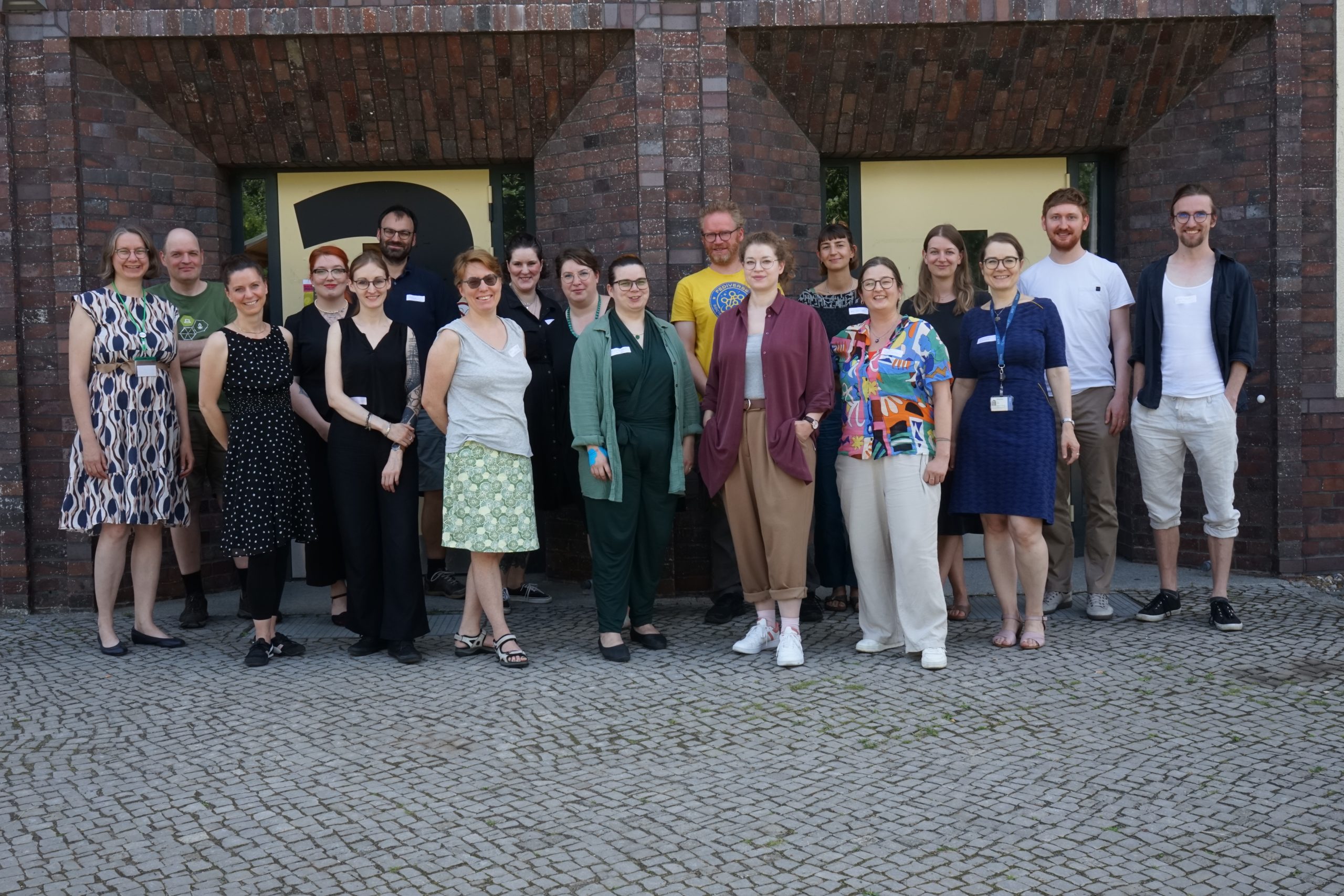
Have you been meaning to set up an appointment to ask about research data management for your project, an aspect of your research workflow, or a specific DH tool or method? Visit one of our drop-in sessions and we will help you on the spot! No need to make an appointment!
The sessions are designed to support researchers, students, and staff members in all areas of digital scholarship. The initiative is a collaboration between Artes Research, DH-support staff and researchers at the Faculty of Arts, and ICTS at the Faculty of Arts.
Some areas we can help you with:
Providing resources for various DH and RDM tools
Advice on DMPs and Research Data Management in general
Suggesting DH tools or methods for your specific research questions
Relational databases in FileMaker
Social Network Analysis and network visualizations
Computational tools for working with texts
…
Getting started with Zotero or optimizing Zotero use with an existing Zotero library
Advice on scholarly communication
Advice on Lirias
… and much more!
Don’t have a question about any of the above but want to learn more about DH? No problem! Come and use our space for co-working! It’s a great moment to develop digital skills by starting a Programming Historian tutorial, for instance!
Everyone is welcome to attend, you do not need to register!
Stop by on one of the following dates and we will be glad to help you:
29/01/2026: 14:00h -16:00h, Het Salon LETT 00.24, Erasmushuis
19/02/2026: 14:00h -16:00h, Het Salon LETT 00.24, Erasmushuis
19/03/2026: 14:00h -16:00h, Het Salon LETT 00.24, Erasmushuis
28/04/2026: 14:00h -16:00h, Het Salon LETT 00.24, Erasmushuis
26/05/2026: 14:00h -16:00h, Het Salon LETT 00.24, Erasmushuis
25/06/2026: 14:00h -16:00h, Het Salon LETT 00.24, Erasmushuis
Are you interested in presenting your work at the Open Science Day?
The Open Science Day is organized for and by researchers at KU Leuven and the KU Leuven Association, as an opportunity to take part in the discussion about Open Science. Researchers can showcase their own Open Science efforts, shed a light on difficulties they might encounter or share experiences and solutions.
Indeed, Open Science is an integral part of today’s research. It encompasses a wide range of practices and outputs across all stages of the research lifecycle. For instance, researchers share their publications via repositories, publish in Open Access journals, and disseminate early findings through preprints. They make their data FAIR, preregister their research protocols, and engage the public through Citizen Science initiatives.
Challenges include selecting the most appropriate channel for publishing research, considering the economic implications of this choice, as well as managing the learning curve and time investment required to implement certain Open Science principles. At the same time, researchers must navigate various considerations, including GDPR compliance, intellectual property rights, and research security. KU Leuven is committed to Open Science, guided by the principle: “as open as possible, as closed as necessary.”
Many things to discuss! Submit your proposal on the Open Science website.
In short
For who: This call is intended to researchers of the KU Leuven Association.
Formats: presentations (+/- 15 minutes, depending on submissions), posters, workshop. Other contribution types may be considered by the scientific committee.
These events are only open to KU Leuven researchers and staff
PhD Researchers at KU Leuven, ready to plan your next training? Willing to learn more about Open Science? Join us on 23 October for the Open Science Discovery. You can participate in the morning session, in an afternoon workshop, or both.
Program
Morning: Open Science Discovery Explore key themes like reproducible research, Citizen Science, and how to implement Open Science in your own work. Join online or in-person!
This training is an opportunity to learn more about different Open Science principles and how they contribute to high-quality research. Special attention will be paid to the reproducibility of research and to Citizen Science as a means to create a connection with society. This session includes a workshop during which participants will explore in small groups how Open Science can be implemented in practice. This is followed by a discussion on potential challenges as well as strategies on how to overcome them.
Afternoon: Hands-on Workshops Choose your session:
Peer Review: A key element of the publication process, essential for validating research.
Preregistration: Learn how preregistration supports research integrity by distinguishing between exploratory and confirmatory research.
Data Sharing: Explore the concept of FAIR data and responsible sharing, guided by the principle “as open as possible, as restricted as necessary.”
Practicalities
When: October 23, 2025 from 09h30 to 18h00
Where: Hybrid (on-site sessions atKasteelpark Arenberg (Thermotechnical Institute & MTM)
For who: Training targeted at PhD researchers, but other researchers and support staff are welcome.
Price and registration: Free but mandatory. Clickhere to register. Certificate of participation included.
Die Frage, was Openness in und für die Wissenschaft(en) meint, ist seit dem Aufkommen der Open-Science-Bewegung einem kontinuierlichen Wandel unterworfen. Allerdings war die Stoßrichtung bisher stets klar – es wurde eine zunehmend umfassendere Öffnung wissenschaftlicher Veröffentlichungen, Daten, Software, Methoden oder Infrastrukturen angestrebt (vgl. UNESCO Recommendation on Open Science 2022). Lediglich datenethische Erwägungen, wie bspw. in den CARE-Prinzipien (vgl. Carroll et al. 2020) formuliert, standen dem partiell entgegen.
Gegenwärtige Entwicklungen um die Einsatzmöglichkeiten wie Datenquellen Künstlicher Intelligenz, eine datenbasierte Kriegsführung, populistische Kulturkämpfe und Vereinnahmungsversuche oder eine zunehmende gesellschaftliche Polarisierung werfen Fragen nach einer kritischen Reflexion von Openness auf. Was heißt ‚offen‘ in diesem Zusammenhang? Wann und wo sind Formen der Schließung sinnvoll oder erforderlich? Und was bedeuten derartige Überlegungen für die arbeitspraktische Ebene von Wissenschaft? Letztlich geht es somit um eine Diskussion wie Bestandsaufnahme des status quo der Openness und der damit verbundenen Open-Science-Transformation.
Diese Diskurse sind für die Kommunikations- und Medienwissenschaft besonders relevant, da es nicht nur die eigene fachliche digitale Transformation betrifft, sondern auch die Gegenstandsbereiche der Forschung selbst. Denn nicht zuletzt sind Fachdisziplinen, die sich mit der Kommunikation und deren medialen Ausdrucksformen auseinandersetzen, besonders geeignet, Wissenschaftskommunikation wie auch deren Medien und Infrastrukturen kritisch zu reflektieren. Deshalb widmet sich die Veranstaltung den Themenbereichen Offenheit und Kommunikation, Daten und Digitalität sowie Infrastrukturen. Der Workshop möchte einen Diskursraum schaffen, Perspektiven und Menschen zum Themenbereich vereinen und hieraus zentrale Bedarfe und Anforderungen für die Gestaltung fachspezifischer Informationsinfrastrukturen ableiten.
10:00 – 10:30 Open-Science-Transformation in der Kommunikations- und Medienwissenschaft
Malte Hagener und Andrea Wolff-Wölk (Philipps-Universität Marburg): Begrüßung
Kai Matuszkiewicz (Philipps-Universität Marburg): Rethinking Openness in 2025 – eine thematische Einführung
10:30 – 10:45 Kaffeepause
10:45 – 12:15 Panel 1: Offenheit und Kommunikation
Sophie G. Einwächter (Philipps-Universität Marburg): Strukturelle Hürden und strategische Grenzen. Zur notwendigen Ambivalenz von Openness
Franziska Heller (Martin-Luther-Universität Halle-Wittenberg): „I’m open. Are you?“ (Digitale) „Openness“ als medienkulturelle Praxis
Niels-Oliver Walkowski (Universität Luxemburg): Openness an ihren Grenzen. Auszüge andauernder Diskussionen über einen „offenen Zugang“ in den Wissenschaften
12:15 – 13:15 Mittagessen (Vorraum)
13:15 – 14:45 Panel 2: Daten und Digitalität
Denise Sommer (Ostfalia Hochschule): Von der Verdatung zur Datafizierung – kommunikationswissenschaftliche Forschung in datengetriebenen Zeiten
Gerhard Lauer (Johannes-Gutenberg-Universität Mainz): Infrastrukturen gegen/für Science Tracking
Thomas Scherer (Europa-Universität Viadrina): Offene Filmwissenschaft? Zwischen Urheberrecht, Computer-Vision-Disruption und Datenethik
14:45 – 15:00 Kaffeepause
15:00 – 16:30 Panel 3: Infrastrukturen
Stefan Höltgen (Universität Bonn): Materielle Infrastrukturen. Möglichkeiten der Vernetzung akademischer Game-Preservation-Initiativen
Götz Lachwitz (Deutsches Rundfunkarchiv): Archivöffnung. Perspektiven aus dem Deutschen Rundfunkarchiv
Have you been meaning to set up an appointment to ask about research data management for your project, an aspect of your research workflow, or a specific DH tool or method? Visit one of our drop-in sessions and we will help you on the spot! No need to make an appointment!
The sessions are designed to support researchers, students, and staff members in all areas of digital scholarship. The initiative is a collaboration between Artes Research, DH-support staff and researchers at the Faculty of Arts, and ICTS at the Faculty of Arts.
Some areas we can help you with:
Providing resources for various DH and RDM tools
Advice on DMPs and Research Data Management in general
Suggesting DH tools or methods for your specific research questions
Relational databases in FileMaker
Social Network Analysis and network visualizations
Computational tools for working with texts
…
Getting started with Zotero or optimizing Zotero use with an existing Zotero library
Advice on scholarly communication
Advice on Lirias
… and much more!
Don’t have a question about any of the above but want to learn more about DH? No problem! Come and use our space for co-working! It’s a great moment to develop digital skills by starting a Programming Historian tutorial, for instance!
Everyone is welcome to attend, you do not need to register!
Stop by on one of the following dates and we will be glad to help you:
25/09/2025: 14:00h -16:00h, Het Salon LETT 00.24, Erasmushuis
28/10/2025: 14:00h -16:00h, Het Salon LETT 00.24, Erasmushuis
20/11/2025: 14:00h -16:00h, Het Salon LETT 00.24, Erasmushuis
11/12/2025: 14:00h -16:00h, Het Salon LETT 00.24, Erasmushuis
KU Leuven RDR, our institutional research data repository, has achieved CoreTrustSeal certification, making RDR the first repository in Belgium to receive this recognition.
CoreTrustSeal is an international, community-driven, non-governmental, and non-profit organization dedicated to promoting sustainable and trustworthy data infrastructures. It provides a globally recognized industry-standard certification to any data repository seeking core-level certification. At present, 155 repositories have obtained this certification, including the Cambridge Crystallographic Data Centre, the NASA Atmospheric Science Data Center, the ETH Zurich Research Collection and UniProt. The certification is based on the Core Trustworthy Data Repositories Requirements, which outline the essential characteristics of trustworthy data repositories. All requirements are mandatory and are equally weighted, standalone items.
The CoreTrustSeal certification highlights KU Leuven’s commitment to providing trustworthy and sustainable research infrastructure and supporting open science practices. The certification, along with the updated RDM policy, ensures that research data is published transparently and sustainably.
Find out more on the CoreTrustSeal certification on de RDR website.
OpenAlex is a database of academic authors, institutions and publications. Since its launch in January 2022, OpenAlex has received a lot of attention as an alternative to commercial research databases such as Web of Science or Scopus that would better meet academic needs and values. OpenAlex is based on a multitude of sources across all fields of science and languages, and on a global scale. A user can search by author, institution and research output, and select specifically by type of output (article, book, dataset, preprint, editorial, etc.), citations, publication date or availability in Open Access. The starting point for OpenAlex was the dataset of the discontinued Microsoft Academic Graph (which was the second largest academic search engine after Google Scholar), which was enriched and refined – a process that is still ongoing – to be able to be used as an alternative to commercial research databases for all kinds of searches and/or bibliometric analyses.
The OpenAlex data – which is shared under an open licence, namely Creative Commons Zero (CC0) – is available in three ways: via an online user interface (i.e. ‘OpenAlex Web’), via data snapshots (which enable you to save a copy of the OpenAlex database locally – as is at the time of download) and via the OpenAlex API. Use of OpenAlex Web, the data snapshots and the OpenAlex API is free of charge. There is a paid service which accomodates intensive use and offers additional support, but the free version suffices for the typical individual user.
The (lack of) cost, as well as the open philosophy behind it, is something that sets OpenAlex aside from commercial products like Web of Science and Scopus. These are expensive products and a recent study even shows that the companies behind these use specific sales strategies that maximise profits but come at the expense of the academic community. What is more, OpenAlex is lauded for its completeness and inclusivity. Web of Science and Scopus are selective databases, based on a curated set of sources (which has been criticized in the past for being too focused on particular disciplines, as well as specific languages, regions and publication types); whereas OpenAlex tries to be as complete as possible and is therefore not only more representative for disciplines like humanities, but also for the state of research in various languages on a global scale.
Quite a large number of studies analysing the quality and (dis)advantages of OpenAlex have been produced recently. The status quaestionis is:
If one wants to get as complete a picture as possible of the research output of an author or of an institution as a whole (all scientific disciplines, all languages, all publication types), it is advisable to use OpenAlex.
If one wants to map the OA availability of research output, it is advisable to use OpenAlex.
For specific bibliometric analyses, it may be advisable to use Web of Science or Scopus due to the selectivity of the database and the (for the time being at least) relative superiority of the metadata, provided that one is aware of the limitations (e.g. in terms of scientific discipline, publication type and language).
When compiling systematic reviews, it depends on the exact objective. If one wants to map scholarly literature on a particular topic as completely as possible, it is advisable to use OpenAlex; if, on the other hand, one wants to obtain a selection of scholarly literature that is representative of mainstream researchin Western Europe and North America, it is advisable to use Web of Science or Scopus for certain scientific disciplines (for other disciplines, no database is suitable for this purpose).
Join us for the KU Leuven Open Science Day 2025 on 6 May.
The KU Leuven Open Science Day is an event for and by researchers, offering an opportunity to gain deeper insights into Open Science, share experiences, and engage in discussions with fellow researchers.
Program
Our day will begin with a keynote address titled Open Science needs more than enthusiasm by Evie Vergauwe (University of Genève), who is a co-founder of the Swiss Reproducibility Network. In the afternoon, we will feature a keynote on the Citizen Science project “Community First Responders“, a Citizen Science project that was created in the context of KU Leuven’s 600th anniversary. The Citizen Science approach is used as a method to create awareness, enthusiasm and trust for research in society and to increase the social impact of science.
The programme includes workshops on reproducibility as well as presentations and posters from scholars from diverse backgrounds: early career researchers and professors, from various disciplines such as humanities and social sciences, biomedical sciences and science, engineering and technology. Topics will cover a great variety of Open Science practices, including preregistration and registered reports, data, open education, scholarly publishing, peer review and Citizen Science. Additionally, the poster fair will also showcase contributions from KU Leuven’s support services for Open Science and Research Data Management
As part of our blog series, “Stories from the Research Trenches,” we often invite researchers and colleagues to share their personal experiences. For this installment of the series, we are delighted to have our colleague Marleen Marynissen from KU Leuven Libraries Nexus Research Data Management team sharing about her recent Erasmus+ experience in Barcelona.
A Journey of Collaboration and Learning: My Erasmus+ Experience in Barcelona
In October 2024, I had the opportunity to participate in the Catalan University Libraries Erasmus Staff Week in Barcelona. This five-day event, held from October 7th to 11th, brought together library professionals from across Europe to collaborate, exchange experiences, foster collaboration, and explore the evolving role of university libraries in the field of open science.
The week kicked off with an international coffee break and an icebreaker activity, setting a friendly and collaborative tone for the days ahead. Hosted by the Consortium of University Services of Catalonia (CSUC), the event provided a platform for participants to introduce themselves and share their expectations. It was also very interesting and inspiring to see how CSUC facilitates shared services and infrastructures among Catalan universities and research centers, enhancing their efficiency. The first day concluded with a guided tour of Barcelona – allowing us to discover the city’s vibrant culture.
The next day we went to the Universitat Politècnica de Catalunya (UPC), where we explored the research support services offered by the libraries. We learned about the Library’s Research Café, user training programs, and cultural programming in collaboration with UPCArt. This day also featured the first round of participant presentations, including my own presentation titled: Empowering Open Science, promoting FAIR dataset publication through documentation and metadata enhancement.
On the third day, we visited the Universitat Pompeu Fabra (UPF), where we focused on teaching support services. We were introduced to La Factoria, a support service for digital production managed by the library and IT. The day also included engaging presentations and discussions.
At the Universitat Autònoma de Barcelona (UAB), we delved into open education and citizen science initiatives. One of the highlights was a collaborative task focused on creating an open educational resource, which allowed us to explore the opportunities and challenges of open education in practice. After visiting the UAB’s facilities and enjoying several participant presentations, we concluded the day with a social dinner.
On the final day we had a session to reflect on our shared experiences and key takeaways. The program concluded with a visit to the Catalan National Library.
The Catalan University Libraries Erasmus Staff Week in Barcelona was an unforgettable experience. Each location we visited enriched the program by showcasing its unique approach to library services and open science. The participant presentations offered fresh perspectives and it was really nice to meet and exchange ideas with colleagues from across Europe. Of course, the beautiful and dynamic city of Barcelona added an extra charm to the entire event. This week was a perfect blend of learning, networking, and cultural discovery, and I am grateful for the chance to be part of it.
Have you been meaning to set up an appointment to ask about research data management for your project, an aspect of your research workflow, or a specific DH tool or method? Visit the DH@rts drop-in sessions and we will help you on the spot! No need to make an appointment!
The sessions are designed to support researchers, students, and staff members in all areas of digital scholarship. The initiative is a collaboration between Artes Research, DH-support staff and researchers at the Faculty of Arts, and ICTS at the Faculty of Arts.
Some areas we can help you with:
Getting started with Zotero
Optimizing Zotero use with an existing Zotero library
Helping with DH tools or methods for your specific research questions including
Relational databases
Social network analysis
Text analysis
…
Providing resources for various DH and RDM tools
Advice on DMPs and Research Data Management in general
Advice on scholarly communication
Advice on Lirias
… and much more!
Don’t have a question about any of the above but want to learn more about DH? No problem! Come and use our space for co-working! It’s a great moment to develop digital skills by starting a Programming Historian tutorial, for instance!
Everyone is welcome to attend, you do not need to register!
Stop by on one of the following dates and we will be glad to help you:
27/02/2025: 14:00h -16:00h, Het Salon LETT 0.24, Erasmushuis
27/03/2025: 14:00h -16:00h, Het Salon LETT 0.24, Erasmushuis
17/04/2025: 14:00h -16:00h, Het Salon LETT 0.24, Erasmushuis
13/05/2025: 14:00h -16:00h, Het Salon LETT 0.24, Erasmushuis
26/06/2025: 14:00h -16:00h, Het Salon LETT 0.24, Erasmushuis
The KU Leuven Open Science Day is an event for and by KU Leuven researchers. KU Leuven is organizing the Open Science Day as an opportunity for researchers to get involved, to share insights and to bring forward their own contribution.
The 2025 edition of the Open Science Day will be organized around two tracks, with two different goals. The first track aims to give a broad overview of Open Science practices and principles, while the second will focus on research data, reproducibility and software. We welcome theoretical studies, more practical contributions, posters, and contributions that fit in a workshop format. Ideas for interactive sessions are explicitly encouraged.
You can submit your own contribution to the Open Science fair on the Open Science website until 31 January. We want to create a welcoming environment, so all researchers can apply, regardless of their research interests, career stage or level of expertise in Open Science.
Autorin: Ulrike Wuttke (Professorin für Bibliothekswissenschaft – Strategien, Serviceentwicklung, Wissenschaftskommunikation an der Fachhochschule Potsdam
Der Fachbereich Informationswissenschaften der Fachhochschule Potsdam hatte vom 18.-19.07.2024 die Ehre mehr als zwanzig Vertreter*innen der Wissenschaftspodcast-Community zu einem inspirierenden Workshop willkommen zu heißen. Der Nachbericht fasst die Höhepunkte und Ziele des Workshops zusammen und würdigt die Teilnahme und Mitwirkung der Akteure.
In den letzten Jahren haben sich Podcasts als dynamisches Medium für die Wissenschaftskommunikation erwiesen. Sie ermöglichen Wissenschaftler*innen, Projekten und Forschungsinstitutionen, komplexe Themen auf eine direkte, flexible und persönliche Weise einem breiten Publikum sowie der eigenen Fachcommunity zugänglich zu machen. Der von Ulrike Wuttke (Fachhochschule Potsdam) und Jacqueline Klusik-Eckert (arthistocast) organisierte und konzipierte Workshop Wissenschaft auf die Ohren – Workshop zu Formaten und Etablierung von Wissenschaftspodcasts bot aktiven Podcaster*innen sowie Vertreter*innen wissenschaftlicher Institutionen wie Forschungseinrichtungen und Bibliotheken eine einzigartige Gelegenheit für den Austausch. Die Teilnehmenden waren dem CFP gefolgt bzw. als Impulsgeber für Kreativsessions (Jacqueline Klusik-Eckert) bzw. für ein Kamingespräch (Tessa Gengnagel) eingeladen.
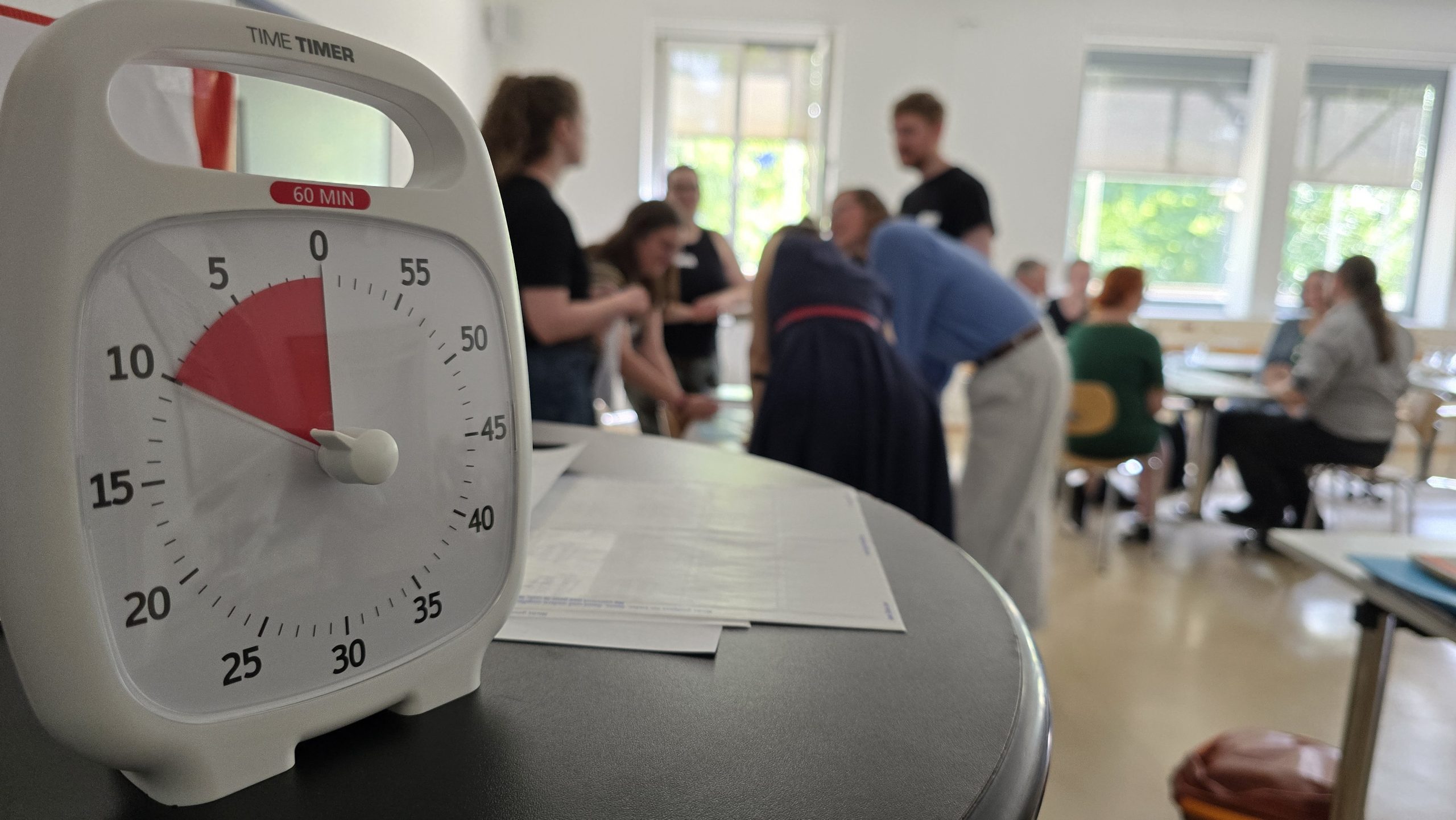
Workshop-Teilnehmende in Aktion während der Kreativsession (20240718_164021-CCBY_4_Nussbaum.jpg)
Im Mittelpunkt des Workshops stand der fokussierte Austausch zu den Themen Formate und die Etablierung von Podcasts als Medium der Wissenschaftskommunikation im Mittelpunkt. Die Themenbreite reichte von der Vorstellung von Podcast-Konzepten, wie z. B. durch eine Studierende des Studiengangs Archiv der Fachhochschule Potsdam für einen Archiv-Podcast, bis zu Evaluation und Impact wissenschaftlicher Podcasts durch eine Vertreterin von Wissen im Dialog.
Die Teilnehmer*innen betonten die Bedeutung von Podcasts als Open Science-Praktik der Wissenschaftskommunikation und die Potenziale zur Förderung des Zugangs zu Wissen. In einer Welt, in der die Zugänglichkeit von Wissenschaft und Forschung immer wichtiger wird, haben Podcasts ein großes Potenzial für die Demokratisierung von Wissen und dazu, die Diskussion über wissenschaftliche Themen über akademische Kreise hinauszutragen. Um dies zu erreichen, müssen jedoch Herausforderungen gelöst werden, wie z. B. nachhaltige, offene Infrastrukturen für Nachweis und Langzeitverfügbarkeit. Das gesamte Programm findet sich tabellarisch hier. Im Folgenden sind einige Programm-Punkte mit verfügbaren Materialien verlinkt.
Den Einstieg in den ersten Workshoptag (Fokus Formate) boten Jonathan D. Geiger (Akademie der Wissenschaften und Literatur, Mainz), Lisa Kolodzie, Jascha Schmitz (HU Berlin), Mareike Schumacher (Universität Stuttgart) von RaDiHum20 mit “Erfahrungen eines Community-Podcast” (Google-Slides), ein Bericht zu praktischen Erfahrungen als Hosts sowie Impulsen für theoretische Reflexionen. Danach stellte Sharon Hundehege (Fachhochschule Potsdam) ihr Konzept “Podcast aus dem Archiv” und Ulrike Wuttke (Fachhochschule Potsdam) und Anne Baillot (DARIAH EU) ihre Überlegungen “From Global to Local? Perspektiven und Herausforderungen für eine Podcastreihe im Rahmen eines multimedialen Sammelbands” vor. Eine Metaranalyse boten anschließend Mareike Schumacher (Universität Stuttgart), Melanie Seltmann (Humboldt-Universität zu Berlin), Ulrike Wuttke (Fachhochschule Potsdam) mit “Potenziale von Podcasts für die Dissemination von Digital Humanities” (Google-Slides). Im Fokus dieses Beitrags standen Podcasts als Forschungsobjekt, z. B. für Formalanalyse oder Netzwerkanalyse, sowie Kompetenzen für die digitale Wissenschaftskommunikation (zu letzterem siehe Frick und Seltmann 2024). Danach war es Zeit für die Kreativsession “Formate für Wissenschaftspodcasts” mit Jacqueline Klusik-Eckert. Den Abschluss des ersten Tages bildete ein “Kamingespräch” mit Tessa Gengnagel (Universität Köln) (moderiert von Jacqueline Klusik-Eckert) zu ihren reichhaltigen Erfahrungen insbesondere aus dem Kontext von Coding Codices, dem Podcast des Digital Medievalist Postgraduate Committee. Dazu gab es Pizza und ein laues Sommerlüftchen, denn anders als der Name vielleicht vermuten ließe, fand dieser Programmpunkt mitten im Grünen auf dem Campusgelände der Fachhochschule Potsdam statt.
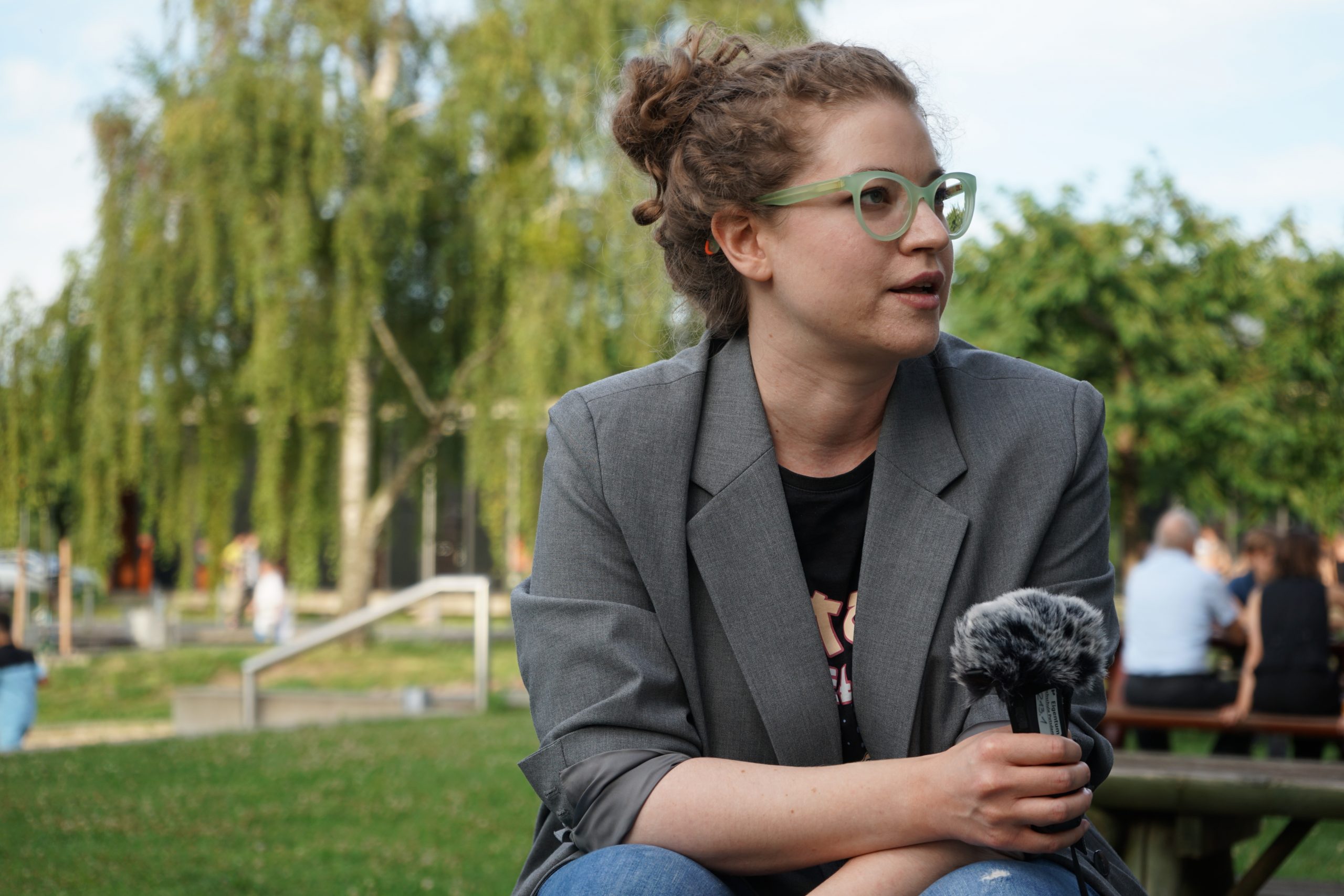
T. Gengnagel beim Kamingespräch auf dem Campus der Fachhochschule Potsdam (Gengnagel_WissPod_CCBY_4_Wuttke.JPG)
Der zweite Tag (Fokus Etablierung als Medium der Wissenschaftskommunikation) setzte mit Impulsen zu Infrastrukturen und wissenschaftlichen Datenbanken ein. Den Kick-Off machten Jakob Reuster (Bayerische Staatsbibliothek München, Fachinformationsdienst Ost-, Ostmittel- und Südosteuropa) mit “Nachweis von wissenschaftlichen Podcasts mit Osteuropabezug im Forschungsportal osmikon”; Stella Philipp (Sächsische Landesbibliothek – Staats- und Universitätsbibliothek Dresden): Infrastrukturen für Produktion und Nachweis von Wissenschaftspodcasts an der SLUB Dresden; Jens Kösters, Carolin Eisentraut, Matti Stöhr (TIB – Leibniz-Informationszentrum Technik und Naturwissenschaften: und Universitätsbibliothek): SciPAI: Zur Idee eines KI-gestützten Infrastrukturframeworks für Wissenschaftspodcasts. Weiter ging es denn in der zweiten Session mit Alexander Winkler (digiS, dem Forschungs- und Kompetenzzentrum Digitalisierung Berlin): Podrot? Die Langzeitverfügbarkeit von Podcasts als Herausforderung, Jacqueline Klusik-Eckert (HHU Düsseldorf): “Der Traum von einer All-in-One-Lösung?”, Julia Panzer (Wissenschaft im Dialog): “Wissen, was wirkt – Evaluation und Impact wissenschaftlicher Podcasts”. Den Abschluss des zweiten Tags machte die Schreibsession mit Jacqueline Klusik-Eckert “Nachhaltiges Wissenschaftspodcasting und die FAIR-Prinzipien”.
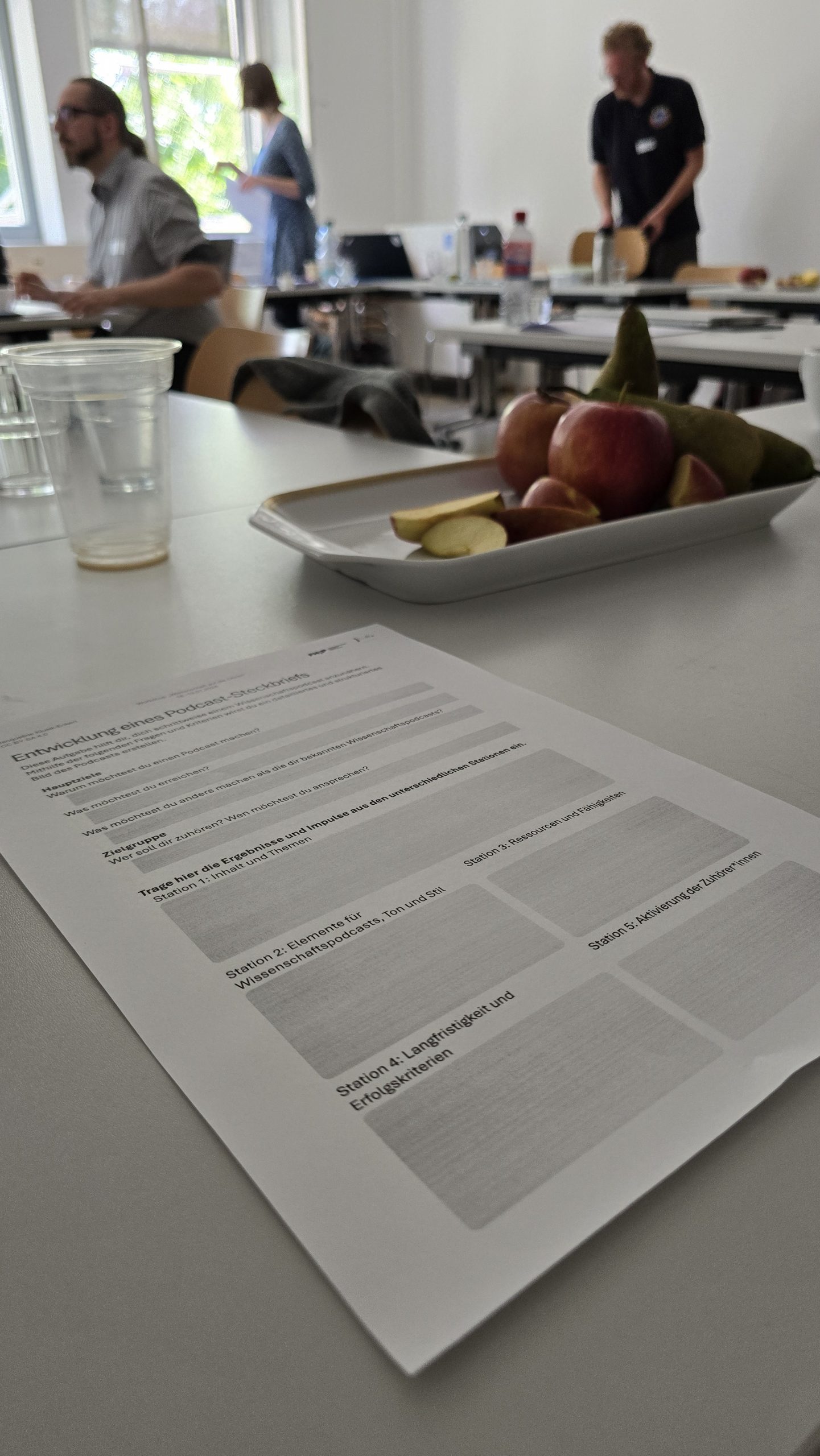
Entwicklung eines Podcaststeckbriefs, Kreativsession mit J. Klusik-Eckert (20240718_163420-CCBY_4_Nussbaum.jpg)
Ein zentrales Ziel des Workshops war es, eine Plattform für den interdisziplinären Austausch und das Community Building rund um Wissenschaftspodcasts zu bieten. Die Teilnehmenden konnten wertvolle Erfahrungen teilen und neue Ideen entwickeln.
Ein großer Dank gilt allen Teilnehmenden für ihre aktive Mitwirkung und ihre wertvollen Beiträge zum Erfolg des Workshops, sowie dem studentischen Team und der Unterstützung des Fachbereichs Informationswissenschaften der Fachhochschule Potsdam. Nun gilt es, die gewonnenen Erkenntnisse und Ideen in zukünftige Projekte einfließen zu lassen und die Rolle von Wissenschaftspodcasts weiter zu stärken.
die Fyyd-Sammlung der Teilnehmer:innen-Podcasts dieses Workshops (bei denen Henning Krause einen frei zugänglichen Podcastfeed gefunden hat, Ergänzungen, Kommentare gerne an @hnnng@chaos.social),
die Konferenz und Workshopreihe für Podcasting “Subscribe”.
Als Ausrichterinnen wünschen sich Ulrike Wuttke und Jacqueline Klusik-Eckert, dass dies nicht der letzte Workshop zu diesem Thema gewesen ist, vielleicht mag ja jemand den Staffelstab übernehmen?
Auf jeden Fall haben Ulrike Wuttke und Alexander Winkler eine Hands-On-Session zum Thema Podcasting für den 9. Bibliothekskongress/ 113. BiblioCon in Bremen 2025 eingereicht, drückt uns die Daumen!
Have you been meaning to set up an appointment to ask about research data management for your project, an aspect of your research workflow, or a specific DH tool or method? You can now come to one of our drop-in sessions and we will help you on the spot! No need to make an appointment!
The sessions are designed to support researchers, students, and staff members in all areas of digital scholarship. The initiative is a collaboration between Artes Research, DH-support staff and researchers at the Faculty of Arts, and ICTS at the Faculty of Arts.
Some areas that we can help with:
Getting started with Zotero or optimizing Zotero use with an existing Zotero library
Suggesting DH tools or methods for your specific research questions
Relational databases in FileMaker
Social Network Analysis and network visualizations
Computational tools for working with texts
Providing resources for various DH and RDM tools
Advice on DMPs
Advice on scholarly communication
Advice on Lirias
… and much more!
Don’t have a question about any of the above but want to learn more about DH? No problem! Come and use our space for co-working! It’s a great moment to develop digital skills by starting a Programming Historian tutorial, for instance!
Stop by on one of the following dates and we will be glad to help you:
Thursday 7 November, 14h-16h, the Salon (LETT 00.24)
Thursday 5 December, 14h-16h, the Salon (LETT 00.24)
The aim of Open Science is to share all kinds of research output, knowledge and tools, as early and widely as possible in the research process. It is based on collaboration and enhanced transparency, and brings thus opportunities for high-quality research.
The Open Science Discovery for PhD researchers on 21st of October is a training that provides theoretical and practical insights about Open Science practices. The focus is on topical Open Science themes and their practical implementation, which makes this introduction different from other trainings related to Open Science. During this training, different researchers from our university share their experiences with the implementation of Open Science practices in their own research, while Open Science experts provide useful background infirmation.
Programme
The programme of the 2024 edition of The Open Science Discovery for PhD researchers is a combination of presentations on theoretical concepts in the morning and a more hands-on approach during the workshops in the afternoon.
Morning session
9:30 – 9:40: Introduction
9:40 – 10:25: Session 1, Preprints
Speakers: Jean-Jacques Orban de Xivry and Julie Jansens
10:25 – 10:45: Break
10:45 – 11:30: Session 2, Sharing reproducible research output Reproducibility and code sharing When Open Science meets valorization
The term “preprint” is actually used for two related, but still slightly different, things. The term can refer to an author’s original manuscript (of an article, a book chapter, or a complete book) as it is submitted for publication (hence also known as “the submitted version” of the text). This submitted version typically remains private, whereas later versions of the text (revised after peer review and/or copy-edited by the publisher) are made available, either behind a paywall or in Open Access. However, the term preprint can also refer to the first public version of a text, which is being disseminated before formal peer review took place and which afterwards might or might not be developed into a more traditional publication. This second meaning of preprint is thus basically identical to what is known as “working papers” in disciplines like economics, law, and political sciences. To put it succinctly: the first meaning of the term preprint refers to a manuscript of an article, a chapter, or a book before publication; the second meaning – typically only used for articles – is considered to be the first public version of a text and therefore oftentimes treated as a publication in its own right. Both meanings of the term have in common that they refer to a text which was not submitted to formal peer review (yet).
Lately, the second meaning of the term preprint has become more dominant, not in the least because the habit of disseminating articles before they have been peer-reviewed is becoming more widespread.
Preprints can be distributed through designated preprint servers, i.e. online repositories where researchers share articles before they have undergone formal peer review. Preprint servers are often connected with a specific discipline, such as medRxiv (health sciences) or bioRxiv (biology), or region, such as AfricArXiv, and typically guarantee some basic form of quality control such as a plagiarism check before the text is accepted for publication as a preprint. However, preprints can also be shared using general repositories which are discipline-agnostic (like Zenodo) and/or platforms which accept all kinds of research outputs (such as the CORE repository of Humanities Commons), and which do not perform such basic quality checks. Preprints typically get a permanent identifier (such as a DOI) and are indexed by services such as Google Scholar, Open Science Framework (OSF) Preprints, or Web of Science’s Preprint Citation Index.
As said, the practice of disseminating preprints is on the rise. In some disciplines, such as astronomy and mathematics, up to 35% of articles start out as preprints, which are seen as an important instrument for Open Scholarship (as preprints can always be shared openly), as a way of speeding up research (since dissemination of research results is no longer slowed down by pre-publication peer review) and as a way to establish priority of discoveries. Preprints also make other innovations in scholarly communication possible (such as open peer review or the publish-review-curate approach – topics which deserve a blog post of their own) and put into question the exorbitant prices of journal subscriptions or article processing charges. Recent research by Brierley et al. and Davidson et al. in the context of the COVID-19 pandemic even brought to light that differences between preprint and final versions of articles published in biomedical journals are limited, which gives cause to reconsider the time and money spent to develop a preprint into a journal article.
Recommended reading:
J. Bosman et al. (2022), New Developments in Preprinting and Preprint Review, DOI: 10.5281/zenodo.7040997
K. Hettne et al. (2021), A Practical Guide to Preprints: Accelerating Scholarly Communication, DOI: 10.5281/zenodo.5600535
Have you been meaning to set up an appointment with Artes Research to ask about research data management for your project, an aspect of your research workflow, or a specific DH tool? You can now come to one of our drop-in sessions, and we will help you on the spot! No need to make an appointment!
Some areas that we can help with:
Getting started with Zotero
Optimizing Zotero use with an existing Zotero library
Suggesting DH tools or methods for your specific research questions
Providing resources for various DH and RDM tools
Advice on DMPs
Advice on scholarly communication
Advice on Lirias
… and much more!
Don’t have a question about any of the above but want to learn more about DH? No problem! Come and use our space for co-working! It’s a great moment to develop digital skills by starting a Programming Historian tutorial, for instance!
Stop by on one of the following dates and we will be glad to help you:
Thursday 25 January from 10h30-12h30, Erasmushuis (LETT 01.16)
Thursday 22 February from 10h30-12h30, Erasmushuis (LETT 01.16)
Thursday 18 April from 10h30-12h30, Erasmushuis (LETT 01.16)
Thursday 30 May from 10h30-12h30, Erasmushuis (LETT 01.16)
Do you want to know more about Open Science or maybe you have ideas or expertise that you wish to share? Or you just want to take part in the debate? Participate in the KU Leuven Open Science Day and submit your own contribution. Accepted proposals will be published in the proceedings of the KU Leuven Open Science Day.
KU Leuven Libraries has developed a game focused on the possibilities, requirements, and best practices regarding Open Access, Research Data Management, and in the future also Information Retrieval.
The Research Survival Game follows a researcher who is stranded on a desert island and can only leave by acquiring knowledge. This knowledge is obtained by correctly answering and subsequently collecting the Q&A cards. As the players advance along the gameboard, both the spaces they land on and the Q&A cards will help familiarize them with some of the key concepts of a research project. The game is won by collecting the most cards, as this means enough skills have been obtained to properly conduct the research and the researcher is thus ready to leave the island.
Who can play the game? The target audience is both researchers, in any stage of their career, and research support staff. But anyone who is interested can get in touch!
How can I reserve the game? You can request a game session with one of our staff members via the Open Science Helpdesk.
How to play the game? Check out the website to find out more about the game!
Open Science aims to make scientific research freely available to other scholars and to society. It is an extra opportunity for high-quality research because it makes the whole research process more transparent.
This training is a half-day session that provides theoretical and practical insights about Open Science practices. The focus is on topical Open Science themes and their practical implementation, which makes this introduction different from other trainings related to Open Science. The organizers invite researchers with diverse backgrounds from our university as speakers, including PhD researchers, who share their experiences with implementation Open Science practices in their own research. The programme is a combination of presentations on theoretical concepts and a more hands-on approach.
Programme
The 2023 edition of The Open Science Discovery for PhD researchers will focus on practical applications of Open Science, at the different stages of the research lifecycle.
13h30 – 14h00: Introduction, including testimonies by researchers – Joos Vandewalle
14h00 – 15h00: Session on preregistration
Sharing experiences.
Preregistration from a researcher’s point of view – Laura Dewitte
Hands-on training – Olivia Kirtley
15h00 – 15h30: Break
15h30 – 16h15: Session on data sharing
KU Leuven’s Research Data Repository (RDR) – Marleen Marynissen
Data sharing in a discipline specific repository – Carolina Velázquez
16h15 – 17h00: When early sharing meets valorization – Leuven Research & Development
17h00 – 17h15: Conclusions. How to go further with Open Science – Stef Van Puyenbroeck
Practicalities
When and where: 24 October, 13h30-17h30 (STUK aula, Naamsestraat 96 in Leuven)
Who: Training targeted at PhD researchers, but other researchers and support staff are welcome.
NOTE: A streaming option will be available, but we cannot offer the full experience to online participants, especially during the hands-on session about preregistration. The certificate of attendance will be delivered only to in-person participants.
Have you been meaning to set up an appointment with Artes Research to ask about research data management for your project, an aspect of your research workflow, or a specific DH tool? You can now come to one of our drop-in sessions, and we will help you on the spot! No need to make an appointment!
Some areas that we can help with:
Getting started with Zotero
Optimizing Zotero use with an existing Zotero library
Suggesting DH tools or methods for your specific research questions
Providing resources for various DH and RDM tools
Advice on DMPs
Advice on scholarly communication
Advice on Lirias
… and much more!
Don’t have a question about any of the above but want to learn more about DH? No problem! Come and use our space for co-working! It’s a great moment to develop digital skills by starting a Programming Historian tutorial, for instance!
Stop by on one of the following dates this fall and we will be glad to help you:
Thursday 28 September from 13h-15h, Erasmushuis (LETT 01.17)
Thursday 26 October from 13h-15h, Erasmushuis (LETT 01.17)
Thursday 30 November from 13h-15h, Erasmushuis (LETT 01.17)