The DARIAH-EU Community Engagement Working Group and the DARIAH-Campus Editorial Board invite participants to join us during the DARIAH Annual Event in Rome for a DARIAH-Campus Open Education Resource Showcase.
This event will take place on Tuesday 26th May from 2-3.30pm in the Aula Bisconti in the main conference venue.
Please register your intention to attend by completing this form by Friday 22nd May:
This event is targeted at early career researchers, practitioners and those who are currently engaged in training provision as educators (e.g. lecturers, academics, trainers) as well as postgraduate students and lifelong learners.
The session will showcase DARIAH-Campus resources through demonstrations from leading educators, using examples from their own teaching practices. Following the demonstrations a moderated discussion will afford the DARIAH-Campus team the opportunity to gain a deeper insight from the community in how they engage with Open Education Resources (OERs) such as those available on DARIAH-Campus. Potential topics of discussion will include:
What formats work best?
How are training materials identified?
What sources are trusted for recommendations in OERs?
Participants in the workshop will leave with a deeper understanding of using DARIAH-Campus as a resource for teaching, training and learning and will also have played an active role in informing and shaping the direction of DARIAH-Campus and the development of training materials in current and future projects (e.g. ATRIUM, ARTEMIS, ECHOES).
DARIAH ERIC is seeking a EU Projects & Policy Officer to assist with the day-to-day management of both internal DARIAH projects as well as externally grant-funded ones.
This successful candidate will also play a key role in developing policy, sustainability, and governance documentation, particularly for EU-funded projects in which DARIAH partners. The position holder will support DARIAH’s growth as a European Infrastructure and contribute on its behalf to European projects such as ECHOES, CHIRON and ECHOLOT.
The successful candidate will work in collaborative, international project environments, playing a central role in managing DARIAH projects as well as designing high-quality policy and governance documentation that promotes and sustains network collaboration across a wide European partnership.
Key Responsibilities
Manage several EU-funded projects on which DARIAH partners: collaborate with both internal and external partners to fulfill grant objectives, while keeping DARIAH staff on track in terms of time and budget management.
On behalf of DARIAH lead Work Packages in the areas of policy, sustainability, and governance documentation, coordinating with other project partners for the successful completion of deliverables.
Contribute to Work Packages on behalf of DARIAH to author documentation, white papers, etc. to fulfill project objectives.
Advise and assist colleagues in DARIAH to develop and revise existing internal documentation in the areas of policy, governance, and sustainability.
Collaborate with European partners to deliver project goals and to develop network synergies.
Contribute to dissemination, communication, and reporting activities in line with EU funding requirements.
Support the development of new grant and funding proposals.
Other duties within the scope of the contracted projects’ implementation.
Required Qualifications
Master’s degree or equivalent in management, business administration, information systems, data science, humanities or social sciences.
At least two years experience in project management and/or participation in the implementation of European Commission (EC) Framework Programmes, and/or two years of policy, governance, regulatory, compliance, and/or sustainability research and documentation, particularly within research organisations.
Experience working in international, project-based environments.
Excellent written and spoken English.
Willingness to travel when required.
An adaptable team player.
What we offer
The ability to work at the centre of research infrastructure in Europe and make a difference in the development of data services and IT systems key to researchers and heritage professionals working in the digital arts and humanities.
An opportunity to work on a European projects in a friendly and collegial experienced coordination team.
Collaborate with a broad network of researchers, GLAM professionals, and IT specialists, as well as European and National officials throughout Europe.
Be part of an experienced EU project coordination team.
Opportunities to develop one’s professional skills.
Who we are
The Digital Research Infrastructure for the Arts and Humanities (DARIAH) enhances and supports digitally-enabled research and teaching across the arts and humanities. DARIAH is a network of people, expertise, information, knowledge, content, methods, tools and technologies from its member countries. It develops, maintains and operates an infrastructure in support of ICT-based research practices and sustains researchers in using them to build, analyse and interpret digital resources. By working with communities of practice, DARIAH brings together individual state-of-the-art digital Arts and Humanities activities and scales their results to a European level. It preserves, provides access to and disseminates research that stems from these collaborations and ensures that best practices, methodological and technical standards are followed.
DARIAH was established as a European Research Infrastructure Consortium (ERIC) in August 2014. Currently, DARIAH has 24 member countries and numerous cooperating partners.
Application procedure
If you are interested in applying for the position, please send your CV and a short cover letter by email to recruitment@dariah.eu by 29.05.2026 at the latest.
For more information and details on the application procedure, please download the full post description.
Humanities researchers today work across a fragmented landscape of digital tools. Citation managers know nothing about manuscript images. Transcription software has no connection to the writing environment. Collection metadata lives in spreadsheets that no other application can read. The result is not merely inconvenience; it is a structural barrier to the kind of cross-referencing, discovery, and synthesis that scholarship demands.
The prototype (early stage) Playfair Suite takes a different approach: a family of desktop applications for collection and source management (Playfair), academic writing (Scribe), manuscript analysis (Quire), OCR and transcription (Almanak), and prosopographical work (Proso), all built on a shared data layer. At the centre sits Playfair, which manages sources, entities, and metadata across the entire research lifecycle, and makes them available to every other application through embeddable views and a common interface. A citation entered in Playfair is immediately accessible while writing in Scribe. A manuscript catalogued in Playfair carries its metadata into analysis in Quire.
This talk introduces the architecture and vision of the Playfair Suite, demonstrates the integration between Playfair and Scribe, and asks what a truly integrated research environment could mean for humanities scholarship.
***
Die Veranstaltung findet virtuell statt; eine Anmeldung ist nicht notwendig. Zum Termin ist der virtuelle Konferenzrraum über den Link https://meet.academiccloud.de/gl/rooms/lou-eyn-nm6-t6b/join erreichbar. Wir möchten Sie bitten, bei Eintritt in den Raum Mikrofon und Kamera zu deaktivieren. Nach Beginn der Diskussion können Wortmeldungen durch das Aktivieren der Kamera signalisiert werden.
Der Fokus der Veranstaltung liegt sowohl auf praxisnahen Themen und konkreten Anwendungsbeispielen als auch auf der kritischen Reflexion digitaler geisteswissenschaftlicher Forschung. Weitere Informationen finden Sie auf der Website der BBAW.
Recogito ist eine Webumgebung, mit der man in Texten und Bildern Orte, Personen und Ereignisse einfach semantisch auszeichnen kann. Die Dokumente können gemeinsam bearbeitet und Orte bereits während der Annotation auf Karten angezeigt werden. Die Annotationen können in einer Vielzahl von Formaten exportiert werden, um dann weitere Schritte in GIS, Gephi oder in digitalen Editionen vorzunehmen. Der Einstieg ist niedrigschwellig und jede:r kann sofort starten. Recogito wurde 2018 mit dem DH Award ausgezeichnet und seitdem umfangreich weiterentwickelt.
Il 6 maggio 2026 alle ore 17.30 si terrà il secondo appuntamento di “Aspettando AIUCD2026“, il ciclo di seminari online che accompagnerà la comunità verso il convegno annuale AIUCD, in programma a Cagliari dal 3 al 5 giugno 2026.
L’incontro sarà dedicato a Programming Historian, rivista internazionale open access che pubblica lezioni peer-reviewed su metodi e strumenti digitali per la ricerca nelle scienze umane. Interverranno Massimiliano Carloni (ACDH, Österreichische Akademie der Wissenschaften, Austria) e Nabeel Siddiqui (Director of the Center for Teaching and Learning, Susquehanna University, USA); l’incontro sarà introdotto da Giampaolo Salice.
Dopo una presentazione della rivista, seguirà una sessione pratica in lingua inglese, con slide in italiano, dedicata alla lezione di Programming Historian“Corpus Analysis with Voyant Tools”. L’attività sarà applicata a un corpus di testi italiani fornito durante l’incontro.
Il programma completo della rassegna, con i link per registrarsi ai singoli appuntamenti, è disponibile sul sito del convegno AIUCD2026.
La partecipazione è gratuita, è richiesta l’iscrizione tramite il modulo online: [ISCRIVITI AL WEBINAR]
Im Rahmen des Praxislabors 2026 zeigt dir Olaf Simons, wie du mit Wikibase eigene Datenprojekte umsetzen und dich mit bestehenden Wissensnetzwerken wie Wikidata oder FactGrid verbinden kannst. Der Workshop richtet sich an alle, die erste Schritte mit strukturierten Daten und Knowledge Graphen machen wollen.
Oralstats Aroca: una herramienta de consulta y descarga de datos de corpus orales
12 DE MAYO DE 2026 – 19:00 (GMT+2)
Andrea Carcelén Guerrero
Universidad Católica de Valencia San Vicente Mártir
Andrea Carcelén Guerrero es doctora en Estudios Hispánicos Avanzados por la Universitat de València y en estos momentos ejerce como profesora en el Departamento de Lengua y Literatura de la Universidad Católica de Valencia San Vicente Mártir.
Su trayectoria investigadora se centra en la Lingüística de corpus, la pragmática y la sociolingüística, en particular, en la construcción de corpus orales para el estudio del español coloquial. Entre sus trabajos destaca su papel como coordinadora técnica del corpus Ameresco (América y España Español Coloquial) y su investigación postdoctoral en la Universidad de Helsinki sobre las relaciones entre lenguaje, género y sociedad a través del corpus CoLaGe (Corpus for the Study of Language and Gender in Spanish). Actualmente, su investigación está vinculada a los proyectos ESPRINTER
(Estudio de las estructuras pragmático-interactivas de la comunicación conflictiva entre parejas en español: conversaciones y terapias de pareja en América y España) y ECOS-C/N (Estudio de los condicionantes sociales del español actual en el centro y norte de España: Nuevas identidades, nuevos retos, nuevas soluciones.
Resumen de la intervención
En esta sesión de Compartir Pantalla se abordará de manera práctica cómo una herramienta informática, Oralstats Aroca, desarrollada por los lingüistas del proyecto Ameresco, cumple funciones tanto de gestión y procesamiento de datos como de análisis del corpus. Oralstats Aroca (Cabedo y Carcelén, 2022) se presenta como un entorno digital diseñado para transformar y examinar datos provenientes de cualquier tipo de interacción verbal, con un enfoque particular en conversaciones acompañadas de metadatos sociolingüísticos. Esta herramienta se inscribe en el marco del uso de nuevas tecnologías y lenguajes de programación aplicados al análisis lingüístico. Su propósito es facilitar el acceso al corpus mediante un recurso abierto que, además, permite a usuarios con conocimientos técnicos más avanzados modificar el código base y añadir nuevas capas de información.
근현대잡지자료 DB는 주요 근현대잡지를 원문 전체 또는 목차만을 입력하여 디지털화한 데이터베이스이다. 근현대의 잡지는 대한제국기부터 해방 직후까지 학술, 사상, 사회, 문예 등 각 분야의 정제된 정보를 담고 있는 자료로 근현대사 연구의 기초 사료이다. 신문자료와 함께 활용도가 높은 자료인 만큼 근현대잡지자료의 확충과 기존 데이터의 수정 보완을 위한 작업이 진행 중이다.
2022년부터 국사편찬위원회와 현담문고가 협력하여 현담문고 소장 주요 잡지자료를 스캔하였고 2024년에는 성균관대학교 동아시아역사연구소에서 진행한 한인 발행 근현대신문잡지 DB의 결과물 일부를 제공받을 수 있었다.
2025년에는 기구축 자료 중 누락 호수 21종과 신규 자료 24종의 목차를 구축하였다. 상세 내역은 다음과 같다.
Liebe WissKI-Community und alle die sich für Linked Open Data Management interessieren,
auch in diesem Jahr laden wir alle WissKI-Anwender*innen und -Entwickler*innen herzlich ein, um gemeinsam über Projekte und Themen zu diskutieren, sich über aktuelle Entwicklungen zu informieren und gemeinsam Lösungen für Herausforderungen zu entwickeln. Das 8. WissKI Anwender*innentreffen findet statt:
Bis zum 31. August 2026 können Beiträge in Form von Präsentationen und Workshops eingereicht werden. Eure Einreichungen werden dieses Jahr in einem Book of Abstracts veröffentlicht! Mehr dazu in unserem „Call for Abstracts“.
Eine Anmeldung zur Teilnahme am WissKI Anwender*innentreffen ist bis einschließlich 30. September 2026 möglich. Bei Fragen rund um das WissKI Anwender*innentreffen schreibt ihr an info@wiss-ki.eu oder in unseren Mattermost WAT Channel.
Das Dokument vergleicht und fasst gemeinschaftlich entwickelte Arbeitsdefinitionen der TWG zusammen. Ziel ist ein gemeinsamer begrifflicher und modellierungstechnischer Rahmen. Durch Klärung der Konzepte und Darstellung von Modellierungsstrategien (z. B. probabilistische Ansätze, graduelle semantische Abbildungen, Wikibase-Implementierungen) trägt die Arbeit zu transparenteren, interoperableren und FAIR-konformen Lösungen für unsichere, unpräzise oder mehrdeutige Informationen in Kulturerbe-Wissensgraphen bei.
Das Whitepaper kann im Rahmen des NFDI4Objects-Commons-Prozess bis 28. Mai 2026 kommentiert werden! Wir freuen uns auf Euer Feedback!
La Sociedad Internacional de Humanidades Digitales Hispánicas anuncia que el VIII Congreso de la HDH se celebrará en San Cristóbal de La Laguna, Tenerife, del 26 al 28 de octubre de 2027, bajo el título:
Datos, cultura y empleo: un presente para las Humanidades
El congreso estará organizado por la Universidad de La Laguna y Humanidades en Común, red de proyectos y dispositivo colaborativo de ciencia abierta. De momento, cuenta con la colaboración del Instituto de Estudios Canarios.
La presidencia del Comité Local de Organización estará a cargo de Roberto J. González Zalacain, profesor titular de Historia Medieval de la Universidad de La Laguna.
La nueva edición del congreso tendrá lugar en el año del centenario de la creación definitiva de la Universidad de La Laguna y reunirá a la comunidad de las Humanidades Digitales Hispánicas para reflexionar sobre los vínculos entre datos, cultura, trabajo académico, transferencia social y presente de las Humanidades.
Próximamente se ofrecerá más información sobre el evento y la convocatoria de comunicaciones, así con la web y redes propias del congreso.
Title:Unlocking 500 years of Real Data in Historical Spanish with AI Speaker:Prof Patricia Murrieta-Flores, Distinguished Professor in Digital Humanities and Artificial Intelligence at Tecnológico de Monterrey, and Chair in Digital Humanities at Lancaster University Date and time:14 May 2026, 8:30 PM IST Registration:Registration is free for DHARTI members. DHARTI members need to register for the […]
Wir sind eine renommierte Gelehrtengesellschaft und außeruniversitäre Forschungseinrichtung des Landes Baden-Württemberg und suchen in einem inspirierenden Arbeitsumfeld in der Heidelberger Altstadt zum nächstmöglichen Zeitpunkt ganztags für die Dauer von zunächst zwei Jahren eine
Digital Humanities Fachkraft.
Zu den Aufgaben gehört die Entwicklung von Software-Lösungen zur Unterstützung von Forschungsprojekten im Akademienprogramm im Bereich Digital Humanities z. B. im Bereich von eXist-DB, XML und XQuery. Ein weiterer Fokus liegt auf dem Bereich digitaler Editionen und der visuellen Datenpräsentation sowie der Zusammenarbeit mit Wissenschaftler*innen aus verschiedenen Disziplinen bei der Entwicklung von Forschungsfragen und der Konzeption von digitalen Methoden im Rahmen der Projektberatung und Projektumsetzung.
Dieses Profil zeichnet Sie aus:
ein einschlägiges Digital Humanities-bezogenes Studium (mit mindestens Masterabschluss) und mehrjährige Berufserfahrung oder eine vergleichbare Qualifikation
Kenntnisse aktueller Webtechnologien und Erfahrung mit Webentwicklung und KI
fundierte Kenntnisse in verschiedenen Programmiersprachen (z. B. Java, JavaScript, Python, XQuery, XSLT)
Kenntnisse im Bereich XML (z. B. TEI-XML, eXist-DB, XML-Editoren) und Linux
ausgeprägte Teamfähigkeit
einschlägige Erfahrungen in der Projektarbeit und fachliche Unterstützung bei der Einwerbung von Drittmittelprojekten
Erfahrung im Umgang mit Forschungsdaten im Bereich der Digital Humanities und Forschungsdatenmanagement.
Wir bieten Ihnen:
einen attraktiven Arbeitsplatz im ehemaligen Großherzoglichen Palais am Karlsplatz
flexible Gleitzeitregelungen und abwechslungsreiche Tätigkeitsfelder
eine betriebliche Altersvorsorge sowie vermögenswirksame Leistungen
sehr gute Erreichbarkeit mit dem ÖPNV und Jobticketzuschuss
Vergütung nach Entgeltgruppe 13 TV-L (Öffentlicher Dienst der Länder).
Schwerbehinderte Bewerber*innen werden bei gleicher Eignung bevorzugt berücksichtigt.
Ihre Bewerbung mit aussagekräftigen Unterlagen und Angabe der Kennziffer 02/2026 richten Sie bitte bis zum 31. Mai 2026 in einer einzigen PDF-Datei per E-Mail an verwaltung@hadw-bw.de.
Der Webservice correspSearch, der historische Briefe durchsuchbar macht und vernetzt, hat einen wichtigen Meilenstein erreicht. Mit der jüngsten Integration der Briefe an Helmina von Chézy, die durch ein Explorationsprojekt an der Berlin-Brandenburgischen Akademie der Wissenschaften (BBAW) ermöglicht wurde, weist die Plattform nun mehr als 400.000 Metadatensätze von edierten oder wissenschaftlich erschlossenen Briefen nach.
Initiiert von der BBAW-Arbeitsgruppe „Gender & Data“ und mit institutioneller Unterstützung der Akademie wird seit 2025 an der Erschließung der Korrespondenzen in Helmina von Chézys Nachlass im Akademiearchiv gearbeitet (Mitwirkende s. u.). Innerhalb von acht Monaten wurde die umfangreiche Korrespondenz von rund 3.500 Briefen mit Unterstützung von TELOTA und unter Nutzung des CMIF Creators erfasst und für die Aufnahme in correspSearch vorbereitet. Etwa 2.000 Briefe wurden an Chézy gerichtet und knapp 1.400 von ihr verfasst. Erstere sind nun freigeschaltet, die Briefe von Chézy selbst werden in Kürze ebenfalls integriert. Zukünftig sollen die Informationen auch zurück in das Findbuch des BBAW-Archivs fließen, um die Nutzung der Bestände vor Ort zu verbessern.
Helmina von Chézy (1783–1856) war als Schriftstellerin, Journalistin und Intellektuelle in vielfältige Netzwerke eingebunden. Mit rund 20 Jahren ging sie nach Paris und verbrachte dort ein prägendes Jahrzehnt, in dem sie Kontakte zu den Romantikern Dorothea und Friedrich Schlegel knüpfte und journalistisch für französische und deutsche Zeitschriften arbeitete. Ein besonderes Kapitel stellte ihr humanitäres Engagement 1815/16 dar, als sie in Lazaretten in Köln und Namur verwundete Soldaten pflegte. Ihr kritischer Bericht über deren schlechte Behandlung führte zu einer Gefängnisstrafe, vor der sie nach Berlin floh, wo E. T. A. Hoffmann erfolgreich ihre Verteidigung übernahm. Ihre Dresdner Jahre (1817–1823) markierten einen Höhepunkt ihres Schaffens durch die Mitgliedschaft im Dresdner Liederkreis und die Zusammenarbeit mit Carl Maria von Weber am Libretto zur Oper „Euryanthe“.
Helmina von Chézys Korrespondenz bildet den zentralen Bestandteil ihres Nachlasses. Rund 3.500 Briefe dokumentieren ein weitreichendes Netzwerk aus Personen aus Literatur, Kunst, Politik und Verlagswesen. Die Briefe geben Einblick in literarische Arbeitszusammenhänge und soziale Beziehungen und zeigen zugleich die Lebensbedingungen einer Frau, die sich im frühen 19. Jahrhundert in einem überwiegend männlich geprägten kulturellen Umfeld behauptete. Ein nicht unerheblicher Teil der Korrespondenz entfällt auf den Austausch mit Frauen und verweist auf die Bedeutung weiblicher Netzwerke in dieser Zeit.
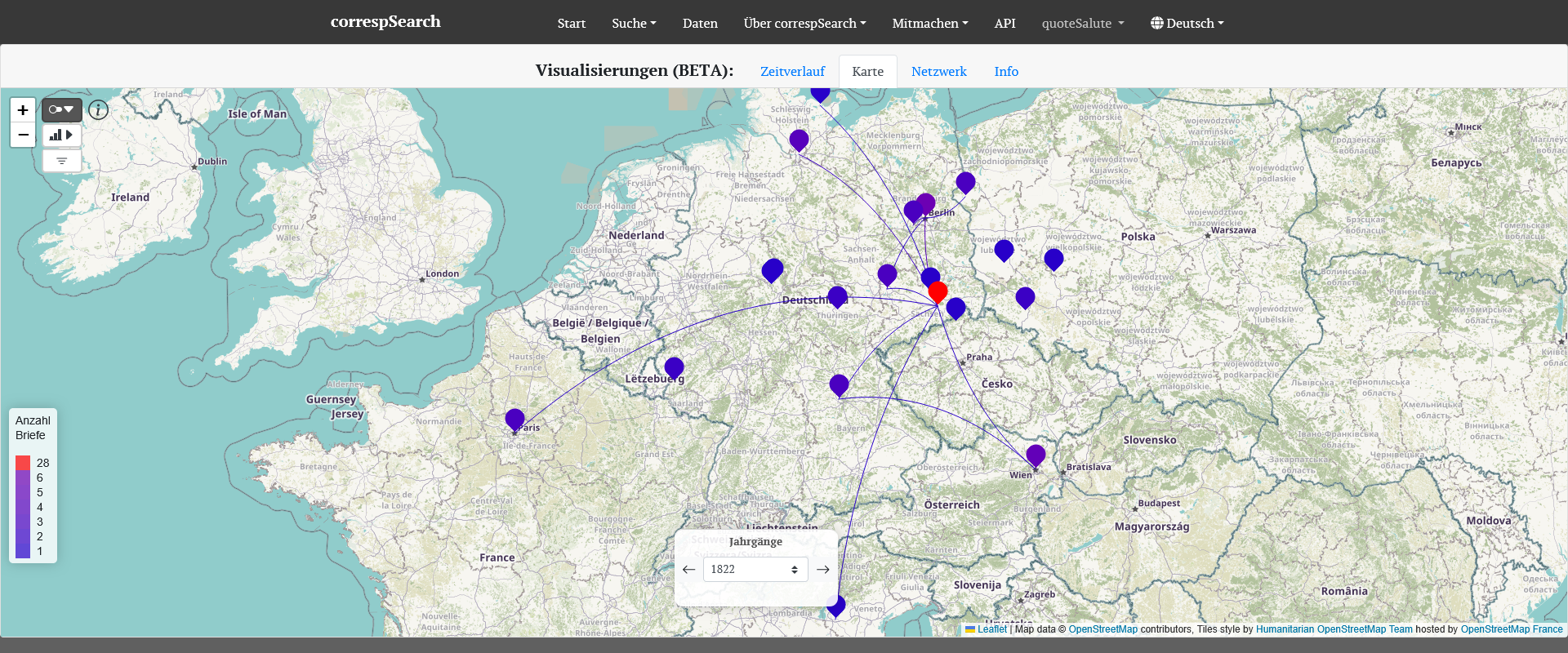
Helmina von Chézys internationales Briefnetzwerk im Jahr 1822 während ihres Aufenthalts in Dresden. [Screenshot der Visualisierung in correspSearch]
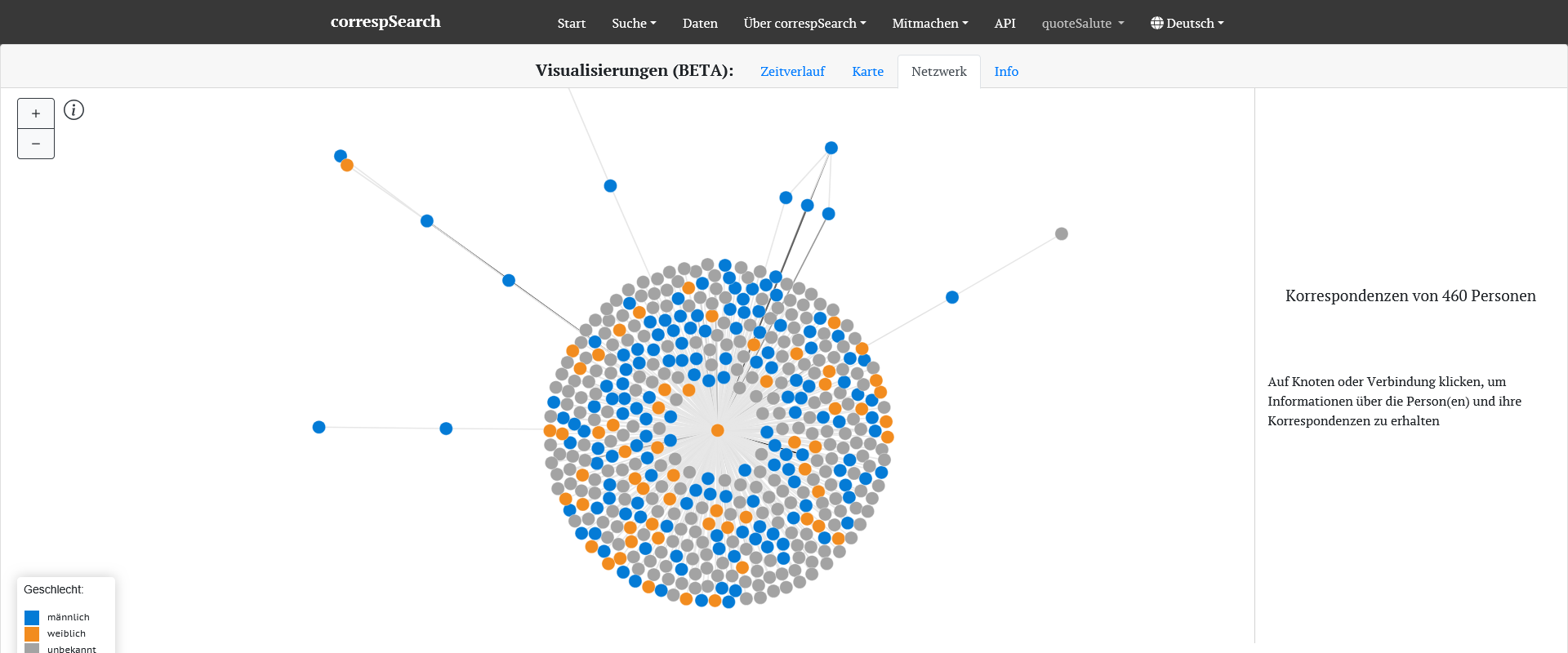
Netzwerk der an Helmina von Chézy gerichteten Briefe mit farblicher Kennzeichnung des Geschlechts der Briefpartner. Graue Punkte markieren Personen ohne Normdaten, für die bislang keine Geschlechtsinformation vorliegt. [Screenshot der Visualisierung in correspSearch]
Aktiv gegen den Gender-Data-Gap
Wie in vielen anderen digitalen Diensten und Sammlungen besteht auch in correspSearch ein deutlicher Gender-Data-Gap. Dieser geht zum Teil auf historisch bedingte Ungleichheiten zurück, wird jedoch durch Überlieferungsbrüche und -lücken sowie eine häufig unzureichende Erschließung vorhandener Bestände weiter verstärkt.
Die systematische Aufarbeitung von Nachlässen wie dem Helmina von Chézys trägt dazu bei, Frauen als historische Akteurinnen im digitalen Raum sichtbarer zu machen und eröffnet neue, auch geschlechtergeschichtliche Perspektiven für die Forschung. Dieses Anliegen wird an der BBAW seit April 2026 von einer auf zwei Jahre geförderten Initiative „Gender & Data“ weitergeführt, die sich unter anderem mit der Rolle der Digital Humanities für eine inklusivere geisteswissenschaftliche Forschung befasst.
***
Mitwirkende an der Erschließung des Chézy-Nachlasses: Michael Rölcke (Bearbeiter), Bénédicte Savoy und Frederike Neuber (Leitung, Herausgeberschaft), Stefan Dumont und Steven Sobkowski (correspSearch), Sandra Miehlbradt (BBAW-Archiv).
We invite you to the online lecture by Prof. Dr. Michael Schonhardt (TU Darmstadt) on 22.05.2026 from 10:00 to 11:30, organised as a part of the seminar series ‘Legal History Meets Digital Humanities’ at the Max Planck Institute for Legal History and Legal Theory.
The presentation will focus on the AI-driven datafication of historical sources, ranging from medieval manuscripts to early modern correspondence, into structured and semantic data. It will explain the Digital Editing Toolkit, a modular AI-based editorial workflow, and discuss the potential of vector embeddings and entity linking for new heuristic approaches to digitised source corpora. Finally, it will evaluate how these methods reshape the role of the editor in the age of large-scale datafication
Fallado el Premio Sociedad Internacional de Humanidades Digitales Hispánicas-Fundación BBVA a la Mejor Tesis Doctoral en Humanidades Digitales 2025
El jurado del Premio Sociedad Internacional de Humanidades Digitales Hispánicas-Fundación BBVA a la Mejor Tesis Doctoral 2023, reunido el 27 de abril de 2026, ha decidido conceder el galardón a:
“GLU – A Gradient Model for Language Universals: A Computational Revisitation of Greenberg Universals”, de Antoni Brosa Rodríguez, profesor ayudante doctor en la Universitat Rovira i Virgili.
Para la concesión del premio, el jurado ha valorado en esta tesis las “aportaciones muy relevantes e innovadoras relativas al procesamiento del lenguaje natural multilingüe y a los modelos de inteligencia artificial desarrollados para las lenguas minoritarias”, menciona el acta.
Composición del Jurado
El jurado ha estado presidido por Ignacio Bosque, catedrático de Lengua Española, Universidad Complutense de Madrid, y académico de la Real Academia Española; y ha contado como secretaria a Carlota Fernández Travieso, profesora permanente laboral del Departamento de Humanidades, Universidade da Coruña, y secretaria de la Sociedad Internacional de Humanidades Digitales Hispánicas. Ha contado como vocales con: Pedro Álvarez de Miranda, catedrático emérito de Lengua y Literatura, Universidad Autónoma de Madrid y académico de la Real Academia Española; Senén Barro, catedrático de Ciencias de la Computación e Inteligencia Artificial, Universidade de Santiago de Compostela; Ángela Celis Sánchez, profesora contratada doctora del Departamento de Filología Hispánica y Clásica, Universidad de Castilla-La Mancha; Pablo Gamallo Otero, catedrático de universidad en el Centro Singular de Investigación en Tecnologías Inteligentes, Universidade de Santiago de Compostela; Roberto José González Zalacaín, profesor titular del Departamento de Geografía e Historia, Instituto Universitario de Estudios Medievales y Renacentistas, Universidad de La Laguna; Montserrat Hermosín Álvarez, profesora titular de Derecho Financiero y Tributario, Universidad Pablo de Olavide, de Sevilla y letrada del Gabinete Técnico del Tribunal Supremo; Patricia Martín-Rodilla, doctora en Ingeniera Informática, científica titular en Humanidades Digitales, Instituto de Estudios Gallegos Padre Sarmiento, Consejo Superior de Investigaciones Científicas (CSIC) y vocal de la Sociedad Internacional de Humanidades Digitales Hispánicas; Félix Ovejero Lucas, profesor de Metodología de las Ciencias Sociales y Filosofía Política, Universitat de Barcelona; Nuria Rodríguez Ortega, catedrática de Historia del Arte, Universidad de Málaga; Esteban Romero Frías, catedrático de universidad del Departamento de Economía Financiera y Contabilidad, y vicerrector de Innovación Social, Empleabilidad y Emprendimiento, Universidad de Granada; Jorge Sebastián Lozano, profesor titular del Departamento de Arte, Universitat de València y vicepresidente de la Sociedad Internacional de Humanidades Digitales Hispánicas.
#JobOpportunities: 1 Postdoctoral and 2 PhD Positions ERC Project BOTLEG – Ruhr University Bochum
The Institute of Philosophy I at Ruhr University Bochum (Germany) invites applications for:
1 postdoctoral position (3 years)
2 PhD positions (4 years)
within the ERC Consolidator Project
BOTLEG – Botanical Legacies: Towards a New History and Philosophy of Virtual Herbaria
Principal Investigator Dr. Jan Baedke
Project Description
This ERC project aims to develop more historically informed, theoretically grounded, and socially just botanical research by focusing on virtual herbaria—digitized collections of plant specimens.
From an integrated history and philosophy of science perspective, the project addresses historical, epistemic, and conceptual challenges of herbarium research in light of current digitization trends.
BOTLEG collaborates with historians, philosophers, digital humanists, botanists, and herbarium experts across:
EADH is pleased to announce the appointment of Øyvind Eide as its new President.
Øyvind’s work moves across digital humanities and cultural heritage informatics, with a long-standing engagement in modelling and how it can be used to better understand the relationships between different media. His research focuses in particular on transformative digital intermedia studies, exploring how texts and maps communicate, interact, and shape meaning in distinct ways.
His academic journey reflects both depth and continuity within the field. Øyvind holds a PhD in Digital Humanities from King’s College London (2013) and worked at the University of Oslo for nearly two decades, contributing to the development of digital humanities and cultural heritage informatics. He later held a position at the University of Passau before joining the University of Cologne, where he is currently Professor of Digital Humanities.
Øyvind has long been an active member of the international digital humanities community. He previously served as Chair of EADH (2016–19 and 2024–26) and is involved in several international organisations, including ICOM’s International Committee for Documentation (CIDOC).
As President, Øyvind will act as an additional, non-voting member of the Executive Committee, supporting its work and contributing to the association’s outreach. Drawing on his extensive experience and international network, he will help strengthen connections across the community and foster collaboration worldwide.
We warmly welcome Øyvind to this role and look forward to the perspective and continuity he brings to EADH.
The Digital Humanities Alliance for Research and Teaching Innovations (DHARTI) warmly invites volunteers to join our Outreach Task Force as Communications Officer (Volunteer Position). About Us DHARTI, a registered non-profit organisation in India, works to enable and support digital practices in arts and humanities scholarship in India, both within and beyond academic institutes. We nurture […]

 登录
登录