普通视图

Received today — 2026年2月5日

EADH: Estensione scadenza invio proposte

2026年2月5日 05:33

Siamo lieti di annunciare che il termine ultimo per l’invio di contributi per la conferenza dell’EADH 2026 (European Association for Digital Humanities) è stato prorogato al 27 febbraio 2026.
La conferenza si terrà dal 15 al 19 settembre 2026 presso la Jagiellonian University di Cracovia (Polonia), ed è co-organizzata dal Jagiellonian Centre of Digital Humanities, dall’Institute of Polish Language of the Polish Academy of Sciences e dall’Università di Breslavia.
Il tema è “Linking Europe: Digital Humanities Without Borders” e il nuovo termine per l’invio è fissato alle 23:59 di venerdì 27 febbraio 2026.
Il bando completo e altre informazioni sono disponibili qui: https://eadh2026.confer.uj.edu.pl/cfp
Le proposte possono essere inviate tramite ConfTool:
https://www.conftool.net/eadh2026/index.php

L'articolo EADH: Estensione scadenza invio proposte proviene da AIUCD.

Received before yesterday

Patrocini: IEEE-CH2026 Venezia

2026年1月30日 02:14

L’associazione AIUCD è lieta di patrocinare la conferenza IEEE-CH2026 Venezia che si terrà a Venezia il 7-9 settembre 2026 a San Servolo.

The IEEE International Conference on Cyber Humanities (IEEE CH) is an annual event co-sponsored by the IEEE Systems, Man, and Cybernetics (SMC) Society. It focuses on theoretical and practical aspects of technologies applied to Social Science and Humanities (SSH) that includes Arts, Heritage, History, Archeology, Linguistics, Libraries, and so forth. SSH Is now considered as a Critical and Complex Human-Cyber-Physical Ecosystem that need protection, valorization and resilience for the future generations. Such Ecosystem should exhibit three relevant properties as Trust, Resilience and Sustainability to pursue its mission in the long term.

The conference explores novel concepts, technologies, solutions and applications along the digital continuum within the Cultural Cyber Critical Ecosystem including digitization, curation, protection, reuse and disseminate Digital Cultural Assets. The IEEE CH 2026 conference will be held in Venice, Italy, during September 7–9, 2026.

Date importanti:

Call for papers

Paper submission deadline: April 12, 2026
Authors’ notification: May 2, 2026
Camera-ready submission: May 15, 2026
Early registration deadline: May 20, 2026
Conference dates: Sept 7–9, 2026

Call for workshops

Proposal submission deadline: December 20, 2026 (send to emanuele.bellini@ieee.org)
Proponents’ notification: December 29, 2026
Paper submission deadline: April 12, 2026
Authors’ notification: May 2, 2026
Camera-ready submission: May 15, 2026
Early registration deadline: May 20, 2026
Workshop dates: Sept 7–9, 2026

L'articolo Patrocini: IEEE-CH2026 Venezia proviene da AIUCD.

Aiucd2026: estensione scadenza presentazione proposte

2026年1月30日 07:40

La scadenza per l’invio delle proposte per il XV Convegno di AIUCD, che si terrà a Cagliari dal 3 al 5 giugno 2026, è stata posticipata all’8 febbraio 2026. Informazioni sulla call e su come partecipare sono disponibili sul sito del convegno.

Date importanti

  • La scadenza per la presentazione delle proposte è fissata per le ore 23:59 (ora italiana) del 31 gennaio 2026 8 febbraio 2026..
  • Informazioni sull’accettazione verranno comunicate agli autori entro il 31 marzo 2026.
  • La versione camera ready deve essere inviata entro il 12 aprile 2026. La scadenza per iscrizione obbligatoria degli autori è il 19 aprile 2026.

Il Convegno è organizzato da DH UNICA, il Centro di Umanistica Digitale dell’Università di Cagliari (Dipartimento di Lettere, lingue e beni culturali). I chair di quest’anno sono Giampaolo Salice e Cristina Marras, affiancati da un comitato scientifico e da un comitato organizzatore.

Il tema dell’edizione 2026 è Digitale e Public Engagement: pratiche e prospettive nelle Digital Humanities: si esplorerà il rapporto tra Digital Humanities e public engagement, offrendo spazio a modelli teorici, metodologie, servizi, applicazioni pratiche che favoriscono il coinvolgimento attivo dei cittadini nei processi di ricerca, documentazione nel campo delle Humanities. Sono temi di interesse del convegno le esperienze che, attraverso il digitale, attivano percorsi di co-creazione, crowdsourcing, narrazione digitale, musealizzazione, archiviazione virtuale e di citizen scienceheritage sharing, dentro cornici Open Access e con approcci innovativi anche alla comunicazione scientifica. Saranno bene accolte proposte che approfondiscono anche altri aspetti dell’ampio panorama delle Digital Humanities, al fine di alimentare il confronto interdisciplinare e il dialogo scientifico in forma inclusiva.  

L'articolo Aiucd2026: estensione scadenza presentazione proposte proviene da AIUCD.

DIGITALIA: Digital Heritrace Training

2026年1月27日 07:45

AIUCD è lieta di annunciare Digitalia Heritrace Training 2026, che si terrà dal 27 al 29 gennaio 2026, presso Ca Foscari, Ca Dolfin.

L’evento si inserisce all’interno del Programma di formazione Erasmus+ “Digitalia: Digital Solutions for Sustainable and Disaster Resilient Heritage Management”.

Programma:

9:00 Welcome & Opening Remarks

Luisa Bienati, Ca’ Foscari University of Venice, Vice-Rector for Teaching
Daniele Baglioni, Ca’ Foscari University of Venice, Department of Humanities, Director
Marina Buzzoni, Associazione per l’Informatica Umanistica e la Cultura Digitale, President
Andrea Erboso, Venice State Archive, Director
Sedef Çokay-Kepçe, Istanbul University, DIGITALIA Principal Investigator
Lorenzo Calvelli, Ca’ Foscari University of Venice, DIGITALIA Venice Coordinator

10:00 Keynote Talks

Chair Franz Fischer, Ca’ Foscari University of Venice, Venice Centre for Digital and Public Humanities, Director

Paolo Mozzi, University of Padua
Geomorphological and Geoarchaeological Perspectives on Venice Lagoon and Relative Sea Level Rise

Fabio Pittarello, Ca’ Foscari University of Venice
Collecting and preserving intangible heritage in the Venice Lagoon: the Bauhaus of the Seas project and the Regenerative Lagoon digital platform

12:00 Hands-On Approaches to Digital Heritage at Risk 

Elisa Corrò, Ca’ Foscari University of Venice
Why Heritage is Our Best Disaster Risk Strategy. The Role of Digital and Public Humanities

Sabrina Pesce, Ca’ Foscari University of Venice
Making the Fragile Accessible: Digital Practices for Heritage Protection and Valorisation

Discussion

L'articolo DIGITALIA: Digital Heritrace Training proviene da AIUCD.

Viertes FAIR February Meetup: 10 Jahre FAIR-Prinzipien – Let’s discuss FAIR Digital Editions

2026年1月12日 23:01

In der Task Area Editions des NFDI-Konsortiums Text+ wird das Know-how digital und interdisziplinär arbeitender Wissenschaftler:innen gebündelt mit dem Ziel, die Forschungsdateninfrastruktur für digitale Editionen zu verbessern. In der 2023 begründeten Veranstaltungsreihe FAIR February beschäftigen wir uns jährlich fokussiert mit den FAIR-Prinzipien Findability, Accessibility, Interoperability und Reusability und ihrer Bedeutung für digitale Editionsprojekte.

Seit ihrer Veröffentlichung 2016 im Scientific Data Journal haben sich die FAIR-Prinzipien als Leitprinzipien innerhalb der Digital Humanities etabliert. 2026 feiern sie ihren 10. Geburtstag, für uns Anlass in die Diskussion zu gehen: Wie hat sich die Landschaft der digitalen Editionen in den letzten zehn Jahren verändert? Werden Daten öfter nachgenutzt? Sind Ressourcen besser miteinander vernetzt? Welche Herausforderungen kommen in den nächsten Jahren auf die Editionswissenschaften zu und wie können die FAIR-Prinzipien hier unterstützen?

Mit der virtuellen Veranstaltungsreihe wenden wir uns an Forschende und Mitarbeitende von laufenden oder geplanten Editionsprojekten, analog wie digital, an die Digital Humanities, und natürlich überhaupt an Interessierte aus den Geistes- und Kulturwissenschaften, die Zugang zum Feld der “Edition” suchen.

Programm der Veranstaltung

5. Februar 2026, Donnerstag, 10.00-11.30 Uhr

Spricht man über die Nachnutzung von Forschungsdaten, so hat man es immer mit zwei Bewegungen zu tun: Vorhandene Daten werden genommen, um sie in neue Projekte zu integrieren – dafür müssen sie aber erst freigegeben worden sein. Jede Seite hat dabei ihre eigenen Herausforderungen und Bedürfnisse. In Form eines ‚Speed-Talk‘ – 6 Fragen in 60 Minuten – wollen wir mit vier Expert:innen diskutieren, was eine gute Nachnutzung ausmacht, wie sie gelingt und an welchen Stellen es noch hakt. Auch möchten wir darauf eingehen, wie neue Entwicklungen, etwa der Einsatz von LLMs/KI, Anforderungen und Arbeitsweisen verändern.

Die Paneldiskussion wird auf Englisch stattfinden.

Als Panelist:innen gewonnen werden konnten:

Sven Jaros (Martin-Luther-Universität Halle-Wittenberg)
Caroline Odebrecht (Humboldt-Universität zu Berlin)
Elena Spadini (Universität Bern)
Peer Trilcke (Universität Potsdam)

18. Februar 2026, Mittwoch, 14.00-15.30 Uhr

Semantic Web, Linked Open Data, Knowledge Graphs – die (semantische) Vernetzung digitaler Ressourcen hat mittlerweile eine eigene Geschichte. Verschiedene Wissensbasen und Ansätze haben sich etabliert. Eckpfeiler sind Normdaten und kontrollierte Vokabulare, Wissensdatenbanken und maschinenlesbare, strukturierte Standardformate. Ist FAIR ohne LO(U)D überhaupt denkbar? Solche und andere Thesen möchten wir in diesem Text+ FAIR February Meetup anschneiden und diskutieren.
Wir bringen damit engagierte Akteur:innen aus diesem Feld zusammen und fragen nach konkreter Praxis, nach Stand und vor allem Perspektiven – und möchten so auch eine Vernetzung der Köpfe aus diesen Bereichen bewirken: Wikidata, Normdaten, BEACON, und mehr.

Das Meetup findet auf Deutsch statt.


Über den folgenden Link können Sie sich zur Teilnahme anmelden: https://events.gwdg.de/event/1351

Wir freuen uns auf Ihre Teilnahme!

Die Task Area „Editions“ von Text+

Organisationsteam:

Martin Fechner (Berlin-Brandenburgische Akademie der Wissenschaften)
Nils Geißler (Cologne Center for eHumanities)
Eva-Maria Gerstner (Max Weber Stiftung
Philipp Hegel (Akademie der Wissenschaften und der Literatur Mainz)
Sandra König (Leopoldina – Nationale Akademie der Wissenschaften)
Harald Lordick (Salomon Ludwig Steinheim-Institut für deutsch-jüdische Geschichte)
Fernanda Wolff (Technische Universität Darmstadt)

Mafoko: Structuring and Building Open Multilingual Terminologies for South African NLP

The critical lack of structured terminological data for South Africa’s official languages hampers progress in multilingual NLP, despite the existence of numerous government and academic terminology lists. These valuable assets remain fragmented and locked in non-machine-readable formats, rendering them unusable for computational research and development. Mafoko addresses this challenge by systematically aggregating, cleaning, and standardising these scattered resources into open, interoperable datasets. We introduce the foundational Mafoko dataset, released under the equitable, Africa-centered NOODL framework. To demonstrate its immediate utility, we integrate the terminology into a Retrieval-Augmented Generation (RAG) pipeline. Experiments show substantial improvements in the accuracy and domain-specific consistency of English-to-Tshivenda machine translation for large language models. Mafoko provides a scalable foundation for developing robust and equitable NLP technologies, ensuring South Africa’s rich linguistic diversity is represented in the digital age.

Creative AI: Prompting Portraits and Matching Datasets

2025年12月31日 08:00

This paper aims to provide a brief exploration of two versions of Creative AI, namely the prompting of portraits by using AI text-to-image generators and the use of GAN, AICAN and Facer to create AI generated portraits. These two versions are in turn compared to corresponding debates in the field of art history, namely the image-text debate as positioned by the image scholar, WJT Mitchell, followed by the concept of schemata as proposed by the art historian EH Gombrich. First, Mitchell’s understanding of the nature of the image versus text is utilized to compare portraits prompted through text-to-image generators. Secondly, Gombrich’s schemata is compared with recent AI portraits generated by means of image datasets. The differences between the art historical and the Creative AI processes are explored to draw initial conclusions about the future of portraiture and creativity.

Pubblicato il volume «Storia dell’informatica italiana» (prima parte)

2026年1月8日 00:22

Sono stati pubblicati i tre volumi della prima parte della “Storia dell’informatica italiana” (a cura di Maristella Agosti e Virginio Cantoni), in cui compare nel terzo volume anche un saggio dedicato all’informatica umanistica (a cura di Marina Buzzoni). Sono disponibili in open access nel catalogo di Cnr Edizioni a partire dall’indirizzo: http://eprints.bice.rm.cnr.it/23926/

Abstract:
Nata da un’idea del gruppo di lavoro AICA sulla Storia dell’Informatica, quest’opera monumentale – articolata in due parti, la prima composta da tre volumi e la seconda da due – ricostruisce, per la prima volta in modo organico, l’evoluzione scientifica, tecnologica e culturale dell’Informatica nel nostro Paese. Si tratta di un viaggio che parte dagli anni Quaranta e arriva ai primi Duemila, raccontato direttamente da chi quell’evoluzione l’ha progettata, costruita e vissuta. Si tratta di un imponente lavoro frutto della memoria collettiva e della ricostruzione storica e rigorosa operata da decine di studiosi, ricercatori, pionieri del settore e protagonisti dell’innovazione italiana coordinati con cura e passione da Maristella Agosti e Virginio Cantoni. L’opera ripercorre i grandi momenti fondativi: dai primi istituti del CNR all’epopea della CEP, dal Progetto Finalizzato Informatica alla nascita di Internet in Italia. Un lavoro unico che offre uno sguardo lucido sulle scelte strategiche, sulle occasioni mancate, sulle collaborazioni decisive e sul ruolo dell’informatica nella società contemporanea.

L'articolo Pubblicato il volume «Storia dell’informatica italiana» (prima parte) proviene da AIUCD.

Public Announcement

2025年12月18日 05:11

Dear Colleagues and Students,

As many of you know, recent organizational changes at Texas A&M, shifts in national funding priorities, and developments within the field of digital humanities have prompted a review of the Center of Digital Humanities Research (CoDHR) and its future direction.

Pending final approval, CoDHR will transition from the College of Arts & Sciences to Texas A&M University Libraries at the end of the Spring 2026 semester. In preparation for this move, CoDHR is collaborating with principal investigators and the Libraries to ensure the smooth transfer and archiving of existing projects. Please note that the Digital Humanities Certificate, administered by the Department of English, will remain unchanged.

Since its founding in 2018, CoDHR has played an important role in advancing Texas A&M’s research profile. We believe the Libraries are well positioned to sustain and strengthen CoDHR’s university-wide mission to support digital humanities research during this period of change in higher education. I want to express my sincere appreciation to Director Maura Ives and Associate Director Amy Earhart for their leadership and service.

The College remains deeply committed to fostering research in digital humanities and the humanities more broadly. To that end, we are investing an additional $50,000 annually for the next three years in the Glasscock Center for Humanities Research to expand existing programs and launch new initiatives that will seed and support digital humanities projects. In addition, the College will fund a new three-year humanities research initiative at up to $50,000 per year to amplify emerging, multidisciplinary areas of scholarship. Additional information and an open call for proposals will be available next semester.


Simon W. North
John W. Bevan Professor of Chemistry
Interim Dean
College of Arts and Sciences

377 Houston Street, 4th Floor
College Station, TX 77843-3357

979-458-6947

ArtSci-dean@tamu.edu

Brighter Social Media Skies: Bluesky For Library-Worker (and DH!) Online Community

2025年12月14日 13:00

Social media can help you build professional and social community, find jobs, learn from others, share your work, ask questions, and hear about new ideas and projects. After the implosion of multiple other social platforms, the Bluesky platform has become one of the best options to keep accessing those benefits. This video captures a live webinar from May I gave for the Metropolitan New York Library Council, aiming to help library and archives workers considering trying out Bluesky, or who’ve dipped a toe in but not felt comfortable using it yet.

All the resources mentioned in this talk are listed at tinyurl.com/intro-bluesky. Most useful is my Bluesky for Academics guide at tinyurl.com/DHBluesky, which remains regularly updated and contains both very-quick cheatsheet and incredibly detailed versions of how to get started understanding Bluesky use for DHers, GLAM folks, and other knowledge work folks. At the end of that guide is a sortable list of “starter packs”, feeds, and lists gathering folks to follow on Bluesky around topics like DH, critical tech, expansive making & crafting, queer studies, social justice work, and more.

Multilingual digital book arts (& an example accepted conference proposal!)

2025年12月3日 13:00

I’ve a talk accepted to the 2026 Global DH conference, and share that proposal here both for its content and as another example of what a conference abstract can look like. I’ve added comments (in ‘'’code formatting’’’) highlighting how the abstract proposal is structured.

“Not having to ask: critical humanities making, zines, & analog tech for multilingual DH”

In “Having to Ask”, a doctoral colleague [2024-2025 Praxis Fellow Amna Irfan Tarar] writes about othering experiences in DH spaces, such as when staff weren’t sure if a web font used by a team project could correctly render her name in Urdu. I’m developing digital and analog letterpress resources as part of our DH center’s critical humanities makerspace studies. Letterpress moveable type is a pre-digital corollary to multilingual web fonts, and Tarar’s essay reinforced my priority of anyone printing with us being able to print their name—without singling out that name as needing special effort or research.

Motivation / underlying research question.

This lightning talk covers the DH work I’ve started toward this goal, and will be of interest to scholars curious about: zine creation for teaching, critical humanities making, multilingual DH, accessibility, book arts, and connections between historical/retro tech and current DH methods. I’ll share my first set of moveable non-English type, my forthcoming zine on how to inexpensively create similar type, and an overview of my research into historical and current strategies for fabricating non-Latin type (some of which cannot be segmented into easily interoperable rectangles the way Latin type can). I know there are too many languages for us to complete this goal; while slowly moving toward that vision language by language, I’m also developing some quick hacks to at least slightly improve type accessibility in the mean time, as well as working to replicate how such scripts were historically printed.

Specifics on what the talk will cover. Which scholars might want to attend it and why, including showing how that's not limited to e.g. "people who do letterpress" or "makerspace people". Quick note that I understand the most immediate likely challenges to this work.

I’ve wanted to contribute to a more multilingual DH, despite my monolingual ability restricting what I can do. My hope is to develop enough type design and fabrication competency to partner with colleagues who have greater language competency than me, and I’m eager to hear advice from session attendees toward this goal.

Where is this in-progress research headed, and how might that benefit others? What kind of Q&A might this talk elicit from its audience?

How to get and/or print you some zines, for free

2025年9月12日 12:00

Direct link to some good culture, tech, and/or social justice zines you can print for free

Printing zines to read yourself

I use “free zine” to mean zines you don’t need to pay to access in some way—read online, print copies of to read on paper, and/or get a pre-printed copy of from someone else. Unfortunately, printing is not always free or affordable.

I’m not sure how many libraries offer any free printing these days, but a good library worker will want to help you access info and reading if they can. If you aren’t able to afford printing a zine on your own and your library posts writing saying it charges for printing, you might still ask your local library workers if they know of options, and let them know you’re trying to access zines for reading or learning purposes.

I am not aware of such options at UVA—where I currently work—but I would not necessarily know of any! If you’re near UVA Library—which serves anyone in the region, not just folks studying/working at UVA—consider asking folks at a front desk of one of the libraries, or using the UVA Library homepage’s “Ask a Librarian” chat for questions about community printing (or other topics, especially anything you may feel more comfortable asking online than in person).

Here’s the subset of all my Zine Bakery project’s catalogued zines allowing online or printable free access; and here’s the subset of all catalogued zines you can print for free. The difference between the two sets is a small number of zines are free to read online but cannot be downloaded; for example, some are on platforms like Issuu, where there’s some page-turning reading view but download is disabled by the creator.

Live in (or visiting) Charlottesville? Pt 1

Check out The Beautiful Idea! “A trans-owned antifascist bookstore, queer makers’ market, alternative event space, and radical community hub on the Downtown Mall in Charlottesville, VA… Come in today to find your new favorite read, the perfect gift, or just a safe, friendly place to relax!”.

In addition to selling zines (I bought so many zines there first time I went…), they often have free zines as well. And also frequent free community events prioritizing queer folks, community building, community safety and resistance (check their Instagram too).

Live in (or visiting) Charlottesville? Pt 2

I run a small, free public zine distro in my workplace (the Scholars’ Lab in the University of Virginia’s Shannon Library): Zine Bakery @ Scholars’ Lab. Anyone (no UVA affiliation needed) is welcome to take as many zines as they’d like, including multiple copies of the same zine to share with friends, students, etc. These are mostly zines that are free for anyone to print and share, plus some additional zines where the creators have generously allowed us to share copies we print for free from our one location (but you’d otherwise need to pay to access the zine).

We have nothing near to the entire ZB catalog available on our distro racks—these zines are all printed, folded, stapled, and shelved by me during meetings and in random bits of free time (i.e. isn’t my core job), so it’s always a small, rotating selection and can get scant when I’m on vacation, sick, or especially busy.

To make sure I maintain the ability to do this project with as much justice and care as I can manage, that distro is a subset of a larger project (“Zine Bakery @ Scholars’ Lab”, rather than Zine Bakery). That means that the kinds of neutral (is this zine likely of use to folks who tend to visit the library or work with Scholars’ Lab?) and negative (will including this zine in the public distro attract censorship, require closing the distro, imperil lab/library/job?) decisions I make curating that distro don’t impact what I do with the larger project. But do know there are some zines in my catalog the Scholars’ Lab distro does not offer copies of.

(We’re not able to print zines for folks by request, unfortunately.)

Free zines vs paying for zines

Art is work, and workers deserve to benefit from their labor. (Everyone deserves a thriving wage regardless of if they “work”, but that’s a tangent I’ll save for elsewhere, other than to ask you if you had a kneejerk response to that, to sit with the large number of jobs that are actively harmful and disrespectful to workers for no reason—e.g. so many retail jobs—and think about what makes forcing people to work in such situations the qualification for deserving and getting a good life.)

I’ve prioritized cataloguing free zines for a number of reasons, including to be able to make them a visible, free part of my library work that anyone can take away to keep. I haven’t yet been able to find or successfully propose a pool of funding to use how I want: toward working with authors of non-free zines around a paid license to distribute physical zines from just our location. If anyone knows of models for that, please do let me know!

Wanting to pay authors/creators, and also wanting to help anyone access information and reading without needing to pay or prove they’re a member of a university, are both important to me. The Zine Bakery distro at Scholars’ Lab is the way I’ve found to balance those goals, using my ability to print some zines as an employe, as well as putting work time and work space toward supporting a distro.

I include direct links to where authors host their zines, rather than rehost them myself—both as an ethical and legal requirement, but also because collecting has historically been (and still is) often extractive work. I want to amplify zines and point people to their authors and websites. I’m hoping to pull out these sites into one webpage in the future that just links to zine authors’ webpages and stores, to amplify those further. I’m hoping to work on more design approaches like that; e.g. a small one is I recently added a bit of code to the top paragraph on my homepage that rotates through names of specific catalogued authors, to try to make it more obvious these zines are not mine.

Il socio Federico Meschini è stato nominato nel comitato scientifico della Digital Library

2025年9月3日 17:54

Siamo felici di annunciare che il socio Federico Meschini (già membro del direttivo AIUCD) è stato nominato nel comitato scientifico dell’istituto centrale per la digitalizzazione del patrimonio culturale.

Come si legge dalla pagina istituzionale (https://digitallibrary.cultura.gov.it/chi-siamo/) la missione della Digital Library è quella di accompagnare le istituzioni e i luoghi della cultura nell’attuare la propria trasformazione digitale: migliorare la gestione dei beni conservati, ridisegnare le modalità di interazione con il patrimonio culturale, sviluppare nuovi modelli di creazione del valore in una logica di ecosistema.

Visione, strategia e strumenti attuativi sono i contenuti essenziali per affrontare tale sfida; compito della Digital Library è definire la cornice di riferimento all’interno della quale ogni istituzione potrà disegnare il proprio percorso di cambiamento.

L'articolo Il socio Federico Meschini è stato nominato nel comitato scientifico della Digital Library proviene da AIUCD.

Olá, Lisboa: DH2025 – Building Access and Accessibility, open science to all citizens

2025年8月28日 22:51

Die diesjährige Digital Humanities Konferenz fand im schönen (wenn auch ziemlich heißen!) portugiesischen Sommer in Lissabon statt. Als Brasilianerin war ich besonders froh, die DH-Community in einem portugiesischsprachigen Umfeld zu erleben, und bin mit Unterstützung eines Reisestipendiums des Verbands Digital Humanities im deutschsprachigen Raum (DHd) nach Lissabon gegangen. Ich bin daher dem Dhd für die Unterstützung sehr dankbar, welche mir die Teilnahme an der Konferenz ermöglicht hat. Ohne diese Unterstützung hätte ich diese Erfahrung nicht erleben können.

Unter anderem hatte ich vor, Ergebnisse aus dem Projekt „digitale Edition von Fernando Pessoa – Projekte und Publikationen” zu präsentieren, einem Text+ Kooperationsprojekt mit Prof. Ulrike Henny-Krahmer (Universität Rostock), mit der ich 2023 zusammengearbeitet habe. Das Projekt sollte die Infrastruktur der digitalen Edition auf den neuesten Stand bringen. Da Fernando Pessoa einer der wichtigsten Autoren der Literatur in portugiesischer Sprache und ein echter Lisboeta ist, war Lissabon der perfekte Ort, um die Ergebnisse des Projekts zu teilen.

In diesem Blogbeitrag teile ich ein paar Eindrücke von der DH2025 und während wir auf das Abstract-Buch warten, möchte ich auch ein paar Eindrücke vom Programm zeigen.

DH in Lissabon

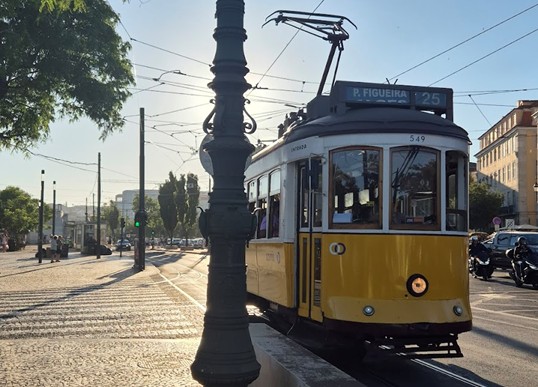
Ein gelber Straßenbahnwagen fährt durch eine sonnige Stadtstraße, umgeben von Gebäuden, Bäumen und Oberleitungen.

Unter dem Motto „Accessibility & Citizenship“ ging es bei der Konferenz darum, den Zugang zu Wissen demokratischer zu machen, das Engagement der Community zu fördern und aktuelle gesellschaftliche Probleme auf sinnvolle Weise anzugehen. Barrierefreiheit war nicht nur ein Thema, sondern hat auch die Organisation beeinflusst. Bei der Eröffnungsfeier gab es sowohl im Saal als auch beim Zoom-Livestream Gebärdensprachdolmetscher. Das hybride Format, das an sich schon ein Zeichen für Barrierefreiheit ist, baut auf den letzten Konferenzen in Graz (2023) und Washington, DC (2024) auf und versucht, die Online-Teilnahme zu verbessern. Obwohl ich vor Ort in Lissabon war, finde ich es sehr wichtig, dass unsere Community weiterhin den Möglichkeiten für DHler:innen und Interessierte, die nicht reisen können, Priorität einräumt.

Auch die Multilingualität stand im Mittelpunkt. Präsentationen in anderen Sprachen als Englisch sind auf DH-Konferenzen nichts Neues, aber in Lissabon gab es mehrere Vorträge auf Italienisch, Portugiesisch und Spanisch. Da die ADHO neue Mitglieder wie die Associazione per l’Informatica Umanistica e la Cultura Digitale (AIUCD) aufnimmt, sollten wir den wissenschaftlichen Austausch über Sprach- und Landesgrenzen hinweg weiter fördern. Englisch ist vielleicht die Lingua franca der Wissenschaft, aber als Geisteswissenschaftler:innen sollten wir die damit verbundenen Auswirkungen kritisch hinterfragen.

Aus einer brasilianischen akademischen Perspektive ist diese Diskussion bekannt: Englisch ist oft die gemeinsame Sprache in der Wissenschaft, aber es kann auch eine Barriere darstellen, die Leute von der Teilnahme ausschließt, und zwar selbst wenn es, z.B., auf Portugiesisch fundierte wissenschaftliche Arbeiten gibt. Für uns, bei einem Vortrag über einen portugiesischen Autor im Herzen Portugals durch eine brasilianische Forscherin, haben wir (das Team: Ulrike Henny-Krahmer, Erik Renz und ich) uns dafür entschieden, auf Portugiesisch zu präsentieren. Es war wie eine Heimkehr für Pessoas Ausgabe in seine Heimatstadt.

Ich werde hier nicht versuchen, das Problem zu lösen, aber die Anzahl der mehrsprachigen Vorträge auf der Konferenz unter dem Motto „Accessibility“ hat mich wieder an diese Fragen erinnert. Das ist es meiner Meinung nach, was ein Konferenzmotto bewirken sollte. Gut gemacht, Organisationskomitee!

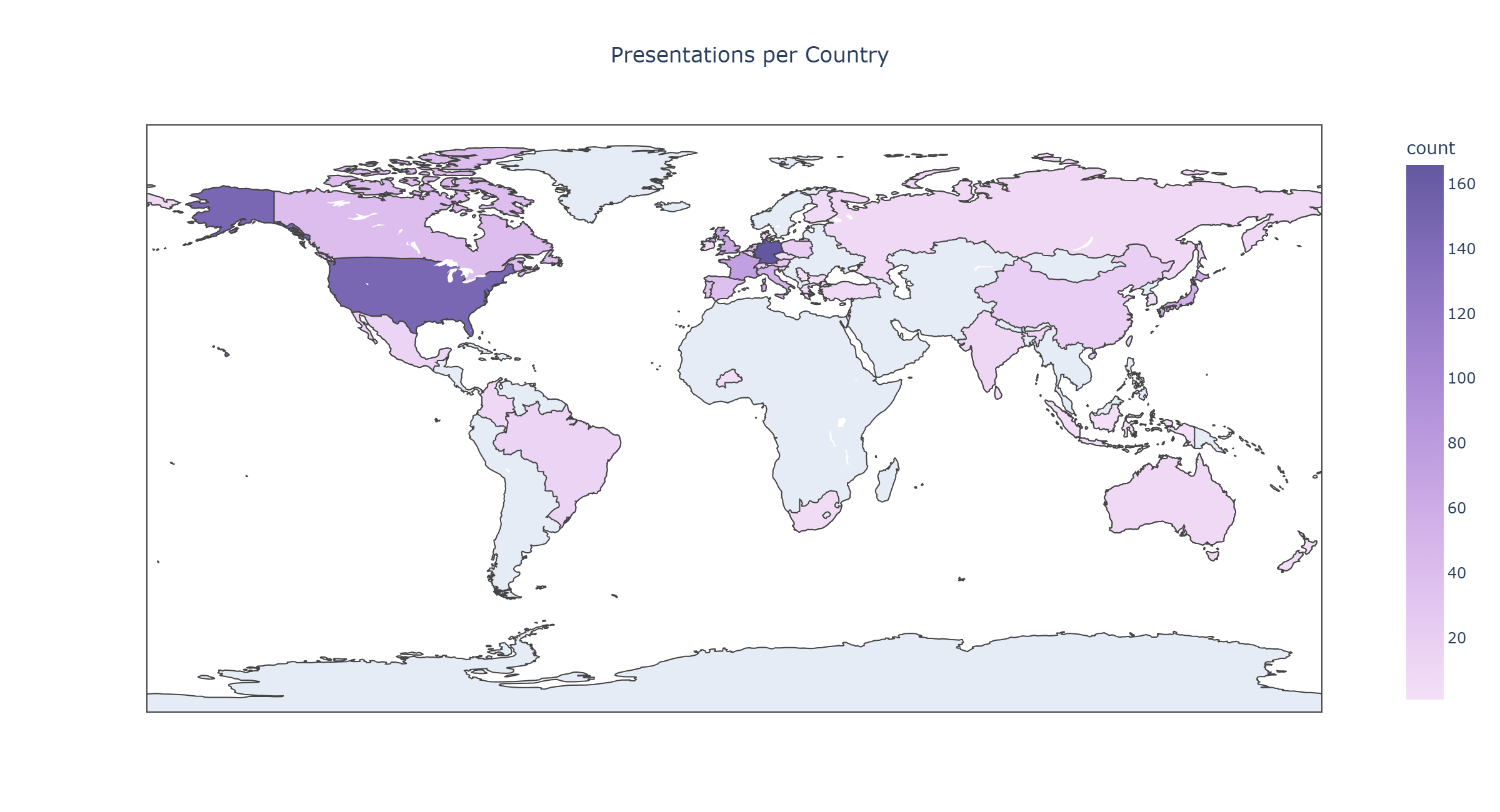
Die DH-Konferenz in Lissabon war nicht nur mehrsprachig, sondern auch echt international. Die Referenten kamen aus Institutionen von 45 Ländern. Die Karte unten zeigt die Teilnahme nach Ländern, basierend auf dem Konferenzprogramm und den Angaben der Teilnehmer zu ihrer jeweiligen institutionellen Zugehörigkeit. (Die Karte zeigt das Land der Institution der Referenten, nicht ihre Staatsangehörigkeit.)

Die Grafik zeigt eine Weltkarte mit der Anzahl der Präsentationen pro Land, dargestellt durch verschiedene Farbabstufungen von hellviolett bis dunkelviolett. Je dunkler die Farbe, desto mehr Präsentationen fanden in diesem Land statt.

Bei der Eröffnung hat ADHO sein 20-jähriges Jubiläum in Erinnerung gerufen (gegründet 2005) und Italien über AIUCD als neues Mitglied begrüßt. Der Antonio Zampolli Preis 2026 wurde für das Stylo Tool und die Computational Stylistics Group verliehen, deren R-Library für stilometrische Analysen und ihr Engagement für den Aufbau einer Community gewürdigt wurden. Michael Sperberg-McQueen (1954–2024) wurde außerdem in Erinnerung gerufen und der Michael Sperberg-McQueen Digital Nachlass vorgestellt (https://dh.phil-fak.uni-koeln.de/en/research/cmsmcq), eine Initiative des Departments für Digital Humanities der Universität zu Köln zur Bewahrung seines digitalen Nachlasses unter der Leitung von Elisa Cugliana und Øyvind Eide. Das Programmkomitee unter der Leitung von Gimena del rio Riande (IIBICRIT- CONICET/ USAL) und Manuel Portela (Fachbereich für Sprachen, Literatur und Kulturen, UCoimbra) folgte mit einem lustigen Sketch über KI-„Halluzinationen” und die Schwierigkeiten des akademischen Lebens, der die Stimmung auflockerte und uns gleichzeitig auf die Themen des Jahres zurückführte: Mehrsprachigkeit, Politik, Barrierefreiheit und Wissenschaft als citizenship.

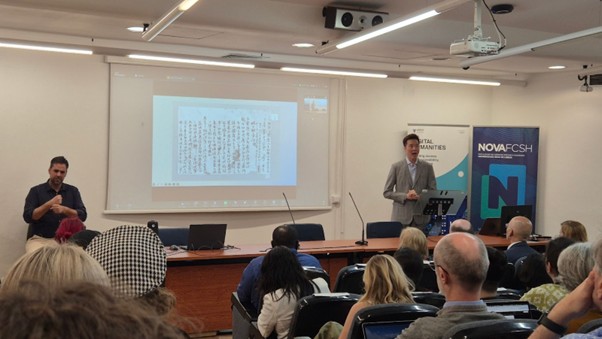
Javier Cha steht vor dem Publikum im Konferenzraum und präsentiert Folien mit Schriftzeichen, während ein Dolmetscher daneben steht.

Dann kam die Keynote von Javier Cha. Cha erzählte von seiner Karriere und seiner Sicht auf (digitale) Geschichte, von seinen ersten netzwerkbasierten Rereadings historischer Quellen bis hin zu aktuellen Anwendungen von KI, die uns helfen, Archive besser im Kontext zu lesen. Der Fokus liegt nicht darauf, mit KI das Rad neu zu erfinden, sondern anders zu lesen: mithilfe von Computern Verbindungen, Nuancen und Kontexte zu erkennen, die durch Schlüsselwörter und Häufigkeit nicht erfasst (oder erkennt) werden, während der Historiker:in die Kontrolle behält. Er bezeichnete dies als „fine-tuning the historian’s macroscope”: die Fähigkeit, das Ganze zu überblicken und die richtigen Stellen zu finden, um näher hinzuschauen und genauer zu lesen.

Überblick: Poster, Präsentationen und Panels

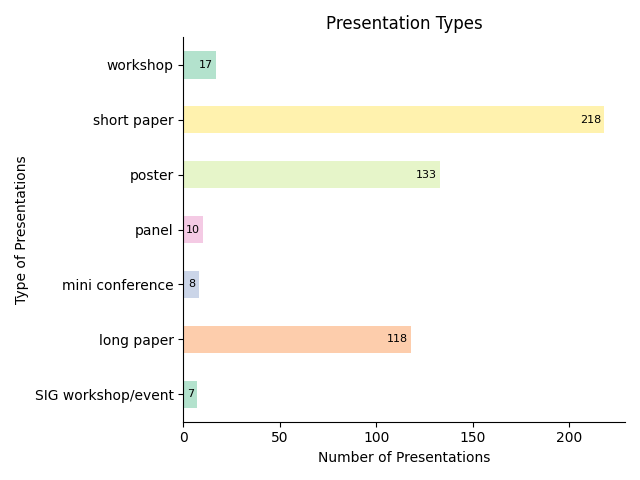
Ein Balkendiagramm zeigt die Anzahl der Präsentationen nach Typ. "Short paper" hat mit 218 die meisten Beiträge, gefolgt von "Poster" mit 133 und "Long paper" mit 118. Weitere Kategorien sind "Workshop" (17), "Panel" (10), "Mini conference" (8) und "SIG workshop/event" (7).

Das Programmheft ist noch nicht da, aber während wir warten, können wir uns schon mal das Programm anschauen und, um einen Begriff von Cha zu verwenden, mit unserem Makroskop die Konferenz aus der Ferne betrachten und versuchen, einen Eindruck davon zu bekommen, was unsere DH Community so treibt. Ein Überblick über die Arten der eingereichten Beiträge zeigt uns die Verteilung des diesjährigen Programms (siehe oben). Die Daten für diesen Überblick stammen aus dem Programm auf Conftool (https://dh2025.adho.org/browse-the-program-agenda/), wurden maschinell erfasst und anschließend mit Python bereinigt und analysiert.

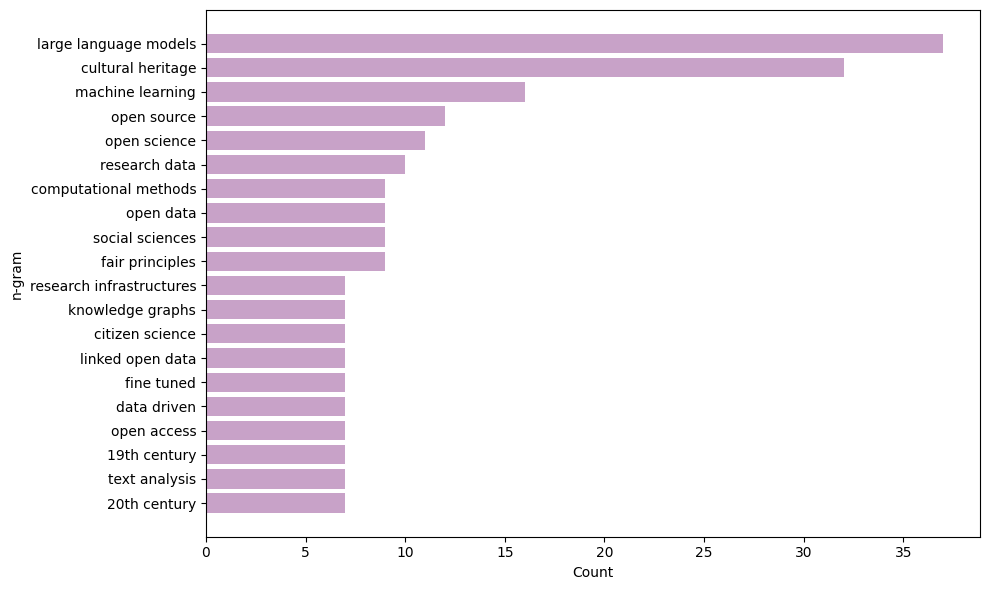
Ein Balkendiagramm zeigt die häufigsten n-Grams. "Large language models" und "cultural heritage" sind am häufigsten, gefolgt von "machine learning" und "open source".

Wenn man sich die Abstracts der Vorträge im Programm anschaut (Workshops und Panels nicht mitgerechnet), zeigt das Balkendiagramm die häufigsten N-Grams, also wie oft ein Begriff in den Abstracts vorkommt. Das Thema, das ganz klar dominiert, sind „Large Language Models” (LLMs). Das zeigt, dass der Einsatz von LLMs in den Digital Humanities weiterhin ein Trend ist, der sich durchsetzt. Gleich danach kommt „cultural heritage”, was zeigt, dass GLAM und die Arbeit mit Kulturgütern nach wie vor ein zentraler Anwendungsbereich für DH sind. Methoden sind sehr präsent, vor allem KI („machine learning” und „large language models” stehen ganz oben), während „“computational Methods” und „text analysis” den methodischen Fokus verstärken. Der Fokus auf KI und LLMs ist nicht überraschend und war auch schon in der letzten DH zu sehen. Offenheit zieht sich durch das ganze Programm, wobei „open source”, „open science”, „open data” und „FAIR principles ” häufig auftauchen. Auch Wissensrepräsentation ist ein lebhaftes Thema, wobei „knowledge graphs” und „linked open data” auf Interoperabilität und semantische Anreicherung hinweisen.

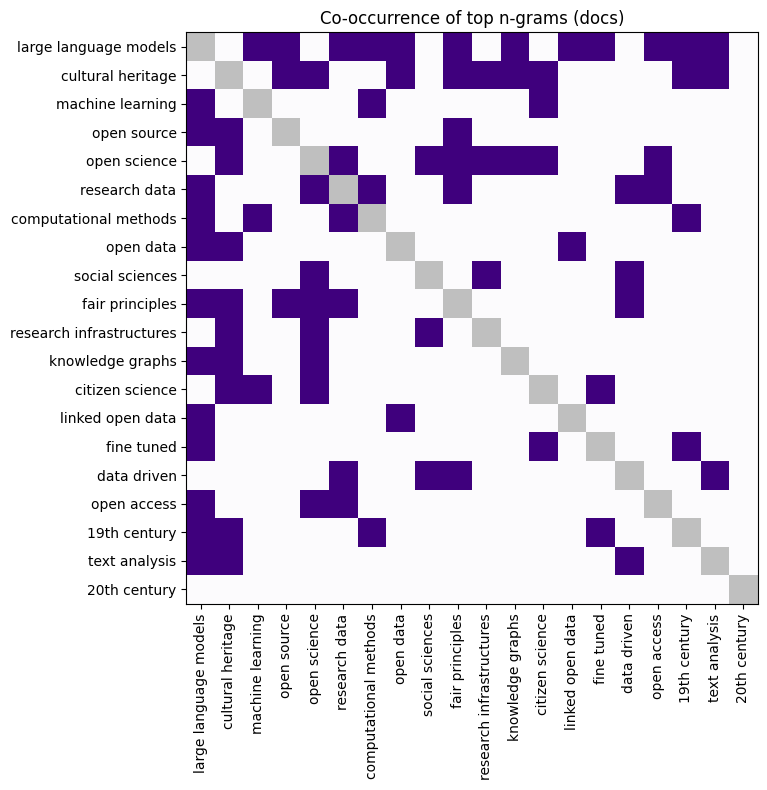
Eine zweite Visualisierung zeigt, wie Themen in den Abstracts der Vorträge zusammen auftreten. In dieser Co-Occurrence-Heatmap zählt jede Zelle die Abstracts, die ein Paar der Top N-Grams im selben Text erwähnen (die Diagonale ist ausgegraut, weil Selbstpaare raus sind). Die Matrix ist ziemlich sparsam, was darauf hindeutet, dass sich viele Beiträge auf ein einziges Hauptthema konzentrieren, aber es gibt auch klare Überschneidungen. Begriffe rund um Offenheit wie “open science”, „open source”, „open data” und „FAIR principles” tauchen zusammen auf, oft in Kombination mit „research data“ und oft in Kombination mit „cultural heritage“. Methodische Themen bilden ein weiteres Cluster, insbesondere „large language models“, „machine learning“ und „computational methods“, die gelegentlich gemeinsam mit „text analysis“ erscheinen. „Cultural heritage“ zeigt Verbindungen zu mehreren dieser Bereiche, was darauf hindeutet, dass Kulturgüter häufig durch offene Praktiken, datengetriebene Ansätze und KI-gestützte Methoden in Fallstudien integriert werden.

Ein Heatmap zeigt die Co-Occurrence der häufigsten n-Grams. Dunkle Felder markieren häufige gemeinsame Vorkommen von Begriffen wie "large language models", "cultural heritage" und "open science".

Was ich mitnehme…

Die Teilnahme an der DH ist immer eine Chance, Freunde zu treffen, neue Leute kennenzulernen und viel zu lernen. Als ich Lissabon verlassen habe, hatte ich frische Ideen für LLM-basierte Methoden zum Erfassen und Analysieren von Daten im Gepäck. Wie Cha uns betonte, müssen wir uns nicht zwischen dem Überblick und den Details entscheiden; wir können zwischen beiden hin- und herwechseln und LLMs kritisch einsetzen, während wir selbst entscheiden, wann wir den Fokus auf Nuancen legen wollen. Außerdem wurde mir wieder bewusst, wie wichtig Dokumentation und Wiederverwendbarkeit sind: Unsere beste Arbeit ist für andere nur dann nützlich, wenn sie gut dokumentiert und frei verfügbar ist. Die DH2025 hat meine Neugier geweckt und mein Notizbuch mit Ideen gefüllt. Vielleicht werden wir uns 2026 in Wien zur DHd wieder treffen.

Tchau, Lisboa, até a próxima! Bis dahin hat Lissabon uns allen beigebracht, was Saudade bedeutet.

Ein Flugzeug fliegt über Lissabon bei Sonnenuntergang, die Skyline ist im Schatten sichtbar.

❌