❌

普通视图

Received before yesterday

DHARTI2026: Call for Hosts

2026年8月9日 16:01

The Digital Humanities Alliance for Research and Teaching Innovations (DHARTI) is seeking proposals from educational institutions and/or stakeholders from the G.L.A.M. [galleries, libraries, archives, and museums ]sector in India to host the DHARTI 2026 biennial conference scheduled to take place in December 2026.

Based on the previous conferences organised under the aegis of DHARTI, DHARTI 2026 will be:

  • A 2-day conference with multiple parallel sessions
  • Accompanying pre-conference workshops
  • A respectful, collaborative platform stimulating debates on past, present, and future of Digital Humanities in India in all configurations

ORGANIZATIONAL CONTEXT AND BRIEF OVERVIEW OF PAST CONFERENCES

The Digital Humanities Alliance for Research and Teaching Innovations or DHARTI, is an initiative toward organizing and facilitating digital practices in arts and humanities scholarship in India, both within and beyond academic institutes. DHARTI is India’s first Digital Humanities Collective and is affiliated as a Constituent Organization of the The Alliance of Digital Humanities Organizations (ADHO) DHARTI, in its previous avatar as the Digital Humanities Alliance of India (DHAI) successfully held its inaugural conference in June 2018 at IIM Indore, which was organized jointly by IIM Indore and IIT Indore. The two-day conference with the theme: “Contestations, Connections and Collaborations” saw participation from more than 50 national and international delegates from 16 Indian states and 5 countries. DHARTI 2020 conference organized as India’s first twitter conference in January 2020 that also saw tremendous participation from DH enthusiasts from across the world. 

The second DHARTI 2022 biennial conference was held from February 21 to 25, 2022, with the theme: “The Digital Divides: Discontents, Debates and Discussions” and with the aim to acknowledge the vertiginous divides, celebrate the productive debates, and encourage new models of thinking about humanistic inquiry in a post-Covid digital landscape. Thus far, participation at all DHARTI events has been transdisciplinary with representation from diverse disciplines including (but not limited to) Language, Literature, Visual Art, Performance / Theatre Studies, Media Studies, History, Sociology, Psychology, Language Technologies, Library Studies, Methodologies as well as Software and Critical Computational Studies. These modes of participation are representative of the aims of DHARTI, namely, to provide a methodological commons to promote and accommodate the diverse nature of DH studies within the Humanities, Social Sciences, and beyond through interdisciplinary research and pedagogy. DHARTI also aims to foster connections and associations with fellow DH organizations from the Global South that are similarly committed toward a decolonized praxis of DH.

The third DHARTI 2024 biennial conference was held from 10–13 December 2024 at IIT Jodhpur, with the theme “Digital Subject/ivities in the Global South.” The conference brought together scholars, practitioners, and students to discuss emerging methods, pedagogies, and critical debates in Digital Humanities within Global South contexts.

Besides conferences, DHARTI also conducts workshops and talk series. In July 2020, a DHARTI panel on “Toward a Postcolonial/Decolonial Digital Humanities” for DH2020 was held online, streamed live on YouTube, and archived on the Humanities Commons Portal. In December 2020, DHARTI launched the DHARTI Speaks! Webinar series with a talk on Electronic Literature as DH-Perspectives from Ghana and India. In August and September 2025, the talks on electronic literature and AI were conducted as part of the series and  we have an upcoming talk series which will be regularly posted on our website. This online series aims at facilitating a sustained dialogue between Global Voices and/in Local Conversations on the Global South.

We are particularly interested in proposals from institutions/ groups of institutions that:

  • Have developed or are developing digital humanities communities and organizations
  • Have not previously hosted a DH conference and/or
  • Are interested in developing new modes of engagement for DH
  • Are similarly committed toward a decolonized praxis of DH

Scope of Proposal

The selected educational institution(s) and/or stakeholders from the G.L.A.M. [galleries, libraries, archives, and museums ]sector will be responsible for the following:

  1. Event Planning
  • Develop the conference website, a comprehensive event plan outlining key
    milestones, and timelines.
  • Coordinate with DHARTI functionaries to understand the conference objectives, theme, and target
    Audience.
  • The academic aspects of the conference, including overall intellectual direction, will be overseen by the DHARTI Governing Body. The members from the host and DHARTI Governing Body members will be in the programme committee.
  1. Venue Selection and Logistics
  • Identify and secure a suitable venue that aligns with the conference requirements for
    Hybrid (if preferred) and offline participation (including room sizes and technical capabilities, hotel, options for student housing, and other accommodations, arrangements for access accommodations
  • Manage logistics, including audio-visual equipment, catering, signage, and seating
    Arrangements.
  • A decision regarding the inclusion of hybrid participation will be made jointly by DHARTI and the host[s]. If hybrid options are adopted, the host[s] must ensure conducive facilities and reliable technical infrastructure for seamless online and offline engagement.
  • The decided number of participants will be based on the capacity of the host.
  1. Program Development
  • Collaborate with DHARTI functionaries to create a diverse and engaging conference program.
  • Source and coordinate speakers, panelists, and workshop facilitators.
    DHARTI will liaison with the keynote speakers.
  1. Marketing and Promotion
  • Develop promotional strategies to promote the conference and invite participation.
  • Create promotional materials, including brochures, banners, and online content.
  1. Registration and Attendee Management
  • Implement an efficient registration system for participants.
  • Handle attendee inquiries and manage participant communications.
  1. Sponsorship and Exhibitor Coordination
  • Secure sponsorships and manage relationships with sponsors.
  • Coordinate exhibitor logistics, including booth assignments and setup.
  • Financial structure will be mutually decided. 
  • DHARTI may offer a few bursaries for the presenters.
  1. On-Site Management
  • Oversee on-site logistics and ensure smooth event execution.
  • Provide event staff for registration, information, and support.
  1. Post-Event Evaluation
  • Collect feedback from participants, sponsors, and exhibitors.
  • Prepare a comprehensive post-event report, including recommendations for future
    conferences.

Proposal Submission: Interested institutions are invited to submit a letter of intent that addresses their suitability for hosting the conference as well as a few proposed conference themes. Thereafter, a detailed proposal should be submitted.

The proposal should include the following:

  • Institutional background and experience in conference planning
  • Suggestions for conference theme and subthemes
  • Proposed event plan and timeline
  • Budget estimate, including a breakdown of costs and sources of funding.
  • Previous experience with similar events and references
  • Marketing and promotional strategies

Submission of Letter of Intent: 22 Apr 2026
Submission of Detailed Proposal: 8 May 2026
Proposal Submission Address: dhallianceindia@gmail.com

Proposals will be evaluated based on the following criteria:

Access for attendees with disabilities is mandatory at all venues and events associated with the conference. This includes accommodations in presentation rooms for participants who are sight- and/or hearing-impaired. If excursions cannot be made accessible to people with disabilities, this should be clearly noted in the registration materials.

Experience and expertise in conference planning and event management.
Proposed budget and cost-effectiveness.
References and past performance.
Marketing and promotional strategies.

DHARTI reserves the right to reject any or all proposals or to negotiate separately with educational institutions deemed to be the most qualified.

We look forward to receiving your proposal.Sincerely,
DHARTI Governing Body
dhallianceindia@gmail.com

DHARTI 2022 Conference

2026年8月9日 16:01

The DHARTI2022 conference was held online 21 – 25 February 2022.

#DHARTI2022

The theme for the 2022 conference was “The Digital Divides: Discontents, Debates and Discussions”.

The following were the keynote speakers for the conference:

21 Feb 2022
7PM
(UTC +530)
P. Thirumal
Professor
Department of Communication
University of Hyderabad
Of Technological milieus and Literary telling: A limited reading of the Kannada Digital audio Swapne Saraswathe
22 Feb 2022
7PM
(UTC +530)
Anubha Sinha
Senior Researcher
Centre for Internet and Society, India
Open Access in India
23 Feb 2022
7PM
(UTC +530)
Aishatu Gwadabe
Peace Technologist and AI Artist
Digital humanities and tech for good: An exploration of Peace Technology
24 Feb 2022 7:30PM (UTC +530)Paola Ricaurte
Associate Professor
Department of Media and Digital Culture
Tecnológico de Monterrey, Mexico City
DH in a global pandemic: responses from the majority world

                Conference Timeline:  Dates
Call for Papers  23 August 2021
Deadline for Abstract submissions  12 December 2021
Communication of decisions after peer review  15 January 2021  
Last date for registration (participants) 10 Feb 2022  
Last date for registration (attendees)18 Feb 2022
Conference Week  21 Feb – 25 Feb 2022  
Workshop: Introduction to R for Humanities28 Feb – 11 Mar 2022
Workshop: Webscraping using Chrome extension5 Mar 2022

Access the Conference Schedule here.

Congratulations to 2026 conference bursary winners!

作者khemka
2026年8月12日 07:58
ADHO is happy to support the DH2026 bursary winners: In addition to support from ADHO, Chiyoung Song, Geethapriya Chandramohan, and Joyce Ann S. Pagalilawan also received bursaries from KADH! These bursaries support students and early-career scholars presenting at the annual Digital Humanities conference, helping them share their research, connect with peers, and enrich our global… Read More »Congratulations to 2026 conference bursary winners!

DHARTI 2024 Biennial Conference

2026年8月9日 16:01

DHARTI 2024 Biennial Conference

The Digital Humanities Alliance for Research and Teaching Innovations (DHARTI) successfully hosted its DHARTI 2024 biennial conference themed ‘Digital Subject/ivities in the Global South‘ with the Interdisciplinary Research Platform for Digital Humanities (IDRP-DH) at Indian Institute of Technology, Jodhpur (IIT-J) on December 10-13, 2024.

Please visit the conference website for further details. The sessions’ details can be found on the website under the ‘Highlights’ section.

Conference theme: Digital Subject/ivities in the Global South

The theme builds upon DHARTI’s last conference in 2022, which explored ‘digital divides’ in DH spaces across India and the globe. In the process, it hopes to create a platform for crucial dialogue between the scientific-technological discourses, and humanities and sociological research so that they may act together, in complementary ways, affecting timely interventions. Because of, or even despite the digital divide we witness, it is important, to not just study digitality in Global South societies, but also how cultural meaning- making play a key role in negotiations of agency and accessibility of resources across social networks within the Global South, and vis-a-vis the Global North.

We invite proposals from interested scholars, educators, researchers, industry personalities, artists, and other stakeholders in the field of Digital Humanities and other allied areas.

Organisers

Official Sponsors


Previous Posts

CALL FOR HOSTS: DHARTI 2024 Biennial Conference

作者DHARTI
2024年3月3日 14:09
The Digital Humanities Alliance for Research and Teaching Innovations (DHARTI) is seeking proposals from educational institutions in India to plan and execute the DHARTI 2024 biennial conference scheduled to take place in 2024. ORGANIZATIONAL CONTEXT AND BRIEF OVERVIEW OF PAST CONFERENCESThe Digital Humanities Alliance for Research and Teaching Innovations or DHARTI, is an initiative toward […]

#DHARTI2022 Workshops

2026年8月9日 16:01

The following workshops will be held in the weeks following the DHARTI2022 Conference

Introduction to R for the Humanities
Webscraping using Chrome extension

Introduction to R for the Humanities

Faculty: Arjun, Professor, Department of Humanities and Social Sciences, IIT Delhi

Schedule: 28 Feb to 11 Mar 2022, 10 days. Mon – Fri. 3-4PM IST (UTC +530).

Objectives of the workshop: To introduce participants to the basic operations on R and enable them to use these skill to work on humanities data.
The workshop will cover the following: Variables, Loops, Pipes, Strings, data structures, data wrangling, text analysis and visualization.

Modules:
Vectors, Arrays, Lists, Data Structures, Data Frames, String Manipulation, Ggplot

Eligibility:

1. Applicants should have at least a Bachelor’s degree in a humanities discipline.

2. The workshop is open for those who don’t have any background in coding/ programming. If you are someone who has any experience in working with another programming language like Python, Java etc. this workshop is not for you.

Technology requirements:

Participants will have to install RStudio on their machines. Detailed instructions will be provided.

Seats limited. If the number of applicants exceed the capacity of the workshop some of the applicants would be waitlisted and/or accommodated at a repeat workshop.

All workshop participants will be awarded an eCertificate.

To apply please fill up this form.

Webscraping using Chrome Extension

Faculty: Arjun, Professor, Department of Humanities and Social Sciences, IIT Delhi

Date and time: 5 March 2022, 3-5 PM IST (UTC +530)

Objective: To enable participants to scrape data from websites.
The workshop will offer hands on live demonstration of the tool with exercises

Eligibility:

1. Applicants should have at least a Bachelor’s degree in a humanities discipline.

2. The workshop is open for those who don’t have any background in coding/ programming. If you are someone who has any experience in working with another programming language like Python, Java etc. this workshop is not for you.

Technology requirements: Google Chrome/ Chromium browser

Seats limited. If the number of applicants exceed the capacity of the workshop some of the applicants would be waitlisted and/or accommodated at a repeat workshop.

All workshop participants will be awarded an eCertificate.

To apply please fill up this form.

For any queries please contact the workshop faculty.

From Manuscripts to AI: Reflections on DHd 2026

2026年4月15日 00:27

Overall, DHd 2026 was a truly memorable experience for me. What stood out was not only the diversity of research topics and approaches, but also the opportunity to engage with such talented and dedicated researchers. Being able to exchange ideas, receive feedback, and gain inspiration from other projects was both motivating and rewarding, and offered perspectives that I would not have encountered within my own academic environment. It also encouraged me to think more critically about how my own work fits into the broader field of digital humanities, and how it might contribute to ongoing discussions on combining computational methods with traditional manuscript studies.

I would like to sincerely thank the organizers for planning such a well-structured and inspiring conference. I am also very grateful for the travel grant, without which my participation would not have been possible.

Overall, DHd 2026 was a truly memorable experience for me. What stood out was not only the diversity of research topics and approaches, but also the opportunity to engage with such talented and dedicated researchers. Being able to exchange ideas, receive feedback, and gain inspiration from other projects was both motivating and rewarding, and offered perspectives that I would not have encountered within my own academic environment. It also encouraged me to think more critically about how my own work fits into the broader field of digital humanities, and how it might contribute to ongoing discussions on combining computational methods with traditional manuscript studies.

I would like to sincerely thank the organizers for planning such a well-structured and inspiring conference. I am also very grateful for the travel grant, without which my participation would not have been possible.

Overall, DHd 2026 was a truly memorable experience for me. What stood out was not only the diversity of research topics and approaches, but also the opportunity to engage with such talented and dedicated researchers. Being able to exchange ideas, receive feedback, and gain inspiration from other projects was both motivating and rewarding, and offered perspectives that I would not have encountered within my own academic environment. It also encouraged me to think more critically about how my own work fits into the broader field of digital humanities, and how it might contribute to ongoing discussions on combining computational methods with traditional manuscript studies.

I would like to sincerely thank the organizers for planning such a well-structured and inspiring conference. I am also very grateful for the travel grant, without which my participation would not have been possible.

Overall, DHd 2026 was a truly memorable experience for me. What stood out was not only the diversity of research topics and approaches, but also the opportunity to engage with such talented and dedicated researchers. Being able to exchange ideas, receive feedback, and gain inspiration from other projects was both motivating and rewarding, and offered perspectives that I would not have encountered within my own academic environment. It also encouraged me to think more critically about how my own work fits into the broader field of digital humanities, and how it might contribute to ongoing discussions on combining computational methods with traditional manuscript studies.

I would like to sincerely thank the organizers for planning such a well-structured and inspiring conference. I am also very grateful for the travel grant, without which my participation would not have been possible.

Overall, DHd 2026 was a truly memorable experience for me. What stood out was not only the diversity of research topics and approaches, but also the opportunity to engage with such talented and dedicated researchers. Being able to exchange ideas, receive feedback, and gain inspiration from other projects was both motivating and rewarding, and offered perspectives that I would not have encountered within my own academic environment. It also encouraged me to think more critically about how my own work fits into the broader field of digital humanities, and how it might contribute to ongoing discussions on combining computational methods with traditional manuscript studies.

I would like to sincerely thank the organizers for planning such a well-structured and inspiring conference. I am also very grateful for the travel grant, without which my participation would not have been possible.

Overall, DHd 2026 was a truly memorable experience for me. What stood out was not only the diversity of research topics and approaches, but also the opportunity to engage with such talented and dedicated researchers. Being able to exchange ideas, receive feedback, and gain inspiration from other projects was both motivating and rewarding, and offered perspectives that I would not have encountered within my own academic environment. It also encouraged me to think more critically about how my own work fits into the broader field of digital humanities, and how it might contribute to ongoing discussions on combining computational methods with traditional manuscript studies.

I would like to sincerely thank the organizers for planning such a well-structured and inspiring conference. I am also very grateful for the travel grant, without which my participation would not have been possible.

Overall, DHd 2026 was a truly memorable experience for me. What stood out was not only the diversity of research topics and approaches, but also the opportunity to engage with such talented and dedicated researchers. Being able to exchange ideas, receive feedback, and gain inspiration from other projects was both motivating and rewarding, and offered perspectives that I would not have encountered within my own academic environment. It also encouraged me to think more critically about how my own work fits into the broader field of digital humanities, and how it might contribute to ongoing discussions on combining computational methods with traditional manuscript studies.

I would like to sincerely thank the organizers for planning such a well-structured and inspiring conference. I am also very grateful for the travel grant, without which my participation would not have been possible.

Overall, DHd 2026 was a truly memorable experience for me. What stood out was not only the diversity of research topics and approaches, but also the opportunity to engage with such talented and dedicated researchers. Being able to exchange ideas, receive feedback, and gain inspiration from other projects was both motivating and rewarding, and offered perspectives that I would not have encountered within my own academic environment. It also encouraged me to think more critically about how my own work fits into the broader field of digital humanities, and how it might contribute to ongoing discussions on combining computational methods with traditional manuscript studies.

I would like to sincerely thank the organizers for planning such a well-structured and inspiring conference. I am also very grateful for the travel grant, without which my participation would not have been possible.

Overall, DHd 2026 was a truly memorable experience for me. What stood out was not only the diversity of research topics and approaches, but also the opportunity to engage with such talented and dedicated researchers. Being able to exchange ideas, receive feedback, and gain inspiration from other projects was both motivating and rewarding, and offered perspectives that I would not have encountered within my own academic environment. It also encouraged me to think more critically about how my own work fits into the broader field of digital humanities, and how it might contribute to ongoing discussions on combining computational methods with traditional manuscript studies.

I would like to sincerely thank the organizers for planning such a well-structured and inspiring conference. I am also very grateful for the travel grant, without which my participation would not have been possible.

Overall, DHd 2026 was a truly memorable experience for me. What stood out was not only the diversity of research topics and approaches, but also the opportunity to engage with such talented and dedicated researchers. Being able to exchange ideas, receive feedback, and gain inspiration from other projects was both motivating and rewarding, and offered perspectives that I would not have encountered within my own academic environment. It also encouraged me to think more critically about how my own work fits into the broader field of digital humanities, and how it might contribute to ongoing discussions on combining computational methods with traditional manuscript studies.

I would like to sincerely thank the organizers for planning such a well-structured and inspiring conference. I am also very grateful for the travel grant, without which my participation would not have been possible.

DHARTI2026: Call for Hosts

作者DHARTI
2026年4月7日 23:20
The Digital Humanities Alliance for Research and Teaching Innovations (DHARTI) is seeking proposals from educational institutions and/or stakeholders from the G.L.A.M. [galleries, libraries, archives, and museums ]sector in India to host the DHARTI 2026 biennial conference scheduled to take place in December 2026. Based on the previous conferences organised under the aegis of DHARTI, DHARTI […]

Abstract, Review, Postersession – (M)ein Weg zur DHd2026

2026年3月27日 22:46

Wie nimmt man als Nachwuchswissenschaftler, zumal noch als Student, an einer wissenschaftlichen Tagung teil? Allgemeingültig beantworten kann das wohl weder ich noch jemand anders. In diesem kurzen Beitrag will ich aber zumindest meinen Weg zur DHd2026 in Wien nachzeichnen. Ich hoffe damit aus Nachwuchsperspektive allen, für die eine Teilnahme an der Konferenz ebenfalls einen ersten Schritt in die Wissenschaftswelt bedeuten würde, eine Vorstellung zu geben, wie dieser Weg aussehen könnte.

Vom Vorhaben zum fertigen Abstract…

Die diesjährige Konferenz begann für mich am 22. Februar mit Ankunft in Wien. Der Weg dahin nahm seinen Anfang dagegen – wie sicher für viele Forscherinnen und Forscher aus den DH – bald ein Jahr zuvor. Denn: Nach der DHd ist vor der DHd.

Im letzten Jahr hatte ich das Glück, im heimischen Bielefeld als Teil des studentischen Organisationsteams indirekt schon an der letzten DHd-Konferenz teilnehmen zu können. Kein halbes Jahr zuvor hatte ich meine Bachelorarbeit in der Germanistik eingereicht. In dem Zusammenhang entstand bei mir bereits die Frage: Wäre meine Arbeit wohl auch was für die DHd…?

Bald darauf stellte ich meine BA im Kolloquium der Bielefelder Arbeitsgruppe CLS vor, mit anschließendem Gespräch über Publikationsmöglichkeiten. Veröffentlichen in einer Fachzeitschrift(?) – theoretisch möglich, aber vielleicht eine zu große Hürde, wo man nach der ersten Qualifikationsarbeit gerade zu laufen angefangen hat. Womöglich konzentriert man sich besser aufs Studium, immerhin stellt eine Veröffentlichung in jedem Fall einen Mehraufwand dar! Aber die Arbeit war gut, sagt man mir, und wenn man in die Wissenschaft will, gibt es hier Chancen, die sich auszuschöpfen lohnen.

Die alternative Idee: Veröffentlichen im Rahmen einer Konferenz – immerhin schwirrt die nächste DHd schon in den Köpfen rum und hier gäbe es niedrigschwelligere Einstiegsmöglichkeiten. Man könnte es versuchen, und bei Erfolg würde man diesmal als echter Teilnehmer mit eigenem Beitrag an der ersten Wissenschaftskonferenz teilnehmen. Etwa zur selben Zeit dürfte der Call for Papers eingegangen sein.

Ein Poster soll es werden. Mit Deadline für die Abstracts am 1. August ist im Juli Schreibarbeit angesagt. Eine 47-seitige Bachelorarbeit will auf 750 Wörter gestutzt werden und am Ende soll sogar noch so etwas wie eine Aussage rauskommen. Mit tatkräftiger Unterstützung von Prof. Dr. Berenike Herrmann und der ganzen AG ergeht eine x-malige Feedbackschleife – man unterschätze nicht, wie man – vor allem mit sich selbst – um jedes Wort kämpft, um das Abstract passend hinzubekommen. Am Ende bin ich zufrieden, der Beitrag ist im glücklicherweise gut funktionierenden Fidus Writer abgetippt und schließlich auf ConfTool hochgeladen. Dann heißt es auf das Open Peer-Review-Verfahren warten, um zu erfahren, ob man angenommen wurde oder nicht.

…über Reviewprozess und Posterdesign…

Und das dauert, naturgemäß. Über drei Monate, in denen das Leben natürlich weitergeht, aber man – weil es das erste Mal ist – trotzdem ungeduldig wartet. Schließlich wissen wir, ich und die weiteren drei(!) an AG-Projekten beteiligten Hilfskräfte mit Einreichungen, dass unsere Poster-Abstracts angenommen wurden! Die Freude ist groß.

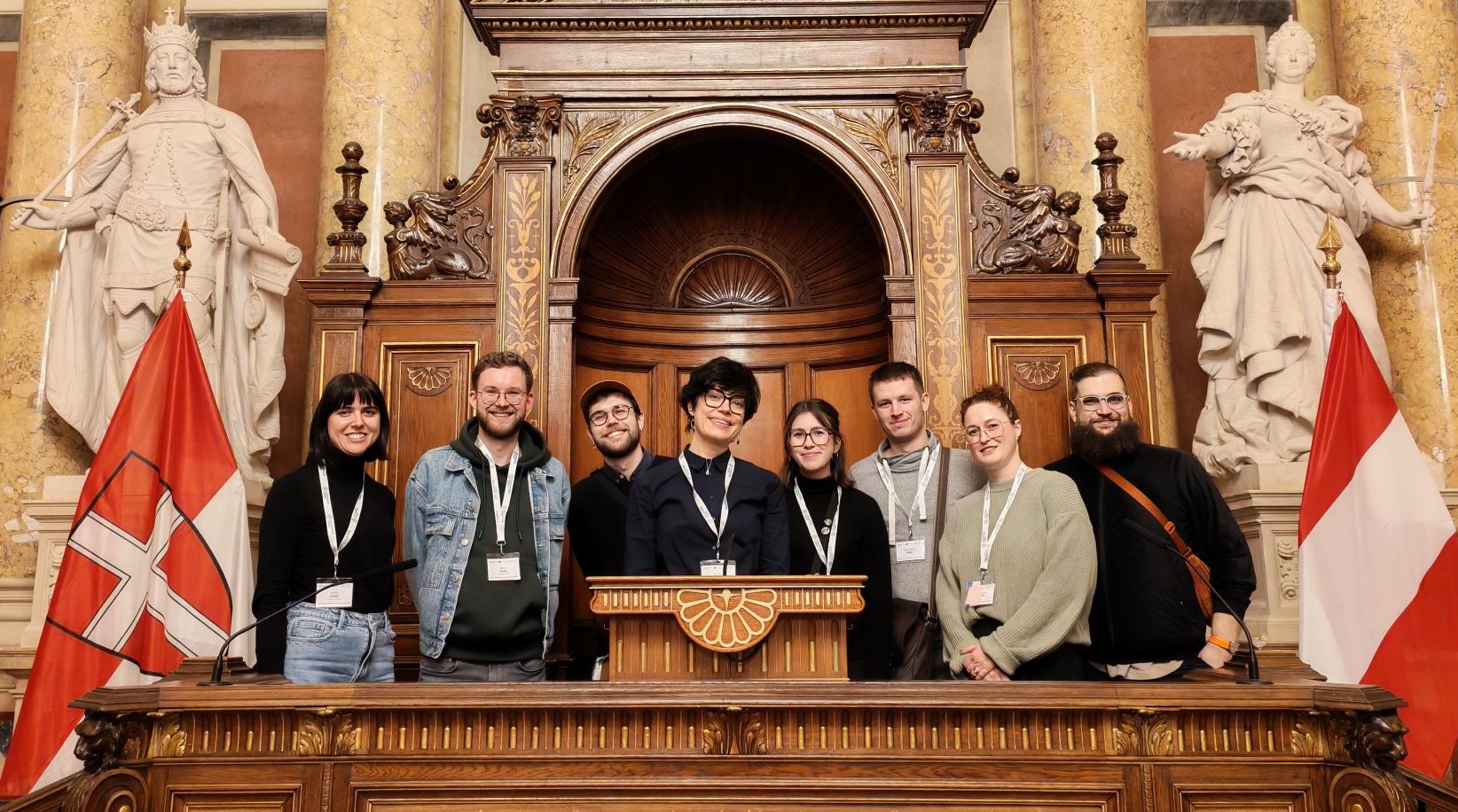
Die ganze mitgereiste Bielefelder AG CLS im gr. Festsaal der Universität Wien

Sofort geht es aber weiter, denn für das Metagutachten und die Veröffentlichung im Book of Abstracts wollen die Beiträge binnen eines Monats überarbeitet werden. Außerdem muss man sich nun ernsthaft Gedanken machen, wie man eigentlich nach Wien kommt.

In den nächsten Wochen wird sich für Konferenz und Workshops registriert, es werden Absprachen getroffen und Reisen und Unterkünfte gebucht. Man beachte: Für all das muss man üblicherweise in Vorleistung gehen, und es kommt ein bisschen was zusammen. Aber es gibt Finanzierungsmöglichkeiten. Neben der Forschungskommission der eigenen Universität, ggf. sogar der betreffenden AG, schreiben die Beteiligten am Stipendienprogramm des DHd-Verbands großzügig eine ganze Reihe Reisekostenstipendien aus, für die man übrigens nicht zwingend einen Konferenzbeitrag mitbringen muss. Wer den ganzen Organisations- und Verwaltungsaufwand zum ersten Mal macht, berechne aber auch hier etwas Zeit und Nerven ein, die immer dazugehören.

Im neuen Jahr schließlich, nachdem die Überarbeitung für das Metagutachten eingereicht und die meisten Fragen geklärt sind (die letzten werden es noch auf den letzten Drücker, keine Sorge), muss nur noch das eigentliche Poster designt werden. Also nochmal reduzieren und fürs Auge aufbereiten, bei ConfTool hochladen und ab in den Druck. Dann endlich ist alles in trockenen Tüchern und ein paar Tage später ist man, eh man sich versieht, auf dem Weg zur Konferenz.

…bis schließlich zum Ziel

Und was erwartet einen da? Nun, vorausgesetzt das gewählte Verkehrsmittel bringt einen erst einmal planmäßig an sein Ziel, eine ganze Menge. Mit Wien in meinem Fall zunächst eine prächtige Kulturstadt im Herzen Europas, die ich trotz des vollen Konferenzprogramms etwas Zeit hatte, zu erkunden. Neben großen, auch im Frühjahr schönen Gärten und viel ansehnlichem habsburgischen Prunk gehörte dazu nicht zuletzt das Hauptgebäude der ältesten Universität im heutigen deutschsprachigen Raum, wo die Konferenz ihre Räumlichkeiten fand.

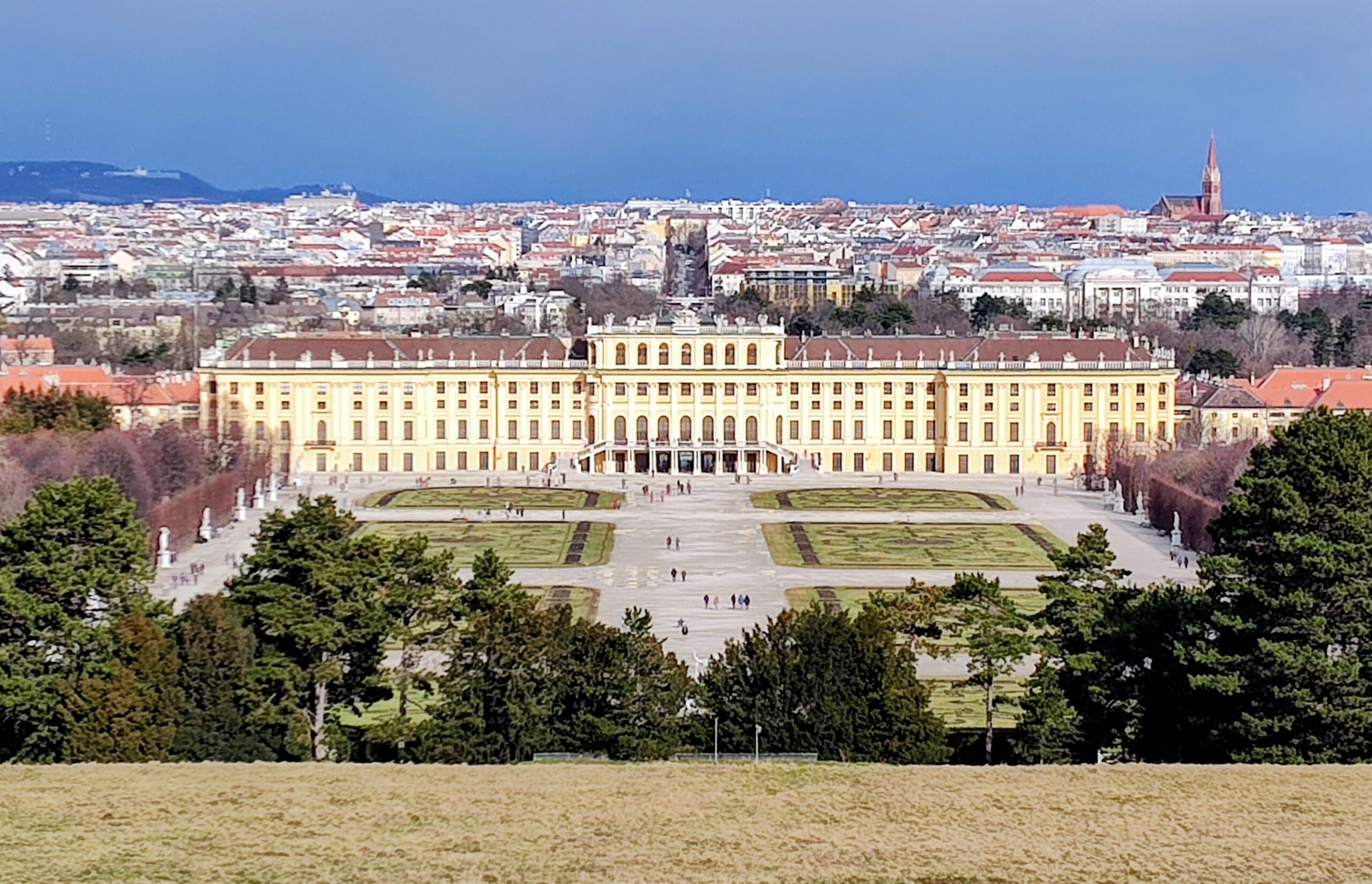
Auch das war drin: Schloss Schönbrunn mit der Stadt im Hintergrund, aufgenommen von der Gloriette-Anhöhe

In den Workshops gab es dort ungezwungenen Erfahrungsaustausch im Konferenz-Du und Raum zum Ausprobieren und Selbermachen. Das Kernprogramm, in dem ich durch meine Teilnahme die Möglichkeit hatte, eine ganze Reihe hochaktueller, interessanter Vorträge in breitgefächerten Konferenztracks zu hören, war gerahmt von zwei großen Keynotes im Audimax, die Anlass für anregende Gespräche boten. Dazwischen tischten die Veranstalter im kleinen und großen Festsaal zu Eröffnungsfeier und Kaffeepausen und nicht zuletzt zum großen Empfang im Ballsaal des Wiener Rathauses auf.

Der Mittelpunkt der Konferenz war für mich aber die große Poster-Vorstellung am Donnerstag. Nach vormittäglichem Poster-Slam, wo einige Mutigere die restlichen Teilnehmer kreativ und humorvoll schon auf ihre Poster heißgemacht hatten, warteten die zwei aufeinanderfolgenden Poster-Sessions mit insgesamt 98 Beiträgen.

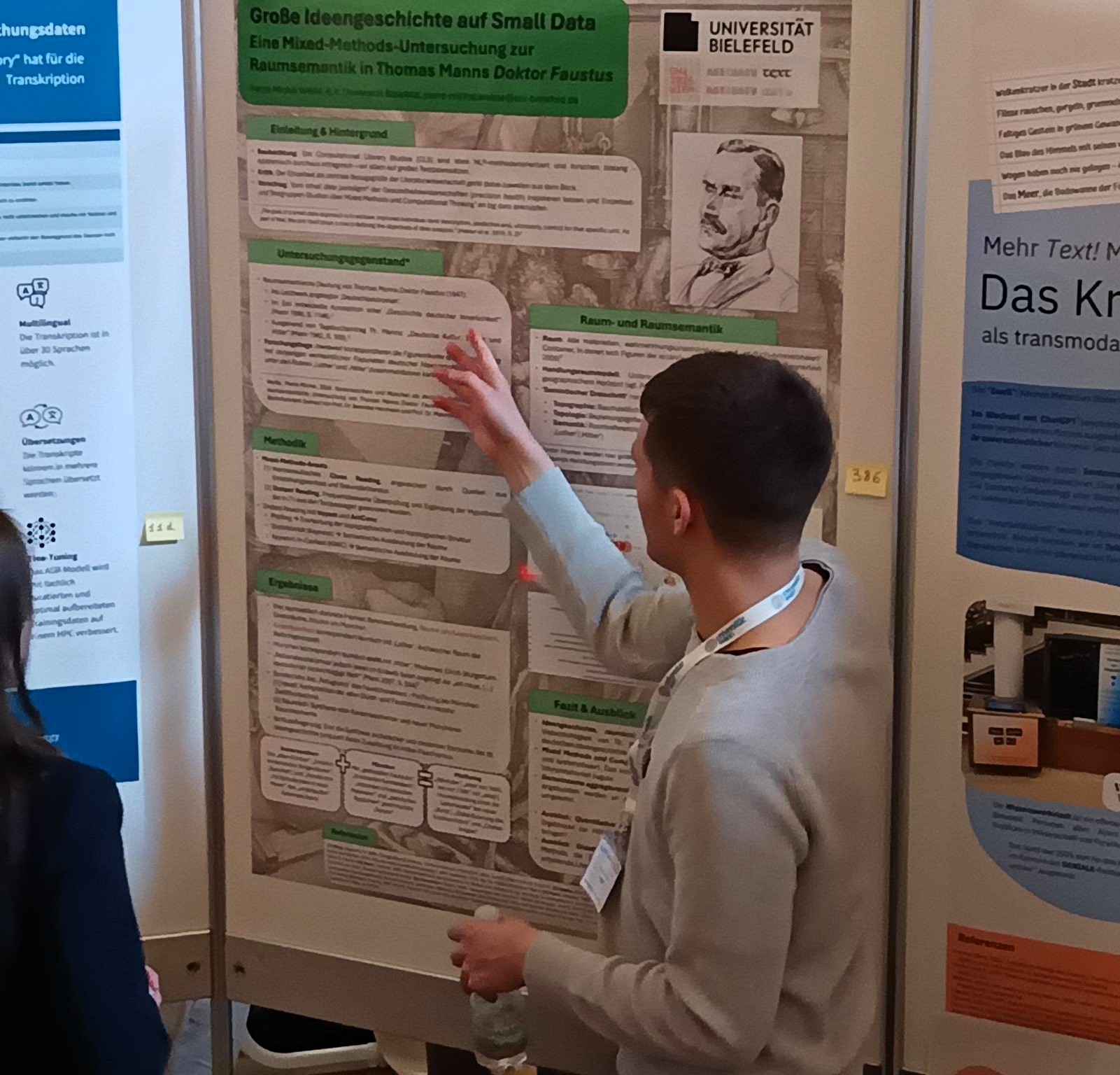
Vorstellung meines Posters in der ersten Session

Es war eindrucksvoll, das eigene Poster dort endlich im A0-Format neben all den anderen hängen zu sehen, zumal im üppigen großen Festsaal der Universität Wien. Während der Poster-Session hatte ich die Möglichkeit, mit gestandenen Wissenschaftlern und anderen Studenten und frisch Promovierenden gleichermaßen ins Gespräch zu kommen, Zusammenhänge meiner Arbeit zu erklären und Rückfragen zu beantworten. Und in der zweiten Session konnte ich dann auch selbst herumgehen und mich mit anderen wiederum über ihre Poster austauschen. Bei all dem habe ich die Erfahrung machen dürfen, mich wirklich als Teil einer wissenschaftlichen Community zu fühlen.

In diesem Sinne kann ich allen, die wie ich noch weit am Anfang ihres akademischen Werdegangs stehen, nur empfehlen, bei Möglichkeit auch diese Erfahrungen zu machen. Ob mit eigenem Beitrag oder ohne, der Weg zur DHd kann für Nachwuchswissenschaftler ganz unterschiedlich aussehen – aber es lohnt sich in jedem Fall, ihn zu beschreiten.

—

Dieser Beitrag ist im Rahmen eines Early Career-Reisestipendiums für die 13. Jahrestagung des Verbands Digital Humanities im deutschsprachigen Raum e.V. entstanden. Mein herzlicher Dank gebührt dem DHd-Verband als Stipendiengeber für die finanzielle Ermöglichung meiner Teilnahme.

Recap of the DHd 2026 Conference in Vienna

2026年3月11日 23:08

Two weeks ago, I had the pleasure in attending the DHd 2026 in Vienna! The week long conference started with being greeted and checked in by extremely kind and helpful people and receiving a DHd tote bag containing a travel mug, a programmable LED name tag, a program book, a DHd pen, and a notebook.

Then the first workshop began. I had enrolled in Workshop 6: Library Labs als Innovation Hubs für DH – Worldcafé & Community Building. Here we heard from the Bibliothek für Bildungsgeschichtliche Forschung des DIPF, the Deutsche National Bibliothek, the Stabi Lab which is part of the Staatsbibliothek zu Berlin, DIGIPOP, and the Vernetzungs- und Kompetenzstelle Open AccessBrandenburg. Each presented what offers they have, what events they host, how to access their datasets and open source resources, and how to get in touch. Then after a 15-minute coffee and pastry break, we broke out into groups and discussed the overarching theme of Library Labs, broken up into the subcategories of physical location, teaching formats, personnel/resources, target groups and communication, and cooperation and sustainability. The breakout groups was an amazing opportunity to learn and chat with other people attending the conference and hear about the work they are currently involved in.

The next day I participated in the workshop hosted by the DNBLab from the Deutsche Nationalbibliothek called “Von der Forschungsidee zumDatenkorpus”. Here we learned how to use the DNB SRU Query Tool to query and create metadata sets via the SRU interface. This workshop was again a very open and welcoming space, with all coding levels represented and everyone working together to use the tool and create visualizations from the datasets.

During the lunch break after, due to the sunny weather, many people decided to picnic outside at a nearby park before the next workshop. Tuesday evening was the Opening Keynote from Miriah Meyer, a professor in the Department of Science and Technology at Linköping University who is funded by the WASP program. Her research focuses on developing visualization tools that support exploratory and reflective data analysis and provide new ideas for using data in our lives. These tools enable people to learn more about their own data, redefine their perspectives, and revolutionize their thinking. In her keynote “Data As _: Exploring the Plurality of Data in Visualization”, she presented four different perspectives on data that reflect the range of approaches used by visualization researchers. By clearly distinguishing these perspectives, she opened new possibilities for how we create and use data and visualizations, and how we can simultaneously question our common notions of data-driven work. She also described the various projects she is and has been involved in, including one where young women are the target audience, with whom she explored Data Crafting and Data Physicalization Methods.

After the interesting Keynote, we all went to the Main Ceremonial Hall (Grosser Festsaal) for the Opening Reception where we were welcomed with food, drinks, and deserts and had time to socialize. Starting Wednesday and going until Thursday at noon, there were lectures where 2 to 3 people or groups presented their work, each total lecture lasting 1.5 hours and each having an overarching topic. The topics included digital soundscapes, digital art history, research data standards, Doctoral consortiums, named entities, digital editions, history of DH research, research software engineering, graph networks, virtuality, AI in interaction scenarios, epistemology and interpretation, research platforms as well as panel discussions. Between each lecture, there was either a coffee and pastry break, or a lunch break.

Thursday after the first coffee break, everyone headed to the Audimax where the Poster Slam took place. Each person or group presenting a poster had 60 seconds to introduce themselves, their topic and their research. The audiences applause level was recorded and whichever group received the loudest applause won. The slams were all so creative, with people working with props, being wrapped in toilet paper, performing poetry, sonnets, raps, and skits. After the Poster Slam followed lunch, and afterwards everyone gathered in the Main Ceremonial Hall for two Poster Sessions where we were able to ask questions and hear more about each poster from each of the participants.

In the evening, we were invited to the Reception in the City Hall. We entered the City Hall and were greeted with breathtaking architecture. The mayor’s representative welcomed us, speeches were held, the awards of the Poster Slam and the Poster Sessions were announced, selfies were taken and the buffet was opened. The night continued with food, drinks, desserts, and dancing and then once the City Hall closed, everyone went to a bar where bingo was played at midnight.

On Friday there were two more lecture sessions with topics including historical perspectives, digital editions II, text recognition, automation and AI, operationalization, multimodality, data modeling, digital art history II, and two more panel discussions.

This was followed by lunch and then the closing Keynote which was held by Katharina Kinder-Kurlanda, a Professor of Humanwissenschaft des Digitalen at the University of Klagenfurt in Austria. She works across disciplines in digital humanities, science and technology studies, sociology of technology, and internet research. Her research interests include new epistemologies for big data, algorithms in everyday life, data practices, social casual games, and (fair) artificial intelligence. The keynote invited us to understand digital humanities as a critical discipline that not only applies digital methods but also reflects on their social implications. She asked the question of how can we, as researchers in digital humanities, make the politics of data visible?

Following the Keynote, closing remarks were made, the Organizational Team from Vienna was brought on stage and given roses and thanked for their amazing effort, and there was a presentation about the DHd Conference 2027 which will take place in Marburg Germany.

Overall, the DHd 2026 was an amazing experience! It was an extremely open and supportive environment, allowing everyone to meet and learn from their peers and the pioneers of the field. I am very grateful to the DHD for the scholarship and this opportunity. Thank you for the inspiring week full of wonderful presentations, workshops, posters, delicious food and drinks and lovely interactions. I’m already looking forward to next year! 🤩

Call for Bursaries: DH2026 

作者khemka
2026年3月3日 05:14
To encourage new contributions to scholarship in the digital humanities, the Alliance of Digital Humanities Organizations (ADHO) offers bursaries to students and early career scholars whose submissions have been accepted for presentation at DH2026. Both online and in-person conference attendees are eligible for the award. Online presenters will have the virtual registration fee paid for.… Read More »Call for Bursaries: DH2026 

Call for Hosts, DH2029

作者adho
2026年2月7日 00:22
The Alliance of Digital Humanities Organizations (ADHO) invites proposals to host the Digital Humanities Conference in 2029. Digital Humanities (DH) is ADHO’s annual international conference. ADHO’s constituent organizations are the Australasian Association for Digital Humanities (aaDH), the Association for Computers and the Humanities (ACH), the Associazione Informatica Umanistica e Cultura Digitale (AIUCD) the Canadian Society… Read More »Call for Hosts, DH2029

Call for contributions: KU Leuven Open Science Day 2026

2025年12月17日 23:31

Are you interested in presenting your work at the Open Science Day?

The Open Science Day is organized for and by researchers at KU Leuven and the KU Leuven Association, as an opportunity to take part in the discussion about Open Science. Researchers can showcase their own Open Science efforts, shed a light on difficulties they might encounter or share experiences and solutions.

Indeed, Open Science is an integral part of today’s research. It encompasses a wide range of practices and outputs across all stages of the research lifecycle. For instance, researchers share their publications via repositories, publish in Open Access journals, and disseminate early findings through preprints. They make their data FAIR, preregister their research protocols, and engage the public through Citizen Science initiatives.

Challenges include selecting the most appropriate channel for publishing research, considering the economic implications of this choice, as well as managing the learning curve and time investment required to implement certain Open Science principles. At the same time, researchers must navigate various considerations, including GDPR compliance, intellectual property rights, and research security. KU Leuven is committed to Open Science, guided by the principle: “as open as possible, as closed as necessary.”

Many things to discuss! Submit your proposal on the Open Science website.

In short

  • For who: This call is intended to researchers of the KU Leuven Association.
  • Formats: presentations (+/- 15 minutes, depending on submissions), posters, workshop. Other contribution types may be considered by the scientific committee.
  • Language: English
  • Submission: submissions can be made through the website
  • Abstract submission deadline: 31 January 2026 (23:59 CET)
  • Event date: 6 May 2026

DH2026: Submissions due to 15 December

2025年12月1日 18:50
The DH2026 organizers announce that the submission deadline for Digital Humanities 2026 proposals has been extended to December 15, 2025. Next year’s conference (July 27–31, 2026) will be hosted by the Korean Association for Digital Humanities (KADH) at the Daejeon Convention Center in Daejeon, South Korea. The theme for this conference is “Engagement.” Submissions are… Read More »DH2026: Submissions due to 15 December

The Alliance of Digital Humanities Organizations (ADHO) invites submissions for its annual conference, DH2026, to be held in Daejeon, South Korea, from July 27 to 31, 2026

2025年9月30日 18:12
Conference Theme: “Engagement” Our theme, “Engagement,” highlights our commitment to fostering meaningful connections—both among diverse communities and between humans and emerging technologies. It emphasizes vibrancy in community interactions and critical reflection on technologies such as “Artificial Intelligence” and their responsible applications. The increasing prominence of generative AI technologies—including large language models, multimodal systems, and computer… Read More »The Alliance of Digital Humanities Organizations (ADHO) invites submissions for its annual conference, DH2026, to be held in Daejeon, South Korea, from July 27 to 31, 2026

Upcoming Digital Humanities Conferences

2025年7月21日 18:22
As #DH2025 concludes in Lisbon, we collected information in this post on where the DH community will gather in the coming years. Next year, join us in Daejeon, South Korea, from July 27–31, 2026, at the Daejeon Convention Center. The official DH2026 website and social channels are now live. Stay up to date on calls… Read More »Upcoming Digital Humanities Conferences

Congratulations to Francisco Dias Nabais on winning the #DH2025 Paul Fortier Prize!

2025年7月21日 17:56
ADHO is glad to announce that Francisco Dias Nabais (Faculty of Social and Human Sciences, NOVA University Lisbon, NOVA FCSH) has been awarded the Paul Fortier Prize for his outstanding paper, As Humanidades Digitais na Experiência Museológica em Portugal: O Website do Museu Nacional Resistência e Liberdade, presented at the Digital Humanities 2025 conference. The… Read More »Congratulations to Francisco Dias Nabais on winning the #DH2025 Paul Fortier Prize!

DH2025: Extension to the deadline for registration

2025年5月30日 20:04
The Local Organising Committee for DH2025 has extended the registration deadline! This extension gives you a bit more time to get registered for DH2025 in Lisbon. Whether you plan to join us in person or online, make sure to complete your registration by the relevant deadline. To register, please visit the ConfTool, where you will… Read More »DH2025: Extension to the deadline for registration
❌