普通视图

Received before yesterday

Special issue “Digital Roots and Digital Routes” di UD per AIUCD2023 e 2024

2025年9月16日 22:08

La rivista “Umanistica Digitale” ha pubblicato le versioni estese e sottoposte a peer review di una selezione di contributi presentati originariamente alle conferenze AIUCD2023 La memoria digitale. Forme del testo e organizzazione della conoscenza (Siena, 5-7 giugno 2023, chair Francesco Stella, co-chair Emmanuela Carbé) e AIUCD2024 Me.Te digitali. Mediterraneo in rete tra testi e contesti (Catania, 28-30 maggio 2025, chair Daria Spampinato e Antonio Di Silvestro).

Questo numero speciale, intitolato Digital Roots and Digital Routes (“Umanistica digitale”, no. 20), ha avuto come guest editors Emmanuela Carbé (Università Ca’ Foscari di Venezia), Christian D’Agata (Università di Catania), Antonio Di Silvestro (Università di Catania), Mariangela Giglio (Università di Bologna) e Daria Spampinato (CNR ISTC di Catania).

L'articolo Special issue “Digital Roots and Digital Routes” di UD per AIUCD2023 e 2024 proviene da AIUCD.

Call for Proposals to Host DHA2023

2022年9月15日 18:00

Expressions of Interest are now open to host the 2023 Digital Humanities Australasia (DHA) Conference in Australia or New Zealand.

The Executive Committee of the Australasian Association for Digital Humanities (aaDH) invites proposals to host the Digital Humanities Australasia (DHA) Conference in Australia or New Zealand in 2023. DHA is the major conference of the aaDH, which was formed in March 2011.

Prior DHA Conferences have been 2-4 days in duration. The host organisation is welcome to design the conference program and scope in a way best suited to their local context.

There are normally parallel sessions, a small number of plenary presentations, workshops, tutorials, posters and a postgraduate support event. A meeting of the aaDH committee will occur during the conference, and lunchtime slots are normally used for meetings of associated working groups or sub-committees.

The aaDH Executive Committee provides guidance and assistance to the host institution and can advise on aspects relating to the conference website, facilities, book of abstracts, and any social events the local host thinks would be appropriate.

The conference is self-financed through conference fees and any other financial contributions that the local organiser is able to arrange. aaDH expects no payment from the local host in the event that the conference makes a profit, but no financial support is provided for the conference by aaDH, except in relation to possible awards, such as named prizes and a bursaries for postgraduate students.

The local organiser is expected to set (and verify) three levels of fees: members of aaDH, non-members, and students (negotiable).

There should be a clear process for peer-reviewing paper, poster and panel proposals.

Proposals should include:

  • Proposed dates (it is anticipated the conference will be between August – October 2023, however, there is some flexibility)
  • Overview of facilities at the host institution
  • Overview of local institutional engagement and support which the host institution expects to be available
  • Sponsorship
  • Indicative local organising committee
  • AV/Computer, Internet access/wireless facilities
  • Social events, including the conference banquet
  • Options for accommodation (with provisional costs)
  • Travel information and advice
  • A provisional budget, with a provisional registration fee
  • Options for payment (credit card, foreign currency etc) by participants

Shortlisted hosts will be invited to meet with the aaDH Executive Committee to discuss their proposal. Budgets and other information from previous conferences, where available, can be made available on request, for planning purposes.

For further information, proposers are invited to discuss their proposals informally with members of aaDH Executive Committee including Vice-President Tully Barnett tully.barnett@flinders.edu.au or Communications Manager Tyne Sumner tdsumner@unimelb.edu.au

Proposals should be submitted to the Committee (via one of the above email addresses) by 28 October 2022.

CSDH/SCHN Congress 2024: Sustaining Shared Futures

作者Kyle Dase
2023年12月15日 01:19
New Dates: 19-21 June 2024 New Location: Our annual gathering has moved to Université de Montréal with Michael E. Sinatra as local host (Merci, Michael!) McGill University, Montreal Student Travel Support: The CSDH/SCHN offers support to student presenters at its Annual Conference at Congress (McGill University, Montreal) for travel and/or accommodation expenses (note: it does […]

Berichte von DH2023 ADHO Conference Bursary Award Empfänger*innen

2023年11月19日 23:17

As one ADHO’s constituent organizations and sponsor of DH2023 the Association for Digital Humanities in the German Speaking Areas (DHd) congratulates all recipients of ADHO-Travel bursaries for DH2023 at Graz (Austria). To promote these bursaries and to encourage applications in coming years DHd has asked recipients from the German speaking areas to write individually short blog posts about their experiences.

These posts are part of the series (German and English):

Enjoy reading and consider applying for ADHO-travel bursaries for DH2024 (Washington)!

Also DHd-offers travel bursaries for its annual conference and (new) independent travel bursaries.

Eindrücke von der DH2023 – Austausch und Inspiration

2023年11月17日 01:20

Als eine der ADHO-Mitgliedsorganisationen und Sponsor der DH2023 gratuliert der Verein
Digital Humanities im deutschsprachigen Raum (DHd) allen Empfänger*innen der ADHO-Reisestipendien für die DH2023 in Graz (Österreich). Um die Stipendien bekannter zu machen und um Bewerbungen in den kommenden Jahren zu fördern, hat der DHd die Stipendiat*innen aus dem deutschsprachigen Raum gebeten, jeweils einen kurzen Blogbeitrag über ihre Erfahrungen zu schreiben. Dieser Beitrag ist Teil der Serie.

Mit großzügiger Unterstützung durch eines der Reisestipendien reiste ich von Darmstadt nach Graz, um an der DH2023 teilzunehmen – meiner ersten ADHO-Jahreskonferenz. Ich begann meine Konferenzwoche bei strahlendem Wetter mit einem Workshop über Werkzeuge und Strategien zur Datenvisualisierung, bevor ich am Dienstagabend an der Eröffnungskeynote und dem Empfang teilnahm. Im Innenhof des Messegeländes genossen wir einen schönen Sommerabend und die Gelegenheit, Freunde wiederzutreffen und neue Kontakte zu knüpfen.

Höhepunkte des Mittwochs, des ersten „richtigen“ Konferenztages, waren eine Session zu Literaturwissenschaft, meinem Arbeitsschwerpunkt, und ein langer Spaziergang durch die Postergalerie. Am Donnerstag konnte ich mir einige spannende Vorträge über Natural Language Processing und Sprachmodelle anhören, bevor ich in der letzten Session des Tages einen eigenen Vortrag halten durfte – mein erster Vortrag überhaupt auf einer Konferenz. Nach dem erfolgreichen Vortrag konnte ich zusammen mit allen anderen Empfänger*innen der Reisestipendien beim Konferenzdinner im Restaurant auf dem Schlossberg feiern.

Am Freitag gab es weitere Sessions zu Literaturwissenschaft, die ich nutzen konnte, um mich weiter mit Kolleg*innen aus nah und fern auszutauschen. Ich habe viel Inspirationen und neue Denkanstöße zu aktuell verwendeten Methoden und derzeit diskutierten Themen mitgenommen und verlasse diese DH-Konferenz motiviert und stolz auf meine erste Präsentation. Ich bin auch sehr dankbar für all die Menschen, die ich treffen und wieder treffen konnte, und ich freue mich darauf, in Zukunft mit einigen von ihnen zusammenzuarbeiten. Die Organisation und der Veranstaltungsort der Konferenz waren ausgezeichnet, auch in den Pausen wurden wir gut versorgt. Ich möchte mich bei den Unterstützer*innen der Reisestipendien bedanken und kann allen Early Career Researchers nur empfehlen, sich zu bewerben. Ich freue mich schon auf die nächsten DH-Konferenzen in Washington D.C. und Lissabon!

DH2023 ADHO Conference Bursary Award

2023年10月28日 16:09

As one ADHO’s constituent organizations and sponsor of DH2023 the Association for Digital Humanities in the German Speaking Areas (DHd) congratulates all recipients of ADHO-Travel bursaries  for DH2023 at Graz (Austria). To promote these bursaries and to encourage applications in coming years DHd has asked recipients from the German speaking areas to write individually short blog posts about their experiences. This post is part of the series. 

The Alliance of Digital Humanities Organizations Annual Conference (ADHO) in Graz was an enlightening experience for me. I had the privilege of presenting our collaborative project, „Magnetic Margins: A Census and Reader Annotations Database,“ alongside my colleagues, Alessandro Adamou (Digital Humanities Lab at the Bibliotheca Hertziana, Rome) and Hassan el Hajj (Research IT at the Max Planck Institute for the History of Science, Berlin). Our panel was thoughtfully curated and expertly moderated, making our participation all the more rewarding.

While Alessandro was present in Graz, Hassan and I participated online as I was located in the US at the time and traveling all the way to Graz seemed somewhat over the top. I nevertheless applied for one of the ADHO’s travel grants, but  in order to be reimbursed only for the conference fees – EUR 165 instead of up to EUR 850, being the regular lump sum for travel costs. At the time of the conference, I myself had a fellowship with the Linda Hall Library at Kansas City that could not cover participation fees. To my great delight, it was no problem for ADHO to be flexible and pragmatic in this respect. 

The virtual format of the conference proved to be highly effective. Despite being in a North American time zone, I could seamlessly join the sessions via webinars. The ease of accessing live streams and recorded sessions meant I never missed any critical discussions or intriguing talks. Our presentation on “Magnetic Margins” was a culmination of collaborative efforts and research. Alessandro, Hassan, and I had worked diligently to develop a comprehensive census and reader annotations database, making use of cutting-edge digital humanities methodologies. Alessandro’s presence in Graz allowed for a smooth and seamless delivery of the presentation. Hassan and I were able to contribute effectively through the virtual medium, which was testament to the ADHO’s seamless integration of online participants.

Although I missed the opportunity for in-person networking, the virtual setting offered a range of networking tools. ADHO’s digital platforms facilitated communication among participants, allowing us to engage in meaningful conversations and connect with fellow researchers. The ADHO Annual Conference 2023 in Graz was a resounding success, leaving a lasting impression on me. I look forward to future opportunities to participate in ADHO conferences and continue contributing to the thriving community of digital humanities scholars.

DHNB2023 Conference Proceedings published in our new diamond open-access publication platform!

2023年10月20日 21:30

We are delighted to announce the publication of DHNB Conference Proceedings, Volume 5, Number 1 (2023), within our newly established diamond open-access publication platform, Digital Humanities in the Nordic and Baltic Countries Publications, abbreviated as DHNB Publications.

The latest installment, DHNB Conference Proceedings, Volume 5, Number 1 (2023), comprises a collection of 25 articles. This edition also features an informative editorial, featuring conference statistics and a personal note from the conference organizers, offering valuable insights into the overarching themes and achievements of the event.

From now on, the series DHNB Publications is published by the University of Oslo Library, Norway, and edited by Annika Rockenberger (University of Oslo) and Eetu Mäkelä (University of Helsinki). While the Board of the Association for Digital Humanities in the Nordic and Baltic Countries will serve as the Editorial Board and ensure solid regional and international anchoring. Additionally, individual numbers of DHNB Publications, with conference or workshop proceedings, will have guest editors.

We’re excited for your ongoing involvement with DHNB Publications, and we want to thank all the contributors, scholars, and institutions that have been instrumental in our success. Together, we’ll keep pushing for progress in Digital Humanities and Social Sciences.


Announcing the Winner of the 2023 Ian Lancashire Award for Student Promise, Megan Perram!

作者Kyle Dase
2023年9月19日 05:22
It is with great pleasure that we announce the winner of the 2023 Ian Lancashire Award for Student Promise! This year’s award recipient is Dr. Megan Perram (she/her), who successfully defended her dissertation in the Department of Modern Languages and Cultural Studies at the University of Alberta (shortly after Congress) and is a Senior Policy […]

Das war die DHd2023!

2023年9月4日 17:22

In schnellen Schritten geht es auf die DHd2024 in Passau zu. Daher möchten wir uns an dieser Stelle noch einmal herzlich für die Konferenzbegleitungsbeiträge unserer Reisestipendiat:innen der  DHd2023 bedanken. Insgesamt gab es 11 Stipendien für Very-Early-Career-Scholars: Der Verband »Digital Humanities im deutschsprachigen Raum e.V.« und der Verein »Geistes- und kulturwissenschaftliche Forschungsinfrastrukturen« haben je 3 Reisekostenstipendien vergeben. Zusätzlich haben »NFDI4Culture« 4 Stipendien und »NFDI4Memory« ein Reisekostenstipendium beigetragen. Weiterhin wurden 20 Doktorand:innenstipendien von der Gerda-Henkel-Stiftung vergeben. 

DHd2023 Stipendiat:innen

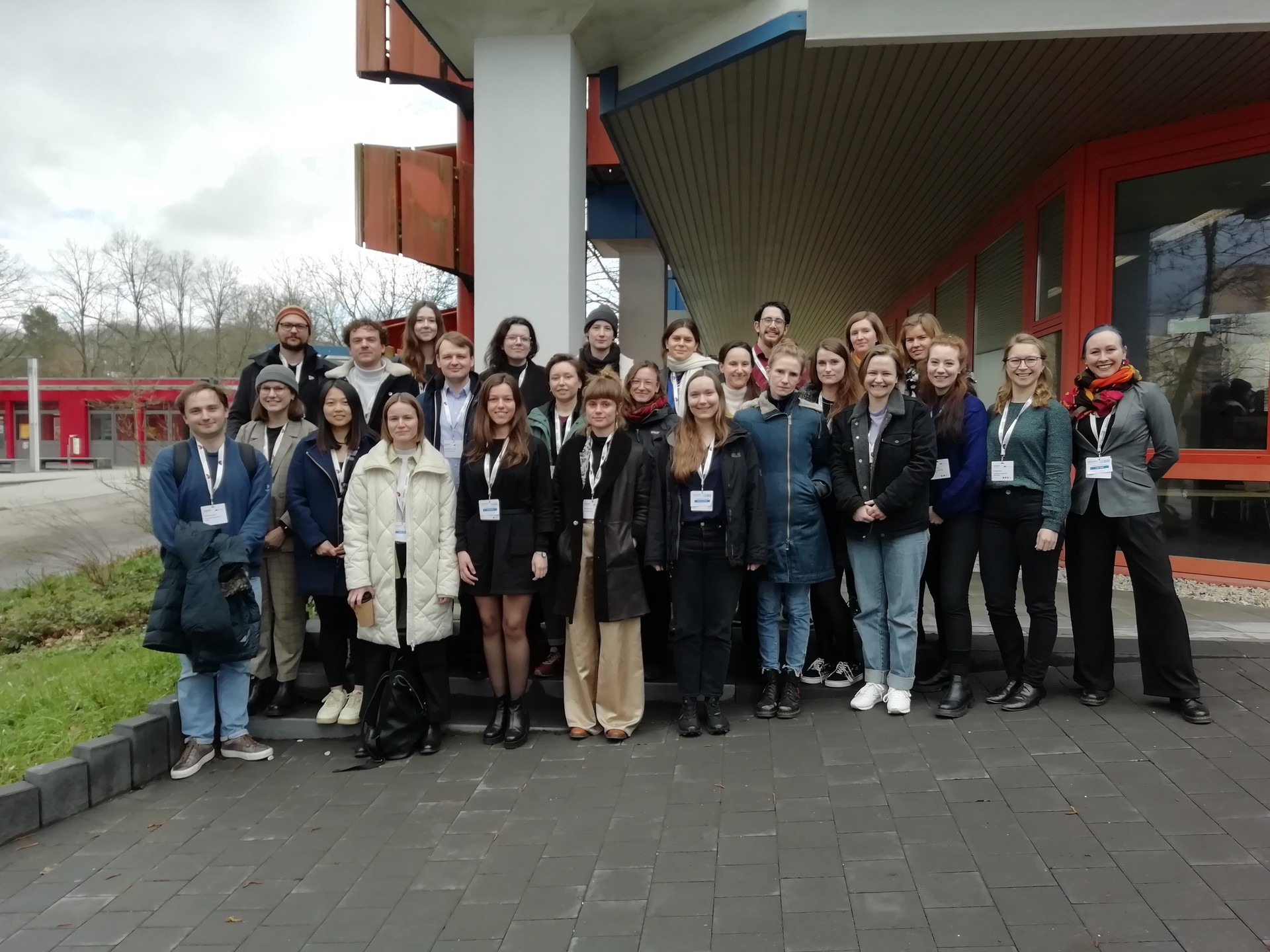
Gruppenfoto der DHd2023-Stipendiat:innen vor der Universität Trier.

Die Stipendiat:innen konnten im Gegenzug die Konferenz entweder auf Social Media begleiten oder haben im Anschluss an die Tagung jeweils einen Blogpost verfasst, der die breite Palette an Themen und Ansätzen auf der DHd dokumentiert. Nachfolgend findet sich eine Übersicht über die verschiedenen Blogposts mit den dazugehörigen Links:

  1. Noah Baumann, Wissenschaftsbloggen und der Aufruf zu „Open Humanities, Open Culture“
    Link zum Blogpost

  2. Anna-Lena Brunecker, Provenienzforschung im digitalen Zeitalter
    Link zum Blogpost

  3. Lena Ehlers, Die DHd2023 im Rückblick: Eindrücke und Erfahrungen aus Sicht einer Studentin
    Link zum Blogpost

  4. Vera Piontkowitz, Leipziger Forschung im Fokus: Eine Übersicht von Leipziger Beiträgen auf der DHd2023
    Link zum Blogpost

  5. Lukas Panzer, Illustrierte Digitial Humanities – Die Vorträge der DHd2023 visualisiert mit Stable Diffusion
    Link zum Blogpost

  6. Miriam Schirmer, Networking, Feedback und Inspiration. Meine Erfahrungen auf dem Doctoral Consortium der DHd23
    Link zum Blogpost

  7. Nadine Sutor, Von der Mittelmosel bis zum Maison du Savoir. Die DHd2023 in Trier und Belval
    Link zum Blogpost

  8. Nina Rastinger, Räumliche und thematische (Selbst-)Verortung der DHd2023. Ein Blick in die Metadaten des diesjährigen Book of Abstracts
    Link zum Blogpost

  9. Julian Stalter, KI-basierte Tools und Forschungsmethoden auf der DHd23 – eine Mindmap
    Link zum Blogpost

  10. Selina Galka, Die DHd 2023: Ein vielfältiges Programm
    Link zum Blogpost

  11. Svenja Guhr, Als Editorial Assistant beim neu gegründeten Journal of Computational Literary Studies. Ein Erfahrungsbericht
    Link zum Blogpost

  12. Maximilian Teich, Von Trier nach Passau. Eindrücke von der DHd23 – und Überlegungen für die nächste DHd-Konferenz
    Link zum Blogpost

Diese Blogposts in ihrer Themenvielfalt zeigen die Bandbreite der Methoden und Ansätze in den Digital Humanities im deutschsprachigen Raum. Die vielseitigen Beiträge der Stipendiat:innen sind ein wertvoller Beitrag zur Dokumentation Diskurse und Erlebnisse der DHd2023.

Helsinki Di­gital Hu­man­it­ies Hack­a­thon #DHH23

2023年8月9日 20:04

Helsinki Digital Humanities Hackathon #DH­H23 gathered students and researchers of humanities, social sciences, and computer science in May and June at the University of Helsinki. During a week and a half of intensive multi-disciplinary work, the groups applied digital methods to a variety of datasets, with the goal of solving research questions in the following themes:

  • Epistolary exchanges
  • Interactional dynamics of online discussion
  • Early modern images
  • Political polarisation in the parliament

The event was organised as an international summer school by the University of Helsinki and Aalto University, with a financial support by CLARIN ERIC – European Common Language Resources and Technology Infrastructure, and DARIAH ERIC – the Digital Research Infrastructure for the Arts and Humanities, and HIIT – Helsinki Institute for Information Technology.

The Hackathon participants were from 13 different countries. 60 people participated including 48 participants in thematic groups.

Overall organisers (4 persons)

Team leaders and consultants (15 persons)

Feeza Vasudeva, Postdoctoral Researcher, University of Helsinki

Participating thematic groups

1. Epistolary participation

The Epistolary participation group focused on the connections between letter-writing and the rise of literacy within the 19th century in Finland. By analysing two different datasets, CoCo dataset consisting of letter metadata from the period of the Grand Duchy of Finland, as well as Translocalis, a dataset made of Finnish newspapers’ readers’ letters from 1775 to 1885, the group discussed occupational sectors, epistolary literacy, travel patterns, as well as analysed the importance of bias in the datasets themselves.

View the poster here.

Members (12 persons): Alie Tacq, Anna Moschitta, Efthymios Kokordelis, Elias Mucha, Imama Alishova, Koldo Garai, Lilli Peura, Michele Stefani, Olof Falk, Ruxandra Gidei, Tetiana Shyshkina, Ville-Pekka Kääriäinen

2. Interactional dynamics of online discussion

The Interactional dynamics of online discussion group explored the ways in which a specific group of people interacts with one another as well as the outside world – focusing on a dataset of discussions on a forum of incels (involuntary celibate; people “who feel unable to find a sexual or romantic partner and express hatred towards those they blame for this”). They strived to find out how the members talk to each other, group themselves together, and the key differences between themselves and others they deem unfit to be part of the closed group.

View the poster here or visit the GitHub repository.

Members (10 persons): Selenia Anastasi, Yan Asadchy, Nina Eckertz, Annika Grützner-Zahn, Nina Jokirinne, Milja Ketoja, Kerstin Marki, Harri Haralds Matulis, Siyi Wang, Laura Chilla

3. Early modern images

The Early modern images group was the only one to focus on, as the name implies, images – particularly on the evolution of scientific illustrations during the 18th century. By analysing over 100,000 pages of images from the ECCO scientific collection, they showed the different ways in which particular genres of illustrations were used, while also noting how much the practice of illustrating evolved overtime and was closely tied with technological, social and cultural development.

View the poster here or visit the GitHub repository.

Members (10 persons): Mourad Boumlik, Prolet Decheva, Lenka Kalvodová, Linda Nurmi, Ánh Dương Nguyễn, Magdalena Piotrowska-Grot, Telma Peura, Reetta Sippola, Aleksi Suuronen, Ari Vesalainen

4. Political polarisation in the parliament

The Political polarisation in the parliament group strove to explore the phenomenon of political division by discovering the differences in different countries’ parliamentary speeches. Using the ParlaMint corpora of parliamentary debates, with a specific focus on Great Britain, Hungary, Slovenia and Ukraine, they analysed how different topics of debate are affected by polarisation, its temporal changes, as well as how well these kinds of trends can be measured computationally.

View the poster here or visit the GitHub repository.


Members (12 persons): Anna Krvvenko, Ari-Heikki Rintaniemi, David Bordon, Ekaterina Glazacheva, Katia Meden, Mark Mets, Nikoletta Jablonczay, Paul Pope, Pontus Hedlund, Topi Ranta, Vadym Kuzyak, Vid Klopčič

Feedback

According to the feedback form, participants had a great time working together on an interdisciplinary project with people from all over the world and of differing backgrounds. Moving forward, it is apparent that still greater attention needs to be devoted to resolving organisational matters such as communication about different roles in groups and ensuring alignment among individuals regarding different aspects of group work (for example, clearer instructions with respect to division of labour). It is important to note that the Hackathon is an event that is constantly improving largely thanks to the feedback we get from participants, so every positive note as well as constructive criticism are all taken into consideration.


More information about #DHH23 can be found on Instagram and Twitter!

Registration for the BSSDH 2023 is open

作者Anda
2023年5月24日 18:09

Registration for the Baltic Summer School of Digital Humanities 2023 is open

Students, researchers, and GLAM professionals are welcome to enrol in the Baltic Summer School of Digital Humanities: Discourse Analysis and Digital Literary Studies, which will be held on 25-28 July 2023 at the National Library of Latvia (NLL) and Online.

The Baltic Summer School of Digital Humanities is an international intensive continuing education programme that provides the opportunity to researchers, educators, and students of humanities and social sciences, as well as archive, library and museum professionals to master various digital research skills, from data wrangling and analysis to visualisation.

In 2023, the school is organised for the fifth time and provides the opportunity to learn the basics of data analysis and visualisation with Python programming language, master web harvesting skills, and learn to use Tableau and Gephi platforms for visualisation. Particular areas of interest this year are discourse analysis, digital literary studies, audiobooks, and DH infrastructures. The full programme can be viewed on the website Digital Humanities in Latvia.

The school is organised as a hybrid event on-site and remotely. The fee for completing the full course is EUR 30 for both on-site and online participants; keynote lectures will be accessible for free and streamed on the NLL’s Facebook and YouTube channels. The working language is English.

Registration form for the summer school is available here:

http://www.digitalhumanities.lv/bssdh/2023/registration

The Baltic Summer School of Digital Humanities is organised in cooperation with the National Library of Latvia, the Institute of Literature, Folklore and Art of the University of Latvia, and the University of Latvia. The programme is supported by the project “Towards Development of Open and FAIR Digital Humanities Ecosystem in Latvia” (No. VPP-IZM-DH-2022/1-0002), which is implemented within the framework of the National Research Programme “Digital Humanities” and funded by the Latvian Council of Science of the Ministry of Education and Science.

For more information contact:

Anda Baklāne
National Library of Latvia
Head of Digital Research Services
E-mail: dh@lnb.lv
http://www.digitalhumanities.lv/bssdh

DHNB on Mastodon (Social Network)

2023年3月2日 16:56

Follow us on Mastodon!

Digital Humanities in the Nordic and Baltic Countries is now also on Mastodon.

What is Mastodon, you ask? Wikipedia says it “is free and open-source software for running self-hosted social networking services. It has microblogging features similar to Twitter, which are offered by a large number of independently run nodes“.

DHNB has found its home on the Fedihum node: Federated Digital Humanities, which is hosted by the Association for Digital Humanities in the Geman Speaking Countries (DHd). You can follow us @dhnb@fedihum.org.

For the #DHNB2023 conference, our social media team will publish content on our Mastodon and Twitter accounts. We use Moa to link our accounts and publish content in parallel. So, whichever platform you prefer, you can follow us and keep yourself up-to-date with everything #DigitalHumanities in the Nordic and Baltic Countries and #DHNB2023!

How to join the party

Create an account on Mastodon. You can choose a node or instance that fits you best or join us at @fedihum.org. Search for @dhnb@fedihum.org and follow. For the DHNB2023 conference, we use the hashtag #DHNB2023. Tweet about presentations, show us your digital humanities research, and join our discussions and threads!

Conference Program

2023年2月9日 15:33

Program Online

We published the DHNB2023 conference program a while ago, but some smaller changes were necessary. You can check out the up-to-date program on our website or ConfTool.

Build your Conference Agenda

To build your personalised agenda, once you have registered for the conference, you can add the sessions you are interested in by clicking on the plus sign ⊕ in the upper right corner of each session.

Themed Tracks and Open Tracks

DHNB2023 is a themed conference centred around three aspects of Sustainability: Environment, Community, and Data. Many papers address these themes explicitly, while others focus more on methods and research objects. To help navigate the program, we have used colours and session codes to indicate themes and gathered them into themed tracks which use the same Zoom room throughout the conference:

Environment Track

  • Sessions have a red colour,
  • They are coded ET01, ET02, ET03, etc.
  • They are streamed in the Environment Track

Community Track

  • Sessions have a yellow colour,
  • They are coded CT01, Ct02, etc.
  • They are streamed in the Community Track

Data Track

  • Sessions have a dark blue colour,
  • They are coded DT01, DT02, DT03, etc.
  • They are streamed in the Data Track

Open Tracks: Methods and Objects

  • Sessions have no colour,
  • They are coded OT01, OT02, OT03, etc.
  • They are stremed in the Open Track

Open Track: Political Discourse Analysis

  • Sessions have a green-blue colour,
  • They are stremed in the Political Discourse Track

Show-and-Tell Reels

All Show and Tell presentations will be streamed in their track. Show and Tells are short presentations or pitches that are pre-recorded and thematically assembled. They will loop throughout the afternoon with ample opportunity to interact with the presenters and their projects. All Show and Tells will be featured with visual material on the DHNB website.

Keynote Speakers announced!

2023年1月23日 18:46

Keynotes have been confirmed for DHNB 2023.

Check out more information on the Keynote speaker webpage!

The events will be held on-site at the University of Oslo Library, the University of Bergen Library, and The Greenhouse at the University of Stavanger.

All keynotes will also be live-streamed for online participants.

Register for the DHNB2023 conference on ConfTool: https://www.conftool.org/dhnb2023/.


Conference Registration is now open!

2023年1月23日 18:44

The DHNB 2023 Conference is now open for registration. The Conference will be held online and will feature a variety of topics on our theme of Sustainability: Environment, Community, and Data in the digital humanities. Create an account and register on ConfTool to secure your spot!

The Program Committee and the Organising Committee are working on drafting a complete conference program. A preliminary program will be published on our website by the end of January 2023. Stay tuned!

DHNB2023 Workshops Published – Registration Open!

2023年1月5日 20:46

Workshops Published

The DHNB 2023 Conference workshops have been published and are available to view on the DHNB2023 Conference workshops webpage. The Conference offers a mix of both in-person and online workshops, and a range of topics will be covered. To sign-up follow the instructions on the specific Conference’s page.

The Program Committee and the Organising Committee are working on drafting a full conference program. A preliminary program will be published on our website by the end of January 2023. Stay tuned!

DHNB2023 Notifications to Authors – Program Committee

2022年12月16日 18:10

Notifications Sent to Authors

On December 15th, notifications were sent to all authors who submitted proposals to DHNB2023. We received 85 submissions for long papers, panels, show-and-tell presentations and workshops. All accepted proposals will be published in the Book of Abstracts. All authors of accepted proposals will also be invited to submit full papers for the Conference Proceedings. As in previous years, we are publishing the proceedings with CEUR workshop series. Detailed instructions and the timeline for submissions, reviews, and production of the proceedings will be communicated to authors on December 20th 2022.

The Program Committee and the Organising Committee are now working on drafting the program. A preliminary program will be published on our website by the end of January 2023. Stay tuned!

Program Committee

The DHNB2023 Program Committee is chaired by Annika Rockenberger (Norway).

The members of the PC are, in alphabetical order:

  • Emma Aadland (Norway)
  • Anda Baklāne (Latvia)
  • Peder Gammeltoft (Norway)
  • Sofie Gilbert (Norway)
  • Finn Arne Jørgensen (Norway)
  • Lars Kjær (Denmark)
  • Torsten Roeder (Germany)
  • Juliane Tiemann (Norway)
  • Costanza Navarretta (Denmark)
  • Jurgita Vaičenonienė (Lithuania)

Submit On-site, Hybrid, or Online Workshops for DHNB2023

2022年11月8日 03:41

SUBMIT WORKSHOPS UNTIL 15 NOVEMBER!

Workshops can be submitted for DHNB2023 until Tuesday, 15 November 2022, 23:59 CET.

Submit abstracts via ConfTool, or send your proposal to dhnb2023@dhnb.eu. Read the call for submissions for requirements and specifications.

Workshops

  • for you who want to have a local, in-person event adjacent to the virtual conference
  • for you who want to have a hybrid (in-person and online) event
  • for you who want to have a fully online event
  • for you who want to teach a digital tool, method, or other relevant research activity
  • for DHNB working groups to gather and present their work
  • for any other format that addresses or embodies aspects of community building and maintenance in a local setting
  • during March 2023, before and/or after the conference
  • 400–600 words abstract

Still unsure? Talk to us!

Sign up for the DHNB Slack and join the #dhnb2023 channel.

Or write to us at dhnb2023@dhnb.eu.

Call for Proposals to Host DHA2023

2022年9月15日 14:02

Expressions of Interest are now open to host the 2023 Digital Humanities Australasia (DHA) Conference in Australia or New Zealand.

The Executive Committee of the Australasian Association for Digital Humanities (aaDH) invites proposals to host the Digital Humanities Australasia (DHA) Conference in Australia or New Zealand in 2023. DHA is the major conference of the aaDH, which was formed in March 2011. 

Prior DHA Conferences have been 2-4 days in duration. The host organisation is welcome to design the conference program and scope in a way best suited to their local context.

There are normally parallel sessions, a small number of plenary presentations, workshops, tutorials, posters and a postgraduate support event. A meeting of the aaDH committee will occur during the conference, and lunchtime slots are normally used for meetings of associated working groups or sub-committees.

The aaDH Executive Committee provides guidance and assistance to the host institution and can advise on aspects relating to the conference website, facilities, book of abstracts, and any social events the local host thinks would be appropriate.  

The conference is self-financed through conference fees and any other financial contributions that the local organiser is able to arrange. aaDH expects no payment from the local host in the event that the conference makes a profit, but no financial support is provided for the conference by aaDH, except in relation to possible awards, such as named prizes and a bursaries for postgraduate students. 

The local organiser is expected to set (and verify) three levels of fees: members of aaDH, non-members, and students (negotiable). 

There should be a clear process for peer-reviewing paper, poster and panel proposals.

Proposals should include:

  • Proposed dates (it is anticipated the conference will be between August – October 2023, however, there is some flexibility)
  • Overview of facilities at the host institution
  • Overview of local institutional engagement and support which the host institution expects to be available
  • Sponsorship
  • Indicative local organising committee
  • AV/Computer, Internet access/wireless facilities
  • Social events, including the conference banquet 
  • Options for accommodation (with provisional costs) 
  • Travel information and advice 
  • A provisional budget, with a provisional registration fee 
  • Options for payment (credit card, foreign currency etc) by participants

Shortlisted hosts will be invited to meet with the aaDH Executive Committee to discuss their proposal. Budgets and other information from previous conferences, where available, can be made available on request, for planning purposes.

For further information, proposers are invited to discuss their proposals informally with members of aaDH Executive Committee including Vice-President Tully Barnett tully.barnett@flinders.edu.au or Communications Manager Tyne Sumner tdsumner@unimelb.edu.au

Proposals should be submitted to the Committee (via one of the above email addresses) by 28 October 2022.

#DH2023: Collaboration as Opportunity

2023年7月21日 22:49

It was a busy week Graz, Austria, from 9th-15th July as the international community of Digital Humanities scholars gathered at the University of Graz and Messe Congress Graz for the 2023 Alliance of Digital Humanities Organizations (ADHO) Annual Conference #DH2023! The theme of this year’s conference was ‘Collaboration as Opportunity’, and we left feeling inspired by all the potential opportunities for collaboration and research outlined throughout the week.

Several pre-conference workshops took place on 9th, 10th, and 11th July, including an Intavia workshop entitled “Smashing the Silos! The Future of Cultural Heritage Information and Visualization” which was designed to reflect on novel developments and challenges in the field of cultural heritage information and visualization. An OpenMethods workshop entitled “Amplifying Unheard Voices in Digital Humanities: an OpenMethods Edit-a-thon” took place which invited Digital Humanists to explore the OpenMethods metablog as an innovative publication forum to strengthen the representation of traditionally underrepresented languages.

Our President of the Board of Directors, Toma Tasovac, and Anne Baillot fulfilled their roles as Programme Committee Chairs of #DH2023, and DARIAH shared a booth with CLARIN-ERIC in the breakout space, where we discussed what role DARIAH plays as European Research Infrastructure Consortium for the DH community, how to join its activities or how to use its services, such as DARIAH Campus and SSH Open Marketplace with conference participants. 

The opening keynote address was delivered by Professor Sarah Kenderdine (DARIAH Scientific Board member) and was entitled “Two-Fold Revolutions: Computational Museology in the Age of Experience” and covered panoramas and stereoscopic photos, Shaw’s virtual museum (1989), and on to the future with digital twins, text-to-image generators, and deepfakes.

DARIAH was well represented across the week: DARIAH Director Agiatis Bernardou chaired and presented several sessions, former Directors Jennifer Edmond and Frank Fischer also spoke, chaired and presented posters during the Thursday evening poster session, while the Bibliographical Data DARIAH-EU Working Group presented their recent findings in a panel entitled “Fostering Collaboration to Enable Bibliodata-driven Research in the Humanities”. Training and Education Officer Vicky Garnett chaired the Thursday morning panel on “Collaboration”, while European Project Officer Laure Barbot led the Tuesday pre-conference workshop entitled “Creating a DH workflow in the SSH Open Marketplace”.

The closing keynote address was delivered by Claire Fernandez (European Digital Rights) “Contesting Power in the Digital Age: The Role of Civil Society in Europe” and prompted a stimulating discussion during the Q&A before the conference’s closing remarks, in which the fantastic organising committee, hosts, and volunteers who made #DH2023 possible were thanked with a standing ovation.

Despite the busyness of the week, we were fortunate to find time for the Conference Banquet at Schlossberg which treated us to some beautiful sunset views of Graz, and we also enjoyed delicious vegan ice cream to counteract the high temperatures throughout the week. We left the week with an immensely positive sense of the opportunities afforded by collaboration and communication between DH scholars and beyond, and are already looking forward to #DH2024, which will be held in Washington DC, with the theme of “Reinvention & Responsibility” from August 6-9th, 2024! 

❌