普通视图

Received before yesterday

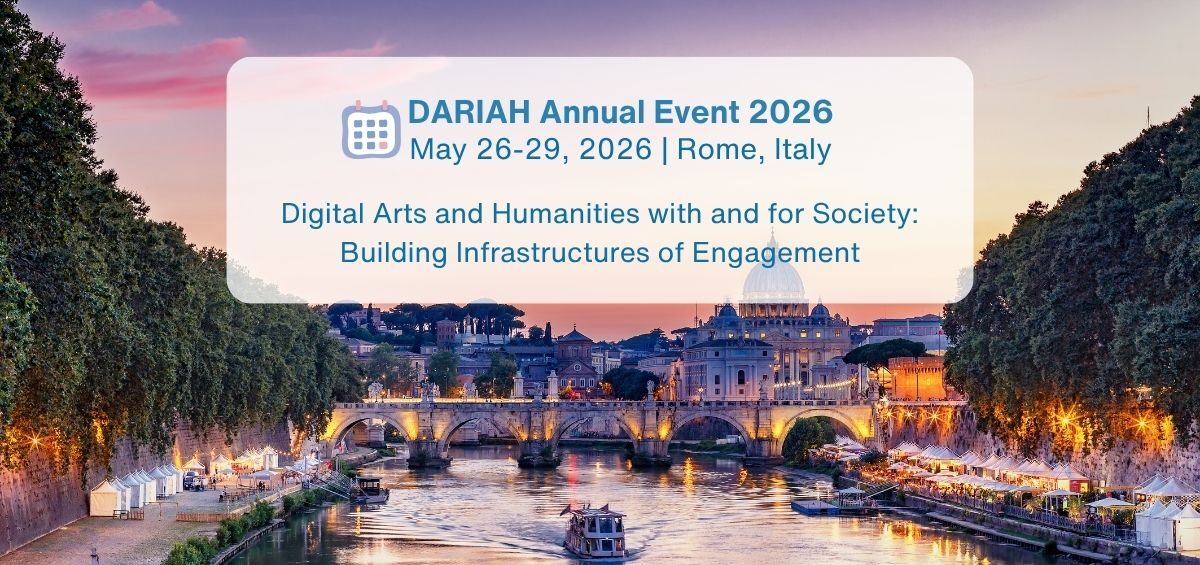
DARIAH Annual Event 2026: Call for Papers is now open

2025年11月18日 22:28
 
We are happy to inform you that the call for papers for the DARIAH Annual Event 2026 on the topic of Digital Arts and Humanities With and For Society: Building Infrastructures of Engagement is now open! The deadline for submitting contributions is December 22.
 
This year we seek to explore how digital, social and institutional infrastructures can support engaged research, and nurture generosity, participation and shared creativity in the digital arts and humanities.

We welcome contributions in the form of:
  • Papers
  • Panels
  • Posters and Demos

The 2026 DARIAH Annual Event is planned to take place on May 26th-29th in Rome, Italy. May 26th will be a day for DARIAH internal meetings, followed by the main conference on May 27th to 29th.
 
Find all information on the event at https://annualevent.dariah.eu/ 
More information on the Call for Papers at https://annualevent.dariah.eu/call-for-papers/ 
If you have any questions or comments, please do not hesitate to get in touch with us at annualevent@dariah.eu. 

BALTIC SUMMER SCHOOL OF DIGITAL HUMANITIES 2024

作者Anda
2024年5月10日 15:05

Students, researchers, and GLAM professionals are welcome to enroll in the Sixth Baltic Summer School of Digital Humanities:  Large Language Models and Small Languages, which will be held on 22-26 July 2024 at the National Library of Latvia (NLL) in Riga and online.

Register here: https://www.digitalhumanities.lv/bssdh/2024/registration/

This year, participants will have the opportunity to learn text processing and data visualization using the Python programming language, led by researchers from the National Library of Latvia and faculty from the University of Latvia and Riga Technical University, Uldis Bojārs and Valdis Saulespurēns. The curriculum will spotlight the capabilities and research applications of large language models. Andres Karjus, a researcher specializing in computer linguistics and cultural analytics at the University of Tallinn’s CUDAN Open Lab, will showcase the efficiency and speed with which these sophisticated language models can conduct text annotation and analysis, surpassing the output of earlier technological generations. Līva Rotkale, a philosopher and docent at the University of Latvia, will share her insights on formulating effective inquiries for the ChatGPT language model, focused on the needs of humanities researchers and students.

We will also discuss how the development of natural language processing tools and large language models is progressing for smaller languages. Presentations will be made by Javier de la Rosa, a researcher from the Artificial Intelligence Laboratory of the National Library of Norway, who will talk about the development of a large language model for the Norwegian language, as well as by researchers of the Latgalian language Sanita Martena, Ilga Šuplinska, and Antra Kļaviņa, who will introduce the digital resources for the Latgalian language. A separate session will be dedicated to text morphological and syntactic annotation tools, which are particularly important when working with morphologically rich languages (session led by Normunds Grūzītis, a lead researcher at the Artificial Intelligence Laboratory at the Institute of Mathematics and Computer Science of the University of Latvia).

Focusing on the use of artificial intelligence in image processing, the special guest for BSSDH 2024 will be the researcher and artist Mar Canet Solà, who will demonstrate the Collection Space Navigator – a tool that provides the ability to examine multidimensional image data from various perspectives. This topic could be of particular interest to specialists from memory institutions who oversee the creation and research of digital image collections.

The school is organised as a hybrid event on-site and remotely. The fee for completing the full course is EUR 40 for both on-site and online participants; keynote lectures will be accessible for free and streamed on the NLL’s Facebook and YouTube channels. 

The working language is English.

The Baltic Summer School of Digital Humanities is organised in cooperation with the National Library of Latvia, the Institute of Literature, Folklore and Art of the University of Latvia, and the University of Latvia. 

Supporters:

Project “Towards Development of Open and FAIR Digital Humanities Ecosystem in Latvia” (No. VPP-IZM-DH-2022/1-0002), National Research Programme “Digital Humanities” 

Common Language Resources and Technology Infrastructure CLARIN, CLARIN-LV

For more information contact:

Anda Baklāne
National Library of Latvia
Head of Digital Research Services
E-mail: dh@lnb.lv
http://www.digitalhumanities.lv/bssdh

Virtual Lectures (Free): “Scholarly Editing: Fostering Communities of Recovery” (04/04/24 and 04/08/24)

2024年3月28日 22:03

Scholarly Editing is an open-access, peer-reviewed annual that fosters multiple communities of recovery. The journal seeks to amplify contributions from and about Black, Latinx, and Indigenous peoples; Asian Americans and Pacific Islanders; women; LGBTQ+ individuals; and peoples and cultures of the Global South. A public-facing publication platform, the journal welcomes contributions from all custodians of knowledge, including academics from all disciplines and at any career stage, K-12 teachers and students, community groups, collectors, and local genealogists. In addition to textual scholarship theory and praxis, we welcome interviews, oral histories, creative works of “rememory,” and the decolonizing of artistic works, archives, records, and editions for the discoverability of underrepresented stories and artifacts.

In a two-part event series, two of Scholarly Editing’s editors and two of its contributing authors will explore the nature and impact of the journal’s expanding content and communities of journal editors, readers, contributors, and genres. In the second part, they will also invite you to engage in project planning exercises similar to those asked of authors, peer reviewers, and other collaborators.

Part one, which will be held on April 4 at 11:00 AM EDT, will welcome Co-Editor in Chief Noelle Baker and author Artist Marcia X. Baker will introduce the journal’s philosophy and infrastructure, and will discuss how these components have been essential to cultivating communities of recovery. Following, the Artist Marcia X will share their art, demonstrating how their recovery work evolved as a result of engaging with the Scholarly Editing community. To register for part one, please visit https://elaboratories.org/event/scholarly-editing-fostering-communities-of-recovery-part-1/.

Part two, which will be held on April 8 at 1:30 PM EDT, will welcome Essays Section Co-Editor Raquel Baker and author Bianca Swift. Together, they invite you to workshop your scholarship goals and to apply Scholarly Editing’s community-driven philosophy to your own work. To register for part two, please visit https://elaboratories.org/event/scholarly-editing-fostering-communities-of-recovery-part-2/.

Sincerely,

Katie Blizzard (she/her/hers)

Managing Director, eLabs

kblizzard@virginia.edu | 434-227-7284

Virtual Lecture (Free): “Historical Social Network Analysis: The Apprenticeship Networks of London Brewers, 1530-1800”, Dr. Harvey Quamen (04/04/24)

2024年3月28日 21:43

Harvey Quamen, Associate Professor of English and Digital Humanities and Academic Director of the Digital Scholarship Centre at the University of Alberta, will walk us through the intricate web of relationships from 1530 to 1800 within the Brewing Guild’s apprenticeship program, a key component of London’s beer and brewing history. By analyzing nearly 6,000 records from the Worshipful Company of Brewers and integrating other historical data sources, such as marriage, birth, death records, and criminal proceedings, Quamen unveils the dynamic interplay between apprentices, master brewers, and the broader societal shifts that shaped the industry over 270 years. Through this talk, we aim to shed light on the historical social networks that fueled an industry and explore methodological innovations in digital humanities research.

This talk will be delivered in a hybrid model. Participants can register here to join the live session in the Digital Scholarship Centre in Cameron Library, 2nd Floor, or via Zoom.
For in-person session, please use the register here. To participate virtually, please register via Zoom using the link here.

For any questions, please contact Andrew Ip at cip@ualberta.ca.

ANDREW IP, BA, MLIS (he/him)
Academic Library Resident

UNIVERSITY OF ALBERTA
Collection Strategies Unit
5-25 Cameron Library
Edmonton, AB Canada T6G 2J8

Virtual Lecture (Free): “Spatial Humanities & Deep Mapping: New Approaches to Understanding the Historical Geographies of the English Lake District”, Dr. Ian Gregory (03/04/24)

2024年3月1日 06:12

The Institute for Historical Studies in the Department of History invites you to:
“Spatial Humanities & Deep Mapping: New Approaches to Understanding the Historical Geographies of the English Lake District”

A talk by Dr. Ian Gregory
Distinguished Professor of Digital Humanities in the Department of History; and Co-Director, Centre for Digital Humanities
Lancaster University
https://www.lancaster.ac.uk/staff/gregoryi/

Mon. March 4. 12-1:30pm CST.
GAR 4.100 & Zoom.
Info/Register: bit.ly/3T7tEFj

Extracting geographical information from textual sources and using them to present new knowledge from these sources are major challenges within the spatial and digital humanities. This paper will present a variety of approaches to doing this based on a corpus of writing about the English Lake District from the seventeenth to the nineteenth centuries. The Lake District is an area with a rich tradition of landscape writing most famously by William Wordsworth and the other Lake Poets. This paper will present new methods on how these texts can be explored, represented and understood.

Ian Gregory is Distinguished Professor of Digital Humanities in the Department of History at Lancaster University where he also co-directs Lancaster’s Centre for Digital Humanities. His career started using quantitative sources to study the geographies of topics such as mortality and poverty in 19th century Britain, leading to the development of a field known as Historical GIS. More recently, his interests have moved into how textual sources can be analysed using geospatial technologies. The methods develop have been applied to a wide range of topics including, in particular, the study of writing about the English Lake District. This work has attracted funding from a wide range of sources including the European Research Council, the UK’s Arts & Humanities Research Council, and the Economic & Social Research Council (most recently for grant partnering with the US National Science Foundation), the Leverhulme Trust, and others. He has authored six books, most recently Deep mapping the Literary Lake District: a geographic text analysis (with Joanna Taylor), edited two volumes including the Routledge Companion to Spatial History (with Don DeBats and Don Lafreniere), and around 100 other publications.

The speaker will join virtually via Zoom for this talk and discussion. Guests may join virtually online by registering at the link below, or in-person in GAR 4.100 with RSVP.

In-person RSVP: cmeador@austin.utexas.edu. Venue: Garrison Hall 4.100. Light lunch provided.

Virtual attendance via Zoom: Please register to receive the access link at https://utexas.zoom.us/meeting/register/tJArf-CsqT4pGNBnBCrooRT4dDiiuv0e2lxA

Virtual Event (Free): International Women’s Day Wikipedia Editathon (03/03/24 and 03/08/24)

2024年2月28日 04:10

Hi all,

Are you ever frustrated by what is missing from Wikipedia? Are you interested in women’s history and queer history in Canada? Join us for a 2-part Wikipedia Editathon in celebration of International Women’s Day.

This event is offered as a partnership between the Lesbian and Gay Liberation in Canada project, The Humanities Data Lab, and the University of Ottawa’s DHToolbox series. If you are new to editing Wikipedia, join us for the Training and Practice session, otherwise feel free to come out just for the Drop-In Editathon. We’ll have snacks, a support team, research resources, and most importantly, lots of pages that could use your help.

Register here: http://bit.ly/uO-wiki-2024


DATES AND TIMES:

Training & Practice Editathon:

Monday, March 4th 2024

Time: 1pm-4pm EST


Drop-in Editathon:

Friday, March 8th 2024

Time: 12pm – 4pm EST


LOCATION:

In person:

The CreatorSpace

University of Ottawa


Virtual:

The Zoom link will be sent to people who register

This event is the English-language follow up to our French editathon last October. The event will be in English, but we are a bilingual team: N’hésitez pas à vous joindre à nous pour travailler ensemble en français.

A special thanks to the Social Science and Humanities Research Council of Canada and the Ministry of Heritage for their support.

See you soon!

Connie

______________________
Constance Crompton (she/elle)
Canada Research Chair, Digital Humanities
Professeure agrégée | Associate Professor
Directrice du Labo de données en sciences humaines | Humanities Data Lab Director

Département de communication | Department of Communication
Université d’Ottawa | University of Ottawa
@clkcrompton  | humanitiesdata.ca | @humanitiesdata
En savoir plus sur le SHN à uOttawa | Curious about DH at uOttawa? dhsite.org

Virtual Keynote (Free): “Reimagining a Collaborative, Sustainable Student-Focused Digital Humanities Initiative”, UH@DH (03/05/24)

2024年2月28日 04:00

The UH Digital Humanities Core facility, a partnership between UH Libraries and the HPE-Data Science Institute, is thrilled to bring Dr. Bryan Carter, Director of the Digital Humanities Center at University of Arizona, to UH on Monday, March 4, and Tuesday, March 5, for a series of engagements with the Core’s key partners. This visit is part of the DH Core’s 2024 DH@UH program.

We hope you will join us as Dr. Carter delivers this program’s inaugural keynote address, “Reimagining a Collaborative, Sustainable Student-Focused Digital Humanities Initiative”  in the Rockwell Pavilion, M.D. Anderson Library, at 11:00 AM cst on Tuesday, March 5th. For those of you unable to join us in person, we are offering the opportunity to livestream Dr. Carter’s talk RSVP here.

Regards,

Linda

Linda García Merchant, PhD (she/her/ella)
Public Humanities Data Librarian | Digital Humanities Core Facility
Research Services, University Libraries
University of Houston
Office (713) 743-8743
lgarciamerchant@uh.edu
https://uh.edu

Virtual Workshop (Free): “Critical Toolkits for Crowdsourcing and Community Engagement” (03/21/24)

2024年2月28日 00:22

RSVP here: https://elaboratories.org/event/critical-toolkits-for-crowdsourcing-and-community-engagement-a-free-virtual-workshop/.

Are you interested in developing a digital project for crowdsourcing and community engagement? Join eLaboratories for a free, virtual 90-minute workshop that explores the process of organizing programs and digital projects that invite school and community groups to help enrich digitized archives.

Led by Denise Burgher and Jim Casey (Center for Black Digital Research, Penn State), this workshop is designed for teams who may wish to develop crowdsourcing transcription projects to invite communities to participate in the work of developing electronic editions. Burgher and Casey will cover the basics by sharing a series of resources from Douglass Day, including organizing kits, outreach materials, and strategies for curricular engagement. Along with exploring the most popular crowdsourcing platforms, there will be time in the workshop to start thinking practically about developing your projects and programs.

Virtual Workshop (Free): “Introduction to CollectionBuilder-SHEETS” (03/06/24)

2024年2月28日 00:19

RSVP here: https://elaboratories.org/event/introduction-to-collectionbuilder-sheets-a-free-virtual-workshop/.

Learn how to use CollectionBuilder-Sheets (SHEETS) to create a free digital collection website that encourages browsing and contextualizing items through timelines, maps, and word cloud visualizations. No programming experience or software installation is required for this workshop; beginners from any background are welcome! SHEETS, the newest CollectionBuilder template, enables users to build digital collections directly from a Google Sheet of metadata. The first part of the workshop will review how to use SHEETS’ built-in development mode to prototype, test, and share a draft of your digital collection site. Next, participants will learn how to publish a permanent digital collection site using SHEETS. There will be demo metadata and digital objects available to use, but participants are also welcome to bring their own metadata and objects to work with. Before attending the workshop, we encourage you to view examples of CollectionBuilder projects in our CollectionBuilder Examples collection: https://collectionbuilder.github.io/cb-examples/.

This workshop will be taught by Julia Stone (University of Idaho), Olivia Wikle (Iowa State University), and Evan Peter Williamson (University of Idaho).

Virtual Workshop (Free): “Ethical Community Archiving: Tools for Meaningful Partnerships” (03/04/24)

2024年2月28日 00:14

RSVP here: https://elaboratories.org/event/ethical-community-archiving-tools-for-meaningful-partnerships/.

This workshop aims to equip participants with the tools and resources necessary for fostering partnerships and community relations to advance preservation efforts of marginalized collections.

Drawing from the experiences of the Recovering the US Hispanic Literary Heritage Program, this workshop will explore strategies for collaborating with individuals and community organizations to ethically digitize, preserve, and disseminate historical materials. Through a lens of care and post-custodial approaches, the program will share its methodologies for identifying and making these historical resources accessible.

Central to this approach is the recognition of the vital role that Latina/o communities play in knowledge production, nation-building, and community activism. By prioritizing best practices, the program seeks to affirm and support community contributions. Rather than replicating traditional archival methods, the program focuses on creating inclusive spaces for mutual knowledge exchange.

Facilitated by Drs. Gabriela Baeza Ventura and Carolina Villarroel, participants will gain insights into the tools and resources utilized by the Recovery Program and the USLDH in initiatives such as Community Archiving Day, the Young Scholars Program, and various digital projects.

Registration for the BSSDH 2023 is open

作者Anda
2023年5月24日 18:09

Registration for the Baltic Summer School of Digital Humanities 2023 is open

Students, researchers, and GLAM professionals are welcome to enrol in the Baltic Summer School of Digital Humanities: Discourse Analysis and Digital Literary Studies, which will be held on 25-28 July 2023 at the National Library of Latvia (NLL) and Online.

The Baltic Summer School of Digital Humanities is an international intensive continuing education programme that provides the opportunity to researchers, educators, and students of humanities and social sciences, as well as archive, library and museum professionals to master various digital research skills, from data wrangling and analysis to visualisation.

In 2023, the school is organised for the fifth time and provides the opportunity to learn the basics of data analysis and visualisation with Python programming language, master web harvesting skills, and learn to use Tableau and Gephi platforms for visualisation. Particular areas of interest this year are discourse analysis, digital literary studies, audiobooks, and DH infrastructures. The full programme can be viewed on the website Digital Humanities in Latvia.

The school is organised as a hybrid event on-site and remotely. The fee for completing the full course is EUR 30 for both on-site and online participants; keynote lectures will be accessible for free and streamed on the NLL’s Facebook and YouTube channels. The working language is English.

Registration form for the summer school is available here:

http://www.digitalhumanities.lv/bssdh/2023/registration

The Baltic Summer School of Digital Humanities is organised in cooperation with the National Library of Latvia, the Institute of Literature, Folklore and Art of the University of Latvia, and the University of Latvia. The programme is supported by the project “Towards Development of Open and FAIR Digital Humanities Ecosystem in Latvia” (No. VPP-IZM-DH-2022/1-0002), which is implemented within the framework of the National Research Programme “Digital Humanities” and funded by the Latvian Council of Science of the Ministry of Education and Science.

For more information contact:

Anda Baklāne
National Library of Latvia
Head of Digital Research Services
E-mail: dh@lnb.lv
http://www.digitalhumanities.lv/bssdh

Conference Registration is now open!

2023年1月23日 18:44

The DHNB 2023 Conference is now open for registration. The Conference will be held online and will feature a variety of topics on our theme of Sustainability: Environment, Community, and Data in the digital humanities. Create an account and register on ConfTool to secure your spot!

The Program Committee and the Organising Committee are working on drafting a complete conference program. A preliminary program will be published on our website by the end of January 2023. Stay tuned!

Recap of the Annual Event 2023: Cultural Heritage Data as Humanities Research Data?

2023年7月7日 23:14

The DARIAH-EU Annual Event 2023 took place in Budapest, Hungary, from June 6th – 9th 2023. The topic of this year’s event was Cultural Heritage Data as Humanities Research Data? This was a busy annual event, as we welcomed more than 200 participants from over 30 countries around the world. The event was held in-person with additional streaming of the main plenary room across all three days.

Theme of Cultural Heritage Data as Humanities Research Data?

Collections in libraries, archives and museums have been at the heart of humanities research for centuries. However, with the current focus on data-driven research, data management plans and the research data lifecycle, in what ways do we need to think differently about cultural heritage collections as data? Inspired by the proclamation “cultural heritage data is humanities research data”, this year’s DARIAH Annual Event explored what this means in practice. What does it mean for cultural heritage institutions to provide access to their ‘collections as data’? Do we need to think of different workflows for digitised and born-digital datasets? Can we think of a humanities research data continuum? These are only some of the questions that we discussed, debated, and answered at the 2023 DARIAH Annual Event.

Three themes were proposed for the 2023 Annual Event to inspire submissions:

1. Sustainable workflows for data management and curation

2. Imagining experimental data spaces for cultural heritage

3. Advancing digital methods for the analysis of cultural heritage

For more pictures of the event, please visit our Flickr album.  

Programme

The 2023 event kicked off with meetings of DARIAH bodies, followed by three conference days with panels, papers, keynote speeches, performances and poster sessions. Specifically, the programme of the event consisted of:

  • A keynote lecture and keynote panel on the event’s theme: an opening lecture by Thomas Padilla (Deputy Director at Archiving and Data Services of the Internet Archive) entitled ‘A Mutualistic View of AI in the Library or a Continuation of Craft’ and a closing keynote panel entitled ‘DARIAH Data Spaces Dialogue: Imagining Experimental Data Spaces for Analysis of Cultural Heritage Using Digital Methods’, chaired by DARIAH Director Sally Chambers. 
  • Paper sessions on topics including ‘Exploring Cultural Heritage in Research: Case Studies in Genealogy, Gaming, Language, and Historical Data’, ‘Imagining Data Spaces’, and ‘Data quality and data management for CH in the context of open science’
  • Panel session on the topic ‘The digital research axis at C2DH: sustainable workflows, data usability, and multi-layered publishing’. 
  • Poster sessions each afternoon
  • Two country-specific showcases: ‘DARIAH Hungary Showcase: Road to DARIAH’ and ‘Dariah.lab Poland – Together for Cultural Heritage’
  • Plenary sessions
  • Internal meetings of several DARIAH organisational bodies including the Scientific Board.

Over the three days, the participants listened and contributed to many exciting topics such as data quality and management for Cultural Heritage, new ways of accessing DH data for GLAM or Exploring Digital Heritage: Innovations in Digitization and Data Services.

A key take home message from this year’s event was the importance of collaboration across cultural institutions in order to best facilitate the integration of cultural heritage data and the management of humanities data.  

Find out more

Get a glimpse of the 2023 Annual Event in this recap film:

All three days were streamed in full and are available via the ELTE Youtube channel (Day One, Day Two, and Day Three)

The Book of Abstracts is available in the Zenodo community for the Annual Event 2023.

❌