❌

普通视图

Received today — 2026年11月24日

A Multimodal Dataset of 18th-Century Prints for Segmentation and Analysis of Rocaille Ornaments

2026年11月22日 19:00

Sci Data. 2026 Nov 22;13(1):1671. doi: 10.1038/s41597-026-08703-0.

ABSTRACT

We present a multimodal dataset for the computational study of 18th-century Rococo ornamental prints. Rocaille, a characteristic ornament of the period, exhibits a continuously transforming morphology that has historically resisted systematic formal description. The dataset comprises 1,611 high-resolution digitizations from major German collections, accompanied by expert-curated bilingual metadata and commentary describing iconography and ornamental morphology. A subset of 229 images includes pixel-accurate segmentation masks distinguishing the structural volutes and comb-like extensions of the Rocaille. The images, structured metadata, textual descriptions, and segmentation annotations together support computational analyses ranging from visual multimodal retrieval and semantic segmentation to morphological analysis. As technical validation, we train two standard vision backbones for segmentation, showing that the annotations provide a learnable segmentation signal and that pre-training on both external data and our dataset can support downstream learning. Code, data splits, trained model weights, and evaluation outputs are provided to facilitate reproducible use of the resource. The dataset provides a foundation for cross-disciplinary research at the intersection of art history, digital humanities, and computer vision.

PMID:43069255 | DOI:10.1038/s41597-026-08703-0

Received before yesterday

What the License Tag Does Not Cover: Database Rights, Container Licensing, and Rights Disclosure at Deposit

2026年11月20日 08:00

An earlier audit of license provenance in African-language natural language processing (NLP) examined more than twenty corpus families. It found that license-compatibility rules are rarely applied and, alongside one case already known in the field (JW300), documented three further failure modes. A far larger independent audit reports the same pattern at scale. Lanfrica Labs, with the Masakhane Research Foundation, Zindi, and Lelapa AI, found that over the past five years only about half of African-language datasets were published with a license at all, with no sign of improvement.

The earlier audit left one question open: the sui generis database right, a European right that protects investment in compiling a database. This article argues that a license tag describes a container rather than its contents. One resource can carry two rights profiles at once, and no single license tier describes both. A database right can exist whatever the copyright status of the contents, and it cannot be seen from outside the compilation.

The argument is developed through the Atlas of Pidgin and Creole Language Structures Online (APiCS), where one Creative Commons Attribution (CC BY) footer spans three independent rights layers. We then apply three disclosure questions, on jurisdiction, rights, and contract, to five resources: JW300, Tanzil, WAXAL, the Congolese Radio Corpus, and APiCS. Most of the questions cannot be answered, and the gaps fall in the same places each time. Whether a database right exists cannot be determined for any of the five. For JW300, Tanzil, WAXAL, and the Congolese Radio Corpus, the user's position under that right cannot be determined either. For APiCS it resolves only because CC BY 4.0 licenses the database right itself, on the condition that the licensor is the maker. For WAXAL and the Congolese Radio Corpus, no layer can be fully settled.

This is not a failure of researcher diligence. The facts that decide these questions are held by compilers and hosts, and published by nobody. The remedy is therefore an upstream disclosure obligation rather than a heavier checking burden downstream. We specify it as a minimal schema in Appendix A, expressible in rights-expression vocabularies the surrounding communities settled on decades ago.

Archival ASR for African Broadcasting: Automatic Transcription of VOA African-Language Audio

2026年11月20日 08:00

Voice of America (VOA) broadcast in African languages for more than six decades through dedicated language services: newsrooms that each produced radio, television, and web content in one language. Its own output is in the public domain under United States (US) law, because works of US federal government employees are not protected by US copyright. The March 2025 shutdown of VOA's Africa division has frozen the archive.

We crawl all 16 African-language services (Afaan Oromo, Amharic, Bambara, French, Fulfulde, Hausa, Kinyarwanda and Kirundi, Lingala, Ndebele, Portuguese, Sango, Shona, Somali, Swahili, Tigrinya, and Wolof), plus Haitian Creole. We transcribe the eight languages covered by OpenAI's Whisper speech recognition model into 364,815 utterances; Hausa (220.4 hours) and Portuguese (235.7 hours) are the largest.

Meta's Massively Multilingual Speech (MMS) model covers every service language except Ndebele, and we add MMS transcripts of 3,000-segment samples for Afaan Oromo, Tigrinya, Kinyarwanda, and Bambara. Audio on modern VOA pages loads through JavaScript and resists standard download tools; a legacy content management system recovers most of what we archive.

On FLEURS (Few-shot Learning Evaluation of Universal Representations of Speech), a read-speech benchmark, MMS has a lower word error rate (WER) than Whisper for all six languages where both run, 14.0 to 44.3% against 35.2 to 157.9% for Whisper large-v3, and reaches 38.9% on Wolof and 63.9% on Afaan Oromo. Fine-tuning Whisper-small on public domain lesson audio lowers its WER for two of four languages but does not reach large-v3. On the archive itself, transcript quality tracks each language's coverage in the base model. We release the audio, provenance metadata, transcripts with per-language quality grades, and the pipeline code.

AfriBase-Speech: Auditing, Tiering, and Packaging African Speech Resources from Government Public Domain Archives

2026年11月20日 08:00

African speech data for natural language processing (NLP) has grown rapidly, but the licensing that governs it is fragmenting. We document license washing in four African speech datasets: a permissive Creative Commons Attribution (CC BY) tag on the hosting platform, contradicted by restrictive terms in the data card, end-user licence agreement, or terms of service.

As an alternative we package source audio that needs no licence in the United States (US) into a dataset released under CC BY 4.0. The US Foreign Service Institute, Peace Corps, and Defense Language Institute produced language courses to train diplomats, volunteers, and service members, and recorded the lessons of those courses as audio (``lesson audio''). As works of the US federal government, these recordings are in the public domain in the US under Section 105 of the US copyright law (Title 17 of the US Code), yet they have never been prepared for NLP use.

We inventory such lesson audio for 22 African languages and Haitian Creole. Our pipeline splits each recording into utterances, labels them with Whisper large-v3, and removes the English speech of the course instructor by language identification; English makes up 2 to 36% of segments, depending on the language.

Fine-tuning Whisper-small on the result lowers word error rate on the FLEURS (Few-shot Learning Evaluation of Universal Representations of Speech) benchmark for three of five languages, by 13 to 57 points. Removing English moves it by less than 2 points except for Amharic, where the quality of the machine labels limits training. The corpus, its per-language data sheets, and the pipeline code are released.

Beyond the Feature: Comparing Spectral, Cepstral, and Self-Supervised Representations for Sesotho Tone Classification, and What It Means for a Southern African Methodological Commons

2026年11月20日 08:00

Sesotho, a Southern Bantu language spoken by roughly 5.6 million people in South Africa and Lesotho, uses a binary High/Low pitch system to distinguish word meanings and grammatical forms (for example, the person of a verb’s subject), a system that most speech and language technologies are not built to recognise. This paper reports a controlled comparison of four feature-extraction paradigms for automated Sesotho tone classification – Fast Fourier Transform (FFT) spectral features, a Librosa acoustic pipeline, Mel-Frequency Cepstral Coefficients (MFCC), and Wav2Vec2 self-supervised embeddings – each evaluated with five classifiers on 4,056 syllable segments from 15 speakers, of which 1,278 carry expert tone labels. Evaluation uses a speaker-disjoint split: 11 speakers for training and four held-out speakers (297 syllables) for testing. A 156-dimensional MFCC feature set paired with a neural network achieves the best held-out result (F1 = 0.9190, ROC-AUC = 0.9583), ahead of a 24-dimensional FFT feature set (F1 = 0.8718, ROC-AUC = 0.9358), Wav2Vec2 (F1 = 0.7966, ROC-AUC = 0.8938), and the Librosa baseline (F1 = 0.6916, ROC-AUC = 0.7740). The ranking holds when classifiers are chosen by cross-validation instead of on the test set. Feature dimensionality alone does not predict performance: the 24-dimensional FFT set outperforms the 776-dimensional Wav2Vec2 set and trails MFCC by 0.047 F1. The feature representation matters more than the classifier: the gap between the best and worst feature sets (0.227 F1) exceeds the spread across classifiers within any feature set (0.041 − −0.072). An earlier MFCC extraction lacked features for most syllables; the results reported here use a corrected extraction. Beyond these findings, we situate the work within the Digital Humanities Association of Southern Africa’s call for a methodological commons, arguing that reproducible, low-resource benchmarking of this kind is a form of infrastructure-building for linguistic justice in the region.

Early Modern Amateur Botany and Historical Biodiversity: An Interdisciplinary Approach to the Herbarium Ruperti (1698-1705)

2026年11月5日 19:00

Ber Wiss. 2026 Nov 5:e70052. doi: 10.1002/bewi.70052. Online ahead of print.

ABSTRACT

The Herbarium Ruperti, compiled by the Lutheran theologian Georg Andreas Ruperti and containing ca. 1300 plants, represents one of the earliest comprehensive collections documenting the flora of northern Germany before the emergence of systematic botanical surveys. This paper situates the herbarium within current interdisciplinary research on historical herbaria. By combining historical analysis with botanical identification, conservation, and digitisation, the project reconstructs Ruperti's botanical practices and examines the broader cultural, scientific, and regional contexts in which the collection was created. Secondly, attention is given to the herbarium's value for reconstructing late seventeenth-century vegetation in Lower Saxony, documenting changes in flora, landscape and climate change. The paper also addresses the practical and methodological challenges of conserving contaminated historical plant collections and integrating them into modern digital research infrastructures through standards compatible with both humanities scholarship and biodiversity databases. The Herbarium Ruperti demonstrates that pre-Linnaean herbaria are not merely obsolete taxonomic relics but multifaceted historical sources that connect the history of science, environmental history, biodiversity research, and digital humanities. More broadly, the project illustrates how interdisciplinary collaboration between historians, biologists, conservators, and digital specialists can generate new perspectives on early modern natural history and contribute to contemporary biodiversity research.

PMID:42984290 | DOI:10.1002/bewi.70052

Computational Auto-Archaeology: A Multi-Scale Analysis of the Language-Aesthetics Dialectic

2026年10月19日 08:00
This article introduces and applies computational auto-archaeology to move beyond purely hermeneutic interpretation with anonymity but philosophical depth, demonstrating how digital text analysis can identify patterns consistent with conceptual structures operating beneath conscious philosophical argumentation.

DARIAH-DE owncloud wechselt zu NextCloud

2026年10月7日 21:46

Der beliebte DARIAH-DE-Dienst owncloud (owncloud.gwdg.de und sync.academiccloud.de) wird zum Jahresende 2026 abgeschaltet und steht nicht mehr zur Verfügung. Danach und auch ab sofort ist der Dienst NextCloud (files.academiccloud.de) für alle DARIAH-Accounts nutzbar.

Damit auch nach der Umstellung weiterhin auf Daten zugegriffen werden kann, muss die Migration bzw. Sicherung des ownCloud-Accounts vor dem 31.12.2026 abgeschlossen sein. Die Migration kann händisch oder durch das durch die GWDG bereitgestellte Migrationstool durchgeführt werden.

Sämtliche Informationen zur Migration sind zu finden unter https://docs.gwdg.de/doku.php?id=de:services:storage_services:nextcloud:start

CDH vision on GenAI

作者masch001
2026年9月28日 18:34

Both the use and non-use of Generative Artificial Intelligence (GenAI) are the subjects of ongoing debate, within academia and beyond. When and how should we use GenAI in research and education? And how can we use it responsibly and effectively? The Centre for Digital Humanities (CDH) has formulated a vision on the use of GenAI in the humanities.

Ani Encheva en Karin van Es, with the input and feedback from the CDH management team, programme team, and ambassadors, have formulated the document Centre for Digital Humanities: on Generative AI in the Humanities. This is a living document: the CDH and Faculty of Humanities will continue to reflect on and revise its vision.

The CDH believes that the use of GenAI should always be guided by the purpose of the activity. Choosing not to use GenAI can be a legitimate scholarly, pedagogical or professional decision. When using GenAI, we should take responsibility for how we use it, develop a realistic understanding of its capabilities and limitations, and make well-founded judgements about it.

The post CDH vision on GenAI appeared first on Centre for Digital Humanities.

TASK, a new educational planning tool built by CDH developers

作者masch001
2026年9月28日 17:35

TASK, a new educational planning tool developed for the Faculty of Humanities, is now live. Since 1 September, the tool has been in use across the entire faculty and was officially introduced at the opening of the 2026-2027 academic year on 7 September.

Every year, the Faculty of Humanities faces the complex challenge of matching around 5,000 teaching assignments with suitable teachers and put together teaching portfolios for 600 staff members. Until recently, this process relied on a combination of Excel spreadsheets, Access databases, and an endless stream of emails.

Over the past few years, a team of CDH developers (Xander Vertegaal, Evania Fasya, Tyler Mees, Tijmen Baarda and Edo Storm) has contributed to the development of TASK, helping to bring the faculty’s educational planning together in one central tool.

Simplifying educational planning

TASK gives teaching staff and operational coordinators real-time insight into teaching duties, including which courses and theses are scheduled and who is teaching or supervising them. The tool is intuitive and easy to navigate and offers reporting features that provide clear insights for management.

Xander Vertegaal
Evania Fasya, CDH developer

‘Organising hundreds of lecturers and thousands of course tasks across dozens of sections, along with all the related arrangements, is no easy task! In the past, each department in our faculty used its own complicated workflow, sharing huge spreadsheets via email and merging them by hand.’

‘With TASK, we unify and simplify this workflow. Using just a few main pages, coordinators and managers can organise the faculty’s teaching activities in one single place. Lecturers can see their scheduled teaching activities in real time.’

Xander Vertegaal and Evania Fasya on TASK

The post TASK, a new educational planning tool built by CDH developers appeared first on Centre for Digital Humanities.

Join the 3rd Base4NFDI User Conference in Berlin (November 24–25)

2026年9月24日 19:29
How can shared research data management services become truly useful for diverse research communities? How can generic infrastructure services be integrated into disciplinary workflows? And what does sustainable operation of such services look like in practice?
 
These questions are at the heart of the 3rd Base4NFDI User Conference (UC4B2026), which will take place at the Staatsbibliothek zu Berlin – Haus Potsdamer Straße on November 24–25. The conference brings together Base4NFDI, its funded basic service teams, and the wider National Research Data Infrastructure (NFDI) community for two days of exchange, collaboration, and hands-on discussions.
 
For researchers, data stewards, infrastructure providers, and community representatives from the humanities and cultural studies, UC4B2026 offers an excellent opportunity to engage directly with services that are shaping the future of research data management in Germany.
 
This year’s programme focuses on practical exchange and strategic reflection. Participants can look forward to hands-on sessions, incubator presentations, and opportunities to showcase how basic services are being integrated into specific communities. The event will also address broader questions such as operating models, long-term sustainability, and the successful technical and organisational roll-out of services across the NFDI consortia.
 
A particular strength of UC4B2026 is its interactive format. Rather than simply presenting finished results, the conference invites participants to discuss needs, challenges, and possible paths towards broader adoption. This makes it especially relevant for communities in the humanities and cultural studies, where research data, methods, tools, and workflows are often highly diverse and context-dependent.
 
At its core, the conference aims to strengthen collaboration between basic service teams and NFDI consortia. It showcases the progress of Base4NFDI services while opening up space to discuss how shared infrastructure can support concrete research practices across disciplines.
 
Participation is free of charge.
Registration: https://events.gwdg.de/event/1337/registrations/1091/

Base4NFDI is an initiative of all 26 NFDI consortia. It develops, integrates, and operates shared basic services for research data management across the NFDI community. Existing services are adapted or extended to support researchers from different disciplines.
If you are interested in research data management, sustainable infrastructure, or the future of shared services in the NFDI, UC4B2026 is the place to be. We warmly invite you to join us in Berlin and contribute your perspective.

Seeking an NVivo expert for CDH workshops and support

作者masch001
2026年9月10日 17:03

The Centre for Digital Humanities (CDH) regularly receives requests for NVivo workshops and one-on-one advice. To expand our support in this area, we are looking for a colleague with research experience using NVivo who would be interested in providing workshops and individual support.

This role would involve one or two three-hour workshops per year, supplemented by consultations on request from colleagues and the occasional student.

A workshop could build on our previous NVivo workshop, while leaving plenty of room for your own approach and input. We also have an existing NVivo tutorial series that can be used as a resource.

You will be compensated for your time and expertise; the exact arrangements can be discussed and agreed upon.

Do you have research experience with NVivo, enjoy sharing your knowledge with colleagues, and are you a staff member at Utrecht University? We would love to hear from you! Please get in touch via cdh@uu.nl.

The post Seeking an NVivo expert for CDH workshops and support appeared first on Centre for Digital Humanities.

Contextual Word Embeddings for Paracelsian Lexicography: Tangled Terminologies and their Origins in Ruland's Alchemical Dictionary

2026年9月4日 18:00

Ambix. 2026 May-Aug;73(2-3):205-238. doi: 10.1080/00026980.2026.2692190. Epub 2026 Sep 4.

ABSTRACT

Martin Ruland the Younger's Lexicon Alchemiae (1612) is one of the most influential alchemical dictionaries of the early modern period, yet its sources and compilation methods remain poorly understood. This study applies computational approaches to investigate the vocabulary underlying Ruland's lexicon and to identify potential textual influences. Using a TEI-XML encoded version of the Lexicon Alchemiae, a standard data format for encoding textual data in the digital humanities, we extract its headwords and compare them against large-scale digital corpora of Latin literature, including the Early Modern Latin Alchemical Prints (EMLAP) dataset and the broader GreLa database. By combining frequency-based lexical comparison with contextual word embeddings generated through a Latin BERT (Bidirectional Encoder Representations from Transformers) model, the analysis traces both the distribution and semantic behaviour of terms across earlier alchemical and scientific texts. The article is accompanied by an interactive web application allowing readers to explore additional case studies. Our analysis indicates that Ruland drew not only on earlier Paracelsian word lists, but also on large-scale contemporary compilations such as Andreas Libavius's Alchemia (1597), suggesting that the Lexicon Alchemiae should be understood within a broader movement to systematise and professionalise alchemical knowledge in the late sixteenth and early seventeenth centuries.

PMID:42695817 | DOI:10.1080/00026980.2026.2692190

Call for student speakers: Share your digital humanities project

作者masch001
2026年8月27日 17:58

Are you a humanities student (3rd-year BA, MA, or PhD) using digital methods in your research or thesis? And would you like to present your work to fellow students? The Digital Humanities Dialogue for Students is back!

We – Finn Pietrass and Thomas Rozendaal, student ambassadors at the Centre for Digital Humanities at Utrecht University – are organising the second edition of The Digital Humanities Dialogue for Students. After a successful first edition in June, we’re excited to bring it back.

The event is designed to give students insight into how digital methods can be applied across different humanities disciplines, and to inspire students to explore these approaches themselves.

We are looking for 2 to 3 student speakers from the Faculties of Humanities who are interested in sharing their experiences with digital methods in their studies or a research project. Presentations will be short (approximately 15 minutes) and aimed at a broad student audience. No prior presentation experience is required.

Why participate?

  • Present your research in a supportive, low-pressure environment
  • Gain experience as a speaker in an academic context
  • Discuss and exchange ideas with like-minded individuals

Sign up

Interested in participating or want to learn more? Get in touch via cdh@uu.nl. The deadline to sign up as a speaker is 15 September. We’d be happy to hear from you!

The post Call for student speakers: Share your digital humanities project appeared first on Centre for Digital Humanities.

DH2026 DAEJEON, SÜDKOREA • Engagement zwischen Schnittmuster, Daten und 3D Garment Reconstruction

2026年8月27日 04:03

Dank des Reisestipendiums der DHd durfte ich diesen Sommer zur DH2026 nach Daejeon, Südkorea, reisen. Da ich zurzeit an der Schwelle zwischen Masterarbeit und Konzeption meines Promotionsprojektes stehe, war die Konferenz für mich eine transformative Erfahrung: eine Woche voller interdisziplinärer Impulse, wertvollem Fachfeedback und neuer internationaler Perspektiven, alles unter dem diesjährigen Fokus „Engagement“.

Hands-on: Die ersten Konferenztage

Der Auftakt der Konferenz bestand wie üblich aus Workshops und Minikonferenzen, die für mich ganz im Zeichen des praktischen Ausprobierens und des methodischen Querdenkens standen. Durch meinen Hintergrund in Medienwissenschaften/Medieninformatik habe ich besonders Gefallen an Workshops/Minikonferenzen gefunden, die Visualisierung und interaktive Medienformen aufgriffen.

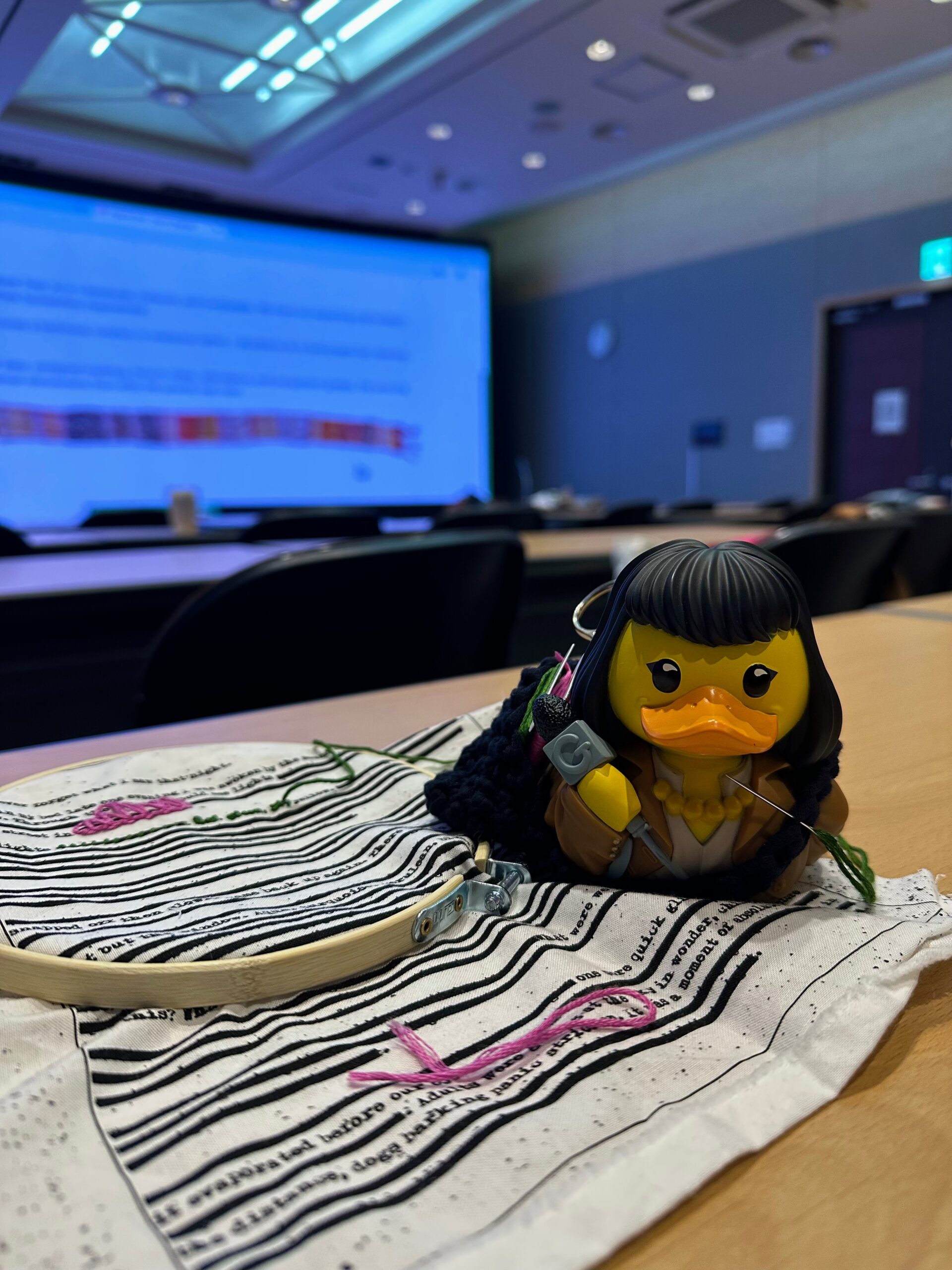
Rubber duck doing craftsSo bot mir bereits am ersten Tag der Workshop zu IIIF-Tools von Glen Robson und Martin Kalfatovic direkte Anwendungsmöglichkeiten für die eigene Forschungspraxis. Ein besonderes Highlight für mich folgte jedoch direkt im Anschluss beim Brainstorming & Prototyping für Educational Games mit Sophia Booij und Nellie Seale. Das metaphorische „toying with ideas“ zeigte nachdrücklich, wie Fachinhalte und Informationen für unterschiedliche (schwierige) Zielgruppen zugänglich gemacht und methodisch aufgearbeitet werden können. 

Ähnlich verhielt es sich am zweiten Tag in der Minikonferenz „#DHMakes: Embodied Craft as Critical Engagement“. Das Verknüpfen von klassischem Handwerk und textiler Kunst mit Datenvisualisierung eröffnete für mich neuartige Zugänge der Interaktion: Die Übersetzung von Daten in das Haptisch-Physische verändert grundlegend, wie wir uns mit Inhalten auseinandersetzen können. Da ich mich im Digitalen viel mit textiler Kunst auseinandersetze, sprach mich hier die Minikonferenz besonders an.

Digital Fashion als Forschungsmethode: Mein Beitrag auf der DH2026

Der Kern meiner Reise war die Präsentation meines Konferenzbeitrags am dritten Tag. Vorgestellt habe ich das Paper „From 2D sewing patterns to dynamic 3D models: documenting cultural heritage in digital fashion.“, welches ich in Zusammenarbeit mit meinem Co-Autor Prof. Dr. Øyvind Eide eingereicht habe. Das Paper fokussiert sich auf ein in den Digital Humanities bislang stark unterrepräsentiertes Themenfeld: die Erforschung und Dokumentation von Kleidung als materielles und immaterielles Kulturerbe.

Der Erhalt von Kleidung als materielles Kulturerbe und damit die Dokumentation von Fashion, oder auch Mode, als immaterielles Kulturerbe, steht in enger Abhängigkeit von der Minimierung des materiellen Zerfalls von Textilien. Entsprechende Aufbewahrungsrichtlinien schränken dadurch jedoch die Rezipierbarkeit der Kleidung in ihrem ursprünglichen Kontext stark ein. Einflüsse wie Gravitation, Bewegung und das Gefühl des Stoffes, sowie das Binden, Knoten oder Layering von Kleidung gehen hier nahezu oder vollständig verloren.

Unsere reproduzierbare Methodik der digitalen Rekonstruktionen basiert auf 2D-Schnittmustern und transformiert diese zu dynamischen 3D-Kleidungssimulationen, welche dabei nicht nur als Erkundung der Beziehung zwischen Schnittmustern, Kleidungsstücken und dem Digital Fashion Object dienen, sondern auch eine direkte Simulation darstellen, wie wir Kleidung tragen und herstellen.

Da diese Forschung auf meiner Masterarbeit aufbaut und das Fundament meines geplanten PhD-Projektes bildet, war der direkte Austausch vor Ort von hohem Wert für mich. Das konstruktive Feedback aus unterschiedlichen Disziplinen und kulturellen Kontexten hat mir wichtige Impulse in Sachen 3D-Modellierung, Verbindungen mit Game Studies und die Einbettung in das Digital Cultural Heritage geliefert. Die aufschlussreichen Diskussionen verankerten unsere theoretische Arbeit in der Modelltheorie und der Intermedialität und unterstrichen gleichzeitig die Bedeutung der Forschung. Die Verbindung zu der globalen Community hat meine wissenschaftliche Perspektive zutiefst bereichert und mich für die nächste Phase meines akademischen Weges inspiriert. Nicht nur durch Feedback, sondern auch durch neue Kontakte.

Austausch und Nachwuchsperspektive

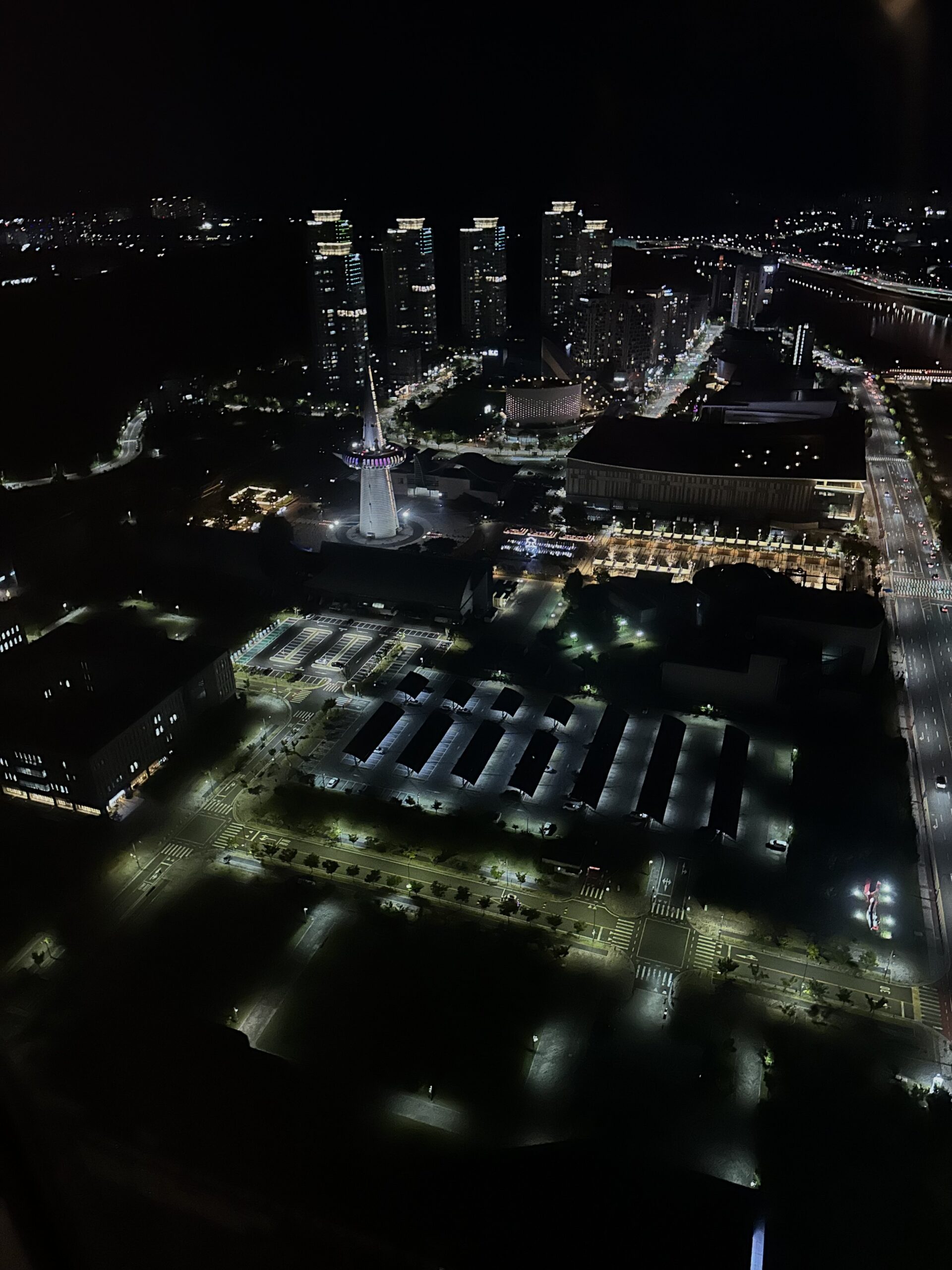
Neben den wissenschaftlichen Panels lebte die DH2026 von der warmen Gastfreundschaft und dem lebendigen Austausch bei der Poster-Session, den Coffee Breaks oder dem Konferenzbankett. Daejeon by night

Die Teilnahme an der DH2026 hat noch einmal meinen Horizont hinsichtlich der Vielfältigkeit der Digital Humanities erweitert. Auch wenn mir diese Vielfalt vorher schon bewusst war, ist das Erleben der Bandbreite an unterschiedlichen Forschungsfeldern, Interessen und kreativen Anwendungsansätze sehr aufschlussreich für mich gewesen. Vor allem aber hat die Vielfältigkeit mich dazu angeregt, mich weiterhin mit unterschiedlichen Medientypen auseinanderzusetzen und verschiedene Formen der Visualisierung, Modellierung und Dokumentation stetig kritisch zu reflektieren. Was langfristig meine eigene akademische Praxis beeinflussen wird.

Besonders gefallen hat mir unter anderem der Beitrag „Where War Lived“ von Liam Isaac Downs-Tepper und dessen Einblicke in Photogrammetry oder die Keynote von Maciej Eders als Antonio Zampolli-Preisträger, die ganz unter dem Motto stand: „All you need is a coffee machine and a couch!“.

Die DH2026 hat mir gezeigt, dass „Engagement“ für mich nicht nur die aktive Teilnahme an einer Konferenz bedeutet. Es bedeutet auch, sich auf neue Methoden einzulassen, Forschung über Disziplingrenzen hinweg zu denken und Teil einer internationalen wissenschaftlichen Gemeinschaft zu werden.

Meine Erfahrung auf der DH2026 habe ich ebenfalls in einer Live-Dokumentation über meinen Mastodon-Account (https://fedihum.org/@lpascale) geteilt. Auch hier war ich begeistert von der schnellen Aufnahme in die Community, die mich und meine Reporterquietscheente mit offenen Armen empfangen hat.

Fazit & Dank

Die DH2026 in Daejeon war geprägt von inspirierenden Keynotes, informativen Vorträgen und bereichernden Begegnungen. Der Tagungsabschluss hat verdeutlicht, wie essenziell der persönliche Kontaktaufbau für Forschende ist. Mein herzlicher Dank gilt meinem Co-Autor Prof. Dr. Øyvind Eide, den Organisator*innen vor Ort sowie insbesondere der DHd für die finanzielle Unterstützung durch das Reisestipendium. Ohne diese Unterstützung wäre diese wertvolle Erfahrung für mich nicht möglich gewesen!

 

❌