普通视图

Received before yesterday

Brighter Social Media Skies: Bluesky For Library-Worker (and DH!) Online Community

2025年12月14日 13:00

Social media can help you build professional and social community, find jobs, learn from others, share your work, ask questions, and hear about new ideas and projects. After the implosion of multiple other social platforms, the Bluesky platform has become one of the best options to keep accessing those benefits. This video captures a live webinar from May I gave for the Metropolitan New York Library Council, aiming to help library and archives workers considering trying out Bluesky, or who’ve dipped a toe in but not felt comfortable using it yet.

All the resources mentioned in this talk are listed at tinyurl.com/intro-bluesky. Most useful is my Bluesky for Academics guide at tinyurl.com/DHBluesky, which remains regularly updated and contains both very-quick cheatsheet and incredibly detailed versions of how to get started understanding Bluesky use for DHers, GLAM folks, and other knowledge work folks. At the end of that guide is a sortable list of “starter packs”, feeds, and lists gathering folks to follow on Bluesky around topics like DH, critical tech, expansive making & crafting, queer studies, social justice work, and more.

ADHC Talks Podcast- Graduate Student Spotlight: A Conversation with Kathleen Lewis (3.3)

作者adhcadmin
2025年11月18日 03:05

Description

Our guest today is Kathleen Lewis. Kathleen is the first in a series of graduate student spotlight guests, which is a way for us to highlight the digital humanities work being done by our amazing graduate students here at the University of Alabama. Kathleen is a doctoral candidate in the composition and rhetoric in English studies program in the Department of English. Her research uses new materialism to explore recomposition and circulation of the pride flag on social media platform Tumblr.

Season: 3

Episode: 3

Date: 3/2024

Presenter: Kathleen Lewis

Topic: LGBTQ Flag on Tumbler

Tags: Social Media Studies; Digital Rhetoric ; Rhetorical Velocity

The post ADHC Talks Podcast- Graduate Student Spotlight: A Conversation with Kathleen Lewis (3.3) appeared first on Alabama Digital Humanities Center.

“Il gesuita che portò le macchine a leggere”: podcast divulgativo su Padre Roberto Busa

2025年11月13日 22:05

Si segnala che il podcast “Prima del futuro” di Emotion Newtork, pubblicato sul sito del “Corriere della Sera”, ha dedicato una puntata alla storia di Padre Roberto Busa e dell’Index Thomisticus.

Voce di Lucilla Giagnoni

Contributi tecnici di Massimiano Bucchi

Testi di Alberto Mattiello con il contributo artistico di Lucilla Giagnoni

Montaggio, post-produzione e sound design a cura di Gabriele Beretta

Coordinamento produttivop per Emotion Network a cura di Valentina Di Leo, Marco Tabasco e Benedetta Barzaghi

L'articolo “Il gesuita che portò le macchine a leggere”: podcast divulgativo su Padre Roberto Busa proviene da AIUCD.

National Geographic reporter Myrthe Prins plays guinea pig at ILS Labs

作者Bas
2025年6月12日 20:02

‘Soe-gi-ta-geu-bu-ti-to-ba-meu…, for ten minutes now I have been listening to a robotic voice, droning on meaningless syllables without intonation or emotion.’

National Geographic reporter Myrthe Prins visited the Institute for Language Sciences (ILS) Labs, part of the Centre for Digital Humanities. Guided by PhD candidate and psycholinguistics researcher Iris van der Wulp, Prins participated in a series of experiments measuring her working memory, vocabulary, sense of rhythm, and ability to learn a non-existent language – all while wearing a EEG cap with dozens of electrodes to monitor her brainwave activity.

Read the National Geopgraphic article (in Dutch, one free session).

Curious whether the ILS Labs could support your research? Or, like Prins, would you like to contribute to science as a participant? Visit the ILS Labs website for more info.

The post National Geographic reporter Myrthe Prins plays guinea pig at ILS Labs appeared first on Centre for Digital Humanities.

DPG Media and Utrecht University’s Data School develop tool to support ethical use of data and AI in the media sector

作者Bas
2025年6月2日 21:09

DPG Media and the Utrecht University Data School are jointly developing a ‘Data Ethics Decision Aid for Media (DEDA for Media)’. Starting in 2026, this analogue model will help media companies in recognizing and addressing ethical issues concerning digitalisation, data and AI projects. Development will be completed by the end of this year, after which DEDA for Media will be made accessible to the entire media sector.

When using DEDA, editors, data specialists, developers, legal experts and other stakeholders gather around a large, table-sized poster. Together, they work through an interconnected series of questions designed to prompt reflection on the ethical dimensions of their project. At the end of the session, the group assesses whether the previously defined values are sufficiently safeguarded. Based on this evaluation, they may decide not to proceed with a project, or to make adjustments – such as introducing more human oversight, or increasing transparency towards users on how a system operates and is applied.

With this collaboration, DPG Media underscores the importance of the responsible use of data and AI in a sector undergoing rapid technological transformation.  “We are making major advances with AI and data, but in doing so, we encounter many ethical challenges, both in journalism and in our business operations,” says Philippe Remarque, Director of Journalism at DPG Media. “It is our societal responsibility as a publisher, and part of our ESG policy, to approach these with care. We need to ensure, together with all teams involved, that relevant questions are identified and addressed as part of the development process – not afterwards. That requires a professional framework, and this model provides exactly that.”

Researcher Karin van Es, associate professor and project lead for the Data School at UU, is excited about this valuable exchange between academic knowledge and practical experience: “DEDA is already widely used by Dutch and international government organisations. This new collaboration will enable the development of a version specifically tailored to the media industry and its particular use of data and AI.” According to Van Es, explainability and due diligence are essential in working with data and AI: “DEDA helps make the inherent complexity of these technologies more manageable. By documenting the decision-making process, the tool also provides a framework for accountability towards various stake-holders, both inside and outside of an organisation.

DPG Media will not only contribute financially to the development of DEDA for Media, but will also provide expertise and real-world cases to thoroughly test the tool. To this end, stakeholders will be asked to actively contribute to the model’s development by sharing relevant questions, datasets, and use cases.. Once development is completed at the end of this year, DEDA for Media will be made available to the entire media sector.

This article was originally published here at DPG Media (in Dutch).

The post DPG Media and Utrecht University’s Data School develop tool to support ethical use of data and AI in the media sector appeared first on Centre for Digital Humanities.

Open letter & petition: Call for digital autonomy UU

作者yara
2025年3月28日 22:09

In an open letter to the Executive University Board of Utrecht University, Prof. dr. Albert Meijer (Professor of Public Innovation, UU) & Prof. dr. José van Dijck (Professor of Media and Digital Society, UU) are calling for a transformation to digital autonomy. They express their “concern about Utrecht University’s increasing reliance on services from Big Tech companies (particularly Microsoft, Google, Amazon) for our research, teaching and administrative activities”.

If you support this call, you can contribute by signing the local petition (also possible anonymously), preferably before 16 April.

With this open letter we call upon you to change course, thereby freeing our university from this heavy reliance on services from these companies and contributing to greater technological self-determination, resilience and public innovation for and with universities across Europe.”

Albert Meijer & José van Dijck

More info

Prof. dr. José van Dijck is a member of the CDH Advisory board. She has been interviewed on this topic by the Dutch newspaper NRC (Onderzoekers kiezen voor een alternatieve cloud: ‘Ik wil zelf kunnen kiezen met wie ik mijn bestanden deel’, 31 December 2024). For Dutch newspaper Trouw, she wrote an opinion article together with Prof. dr. Albert Meijer: Opinie: Universiteit, maak je los van Big Tech (23 February 2025).

CDH affiliate dr. Fabian Ferrari will be one of the speakers at Studium Generale’s hybrid event Can we stop the techbro’s takeover? on 17 April 2025. His postdoctoral research on AI governance (2022-2024) was supported by a Spinoza-funded project led by Prof. dr. José van Dijck.

The post Open letter & petition: Call for digital autonomy UU appeared first on Centre for Digital Humanities.

CDH Research Software Lab highlighted in LCRDM report ‘Professionalizing the role of Research Software Engineers in the Netherlands’

作者yara
2025年3月21日 17:35

The Centre for Digital Humanities (CDH) Research Software Lab was highlighted in the recently published LCRDM report ‘Professionalizing the role of Research Software Engineers in the Netherlands’. The report maps the landscape of Research Software Engineering in the Netherlands, highlighting both successful models and persistent barriers.

The National Coordination Point Research Data Management (LCRDM) is a national network of experts on research data management (RDM) in the Netherlands. This report provides concrete recommendations for RSEs and their research organizations, funders, and policy makers to fully integrate RSEs into the academic ecosystem.

CDH Research Software Lab highlight

The CDH Research Software Lab is highlighted on the whole of page 10 of the report, in section 2: ‘The research software engineering landscape’.

Centre for Digital Humanities
The CDH Research Software Lab at Utrecht University was established in 2014, and serves as a central RSE pool primarily dedicated to the Faculty of Humanities. The development team consists of 10 RSEs, all of whom hold permanent positions. They provide technical support to staff by developing custom software solutions for research and educational purposes. Additionally, the team offers guidance on (the adaptation of) ready-to-use (open source) tools.

Projects
The expertise of the CDH RSLab spans a wide range of applications; however, the team most often focuses on building databases, visualizations, and text mining tools. Project durations range from a few weeks to several years, and for assignments exceeding 160
hours, funding is required. All RSEs have academic backgrounds in humanities sub-disciplines such as linguistics, history, musicology, and artificial intelligence, enabling them to optimally connect with
researchers in the field.

Funding
Approximately 65% of the lab’s costs are covered by externally funded projects. Funding sources include research grants (e.g., NWO, ERC) and collaborations with external partners, such as media organizations and government agencies.

UFO Profiles
ICT Developer”

LCRDM report ‘Professionalizing the role of Research Software Engineers in the Netherlands’, March 2025

The post CDH Research Software Lab highlighted in LCRDM report ‘Professionalizing the role of Research Software Engineers in the Netherlands’ appeared first on Centre for Digital Humanities.

Sospensione degli aggiornamenti di AIUCD su X

2025年3月1日 01:00

Il direttivo di AIUCD ha deciso di interrompere la pubblicazione di contenuti su X.


Gli aggiornamenti proseguiranno su questo sito web, sul gruppo Facebook (https://www.facebook.com/groups/aiucd), su LinkedIn (https://www.linkedin.com/company/aiucd/) e su Mastodon (https://fedihum.org/@aiucd)

Aus aktuellem Anlass: Folien zum Mastodon Workshop bei der DHd 2024 online!

2025年1月24日 17:55

Wer mit dem Gedanken spielt zu Mastodon umzuziehen und noch nicht genau weiß, wie das eigentlich funktioniert, kein Verzagen! Bei der DHd 2024 gab es einen Workshop zu den Grundlagen von Mastodon, zur Digital Humanities Instanz Fedihum (herzliche Einladung) und zum automatisierten Tröten mit Autodone.

Die Folien zum Workshop mit Mareike König, Jürgen Hermes, Philip Schildkamp, Vivien Wolter, Ulrike Wuttke und Henrik Schönemann haben wir aus aktuellem Anlass auf Zenodo zur Nachnutzung veröffentlicht, viel Erfolg!

König, M., Hermes, J., Schildkamp, P., Wolter, V., Wuttke, U., & Schönemann, H. (2025, Januar 23). Microblogging mit Mastodon: Fediverse, Fedihum und Co. in den Digital Humanities – ein Praxisworkshop. DHd 2024 Quo Vadis DH (DHd2024), Passau. Zenodo. https://doi.org/10.5281/zenodo.14728233

Zu Autodone freuen sich über Nachrichten: Jürgen Hermes und Philip Schildkamp.

Wie Mastodon als Teil des Fediverse zur offenen Wissenschaftskommunikation beiträgt, welche Gedanken sich der DHd-Verband beim Aufsetzen der Fedihum-Instanz gemacht hat und welche Einsatzmöglichkeiten, z. B. in der Lehre die automatisierte Veröffentlichung von Kurznachrichten bietet, kann genauer im dazugehörigen Abstract im Book of Abstracts der DHd 2024 nachgelesen werden: König, M., Hermes, J., Schildkamp, P., Wolter, V., & Wuttke, U. (2024, Februar 21). Microblogging mit Mastodon: Fediverse, Fedihum und Co. in den Digital Humanities – ein Praxisworkshop. DHd 2024 Quo Vadis DH (DHd2024), Passau, Deutschland. https://doi.org/10.5281/zenodo.10698458

Book ‘Collaborative Research in the Datafied Society’ recommended by DUB

作者yara
2024年12月18日 20:44

The book Collaborative Research in the Datafied Society: Methods and Practices for Investigation and Intervention (2024, Amsterdam University Press) has been recommended by DUB (the independent news site of Utrecht University) in their December 2024 book review. This book was edited by Mirko Tobias Schäfer (Science Lead at Data School), Karin van Es (Humanities Lead at Data School), and Tracey P. Lauriault (Carleton University).

DUB review of Collaborative Research in the Datafied Society

Can universities change the world? According to Collaborative Research in the Datafied Society, edited by Mirko Tobias Schäfer, Karin van Es and Tracey P. Lauriault, the answer is a resounding “yes” – provided they break through the walls of academia. UU scientists Schäfer and Van Es play a prominent role in this book, which shows how cooperation between researchers and social partners can be not only necessary but also revolutionary.

The book offers a rich collection of examples of how universities can tackle complex social issues. One of them is Data Against Feminicide, a project against gender-based violence that involved data scientists and activists. They teamed up to develop digital tools to make figures about murdered women more visible. Another example is the collaboration between researchers and local governments for the DataWorkplace project, which explores how governments can use data and AI to develop fairer and more transparent services. Fairwork Project offers a critical look at unfair practices perpetrated by companies like Uber, looking to enforce better working conditions in the platform economy.

The book also explores theoretical issues around collaboration. For example, how can academics remain neutral when they are actively involved in policy-making? What does it mean to make science open and inclusive in a world increasingly dominated by datafication?

What makes this work truly thought-provoking is its call to action. The authors ask if universities dare to go beyond papers and theories. Do they dare to collaborate with policymakers, businesses and citizens to increase its impact? Utrecht University seems to be leading by example, but the question remains whether others will follow.

With gripping insights and real-life stories, this book is not only a manual for researchers but also a wake-up call for academia. After all, as evidenced in the book, collaboration is no longer optional, it is essential.”

Phine Hazelbag for DUB

Other book reviews

More reviews for Collaborative Research in the Datafied Society have been shared by experts in the field:

Datafication is profoundly changing societies, often in concerning ways. It also opens possibilities for critical social action, so far little explored. This groundbreaking collection convenes a terrific range of leading international writers to showcase collaborative research into this important phenomenon.”

Nick Couldry, Professor of Media, Communications and Social Theory, London School of Economics and Political Science

Thinking and doing, mens et manus …. this provocative collection of perspectives, methods, theories, and case studies on data and society is above all a testament to the power of collaborative, societally-engaged, and applied research. The plurality of voices and experiences gathered in these pages demonstrate the assertion that the more complex the problem, the more crucial are collaborative solutions.”

William Uricchio, Emeritus Professor of Comparative Media Studies, Massachusetts Institute of Technology

Schäfer, van Es and Lauriault have brought together an impressive collection of authors, case studies and data practices. Separately and together, the chapters provide theoretical inspiration and practical advice to help the rest of us engage in meaningful collaborations across disciplines and beyond the confines of the university.”

Sally Wyatt, Professor of Digital Cultures, Maastricht University

A deep dive into dynamics, challenges and urgency of collaborative research in the datafied society, this critical collection showcases how academia and society jointly can drive impactful change. It is an essential reading for anyone willing to engage in research that matters.”

Stefania Milan, Professor of Critical Data Studies, University of Amsterdam and European University Institute

About the book

Collaborative Research in the Datafied Society offers a combination of theoretical insights, practical methodologies, and case studies. It showcases the power of collaborative research with stakeholders across diverse communities and civil society, to tackle the pressing challenges of our datafied society.

In an era shaped by austerity and neoliberal ideologies, the role and relevance of academic institutions are being redefined. This volume explores how universities can transcend their institutional boundaries by partnering with stakeholders and civil society. Through such collaboration, academia can promote democratic engagement, drive knowledge economies, and address critical social justice issues. Combining theoretical insights, practical methodologies, and real-world case studies, this book offers an essential resource for advancing societally engaged research.

(Re)connecting DH on Social Media

2024年11月1日 12:00

Want an overview of what folks have been doing to rebuild DH community online post-Twitter? I wrote a report on the ACH working group “(Re)connecting DH on Social Media”, which was active Fall 2023-Summer 2024 and is now sunsetting. Below, we share what we did toward supporting reconnecting community, as well as our sense of the state of DH social media (which has changed positively between July and October 2024!).

Activities

  • Working plan: public GDoc with
    • suggested hashtag prompts for building conversations and amplifying community members’ work
    • Creation of Bluesky feeds per hashtag, to aid following (none of these ended up taking off)
  • Original working group proposal: public GDoc with
    • explanation of current state of DH social media
    • ideas for improving and (re)connecting folks
  • Quinn and Brandon ran a mutual aid effort gathering and distributing Bluesky invites, and publicizing their availability, while these were still required
  • Amanda continues to maintain an up-to-date guide to Bluesky for academics
  • Quinn and Amanda continued regular contributions to #DHmakes on Bluesky, where that hashtag has enjoyed an improved post-Twitter life!
    • We’re delighted to see its users and use expand, and several pieces of scholarship continue to be built on it (in addition to the past ACH 2023 session, successful mini-conference at DH 2024, peer-reviewed publication in the inaugural Journal of Korean DH (the latter documenting how changes in social media platform use have influenced DH community building, conversation, and scholarship around DH crafting and making).
    • The #DHMakes Methodz Talks series of free, public, chill maker/crafter method zoom talks are a sync community-building offshoot of the #DHMakes hashtag. Several email conversations about current social media use & analysis of what we’re seeing there, among working group

Report

We made contributions toward our goal (above), but didn’t ultimately have the energy—nor find social media platforms/community conducive—to some of the approaches we’d originally envisioned trying. In July 2024, we decided to sunset the group. Anyone is welcome to use our documentation and/or working group name to propose resuscitating the group to ACH (or to do something of your own related to DH social media, without matching what we’ve done here!).

Our assessment of these platforms and their DH use is purely anecdotal, based on personal observation and vibes. We’ve found Bluesky to be the best approximation of our previous Twitter experiences (noting those are not necessarily representative of others’ experiences on any of these platforms). In July 2024, we had found 3 of us use it regularly (daily or multiple times a week) as our primary venue for DH online connection.

Both Bluesky and Mastodon in July 2024 had seemed to have failed yet to approximate Twitter’s size of active posters and readers, frequency of conversations across users, and ability to connect to a variety of communities (e.g. by language; geographic region; personal identity; DH role; non-DH adjacent communities doing work in areas like art, tech, social justice).

We’d found Bluesky to be more active than Mastodon for our particular segments of the DH community, and more active in general; but noted that Mastodon seems to maybe be preferred by other segments such as European DHers and research software engineers.

In October 2024, we’ve seen a large influx of DHy Bluesky users as Twitter/X continued to disintegrate and become an explicit machine for hate and fascist lies. Bluesky now feels similar to “early DH Twitter” (e.g. 2009-2015) to at least one of our working group. Advances in Bluesky features and in bridging between Bluesky and Mastodon are growing the user community.

We’re interested to see what happens with Discord (less accessible as finding and being invited to servers is harder; live chat rather than message posting format) and Threads (has had a more Instagram-y “non-academic use by academics” vibe so far; federation allowing people to read across various platforms including Threads may help?). In July 2024, a few of us had also noticed turning more often to group direct messages on Slacks that we would have put on Twitter DMs or Twitter in the past, including via the Digital Humanities Slack (free platform, so doesn’t keep all messages readable forever) and ACH Exec’s internal private Slack. In October 2024, Bluesky has had individual DMs for a while now and are starting to see use, but the lack of group DMs is an issue.

The group didn’t have bandwidth to continue with formal async or sync work, we are proactively sunsetting so that we can document our work and allow others to build on it or pick it up, rather than letting it linger as something we still semi-committed to doing but aren’t.

Working group members

And their social media handles:

Name Bluesky Mastodon
Amanda Wyatt Visconti @literaturegeek.bsky.social @Literature_Geek@hcommons.social
Quinn Dombrowski @quinnanya.me @quinnanya.mstdn.social
Brandon Walsh @walshbr.bsky.social @walshbr.hcommons.social
José Eduardo González @jose-eduardo.bsky.social @jose_eduardo.mastodon.social
James Cummings @jamescummings.bsky.social @jamescummings@scholar.social

Meme image of Star Trek's Captain Jean-Luc Picard gesturing to "make it so" (or something like that?), with the overlaid custom meme text "#DHengage! To amplify & encourage DHy social media community"

What is #DHMakes?

This post is by Amanda, Claudia, and Quinn—a few of the many #DHmakes community members, who’ve described the community in a couple places. We’re gathering those descriptions into one post (though a hashtag in use across multiple platforms is defined by its users, so we aren’t the authority, and its use will evolve over time!).

  1. DH = digital humanities (folks using or building digital tools like websites, code, VR to explore humanities areas like culture, history, art, ethics; folks using those kinds of humanities approaches to critique technology)
  2. Makes = craft, making, makerspace types of creative work

We published a peer-reviewed article in the Korean Journal of Digital Humanities,”#DHmakes: Baking Craft into DH Discourse”, if you want to know a lot about the community’s origins, history, and outputs.

If you want a ✨tl;dr✨ though, here’s a FAQ!

Who started this?
We’re digital humanities people who incorporate physical making/art into our work (or do it as a hobby and share it online somewhere)!

Who is this for?
#DHmakes is loosely folks in digital humanities/libraries/academia/learning-work who craft/make (including as non-job hobby), open to anyone interested.

What kinds of things get posted?

  • “I made/am making a thing!”
  • work related to including craft/textile work in making
  • works-in-progress, fails, public figuring-out how to do some method/project
  • explicitly celebrating, amplifying, encouraging neat craft/make work, whether or not the creators are digital humanities people
  • encouraging sharing “this is my hobby, not my job” crafts
  • getting started

What kinds of making/crafting?
All of them? We’re interested in an expansive definition and especially things that have sometimes gotten left out of how people think of makerspaces/making, such as textile art. Other frequent areas of interest tagged #DHmakes include craft/making work related to:

  • history
  • culture & pop culture
  • zines
  • data visualization & embodiment, including personal data
  • queer/feminist/critical tech, social justice
  • play with historical craft practices
  • expansive definitions of making that assert awesomeness of areas like fabric arts, cooking, fashion

For examples, check out Quinn’s Textile Makerspace, Claudia’s and Gabby Evergreen’s “Pockets of Information”, Jacqueline Wernimont’s “Visualizing Energy Data or Visceralizing Energy Transitions”, and Amanda’s Scholars’ Lab “expansive makerspace”-tagged posts page.

Why have I been tagged #DHmakes?
Folks RT/repost cool, relevant craft/making work with the tag so others get to admire them too.

Am I “DH enough” to use the hashtag?
The “DH” in #DHmakes is digital humanities. We’re guessing the other most active hashtag users agree with us: anyone curious about DH (not necessarily “experienced” or in a “DH job”) should participate! Workers, students, hobbyists in areas like gallery/library/archive/museum/learning that are DH or feel adjacent too.

Have you done things beyond using a hashtag?
Yes!

You can follow #DHmakes using a feed of all tagged posts, or a feed of just the #DHmakes posts that include photos.

A banner logo image that shows a cartoon of a groovy skeleton wearing sunglasses, holding a laptop in one hand and a ball of yarn and knitting needle in the other, with the #DHmakes hashtag written underneathA logo image that shows a cartoon of a groovy skeleton head wearing sunglasses and a blue knit beanie, holding a ball of pink yarn between its skeletal hands and chomping into it; in the background is blurred-out code text, and the #DHmakes hashtag is written at the topPhoto of a full-size skeleton model, Quinn Dombrowski's "Dr. Cheese Bones", with one hand up waving, wearing a denim vest decorated with various small crafting projects made by multiple members of the #DHmakes community including a felted "ACH" patch and a tiny data visualization quilt patch

My digital humanities makerspace research

2024年8月6日 12:00

My DH 2024 conference talk on my recent book-adjacent data physicalizations and makerspace research, as part of co-facilitating the #DHmakes mini-conference. What is #DHmakes? Briefly: anyone (you?) DH-adjacent sharing their (DH or not) crafty or making work with the #DHmakes hashtag, getting supportive community feedback. Resulting collaborations have included conference sessions and a journal article. For an in-depth explanation of #DHmakes’s history, rationale, goals, examples, see the peer-reviewed article I recently co-authored with Quinn Dombrowski and Claudia Berger on the topic.

Hey! I’m Amanda Wyatt Visconti (they/them). I’m Director of the Scholars’ Lab at the University of Virginia Library.

My background’s in librarianship, literature and textual scholarship, so a lot of my making is reading- or book-adjacent. I know the ways we do and share knowledge work can take really any format, as can the things that influence our scholarly thinking. I have been informed or inspired by, for example, a literal bread recipe; fictional creative work that explores new possibilities, or conveys an ethos I took back to my research; tutorials, informal discussions, datasets, infrastructural and administrative work, zines, social media posts, and countless other of the ways humans create and share thinking*.

First slide from my DH2024 #DHmakes talk, showing screenshots of my zine grid and zine database, and saying "to amplify & credit more formats of knowledge: data => making!"

Why make book-adjacent prototypes?

“Generous” citation—in whom we cite, and what formats of work we cite—is actually just accurate citation. Academia routinely lags in citing all the emails, attended conference talks, social media posts, elevator conversations, podcasts, reviewer comments, and more that inspire and inform our scholarship. With my particular context of a library-based lab: physical scholarship displays in academic libraries tend to disinclude relevant reads that aren’t in a print scholarly book or journal format.

It’s hard to display many of the formats I just listed, but also many people don’t think of them as worth displaying? This sends a message that some scholarly formats or methods are lesser, or not relevant to the building and sharing of knowledge. We know there’s systemic racism, sexism, and other harms in publishing and academia. Limiting ourselves to displaying and amplifying just some of the most gatekept formats of knowledge sharing—books and journal articles—fails at presenting a welcoming, inclusive, and accurate picture of what relevant work exists to inform and inspire around a given topic.

So, I’ve been using making projects to change what scholarly formats and authors the Scholars’ Lab will be able to amplify in its public space…

Data-driven research making

I started by focusing on collecting and describing a variety of DHy digital and physical zines, though I hope to expand the dataset to other formats eventually. (Briefly, you can think of zines as DIY self-published booklets, usually intended for replication and free dissemination, usually in multiple copies as opposed to some artists’ books being single-copy-only or non-replicable.) In the upper-left of the slide is a slice of my digital “zine quilt”, a webpage grid of zine covers from zines in my collection.

Second slide from my DH2024 #DHmakes talk, showing photos of my digital zine cover grid, themed reading card decks, a notebook open to design drawings, and a pile of makerspace supplies including a neon loop and a book cover

Having a richly described zine-y database I know by heart, because I researched and typed in every piece of it, has opened my eyes to ways data can suggest data-based research making.

I’ve got 3 crafting projects based on this zine database so far:

1st, I created a playing card deck that fits in a little case you can slip into your pocket. Each card has the title and creators of a zine, and a QR code that takes you to where you can read the zine for free online. This lets me hand out fun little themed reading lists or bibliographies, as shuffle-able card decks… or potentially play some really confusing poker, I guess?

2nd, I’m learning to work better with LEDs, sheet acrylic, and glass by reverse-engineering a simple and less gorgeous version of Aidan Kang’s Luminous Books art installation. Kang’s sculptures fills shelves with translucent, glowing boxes that are shaped and sized like books with colorful book covers. I’ve been prototyping with cardboard, figuring out how to glue glass and acrylic securely, and figuring out programmable lights so I can make these book-shaped boxes pulse and change color. I hope to design and print fake “covers” for non-book reads like a DH project or a dataset. This would let me set these glowy neon fake books on our real book shelves, where the colored light might draw people to look at them, and follow a link to interact with the read further.

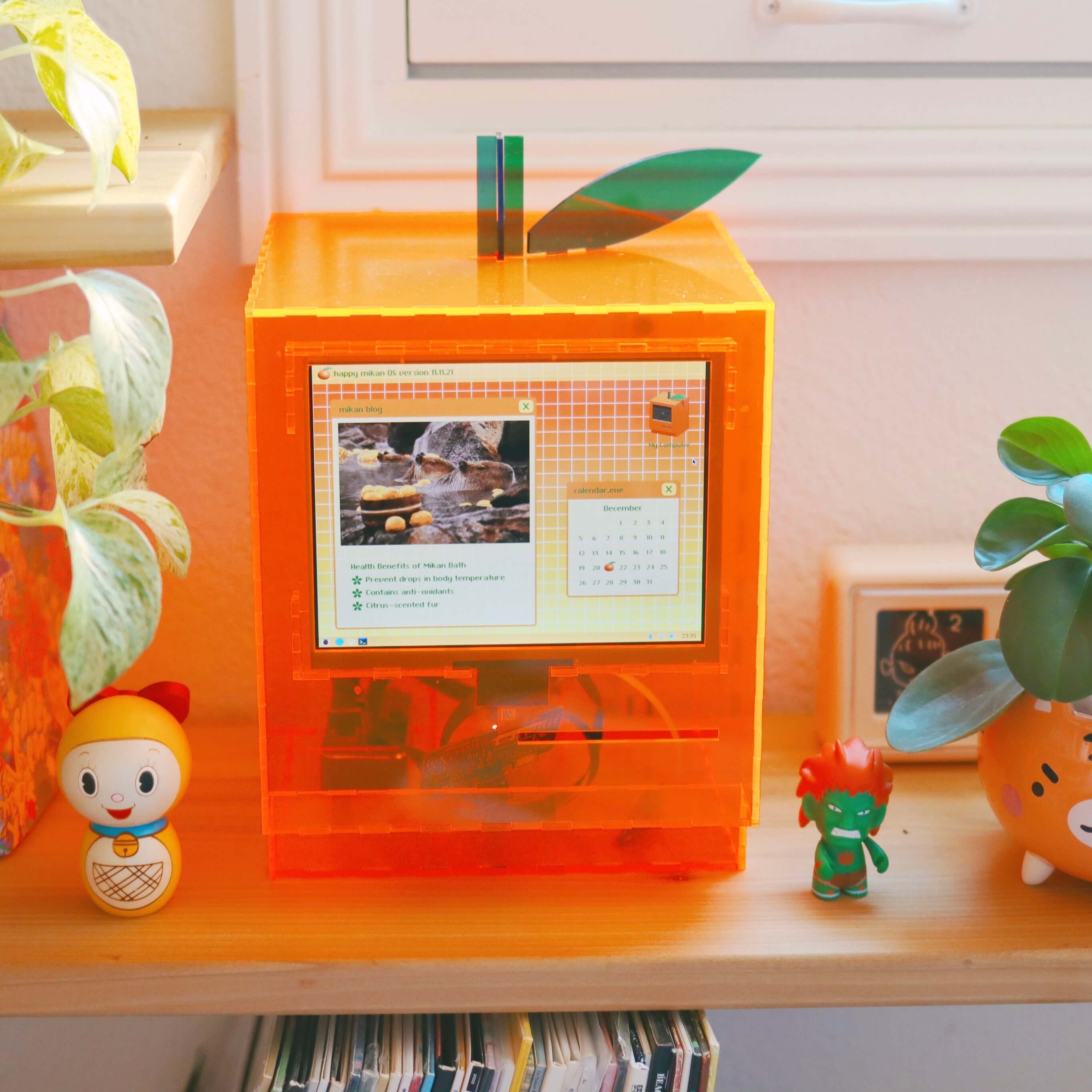
3rd, I’m hooking up a tiny thermal printer, like the ones that print receipts, to a Raspberry Pi and small display screen. I’m hoping to program a short quiz people can take, that makes the printer print out a little “receipt” of reading recommendations you can take away, based on metadata in my reading database. I’d been working to construct a neon acrylic case that looks like a retro Mac to hold the display and printer, again figuring out how to make a simpler approximation of someone else’s art, in this case SailorHg’s “While(Fruit)”. But naming my collection a “Zine Bakery” got me excited about instead hiding the receipt printer inside a toaster, so the receipt paper could flow out of one of the toaster’s bread holes. You can read more about these book-adjacent making projects at TinyUrl.com/BookAdjacent, or the zine project at ZineBakery.com.

Unrelatedly: resin!

Completely unrelated to reading: I’ve been learning how to do resin casting! You can think of resin like chemicals you mix up carefully, pour carefully into molds over multiple days and multiple layers of pouring with various pigments and embedded objects, and carefully try not to breathe. It hardens into things like this silly memento mori full-size skull I made, where I’ve embedded novelty chatter teeth and a block of ramen for a brain. Or for this necklace, I embedded multicolor LED bulbs in resin inside of D&D dice molds.

Third slide from my DH2024 #DHmakes talk, showing photos of a translucent frosted resin skull with a ramen brain and chatter teeth, and a light-up D&D dice necklace

(See my recent post on resin casting for more about this work!)

Come #DHmakes with us!

I’ve discovered I really like the experience of learning new crafts: what about it is unexpectedly difficult? How much can I focus on the joy of experimenting and learning, and grow away from frustration that I can’t necessarily make things that are pretty or skillful yet? So I’ve got a weird variety of other things cooking, including fixing a grandfather clock, building a small split-flap display like in old railway stations (but smaller), mending and customizing clothes to fit better, prototyping a shop-vac-powered pneumatic tube, carving and printing linoleum, and other letterpress printing.

To me, the digital humanities is only incidentally digital. The projects and communities I get the most from take a curious and capacious approach to the forms, methods, fields we can learn from and apply to pursue knowledge, whether that’s coding a website or replicating a historical bread baking recipe. #DHmakes has helped me bring more of that commitment to experimentation into my life. And with that comes the joy of making things, being creative, and having an amazing supportive community that would love yall to share whatever you’re tinkering with using the #DHmakes hashtag, so I hope you join us in doing that if you haven’t already!

* Some of the text of this talk is replicated from my Spring 2024 peer-reviewed article, “Book Adjacent: Database & Makerspace Prototypes Repairing Book-Centric Citation Bias in DH Working Libraries”, in the DH+Lib Special Issue on “Making Research Tactile: Critical Making and Data Physicalization in Digital Humanities”.

Networks of Gothic

作者adhcadmin
2024年4月20日 07:00

Networks of Gothic

projects

Description

Networks of Gothic brings together art historians, computer scientists, film and digital media experts to advance the teaching and research of Gothic buildings.

Project Owner(s): 
Topic: Art History, Digital Media, Film Studies, Computer Science
Tool: WordPress
Methodology: Networking
Project Status: Active

The post Networks of Gothic appeared first on Alabama Digital Humanities Center.

Les idéologies cachées dans les jeux vidéo de construction

2022年12月15日 22:53

Dans le dernier numéro de l’uniscope, le magazine du campus de l’UNIL, un article présente les recherches de Guillaume Guenat, collaborateur du GameLab UNIL-EPFL, doctorant en sciences sociales et membre du dhCenter.

SimCity, RollerCoaster Tycoon, Planet Zoo… Nombreux sont celles et ceux qui ont un jour aligné routes, bâtiments et autres infrastructures sur ordinateur ou console. Guillaume Guenat ne prend pas ces jeux vidéo à la légère et analyse les visions qu’ils véhiculent, faisant d’eux de véritables sources historiques.

Lire l’article : “Les idéologies cachées dans les jeux vidéo de construction” (12 décembre 2022) par Marion de Vevey pour l’uniscope.

The post Les idéologies cachées dans les jeux vidéo de construction appeared first on dhCenter.

DÉCRYPTÉ S2 – Littérature et intelligence artificielle | Coline Métrailler

2022年11月10日 18:11

Portrait de Coline Métrailler, doctorante en section des sciences du langage et de l’information à l’UNIL et membre du dhCenter, dans DÉCRYPTÉ. La chercheuse présente son travail sur l’automatisation des réseaux de personnages et leurs usages dans le cas des adaptations et des jeux vidéos.

« J’ai l’impression qu’on pourrait beaucoup s’apporter les uns les autres à juste un peu plus dialoguer entre sciences et lettres […] »

La génération automatique de réseaux de personnages n’a plus de secret pour vous ? Faites le quiz ! https://bit.ly/3SbGP4y

DÉCRYPTÉ est une série de courtes capsules vidéo qui propose de découvrir les divers travaux de recherche menés à l’UNIL et leur(s) écho(s) dans la société tout en partant à la rencontre des chercheur·e·s qui les portent. Une coproduction @L’éprouvette et @Mousqueterre Production

The post DÉCRYPTÉ S2 – Littérature et intelligence artificielle | Coline Métrailler appeared first on dhCenter.

RTS: intervention de Nathalie Dietschy sur l’art face aux algorithmes et à l’intelligence artificielle

2022年10月19日 21:18

Nathalie Dietschy, professeure en histoire de l’art (Faculté des lettres, UNIL) et membre du dhCenter, est intervenue dans le 19h30 de de la RTS du 8 octobre 2022.

Les programmes Dall-E, Midjourney ou encore Stable Diffusion permettent depuis quelques mois à tout un chacun de créer une image à partir d’une simple description textuelle. Une prouesse technologique reposant cette question centrale: l’intelligence artificielle remplacera-t-elle bientôt l’artiste?

A voir, le grand format consacré à l’art et l’intelligence artificielle.

The post RTS: intervention de Nathalie Dietschy sur l’art face aux algorithmes et à l’intelligence artificielle appeared first on dhCenter.

CQFD : Les cultures numériques à la une

2022年9月29日 22:33

Isaac Pante, directeur scientifique du dhCenter pour l’UNIL, et David Javet, médiateur scientifique à l’Éprouvette (UNIL), sont intevenus dans l’émission “CQFD” (La Première/RTS) du 26 septembre.

Lors de cette émission, David Javet et Isaac Pante ont présenté le nouveau programme thématique interdisciplinaire “cultures numériques” développé par l’Éprouvette, et notamment l’atelier scientifique “Créons en direct un jeu vidéo ensemble! ” qui aura lieu le 5 novembre prochain.

Ecoutez l’émission.

The post CQFD : Les cultures numériques à la une appeared first on dhCenter.

Uniscope: Les plateformes de streaming font tout pour encourager le « binge watching »

2022年9月23日 15:21

Le 9 novembre 2022, un cours public intitulé « Les séries TV et la grande guerre des plateformes » s’intéressera à la manière dont le streaming impacte les contenus proposés. Comment leurs exploitants utilisent-ils les données récoltées pour orienter les scénarios de manière à fidéliser leur public ? Ce cours met en lumière leurs méthodes ainsi que les recherches conduites à l’UNIL sur ces questions. Interview croisée entre deux de ses intervenantes, Maèva Flayelle de l’Institut de psychologie (Faculté des sciences sociales et politiques, UNIL) et Coline Métrailler, de la Section des sciences du langage et de l’information (Faculté des lettres, UNIL) et membre du dhCenter.

Qu’est-ce qui nous donne envie de regarder une série jusqu’au bout de la nuit ?

Maèva Flayelle : Ma thèse s’est justement intéressée aux processus psychologiques impliqués dans le binge watching. Les facteurs sont multiples. En premier lieu, l’architecture des plateformes est effectivement pensée pour y inciter, notamment en mettant à disposition l’intégralité des épisodes d’une saison. Les spectatrices et spectateurs n’ont certes pas attendu Netflix pour visionner l’entièreté d’une saison de série en un week-end. Mais auparavant c’était plus compliqué, il fallait se procurer le coffret DVD intégral en amont. Ensuite, ces dix ou quinze dernières années, les séries TV ont réellement acquis leurs lettres de noblesse en termes de narration. Mieux construites, elles sont aussi plus profondes et complexes, à l’instar de leurs personnages auxquels on peut s’attacher durablement. Il devient par conséquent plus difficile d’interrompre son visionnage, car on a envie de savoir ce qui va leur arriver.

Coline Métrailler : Cette architecture incitative apparaît également lorsque l’on recense les interactions entre les différents personnages. Cela constitue une partie de mon travail et cela permet notamment de repérer ceux qui jouent un rôle central en fonction du nombre d’interactions qu’ils ont avec les autres, de dégager des arcs narratifs pour voir comment un épisode, une saison ou toute une série évoluent. Je mets ce type de donnée à portée des chercheurs en travaillant à partir des scripts et je les aide aussi à déterminer quel genre d’informations ils peuvent tirer de ces données.

Justement, quelles sont les données pertinentes pour les plateformes ?

CM : Elles s’intéressent bien sûr à ce que nous regardons et à la manière dont nous le regardons, mais cela peut aller beaucoup plus loin. Par exemple, en proposant des films interactifs où le public pouvait décider de la suite de l’histoire, Netflix a été en mesure d’analyser le style de rebondissements qu’il préfère. Le but était bien entendu de lui mettre ensuite à disposition des contenus susceptibles de lui plaire pour le garder captif.

D’autres types de plateformes, musicales ou commerciales, ne fonctionnent-elles pas aussi selon ce principe ?

MF : Oui, les intelligences artificielles décryptent assez finement nos interactions avec toutes ces plateformes, qu’il s’agisse de vendre des livres ou des vêtements. Mais les plateformes de streaming ont une longueur d’avance dans ce domaine, car pour elles l’enjeu est central, il en va ni plus ni moins de leur survie. En témoigne notamment le fait que, sur le portail emploi de Netflix, on recherche beaucoup de spécialistes en ingénierie des données !

CM : Ce qui se passe dans le monde du streaming n’est qu’un miroir de ce qui se prépare sur d’autres terrains. Ce mouvement qui consiste à proposer aux personnes ce qu’elles aiment déjà va toucher toute la culture, de la littérature à la musique. Les réseaux sociaux fonctionnent également sur ce principe, on peut scroller pendant des heures, on verra toujours arriver sur notre fil des contenus en rapport avec ce que nous avons visionné ou liké précédemment. Cela ne concerne pas uniquement la culture, tous les secteurs se sont mis à analyser les habitudes de leurs clients pour mieux cibler leurs publicités, des hôtels aux plateformes de ménage. Parce que jamais auparavant on n’a disposé d’informations aussi individualisées et aussi largement accessibles.

Les algorithmes sont-ils toujours les plus forts ou y a-t-il des façons de ne pas se faire avoir ?

MF : Il est important de rappeler que passer de temps à autre une journée entière à regarder des séries TV n’est pas forcément pathologique. La majorité des gens sont capables de s’autoréguler. En les aidant à comprendre ce qui se joue vraiment, on peut leur permettre de développer des stratégies d’autocontrôle pour contrer les techniques utilisées par les plateformes. Cela peut néanmoins rester difficile pour une sous-partie de la population, les personnes les plus impulsives notamment. Les centres de traitement des addictions comportementales commencent d’ailleurs à recevoir des demandes liées à un usage problématique des plateformes de streaming.

Y a-t-il des recommandations faciles à appliquer ?

MF : Le plus simple et le plus efficace consiste à désactiver les notifications. Ensuite, il faut faire de la prévention auprès des plus jeunes notamment. Leurs capacités d’autocontrôle étant encore en évolution, cela les rend plus vulnérables. Apprendre à bien utiliser ces instruments (réseaux sociaux, smartphones), qui sont par ailleurs formidables, devrait faire partie du programme scolaire sous la forme d’éducation au numérique. Pour le moment, on laisse cette mission aux parents. L’ennui est qu’ils ne gèrent peut-être pas forcément très bien eux-mêmes leur utilisation !


Cet article a été publié le 15 septembre 2022 par Sylvie Ulmann pour l’uniscope.


Le cours public “Les séries TV et la grande guerre des plateformes” précède d’une semaine la tenue du colloque international « L’audiovisuel en Suisse, état des lieux et perspectives » qui rassemblera à l’UNIL les spécialistes des études télévisuelles suisses.


The post Uniscope: Les plateformes de streaming font tout pour encourager le « binge watching » appeared first on dhCenter.

❌