普通视图

Received before yesterday

ADHC Talks Podcast: A Conversation with Lauren Cardon (3.4)

作者adhcadmin
2025年11月18日 03:08

Description

Our guest today is Dr. Lauren Cardon. Lauren is Associate Professor and Director of graduate studies in the Department of English here at the University of Alabama. She specializes in 20th-century and contemporary American literature, cultural studies, and critical pedagogy. Lauren has a long history of partnering with the ADHC to give her students the opportunity for multimodal research in the literature classroom.

Today she is joined with one of her undergraduate students, Maylee Hamlet, who was enrolled in EN 361 and worked on the project that we’re going to talk about today. Welcome, Lauren and Maylee.

Season: 3

Episode: 4

Date: 3/2024

Presenter: Lauren Cardon and Maylee Hamlet

Topic: Building a collaborative TimelineJS for Special Topics in American Literature

Tags: American Literature; Digital Projects; TimelineJS

The post ADHC Talks Podcast: A Conversation with Lauren Cardon (3.4) appeared first on Alabama Digital Humanities Center.

Our Journey to Praxathon

2025年4月18日 12:00

My cohort just finished our second week of Praxathon and I wanted to reflect on the development of our project and how we ended up focusing on conducting text analysis of the UVa students’ satirical publication, The Yellow Journal.

For me, this project started back in 2018 when I was accepted into The Yellow Journal as a second year undergraduate student at UVa. The Yellow Journal is an anonymously-published satirical newspaper that has operated on and off since 1913. Undergraduate students know The Yellow Journal for its members’ semesterly tradition of disrupting libraries during the first day of finals by raucously distributing the publication while masked and wearing all yellow… and often blasting Yellow by Coldplay or Black and Yellow by Wiz Khalifa on giant speakers. I started my tenure as a satirical writer with the headline and article below:

Hardest Part of Getting Accepted into the Comm School is Needing to Replace All of Your Friends, Student Says

As the season of applying to the McIntire School of Commerce approaches for second years, older students reflect on their prior application experiences. Kody, a fourth year in the Comm school, explains that the application itself was easy; he had no doubt in his mind that he would get in. The hardest part was letting go of all of his non-Comm friends afterwards. “I just can’t let failure into my life,” Kody explains. “Once you’re in the Comm School, you have to start setting standards for your friends, and most of my friends weren’t meeting mine.” Kody was on the fence about keeping his Batten friends, but eventually decided against it. “Hanging out with them is bad for optics, in my opinion,” Kody stated. “While Batten kids are also good at networking, I can’t let their morals get in my way. They’re all about government intervention… hey dummies, what about the invisible hand?” Drew, an Economics major, elaborates on his ended friendship with Kody: “The minute my roommate Kody got accepted, he turned to me and asked me to move out. I was heartbroken, we had been living together since first year. In fact, he’s also my cousin. But I understand… it had to be done.” Drew wasn’t sure if it was worth it to even continue college after his rejection from Comm. To him, having no diploma at all is better than getting an non-Comm Economics degree.

Outside of writing headlines and articles, Yellow Journal members were also in the midst of digitizing and archiving the entire history of the paper on our Google Drive. The publication started in 1913, but it was only published regularly starting in 1920 and then was subsequently banned in 1934 by the UVa administration due to its anonymity. The publication then resumed in 1987, having its own office next to The Cavalier Daily with a modest amount of revenue from selling ad placements. The paper was discontinued again in 1999, but a group of students revived it in 2010 which resulted in its current, ongoing iteration.

In late 2019, I realized that we were approaching 100 years since The Yellow Journal was published regularly and I applied to a few grants that could possibly fund a special anniversary issue. I wanted to use the extensive archive work that members had so painstakingly organized for future members to look back on. The idea was to publish some highlights from our archive, especially the jokes that still remained relevant today. With quarantine in March 2020, however, interest from my collaborators waned and I eventually abandoned that project. I knew that I wanted to return to working on a project about The Yellow Journal someday because it provided such unique insight on the student experience of the University. Also, even 100 years later, many of the early issues are still so funny.

My position as a former member of The Yellow Journal was definitely the reason that the subject was brought up as a possible topic for our Praxathon, but I don’t think this project would have necessarily worked with other cohorts. The final section on our charter is titled “Make Learning a Playful Process.” That was a big goal of our cohort: to approach the work in a fun, lighthearted way. I wasn’t completely sure about the viability of that pledge when we first wrote the charter. I didn’t know the rest of my cohort well at the time and I was still very operating in “traditional graduate classroom” mode. As we are approaching the end of the year, however, I think I can now safely say that we made every single part of Praxis fun and playful. I spend a good portion of my time in Praxis attempting to stifle my laughter at Oriane’s 10,000 things to commit to Github, Shane’s river drawing, or Brandon attempts to find new phrases because we accidentally made him insecure about saying “for what it’s worth.”

When I first pitched The Yellow Journal as an idea for Praxathon, I was mainly thinking about how it made sense as a project in a practical way: we already had access to high quality digitized records of all of the issues. The scope seemed manageable and it did not require too much preparatory work. As we’ve progressed in the project, I’ve slowly realized why it resonated with us as a group beyond logistics. Since we’re all graduate students at UVa, we are all familiar with and invested in the University’s history (especially told from a student perspective). We want to have fun with the material, which has led to many instances of us sitting in the fellows lounge and reading funny headlines out loud to each other.

Most of all, I think that the way we’ve developed the project has played into our individual and collective strengths. I never even thought about looking at student records from the 1920s and 30s but Gramond, being an incredible historian and lover of data, introduced us to that possibility. Oriane has done some amazing research on the history of the University at the time period that we’re looking at and, more generally, on analyzing satire. Because of her research of poetry, Amna was already interested in many of the text analysis methods that we’re using so she has expertly led us in thinking about how to apply those to The Yellow Journal. Kristin, as always, has shown herself to be an amazing problem solver, ready to tackle any coding task with such resolve and creativity. I just love assigning tasks to people so I have commandeered our Trello board.

Our poster will hopefully be done in the next few weeks, but it is clear to me now that the process, or journey, through the Praxathon is much more important than the end product. As I read through our charter again, I realize how true to our goals we’ve been and how interdisciplinary (and fun!) our final project is.

Mill Marginalia

作者adhcadmin
2025年2月1日 04:40

Mill Marginalia Online is a digital edition of all marks and annotations in the books of the John Stuart Mill Collection, held at Oxford University’s Somerville College. 

Project Owner(s): Albert Pionke

Tools: WordPress

Methods: Digitization, Preservation, Metadata

Topics: John Stuart Mill

The post Mill Marginalia appeared first on Alabama Digital Humanities Center.

The Ethics of Teaching Pornography from the Eighteenth Century

2024年10月3日 12:00

Last semester, I presented a paper on what I call the “Great Lesbian Panic of Eighteenth-Century France”. As part of my presentation, I chose to show an engraving from Sade’s Juliette ou les prospérités du vice, in which several lesbian couples are having sex on a stage, performing in front of a man sexually stimulated by the spectacle. Because I did not want to potentially unsettle people with pornography – even if that pornography is from the late eighteenth-century – I chose to use my great editing skills and went on Paint to add lavender-coloured circles on the characters’ genitalia. Let me just say that there were quite a lot of circles on this engraving.

Being a Praxis fellow has shed a new light on this paper I presented, and on the choice I made to show sexually explicit content in a conference. Especially, as someone who’d like to pursue a career in academia, the discussions around DH pedagogy made me question the way I would envision my future teaching. How can we present undergraduates, or even graduate students, with sexually explicit content (in this case, engravings depicting not always consensual sexual intercourse)? Putting aside the pertinent but limiting argument of tradition and memory (“This content is a significant portion of eighteenth-century French literature, which is why you should learn it: it is part of literary history”) and engaging with scholarship on care and trauma-informed practices, why would we choose to do so, and what methods should we use?

In his article “Presenting Potentially Harmful Images in College Classrooms”, Connor Kenaston reflects on his pedagogical practice to discuss what it means for a professor to choose to show potentially harmful images in class. Although the gravity of the discussed content cannot, in any way, be compared to what I am reflecting on here – as the author talks about photographs of lynching, that is, the representation of the lived and real suffering of black men – I would like to draw on his analysis of the potential physical and emotional response of students to being shown harmful images, asking myself the same questions: “Should teachers use potentially harmful images in their classroom? Is choosing to do so a form of “pedagogical violence”? And for teachers who do decide the benefits of presenting an image outweigh the potential risks, what are ways to ameliorate the harmful effects?” Connor Kenaston proposes different solutions to this last question:

  1. allowing students to opt out of the class when harmful images are being displayed,
  2. prepare students and provide them with ample context, and
  3. maintain a posture of care.

One could add to this list that showing potentially harmful images to students is always a conscious choice on the teacher’s end. Consequently, it should never be gratuitous: there should always be an intention, evident to the students, behind this decision. Why did I choose to show this eighteenth-century engraving to an audience of graduate students and professors? I wanted to reveal, in obvious and undeniable terms, that lesbianism was solely presented by the author (and by the engraver) as a stimulant for straight men, making my later argument about late eighteenth-century women authors refusing to show lesbian sexuality, hence creating a space of lesbian resistance and counter-discourse through silence, all the more convincing.

I take no pleasure in looking at this particular engraving – it even hurts me, to a certain extent. My lesbian identity is negatively challenged by this representation, as old as time, of lesbianism as a stimulant for straight men. But there is something healing about deconstructing the work that this engraving is doing; about showing it in order to disrupt the intended effect (sexual stimulation for the reader). This all goes back to the idea of care. In her work Teaching to Transgress: Education as the Practice of Freedom, bell hooks explores the figure of the professor as a healer, the one who can heal students. But the healing goes both ways, as she argues that “when our lived experience of theorizing is fundamentally linked to the process of self-recovery, of collective liberation, no gap exists between theory and practice” . Keeping this in mind, one can argue that, with the appropriate parameters (allowing students to consult the material before class; allowing them to opt out; preparing them and giving them content; maintaining a posture of care; setting a clear intention), presenting students with hundred years-old pornography is not antithetical to envisioning the class as a space for healing. Just like within oppression, one can shape archipelagos of resistance, within what harms us, there is room for recovery.

Indicating zine-making effort? quality? format? type

2024年9月23日 12:00

I’d like to develop some kind of scale to show what a reader can expect from a zine I author, in terms of their reading experience and perception of the effort and care that went into a given zine. For example, was it hand-lettered in one sitting with a few grayscale images pasted in, or does it have extensive digital design work (and digital font, possibly allowing denser legible text)? Does it represent significant research and/or creative writing, or is it something quicker (like a short quick blog post)? I’d like to create all kinds of zines, and I think having language for different kinds of approaches could help people know that when I share I’ve made a new zine, it might look different from my zines they’ve seen in the past. I think these are all great forms of zine to have in the world, though, so I don’t want to use language that treats one level of time/effort/etc. as inherently higher “quality” or better, than another.

I liked the idea of “trash games” that Stephanie Boluk and Patrick LeMieux shared at a past workshop for the Scholars’ Lab—the idea was to create more quick, probably crappy art/games, as a way to enjoy making things, make more things, expand your game design knowledge in ways that could ultimately contribute to non-“trash games” as well. I like the “make more bad art” idea I saw on a laptop sticker somewhere.

I’m a bit uncomfortable with using “trash” to describe this kind of zine (assuming I make some), given classist/racist/gross applications to people and cultures it’s been part of. I also don’t think such games, zines, other art actually are trash—they’re worth sharing, preserving, discussing, and I don’t want people unfamiliar with the term to assume otherwise. I do dig how a term like “trash zines” could be freeing in terms of lowering a mental barrier—just sketch a thing! Don’t worry if the writing is legible to others! Include arrows when you realize you ned to move chunks of text elsewhere! And maybe you just have some personal creative enjoyment, which is enough in itself. But it might also help you get comfortable with sharing or polishing a zine?

I’ve been thinking of “initial rise” for Zine Bakery homemade first-draft zines, but that depends on my running bread puns. I also think initial draft is not the same as deliberately crappy zine sketching in spirit or outcome. Regardless of what terms I end up using, I think developing a list of features I sometimes include in zines I make could help in how I describe them—things like what kind of research went into a zine, amount of time spent on art and layout, maybe other kinds of media formats I think a given zine approximates (e.g. journal articles vs. quick blog post).

Ideas for other ways to refer to this kind of “do bad art quick” than as “trash art”/trash games/trash zines? Let me know! (e.g. on Bluesky; check out my friendly academic/DHy guide to Bluesky if you aren’t on yet!)

5 things learned making my first complete zine

2024年9月19日 12:00

I recently published my first zine! I actually fully drafted another zine just beforehand (on letterpress printing!), but for whatever reason I finished this lasercutter cheatsheet zine draft first.

Very excited to finally finish making a zine!

I’ve drafted a couple zines online using Google Docs in the last year or so, but never completed them. (One was from notes on Miriam Posner’s cool Scholars’ Lab talk on the tech underlying the ethical choices of global logistics systems, and one was on the “#DHmakes: Baking Craft into DH Discourse” article I cowrote with Quinn Dombrowski and Claudia Berger.) I’ve wanted to make my own zine for a while, and I think it happened now because:

  • I took a 4-day intensive letterpress printing training I was really excited about, and taking notes to help me remember what I learned each day involved a fair amount of sketching. That probably made me think of using a standard 8-page minizine layout as a way to organize the notes—that layout folds a sheet of paper into 8 parts (fold in half once across vertical axis, fold across horizontal axes to divide those two parts into eight parts).
  • I realized that I liked hand-drawing/lettering the zine a lot better than I did struggling with GDocs not wanting to support zine layouts well (GDocs no longer allows custom page sizes, and its tables have issues for page sizing too; Canva felt like it would end up looking too not like my personal style, though I still want to try using it in the future.)
  • I met with Ammon Shepherd, Scholars’ Lab’s makerspace expert and lead, to get a training refresh on our new lasercutter. I took a few notes on paper, then more afterward while preparing to try lasercutting something by myself the next day. Again, the combination of a sequence of steps and needing to sketch rather than write/type some parts made a zine feel comfortable as the format.

5 things I learned while drafting these two paper zines

(Noting the second zine, on letterpress printing, isn’t finished/published yet—but a first draft was done 8/2024.)

  1. Leaving space on the sheet around each zine page, during the first draft, really helped with organizing and layout (and with not worrying too much about placing things wrong then needing to move to a new sheet of paper). For the letterpress printing zine first draft, I used both sides of the minizine-folded paper instead of the intended eventual one side, which let me use the page space below each real page as a pre-drafting zone. You can see where I drafted the idea of a Vandercook press sketch in the lower-left, then sketched the full thing in the upper-left:

    Photo of the 1st draft of a letterpress minzine, using black pen to sketch on white copier paper

    For the final version of that zine, I’m switching to a larger page zine and different folding format (see #2 below) that will print to legal-size paper. I didn’t have any of that size paper yet, but I made drafting templates that fit two pages per sheet, with lot of space around them for layout notes:

  2. Folding standard 8-page minizines is annoying—you have to pay a lot of attention to lining up each edge, and creasing carefully. I started a table to track what different sizes of paper + folding techniques produced, in terms of final page dimensions and number of pages, so it’s easier to select something that fits my needs (such as making such a zine fits into an acrylic brochure holder I’d bought for sharing small zines).

    Photo of a digital table showing various zine formats, and the page sizes, folding instructions, etc. each requires

  3. I forgot to leave space around the margins for printing. The lasercutter zine PDF looks fine, but when you print (even using “borderless” or no-margin settings, on some printers) the place the printer grips the paper might not get inked, and text/images at the edges get cut off. (If you don’t fold precisely or leave space around the folding lines, stuff can get cut off/moved to the next page that way, too.) I started to use Photoshop to move things in the PDF around away from those places needing more space, so the whole zine could print. I’d assumed that simply scaling down the zine wouldn’t work, given that the folding-in-eighths would still hit in the same places on the sheet—but it occurred to me to try printing at a slightly smaller scale (96%), and that actually solved the whole issue? A little annoying to have to tell people to scale when printing, but for a first zine, that’s fine by me.

  4. I enjoy doing small, neat lettering, so handlettering in the minizine’s small space was fun. I made it until the final line before my brain glitched and I wrote the wrong letter in a word. Luckily, I was able to use what I infer is a time-honored zine technique: covering the typo with a pasted-in image. I promptly purchased some whiteout, too. (And I can always fix things after scanning, using Photoshop—but I like the idea of the final paper copy being accurate to the PDF.)

  5. I researched and bought a $70 scanner, so I could take better zine scans from paper zines at home. I used standardish white copier paper for the lasercutter zine, but the texture of the paper still kind of came through in the scan? So I’ll need to experiment in the future, if I want zines digitized from paper to have their backgrounds look as clean as digitally-produced zines. Or maybe just accept that’s part of the charm.

Zine Bakery: catalog as dataset research

2024年9月16日 12:00

A catalog is also a dataset, which means because of my Zine Bakery project’s zine catalog, I’ve got a hand built, richly described, tidily organized dataset I know well. Seeing my zine catalog as a dataset opens it to my data science and digital humanities skillset, including data viz, coding, and data-based making. Below, I share some of the data-driven scholarship I’ve pursued as part of my Zine Bakery project.

Photo of Amanda Wyatt Visconti presenting virtually at the DH 2024 conferenceGiving a talk on data-driven making for the DH 2024 conference

A peek under the hood

Screenshot of just a small portion of my thematic tagging. I’ve got 134 different tags used on catalog zines (as of 9/16/2024): Screenshot of a portion of the Zine Bakery catalog, showing a variety of thematic tags including AI, anti-racism, and coding

Below, a zoomed-out screenshot of my tagging table, which does not capture the whole thing (which is about twice as wide and twice as a tall as what’s shown); and a zoomed-in view: Screenshot of a portion of the Zine Bakery catalog, showing a way-zoomed-out screenshot of a portion of the zine catalogue's underlying thematic tags to zine titles tableScreenshot of a portion of the Zine Bakery catalog, showing a zoomed-in screenshot of a portion of the zine catalogue's underlying thematic tags to zine titles table

The tags are just one of many fields (78 total fields per zine, as of 9/16/2024) in my database: Screenshot of a portion of the Zine Bakery catalog, showing several titles of zines

I’m able to easily pull out stats from the catalog, such as the average zine length in my collection being 27 pages (and shortest, longest zine lengths):

Screenshot of a portion of the Zine Bakery catalog, showing average zine length is 27 pages long, longest zine is 164 pages long, and shortest zine length is 4 pages long

Data-driven making research

My Spring 2024 peer-reviewed article “Book Adjacent: Database & Makerspace Prototypes Repairing Book-Centric Citation Bias in DH Working Libraries” discusses the relational database I built underlying the Zine Bakery project, as well as 3 makerspace prototypes I’ve built or am building based on this data.

One of those projects was a card deck and case of themed zine reads, with each card displaying a zine title, creators, and QR code linking to free reading of the zine online: Example themed reading card deck, prepared for the ACH 2023 conference's #DHmakes (digital humanities making) session. An open plastic playing card case holds a playing-card-style card with information about the "#DHMakes at #ACH2023" project governing the readings chosen for inclusion in the deck; next to the case is a fanned-out pile of playing-card-style cards showing tech, GLAM, and social justice zine titles such as "Kult of the Cyber Witch #1" and "Handbook for the Activist Archivist"; on the top of the fanned pile you can see a whole card. The whole card is white with black text; the title "Design Justice for Action" is in large print at the top of the card, followed by a list of the zine's creators (Design Justice Network, Sasha Costanza-Chock, Una Lee, Victoria Barnett, Taylor Stewart), the hashtags "#DHMakes #ACH2023, and a black square QR code (which links to an online version of that zine).

Photo of a fake, adult-size skeleton (Dr. Cheese Bones) wearing the ACH 2023 #DHMakes crew's collaborative DH making vest, which boasts a variety of neat small making projects such as a data visualization quilt patch and felted conference name letters. One of my themed reading card decks is visible half-tucked into its vest pocket. Photo and Dr. Bones appearance by Quinn Dombrowski.

My online zine quilt dataviz will eventually be an offline actual quilt, printed on fabric with additional sewn features that visualize some of the collection’s data: Screenshot of a digital grid of photos of zine front covers; it's very colorful, and around 200 zine covers are shown

The dataset is also fueling design plans for a public interactive exhibit, with a reading preferences quiz that results in a receipt-style printout zine reading list: My sketches and notes planning the layout of the Mini Book List Printer's acrylic case. A photo of a spiral-bound sketchbook, white paper with black ink. The page is full of notes and drawings, including sketches of a simplified Mac Classic-style computer case, as well as the various pieces of acrylic that would need to be cut to assemble the case and their dimensions. The notes contain ideas about how to assemble the case (e.g. does it need air holes?), supplies I needed to procure for the project, and note working out how to cut and adhere various case piece edges to achieve the desired final case dimensions.

Author's sketch of what the final Mini Book List printer should look like. A rough drawing in black ink on white paper, of a computer shaped like a simplified retro Mac (very cubic/boxy); the computer screen reads "We think you'll enjoy these reads:" followed by squiggles to suggest a list of suggested reads; from the computer's floppy drive hole comes paper receipt tape with squiggles listed on it to suggest a reading recommendation list printout on receipt-width paper. There are sparkly lines drawn around the receipt paper, with an annotation stating these denote "magic" rather than light, as there are no LEDs in this project.

I’m also experimenting with ways to put digital-only zines visibly on physical shelves: Photo of materials for the Ghost Books project artfully arranged on a floor, including a swirl of blue LEDs with silicone diffusion making them look like neon lights, superglue, acrylic and glass cut to size to be assembled into a rectangular-prism/book shape with smoothe or crenellated edges, and one of the books I'm basing the initial prototype on (10 PRINT) because of it's interesting blue and white patterned cover.

Zine Bakery: research roadmap

2024年8月18日 12:00

Some future work I’m planning for my Zine Bakery project researching, collecting, and amplifying zines at the intersections of tech, social justice, and culture.

Critical collecting

  • Ethical practices charter: how do I collect and research?
    • Finish drafting my post on ethics-related choices in my project, such as
      • not re-hosting zines without creator informed, explicit consent, so that catalogue users use zine creator’s versions and see their website; and
      • taking extra care around whether zines created for classes gave consent outside of any implicit pressures related to grades or the teacher serving as a future job reference
    • Read the Zine Librarians Code of Ethics in full, and modify my charter wit citations to their excellent project.
  • Collecting rationale: why do I collect, and what do I/don’t I collect?

  • ID areas I need to collect more actively, for Zine Bakery @ Scholars’ Lab goals of a welcoming, diverse collection reflecting SLab’s values and our audience

  • Contact zine creators: I already don’t display, link, etc. zines creators don’t positively indicate they want people to. But I could also contact creators to see if they want something added/edited in the catalogue, or if their preferences on replication have changed since they published the zine; and just to let them know about the project as an example of something citing their work.

  • Accessibility:
    • Improve zine cover image alt text, so rather than title and creators, it also includes a description of important visual aspects of the cover such as color, typography, illustration, general effect. Retry Google Vision AI, write manually, or look at existing efforts to markup (e.g. comics TEI) and/or extrapolate image descriptions.
    • Look into screen-reading experience of catalogue. Can I make a version (even if it requires scheduled manual exports that I can format and display on my website) that is more browsable?
    • Run website checks for visual, navigational, etc. accessibility

Data, website, coding

  • Better reader view:
    • Create a more catalogue-page-like interface for items
    • Make them directly linkable so when I post or tweet about a zine, I can link people directly to its metadata page
  • Self-hosted data and interface: explore getting off AirTable, or keeping it as a backend and doing regular exports to reader and personal collecting interfaces I host myself, using data formats + Jekyll

  • Make metadata more wieldly for my editing:
    • I wish there were a way to collapse or style multiple fields/columns into sections/sets.
    • I might be able to hackily do this (all-caps for umbrella field for a section? emojis?); or
    • Using an extension allowing styling view (unsure if these are friendly for bulk-editing);
    • the self-hosted options mentioned above might let me better handle this (use or make my own, better viewing interface)
  • Crosswalk my metadata to xZINECOREx metadata?: so is interoperable with the Zine Union Catalogue and other metadata schema users

  • File renaming:
    • I started with a filename scheme using the first two words of a zine title, followed by a hyphen, then the first creator’s name (and “EtAl” if other creators exist)
      • I quickly switched to full titles, as this lets me convert them into alt text for my zine quilt
      • I need to go back and regularize this for PDFs, full-size cover images, and quilt-sized cover images.
  • Link cover images to zine metadata (or free e-reading link, if any?) from zine quilt vis

Metadata & cataloguing

  • Create personal blurbs for all zines that don’t have one written by me yet

  • Further research collected zines so I can fill in blank fields, such as publication date and location for all zines

Community

  • Explore setting up for better availability to the Zine Union Catalogue, if my project fits their goals

  • Further refine logo/graphics:
    • finish design work
    • create stickers to hand out, make myself some tshirts :D
  • Learn more about and/or get involved with some of the
    • cool zine librarian (Code of Ethics, ZLUC, visit zine library collections & archives) and
    • zine fest (e.g. Charlottesville Zine Fest, WTJU zine library) efforts

Research & publication

  • Publication:
  • More visualization or analysis of metadata fields, e.g.
    • timeline of publication
    • heatmap of publication locations
    • comparison of fonts or serif vs. sans serif fonts in zines
  • Digital zine quilt: play with look of the zine quilt further:
    • Add way to filter/sort covers?
    • Add CSS to make it look more quilt-like, e.g. color stiching between covers?

Making

  • Thermal mini-receipt printer:
    • Complete reads/zines recommendation digital quiz and mini-receipt recommendation printout kiosk.
    • Possibly make a version where the paper spools out of the bread holes of a vintage toaster, to go with the Zine Bakery theme?
    • Thanks to Shane Lin for suggesting a followup: possibly create version that allows printing subset of zines (those allowing it, and with print and post-print settings that are congenial to some kind of push-button, zine-gets-printed setup.
  • Real-quilt zine quilt: Print a SLab-friendly subset of zine covers as a physical quilt (on posterboard; then on actual fabric, adding quilt backing and stitching between covers?)

  • More zine card decks: create a few more themed subsets of the collection, and print more card decks like my initial zine card deck

Zine Bakery: topical zine collections

2024年8月16日 12:00

The Zine Bakery catalog is a public view of a subset of the Zine Bakery dataset. It includes most/all of the zines in my personal catalogue, but only a subset of the metadata fields—leaving out fields irrelevant to the public like how many copies of a zine do I have at home, or private data like links to private PDF backups of zines.

I recently set up a “Zine Reader’s View” here, which is 1) only the zines that allow anyone to read them online for free, and 2) only includes my catalogue metadata of most interest to folks looking to read zines (e.g. the metadata about printing zines is hidden).

I also set up my catalogue to link readers directly to just zines with certain themes, like feminist tech zines and digital humanities zines!

Screenshot of the multi-colored buttons on my ZineBakery.com website, linking people to specific subsets of my zine catalogue such as "tech knowledges" zines and "feminist tech" zines

Screenshot of the multi-colored buttons on my ZineBakery.com website, linking people to specific subsets of my zine catalogue such as “tech knowledges” zines and “feminist tech” zines.

In addition to viewing the whole public catalogue, you can now easily see:

(The “+” means that was the count of zines when I created these tags in early August, but I’m adding more zines all the time.)

New Nationalism, Legendary Women: Panchanan Bhattacharyya’s Ideals of Indian Womanhood (1921) after the Great War

2024年8月15日 12:00

A Co-authored Series of Posts ‘About 1919,’ that is, about English-language books published from 1914 to 1921, according to the online bibliography and database, Collective Biographies of Women.

Introduction

In the aftermath of the Great War, the Bengali educator Panchanan Bhattacharyya published a collective biography analyzing the virtues of twenty Indian women from the mythic era to the present. An unusual text among pre-1940 Anglophone collective biographies of women, Ideals of Indian Womanhood (Calcutta: Goldquin & Co., 1921) draws moral lessons from the lives of Hindu, Buddhist, and Muslim women in Indian literature and history. When formatting Bhattacharyya’s text for the Collective Biographies of Women database, I recognized important relationships to the biographical practices represented throughout the database, particularly to those examples our team selected for “A World World One Gallery of Women.” In the process of selecting and retelling the featured life narratives, Bhattacharyya portrays the ideal Indian woman as resisting the ancient injustices of religious intolerance and familial strife, while simultaneously continuing a tradition of femininity distinct from the Westernized, Christianized New Woman represented in other collective biographies of his era. At a pivotal historical moment, and with the support of various intellectuals associated with the Bengali Renaissance, Bhattacharyya’s didactic project intervenes in complex narratives of nation, empire, gender, and religious reform.

Marketing a National Collection of Biography

The presenters directly oppose Ideals of Indian Womanhood to other Anglophone collective biographies of women. More than a marketing strategy, the vehement publishers’ note contrasts Bhattacharyya’s timeless ideals of self-sacrifice with the prosaic focus on “academic laurels,” “continental travels,” and “litigation” portrayed by a “European lady” in her “sketches of five ‘distinguished’ Indian women,” the product of “a materialistic civilization” (i). Bhattacharyya’s publishers most likely referred to E. F. Chapman, Sketches of Some Distinguished Indian Women (London; Calcutta: 1891), which presents biographies of Pundita Ramabai Sarasvati, Dr. Anandibai Joshee, the Maharani of Cooch Behar, Toru Dutt, and Cornelia Sorabji. Emphasizing that “most of these ladies are Christians,” Chapman represents conversion to Christianity as a strategic advantage in pursuing “education and enlightenment” (13), and indeed Chapman’s five subjects are comparatively known in Anglophone publications in Britain and the United States. Writing for Scholars’ Lab in 2020, Zaina Ujayli argues that Chapman’s work and its predecessor Gems of India, Sketches of Distinguished Hindoo and Mahomedan Women (New York; Cincinnati: 1875) dramatize “self-sacrificing deaths” in order to advocate the “conversion [of Indian women] to Christianity or Western education.” In contrast to such biographies celebrating Christianization, Bhattacharyya lauds the self-sacrificing virtues of two Buddhist, one Muslim, and seventeen Hindu women, ranging from famous epic heroines to figures that he wishes were more widely recognized. Examining late colonial Bengal’s erasure of Muslim women from nationalist historical texts, the sociologist Mahua Sarkar cites a 1927 review of Ideals of Indian Womanhood as an example of a Hindu author blaming the Mughal conquest for the oppression of women in twentieth-century India (63, note 76). Even Bhattacharyya’s chapter structure is designed to foreground Hindu women: The table of contents divides the work into “The Mythic Cycle”; “The Epic Cycle” (subdivided into “Ramayana” and “Mahabharata”); “The Historic Cycle” (subdivided into “Ancient”, “Medieval” and “Modern”); and “The Cycle of Transition.” This plan allots two chapters to Hindu mythology, two chapters to each of the major Sanskrit epics, two chapters to Buddhist nuns periodized as “ancient”, four chapters to “medieval” women of the Rajput dynasty, five chapters to “modern” women of the sixteenth through eighteenth centuries (beginning with the sole Muslim figure Chand Sultana, who at five biographies in Collective Biographies of Women attained a higher recognition rate than Bhattacharyya’s other subjects), and three concluding chapters to nineteenth-century Bengali philanthropists. Consequently, the work’s construction underscores Bhattacharyya’s ideological curation of national biography.

*Ideals of Indian Womanhood*, table of contentsDetail: Panchanan Bhattacharyya, Ideals of Indian Womanhood (Calcutta: Goldquin, 1921) table of contents. Accession # AS-003871, Central Secretariat Library, New Delhi, India. Page images provided by the National Virtual Library of India.

Regarding the ideal readership for Ideals of Indian Womanhood, the Goldquin publishers claim that while “the young undergraduate of the Indian university” is capable of analyzing European mythological and literary classics, only a book such as this can provide him with what the Calcutta University vice-chancellor Sir Ashutosh Mukherjee (1864-1924) described in 1909 as “‘virtues appropriately selected from the great national books of Hindus and Muhammadens [sic]…cameos of character’” (v). While Mukherjee describes the Calcutta undergraduate as an “‘Indian youth,’” the publishers also hope to inspire “young boys and girls” as well as the “general reader” (iv, v). Thackers Indian Dictionary (1937-8) shows that Bhattacharyya lectured at Calcutta University and its affiliate Bethune College for Girls, and the Calcutta Gazette credits Panchanan Bhattacharyya with three textbooks on elementary English reading and composition published between 1930 and 1934. Bhattacharyya’s insistence on patriotic education reflects the two-century tradition of the Bengali Renaissance, as suggested by his use of literary and scholarly sources and endorsed by the influential Bengali jurists and literary figures presenting this work. In his author’s note, Bhattacharyya emphasizes his reliance on eight Indian authors and six European authors, and thanks two named Indian scholars and an anonymous European chair in English literature “in one of the Indian universities” for editing the work (ii-iii). The only woman thanked in the front matter is the subject of the dedication, Lady Mukhopadhyaya [Jogamaya Devi Bhattacharyya (1871–16 July 1958)], the wife of Ashutosh Mukherjee, and, as my research suggests, Bhattacharyya’s own sister.

Lending international context to the goals of national biography, English-language collective biographies of women from the 1914-21 era on non-English and non-U.S. national types include France: a358: Women of the Revolutionary Era (London: 1914) and a359 : Remarkable Women of France, 1431-1749 (London: 1914); Russia: a659: The Fair Ladies of the Winter Palace (London: 1914); Ireland: a194 : Helena Concannon, Women of ‘Ninety-Eight (Dublin and St. Louis: 1919, 1920, 1930); and Japan: a539 : Maude Whitmore Madden, Women of the Meiji Era (New York; Chicago: 1919); and a611 : Diaries of Court Ladies of Old Japan. With an Introduction by Amy Lowell (Boston and New York: 1920, London: 1921, Tokyo: 1935). Of this set, only the progressive Meiji New Women and the patriotic Irish women of the 1798 Irish Rebellion are treated as role models by their authors, with the remaining biographies emphasizing historical interest, especially the excitements of court life or revolutionary turmoil. Bhattacharyya, however, negotiates the British empire that the Irish biographer Concannon denounces; and he opposes the Westernization and Christianization that the American chronicler of Japanese women, Madden, celebrates. Bhattacharyya’s emphasis on literary, legendary, and traditional tales matches the suspense and tragedy of the court-scandal and revolutionary-drama collective biographies of women, but his insistence on the idealized qualities of each woman has more in common with martyrologies and inspires frequent comparisons to saints. At the same time, Bhattacharyya’s interest in analyzing character hints at the popularized psychoanalytic topologies we find in Gamaliel Bradford’s biographies, as examined in Mackenzie Daly’s recent Scholar’s Lab blog for our team’s World War One series. In an era of literary experimentation, Bhattacharyya’s conservative, didactic writing style sought to exert an authoritative influence over the national character of Indian women.

Ranking National Heroines after 1919

Published amid postwar reckonings with the ideology of self-determination, the work propagandizes a trajectory of India’s historical progression from heroic mythological and medieval conflicts to a peaceable modernity. Bhattacharyya is not alone in preferring continuous nationalistic typologies to direct discussion of the Great War: Of the 107 Anglophone biographies of women published between 1914 and 1921, only about three of these dealt specifically with women during the Great War. Bhattacharyya’s most explicit reference to WWI draws a shockingly, anachronistically nationalistic lesson from the sixteenth-century Rajput nursemaid Panna Dai (Panna Bai), who sacrificed her own infant’s life to thwart the intended assassination of her royal charge: “She holds her place secure in the hearts of the wondering band of patriots who have learnt to love their king and the country as manifested in the spirit of loyalty shown to our King in the recent European War” (165).

While such references to twenty-first century topics are rare, Bhattacharyya is much more eager to competitively contrast Indian and European national heroines. Generally, Bhattacharyya prefers to represent modern Indian women as continuous forces for peaceable reform, and their early modern and ancient predecessors as self-sacrificing legendary heroines. Bhattacharyya’s narrative style blurs the differences between the beneficent reign of the Maratha queen Ahilya Bai Holkar (1725-1795) and the lifelong virtues of the nineteenth-century Bengali women Devi Sarada Sundari (1819-1907), Maharani Swarnamoyee CI (1828-1897), and Devi Aghore Kamini (1856-1896). Bhattacharyya’s competitive ranking of Indian heroines with British and European heroines contrasts with delicate avoidance of criticism of the eighteenth- and nineteenth-century British empire. Bhattacharyya is far from militant in his attitudes toward British imperial rule, and largely follows Mukherjee’s 1909 call for education in “‘devotion to duty, womanly chastity, filial piety, loyalty to the King,’” as cited in the note from Bhattacharyya’s publishers (v).

Allusions and analogies to famous historical women are common narrative strategies for the genre, as shown by the BESS textual analysis schema used for Collective Biographies of Women, but for Bhattacharyya this conventional practice is a vehicle for vehement national contrasts. Bhattacharyya layers European and British symbols to articulate the valor of the sixteenth-century warrior queens Rani Durgavati (whose chapter is subtitled “Love of Country”) and Chand Sultana (subtitled “Patriotism”), among other biographical subjects. According to Bhattacharyya, Chand Sultana made wartime speeches as effectively as Elizabeth I facing the Spanish Armada, only to die like Caesar at the hands of her own allies and earn a warrior’s funeral from her imperial opponent (208, 220). Proposing to add Durgavati to the “Valhalla of nations’ heroes,” Bhattacharyya describes Durgavati as an “Indian Boadicea” who deserves the poetic and historic treatments accorded to “the British warrior queen” and to “the heroic peasant-maid of Domremy” (233). Bhattacharyya’s professed envy of the biographical treatments of European icons such as Joan of Arc (69 collective biographies to date, the highest recognition rate in the database) and Elizabeth I (59 biographies) is a framing device for his vehemently nationalistic pantheon. In this light, eighteenth-century Ahalya Bai (subtitled “The Ideal Queen”) haunts the narrative as an ideal queen coexisting with British military dictatorship and putting Pax Britannia to shame through her orderly, peaceful, self-sacrificing management of her native country.

Referring to a scholarly consensus that the ideal respectable woman in late nineteenth-century Bengal “was chaste, pious, educated and disciplined,” the historian Durba Ghosh claims that forms of respectability continued to be enforced by “an elite nationalist patriarchy” even for twentieth-century radical activists (358). Alison Booth (2004) makes a parallel observation that from 1893 through the early twentieth century, collective biographies of African-American women tended to use rhetorical and formal conventions to elevate model respectable middle-class women (214-215). However, contrasting with Bhattacharyya’s citational neglect of Indian women biographers, in 1893 African-American biographers Dr. Lawson A. Scruggs and Dr. Monroe A. Majors celebrated and credited African-American female biographers such as Susan I. Shorter and Gertrude Mossell (Booth [2004], 214-215). While Bhattacharyya writes with the early twentieth-century educator’s scholarly pomp, and proudly includes imperial honors in his recitation of his heroines’ accomplishments, the long life of transnational respectability informs this work’s relationship to a discursive form crossing ideological and generational bounds.

In an era retrospectively peopled by the New Woman debates and masculine citizenship, Bhattacharyya’s Ahalya Bai joins an imagined lineage of alternatives to Victoria: self-sacrificing avatars of a feminine patriotism indistinguishable from familial and religious devotion. Rather than wear India’s jewels, Chand Sultana fires them from a cannon; rather than hoard the property she wins back from the East India Company, Maharani Swarnamayi spends it on essential humanitarian aid (Bhattacharyya 324, 327). With a few words of justification for the minority of non-royal subjects, Bhattacharyya could have subtitled each chapter “The Ideal Queen” as he did with Ahalya Bai, fitting the work smoothly into the sea of collective biographies of royal women and queens both literal and metaphorical. Instead, Ideals of Indian Womanhood leaves each figure’s queenliness a matter of biographical accident, to be gained or lost based on a higher authority’s recognition of merit or demand for self-sacrifice. In this work promoted so variously to men, women, boys, girls, and the general reader, Bhattacharyya ushers female authority into the realm of nostalgic fantasy, displacing the contemporary New Woman in favor of a national procession of self-effacing ideal phantoms.

Works Cited

Bhattacharyya, Panchanan, and Sir A. Chaudhuri. Ideals of Indian Womanhood. With a Foreword by A. Chaudhuri. Calcutta: Goldquin, 1921. http://cbw.iath.virginia.edu/cbw_db/collections.php?id=1399.

Booth, Alison. How To Make It As A Woman: Collective Biographical History from Victoria to the Present. Chicago: University of Chicago Press, 2004.

Chapman, E. F. Sketches of Some Distinguished Indian Women; With a preface by the Marchioness of Dufferin and Ava. London: W.H. Allen & Co., Limited, 1891. http://cbw.iath.virginia.edu/cbw_db/collections.php?id=1480.

Daly, Mackenzie. “Gamaliel Bradford and Psychography.” Published July 05, 2024. https://scholarslab.lib.virginia.edu/blog/gamaliel-bradford-and-psychography/. Accessed on July 8, 2024. Previously accessed in draft.

Devi, Sunity, Maharani of Cooch Behar, CIE. Nine Ideal Indian Women. Calcutta: Thacker, 1919. https://cbw.iath.virginia.edu/cbw_db/collections.php?id=6

Ghosh, Durba. “Revolutionary Women and Nationalist Heroes in Bengal, 1930 to the 1980s.” Gender & History 25, no.2 (August 2013): 355-375.

Sarkar, Mahua. Visible Histories, Disappearing Women: Producing Muslim Womanhood In Late Colonial Bengal. Durham: Duke University Press, 2008.

Ujayli, Zaina. “Death Politics in Collections of Indian Women’s Lives.” Published October 07, 2020. https://scholarslab.lib.virginia.edu/blog/cbw-indianwomen/. Accessed on June 30, 2023.

My digital humanities makerspace research

2024年8月6日 12:00

My DH 2024 conference talk on my recent book-adjacent data physicalizations and makerspace research, as part of co-facilitating the #DHmakes mini-conference. What is #DHmakes? Briefly: anyone (you?) DH-adjacent sharing their (DH or not) crafty or making work with the #DHmakes hashtag, getting supportive community feedback. Resulting collaborations have included conference sessions and a journal article. For an in-depth explanation of #DHmakes’s history, rationale, goals, examples, see the peer-reviewed article I recently co-authored with Quinn Dombrowski and Claudia Berger on the topic.

Hey! I’m Amanda Wyatt Visconti (they/them). I’m Director of the Scholars’ Lab at the University of Virginia Library.

My background’s in librarianship, literature and textual scholarship, so a lot of my making is reading- or book-adjacent. I know the ways we do and share knowledge work can take really any format, as can the things that influence our scholarly thinking. I have been informed or inspired by, for example, a literal bread recipe; fictional creative work that explores new possibilities, or conveys an ethos I took back to my research; tutorials, informal discussions, datasets, infrastructural and administrative work, zines, social media posts, and countless other of the ways humans create and share thinking*.

First slide from my DH2024 #DHmakes talk, showing screenshots of my zine grid and zine database, and saying "to amplify & credit more formats of knowledge: data => making!"

Why make book-adjacent prototypes?

“Generous” citation—in whom we cite, and what formats of work we cite—is actually just accurate citation. Academia routinely lags in citing all the emails, attended conference talks, social media posts, elevator conversations, podcasts, reviewer comments, and more that inspire and inform our scholarship. With my particular context of a library-based lab: physical scholarship displays in academic libraries tend to disinclude relevant reads that aren’t in a print scholarly book or journal format.

It’s hard to display many of the formats I just listed, but also many people don’t think of them as worth displaying? This sends a message that some scholarly formats or methods are lesser, or not relevant to the building and sharing of knowledge. We know there’s systemic racism, sexism, and other harms in publishing and academia. Limiting ourselves to displaying and amplifying just some of the most gatekept formats of knowledge sharing—books and journal articles—fails at presenting a welcoming, inclusive, and accurate picture of what relevant work exists to inform and inspire around a given topic.

So, I’ve been using making projects to change what scholarly formats and authors the Scholars’ Lab will be able to amplify in its public space…

Data-driven research making

I started by focusing on collecting and describing a variety of DHy digital and physical zines, though I hope to expand the dataset to other formats eventually. (Briefly, you can think of zines as DIY self-published booklets, usually intended for replication and free dissemination, usually in multiple copies as opposed to some artists’ books being single-copy-only or non-replicable.) In the upper-left of the slide is a slice of my digital “zine quilt”, a webpage grid of zine covers from zines in my collection.

Second slide from my DH2024 #DHmakes talk, showing photos of my digital zine cover grid, themed reading card decks, a notebook open to design drawings, and a pile of makerspace supplies including a neon loop and a book cover

Having a richly described zine-y database I know by heart, because I researched and typed in every piece of it, has opened my eyes to ways data can suggest data-based research making.

I’ve got 3 crafting projects based on this zine database so far:

1st, I created a playing card deck that fits in a little case you can slip into your pocket. Each card has the title and creators of a zine, and a QR code that takes you to where you can read the zine for free online. This lets me hand out fun little themed reading lists or bibliographies, as shuffle-able card decks… or potentially play some really confusing poker, I guess?

2nd, I’m learning to work better with LEDs, sheet acrylic, and glass by reverse-engineering a simple and less gorgeous version of Aidan Kang’s Luminous Books art installation. Kang’s sculptures fills shelves with translucent, glowing boxes that are shaped and sized like books with colorful book covers. I’ve been prototyping with cardboard, figuring out how to glue glass and acrylic securely, and figuring out programmable lights so I can make these book-shaped boxes pulse and change color. I hope to design and print fake “covers” for non-book reads like a DH project or a dataset. This would let me set these glowy neon fake books on our real book shelves, where the colored light might draw people to look at them, and follow a link to interact with the read further.

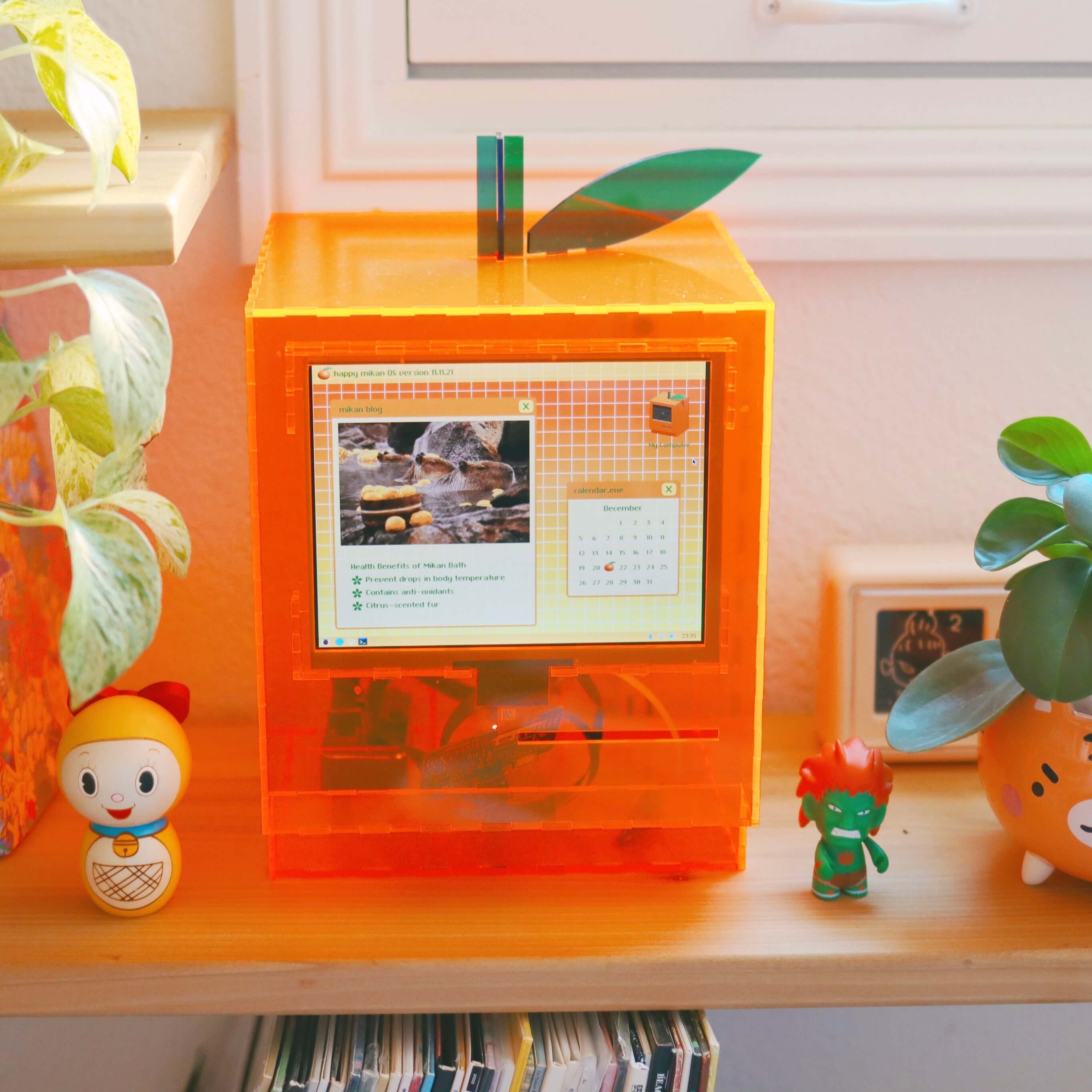
3rd, I’m hooking up a tiny thermal printer, like the ones that print receipts, to a Raspberry Pi and small display screen. I’m hoping to program a short quiz people can take, that makes the printer print out a little “receipt” of reading recommendations you can take away, based on metadata in my reading database. I’d been working to construct a neon acrylic case that looks like a retro Mac to hold the display and printer, again figuring out how to make a simpler approximation of someone else’s art, in this case SailorHg’s “While(Fruit)”. But naming my collection a “Zine Bakery” got me excited about instead hiding the receipt printer inside a toaster, so the receipt paper could flow out of one of the toaster’s bread holes. You can read more about these book-adjacent making projects at TinyUrl.com/BookAdjacent, or the zine project at ZineBakery.com.

Unrelatedly: resin!

Completely unrelated to reading: I’ve been learning how to do resin casting! You can think of resin like chemicals you mix up carefully, pour carefully into molds over multiple days and multiple layers of pouring with various pigments and embedded objects, and carefully try not to breathe. It hardens into things like this silly memento mori full-size skull I made, where I’ve embedded novelty chatter teeth and a block of ramen for a brain. Or for this necklace, I embedded multicolor LED bulbs in resin inside of D&D dice molds.

Third slide from my DH2024 #DHmakes talk, showing photos of a translucent frosted resin skull with a ramen brain and chatter teeth, and a light-up D&D dice necklace

(See my recent post on resin casting for more about this work!)

Come #DHmakes with us!

I’ve discovered I really like the experience of learning new crafts: what about it is unexpectedly difficult? How much can I focus on the joy of experimenting and learning, and grow away from frustration that I can’t necessarily make things that are pretty or skillful yet? So I’ve got a weird variety of other things cooking, including fixing a grandfather clock, building a small split-flap display like in old railway stations (but smaller), mending and customizing clothes to fit better, prototyping a shop-vac-powered pneumatic tube, carving and printing linoleum, and other letterpress printing.

To me, the digital humanities is only incidentally digital. The projects and communities I get the most from take a curious and capacious approach to the forms, methods, fields we can learn from and apply to pursue knowledge, whether that’s coding a website or replicating a historical bread baking recipe. #DHmakes has helped me bring more of that commitment to experimentation into my life. And with that comes the joy of making things, being creative, and having an amazing supportive community that would love yall to share whatever you’re tinkering with using the #DHmakes hashtag, so I hope you join us in doing that if you haven’t already!

* Some of the text of this talk is replicated from my Spring 2024 peer-reviewed article, “Book Adjacent: Database & Makerspace Prototypes Repairing Book-Centric Citation Bias in DH Working Libraries”, in the DH+Lib Special Issue on “Making Research Tactile: Critical Making and Data Physicalization in Digital Humanities”.

A Limited Comparison of Louisa May Alcott and Harriet Tubman

2024年8月5日 12:00

A Co-authored Series of Posts ‘About 1919,’ that is, about English-language books published from 1914 to 1921, according to the online bibliography and database, Collective Biographies of Women.

Comparing American Women of Achievement, White or Black, in Books, Statues, and Plaques

Louisa May Alcott and Harriet Tubman

We feel compelled to say more about a connection Lloyd Sy made between Louisa May Alcott and Harriet Tubman, women who were contemporaries but so differently represented in cultural memory. Today, CBW as a modern research database brings disparate figures together, a format that encourages critique of their selective representation in older biographical texts. But Lloyd’s blog post compared tables of contents of 1919 that show Alcott and Tubman in separate cohorts, that is, they are not “siblings” as we call the female subjects of chapters in the same table of contents. They never appear in the same book of female biographies until about fifty years after World War II: 1994 and 1995, in the second wave of feminist historiography.

  1. p007 Herstory 1995
  2. p109 100 Women Who Shaped World History 1994

As a context, note especially Isabel’s painstaking bibliography of collective biographies of women 1914-1921. Each of us in this blog series has relied on selective examples, two books, two women, one or two biographers, just as we have limited ourselves to CBW texts published during and a bit after world war. Isabel aptly commented on Lloyd’s notice of Louisa May Alcott (RR=34) and Harriet Tubman (RR=16) as two notable women who occupy quite different documentary social networks in CBW. Alcott and Tubman are “members,” respectively, of an all-white and an all-Black collection of American women published in 1919, as Lloyd’s examination of Bradford’s and Brawley’s collections shows.

As a historian, Isabel wrote to Lloyd to “acknowledge some limited similarities between Alcott (1832-1888) and Tubman (1822-1913) as abolitionists, suffragists, and social reformers objecting to current conditions of labor.” Isabel rightly highlights two more types of biographical data for a prosopographical comparison of these women: war service (US Civil War circa 1863) and disability. Alcott attributed decades of illness to mercury poisoning from typhus treatment received during her three-month service as a Civil War nurse between 1862 and 1863. While contemporary scholars interpret symptoms as suggesting Alcott endured lupus before her early death, Alcott’s own hypothesis intertwines her physical suffering with national trauma. Earlier in the century, Tubman suffered a nearly fatal head injury at the hands of a white overseer and never fully recovered, with symptoms of hypersomnia, extreme fatigue, and epilepsy. During the Civil War, Tubman started her military service as army cook and nurse, before switching roles to scout and spy in early 1863.

Yet we can see great disparities between these lives, inextricable from race and U.S. history: Tubman was deprived of education, whereas Alcott grew up in an educator’s household. Isabel further suggests a spatial measure of the intersecting disadvantages of a Black formerly enslaved person in terms of “generational land and house networks,” in her words, which continue to shape different economic fates according to race in the US.

Alison picks up on Isabel’s spatial observation about the locations of these biographies. In her book Homes and Haunts, Alison traced the history of literary house museums and the writing about them, both in North America and in Britain. In How to Make It as a Woman, the basis of the CBW project, she began her studies of statues of women and other public prosopographies (lists of names, portraits, short biographies) such as Halls of Fame as well as books. Returning to Lloyd’s post about 1919 books: Gamaliel Bradford’s American Women mostly lived in New England (Concord, Boston, Hartford, Amherst) and their fame and the status of their writing led to preservation of their houses as museums, comparable to recognition of male authors.

Color photograph of Louisa May Alcott's Orchard House, Concord, Massachusetts, the original for the house in her novel, Little Women
Color photograph of Louisa May Alcott’s Orchard House, Concord, Massachusetts, the original for the house in her novel, Little Women

Several of Brawley’s Women of Achievement achieved much in the Washington DC or Philadelphia circles where post-Civil War freed Blacks of some means could become prominent in arts and politics. Following Tubman’s chapter, Brawley devotes the remainder of the volume to the educators Mary Church Terrell (1863-1954), Mary McLeod Bethune (1875-1955), Nora Gordon (1866-1901), and the artist Meta Warrick Fuller (1877-1968). Tubman’s life in a previous generation, born enslaved, appears the opposite of settled in her many rescue missions. She brought her parents to Canada before settling in retirement with them in Auburn, New York, remote from her upbringing and from the hubs of (Euro)American and African American intellectual life. Historic homes associated with Tubman contrast with the single-household format of many authors’ house museums - today’s Harriet Tubman National Historical Park in New York encompasses her residence, the Harriet Tubman Home for the Aged, and the Thompson A.M.E. Zion Church. Tubman is honored in several civic statues today, ranging from the 1914 memorial tablet depicted in a120 Homespun Heroines and Other Women of Distinction, to Nina Cooke John’s 2023 statue replacing a 1927 Columbus monument. Frances E. Willard, possibly the only Midwesterner in these two books, organized internationally in the Temperance movement; she now stands as a statue in the US Capitol building. A statue of Mary McLeod Bethune stands among bronze Black children to indicate her educational mission (erected 1974), opposite a controversial 1876 statue of Abraham Lincoln with a kneeling enslaved man, in a Capitol Hill park in Washington, DC, Washington’s first public “memorial to honor an African American” and “first portrait statue of an American woman”. A statue of Mary McLeod Bethune was placed to represent Florida in the U.S. Capital building in 2022.

Further research could map plaques such as the one for Mary Church Terrell on the corner of Seventh Street and F Street, NW Washington, DC, in honor of her efforts to desegregate Washington restaurants and her suffrage activism; Terrell also helped to prevent the Daughters of the Confederacy from erecting a statue of an allegorical “Black Mammy” in that city. As statues and as biographical subjects, the memorialization of specific, named women makes important claims to local and national histories. Identifying limited similarities among the experiences of contemporaries typically depicted separately is not as directly applicable to these issues. However, the extent to which such similarities were ignored and obscured in previous eras of popular biography suggests the disruptive power of reading nineteenth-century contemporaries in less exclusionary frames.

Literary Landscapes

作者adhcadmin
2024年4月20日 06:51

Literary Landscapes

projects

Description

The literary movements and periods featured on this site represent the broad spectrum of American literature before the Civil War. For each category, students in two sections of Honors American Literature have provided an introduction to the period, biographical information about several authors important to the period, and some contextual historical information to help viewers better understand the literature of the period––the broader “literary landscape.”

Project Owner(s): 
Topic: Literature, History, Geography
Tool: WordPress
Methodology: 
Project Status: Active

The post Literary Landscapes appeared first on Alabama Digital Humanities Center.

HydroMind

作者adhcadmin
2024年4月20日 06:42

Hydrologic research generates large volumes of peer-reviewed literature across a number of evolving sub-topics. It’s becoming increasingly difficult for scientists and practitioners to synthesize this full body of literature. We explore topic modeling as a form of unsupervised learning applied to 42,154 article-abstracts from six high-impact (Impact Factor > 0.9) journals – Water Resources Research (WRR), Hydrology and Earth System Sciences (HESS), Journal of Hydrology (JH), Hydrological Processes (HP), Hydrological Sciences Journal (HSJ), Journal of Hydrometeorology (JHM), to provide a high-level contextual analyses of hydrologic science literature since 1991. We used a hybrid objective-subjective approach to label a number of broad topics in this body of literature, and used these labeled topics to analyze topic trends, inter-topic relationships, and journal diversity. The methods and outcomes of this endeavor are potentially beneficial to scientists and researchers who aim to gain a contextual understanding of the existing state of hydrologic science literature. In the long term, we see topic modeling as a tool to help increase the efficiency of literature reviews, science communication, and science-informed policy and decision making regarding global hydrological systems.

Project Owner(s): Mashrekur Rahman

Topic: Hydrology, Scientific Literature

Tool: WordPress

Methodology: Topic Modeling, Data Mining

Project Status: Live


The post HydroMind appeared first on Alabama Digital Humanities Center.

Siddhartha Chakraborti on his DH Journey

2020年10月10日 00:26
Any personal journey into a growingly universal medium and mode of living, which is what the Digital in an overarching and permeating manner has proven itself to be, becomes a monologue of the ‘self’ as a protagonist, that must be (and will be) read only with suspicion. We must be able to move from the […]

2025 rare books for Louvain 2025

2022年6月28日 15:53

In 2025, it will be 600 years since a university was founded in Leuven, the forerunner of today’s KU Leuven. In anticipation to these festivities, KU Leuven Libraries, in collaboration with UCLouvain, is putting its academic collection in the spotlight. Thanks to the efforts of the past months and years, images of 2025 rare books published by Leuven professors have now been uploaded to the Lovaniensia platform. However, this enormous growth – in May 2020, about 400 works were available digitally – is not the only reason why it is worth surfing to this website. There are also extra pages with information about the Old University of Leuven (1425-1797) and its various faculties, and the professors’ page was supplemented with biographical descriptions of some 130 professors (with even more extensive records for each professor in ODIS). In addition, via the filters it is now clear which works have been digitised internally or externally. And last but not least, thanks to a collaboration with Google Books, all works from the Leuven collection are now provided with an ocr layer, so that each work on the platform is now textually searchable.

William Wyndaele schenkt zijn voornamelijk historische collectie aan KU Leuven Bibliotheken

2022年6月2日 19:23

William Wyndaele, historicus en donateur van het Bibliotheekfonds Letteren, schonk zijn privécollectie van ongeveer 2000 hoofdzakelijk moderne wetenschappelijke publicaties aan KU Leuven Bibliotheken. De schenking betekent een welgekomen verrijking voor onze collecties, in de eerste plaats de collectie Geschiedenis, maar ook de collecties Klassieke Studies, Humanistische & Neolatijnse literatuur, Kunstgeschiedenis, Oosterse Studies en Theologie & Religiewetenschappen.

Opening The Future: A new funding model for OA monographs

2021年8月31日 19:30

Opening the Future is a collective subscription model for OA books. Libraries can sign up for its membership scheme, which implies that they grow their collections and support Open Access at the same time. The objective is to raise small contributions from a large number of academic libraries, so that no single institution bears a disproportionate burden.

How does it work?

A library subscribes to a backlist package of non-OA books offered by a publisher. The publisher makes this backlist package of non-OA books available to subscribers only (in other words: books in this package remain non-OA), but uses the subscription money to publish new books in OA. These new books are thus made available to everyone in OA, benefitting scholars and institutions around the world.

How it started and how it’s going

Opening the Future was launched by the COPIM project: an international partnership of researchers, universities, librarians, open access book publishers and infrastructure providers supported by the Research England Development Fund (REDFund) as a major development project in the Higher Education sector with significant public benefits, and by Arcadia, a charitable fund of Lisbet Rausing and Peter Baldwin. The Central European Press (CEP) piloted this model and was recently joined by the Liverpool University Press. Both programs are funded by  KU Leuven: membership for the  CEP program is financed by KU Leuven Libraries Artes, whereas membership for The Liverpool University Press program is funded via the KU Leuven Fund for Fair OA.

In June 2021 it was announced that Opening the Future has been shortlisted as a finalist for an ALPSP Award for Innovation in Publishing. ALPSP (Association of Learned and Professional Society Publishers) is the international trade association which represents non-profit scholarly publishing. The winner of the award will be announced during their annual conference on 15-17 September.


Over 100.000 e-books accessible for KU Leuven users through Evidence Based Acquisition

2021年4月26日 20:39

In 2021 KU Leuven Libraries Artes is participating in 5 Evidence Based Acquisition Projects. This results in over 100.000 e-books being accessible for a period of 12 months. At the end of this period, a smaller selection of titles will be acquired (perpetual access) by the library according to collection profiles and in consultation with the academic staff, and (this is why the acquisition method is called evidence based) reinforced by usage statistics. When the EBA Project ends, the library is free to engage for another term of 12 months, thus keeping the larger (not purchased) EBA-collection accessible.

Started in January 2021

Cambridge University Press: full collection* of e-books HSS (CUP + publishing partners)
Cambridge Core – Journals & Books Online | Cambridge University Press (kuleuven.be)

Taylor & Francis (Routledge): defined set of a limited number of preselected titles
Home | Taylor & Francis Group (kuleuven.be)

New from April 2021 onwards

de Gruyter: full collection of e-books (de Gruyter + publishing partners)*
De Gruyter (kuleuven.be)

Brill: full collection of e-books
Brill | Over three centuries of scholarly publishing (kuleuven.be)

Benjamins: full collection of e-books
Books | John Benjamins (kuleuven.be)

*not included: HTML text books, Cambridge Companions, Cambridge Histories

Library Central Services is working hard in order to make all individual titles accessible through Limo. There may, however, be a delay of up to one month in adding newly published titles. In the meantime, those titles can be accessed directly on the publisher’s platform.

❌