普通视图

Received before yesterday

Fellowships Are Temporary but DH Is Forever

2025年5月27日 12:00

I just finished my time in the Praxis fellowship, a year-long program that introduces PhD students to the various aspects of digital humanities. We concluded the program by presenting on all of our various projects that we worked on throughout the year. Leaving Praxis is hard for many reasons: where will I ever find a group of four other PhD students that I love to work with so much? How can I ever have so much fun in a classroom again? And where am I supposed to go to get my weekly little bowl of cheese that Jeremy Boggs would often provide?

While my structured time in the Scholars’ Lab is over, I realize that I now see potential DH projects wherever I go. A former Praxis fellow asked, during our final presentation, how we would want to expand on our hackathon project that analyzed the 1913-1934 issues of UVa’s satirical newspaper The Yellow Journal. I responded that I would like my cohort to present our poster at a conference and maybe even turn it into an exhibition. The month-long hackathon was hopefully only just the beginning of using digital humanities methods to engage with questions of satire and anonymity.

Brandon and I have also briefly discussed working on a DH project about the reality competition TV show Survivor. As noted in my previous blog post, I am unfortunately a huge fan of Survivor and treat every season like it’s my personal March Madness with weekly watch parties and a competitive bracket. Since the main game mechanism of Survivor is “tribal council” where someone is voted off the island every week, tracking voting stats (and stats in general) has become a huge part of being a fan of the show. For example, fans will count how often a player voted with the majority in order to determine how well they’re playing the game. Players are also judged by how many collective days they’ve been on the island, with Boston Rob lasting 152 days over 5 seasons and Parvati Shallow lasting 149 days over 4 seasons. There’s even an entire subreddit called r/Edgic (or “editing logic”) dedicated to figuring out who the winner of a season is based on how much screen time they’re edited to have and what music plays in the background of their confessionals.

There is seemingly an endless supply of “data,” including the transcripts of all 597 episodes of Survivor, to use for DH projects. I think back to one of our first text analysis assignments during Praxis: writing a code that could read the text of Much Ado About Nothing and track the total number of lines said by the two main characters, Benedick and Beatrice. That lesson could easily be applied to the transcripts of the Survivor episodes: how much more are men talking in each season? Does this change over time? Do winners speak the most? How do numbers of confessionals relate to who is voted out?

Aside from those projects that are very far outside of my own area of research, I also have been thinking about how DH informs my art historical research and intervenes in exhibition spaces. Back in November, I went to New York City on a marathon 24-hour trip to visit the Metropolitan Museum of Art, the Museum of Modern Art, and the Whitney Museum of American Art. The highlight of the trip was the Whitney’s exhibition Edges of Ailey that celebrated the life and work of the dancer Alvin Ailey (1931-1989). I was attended the exhibition on a Friday evening when tickets are free and the museum is open until 10pm. The pleasantly crowded and dimly lit gallery space filled with pumping music almost resembled a nightclub instead of a museum. Above the selections of paintings, sculptures, and archival materials, there were several performance recordings projected onto the wall in a frieze that ran around the perimeter of the room. As I walked around the gallery, I thought about how much of this multimedia exhibition was made possible through DH work. It’s difficult to capture the legacy of a dancer in a space usually reserved for static materials, but the curators used timelines and data visualizations to draw connections between the wide range of displayed objects. It was clearly effective; I’ve never seen the Whitney so packed with people from every demographic (even on other free Fridays).

My current research is about Indigenous Australian video installations and performance pieces. Displaying these dynamic works in traditional gallery spaces requires a different type of intermedial design and curation. I think that DH work is the answer to a lot of the issues that multimedia installations pose. DH has the power to transform the museum space from an archive into an intercultural experience.

I am nervous about publishing this post because what if I don’t follow through on any of these projects, and this post acts as documentation of my failed aspirations? But I guess that isn’t the point… this post is about how Praxis made me think about everything through a DH lens, leading me to new questions that I wouldn’t have thought to ask before. Now every time I watch Survivor I have Brandon Walsh’s voice in my head saying “our next project awaits!”

Digital Humanities is Exactly Like The Real Housewives

2025年5月5日 12:00

In 2020 during lockdown, I developed a surprising new interest: reality TV. I never watched reality TV growing up but suddenly I had unbridled time to watch all forty seasons of Survivor in about six months. As my reality TV journey has led me to many different shows since then (Big Brother, The Traitors, and Love Island USA), I’ve now settled on a new project of conquering all twelve installments of The Real Housewives. With this ongoing and all-consuming project in mind, I’ve discovered that Digital Humanities is nearly indistinguishable from the concept of The Real Housewives.

  1. Digital Humanities and The Real Housewives were invented around the same time. As I learned during one session of Praxis, DH was originally called “humanities computing” until the book A Companion to Digital Humanities was published in 2004. This circumstantial rebrand wound up having long-running effects on how the field thinks about itself. The first season of The Real Housewives premiered in 2006, only two years later (causal relationship?).
  2. Digital Humanities and The Real Housewives both have misleading names. As we’ve learned throughout the semester (and from Oriane’s blog post), there are no restrictive rules around what is and what is not a DH project. Our DH workshops didn’t even involve working with digital tools, but instead introduced participants to different interdisciplinary methodologies. Similarly, The Real Housewives is a misnomer because its stars are generally not housewives. They’re often successful businesswomen and sometimes aren’t even married. Being a “housewife” is a very loose term that encompasses a lot of different types of people.
  3. Digital Humanities and The Real Housewives are both people-centric. If you haven’t watched The Real Housewives before, every episode basically consists of wealthy women having conversations in different locations and at varying volumes. The most compelling part of the show is how the women solve (or fail to solve) complex interpersonal conflicts. I too have complex interpersonal conflicts with people in the Scholars’ Lab (Jeremy Boggs)1 but that isn’t the point… Digital Humanities is also about drawing connections between critical humanities questions and digital tools/methods. DH work is collaborative, interdisciplinary, and dialogic.
  4. Digital Humanities and The Real Housewives defined my second year of grad school. This year has been really tough for me academically: I had to submit my Qualifying Paper back in November and this month I will take my comprehensive exams. I use my brain all day long for really hard things so the last thing I want to do is watch TV that uses it even more. The Real Housewives is the perfect show to watch to escape the horrors of grad school. I feel the same about Digital Humanities… the projects that we worked on in Praxis were so different from what I was doing in my own research that it felt like an exciting and stimulating relief from my other academic pressures. Praxis meetings quickly became the highlight of every week… as did my Real Housewives of Salt Lake City study breaks.
  1. I once completely accidentally implied that Jeremy was old (or more like showed my own age by not knowing about pre-1998 gaming consoles) and now we have Real Housewives-style brawls about it during Praxis (but the fun kind). 

Our Journey to Praxathon

2025年4月18日 12:00

My cohort just finished our second week of Praxathon and I wanted to reflect on the development of our project and how we ended up focusing on conducting text analysis of the UVa students’ satirical publication, The Yellow Journal.

For me, this project started back in 2018 when I was accepted into The Yellow Journal as a second year undergraduate student at UVa. The Yellow Journal is an anonymously-published satirical newspaper that has operated on and off since 1913. Undergraduate students know The Yellow Journal for its members’ semesterly tradition of disrupting libraries during the first day of finals by raucously distributing the publication while masked and wearing all yellow… and often blasting Yellow by Coldplay or Black and Yellow by Wiz Khalifa on giant speakers. I started my tenure as a satirical writer with the headline and article below:

Hardest Part of Getting Accepted into the Comm School is Needing to Replace All of Your Friends, Student Says

As the season of applying to the McIntire School of Commerce approaches for second years, older students reflect on their prior application experiences. Kody, a fourth year in the Comm school, explains that the application itself was easy; he had no doubt in his mind that he would get in. The hardest part was letting go of all of his non-Comm friends afterwards. “I just can’t let failure into my life,” Kody explains. “Once you’re in the Comm School, you have to start setting standards for your friends, and most of my friends weren’t meeting mine.” Kody was on the fence about keeping his Batten friends, but eventually decided against it. “Hanging out with them is bad for optics, in my opinion,” Kody stated. “While Batten kids are also good at networking, I can’t let their morals get in my way. They’re all about government intervention… hey dummies, what about the invisible hand?” Drew, an Economics major, elaborates on his ended friendship with Kody: “The minute my roommate Kody got accepted, he turned to me and asked me to move out. I was heartbroken, we had been living together since first year. In fact, he’s also my cousin. But I understand… it had to be done.” Drew wasn’t sure if it was worth it to even continue college after his rejection from Comm. To him, having no diploma at all is better than getting an non-Comm Economics degree.

Outside of writing headlines and articles, Yellow Journal members were also in the midst of digitizing and archiving the entire history of the paper on our Google Drive. The publication started in 1913, but it was only published regularly starting in 1920 and then was subsequently banned in 1934 by the UVa administration due to its anonymity. The publication then resumed in 1987, having its own office next to The Cavalier Daily with a modest amount of revenue from selling ad placements. The paper was discontinued again in 1999, but a group of students revived it in 2010 which resulted in its current, ongoing iteration.

In late 2019, I realized that we were approaching 100 years since The Yellow Journal was published regularly and I applied to a few grants that could possibly fund a special anniversary issue. I wanted to use the extensive archive work that members had so painstakingly organized for future members to look back on. The idea was to publish some highlights from our archive, especially the jokes that still remained relevant today. With quarantine in March 2020, however, interest from my collaborators waned and I eventually abandoned that project. I knew that I wanted to return to working on a project about The Yellow Journal someday because it provided such unique insight on the student experience of the University. Also, even 100 years later, many of the early issues are still so funny.

My position as a former member of The Yellow Journal was definitely the reason that the subject was brought up as a possible topic for our Praxathon, but I don’t think this project would have necessarily worked with other cohorts. The final section on our charter is titled “Make Learning a Playful Process.” That was a big goal of our cohort: to approach the work in a fun, lighthearted way. I wasn’t completely sure about the viability of that pledge when we first wrote the charter. I didn’t know the rest of my cohort well at the time and I was still very operating in “traditional graduate classroom” mode. As we are approaching the end of the year, however, I think I can now safely say that we made every single part of Praxis fun and playful. I spend a good portion of my time in Praxis attempting to stifle my laughter at Oriane’s 10,000 things to commit to Github, Shane’s river drawing, or Brandon attempts to find new phrases because we accidentally made him insecure about saying “for what it’s worth.”

When I first pitched The Yellow Journal as an idea for Praxathon, I was mainly thinking about how it made sense as a project in a practical way: we already had access to high quality digitized records of all of the issues. The scope seemed manageable and it did not require too much preparatory work. As we’ve progressed in the project, I’ve slowly realized why it resonated with us as a group beyond logistics. Since we’re all graduate students at UVa, we are all familiar with and invested in the University’s history (especially told from a student perspective). We want to have fun with the material, which has led to many instances of us sitting in the fellows lounge and reading funny headlines out loud to each other.

Most of all, I think that the way we’ve developed the project has played into our individual and collective strengths. I never even thought about looking at student records from the 1920s and 30s but Gramond, being an incredible historian and lover of data, introduced us to that possibility. Oriane has done some amazing research on the history of the University at the time period that we’re looking at and, more generally, on analyzing satire. Because of her research of poetry, Amna was already interested in many of the text analysis methods that we’re using so she has expertly led us in thinking about how to apply those to The Yellow Journal. Kristin, as always, has shown herself to be an amazing problem solver, ready to tackle any coding task with such resolve and creativity. I just love assigning tasks to people so I have commandeered our Trello board.

Our poster will hopefully be done in the next few weeks, but it is clear to me now that the process, or journey, through the Praxathon is much more important than the end product. As I read through our charter again, I realize how true to our goals we’ve been and how interdisciplinary (and fun!) our final project is.

Global Digital Humanities Conference: Zine Bakery: borderless DH research, methods training, and scholarly communication via zines

2025年4月7日 12:00

I presented about the Zine Bakery today at the Global Digital Humanities conference last week. Below are some links that had to fly by on my screen, so folks have more time to peruse them.

I’m on Bluesky at LiteratureGeek.bsky.social if you want to chat there!

Key parts of Zine Bakery

Where to find zines:

Citations & further reading

Fox, Violet B. et al. “The zine librarians code of ethics” web resource, zine. November 2015. zinelibraries.info/code-of-ethics-1115-web-version.

Freedman, Jenna, et al. Zine Union Catalogue web resource. zinecat.org.

Nemergut, Nicole Acosta. Teaching with Zines zine. 2018. github.com/zinecat/zinecat.org/blob/master/Documents/Teaching%20with%20Zines%20-%20Acosta.pdf.

Sahagian, Jacqui. “Zine-making as Critical DH Pedagogy”. Scholars’ Lab blog post, January 14, 2022. scholarslab.org/blog/workshop-zine-translation.

Stevens, Amanda, et al. Zine Subject Thesaurus web resource. anchorarchive.org/subject-thesaurus.

Visconti, Amanda Wyatt. “Book Adjacent: Database & Makerspace Prototypes Repairing Book-Centric Citation Bias in DH Working Libraries”. DH+Lib special issue, Spring 2024. dhandlib.org/?p=154321.

—. Zine Bakery. ZineBakery.com. Project’s research blogging includes:

—; Quinn Dombrowski; Claudia Berger. “#DHmakes: Baking Craft into DH Discourse”. Korean Journal of Digital Humanities, 1(1), 73-108, 2024. accesson.kr/kjdh/v.1/1/73/43507.

Walters, Jess. “Zines” (Walters’ zines & work, including zines for disability jistice community, learning, advocacy). jesswaltersart.com/zines

Pixels, paper, politics: a digital humanist booklab with an intersectional transfeminist frame

2025年3月25日 12:00

The following is an accepted proposal I submitted to the international Feminist Media Histories journal special issue on “Craftwork within the Digital”, guest-edited by Christina Corfield and Whitney Trettien. In addition to giving a preview of my piece, I thought this might be helpful to folks looking to propose journal articles for the first time.

I propose creating a one-page website consisting of a written scholarly artist statement and 3 digital, printable zines.

The written introduction will consist of 2-4 pages of text exploring the intersections of craft/method-expansive makerspaces and the digital humanities (DH) for feminist practice, including through recounting my zine and #DHmakes community work. I’ll particularly focus on the affordances of one book arts methods and especially letterpress printing craft, offering a list of intersectional, transfeminist values including justice, care, and abundance and how this method offers opportunities to practice these values. I’ll also provide a short, hyperlinked bibliography of free online scholarly readings related to these topics.

Finally, I’ll present a model of one feminist + digital craft case through an overview of how I’m developing my DH-center-based booklab based on intersectional, transfeminist values, to fill local gaps in book arts accessibility, including through:

  • Low-barrier, friendly, safe/hard-to-break printing experimentation available for no cost
  • Building support for inclusive and multilingual printing, especially for non-Latin scripts, Braille, and other typefaces uncommon or difficult to procure in the U.S., with one goal being all lab visitors always have the type available to correctly print their names
  • Experimental & digital humanities explorations, applying our makerspace and prototyping expertise to develop custom, cheaper, and/or otherwise unavailable typefaces and printing apparatus (e.g. to address the dearth of multilingual options), and explore other connections between hands-on book arts practice and our DH skillset
  • Maintaining a free, public zine rack stocking social justice-related titles
  • Growing a collection of historical LGBTQIA+ letterpress blocks, and publishing these in an online gallery; lasercutting wood to create new LGBTQIA+ letterpress blocks to expand what’s available, and sharing the design files and instructions so others may replicate these

The 3 zines associated with this piece will be readable online, as well as by printing and folding. Each will use a feminist-tech tutorial approach (à la Julia Evans) to make introductory letterpress practice more accessible in both a tacit knowledge and a monetary expense sense, covering three topics:

  1. finding your first press
  2. finding your first letterpress type
  3. doing your first typesetting and printing
    I plan these zines to be similar in depth of content to my recent co-authored “DIY Web Archiving” zine, and the zines’ design/polish level to be similar to my co-authored “Speedweve for Mending” zine. I have existing experience with the required methods (web design and zinemaking) for this proposal, and do not need support in achieving them. I have a draft outline and notes toward writing all three zines completed already, so the remaining work is doable during this CFP’s timeframe.

Bio:
Dr. Amanda Wyatt Visconti (they/them) is Director of the Scholars’ Lab, an internationally recognized digital humanities research center; and both a researcher and practitioner of book arts and making (e.g. letterpress, zines, resin, data embodiment). An active contributor to the #DHmakes community, in just the last year they’ve organized a 7-session public zoom series teaching craft methods to digital humanists (#DHMakes Methodz Talks), written and published two zines on craft methods (mending with Sam Blickhan; lasercutting) in addition to four other zines, and published two peer-reviewed journal articles on scholarly making (book-adjacent, data-powered making; #DHmakes community history, with Quinn Dombrowski and Claudia Berger). Their scholarship includes intersectional, transfeminist bibliography and digital humanities research coding, and they hold a Literature Ph.D. and Information M.S. both focused on digital humanities human-computer interaction.

Lasercutter Letterpress: reusable designs for letterpress printing blocks, stickers, & more

2025年3月2日 13:00

I’ve been experimenting with lasercutting type-high wood to make letterpress blocks for letterpress printing (read more & pretty pictures here). Since someone asked on Bluesky, I’m now sharing some of the recent files I’ve lasercut, which are free to use with a CC-BY-NC license, which means you need to credit me when sharing them (Amanda Wyatt Visconti / AmandaVisconti.com) and cannot sell them nor include them in a sold thing.

You can use these for stickers or other purposes; to lasercut them for printing on wood, lino, or other materials, reflect (flip) the images horizontally before carving, so they read correctly when pressed against paper with ink. Here’s an example of one of the images I flipped and lasercut into wood for letterpress printing use:

Photo of a block of wood in a lasercutter, being cut to show a historical illustration of a Luddite, and the text "critical tech! no 'innovation' serving profit over people". Photo is from after 5 total lasercutter passes. Photo digitally flipped for readability.

“made with <3 by” with checkboxes for trans ally or trans printer; & fill-in trans pride flag

Download as: SVG or PNG. (CC-BY-NC Amanda Wyatt Visconti.)

Adobe Illustrator design intended for creating letterpress printing blocks by cutting via lasercutter onto wood, to use to print the image to paper with ink; to achieve this, the black & white colors are inverted. The image will also need to be horizontally flipped, so that when the block is pressed to paper the inked image is legible; but for social media viewing I have left it unflipped. The design is the text "made with love by" followed by checkboxes next to the options "trans ally!" and "trans printer!", followed by the outline for a trans flag you can color in after letterpress printing

“made by a trans ally!” & “made by a trans printer!” with fill-in trans pride flag

Download as: SVG or PNG. (CC-BY-NC Amanda Wyatt Visconti.)

Adobe Illustrator design intended for creating letterpress printing blocks by cutting via lasercutter onto wood, to use to print the image to paper with ink; to achieve this, the black & white colors are inverted. The image will also need to be horizontally flipped, so that when the block is pressed to paper the inked image is legible; but for social media viewing I have left it unflipped. The design is “made by a trans ally!” text next to the outline of a trans flag, which can be filled in later with color

Download as: SVG or PNG. (CC-BY-NC Amanda Wyatt Visconti.)

Adobe Illustrator design intended for creating letterpress printing blocks by cutting via lasercutter onto wood, to use to print the image to paper with ink; to achieve this, the black & white colors are inverted. The image will also need to be horizontally flipped, so that when the block is pressed to paper the inked image is legible; but for social media viewing I have left it unflipped. The design is “made by a trans printer!” text next to the outline of a trans flag, which can be filled in later with color

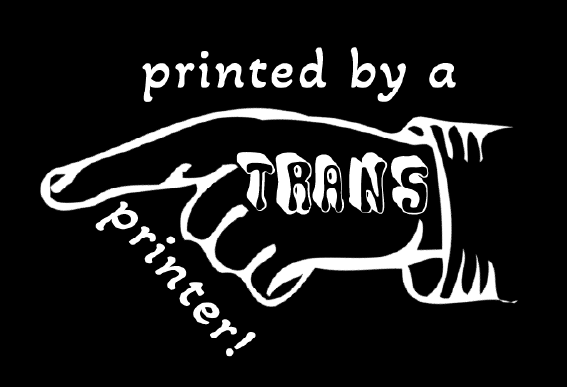
“made by a trans printer!” on manicule with Erin Moore’s Vision font on “trans”

Download as: SVG or PNG. (CC-BY-NC Amanda Wyatt Visconti.)

Adobe Illustrator design intended for creating letterpress printing blocks by cutting via lasercutter onto wood, to use to print the image to paper with ink; to achieve this, the black & white colors are inverted. The image will also need to be horizontally flipped, so that when the block is pressed to paper the inked image is legible; but for social media viewing I have left it unflipped. The design is a pointing hand that says "printed by a trans printer!" The word "trans" is on the back of the hand, in Erin Moore's groovy Vision font.

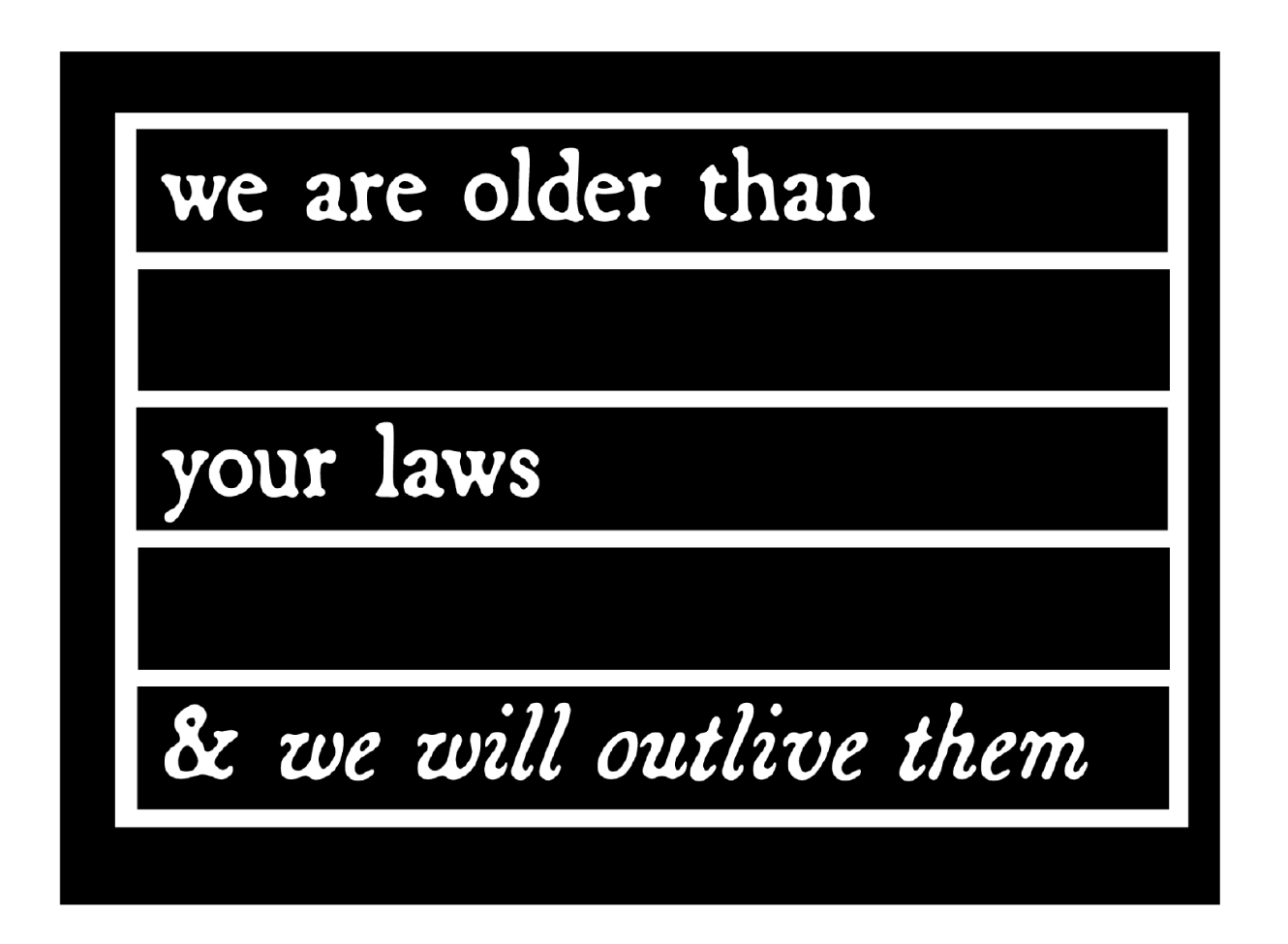
“we are older than your laws and we will outlive them”

The text in this design quotes the text from CoyoteSnout’s art, which quotes an old Yiddish lyric with a 20th-century history of resistance/defiance to Jewish persecution and murder (“we will outlive them”) put into the context of trans rights (there have always been trans people).

Download as: SVG or PNG. (CC-BY-NC Amanda Wyatt Visconti.)

Adobe Illustrator design intended for creating letterpress printing blocks by cutting via lasercutter onto wood, to use to print the image to paper with ink; to achieve this, the black & white colors are inverted. The image will also need to be horizontally flipped, so that when the block is pressed to paper the inked image is legible; but for social media viewing I have left it unflipped. The design is “CoyoteSnout’s text “we are older than your laws & we will survive them” in an antique broadside-style typeface, all over a flag-shaped rectangle divided by by bars into 5 equal sections so it can be later colored in with trans or other pride flag color schemes

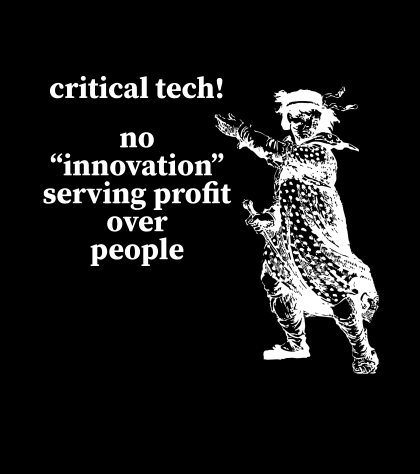
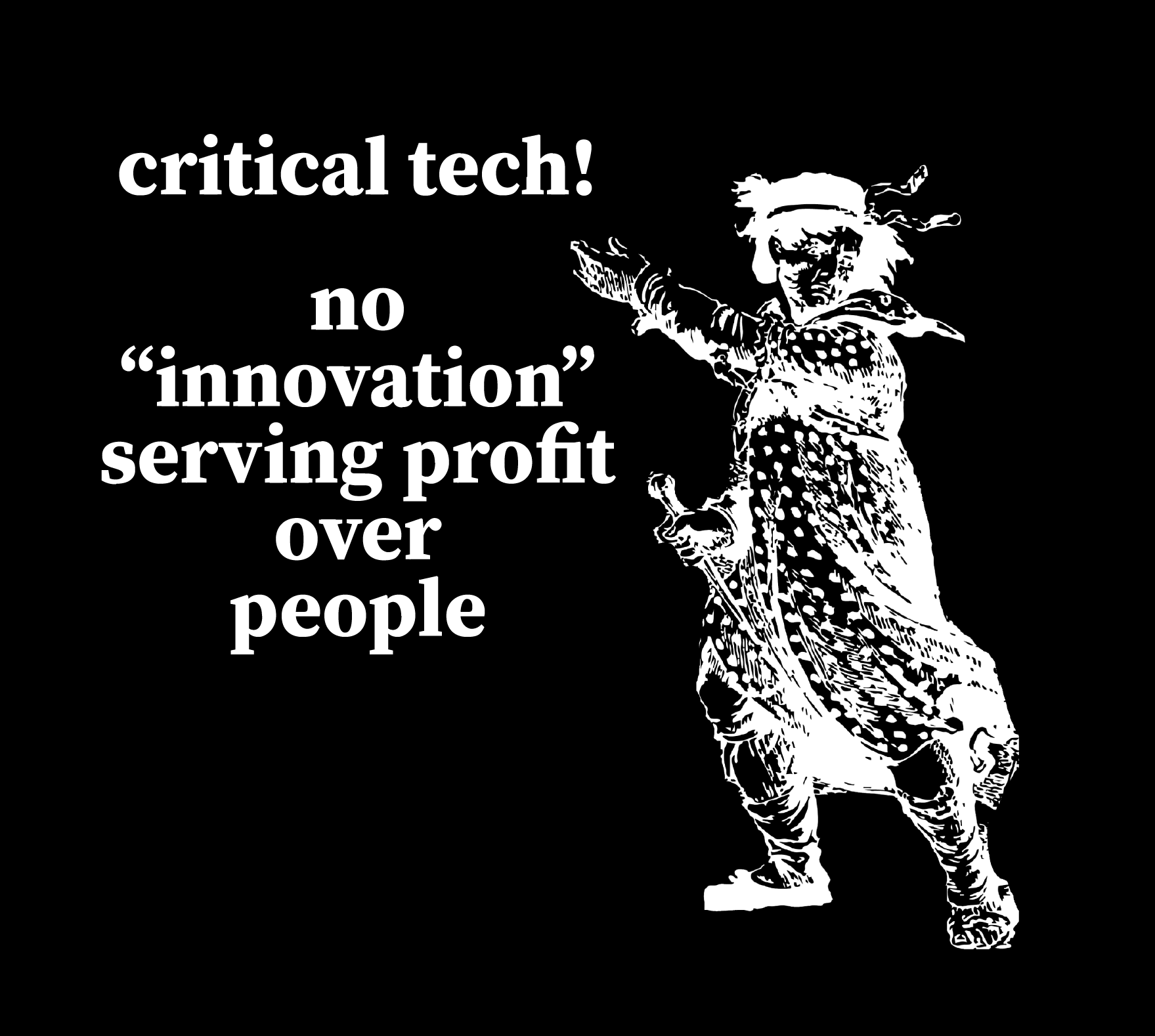
“Critical tech! No ‘innovation’ serving profits over people” + Luddite

This uses a personally digitally edited version of a public domain image from a historical illustration of a Luddite.

Download as: SVG or PNG. (CC-BY-NC Amanda Wyatt Visconti.)

SVG file of an Adobe Illustrator design intended for creating a letterpress printing block by cutting via lasercutter onto wood, to use to print the image to paper with ink; to achieve this, the black & white colors are inverted. The image will also need to be horizontally flipped, so that when the block is pressed to paper the inked image is legible; but for social media viewing I have left it unflipped. The design shows a historical drawing of “the general of the Luddites” edited to be easier to print from a letterpress block, next to the text “critical tech forever! / no 'innovations' serving profit over people.” in antique broadside-style font.

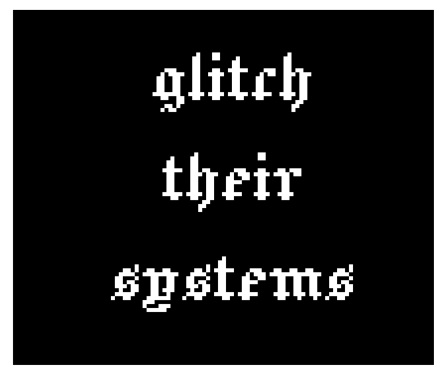
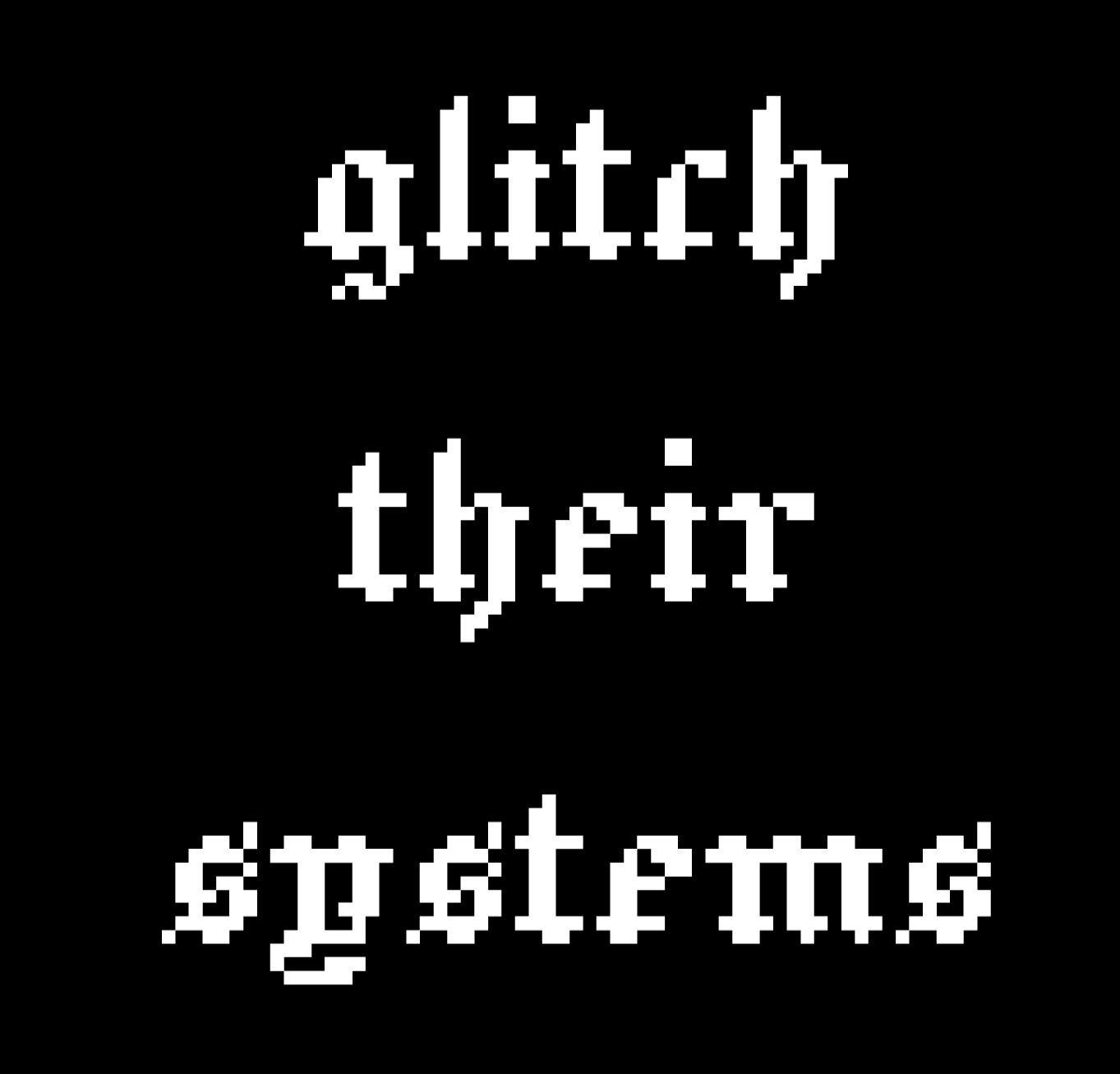
“glitch their systems”

Download as: SVG or PNG. (CC-BY-NC Amanda Wyatt Visconti.)

Adobe Illustrator design intended for creating letterpress printing blocks by cutting via lasercutter onto wood, to use to print the image to paper with ink; to achieve this, the black & white colors are inverted. The image will also need to be horizontally flipped, so that when the block is pressed to paper the inked image is legible; but for social media viewing I have left it unflipped. The design is “glitch their systems” in a pixelated old English font

Lasercutter Letterpress: making my own letterpress printing blocks—with lasers! and fire!

2025年3月1日 13:00

I’ve been experimenting with lasercutting type-high wood to make letterpress blocks for letterpress printing with, greatly helped by forum posts on the BriarPress.org letterpress community site about topics like type-high wood/shims and lasercutting viability (for example). I wrote up my work to share there in return, and wanted to blog it as well in case it can help others.

Here’s the best lasercut letterpress block I’ve made yet! I’ll update with a print once I next get to use the local Vandercook with it. Photo of a block of wood in a lasercutter, being cut to show a historical illustration of a Luddite, and the text "critical tech! no 'innovation' serving profit over people". Photo is from after 5 total lasercutter passes. Photo digitally flipped for readability.

Here’s the art I used to make it, digitally flipped for readability (for non-letterpress folks: the cut block needs to be reflected horizontally, so when pressed to paper with ink the image comes out correctly): Screenshot of a black and white SVG image file of a historical illustration of a Luddite, and the text "critical tech! no 'innovation' serving profit over people". Photo digitally flipped for readability.

Fun images first, followed by in-depth details of what/why/how below

Skip past them for detailed info on why/what/how, for folks who want that. Any cuts that look like I made them wrong (that are readable left to right, thus would print wrong) are actually digitally flipped to make your reading easier; I just got was lazy about including a note to that effect on each one.

Earliest tests, using only 1 lasercutter pass

These produced pretty shallow cuts; they could be printed okay on a Vandercook, with some of the chatter because I was lazy and wanted to print a bunch of slightly-different-heights cuts at the same time without packing under individual cuts to balance them all, and also didn’t sand/seal these at all before printing (some of the chatter was from the height being shallow, though). I also deliberately kept some of the prints with more chatter, as I thought the wood-grain effect was neat, and wanted to remember to explore deliberately including it on some cuts in the future (as well as cutting deeper to avoid it on most cuts). Photo of a letterpress wood block inked in navy ink, with an image on it of a pointing hand that says "printed by a trans printer!" The word "trans" is on the back of the gand, in Erin Moore's groovy Vision font. The photo has been digitally flipped for readability. Photo of a letterpress print made on white paper with navy ink of a pointing hand that says "printed by a trans printer!" The word "trans" is on the back of the gand, in Erin Moore's groovy Vision font. A corona of woodgrain pattern surrounds it.

Photo of a box of 5 letterpress blocks cut from maple wood with a lasercutter Photo of a letterpress print made on white paper with navy ink of a pointing hand. A corona of woodgrain pattern surrounds it.

Photo of letterpress print blocks made from wood and inked in navy ink. One says "Zine Bakery" in a pixelated font next to an icon of a zine, and the other says "made by a trans printer!" in a serif font. The photo has been digitally flipped for readability. Photo of a letterpress print made on white paper from navy ink. The bottom line says "Zine Bakery" in a pixelated font next to an icon of a zine, and the top line says "made by a trans printer!" in a serif font.

This one is especially fun, as it started as a shape cut from craft foam using safety scissors and printed on a BookBeetle; I then scanned the print, cleaned that scan digitally, lasercut it into wood, and printed from that. Photo of a lasercut dog image with long legs, raised up on a block of wood

You can see the cut is fairly shallow: Photo of a lasercut dog image with ling legs, raised up on a block of wood, viewed from the side to show how the image sits higher than the rest of the wood Photo of a letterpress print block made from a wood blick on white paper inked in navy ink. It shows a very long-legged dog silhouette with a woodgrain texture. Photo of a letterpress print block made from wood and inked in navy ink. It shows a very long-legged dog silhouette.

Here’s the original BookBeetle/craft foam print the above cut came from: Photo of a cardboard sheet holding a craft foam cut-out of the silhouette of a very long-legged dog, covered messily in mottled fluorescent blue and pink ink from being used to print with a BookBeetle letterpress. Photo of a Bookbeetle letterpress-printed print of the silhouette of a very long-legged dog, printed in mottled fluorescent blue and pink ink on white paper. You can see some extra ink splots outside the silhouettes from where I didn't cut a frisket to protect the parts of the paper I didn't want printed on

Photo digitally flipped for readability. Sometimes there is flame; optimally, there is not any (power was too high and/or speed too slow): Photo of a rectangle of wood inside a lasercutter, blossoming with orange flame at one end; the words "zine" twice in arow are visible on the wood's surface (inage digitally flipped for legibility)

Testing different laser methods & settings

Next two photos are digitally flipped for readability, zoomed in to show text height from block surface. On the “zines zines zines” block, each word looks slightly different because a different lasercutter method was used on each, with raster cutting deepest (far right) but also burning most, cut (far left) cutting least, and etch in the middle. It probably didn’t help I used subpar random mystery Ebay wood… Photo of two rectangles of wood cut into visa lasercutter to say "dogs" and "zines zines zines"; on the latter, each word looks slightly different because a different lasercutter method was used, with raster cutting deepest but also burning most, cut cutting least, and etch in the middle Photo of two rectangles of wood cut into visa lasercutter to say "dogs" and "zines zines zines"; on the latter, each word looks slightly different because a different lasercutter method was used, with raster cutting deepest but also burning most, cut cutting least, and etch in the middle. The photo is tilted to show the letters are cut to varying depths in the wood; all letters would be feelable with fingers, but only some are deep enough to easily get a clean letterpress print from them

Best outcome yet

“Critical tech: no ‘innovation’ serving profit over people.” 5 lasercutter passes, passes 1, 2 or 3?, 5 shown below (final photo digitally flipped for readability): Photo of a block of wood in a lasercutter, being cut to show a historical illustration of a Luddite, and the text "critical tech! no 'innovation' serving profit over people". Photo is from during the 1st of 5 eventual lasercutter passes. Photo of a block of wood in a lasercutter, being cut to show a historical illustration of a Luddite, and the text "critical tech! no 'innovation' serving profit over people". Photo is from after 2 or 3 total lasercutter passes. Photo of a block of wood in a lasercutter, being cut to show a historical illustration of a Luddite, and the text "critical tech! no 'innovation' serving profit over people". Photo is from after 5 total lasercutter passes. Photo digitally flipped for readability.

Why do this at all?

Because experimenting is fun; because you can make longlasting cuts from your own or other favorite images, including things you can’t buy historical or new cuts of; to design your own type (very advanced to do well); to have type in hard- or impossible-to-find (at least in the U.S.) languages and scripts (ditto). If you have free access to a good-enough lasercutter (eg thorugh a local library or college makerspace), the total cost can be very cheap in general (just the cost of evenly-cut maple blocks and one of many options for materials to make a shim bringing it up to type-high).

What lasercutter & settings?

I’m using the VLS 6.75 lasercutter (aka “Vader”) in Scholars’ Lab’s makerspace, for which I wrote my first zine (a cheatsheet on cutting and etching on acrylic using this lasercutter). You need to be trained by us before using it, but it’s available to anyone who can visit us in-person (no UVA affiliation needed!) and we offer both periodic workshops and 1:1 training by appointment. Non-commercial use is free, but you do need to bring your own materials to cut/etch (unlike our 3D printers, where we provide the filament for free for most non-commercial projects). Luckily, materials can be fairly inexpensive, starting from scrap cardboard, and even nicer looking wood can be fairly reasonable (e.g. a nicely finished bamboo cutting board from Ikea is a great lasercutting block, and costs ~$10).

The final 2 passes I did on the Luddite/critical tech cut above were set to 90 power, 90 speed, and 500 PPI, using 5 total complete lasercutter passes. I’ll continue tweaking those, and ideally I would have done maybe 7-8 passes but I ran out of time. (I varied the settings over the course of the 5 passes, but each took around 13 minutes, which included time the laser was doing nothing cutting the empty space above where my material was because I didn’t know how to move the start point lower, lol).

The SVG file producing the cut was color inverted so that the parts I wanted cut away were black, and the parts I wanted to remain raised were white. I also horizontally flipped the image so it would come out correctly readable when printed.

Finding a lasercutter

If you haven’t used a lasercutter before but are curious, I encourage you to ask a local or college/university librarian if they have or know of any nearby that can be used—with cheaper and smaller versions becoming more available, at least in the U.S. these seem to be popping up in more makerspaces in the last couple years. I’m not sure, but think the standing rather than tabletop kind are the ones with enough power (and safe venting requirements) to cut deep enough into hard woods, though other materials are also possible.

Materials

Lots of good posts if you search the Briar Press forum. For wood, end-grain maple seems to hit the sweet spot for price, hardness, results, but I’ve seen folks mention other options including cherry hardwood.

  • So far I’ve used type-high, maple wood blanks from Virgin Wood Press, McKellier, and Ebay old letterpress blanks with the lead piece chipped off (don’t put lead in a lasercutter, the fumes are toxic)
  • Non-type-high wood: get wood from anywhere cheaper (eg McClains) then add a shim (of wood, 3D printed block, tape, ?) to bring it to type-high
  • Other materials: acrylic (I’ve used this in a lasercutter, lovely results, very quick <2min cuts, can get fun seethrough neon colors!); harder (grey, not “EZ Cut”) or other labeled-laser-safe linoleum (thanks for advice from Ryan Cordell*)

What’s involved: basic

Basic lasercutter use is not overly complicated to learn, if you have some comfort using computer programs, especially saving image files containing letters or shapes from any drawing program. You use a drawing program such as Adobe Illustrator to create the lines or shape you want to cut or etch—any program that can save as an SVG file—give the lasercutter some info (e.g. what kind of material you’re cutting, how thick the material is), and position the material or image so the cuts happen in the right places, then click a button and it does the rest.

A more even and precise press (e.g. Vandercook, rather than hand-pressing or craft press) may be able to print cleaner from shallower-lasercut blocks.

What’s involved: intermediate

I’ve found the non-basic part to be figuring out the best lasercutter settings (such as speed and power) for the material you’re using. Harder materials take more power to cut into and to cut deeper. With wood, speed and power impact whether you get from zero burning, to small flames, to burnt wood.

So far, I’ve had the most success playing with these using cheap sample wood (though preferably of same/similar wood type and height to what you’ll ultimately use, so the settings work the same) to find the highest power (deepest cutting) and highest speed (finishes fastest) that don’t overly burn the wood, then doing multiple passes of the lasercutter (not touching the material at all in between, so that it remains exactly perfectly registered with the cuts going in the exact same places each time).

What’s involved: advanced

I’m not at any advanced stage doing this yet :) but lots of folks are, including users on the Briar Press forum, and some of the folks producing new wood type available via online stores too. Cordell recommended starting cuts on a lasercutter, then using a CNC router to dig out most of the wood farther away from the left-as-type-high bits faster and deeper than a lasercutter can.

There are also a number of folks creating blocks and type completely via CNC router; I took a very fun and informative virtual workshop from Ryan Molloy on this topic via Partners in Print last fall.

* P.S. Thanks to Ryan Cordell (Skeumorph Press) for generously sharing insights on his lasercutting letterpress experience. And unrelatedly, to the extremely generous Briar Press forum users platenman and jnbirdhouse, who’ve helped Scholars’ Lab be able to get closer to starting to teach full-size letterpress to the public!

Video Art and Digital Archives Part 2: The Time I Did Public Speaking About It

2024年11月6日 13:00

In my last blog post, I talked a little about the Mulka Project which is an archive in an Indigenous community in the Northern Territory of Australia. Mulka has two parts: the digital archive, which consists of historical and contemporary material, and the digital production house, which uses the archival material to produce installations and works of art. Mulka began as a digital repatriation project that aimed to give Yolngu people access to their own family documents. Before Mulka, Yolngu people had to travel to institutions across Australia and internationally in order to see photos, videos, and recordings of their family members that had been collected by anthropologists and linguists. Now, Yolngu people can just pop into Mulka and download these documents whenever they want.

I visited Yirrkala, the home of Mulka, last summer and got to see the archive in action. They have a computer room where people can access the archive and put anything they want on USB drives. They also have an auditorium where visitors can queue up videos to watch on the big screen. It was incredible to watch people download hours and hours of family videos, and then come back the next day to download even more. Photos and videos of elders are cherished by many people in the community.

Perhaps most relevant to my work, however, is the space where the “new stuff” gets made (that’s how people at Mulka refer to it). Shortly after Mulka started in 2007, artists became interested in incorporating the archival documents into their artistic practice. Yolngu artists have produced films, songs, sculptural works, and projection installations using the digital materials of their ancestors.

One artist who works at Mulka, Dhukumul Wanambi, was recently a finalist for the National Aboriginal and Torres Strait Islander Award in Multimedia. Her work was titled Gurka’wuy, the name of her father’s ancestral homeland, and featured the projected image of drone footage he recorded at Gurka’wuy surrounded by animated rings of his clan designs.

I had the privilege of moderating a panel with Dhukumul and another artist from Yirrkala, Milminyina Dhamarrandji, at the Asia Society in New York on Saturday, September 21st as part of the exhibition opening of Madayin: Eight Decades of Bark Painting from Yirrkala. It seemed so timely because I had just finished drafting my previous blog post about video art and the way that Indigenous artists are engaging with and building their own archives. I was not originally supposed to be the moderator for that event, but circumstance made it so that I had about 12 hours notice before I was supposed to get up on stage, in front of an auditorium of people at a major New York City museum, and facilitate a discussion about Mulka and Yolngu filmmaking. It was the first panel I ever moderated and it was going to be at such an immense scale!

After my initial freak out over being on stage and having to do public speaking, I reminded myself that my role was just to give Dhukumul and Milminyina the space to talk about what they wanted to talk about. It helped that I had been to Yirrkala recently and was such a huge fan of their work. Dhukumul talked so beautifully about how she wanted to use video to show the inextricable connection between land and Yolngu culture, like with Gurka’wuy’s footage of her father’s Country surrounded by his clan designs. The medium of video makes that connection so explicit while simultaneously acting as an archival document. Milminyina spoke about how important Mulka was for preserving culture for future generations.

Archives and their relationship with Indigenous people is very complex. Archives were used as a tool of colonization, stealing cultural objects in the name of “preservation.” There are many scholars who explain this ongoing history much more eloquently than I ever could. But it is really interesting to watch how Indigenous people conceive of and build their own archive, and how culturally generative Mulka has become.

Because I am only just starting my second year of my PhD, I am still in the process of trying to figure out what my dissertation project will be about. Coupled with my pursuit of Digital Humanities through Praxis, it feels like something keeps pulling me in the direction of video, performance, and the archive. And I’m lucky to know Dhukumul, Milminyina, and other artists who will continue to teach me about their art.

Emmy Monaghan with Dhukumul Wanambi and Milminyina Dhamarrandji at the Asia Society Emmy Monaghan with Dhukumul Wanambi and Milminyina Dhamarrandji at the Asia Society

Video Art and Digital Archives

2024年10月1日 12:00

“With the younger generation, video is more acceptable. Kids have phones, iPads, everything you know? So if you’re using this media that’s accessible to kids, you’re at least feeding culture and language into the digital space. The digital space right now, a lot of people are scared that it’s taking our young people away. Moving away from culture. So we need to put culture into that space, because that’s already where they are.”

- Colin Heenan-Puruntatameri, Tiwi artist

This quote is from an interview I did with Colin Heenan-Puruntatameri during the Darwin Aboriginal Arts Fair this past August. I study contemporary First Nations art from Australia, so I was lucky enough to visit his community, Milikapiti on the Tiwi Islands, back in June as part of my research for graduate school. I was introduced to art from the Tiwi Islands when I had the opportunity to curate an exhibition titled Performing Country at the Kluge-Ruhe Aboriginal Art Collection (March 2023-Februrary 2024). One of the galleries of the exhibition was entirely dedicated to Tiwi art and, through the research and consultation process of that project, I interviewed Tiwi artists about their work.

Performing Country was centered around the concept of performance and its relationship to art production. Much of Tiwi artistic practice is related to song, dance, and the performance of ceremony. The designs seen in prints and paintings in museum galleries are derived from the practice of painting the body for ceremony. When I started to speak with the Tiwi artists about their ideas of performance in artmaking, they introduced me to their recent work with video.

Video art is relatively new on the Tiwi Islands, with the first piece produced by their art center, Jilamara, in 2020. The piece was called YOYI (dance) and it involved 30 artists dancing their totems on their Country. When talking with the artists who worked on it, they said that the piece not only functioned to share their culture with outsiders, but it also was a way of documenting their cultural practices for their own community.

Heenan-Puruntatameri very adeptly articulates this tension in his quote: technology is moving the younger generation away from Tiwi practices, but video and digital projects seem to be the way forward in preserving and generating culture. A lot of Indigenous Australian communities are grappling with the same issues, and a common solution seems to be digital learning centers and cultural archives.

The Mulka Project in Yirrkala is perhaps the prime example of this type of institution in practice. Mulka is attached to the community’s art center and provides a space for photographs, videos, and documents to be digitally stored and continuously accessed. The founders of Mulka, like many Aboriginal communities, realized that a lot of media about their ancestors were dispersed in national and international collections. Mulka provided an on-site keeping place for all of this material. Originally envisioned as an archive, now artists have used old voice recordings, films, and photographs of their ancestors in artistic projects, like Ishmael Marika’s piece Rarrirarri (2023). In this large installation piece, Ishmael digitally recreated and then projected the footsteps of his grandmother onto the floor of the gallery. The installation is accompanied by an audio recording of his grandmother singing.

Jilamara is trying to construct a similar digital media center in Milikapiti. Artists like Heenan-Puruntatameri lead the way in thinking about how to engage with digital media in a way that will respect Tiwi tradition by moving the culture forward.

As a fellow in the Scholars’ Lab this year, I am very lucky that I get the tools to think about Tiwi video/archival work not only art historically but also through a digital humanities lens. In addition to being a graduate student, I am also the Assistant Registrar at the Kluge-Ruhe Aboriginal Art Collection which means that I am often the person who chooses how to store and format the museum’s data. With video and performance art possibly becoming a part of the museum’s collection in the future, I am left with a lot of questions about these media that I hope to explore in future blog posts:

  • What does it mean to own a piece of video art, especially when it involves the performance of ceremony?

  • How can museums conserve video work?

  • What does video allow Tiwi artists to do that other media doesn’t?

  • How does the medium of video change the audience of the artworks?

❌