Mitwirkende der vier geisteswissenschaftlichen Konsortien der Nationalen Forschungsdateninfrastruktur (NFDI) treffen sich zum GND-Forum Humanities@NFDI am 23./24. Juni in Göttingen. Zentrales Thema des Arbeitstreffens ist die Gemeinsame Normdatei (GND) aus unterschiedlichen Blickwinkeln.
Die Veranstalter:innen
Wir organisieren das GND-Forum Humanities@NFDI als Team: Barbara Fischer (Deutsche Nationalbibliothek, GND-Community), Stefan Buddenbohm & Alex Steckel (SUB Göttingen als Gastgeberin sowie Text+). Melanie Gruss & Desiree Mayer (NFDI4Culture), Anja Gerber & Frank von Hagel (NFDI4Objects), Katrin Moeller und Anne Purschwitz (NFDI4Memory), Domenic Schäfer & Michael Markert (VZG des GBV).
Die GND-Foren
Mit dem Veranstaltungsformat FORUM verfolgen wir, d.h. die GND-Community, das Ziel, mit euch gemeinsam – den Nutzenden, den Forschenden, den Infrastrukturbetreibenden – über konkrete Anwendungsszenarien der GND nachzudenken.
GND-Forum Humanities@NFDI
Das Selbstverständnis der GND ist es Brücken zu schlagen zwischen unterschiedlichen Ressourcen und Communities. Wie kann ihre Doppelrolle als Datenbank und Organisation beim Ausbau der Zusammenarbeit der vier geisteswissenschaftlichen Konsortien NFDI4Culture, NFDI4Memory, NFDI4Objects und Text+ helfen, ist die zentrale Frage in Göttingen. Hintergrund der Frage sind zum einen die für 2028 erwartete Neuausrichtung des NFDI-Förderprogramms, und zum anderen wie das Synergienpotenzial der bisherigen Entwicklungen in den jeweiligen Konsortien rund um die GND für die anderen Partner genutzt werden kann. Beides soll aus drei Blickwinkeln diskutiert werden:
Die Rolle der GND in Tools und Services der Konsortien
Unterschiedliche Perspektiven auf vier Entitätstypen der GND
Zukunftspotenzial der vertieften Zusammenarbeit der Konsortien mittels der GND
Themen
Wir wollen Euch die Möglichkeit geben, euch aktiv einzubringen und schlagen den folgenden programmatischen Dreiklang vor:
Tools: Welche Werkzeuge für welche Zwecke?
Die GND im Schulterblick: Tandems aus GND- und NFDI-Kolleg:innen stellen die Entitätentypen der GND im Anwendungskontext vor
Strategie: Pfade für die GND in der NFDI
Anmeldung
Bitte meldet Euch sich bis zum 16.06. über die Anmeldefunktion dieser Veranstaltungsseite an. Wir haben 80 Plätze für Teilnehmende reserviert. Die Teilnahme am GND-Forum ist kostenfrei.
The Social Sciences and Humanities Open Marketplace is a discovery portal which pools and contextualises resources for Social Sciences and Humanities research communities: tools, services, training materials, datasets, publications and workflows.
The Marketplace highlights and showcases solutions and research practices for every step of the SSH research data life cycle.
Training Series Learning objectives
Understand Open Science, FAIR and CARE principles in practice Participants will be able to explain the Open Science paradigm and the FAIR and CARE principles, and assess their implications for responsible research data management across the full data lifecycle in the arts and humanities, social sciences, language sciences, and GLAM-related research.
Navigate and critically use the SSH Open Marketplace Participants will be able to confidently navigate the SSH Open Marketplace to discover, evaluate, and select relevant tools, services, datasets, workflows, and training materials for their research needs.
Integrate digital resources into research workflows Participants will be able to incorporate SSH Open Marketplace resources into discipline-specific research workflows, enhancing transparency, reproducibility, and efficiency in arts and humanities, social sciences, language sciences, and GLAM-related research.
Contribute to and curate resources Participants will be able to contribute their own communities’ high-quality resources to the SSH Open Marketplace by applying editorial guidelines, metadata standards, and best practices for documentation, interoperability, and reuse, as well as reuse Marketplace resources to support reproducible and transparent research practices.
Apply domain-specific standards, resources and research practices Participants will be able to document, share, and reuse domain-specific research workflows, data, and tools within arts and humanities (DARIAH), social sciences (CESSDA), language sciences (CLARIN), cultural heritage contexts, thereby fostering interoperability, FAIR compliance, and sustainable knowledge exchange within national and European research infrastructures
Leverage the SSH Open Marketplace for community-specific applications
Participants will be able to design and implement customized application scenarios by utilizing the SSH Open Marketplace to create, curate, and disseminate tailored resource lists or complex catalogs that meet the specific needs and standards of their respective research communities.
Overview of sessions and learning objectives per session
Training session
Learning objectives
20 February: FAIR, CARE & Open Science Principles
1. Explain the core principles of Open Research and their relevance for SSH research practices.2. Distinguish between FAIR and CARE principles and understand their complementary roles in data governance.3. Identify key FAIR-compliant research infrastructures relevant to SSH research.4. Assess the implications of Open Science requirements for data management planning and project design.5. Apply FAIR and CARE principles to a concrete research use case or project scenario.
20 March: Introduction to SSH Open Marketplace
1. Describe the purpose, scope, and added value of the SSH Open Marketplace for SSH research.2. Navigate the SSH Open Marketplace interface to locate resources (tools, services, datasets, training materials, and workflows).3. Use search and filtering functions to identify relevant resources for a specific research question.4. Understand how the Marketplace connects community use-cases to European SSH research infrastructures.5. Select appropriate resources from the Marketplace for early-stage or exploratory research tasks.
17 April: Making the most of the SSH Open Marketplace
1. Explore and differentiate advanced resource types such as workflows.2. Integrate Marketplace resources into existing research workflows.3. Evaluate the quality, relevance, and reuse potential of Marketplace entries using metadata and relations.4. Enrich existing Marketplace records by adding metadata, links, and contextual information.5. (Re)use Marketplace resources to support reproducible and transparent research practices.
15 May: Contributing to the SSH Open Marketplace
1. Understand the role of community contributions in sustaining the SSH Open Marketplace.2. Add new tools, datasets, workflows, or training materials to the Marketplace.3. Apply editorial guidelines and quality standards for resource curation.4. Use metadata schemas and controlled vocabularies to improve interoperability and discoverability.5. Critically review and improve existing Marketplace entries to enhance reuse and FAIRness.6. Understand programmatic access and re-use of marketplace material via API and WordPress plug-ins.
19 June: Thematic Art and Humanities
1. Identify DARIAH services and workflows relevant to arts and humanities research.2. Understand how arts and humanities research workflows are represented in the SSH Open Marketplace.3. Apply DARIAH tools and workflows (e.g. ATRIUM) to concrete research scenarios.4. Integrate heterogeneous data types typical of arts and humanities research into FAIR-aligned workflows.5. Share and document arts and humanities workflows for reuse within the SSH community.
18 September: Thematic GLAM institutions
1. Understand the specific characteristics and challenges of cultural heritage and GLAM data.2. Identify relevant tools, standards, and services for GLAM data in the SSH Open Marketplace.3. Apply FAIR principles to digitised and born-digital cultural heritage data.4. Integrate GLAM datasets into interdisciplinary SSH research workflows.5. Promote reuse and sustainability of cultural heritage data through documentation and sharing practices.
16 October: Thematic language data
1. Identify CLARIN services and standards for managing and analysing language data.2. Understand FAIR and legal/ethical challenges specific to language data (e.g. sensitive or personal data).3. Use the SSH Open Marketplace to discover language resources, tools, and workflows.4. Integrate CLARIN tools into linguistic research workflows.5. Prepare and document language datasets for reuse within national and European infrastructures.
20 November: Thematic Social sciences
1. Identify CESSDA services, standards, and tools relevant to social science research.2. Understand best practices for managing, documenting, and sharing social science data.3. Use the SSH Open Marketplace to locate CESSDA-related datasets and services.4.Apply FAIR and ethical principles to quantitative and qualitative social science data.5. Connect social science research workflows to European data services and infrastructures.
FAIR-by-design learning materials
The training series are conceptualised following the FAIR-by-design methodology developed in skills4EOSC (Filiposka et al. 2024), which consists in taking a systematic approach for conceptualizing each training session, e.g. defining the target audience, the learning objectives and the means to achieve them in each training session, publishing the materials and guides about how to use them, among others. FAIR learning materials enable the reuse of the materials both by learners and by trainers.
Target audience
The workshop series is aimed at a broad audience with links to the social sciences and humanities – from beginners to experienced researchers and practitioners who want to contribute their perspectives or benefit from the experiences of others.
a discovery portal, to foster serendipity in digital methods
an aggregator of useful and well curated resources
a catalogue, contextualising resources
an entry point in the EOSC for the Social Sciences and Humanities researchers
The SSH Open Marketplace is not:
a repository. Nothing is hosted in the SSH Open Marketplace. Workflow content type can be hosted, but this is an exception.
a data catalogue. The goal is not to collect all the SSH datasets, but selected datasets are indexed to support the contextualisation (dataset mentioned in a publication or used in a training material for example).
a commercial Marketplace. There is nothing to sell in the SSH Open Marketplace. Commercial software/services can be referenced
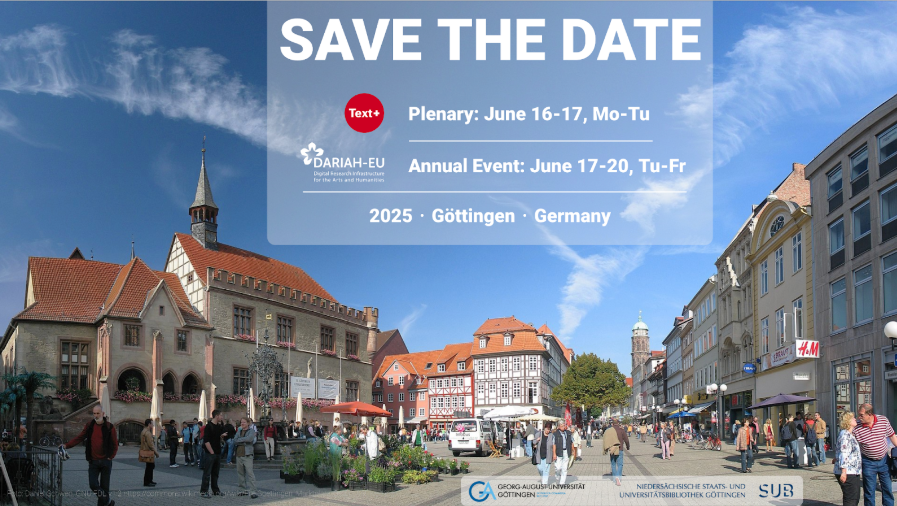
For the DARIAH Annual Event (June 17–20, 2025) at SUB Göttingen, it is possible—thanks to the support of the Federal Ministry of Education and Research (BMBF)—to award ten travel grants of €500 each to students and doctoral candidates.
The Göttingen State and University Library is very pleased to host the European Annual Conference of DARIAH-EU from June 17–20, 2025, in Göttingen. DARIAH-DE is proud to contribute to this event, and we hope to foster fruitful exchange between national and international communities.
Thanks to the generous support of the Federal Ministry of Education and Research, we are able to offer ten travel grants of up to €500 each to support participation in the event.
Eligibility Applications are open to students and doctoral candidates in the humanities—including but not limited to the Digital Humanities—who can demonstrate a strong interest in research infrastructures and their application. Grant recipients will be asked to contribute a small media-related piece about the conference (e.g. interview, blog post, etc.).
About DARIAH DARIAH is a European research infrastructure for the arts and humanities. Its mission is to empower scholarly communities with digital methods to create, connect, and share knowledge about culture and society. The DARIAH Annual Event provides an opportunity for the DARIAH community and humanities scholars at large to present results and new ideas, meet, and network. Participation is free of charge.
Selection Criteria
Demonstrated interest in research infrastructures and the conference, as outlined in the motivation letter
Preference will be given to applicants who do not have access to other sources of travel funding
In cases of equal qualification, applicants presenting at the conference will be prioritized
The selection will be made by the local organizing committee of the DARIAH Annual Event (based at the Göttingen State and University Library). The grants are partial travel grants: each recipient may receive up to €500, even if their actual travel costs are higher. The travel grants will be reimbursed after the event upon submission of appropriate documentation in accordance with the Federal Travel Expenses Act.
Required Documents Please submit the following documents (in German or English) by May 23, 2025 to dae25@sub.uni-goettingen.de:
Motivation letter (approx. 1 page) explaining your interest in the conference and its relevance to your research or work in infrastructures
Short CV (max. 1 page)
Information about your submission to the conference (if applicable)
Application Deadline May 23, 2025
Notification Applicants who submit complete applications will be informed within three weeks after the application deadline whether they will receive a travel grant.
Note Prior to the DARIAH Annual Event 2025, the Text+ Plenary 2025 will also take place at SUB Göttingen. Travel grants are also available for that event. See the conference page for details. It is possible to apply for both travel grant programs.
OAPEN offers a wide range of expertise, services and well-curated academic content aimed at librarians, publishers, researchers, and funders. OAPEN promotes and supports the transition to open access for academic books by providing open infrastructure services to stakeholders in scholarly communication. OAPEN works with publishers to build a quality-controlled collection of open access books and provide services for publishers, libraries, and research funders in the areas of hosting, deposit, quality assurance, dissemination, and digital preservation.
The DOAB (Directory of Open Access Books) is a community-driven discovery service that indexes and provides access to scholarly, peer-reviewed open access books and helps users to find trusted open access book publishers. All DOAB services are free of charge and all data is freely available.
Both initiatives are of relevance for the communities around the NFDI consortia of the MoU group: NFDI4Culture, Text+, NFDI4Memory, and NFDI4Objects.
Silke Davison and Sebastiano Sali, Community Managers at OAPEN & DOAB, will introduce the audience into both services, highlight benefits four our communities, and speak about some of the many already existing working relations with institutions of the German academia.
At the end of this lecture, the participants shall feel intrigued to explore the services of OAPEN and DOAB and open access publishing for their own research projects.
This lecture will be held in English.
Topics
Introduction to OAPEN & DOAB as foundations
Services of OAPEN
Services of DOAB
Questions from the audience
Explanation and demonstration of the OAPEN OA Books Toolkit
Questions from the audience
OAPEN & DOAB engagement in the community (with focus on Germany)
Final questions
Intended Audience
The event is aimed at individuals conducting research in the social sciences and humanities, working at an infrastructure facility in the field, or simply interested in the topic. Furthermore, we especially welcome participants from other NFDI consortia.
OAPEN bietet ein breites Spektrum an Fachwissen, Dienstleistungen und gut kuratierten wissenschaftlichen Inhalten für Bibliothekare, Verleger, Forscher und Geldgeber. OAPEN fördert und unterstützt den Übergang zu Open Access für akademische Bücher durch die Bereitstellung offener Infrastrukturdienste für die Akteure der wissenschaftlichen Kommunikation. Wir arbeiten mit Verlagen zusammen, um eine qualitätsgeprüfte Sammlung von Open-Access-Büchern aufzubauen, und bieten Dienstleistungen für Verlage, Bibliotheken und Forschungsförderer in den Bereichen Hosting, Hinterlegung, Qualitätssicherung, Verbreitung und digitale Bewahrung.
Das DOAB (Directory of Open Access Books) ist ein von der Community betriebener Suchdienst, der wissenschaftliche, von Experten begutachtete Open-Access-Bücher indexiert und zugänglich macht und Nutzern hilft, vertrauenswürdige Open-Access-Buchverlage zu finden. Alle DOAB-Dienste sind kostenlos und alle Daten sind frei verfügbar.
Beide Initiativen sind für die Gemeinschaften rund um die NFDI-Konsortien der MoU-Gruppe von Bedeutung: NFDI4Culture, Text+, NFDI4Memory, und NFDI4Objects.
Silke Davison und Sebastiano Sali, Community Manager bei OAPEN & DOAB, werden die Zuhörer in beide Dienste einführen, die Vorteile für unsere Communities aufzeigen und über einige der vielen bereits bestehenden Arbeitsbeziehungen mit Institutionen der deutschen Wissenschaft sprechen.
Am Ende des Vortrags sollen die Teilnehmer Lust bekommen, sich mit den Diensten von OAPEN und DOAB sowie mit Open-Access-Publikationen zu beschäftigen.
Dieser Vortrag wird in Englisch gehalten.
Zielpublikum
Die Veranstaltung richtet sich an Personen, die in den Sozial- und Geisteswissenschaften forschen, an einer Infrastruktureinrichtung in diesem Bereich arbeiten oder sich einfach für das Thema interessieren. Darüber hinaus sind auch Teilnehmer aus anderen NFDI-Konsortien besonders willkommen.
When you’re ready to submit your papers, posters, demos, or panels, then you can head over to our conftool instance. Registrations from previous Annual Events have been carried over to this new instance (if you permitted it), so you should already have an account there.
Decisions about submissions will be communicated by the end of April; registration for the Annual Event will open later in May and the full programme will be available by the beginning of June.
im Rahmen des von der Nationalen Forschungsdateninfrastruktur (NFDI) finanzierten Text+ Kooperationsprojekts “HAdW GND-basierte Webservices – Beaconizer & Discoverer (Hagrid)” suchen wir zum nächstmöglichen Zeitpunkt Unterstützung beim Aufbau Normdaten-basierter Webservices und Webseiten im Umfang von 50 % (TV-L E13) befristet für zehn Monate.
Polifonia ist ein gerade abgeschlossenes Forschungsprojekt, finanziert aus dem EU Horizon 2020 Programm, das nun seine Forschungsresultate einer breiten Öffentlichkeit zur Verfügung stellt. Situiert zwischen Musikinformation- und dokumentation, Musikwissenschaft und neuen semantischen Web Technologien, bietet das Polifonia Portal einen neuartigen Zugang zum musikalischen kulturellen Erbe Europas.
Eine Lösung für das Problem zersplitterter Musikinformation
Das musikalische Erbe Europas ist reichhaltig, es umfasst Bibliotheken von Noten, Musikaufnahmen, Informationen über Musikveranstaltungen, über Komponisten, usw usf.. Vieles davon ist bereits digitalisiert, und wird auch über das Internet angeboten: aber von unterschiedlichen Anbietern, in unterschiedlichen Formaten, und mit unterschiedlichen Zugangsbedingungen. Das Polifonia Portal ermöglicht eine völlig neue Art des Zugangs. Es vereint Quellen ganz verschiedener Herkunft und ermöglicht es, in die Welt der Musik auf unterschiedliche Weise einzutauchen. Das Projekt selbst hat bereits große Sammlungen (etwa von niederländischen Volksliedern oder von französischen Musikbibliotheken) integriert, die nun mit dem Portal erkundet werden können.
Eine herausragende Rolle für die künstliche Intelligenz
Ebenso wichtig wie das gegenwärtige Portal, sind die Technologien, die benutzt wurden um das Portal aufzubauen. Diese sind als open source verfügbar, und ermöglichen es in Zukunft sowohl weitere Sammlungen in das vorhandene Portal ein- und dadurch miteinander zu verbinden, als auch ähnliche Portale für andere Inhalte zu gestalten.. Die technologische Basis von allem sind sogenannte Wissensgraphen (knowledge graphs) und deren in Ontologien festgelegte Wissensorganisationen. Künstliche Intelligenz wurde eingesetzt, um Lücken in der Musikdokumentation zu schließen. Aber am Ende ist das Wichtigste, einem breiten Publikum Musik auf neue Weise näher zu bringen, und neugierig darauf zu machen, wie Musik neu erforscht und erfahren werden kann.
Zufällige Entdeckungen
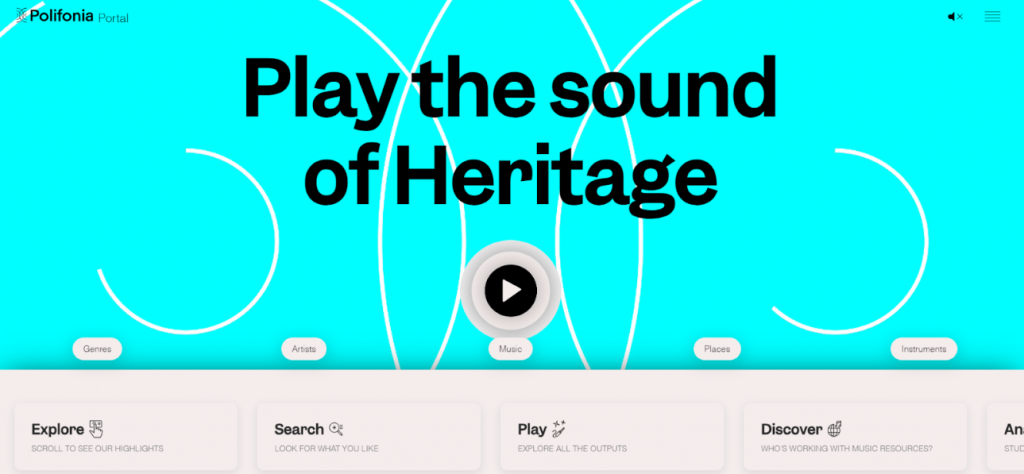
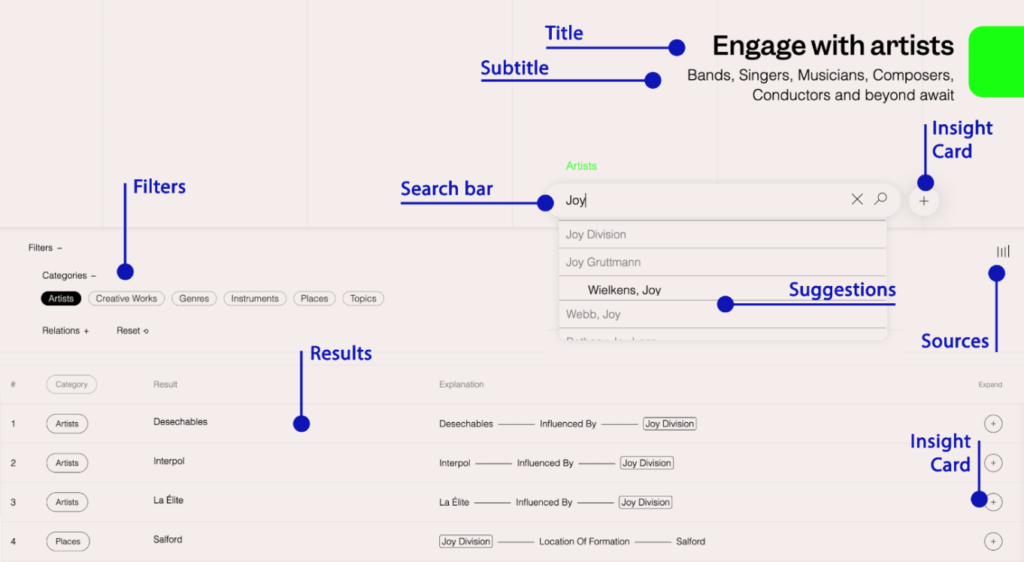
Das Polifonia Portal, ein Webportal, lädt Nutzer zur Erkundung von fünf spezialisierten Suchbereichen ein. Diese wurden basierend auf Nutzerstudien ausgewählt, um sowohl eine effiziente gezielte Suche als auch eine mehr zufällige Erkundung des musikalischen Erbes möglich zu machen. Automatische Vorschläge von Suchbegriffen (suggestions) und Filteroptionen (categories) unterstützen die Verfeinerung der Recherche.
Um eine Suche durch verschiedenartige Bestände zu ermöglichen, müssen erst die Informationen, die diese Bestände beschreiben, miteinander verbunden werden. Basierend auf dieser aufwändigen Integrationsarbeit enthüllt das Portal dann vorher verborgene Verbindungen und ermöglicht neuartige Erzählungen über Elemente und Ereignisse in der reichen europäischen Musiklandschaft. Es bietet den Nutzern eine umfassende und vernetzte Sicht auf unser kulturelles Erbe. Die Benutzererfahrung des Portals ist so gestaltet, dass sie zufällige Entdeckungen begünstigt, anstatt bereits vorgegebene Pfade anzubieten.
Erste positive Berichte von Nutzern über solche zufälligen Entdeckungen lesen sich wie: „Das ist ein wahr gewordener Traum, ich wusste nicht, dass es so ein Tool gibt. Eine Suche nach Punkrock führte mich zu digitalisierten Comics über Rancid und Punk-Subkulturen”.
Hinter dem Portal steht die Gemeinschaftsarbeit von führenden Europäischen Universitäten, Forschungsinstitutionen (der Università di Bologna, die Open University, die University of Galway, die Meertens Instituut-KNAW, das King’s College London und das Centre National de la Recherche Scientifique) mit Einrichtungen, die über grosse Musiksammlungen verfügen (das italienische Ministero della Cultura, das französische Conservatoire National des Arts et Metiers, und das Nederlands Instituut voor Beeld & Geluid). Das Portal basiert auf mehreren Datensätzen, die von Polifonia-Partnern und darüber hinaus erstellt wurden, nämlich: musoW, MEETUPS, CHILD, BELLS, MusicBO, ORGANS, FoNN, TUNES und Wikidata.
Zusätzliche von Polifonia entwickelte Tools
Dies ist bei weitem nicht alles, was dieses vierjährige Projekt hervorgebracht hat. Die Forschung und Entwicklung im Rahmen der Arbeitspakete und der 10 Pilotprojekte umfasste auch die Veröffentlichung von Open-Source-Software, Datensätzen und Ontologien, wie z. B.: Pitchcontext, MELODY, Polifonia Knowledge Extractor, Polifonia Corpus Annotation, Sparql Anything, Polifonia Corpus, CLEF, LHARP, FACETS, Frequently Occuring Patterns, TONALITIES, Roman Chord Ontology, Music Meta, Jams Ontology, Roman Chord APIs, ChoCo, Polifonia Lexicon und MOZ. Darüber hinaus wurden haptische Geräte für hörgeschädigte Zuhörer entwickelt und Experimente mit „Deep Listening“ durchgeführt. Diese Ergebnisse stellen insgesamt den Höhepunkt der Projektanstrengungen dar und sind als Teil des sogenannten ‘Ecosystem’, Polifonia-Ökosystems, dokumentiert. Letzteres zielt daruf ab, Forschung und Innovation in den Musikwissenschaften, den digitalen Geisteswissenschaften insgesamt voranzutreiben und zu einer Bewahrung des Kulturerbes im digitalen Zeitalter beizutragen.
Weitere Informationen
Web Portal Hier gelangen Sie zum Web Portal: https://polifonia.disi.unibo.it/portal/
Ecosystem Polifonia-Daten, -Tools und -Dokumentationen sind frei zugänglich und können hier abgerufen werden: https://polifonia-project.github.io/ecosystem/
Kontakt Anfrage zum Webportal: Marilena Daquino, Senior assistant professor, Fachbereich Klassische Philologie und Italianistik. Università di Bologna <marilena.daquino2[@]unibo.it> Untersuchung über das Ecosystem: Enrico Daga, Senior Research Fellow Fakultät für Wissenschaft, Technologie, Ingenieurwesen und Mathematik. The Open University <enrico.daga[@]open.ac.uk>
In weniger als vier Wochen findet das findet das diesjährige Text+ Plenary an der Niedersächsischen Staats- und Universitätsbibliothek Göttingen statt, zu dem wir Sie alle hiermit noch einmal einladen möchten. Wir haben über 150 Anmeldungen aus Text+, anderen NFDI-Konsortien, Fachverbänden, Fachinformationsdiensten und Partnern. Wir freuen uns auf Sie!
Wir bitten Sie, die Einladung zum öffentlichen Teil des Plenarys (28./29. September 2023) in Ihren Communitys zu bewerben. Der öffentliche Teil bietet für unsere Community Anknüpfungspunkte, Möglichkeiten zur Interaktion und Diskussion, aber auch zur Informationen über die Tätigkeiten von Text+. Das Plenary soll der Community und den Partnern die Gelegenheit zum Austausch mit uns, zur kritischen Rückmeldung sowie für Ideen zur Zusammenarbeit geben.

 登录
登录