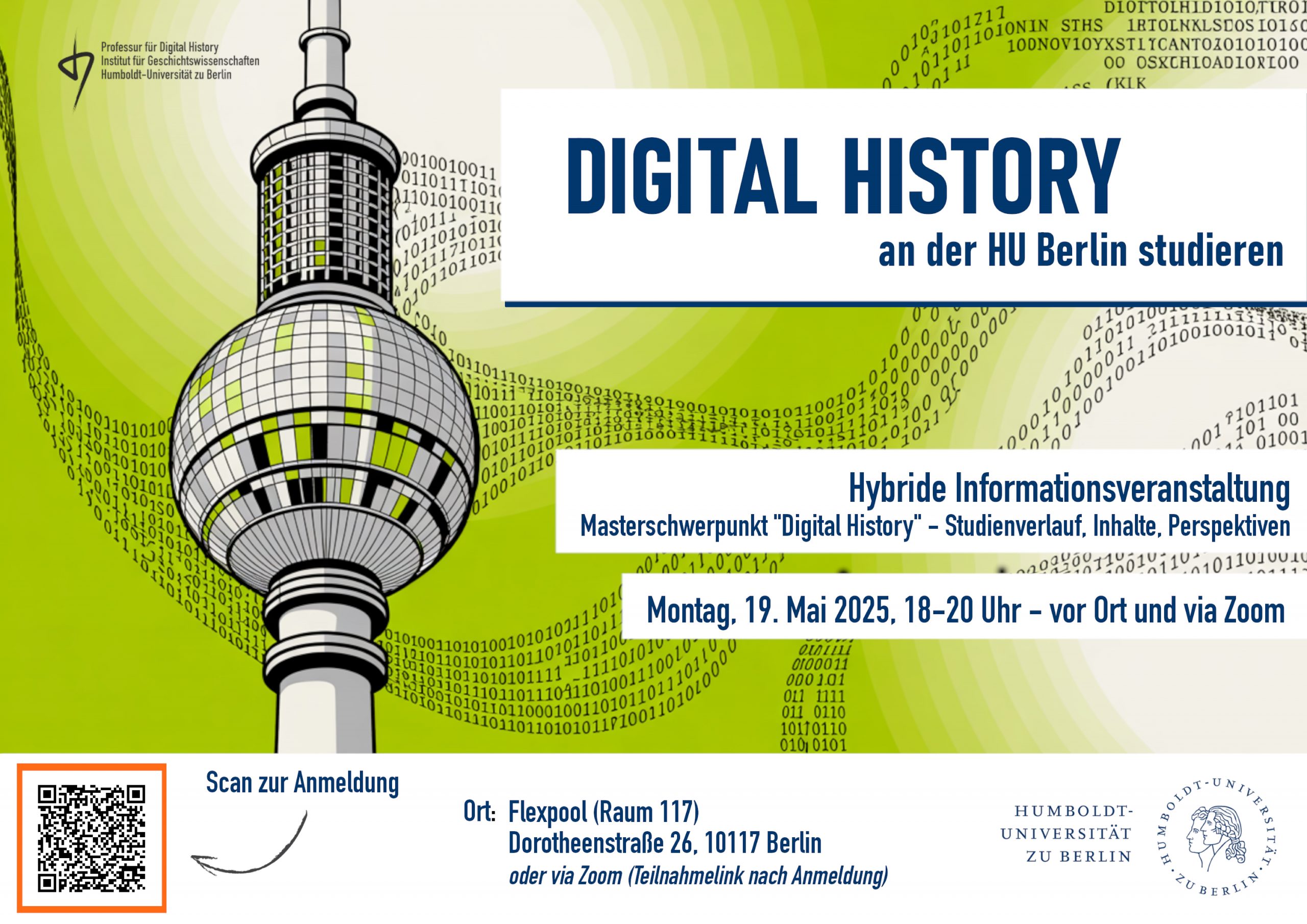
Digital History studieren an der HU Berlin – Einladung zum Sommerschnuppern 2025


Einladung zur online Abschlussveranstaltung des Kooperationsprojekts DiTAH „Digitale Transformation in den Österreichischen Geisteswissenschaften“
Montag, 16. September 2024 von 14:00 bis 17:00 online unter https://uni-graz.zoom.us/j/62306878063?pwd=hIpgbCpZQDfFHBFYlPqTPjuvd6Rqz8.1
Programm:
This summer, Dr. Darren Wershler, the Acting director of the Centre for Technoculture, Art and Games (TAG) at Milieux Institute and professor in the faculty of Arts and Science, will be leading a two-week three (3) credit course on interdisciplinary research at Concordia University. The course will be co-taught with guest faculty Dr. Lai-Tze Fan, Canada Research Chair in Technology and Social Change (Tier 2 SSHRC) and Director of the U&AI Lab at University of Waterloo, and will introduce students to a range of contemporary critical and philosophical approaches to interdisciplinary research.
Students from diverse academic and experiential backgrounds are encouraged to apply. All are welcome, and no particular technical knowledge is necessary. Guest lectures (to be confirmed) will include talks by Steven J. Jackson, Associate Professor in the Department of Information Science and Department of Science and Technology Studies at Cornell University; and Phil Reilly from Right to Repair.
For more information on « ENGL 602: Mess and Method – Maintenance, Repair and Sustainability Edition, 2024« , please visite the course website.
En collaboration avec le Groupe de Recherche sur les Éditions critiques en contexte Numérique (GREN), notre centre est heureux de recevoir Dino Felluga (Purdue University) pour un atelier dédié au projet COVE :
Prof. Felluga will introduce attendees to COVE, including the new tools and abilities made possible because of his current $350,000 National Endowment for the Humanities grant. He will illustrate how you can use COVE with undergraduates for active learning; with co-authors for peer-reviewed publication; and with other scholars for conferences and international networking. Activities he will discuss include text annotation, image annotation, anthology-building, timeline-building, map-building, and gallery-building.
[Prof. Felluga donnera aussi une conférence intitulée « Open Assembly and the Collective: Digital Humanities after the Collapse of the Humanities » le jeudi 28 mars à l’université Concordia.]
Assistant Professor and Digital Scholarship Librarian Carrie Hill shares her work exploring the information behaviors of fanfiction writers who post their work on Archive of Our Own (AO3), self-described as “A fan-created, fan-run, nonprofit, noncommercial archive for transformative fanworks, like fanfiction, fanart, fan videos, and podfic.” She will share the inspiration for her project, challenges she faced while trying to answer her initial question, and where those challenges eventually led her with this study.
Season: 1
Episode: 5
Date: 04/21/2023
Presenter: Carrie Hill
Topic: An Archive of One’s Own
Tags: Fandom, An Archive of Our Own, Fan Information, Taxonomy, Folksonomy
The post An Archive of One’s Own: Exploring How Fanfiction Writers Organize their Work in a Fan-Made Archive (1.5) appeared first on Alabama Digital Humanities Center.
Notre centre est heureux d’être associé de nouveau à la neuvième école d’été sur les humanités numériques du CERIUM qui sera donné par notre directeur avec des interventions de plusieurs de nos membres du lundi 27 mai au samedi 1 juin 2024 prochain.
L’objectif principal de cette école d’été est de familiariser les étudiants avec les humanités numériques dans le domaine des sciences humaines et sociales. Le domaine de recherche des humanités numériques (une traduction de l’anglais digital humanities) s’est développé au cours des vingt dernières années, et est un domaine très vaste et caractérisé par une forte interdisciplinarité. Dans le débat actuel, on essaie de ne pas penser les humanités numériques comme une discipline et de plutôt les envisager comme une approche globale, transdisciplinaire, adoptant une attitude et un point de vue sur la recherche qui devraient impliquer l’ensemble des chercheurs en sciences humaines et sociales. Loin d’être un simple développement technologique ayant uniquement un impact sur le processus de recherche et de visualisation des données en sciences humaines et sociales, les humanités numériques nous amènent à repenser le sens même de la recherche et, par conséquent, l’ensemble du modèle de production et de circulation du savoir.
Les participants à cette école d’été seront initiés à l’histoire et aux théories critiques nécessaires à la compréhension de cette thématique qui révolutionne les disciplines en sciences humaines et sociales, ainsi qu’aux aspects pratiques de la production et l’exploitation des documents numérisés (éditions électroniques, exploitation des réseaux sociaux dans un contexte académique, représentations géographiques, outils d’analyse et de visualisation de textes, etc.).
[Le programme sera disponible courant février 2024.]