阅读视图

Workshop: LLMs für die Geisteswissenschaften (Mainz, 19./20.03.)

Arbeitet ihr mit Textdaten und wollt herausfinden, wie ihr diese mit Large Language Models verarbeiten, anreichern und analysieren könnt? Habt ihr Lust, mit euren Daten praktisch zu arbeiten und dabei Unterstützung zu bekommen? Dann kommt zum nächsten Bring Your Own Data Lab (BYODL) des HERMES | Humanities Education in Research, Data, and Methods Datenkompetenzzentrums am DH Lab des Leibniz-Instituts für Europäische Geschichte in Mainz! In dem Workshop geht es um spezialisierte Large Language Models und spezialisiertes Prompting für die Geisteswissenschaften.

Das Wichtigste in Kürze:

📅 19.–20. März 2026 (Do, 10:00 bis Fr, 16:00)
📍 Präsenz-Workshop: Leibniz-Institut für Europäische Geschichte, Mainz

Was euch erwartet:
🛠 Hands-on-Sessions: Praktisches Arbeiten mit Euren eigenen Datensätzen
🔎 Vertiefung spezifischer LLM-Themen und Anwendungsfälle
🤝 Kollegialer Austausch, Peer-Feedback und gezielte fachliche Unterstützung

Expertinnen:
Sarah Oberbichler (C²DH), Johanna Mauermann (IEG DH LabHERMES), Lauren Coetzee (C²DH)

Alle aktuellen Informationen findet Ihr auf der HERMES-Veranstaltungsseite.

Ziele und Inhalt:

In verschiedenen Impulsvorträgen und Hands-on-Sessions lernen Teilnehmende, wie sie offene, auf die geisteswissenschaftliche Forschung spezialisierte und lokale Modelle mit ihren eigenen Daten verwenden können und wie sie Prompts an geisteswissenschaftliche Fragen anpassen können. Ebenfalls reflektieren wir, wie Daten für ein Fine-Tuning oder Post-Training eines kleinen Sprachmodells aufbereitet werden können.

Voraussetzungen:

Der Workshop richtet sich an Forschende der Geisteswissenschaften, die mit Textdaten arbeiten. Vorausgesetzt werden grundlegende Kenntnisse im Bereich generativer KI. Die mitgebrachten Daten sollten maschinenlesbar vorliegen.

Wir werden in manchen Hands-on-Sessions mit Jupyter Notebooks und Python sowie mit Hugging Face arbeiten. Die Teilnahme ist auch ohne vertiefte Kenntnisse in diesen Bereich möglich. Selbstlernmaterial zur Vorbereitung wird angeboten.

Kontakt und Anmeldung:

Zur Registrierung und bei Fragen: Johanna Mauermann, hermes@ieg-mainz.de

Bitte gebt bei der Anmeldung folgende Informationen an:

  • Fachgebiet
  • Welche Erfahrung habt ihr mit generativer KI?
  • Welche Art von Daten bringen ihr mit?

Hinweis: Die Teilnehmerzahl ist auf maximal 15 Personen begrenzt.

Die Anmeldung ist bis zum 09. März 2026 geöffnet.

Der Workshop findet überwiegend auf Deutsch statt, einzelne Impulse werden auf Englisch sein.

  •  

Preparing for Leave

My wife and I are expecting our second child in just a few weeks, which means that I am gearing up for a new and chaotic phase of life. As a part of the preparation, I’m doing everything I can to keep things running smoothly for student programs in the Scholars’ Lab while I’m out. I set up a process for doing so when I took leave two years ago for our first child, so I’m not exactly working from scratch. Here’s how I’m preparing for my leave this time around to make things easier for my coworkers who will be keeping things going in my absence.

Give notice early

Everyone has different interlocking reasons for when they give notice to their team. Those reasons might be medical, personal, or professional. Given my own particular circumstances, I let my immediate collaborators in the Scholars’ Lab know fairly early, several months before I would be out. With this knowledge well in advance of the due date, my collaborators knew that I was taking steps to accommodate my absence. I also notified students who would be impacted. The dates I chose to take these steps were selected carefully in conversation with my supervisor, who helped me decide who needed to know and when.

Identify areas of responsibility

One of the first tasks in preparing to unplug for two months was to list my tasks, differentiating between major ongoing initiatives and smaller one-off items. This process helped me to create a to-do list such that I can make progress on my leave in a controlled manner. Otherwise, one can get lost in an anxiety spiral feeling like there is already more to do. I identified the Praxis Program, the DH Fellowship Committee, and our summer programs as primary initiatives in need of continuity.

Wrap up what I can

For smaller projects, I sprinted over the past two months to finalize whatever I could. Rather than working with a particular student on a weekly basis, for example, I set a date for a multi-hour meeting where we could make significant progress on their project. I set early writing goals for myself to meet deadlines in advance. And I took advantage of the slow down between semesters as space in which I could get ahead.

Establish points of contact for what I can’t

Some projects and initiatives will inevitably roll over through my leave. Working through my list, I worked with my supervisor and coworkers to identify people whom might be willing to take on specific pieces of my work. This process always involved asking my collaborators a series of questions: what do they need to feel comfortable? What can they do? What do they feel uncomfortable with? Who else might make sense for particular tasks?

Document everything

So much of the work I do exists in my head. Workflows, points of contact, procedures, norms. I tried to write as much of this down as possible so that someone stepping in would know exactly what to do and when. Winnie E. Pérez Martínez has been exceptional at working on this with me as a student worker, especially in regard to clarity and formatting. Winnie has a special talent for taking an enormous brain dump from me and assembling it into a coherent, less intimidating guide. I have learned a lot from her!

Put guardrails on future commitments

If possible, I tried to stop planning major commitments that would take place a couple weeks before the due date. At the very least, when I agreed to something, I made it clear that I might unexpectedly withdraw with little notice. I am also giving a couple weeks buffer before scheduling new commitments after I return in April. After all, babies have their own schedules in mind, and postpartum life is enormously challenging and complex. It’s impossible to know what our lives will be like for the next several months, and I tried to be honest about these facts with everyone involved.

Caveats

Everyone deserves the time and energy that parental leave allows to refocus on their personal life and meet the needs of a difficult transition. Everyone deserves coworkers kind enough to help them make space for their family. But I also know this is not the norm. I am enormously fortunate and privileged to have such support. That being said, I hope that what I’ve outlined above can be helpful even for those who do not possess such a robust support system. In those cases, this post might offer a rough guide for how to advocate, push back, and find small space for what you need in infrastructure that might not otherwise allow it.

  •  

Call for Hosts – Digital History Tagung 2028

Alle zwei Jahre findet die Tagung „Digital History 20XX“ der AG Digitale Geschichtswissenschaft im Verband der Historiker und Historikerinnen Deutschlands (VHD) statt. An wechselnden Standorten fungiert die Konferenz als zentrale Plattform für den wissenschaftlichen Austausch der deutschen digital arbeitenden Geschichtswissenschaft. Bisherige Stationen und Tagungsmottos waren:

  • 2021: Universität Göttingen (virtuell durchgeführt), „Digital History. Konzepte, Methoden und Kritiken digitaler Geschichtswissenschaft“;
  • 2023: HU Berlin, „Digitale Methoden in der geschichtswissenschaftlichen Praxis. Fachliche Transformationen und ihre epistemologischen Konsequenzen“;
  • 2024: Universität Halle-Wittenberg, „Digital History & Citizen Science. Digitale Methoden und neue Erkenntnisse zwischen digitaler Quellenerschließung, Forschung und Bürgerwissenschaften“.

Von 28 September bis zum 1. Oktober 2026 findet die Digital-History-Tagung unter dem Motto „Doing Cultural Heritage“ an der Paris-Lodron-Universität Salzburg statt.

Die AG Digitale Geschichtswissenschaft strebt grundsätzlich an, die Konferenz in den Jahren stattfinden zu lassen, in denen kein Historikertag stattfindet, idealerweise im September. Daher bittet die AG nun um Bewerbungen um die Ausrichtung der fünften Tagung im Jahr 2028.

Die bisherigen Auflagen konnten bis zu 300 Teilnehmer:innen (davon 120 in Präsenz und 180 online) verzeichnen. Dabei verteilten sich auf bis zu vier Tagen das Hauptprogramm mit wissenschaftlichen Vorträgen, Paneldiskussionen, Posterpräsentationen und Keynotes sowie das Begleitprogramm mit (Pre-Conference) Workshops und Social Events. Die Einführung neuer Formate ist in Abstimmung mit dem Komitee der AG möglich.

Das Programm der Tagung wird eigenverantwortlich durch das Ortskomitee der ausrichtenden Institution sowie dem einzurichtenden Programmkomitee auf Grundlage eines Call for Papers und eines anschließenden Review-Verfahrens erstellt. Die Ausrichter:innen sind verantwortlich für die Bereitstellung der Tagungsräume und der notwendigen Infrastruktur, für die Organisation und Sicherstellung des reibungslosen Ablaufs der Tagung, die Planung von Social Events, die Einrichtung und Pflege einer Tagungswebsite sowie für die Öffentlichkeitsarbeit während der Veranstaltung. Die Veröffentlichung von Konferenzbeiträgen kann unterschiedlich umgesetzt werden, etwa in Form eines Tagungsbandes oder durch Bereitstellung von Abstracts auf einem Textrepositorium. Publikationen sollten in jedem Fall Open Access erfolgen.

Da die AG Digitale Geschichtswissenschaften leider nicht über eigene Mittel verfügt, ist die Tagung über Mittel zu finanzieren, die von der ausrichtenden Institution eingeworben oder bereitgestellt werden. Wird eine Tagungsgebühr erhoben, sollte diese möglichst gering gehalten werden.

Eine Bewerbung um die Ausrichtung der Konferenz für 2028 muss beinhalten:

  • einen Vorschlag für ein Tagungsmotto, der überzeugend begründet, welches für die Forschungscommunity relevante übergreifende Themenfeld im Mittelpunkt stehen soll. Mit Blick auf eine erfolgreiche Umsetzung des Tagungsmottos können die Arbeitsschwerpunkte am Ausrichtungsort, Vorschläge für mögliche Keynotereferent:innen, inhaltliche Überlegungen zum Workshopprogramm und weitere Gestaltungspunkte für die Veranstaltung angeführt werden;
  • einen Terminvorschlag (bevorzugt im September). Dabei ist auf potenziell konkurrierende Konferenzen zu achten. Der Termin ist frühzeitig auf der Website bekanntzugeben;
  • eine Aussage über die Verwendung aller für die Organisation und Abwicklung der Tagung notwendigen Systeme (z.B. Conftool, Easychair, etc.);
  • eine Einschätzung zu den Möglichkeiten einer teilweisen virtuellen Partizipation (z.B. zur Übertragung von Keynotes);
  • Ideen für Social Events;
  • Vorschläge zur Erreichung einer hohen Sichtbarkeit der Tagung;
  • Maßnahmen zur Förderung von Early Career Researchers / Studierende;
  • eine vorläufige Kostenkalkulation

Die Einreichungsfrist für Bewerbungen ist der 01.07.2026 (ca. 2-3 DIN-A4-Seiten, formlos per E-Mail an den Sprecher der AG Digitale Geschichtswissenschaft im VHD, Prof. Dr. Werner Scheltjens: werner.scheltjens@uni-bamberg.de). Die Auswahl erfolgt durch das AG-Komitee und wird auf der kommenden Digital-History-Tagung in Salzburg (28.09-01.10.2026) verkündet.


  •  

Event Series: DH@rts Drop-in Sessions (Spring 2026)

Have you been meaning to set up an appointment to ask about research data management for your project, an aspect of your research workflow, or a specific DH tool or method? Visit one of our drop-in sessions and we will help you on the spot! No need to make an appointment!

The sessions are designed to support researchers, students, and staff members in all areas of digital scholarship. The initiative is a collaboration between Artes Research, DH-support staff and researchers at the Faculty of Arts, and ICTS at the Faculty of Arts.

Some areas we can help you with:

  • Providing resources for various DH and RDM tools
  • Advice on DMPs and Research Data Management in general
  • Suggesting DH tools or methods for your specific research questions
    • Relational databases in FileMaker
    • Social Network Analysis and network visualizations
    • Computational tools for working with texts
  • Getting started with Zotero or optimizing Zotero use with an existing Zotero library
  • Advice on scholarly communication
  • Advice on Lirias
  • … and much more!

Don’t have a question about any of the above but want to learn more about DH? No problem! Come and use our space for co-working! It’s a great moment to develop digital skills by starting a Programming Historian tutorial, for instance!

Everyone is welcome to attend, you do not need to register!

Stop by on one of the following dates and we will be glad to help you:

  • 29/01/2026: 14:00h -16:00h, Het Salon LETT 00.24, Erasmushuis
  • 19/02/2026: 14:00h -16:00h, Het Salon LETT 00.24, Erasmushuis
  • 19/03/2026: 14:00h -16:00h, Het Salon LETT 00.24, Erasmushuis
  • 28/04/2026: 14:00h -16:00h, Het Salon LETT 00.24, Erasmushuis
  • 26/05/2026: 14:00h -16:00h, Het Salon LETT 00.24, Erasmushuis
  • 25/06/2026: 14:00h -16:00h, Het Salon LETT 00.24, Erasmushuis
  •  

Seeing, Describing, and Imagining: Human and Machine Vision in the Humanities

Framing the Workshop: Vision, Interpretation, and Context

In recent years, digital tools have quietly transformed how we experience and interpret images in museums, classrooms, and research settings. As an art historian working at the intersection of art history, digital media, and visual culture, I am drawn to examining how people translate visual experience into words, and how that process compares with machine analysis of the same images. I am especially interested in creating spaces that invite us to pause, pay closer attention, and make the act of interpretation visible, rather than treating images or technologies as self-evident.

Seeing, Describing, and Imagining originated from a simple, low-stakes classroom exercise I first encountered while serving as a teaching assistant in a course on formal and visual analysis taught by my advisor. Watching students work through the challenge of turning what they were seeing into words made it clear how tentative and negotiable description can be. That experience stayed with me and prompted me to rethink the exercise beyond the classroom, adapting it into a workshop format.

The workshop aims to create a shared, practice-based method for visual analysis that can be applied in various settings, from visual analysis courses to digital humanities labs, while staying rooted in art-historical approaches to looking.

From Looking to Language: Description and Interpretation

The workshop is conceived as a hands-on, collaborative way of exploring how images move between seeing, describing, and imagining. It is designed to begin with a simple exercise. Participants would look closely at an artwork and translate what they see into words. Working in pairs, one person would study the artwork and describe it in detail, while the other would create a quick line sketch using only that description, without ever seeing the image itself.

This phase aims to slow the process in a constructive way. Participants are encouraged to reflect on the act of describing itself: What do you choose to mention first, and why? Which parts of the artwork are hardest to put into words? These questions are designed to show that description is never neutral. Emphasis, order, and omission all influence how an image is understood.

When sketches and original artworks are placed side by side, the workshop is designed to shift from creating to comparing. Instead of viewing differences as mistakes, participants are encouraged to explore what moments of similarity and difference may reveal about the connection between image and text. The aim is not to fix these gaps but to use them as a way to think about how seeing, knowing, and describing are linked in art history practice.

Human–Machine Translation: AI, Images, and Visual Convention

Starting from this analog foundation, the workshop is structured to move into a digital phase by introducing AI text-to-image systems. Participants would revisit and refine their descriptions before entering them into an AI model such as DALL·E or Adobe Firefly. The resulting AI-generated image would then be placed alongside the original artwork and the participant-created sketch as a third object for comparison.

Rather than evaluating which image is better or more accurate, this stage emphasizes observation. Participants are encouraged to ask what kinds of visual patterns might emerge across AI-generated images. Which elements seem emphasized, simplified, or made more uniform across different outputs? Looking across multiple results is meant to create space for noticing patterns without assuming in advance what those patterns will be.

Existing scholarship by authors such as Kate Crawford, Safiya Umoja Noble, Ruha Benjamin, and Johanna Drucker suggests that AI systems are shaped by the datasets they are trained on, the ways information is classified, and the cultural assumptions embedded in those systems. Drawing on these works, the workshop is designed to create conditions where such influences could become visible through hands-on engagement rather than explanation. As participants compare images, the process opens up the possibility of exploring whether familiar visual conventions emerge, particularly when prompts involve artworks or visual traditions that are not widely represented in large image datasets. What becomes noticeable is deliberately left open and expected to take shape through comparison rather than as a predetermined outcome.

The workshop also introduces a reverse process, moving from image to text. Participants would upload an artwork into an AI vision tool and examine how the system translates the image into language. Reading these AI-generated descriptions alongside participants’ own interpretive accounts is intended to prompt reflection on differences in tone, emphasis, and confidence, and to raise questions about how uncertainty functions in human versus machine descriptions.

Staying with the Process: Open-Ended Inquiry and Reflection

Taken together, Seeing, Describing, and Imagining is framed as an open-ended inquiry rather than a demonstration. Prompt writing and refinement are approached not as purely technical tasks but as interpretive acts, similar to the analytical frameworks art historians use when working with images. While elements of the workshop align with existing practices in art history education, digital humanities, and critical AI studies, Seeing, Describing, and Imagining brings these approaches together in a distinctive sequence that foregrounds interpretation as an active, negotiated process involving both human and machine systems of vision.

The workshop is designed to foster attentiveness, curiosity, and careful comparison. It encourages participants to stay with the process and to observe what may emerge as images move between eyes, words, algorithms, and back again. In this way, both human and machine vision are presented not as stable endpoints, but as ongoing, context-dependent practices shaped by history, culture, and interpretation.

Works Cited

  • Benjamin, Ruha. Race After Technology: Abolitionist Tools for the New Jim Code. Cambridge, UK: Polity Press, 2019.
  • Crawford, Kate. Atlas of AI: Power, Politics, and the Planetary Costs of Artificial Intelligence. New Haven, CT: Yale University Press, 2021.
  • Drucker, Johanna. Graphesis: Visual Forms of Knowledge Production. Cambridge, MA: Harvard University Press, 2014.
  • Noble, Safiya Umoja. Algorithms of Oppression: How Search Engines Reinforce Racism. New York: New York University Press, 2018.

  •  

The OpenAI API documentation is very bad

作者shane-lin

The OpenAI API docs are very bad. In my experience as a coder, I’ve come across my share of bad documentation. Typically, this is because the documentation is poorly organized, too spare, or missing coverage. Or it’s because the design of the API itself is badly conceived, inconsistent, or contains the accumulated cruft of years (or decades!) of bloat and abandoned features.

But I can’t recall ever seeing documentation that contains code samples that are both wrong and also syntactically wrong. It’s bad enough that it comes across as documentation written by GPT–and not even a recent model.

Take this example, part of an entry under the “Core Concepts” section:

context = [
    { "role": "role", "content": "What is the capital of France?" }
]
res1 = client.responses.create(
    model="gpt-5",
    input=context,
)

// Append the first responses output to context
context += res1.output

// Add the next user message
context += [
    { "role": "role", "content": "And it's population?" }
]

res2 = client.responses.create(
    model="gpt-5",
    input=context,
)

The Python code sample here is not syntactically correct. The comments use the ‘//’ convention of C/Java/Javascript in-line comments, rather than Python’s ‘#’. Additionally, OpenAI has the concept of a role, which indicates who (e.g. the system, the user, the model’s responder) is “speaking.” The string “role” is not a valid value for this and making an API call with it results in an error:

openai.BadRequestError: Error code: 400 - {‘error’: {‘message’: “Invalid value: ‘role’. Supported values are: ‘assistant’, ‘system’, ‘developer’, and ‘user’.”, ‘type’: ‘invalid_request_error’, ‘param’: ‘input[3]’, ‘code’: ‘invalid_value’}}

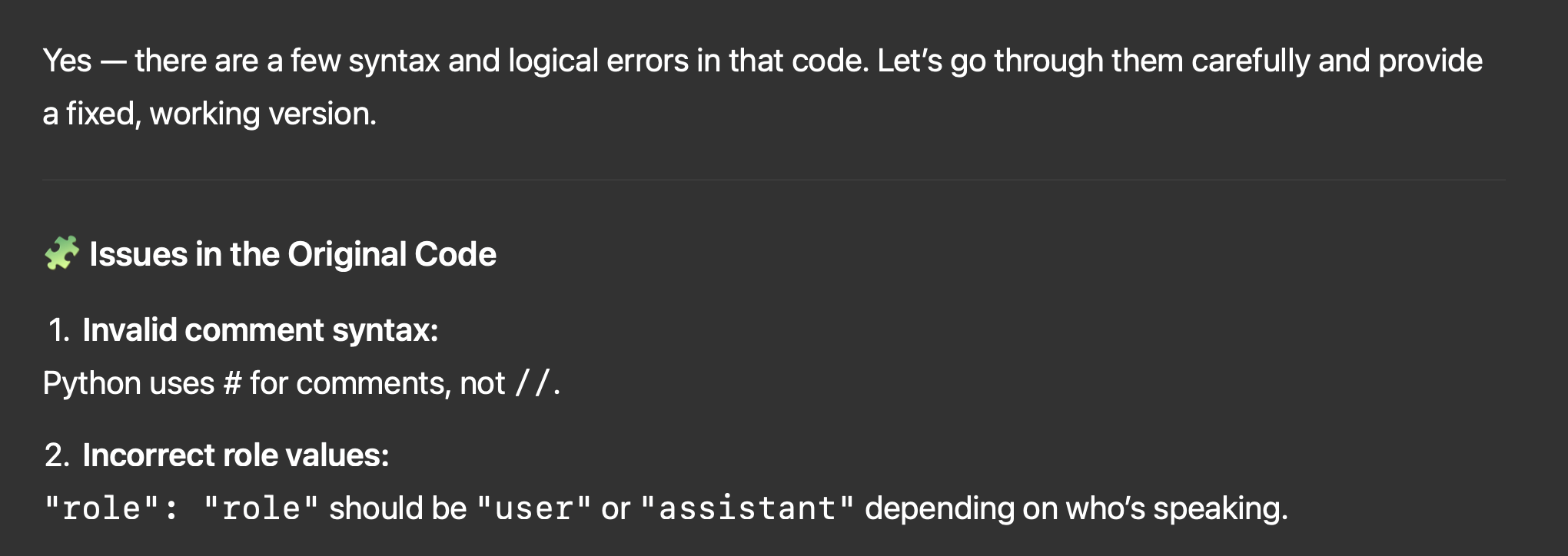
So, there are a total of 7 code statements in this sample, including the comments, and 4 of them have errors. The thing is, GPT-5 is actually pretty good at writing code. It’s even capable of executing Python code in an internal environment. We can see this facility in action by simply asking ChatGPT to debug the code from the OpenAI documentation.

ChatGPT response indicating the two errors from the OpenAI API documentation

This is a mode of LLM use that I haven’t had a lot of luck with, but here it pinpoints the two errors perfectly.

When documentation is bad in a common fashion, it typically creates a frustrating programming experience. And, to be clear, the OpenAI docs are bad in some of those ways too. But the sheer lack of care it demonstrates is both shocking for all the ways that Tech has integrated AI into our world and, frankly, majestic. Like making a horse consul or completely blowing up the system of global trade.

  •  

Committee Questions

It’s application season in the Scholars’ Lab, which means that the DH Fellows program has a CFP live and waiting for new students to send in their work in. We’re also evaluating applications for our Praxis Program Fellowship, and we always have one student representative on the committee to read these applications. Students are closer to the program than we are, even as instructors, so they can help the staff see who will excel in the program. The students thankfully find it useful to be a part of the application committee. Students consistently say they learn a lot from seeing how application committees work, as it’s not a perspective that they often are able to get in their day-to-day graduate training.

I’ve written in the past a post called “questions to ask when applying” about what I wish applicants would ask themselves such that they produce the best applications possible. Questions like…

  • Do I know what the fellowship is?
  • Have I made a clear plan that matches the requirements?

Our student representative told me they have also found it illuminating to hear those questions that experienced application readers ask ourselves, as a committee. So, without too much elaboration, here are some questions that I always ask myself when reading an application for the first time.

  • How does this match the rubric? What’s left out?
  • How might the rubric be insufficient?
  • Who is a bad applicant that put together a good application?
  • Who is a good applicant who wrote a bad application?
  • To what degree are we willing to stretch our imaginations beyond what’s in front of us?
  • How much should we limit ourselves to the materials we have on the page?
  • Who might not yet know who they are?
  • Can we see something in an applicant that they don’t yet see in themselves?
  • Who will get something out of this opportunity they can’t possibly get elsewhere?
  • Who already has the resources to excel?
  • How can we build on the experiences of those who already have a lot of experience?
  • How can we balance the needs of the program with the needs of the applicants?

I’ll leave these hanging as questions, because the answers are things that any particular committee will have to find for itself. But hopefully enumerating them here give future applicants a resource that they can look to while also giving students a peek behind the curtain. The next time you’re putting together an application, think about what questions the evaluating committee might be asking themselves.

  •  

Hackathon: BiblioTech 2026

This event is only open to KU Leuven researchers, students and staff.

In March 2026, KU Leuven Libraries and the Faculty of Arts will organize the second edition of the BiblioTech Hackathon!

What is a hackathon? It is an event that is usually organized over a short period of time where participants come together in small groups and work intensively on a creative digital project or towards some digital end. In the case of BiblioTech, KU Leuven researchers, students, or staff will be divided into small groups and will work specifically on one of the datasets prepared (by LIBIS) for the hackathon. The groups will be guided by at least one group leader and will be able to rely on the help of an expert pool comprised of people who have specific technical knowledge and skills. The groups are free to follow their creative inspiration but must apply some digital approaches or tools to the dataset to produce an end result that will be presented in the form of a short presentation and a poster at the closing event of the hackathon.

Who are we looking for? One of the amazing benefits of hackathons is that they allow many different people with diverse backgrounds and skill sets to come together and to learn from one another. This is our goal for BiblioTech! We welcome applications from researchers at all stages of their careers, motivated students, and also KU Leuven staff members. Digital skills are not a must, but a willingness to learn about digital approaches definitely is. The hackathon should be a fun and engaging experience, and each participant should find themselves with new skills and perspectives at the end.

What about the data? The 2026 edition of the BiblioTech Hackathon is going places! Participants will have the option to work with two datasets both focused on the experience of travel. The first dataset comes from KU Leuven Libraries digitized collections and features historical picture postcards. The second dataset comprises historical travelogues. This combination of image, metadata, and textual materials provides many opportunities for the application of DH methods. We are all excited to see where this data leads you! 

Practical details

The hackathon will span 10 days and will take place from Monday 16 March until Thursday 26 March. In addition to the working period of the hackathon, there will be a pre-hackathon brainstorming event where participants “Meet the Data, Meet the People,” prior to the start of the hackathon, a training day to learn how to use the infrastructure (ManGO and HPC service), and a closing event where the teams’ projects are presented.

  • When: Mark your calendars for the following dates:
    • Application Deadline: 5 January 2026 (23:59 CET)
    • Pre-Hackathon Brainstorm | Meet the Data, Meet the People: 12 March 2026
    • Infrastructure Training: 13 March 2026
    • Hackathon Working Period: 16–26 March 2026
    • Hackathon Closing Event: 26 March 2026
    • from Monday 13 March until Thursday 23 March
  • Where: Leuven (see above for more details)
  • For whom: We welcome applications from researchers at all stages of their careers, motivated students, and also KU Leuven staff members. Digital skills are not a must, but a willingness to learn about digital approaches definitely is.
  • Price: free
  • Registration: Already convinced and want to take part? Great! Submit an application here. The deadline to apply is 5 January 2026 (23:59 CET).  We look forward to hacking with you!

Want to see further details? Check out the BiblioTech Hackathon website for the most current information.

  •  

 ADHC Talks Podcast: A Conversation with Jeff Turner (5.1)

作者adhcadmin

Description

Today our guest is Dr. Jeff Turner. Jeff, I’m going to share what I’ve prepared about you and then you’re welcome to fill in the gaps. So Jeff received his PhD in US history from the University of Utah. His expertise lies in digital humanities, American religious history, and migration. And his research traces the ways migration and immigration inspectors and policymakers construct religion at the US border in the late 19th century and early 20th centuries.

Professor Turner’s digital work spans a variety of digital humanities methods. He entered DH along with Grassroots Graduate Student Group at the University of Utah, who taught themselves to topic model and published an article together.

His subsequent experience came from wanting to understand the relationship between critical theory, and project building, and also a desire to pay the rent. So you’re very practical. He’s worked on public humanities projects such as the Century of Black Mormons, Native Places Atlas, and the Wilford Woodruff Papers Project. And he works in Python, JavaScript, HTML, CSS, and a little bit of R in SQL.

Season: 5

Episode: 1

Date: 3/2025

Presenter: Jeffrey Turner

Topic: Religion at the American Boarder, early twentieth century

Tags: OCR; Machine Learning; History; Digital Humanities

The post  ADHC Talks Podcast: A Conversation with Jeff Turner (5.1) appeared first on Alabama Digital Humanities Center.

  •  

“Il gesuita che portò le macchine a leggere”: podcast divulgativo su Padre Roberto Busa

Si segnala che il podcast “Prima del futuro” di Emotion Newtork, pubblicato sul sito del “Corriere della Sera”, ha dedicato una puntata alla storia di Padre Roberto Busa e dell’Index Thomisticus.

Voce di Lucilla Giagnoni

Contributi tecnici di Massimiano Bucchi

Testi di Alberto Mattiello con il contributo artistico di Lucilla Giagnoni

Montaggio, post-produzione e sound design a cura di Gabriele Beretta

Coordinamento produttivop per Emotion Network a cura di Valentina Di Leo, Marco Tabasco e Benedetta Barzaghi

L'articolo “Il gesuita che portò le macchine a leggere”: podcast divulgativo su Padre Roberto Busa proviene da AIUCD.

  •  

Stellenausschreibung: Mitarbeiter*in im FDM für die Geisteswissenschaften mit dem Schwerpunkt philologische Fächer (UB Kiel, E13, 100%, unbefristet)

Die Universitätsbibliothek der Christian-Albrechts-Universität zu Kiel sucht innerhalb der Abteilung IT der Zentralbibliothek für das Referat Digital Humanities & Forschungsdaten zum nächstmöglichen Zeitpunkt eine*n

Mitarbeiter*in im Forschungsdatenmanagement für die Geisteswissenschaften mit dem Schwerpunkt philologische Fächer

Ihre Aufgaben:

  • Beratung und praktische Unterstützung von geisteswissenschaftlich Forschenden in den verschiedenen Phasen des Forschungsdatenmanagements (FDM)
  • Organisatorische Betreuung von Services zum FDM und den Digital Humanities (DH) sowie deren konzeptionelle Weiterentwicklung mit Fokus auf die Bedarfe der philologischen Fächer
  • Planung und Durchführung von Workshops und Schulungen zu Themen der Digital Humanities
  • Mitwirkung an der Konzeption, Beantragung und Durchführung von inter-/nationalen Drittmittelprojekten

Ihr Profil:

  • abgeschlossenes wissenschaftliches Hochschulstudium (Master oder Äquivalent) einer oder mehrerer Philologien
  • vertiefte nachgewiesene Kenntnisse im fachgerechten Umgang mit geisteswissenschaftlichen Forschungsdaten, insb. in den Philologien
  • vertiefte nachgewiesene Theorie- und Praxiskenntnisse in der Anwendung digitaler Methoden und Werkzeuge in den Geisteswissenschaften, insb. in den Philologien
  • nachgewiesene Kenntnisse in der Datenmodellierung in TEI-XML
  • sehr gute Deutsch- (mind. C2) und Englischkenntnisse (mind. C1) in Wort und Schrift

Persönliche Fähigkeiten:

  • ausgeprägte Fähigkeit zum eigenständigen konzeptionellen Denken und Arbeiten
  • ausgeprägte Servicementalität
  • Kommunikations- und Teamfähigkeit
  • eine systematische, effiziente und zielorientierte Arbeitsweise

Wünschenswert sind:

  • praktische Erfahrungen in der Arbeit mit einschlägigen DH-Softwarewerkzeugen, die derzeit an der UB Kiel im Einsatz sind (Transkribus, Oxygen-XML-Editor, TEI-Publisher, Nodegoat)
  • Kenntnisse und Erfahrungen im Bereich des Natural Language Processing (NLP)
  • Erfahrungen in der Beratung und Unterstützung von Forschenden in den Bereichen FDM und/oder DH
  • Vernetzung in der (inter-)nationalen DH- und/oder FDM-Community
  • Erfahrungen in der Planung und Durchführung von Workshops zu DH-Themen

Wir bieten:

  • eine abwechslungsreiche, eigenverantwortliche und vielfältige Tätigkeit in einem engagierten, innovativen Umfeld mit der Möglichkeit, Entwicklungen mitzugestalten
  • tarifliche Vergütung inkl. Jahressonderzahlung
  • eine gute Work-Life Balance durch die Möglichkeit der variablen Arbeitszeit
  • Mitarbeiterkonditionen (z.B. Mensa, Hochschulsport)
  • 30 Tage Erholungsurlaub pro Jahr
  • Jobticket für den ÖPNV
  • eine betriebliche Altersvorsorge mit hoher Zuzahlung durch den Arbeitgeber
  • einen sicheren Arbeitsplatz beim Land sowie ein universitäres Umfeld mit seiner lebendigen und internationalen Atmosphäre
  • zahlreiche Weiterbildungsmöglichkeiten

Kontakt

Andreas Christ
Referatsleitung Digital Humanities, Forschungsdaten
+49 431 880-5421

Wir freuen uns auf Ihre Online-Bewerbung über unser Portal: Zur Online-Bewerbung

Bewerbungen auf anderem Wege können leider nicht berücksichtigt werden.

  •  

The Gift We Give

As I’ve written in this space before, I’m working on a book project and recently hit a major milestone. I finished developmental editing and initial proofing just last week, and I compiled the whole thing together into a complete manuscript for the first time. I printed the text out for one last proof front to back before I send it out. This means I suddenly have a physical copy of the whole thing for the first time. It’s forty pages longer than my dissertation. Exciting! Feels real and substantial. So much so, in fact, that during my 1:1 meeting with Amanda Visconti I slapped the bundle on the table in front of us.

“Check this out!”

Amanda is an incredible mentor, collaborator, and friend. They’ve been hugely supportive of my work, but especially so about my writing process. I knew they would be excited to see the result. What I couldn’t expect was that Amanda would take my print manuscript, hold it to their chest, and say, “Thank you so much. Getting this has made my day so much better.” I hadn’t intended the printed draft as a gift, but I couldn’t really take it back after a reaction like that. I went back to my laptop and printed out a second copy for myself to replace the unexpected gift.

We should all be so lucky as to have friends and mentors who react to our work like this. The moment was especially meaningful to me as somebody who has all the associated anxieties and imposter syndrome about their project not being good enough. It is so easy to see something only for its flaws and not to see the impact it might have on others even with all its messiness. I wasn’t ready to share my manuscript with Amanda, but I did so anyway.

With the world such as it is, I’ve been thinking a lot about what it’s all for. Why do we write? Why do I write? Who is reading? Does any of it really matter? We all hope that our writing can have some sort of impact in the world, but it’s so rare to see its effect in a tangible way. The same day, Dr. Emily Friedman posted to Bluesky about social media as a space where one can find comfort in “the stars of hope on the far horizon, as here night seems without end.” Friedman’s post resonated so much, in no small part because I find them to be such an inspiring scholar. So often we quietly take hope and inspiration from people that we never meet and they never hear about the effect they’ve had on us.

So I share this small moment for others who might be struggling with their own motivation or with their own perception of their work. Whether you see these kinds of reactions or not, your work matters. You matter. Keep writing. You never know who might clutch your manuscript to their chest when they find it. You might be sharing an unexpected gift someone needs.

For those us of finding hope in the work of others, may we all be more vocal about it.

  •  

VII Encuentro de Humanistas Digitales: una comunidad en expansión

VII Encuentro de Humanistas Digitales: una comunidad en expansión

El VII Encuentro de Humanistas Digitales reunió a una amplia comunidad de especialistas, investigadores, docentes, desarrolladores y estudiantes interesados en explorar las intersecciones entre la tecnología, las humanidades y las ciencias sociales...
Continue reading VII Encuentro de Humanistas Digitales: una comunidad en expansión at Red de Humanidades Digitales.

  •  

Filling the Cup of Each Writing Phase

Given that I work with graduate students at different stages of their PhD journey, it’s probably no surprise that I have many versions of the same conversations.

How do I write my dissertation?

How did you write yours?

In my experience, students struggle to maintain a sense of progress while writing their dissertations. Those perfectionist tendencies that got them so far in life can cause real problems when working on a two-hundred-page document. I had a very careful process for my dissertation writing and for managing those frustrations. Process can be one of the things that saves us from the tyranny and the blank page, so I thought I would share two things that students seem to find inspiring: how I wrote my dissertation and how I go about writing now.

My dissertation process

I often say that I wrote my dissertation at five in the morning. There is some truth to this: I used to be teaching assistant for a study abroad program in London each summer. When I came back to the States, I always found myself jet-lagged and awake at five in the morning. Each summer I kept the jet lag going as long as possible and wrote before anyone else was awake. This sleep habit eventually evolved into a broader strategy: write in the morning and research in the afternoon. Each dawn I wrote until I hit a fairly modest writing goal. After lunch, I spent whatever time I had remaining researching the material that I would then incorporate into my writing the next morning. This schedule was obviously impossible to maintain during seasons of the year when I had meetings and other obligations. But one consistent through line was that I always had a clear goal whenever I sat down at my laptop.

In the afternoon, I didn’t feel the pressure to write because I had already made progress in the morning. And I knew in the afternoon that I my only goal was to set myself up for success the next day, to provide material for when I next sat down to write. I started each morning confident that I knew where to begin. Writing in this formulation felt like riding a train and constantly refueling it to keep it moving. This past week our Praxis student Jimga introduced me to the saying “you can’t give what you don’t have,” an idea that describes the core of my dissertation writing process. The most important part of my process was ensuring that I had more to give.

My process now

I don’t have the luxury of much unstructured writing time with my current full-time gig, but I have clung to and refined certain pieces of that process-oriented approach. In Molly McCowan’s Great Course on Effective Editing, she divides editing into several different phases: developmental editing, line editing, copy editing, and proofreading. The discussion helped me to see my own writing as stepping through a finite set of moments: brainstorming, drafting, developmental editing, proofing, and finalizing. One of the most powerful things you can do for your writing is to recognize that each phase is distinct. Even writers who are fairly advanced might sit down to the page without a clear goal in mind, without knowing which phase they are in. It’s even more challenging to keep your brain from wanting to slide between phases. You might well think you’re sitting down to proof, but before you know it you find something that you need to change. So you make one small edit. Then another. And another. Before you know it, you’re back in the drafting stage. You feel stuck and like you haven’t made tangible progress.

Whenever I find one comma out of place while proofing I suddenly feel as if the whole page is destabilized. I feel like I have to reread the whole thing again. I need a way around this sense that things are always changing, and my way to do so is twofold. First, always sit down with a clear goal when getting ready to write. Second, differentiate the phases of the writing process by actually making them feel different. I mean this quite literally: I have gotten in the habit of using a different tool for each of the stages of the writing process. Most of my drafting I carry out by dictating into my phone while driving to work. When I sit down for the next stage—developmental editing—I have some material ready to go that I work on in a fairly typical word processing environment. When I am ready to proof, I actually print the document out and do so by hand. I find that if I work with a pen I just cannot make the kinds of edits that might come if typing on a keyboard. Instead, I wind up with a very targeted set of changes for my last step, when I go back to my laptop and integrate the handwritten changes into a final document. I have a to-do list, something finite. I know exactly what needs to change, because I have those ink marks on the piece of paper rather than an infinite sea of possibilities.

Each prior phase fills the cup for the next one. I end each session with what I need for tomorrow, a gift for the writing to come. When I sit down for a new phase I find that I now approach it with purpose and gratitude for my past self. Does the system look like chaos to the outsider? Maybe. But I also think of writing as an encounter with chaos every single time you sit down with a new document and expect to find some order in it. My system helps ensure that the page never stays blank for long.

  •  

Summer School “AI and Human Values” at the Marsilius Kolleg Heidelberg

From September 21–26, 2025, the interdisciplinary Summer School AI and Human Values took place at the Marsilius Kolleg of Heidelberg University. The event was organized as the Marsilius Academy 2025 in cooperation with the...
  •  

Mapping Queer Belonging

作者leo-palma

I want to take this first blog post as a chance to write down some reflections prompted by these first months of the Praxis program. Most notably the conversation with Jeremy about the big “why” of Digital Humanities projects in relation to Frank Chimero’s Shape of Design, Zarif’s and Jess’ presentations on poetry and novels, and Drew’s presentation on GIS.

I have been thinking of creating a digital map of Fiore de Henriquez’s (1921- 2004) artworks in their current location. Fiore was an intersex artist and sculptor from Trieste, my hometown, and I have been researching her works as part of my dissertation. While she received commissions from all over the world, the locations of her artworks are largely unknown and not publicised. I have been wondering whether my mapping of her practice should include the artist’s over-the-top stories about her experience of gender difference, as performative acts through which the artist expressed her view of herself and her work. These tales often contain elements of fiction, but they always take place in highly recognisable and memorable places. Thinking about my “why” for this project, and about what it might look like, I was reminded of Queering the Map.

Queering the Map was created by Lucas LaRochelle in 2017, in effort to re-think how queer geographies of space are usually conceived. It anonymously archives queer experience in relation to place via a pink map with black pins, to which anyone in the world can add their own contribution. This collaboration inevitably results in “something that is fundamentally messy, contradictory, and confusing” (LaRochelle, 2019). Some pins are jokes, some are cryptic, some read as reviews of certain locations, others are confessions, personal and heartfelt. Some are tragic and filled with grief.

Repeating a fairly common sentiment, LaRochelle expresses that his “why” was “to contribute to the life-sustaining force that is queer internet culture”, citing his own life-changing experience in digital queer spaces, which made up for the nonexistence of queer places in rural Ontario, where the author grew up. However, I see this map as doing something else. To me, it complicates the narrative of the digital as a place for queer connection when the local is a place of queer solitude and loneliness. Instead, the digital anonymous character of the map makes visible the multiple, contradicting, sometimes imagined ways a place can be queer. It expands the common reduction of queer spaces to bars, clubs and saunas. Instead, it makes visible the multiple, complicated ways any place, no matter how homophobic or transphobic, can be made queer.

Some comments on the map are clearly not interested in recounting real events at all – some pins in the middle of the ocean include comments like “made out with a mermaid :)”. Even for those that seem earnest, there is no guarantee that the pins have been placed in the actual street where the events narrated took place, nor if the events recounted even happened at all.

Reading random pins on this map, I am reminded of Fiore’s way of telling her life stories as half-made-up tales. They also remind me of a poem by Umberto Saba, (1883-1957). Umberto Saba is the only writer from my hometown, Trieste, that is included in high school textbooks around the country. As an Italian irredentist, he’s one of the few writers from the regions that fits the state’s nation-building narrative. I have studied his poems many times, learning them from memory as early as elementary school. But I was never told he was queer, nor that he thematised his experience of queerness in a number of his poems and novels. Here is one of his most famous poems, titled “Trieste”:

Ho attraversato tutta la città.
Poi ho salita un’erta,
popolosa in principio, in là deserta,
chiusa da un muricciolo:
un cantuccio in cui solo

siedo; e mi pare che dove esso termina
termini la città.
Trieste ha una scontrosa
grazia. Se piace,
è come un ragazzaccio aspro e vorace,

con gli occhi azzurri e mani troppo grandi
per regalare un fiore;
come un amore
con gelosia.
Da quest’erta ogni chiesa, ogni sua via

scopro, se mena all’ingombrata spiaggia,
o alla collina cui, sulla sassosa
cima, una casa, l’ultima, s’aggrappa.
Intorno
circola ad ogni cosa

un’aria strana, un’aria tormentosa,
l’aria natia.
La mia città che in ogni parte è viva,
ha il cantuccio a me fatto, alla mia vita
pensosa e schiva.
I traversed the entire town.
Then I climbed a steep slope,
crowded at first, deserted further up,
closed by a low wall:
a nook where I sit

alone; and it seems to me that where it ends
the town ends too.
Trieste has a surly
grace. If one likes it,
it is like a rascal, harsh and voracious,

with blue eyes and hands too big
to offer a flower;
like a love
with jealousy.
Up from this slope every church, any street

I discover, whether it takes to the huddled beach,
or to the hill where, onto the rocky
top, a house, the last one, clings.
All around
circles all things

a strange air, a tormented air,
the native air.
My town that is in every of its part alive,
has a nook made just for me and my life,
pensive and reserved.

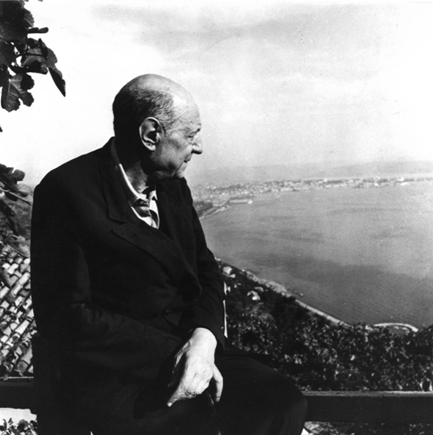
Saba sitting by the bay overlooking Trieste, 1951

Saba sitting by the bay overlooking Trieste, 1951

In this poem the bird’s eye view on the territory allows the poet to see the city in all its contradictions, both crowded and deserted, teeming with life but with quiet, solitary corners. After the difficult ascent to earn such a perspective, the poet finds within these contradictions a sense of belonging. The strange, tormented air is recognised as denoting home. When I studied this poem in school, this sense of belonging was taught as a general one, but I always felt it was queer, even before knowing of Saba’s sexuality. Specifically, the personification of Trieste as a “ragazzaccio” struck me as significant.

Cities are usually personified as female in art and literature. They are to be defended, and protected, they are the “motherland” of the masculine citizen. At the same time, they are also lovers of the presumed male citizen, and the love for one’s hometown needs to be established as a heterosexual one. This is even more explicit in Italian, where they are grammatically gendered female, as in most romance languages. Here however, Trieste is a boy, and a bad boy at that. He’s sweet but rough, he wants to consume and take – he’s voracious – but is unable to be delicate and give anything back, not even a flower. The city is transitioned into an image of an imperfect boy, who the poet cannot help but love in an imperfect way, with jealousy. The poem is queer because it transitions the city in order to make the love between the poet and the city a queer one. I read it as a queer outlook onto the landscape, one that generates a queer sense of belonging and personal peace. Like in Queering the Map, the view from above reveals the multiple, complex, and contradictory ways the landscape is lived in. Among these is the “cantuccio a me fatto”, a small and hidden but safe place for queerness.

These have been some thoughts inspired by these first few months of class. While I have largely used the case of Trieste to work through some of them, I wonder how they might resonate beyond this case study (and I must thank Eleanor for her comments about how they spoke to her own experience). As I am figuring out what my DH project on Fiore will look like, I will keep thinking about Saba and Queering the Map, and whether the digital, with its ability to reunite at a glance such diversity of experience, can make visible how queerness inhabits unlikely places.

Works cited:

  • Chimero, Frank. The Shape of Design. Frank Chimero, 2012.

  • Co-Creation Studio at MIT Open Documentary. ‘Co-Creating a Map of Queer Experience’. Medium, 2 November 2019. Link

  • Queering The Map. ‘Queering The Map’. Accessed 12 October 2025. Link

Poem Translation:

Literaryjoint. ‘Trieste, by Umberto Saba, English Translation’. LiteraryJoint, 6 March 2013. Link

  •  

Up, Down, Lateral Project Scoping

Working with humanists to scope a project can be challenging. Every idea feels precious, and it can sometimes feel as if changing anything at all is somehow a personal attack on what you’re trying to do rather than a good faith effort to help a project come to fruition. Here’s a quick exercise to help students learn how to navigate this process. The activity invites students to push and pull a single project idea in many different directions. I call it “Up, Down, Lateral Project Scoping.”

The main thing you’ll need is an idea that feels neutral in some way, something of vague interest but to which students won’t feel especially attached. As a frame for the work, I tell students that any project can be brown down into a formula:

  • object of study + method = project

This definition is, of course, made up, incomplete, and inadequate. But it still gives some lines in the sand that we will use for the exercise. Any parameter can be changed to affect the nature of the work. You can also make a project bigger or smaller, more ambitious or more tightly doable.

To begin the activity, put your neutral topic on the board on a whiteboard. Discuss the idea for a few minutes to develop some small project for it. Then, at various times, a facilitator calls out “up,” “down,” or “lateral” to indicate a new direction that the group must take the project idea in. Up or down shifts are fairly self-explanatory: practice making the project bigger or smaller and then discussing what such a change would look like. Lateral shifts ask students to practice orbiting around an idea, substituting in a change in method or object of study but keeping the same general area of concern. Lateral shifts are an invitation for students to see the different kinds of projects that can emerge if you keep many other things the same but move sideways. Think of these shifts as in the same genre as the faculty member who comes in asking for help with mapping, but you find yourself pointing out that mapping is a metaphor for them—they are really talking about network analysis, and pointing this out suddenly makes everything fall into place. Making sideways changes can often help others find out what a project is really about.

When I ran this exercise with the Praxis students this past week, the cohort brought in a variety of different interests that they all shared. I picked “recipes” from that list because the idea felt safe, of some interest but not a deep passion for anyone in the room. After framing the activity with the above context, we discussed the topic for a bit and came up with a small project: we took the interest in recipes and developed a project on local food pantries, what kinds of food was actually available at them, and what recipes they do or don’t enable. I then shifted the conversation by saying “Okay. Make it smaller.” The conversation moved to how we could study how people use one particular food pantry in particular. “Smaller again.” Instead of the whole food pantry, we might look at just the vegetarian options made available by that organization. “Now make it bigger.” Maybe we’re going to compare this food pantry to many different pantries in Virginia. “Bigger again.” Now we’re going to provide all these different food pantries with a form where they can collect information from their users about their needs whenever they walk in the door. All of these shifts bring with them new problems and opportunities that were fuel for discussion.

Bigger or smaller are shifts that make sense for students. Lateral movements are more challenging and take more prodding. I often found myself saying, “Okay. Now let’s shift laterally by changing the method to X.” Or “how would this project look different if we keep the same method but change the object of study to Y?” When I called out one lateral shift, for example, I asked students to think about a different kind of project on food had some of the same goals in mind. “Instead of food pantries, what would a project like this look like if we focused on other places where people engage with food?” The students came up with recipe blogs, which brought out some good conversation about how you could study food and diet practices on the web. Another lateral shift—”You’ve mostly focused on the ingredients list. What other kinds of materials are on recipe blogs? Other kinds of things you might study?” These questions led the students to discuss how we might examine the narrative introductions on many food blogs as text analysis materials. Maybe we’re looking at how long or short the particular narratives are to see if there’s some corollary with diet or cuisine. A lateral shift again—”what about other kinds of data sources are available on the website?” We discussed how you might analyze photographic habits on amateur food websites. “Smaller.” Focus on one recipe, one particular type of cuisine, or one particular type of food blogger. “Lateral shift again.” Maybe instead of the actual content on the website, you could make a mapping project where you see if recipe bloggers tend to write in or about particular places.

The goal was ultimately to teach that a project is not any one thing. Any one idea can be modified in a thousand small ways to respect your core interest but make it more doable. By asking students to respond quickly and move a project in a particular direction, they practice skills they can take back to their own work.

Something not working? Try moving it around to look at it a different way.

  •  

Questions With No Answers

The questions I have received while in grad school: What field and discipline are you in? What is your research specifically focused on? What is the topic of your dissertation? All great questions. Questions that know how to give a student a certain amount of anxiety, depending on what year they are in. But great questions nonetheless. These are the questions I have been trained to answer. I expect them. I have varying answers depending on who is asking. So, imagine my surprise when, instead, I am asked by Praxis: What is it that you want to get out of this program? What does community look like to you, and what goes into maintaining a group’s wellness? At the heart of it, what is it that you care about? Finally, truly, the most important question of the bunch- what is your individual superpower? And if it has not been made evident quite yet, mine was deemed sarcasm. And that is the only question and answer that matters. And if I believed I could end this post exactly here (without vaguely getting scolded), I absolutely would. But, alas, probably not a good idea in the first couple of weeks. So, instead, I finish with honesty. I can honestly say that Praxis has left me with more questions than ever. I don’t know that I can answer all the questions quite yet, and I am okay with that. For now, I know with certainty that I care about my community more than anything. And that, that is enough for me.

  •  

Questions for DH

I’m still thinking about Roopika Risam’s DH 2025 keynote entitled “Digital Humanities for a World Unmade.” As a part of that talk, Risam references four questions that form the theoretical foundations for minimal computing, using them to think about the work the field can do in the present moment:

  • What do we need?
  • What do we have?
  • What must we prioritize?
  • What are we willing to give up?

I love this framing, in part because it reminds me so much of the perennial question “what is digital humanities?” So often I think that specific question is how we open introductory syllabi for students new to the topic, but I often find that those discussions go nowhere. It’s not a bad question necessarily, but the topic has to be approached with care to make it matter for newcomers. Risam’s questions, in contrast, are activating, urgent, and provocative. I liked them so much that I fired off a post on BlueSky about how alternative questions like these would serve as a far better foundation for an “Intro to DH” syllabus.

Lately I’ve been putting together a range of potential course descriptions and workshop series about digital humanities. It’s great fun - I always enjoy this part of teaching for how it lets you live in possibilities. I found myself returning to the questions-first model again when I was asked to sketch out a short series meant to introduce digital humanities to a broad audience.

Here’s the rough breakdown, with a few annotations about what I would do in each session. I was asked to sketch out a four-session sequence, with each meeting lasting for roughly ninety minutes.

  1. What is DH?
    • Disciplinary scavenger hunt
    • With some prompting and select resources, students bring projects of interest from their own disciplines back to the group to discuss
  2. How do we do DH?
    • Methods sampler
    • Lightning talks from practitioners about a variety of different methods and approaches
  3. What do we need DH to be?
    • Budgeting workshop
    • Discussion of how funding enables and intersects with the infrastructure for doing DH work that matters to us
  4. What is DH for me?
    • Project proposal design jam
    • Students share project proposals to discuss with the group connecting what they have learned with their own interests and offering a plan for their own future in DH

So the sessions (and questions) start big and abstract. As we move forward, the topics become more personal and dependent on the person. Even if the students end with more questions than they began, my hope is that students will at least be able to see why these questions matter. And with any luck, this kind of framing will help students to see themselves in the field and to see the field in themselves.

What is the field and why does it matter? The answers depend on you.

  •  

Me and My Motivations

I want to write this post as someone who feels constantly on the edge of burnout and only recently repositioned herself.

Throughout college, I had an unwavering sense of self-purpose that I would pursue justice as a scholar. And I believed I was self-aware enough to avoid the pitfalls of ego, because I understood my privileged circumstances and I was genuinely motivated by my ideals. My identity was built on this vision of what my role is in the world.

But since entering grad school, this idealistic bubble of my self-image has busted. Among all kinds of pressures, I feel most defeated by the realization that I’m surrounded by extraordinarily talented people who outperform me, and the path I always imagined for myself turns out to be made up of endless selection processes in which I compete with them. My anxiety drives me to apply meritocratic standards to myself and always feel that I fall short.

This sense of defeat has been crushing, and I’ve been trying to understand where it comes from. I realize now that I had been driven largely by fear. I now see that I subconsciously internalized a social Darwinist worldview from my upbringing that I thought I had consciously resisted. This mindset manifested as a need to see myself and be seen by others as part of an academic elite contributing to my ideals from a position of distinction. Because my self-worth became tied to maintaining this image, whenever I’m challenged, I experience it as shameful incompetence.

This realization has pushed me to reconsider how I understand my identity and my contribution to society. Ultimately, I’m learning to reconcile two powerful, competing motivations: my original, enduring commitment to knowledge and justice, and the more recent, fear-based drive for academic excellence. The goal is to distangle them and to think beyond institutional validation. The most therapeutic and pragmatic step has been to re-evaluate my relationship with the idea of being “ordinary”, and ask myself, how can I make an impact outside academic settings.

So this is a post of my existential rambling, and it feels uncomfortably vulnerable to put these reflections on public record. But I want to do this to help de-stigmatize these feelings which are essentially part of a transformative period of my life. By sharing it, I hope to connect with others who might be navigating a similar journey.

  •