普通视图

Received before yesterday学术机构(海外组织)

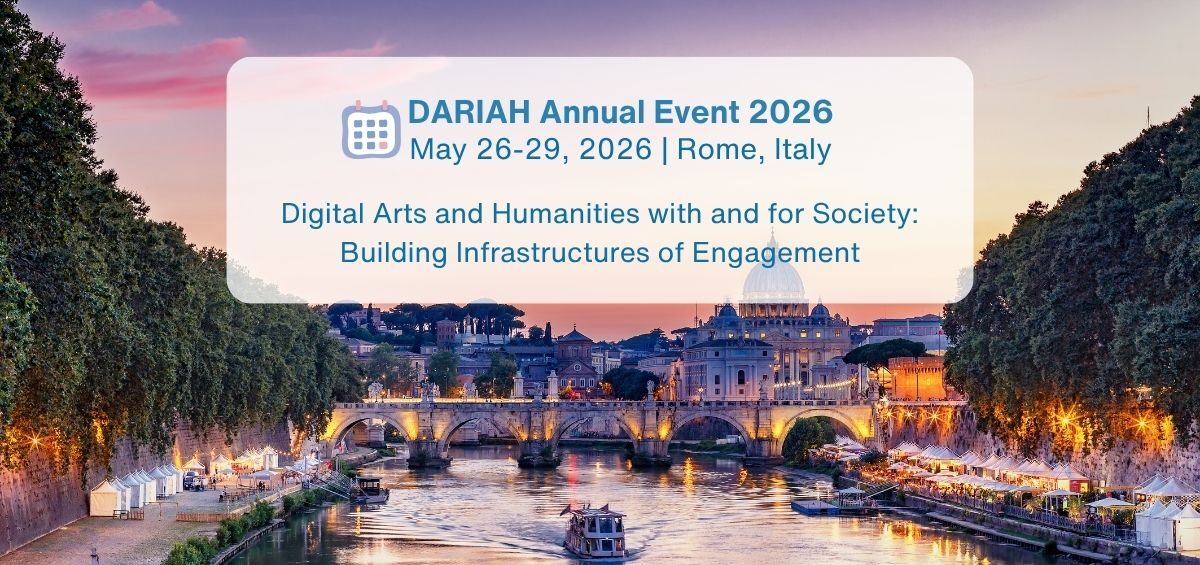
DARIAH Annual Event 2026: Call for Papers is now open

2025年11月18日 22:28
 
We are happy to inform you that the call for papers for the DARIAH Annual Event 2026 on the topic of Digital Arts and Humanities With and For Society: Building Infrastructures of Engagement is now open! The deadline for submitting contributions is December 22.
 
This year we seek to explore how digital, social and institutional infrastructures can support engaged research, and nurture generosity, participation and shared creativity in the digital arts and humanities.

We welcome contributions in the form of:
  • Papers
  • Panels
  • Posters and Demos

The 2026 DARIAH Annual Event is planned to take place on May 26th-29th in Rome, Italy. May 26th will be a day for DARIAH internal meetings, followed by the main conference on May 27th to 29th.
 
Find all information on the event at https://annualevent.dariah.eu/ 
More information on the Call for Papers at https://annualevent.dariah.eu/call-for-papers/ 
If you have any questions or comments, please do not hesitate to get in touch with us at annualevent@dariah.eu. 

BALTIC SUMMER SCHOOL OF DIGITAL HUMANITIES 2024

作者Anda
2024年5月10日 15:05

Students, researchers, and GLAM professionals are welcome to enroll in the Sixth Baltic Summer School of Digital Humanities:  Large Language Models and Small Languages, which will be held on 22-26 July 2024 at the National Library of Latvia (NLL) in Riga and online.

Register here: https://www.digitalhumanities.lv/bssdh/2024/registration/

This year, participants will have the opportunity to learn text processing and data visualization using the Python programming language, led by researchers from the National Library of Latvia and faculty from the University of Latvia and Riga Technical University, Uldis Bojārs and Valdis Saulespurēns. The curriculum will spotlight the capabilities and research applications of large language models. Andres Karjus, a researcher specializing in computer linguistics and cultural analytics at the University of Tallinn’s CUDAN Open Lab, will showcase the efficiency and speed with which these sophisticated language models can conduct text annotation and analysis, surpassing the output of earlier technological generations. Līva Rotkale, a philosopher and docent at the University of Latvia, will share her insights on formulating effective inquiries for the ChatGPT language model, focused on the needs of humanities researchers and students.

We will also discuss how the development of natural language processing tools and large language models is progressing for smaller languages. Presentations will be made by Javier de la Rosa, a researcher from the Artificial Intelligence Laboratory of the National Library of Norway, who will talk about the development of a large language model for the Norwegian language, as well as by researchers of the Latgalian language Sanita Martena, Ilga Šuplinska, and Antra Kļaviņa, who will introduce the digital resources for the Latgalian language. A separate session will be dedicated to text morphological and syntactic annotation tools, which are particularly important when working with morphologically rich languages (session led by Normunds Grūzītis, a lead researcher at the Artificial Intelligence Laboratory at the Institute of Mathematics and Computer Science of the University of Latvia).

Focusing on the use of artificial intelligence in image processing, the special guest for BSSDH 2024 will be the researcher and artist Mar Canet Solà, who will demonstrate the Collection Space Navigator – a tool that provides the ability to examine multidimensional image data from various perspectives. This topic could be of particular interest to specialists from memory institutions who oversee the creation and research of digital image collections.

The school is organised as a hybrid event on-site and remotely. The fee for completing the full course is EUR 40 for both on-site and online participants; keynote lectures will be accessible for free and streamed on the NLL’s Facebook and YouTube channels. 

The working language is English.

The Baltic Summer School of Digital Humanities is organised in cooperation with the National Library of Latvia, the Institute of Literature, Folklore and Art of the University of Latvia, and the University of Latvia. 

Supporters:

Project “Towards Development of Open and FAIR Digital Humanities Ecosystem in Latvia” (No. VPP-IZM-DH-2022/1-0002), National Research Programme “Digital Humanities” 

Common Language Resources and Technology Infrastructure CLARIN, CLARIN-LV

For more information contact:

Anda Baklāne
National Library of Latvia
Head of Digital Research Services
E-mail: dh@lnb.lv
http://www.digitalhumanities.lv/bssdh

Registration for the BSSDH 2023 is open

作者Anda
2023年5月24日 18:09

Registration for the Baltic Summer School of Digital Humanities 2023 is open

Students, researchers, and GLAM professionals are welcome to enrol in the Baltic Summer School of Digital Humanities: Discourse Analysis and Digital Literary Studies, which will be held on 25-28 July 2023 at the National Library of Latvia (NLL) and Online.

The Baltic Summer School of Digital Humanities is an international intensive continuing education programme that provides the opportunity to researchers, educators, and students of humanities and social sciences, as well as archive, library and museum professionals to master various digital research skills, from data wrangling and analysis to visualisation.

In 2023, the school is organised for the fifth time and provides the opportunity to learn the basics of data analysis and visualisation with Python programming language, master web harvesting skills, and learn to use Tableau and Gephi platforms for visualisation. Particular areas of interest this year are discourse analysis, digital literary studies, audiobooks, and DH infrastructures. The full programme can be viewed on the website Digital Humanities in Latvia.

The school is organised as a hybrid event on-site and remotely. The fee for completing the full course is EUR 30 for both on-site and online participants; keynote lectures will be accessible for free and streamed on the NLL’s Facebook and YouTube channels. The working language is English.

Registration form for the summer school is available here:

http://www.digitalhumanities.lv/bssdh/2023/registration

The Baltic Summer School of Digital Humanities is organised in cooperation with the National Library of Latvia, the Institute of Literature, Folklore and Art of the University of Latvia, and the University of Latvia. The programme is supported by the project “Towards Development of Open and FAIR Digital Humanities Ecosystem in Latvia” (No. VPP-IZM-DH-2022/1-0002), which is implemented within the framework of the National Research Programme “Digital Humanities” and funded by the Latvian Council of Science of the Ministry of Education and Science.

For more information contact:

Anda Baklāne
National Library of Latvia
Head of Digital Research Services
E-mail: dh@lnb.lv
http://www.digitalhumanities.lv/bssdh

Conference Registration is now open!

2023年1月23日 18:44

The DHNB 2023 Conference is now open for registration. The Conference will be held online and will feature a variety of topics on our theme of Sustainability: Environment, Community, and Data in the digital humanities. Create an account and register on ConfTool to secure your spot!

The Program Committee and the Organising Committee are working on drafting a complete conference program. A preliminary program will be published on our website by the end of January 2023. Stay tuned!

Recap of the Annual Event 2023: Cultural Heritage Data as Humanities Research Data?

2023年7月7日 23:14

The DARIAH-EU Annual Event 2023 took place in Budapest, Hungary, from June 6th – 9th 2023. The topic of this year’s event was Cultural Heritage Data as Humanities Research Data? This was a busy annual event, as we welcomed more than 200 participants from over 30 countries around the world. The event was held in-person with additional streaming of the main plenary room across all three days.

Theme of Cultural Heritage Data as Humanities Research Data?

Collections in libraries, archives and museums have been at the heart of humanities research for centuries. However, with the current focus on data-driven research, data management plans and the research data lifecycle, in what ways do we need to think differently about cultural heritage collections as data? Inspired by the proclamation “cultural heritage data is humanities research data”, this year’s DARIAH Annual Event explored what this means in practice. What does it mean for cultural heritage institutions to provide access to their ‘collections as data’? Do we need to think of different workflows for digitised and born-digital datasets? Can we think of a humanities research data continuum? These are only some of the questions that we discussed, debated, and answered at the 2023 DARIAH Annual Event.

Three themes were proposed for the 2023 Annual Event to inspire submissions:

1. Sustainable workflows for data management and curation

2. Imagining experimental data spaces for cultural heritage

3. Advancing digital methods for the analysis of cultural heritage

For more pictures of the event, please visit our Flickr album.  

Programme

The 2023 event kicked off with meetings of DARIAH bodies, followed by three conference days with panels, papers, keynote speeches, performances and poster sessions. Specifically, the programme of the event consisted of:

  • A keynote lecture and keynote panel on the event’s theme: an opening lecture by Thomas Padilla (Deputy Director at Archiving and Data Services of the Internet Archive) entitled ‘A Mutualistic View of AI in the Library or a Continuation of Craft’ and a closing keynote panel entitled ‘DARIAH Data Spaces Dialogue: Imagining Experimental Data Spaces for Analysis of Cultural Heritage Using Digital Methods’, chaired by DARIAH Director Sally Chambers. 
  • Paper sessions on topics including ‘Exploring Cultural Heritage in Research: Case Studies in Genealogy, Gaming, Language, and Historical Data’, ‘Imagining Data Spaces’, and ‘Data quality and data management for CH in the context of open science’
  • Panel session on the topic ‘The digital research axis at C2DH: sustainable workflows, data usability, and multi-layered publishing’. 
  • Poster sessions each afternoon
  • Two country-specific showcases: ‘DARIAH Hungary Showcase: Road to DARIAH’ and ‘Dariah.lab Poland – Together for Cultural Heritage’
  • Plenary sessions
  • Internal meetings of several DARIAH organisational bodies including the Scientific Board.

Over the three days, the participants listened and contributed to many exciting topics such as data quality and management for Cultural Heritage, new ways of accessing DH data for GLAM or Exploring Digital Heritage: Innovations in Digitization and Data Services.

A key take home message from this year’s event was the importance of collaboration across cultural institutions in order to best facilitate the integration of cultural heritage data and the management of humanities data.  

Find out more

Get a glimpse of the 2023 Annual Event in this recap film:

All three days were streamed in full and are available via the ELTE Youtube channel (Day One, Day Two, and Day Three)

The Book of Abstracts is available in the Zenodo community for the Annual Event 2023.

❌