阅读视图

The Slideshow And The Video Essay

作者leo-palma

In my discipline, art history, the slide show is not only an intrinsic part of teaching, but it shaped the discipline’s methods from its inception. Practices through which art historians are taught to understand art – like visual analysis and comparative analysis– rely on one or more reproductions of artworks to be available to students in the classroom. Photographic slides have been used in art history since the early twentieth century. Then why are most art history sideshows so plain? Why, now that technology has advanced, have the conventions of the art history slideshow stayed largely the same?

Outside of academia, video is one of the main ways people consume information. Currently, this is largely through online video. Online educational programs vary greatly in quality and accuracy, but many educated individuals who operate outside of academia have taken to platforms like YouTube to share their knowledge and their analysis on a variety of topics. Some of my personal favourite video essayists hold undergraduate and graduate degrees in philosophy. They often start their videos by addressing a current topical issue or event as a departing point to present different philosophers’ ideas and concepts. While these videos use some academic practices – like citing sources on the top right of the video, or providing a bibliography in the description – their presentation style is definitely not academic. Their videos contain elaborate costumes, makeup and sets; their presentation style is highly emotive: they use humor, plot twists, and personal experiences to make complex topics more approachable. On Youtube, maintaining viewers’ engagement and retention is paramount for the monetisation of a channel. This is often achieved by favouring material that emotionally, rather than just intellectually, engages the viewer. Video essays can be long, sometimes multiple hours. The audience is almost by definition assumed to be a distracted one. Viewers are doing chores, or cooking, or on their commute. To keep them interested and listening, one needs to find ways to not only make the content relevant to them, but create emotional resonance and construct exciting visuals and sound design to highlight important moments. This highly emotional way of presenting differs from academic rigor, expectations of objectivity, and separation between the self and one’s field of study.

While in certain academic fields – largely feminist, queer, black and other minority studies – this requirement has been challenged, it is still an underlying practice in disciplines like art history. Yet, we all spend years of our life studying and researching this material because we love it, because we find it interesting and relevant. So why is it so difficult to communicate passion and enthusiasm in public facing presentations?

I believe there are at least two practices from the YouTube video essay that could translate to the academic presentation: encouraging emotional engagement, and providing variety. In regard to emotion, for example: Where can I script a joke or acknowledge the humor of an aspect of my research? Where can I leave out a conclusion or some information, to surprise my listener with it later? Where can I reenact a moment of my research when I found out something exciting or unexpected? Where can I peel back the curtain a bit on the process of my research, so that the listener feels involved in the narrative I’m presenting, and not just a passive bystander? Importantly, how can I use the tools at my disposal to create these moments of emotional engagement? Where can I hide something on the next slide, as to not give away my findings before I get to them? Where can I include a photo that brings up a good anecdote from my time in the archive, or at the collection?

Variety and dynamism can also be accomplished through the slides. Why am I the only one talking? Do I have audio or video clips that I can use? Can I call onto someone in the audience to answer a question? I often find it difficult to not sound monotone when I’m presenting. Embedding audio or video or planning for moments of interaction with the audience could help to break up the sound of my voice. There are also ways to make slides more dynamic and visually interesting without making them look unprofessional. If I need to talk over an image for a long time, how can I animate it in some way? Can I zoom in onto details of the painting as they come up in the talk? Can I show Calder’s mobile sculpture move? Can I play a video of the performance with the sound off as I’m talking about it?

The workshop I’m planning in Spring is an attempt to think about emotional engagement and diversity in the slideshow presentation as a group, without being prescriptive on which methods to adopt and when. I am aware that our cohort works in a variety of fields and from multiple identitarian positions that affect how we are perceived in a professional setting. Some of us can take more liberties when it comes to academic speaking and some of us cannot. But I am interested in finding out what people think about this comparison. Which methods of the video essay can apply to the academic presentation with the slideshow? I plan to use clips from videoessays to show some of these techniques. I’ll then play a clip of an academic presentation, and ask the people in the room to draw a storyboard of it. Storyboards, where a drawing of a shot and notes are put side to side, are very similar to the slide and script style of preparing for a talk. However, they force one in the position of the audience member instead of the presenter. They allow us to think in more detail about framing, and movement, and how to direct the attention of the viewer. I hope this exercise will inspire the group to think about some ways in which the slideshow can improve our ability to communicate our research to a variety of audiences.

  •  

Vector/Vectoria, be yourself at these GIS Workshops

Get over to Chez Scholars’ Lab for the hottest GIS workshops in town. And fear not, our references may be from the nineteen hundreds, but much like the themes of that movie, the content of these workshops is ahead of its time.

Spring semester is when we shift gears and turn our workshop focus to ArcGIS Online (AGOL), Esri’s GIS solution for the cloud. AGOL is browser-based, eliminating any Windows vs. Mac shenanigans, and allowing us to provide temporary access to members of the community that don’t have UVA credentials. Not sure what the difference is between ArcGIS Pro and ArcGIS Online? Mark Patterson sums it up well here. Still not sure? As always, feel free to contact us with any questions.

  • Sessions are one hour and assume participants have no previous experience using GIS. These will be hands-on demonstrations with step-by-step tutorials.
  • We will meet in-person in the Scholars’ Lab (Shannon Library 308) on Wednesdays from 2PM to 3PM, and openly welcome the UVA and larger Charlottesville community.
  • Walk-ins are welcome, but due to limited seating, we strongly encourage registering using the links below or at our Events page. If you’re waitlisted, please contact us at uvagis@virginia.edu.
  • Class materials will be made available on the Spring 2026 Workshops tab of our Teaching Resources page.
  • We will not be offering a virtual option this semester. We apologize for any inconvenience.
  • Please note, these workshops are not intended for course instruction. If you’re here at the direction of your professor, or if you’re teaching a class and would like to include GIS instruction, please contact us at uvagis@virginia.edu.

January 28th - Introduction to ArcGIS Online

ArcGIS Online is the cloud-based younger sibling of ArcGIS Pro. It can’t do some of the less flashy, GISy kind of things, but it’s in the cloud, it’s connected, which adds all the hip functionality we’ve come to expect. With ArcGIS Online, you can find and create spatial data, maps, and applications. Access a limited but powerful set of analysis tools that take advantage of cloud computing and pre-configured data and resources. Share and collaborate with small groups or with the world. It’s an easy-to-use entry into the world of GIS, all from the comfort of your browser.

Register Here!

February 4th - Find and Create Spatial Data

Start your data search with AGOL’s collection of geographic information from around the globe. Not finding the data you seek? We’ll cover how to create your own data, and how to share it with the world.

Register Here!

February 11th - Collect Data in the Field

Whether you are crowd sourcing spatial data or performing survey work, having an application that records location and uploads data directly to a mapping application is incredibly useful.

Register Here!

February 18th - Web Mapping and Visualization

Pop-ups, filters, clustering, advanced symbology. There are many ways to personalize your maps, enhancing the story your data tells. We’ll dive into some of the more advanced functionality that allows you to fine-tune your Web Maps. Don’t be put off by “advanced”, though, this session is beginner friendly.

Register Here!

February 25th - Spatial Analysis with ArcGIS Online

Perform basic analysis with tools like Buffer and Spatial Join. Or, enhance your data, taking advantage of the always up-to-date elevation, streets, and demographics data available in ArcGIS Online with tools like Create Viewshed, Find Nearest, and Enrich. Come for the learning and stay for stories about the old days when we had to create all that data ourselves. Uphill. Both ways!!

Register Here!

March 4th - Spring Break, No Workshop!

Enjoy a break. We’ll see you next week!

March 11th - Instant Apps and More

Dip your toes into the world of web GIS applications with AGOL’s quick-configure app builders. We’ll explore a few of the many options for enriching your map and data with focused applications. From time animation to interactive multimedia, these easy-to-use templates and builders take your data to the next level.

Register Here!

March 18th - Introduction to ArcGIS StoryMaps

StoryMaps is a website builder that makes it easy to add narritive and multimedia context to your ArcGIS Online maps. Whether telling a story, giving a tour, or comparing historic maps, StoryMaps is an easy-to-use tool that allows you to create a polished web presentation.

Register Here!

  •  

Preparing for Leave

My wife and I are expecting our second child in just a few weeks, which means that I am gearing up for a new and chaotic phase of life. As a part of the preparation, I’m doing everything I can to keep things running smoothly for student programs in the Scholars’ Lab while I’m out. I set up a process for doing so when I took leave two years ago for our first child, so I’m not exactly working from scratch. Here’s how I’m preparing for my leave this time around to make things easier for my coworkers who will be keeping things going in my absence.

Give notice early

Everyone has different interlocking reasons for when they give notice to their team. Those reasons might be medical, personal, or professional. Given my own particular circumstances, I let my immediate collaborators in the Scholars’ Lab know fairly early, several months before I would be out. With this knowledge well in advance of the due date, my collaborators knew that I was taking steps to accommodate my absence. I also notified students who would be impacted. The dates I chose to take these steps were selected carefully in conversation with my supervisor, who helped me decide who needed to know and when.

Identify areas of responsibility

One of the first tasks in preparing to unplug for two months was to list my tasks, differentiating between major ongoing initiatives and smaller one-off items. This process helped me to create a to-do list such that I can make progress on my leave in a controlled manner. Otherwise, one can get lost in an anxiety spiral feeling like there is already more to do. I identified the Praxis Program, the DH Fellowship Committee, and our summer programs as primary initiatives in need of continuity.

Wrap up what I can

For smaller projects, I sprinted over the past two months to finalize whatever I could. Rather than working with a particular student on a weekly basis, for example, I set a date for a multi-hour meeting where we could make significant progress on their project. I set early writing goals for myself to meet deadlines in advance. And I took advantage of the slow down between semesters as space in which I could get ahead.

Establish points of contact for what I can’t

Some projects and initiatives will inevitably roll over through my leave. Working through my list, I worked with my supervisor and coworkers to identify people whom might be willing to take on specific pieces of my work. This process always involved asking my collaborators a series of questions: what do they need to feel comfortable? What can they do? What do they feel uncomfortable with? Who else might make sense for particular tasks?

Document everything

So much of the work I do exists in my head. Workflows, points of contact, procedures, norms. I tried to write as much of this down as possible so that someone stepping in would know exactly what to do and when. Winnie E. Pérez Martínez has been exceptional at working on this with me as a student worker, especially in regard to clarity and formatting. Winnie has a special talent for taking an enormous brain dump from me and assembling it into a coherent, less intimidating guide. I have learned a lot from her!

Put guardrails on future commitments

If possible, I tried to stop planning major commitments that would take place a couple weeks before the due date. At the very least, when I agreed to something, I made it clear that I might unexpectedly withdraw with little notice. I am also giving a couple weeks buffer before scheduling new commitments after I return in April. After all, babies have their own schedules in mind, and postpartum life is enormously challenging and complex. It’s impossible to know what our lives will be like for the next several months, and I tried to be honest about these facts with everyone involved.

Caveats

Everyone deserves the time and energy that parental leave allows to refocus on their personal life and meet the needs of a difficult transition. Everyone deserves coworkers kind enough to help them make space for their family. But I also know this is not the norm. I am enormously fortunate and privileged to have such support. That being said, I hope that what I’ve outlined above can be helpful even for those who do not possess such a robust support system. In those cases, this post might offer a rough guide for how to advocate, push back, and find small space for what you need in infrastructure that might not otherwise allow it.

  •  

3D Printed Cityscape

A screenshot of a map

This is a guest post by Makerspace user, Yifan Liu. During the 2025 Fall semester he developed and created a number of amazing cityscapes.

3D Print Tutorial: Cityscapes

By: Yifan Liu (yl3gm), UVA Graduate Medical Student

Creating a 3d Model

  1. Open the online software Map2Model. You will be presented with the following interface. A screenshot of a map
  2. Enter which city or area you would like to model search bar. Then select an area of the map to be modeled.
    A screenshot of a map
  3. Adjusting settings: There are many customizable settings that can be adjusted in the right-hand menus. Below are a few example settings that I commonly choose.
    • Base:
      • Map size: 152mm
      • Base layer: 4mm
      • Topography: Disable if modeling a relatively flat area to reduce complexity
      • Frame: Off
    • Features:
      • Roads
    • Include footpaths: Enable if you want to include detail of hiking trails or parks for example. Disable if you want to reduce file size and processing time
    • Road Types: Play around with disabling different road types for effect or reducing complexity - Grass: Off - Buildings:
    • Buildings Scale: 1.2x – 1.5x - Sand: Off - Piers: Off
  4. Press “Generate Mesh” to generate a 3d model of your selection A screenshot of a map
  5. Click the dropdown menu next to “Export 3MF”. Click “Export STL”
    • Note: you can also export as 3MF to retain features like roads, water, and buildings as separate objects.

Editing and Refining (optional)

You may notice that some structures in the model are not correctly detailed or rendered. If you want to add more detail, import your model into a 3d modelling software. For this example, I used Blender. More detailed instructions on how to use Blender can be found online.

  1. Download or create 3d models of desired buildings. Adjust to correct scale and position and place over existing building on model.
    A screenshot of a map
  2. Delete undesired geometry or vertices on cityscape.
  3. Export file as an STL for slicing and printing.

Slicing

  1. Open STL file in PrusaSlicer
  2. Adjust settings by going to “Print Settings”:
    • Print settings: 0.20mm Structural
    • Brim: 4mm
    • Infill: 10%
  3. Multimaterial Printing: (optional)
    • Click on the STL object and click on Multimaterial printing on the left-hand menu icons
    • Use the Smart fill tool to paint the desired colors. I prefer to paint water features blue and all other features white.

A screenshot of a map

Printing

  1. After slicing export your file to the desired printer. If using Multimaterial printing, use either Kermit (Prusa MK4 MMU3) or Big Bird (Prusa XL).
  2. Load and select desired filaments on printer. Make sure to check that the correct filament is paired with the correct extruder.
  3. Print and wait!

A screenshot of a map

  •  

Seeing, Describing, and Imagining: Human and Machine Vision in the Humanities

Framing the Workshop: Vision, Interpretation, and Context

In recent years, digital tools have quietly transformed how we experience and interpret images in museums, classrooms, and research settings. As an art historian working at the intersection of art history, digital media, and visual culture, I am drawn to examining how people translate visual experience into words, and how that process compares with machine analysis of the same images. I am especially interested in creating spaces that invite us to pause, pay closer attention, and make the act of interpretation visible, rather than treating images or technologies as self-evident.

Seeing, Describing, and Imagining originated from a simple, low-stakes classroom exercise I first encountered while serving as a teaching assistant in a course on formal and visual analysis taught by my advisor. Watching students work through the challenge of turning what they were seeing into words made it clear how tentative and negotiable description can be. That experience stayed with me and prompted me to rethink the exercise beyond the classroom, adapting it into a workshop format.

The workshop aims to create a shared, practice-based method for visual analysis that can be applied in various settings, from visual analysis courses to digital humanities labs, while staying rooted in art-historical approaches to looking.

From Looking to Language: Description and Interpretation

The workshop is conceived as a hands-on, collaborative way of exploring how images move between seeing, describing, and imagining. It is designed to begin with a simple exercise. Participants would look closely at an artwork and translate what they see into words. Working in pairs, one person would study the artwork and describe it in detail, while the other would create a quick line sketch using only that description, without ever seeing the image itself.

This phase aims to slow the process in a constructive way. Participants are encouraged to reflect on the act of describing itself: What do you choose to mention first, and why? Which parts of the artwork are hardest to put into words? These questions are designed to show that description is never neutral. Emphasis, order, and omission all influence how an image is understood.

When sketches and original artworks are placed side by side, the workshop is designed to shift from creating to comparing. Instead of viewing differences as mistakes, participants are encouraged to explore what moments of similarity and difference may reveal about the connection between image and text. The aim is not to fix these gaps but to use them as a way to think about how seeing, knowing, and describing are linked in art history practice.

Human–Machine Translation: AI, Images, and Visual Convention

Starting from this analog foundation, the workshop is structured to move into a digital phase by introducing AI text-to-image systems. Participants would revisit and refine their descriptions before entering them into an AI model such as DALL·E or Adobe Firefly. The resulting AI-generated image would then be placed alongside the original artwork and the participant-created sketch as a third object for comparison.

Rather than evaluating which image is better or more accurate, this stage emphasizes observation. Participants are encouraged to ask what kinds of visual patterns might emerge across AI-generated images. Which elements seem emphasized, simplified, or made more uniform across different outputs? Looking across multiple results is meant to create space for noticing patterns without assuming in advance what those patterns will be.

Existing scholarship by authors such as Kate Crawford, Safiya Umoja Noble, Ruha Benjamin, and Johanna Drucker suggests that AI systems are shaped by the datasets they are trained on, the ways information is classified, and the cultural assumptions embedded in those systems. Drawing on these works, the workshop is designed to create conditions where such influences could become visible through hands-on engagement rather than explanation. As participants compare images, the process opens up the possibility of exploring whether familiar visual conventions emerge, particularly when prompts involve artworks or visual traditions that are not widely represented in large image datasets. What becomes noticeable is deliberately left open and expected to take shape through comparison rather than as a predetermined outcome.

The workshop also introduces a reverse process, moving from image to text. Participants would upload an artwork into an AI vision tool and examine how the system translates the image into language. Reading these AI-generated descriptions alongside participants’ own interpretive accounts is intended to prompt reflection on differences in tone, emphasis, and confidence, and to raise questions about how uncertainty functions in human versus machine descriptions.

Staying with the Process: Open-Ended Inquiry and Reflection

Taken together, Seeing, Describing, and Imagining is framed as an open-ended inquiry rather than a demonstration. Prompt writing and refinement are approached not as purely technical tasks but as interpretive acts, similar to the analytical frameworks art historians use when working with images. While elements of the workshop align with existing practices in art history education, digital humanities, and critical AI studies, Seeing, Describing, and Imagining brings these approaches together in a distinctive sequence that foregrounds interpretation as an active, negotiated process involving both human and machine systems of vision.

The workshop is designed to foster attentiveness, curiosity, and careful comparison. It encourages participants to stay with the process and to observe what may emerge as images move between eyes, words, algorithms, and back again. In this way, both human and machine vision are presented not as stable endpoints, but as ongoing, context-dependent practices shaped by history, culture, and interpretation.

Works Cited

  • Benjamin, Ruha. Race After Technology: Abolitionist Tools for the New Jim Code. Cambridge, UK: Polity Press, 2019.
  • Crawford, Kate. Atlas of AI: Power, Politics, and the Planetary Costs of Artificial Intelligence. New Haven, CT: Yale University Press, 2021.
  • Drucker, Johanna. Graphesis: Visual Forms of Knowledge Production. Cambridge, MA: Harvard University Press, 2014.
  • Noble, Safiya Umoja. Algorithms of Oppression: How Search Engines Reinforce Racism. New York: New York University Press, 2018.
  •  

Brighter Social Media Skies: Bluesky For Library-Worker (and DH!) Online Community

Social media can help you build professional and social community, find jobs, learn from others, share your work, ask questions, and hear about new ideas and projects. After the implosion of multiple other social platforms, the Bluesky platform has become one of the best options to keep accessing those benefits. This video captures a live webinar from May I gave for the Metropolitan New York Library Council, aiming to help library and archives workers considering trying out Bluesky, or who’ve dipped a toe in but not felt comfortable using it yet.

All the resources mentioned in this talk are listed at tinyurl.com/intro-bluesky. Most useful is my Bluesky for Academics guide at tinyurl.com/DHBluesky, which remains regularly updated and contains both very-quick cheatsheet and incredibly detailed versions of how to get started understanding Bluesky use for DHers, GLAM folks, and other knowledge work folks. At the end of that guide is a sortable list of “starter packs”, feeds, and lists gathering folks to follow on Bluesky around topics like DH, critical tech, expansive making & crafting, queer studies, social justice work, and more.

  •  

GIS Mapping Taught Through the Theory of Accompaniment

Geographic Information System (GIS) mapping attaches a dataset to a specific space and place, substantiating a relationship between the two as not only directly related but as affected by or moved to that specific point on a map. However, when thinking about how to teach a workshop on mapping to a group, one problem came to mind: we are in a generation with a profound lack of relationship to and with maps and the locations of countries. Which, in general, is its own point of discussion; however, when considering migration and mapping, a recognition of this lack became a focus for me. The question formed: how do I first get people not only to see, but really understand this non-relationship?

As students, we shape our own archives, perceptions, and pedagogy through the scholars we read and encounter. The scholar whose work inspired this very workshop, and answered the questions I wrestled with, is Ana Patricia Rodriguez. I was guided through my approach by both her first monograph, Dividing the Isthmus: Central American Transnational Histories, Literature, and Cultures, and her article, “The Art of (Un)Accompaniment: Salvadoran Child Refugee Narratives in the Twenty-first Century.” (10 out of 10 recommend others read both)

First The Non-Relationship

Rodriquez begins her monograph’s introduction with an activity she runs in her classroom. I pull that activity and use it as my own introduction to not mapping, but maps. The assumption I make is clear- Latin American countries do not and will not register as located within the group’s imagination. The lack is made evident. Now, no spoilers, go read her book. This part of the workshop will use 3D-printed or woodcut materials, is theoretically brief, and allows me to transition from map to mapping by asking them questions. I don’t know what I will ask quite yet, but they will be fantastic questions.

Accompaniment as Pedagogy

Next point of inspiration. First, the question. How can I make a GIS mapping workshop interactive and include a dataset based on migrant experiences in Mexico? Rodriguez’s article introduced me to the work on accompaniment. In this article, her reading of Javier Zamora’s Unaccompanied (also a book everyone should read), theorizes “a poetics of un/accompaniment” where,

The poems create a path of accompaniment of critical empathy for readers to follow literally and literarily the migratory routes of child migrants … It is in this process of accompaniment that readers are positioned, if not prodded, to question the conditions that produce child migration and the legal violence of migration policies, which shape the outcomes of arrival, detention, exclusion, and deportation, especially for women and children.

The accompaniment that Rodriguez traces in Zamora’s works and literature builds on scholarship and research on accompaniment in movements and research, but ties it to migration. Poetry and narratives create a different space for “readers to follow” migrants on their route to the United States. This, along with the ways readers are “positioned, if not prodded, to question the conditions,” prompted me to consider how a hands-on GIS workshop almost inherently, and unintentionally, seeks to enact an accompaniment. This is not to claim that there is a perfect or unflawed relationship between mapping and accompaniment. The accompaniment will shift a bit in its movement to the digital and/or in the making of narratives into data points. However, through accompaniment, what became clear was that what I considered to be simply an inherent relationship between place and data was flawed when I maintained it as inherent rather than as something to be questioned and interrogated.

The reality is that datasets can risk reducing humans to bodies in the very act of transforming information into points plotted on a map. That risk is exacerbated when the lack of relationship to a map is already present, and all a viewer intakes is a map filled with marks, even when they attempt to filter and narrow the scope of what they are looking at. With that, can embedding the mapping of points as a process of accompaniment shift how a viewer or a mapper processes a large, complex dataset? And is this shift my pedagogical framework? No clue, I will get back to you on that one.

The Actual Workshop

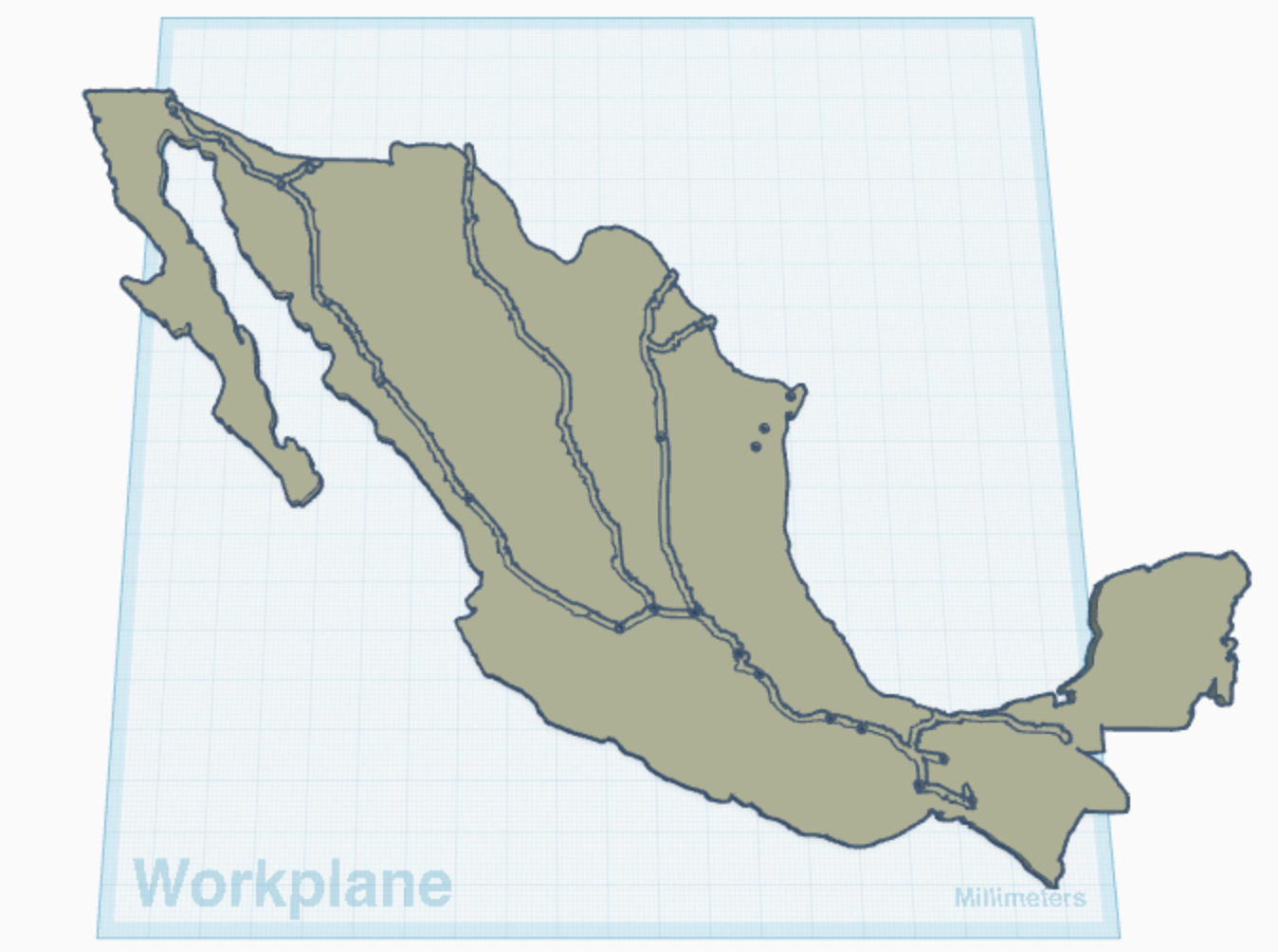
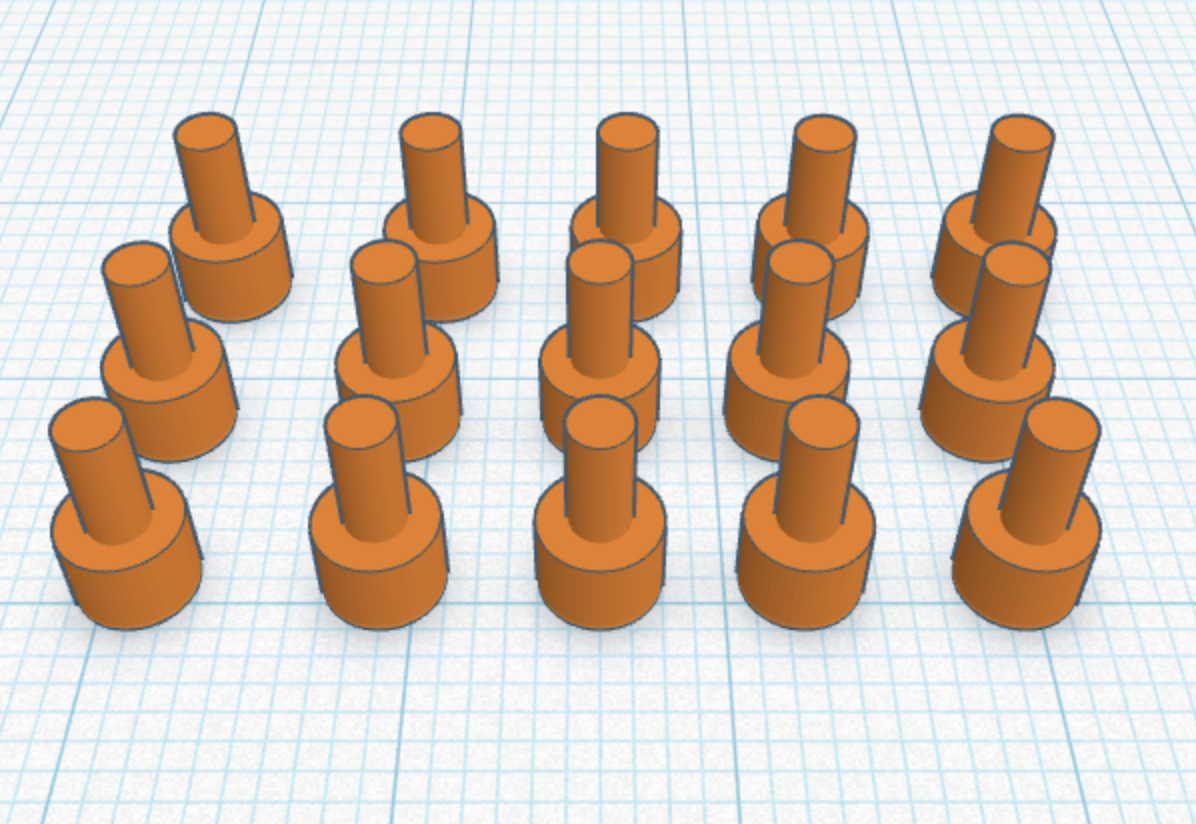
The nitty-gritty part of this actual blog post. Bear with me. In groups, people will be given a 3D-printed or woodcut of México, with holes already embedded into the country. These will be the data points (holes, literally just holes already made in the map) and pins, sized to fit them. The holes are rendered as a permanent facet of the map due to the nature of 3D printing, which makes me consider how the stories and narratives the map represents are always present, whether they are pinned and mapped or not. Which, by no means, should be uncomplicated, we should always consider why data gets mapped, what it is meant to demonstrate, what ends up entering, and what is left out and excluded.

Along with the country, they will also be given a mix of 14 notecards; on the front, each will have a year, the migrants’ nationality, and gender. In a longer workshop, I would leave parts of the data set unlabeled and have participants read the narrative on the other side and fill in the data themselves. Making data collection part of the activity and including a brief interrogation of what we synthesize and ultimately prioritize.

Mexico STL file

Closeup of Mexico STL

STL file for pins

Slowly but surely, they will place a pin on the 3D map at the final location in Mexico mentioned in the narrative, where the hole already exists. By this point, the idea is that each pin they place on the map will serve as an act of accompaniment.

After they finish plotting all the index cards, the hope is that the participant will also be struck by the magnitude and scatter of a map filled with data points everywhere. It is here that the final questions address an essential part of GIS mapping: how does one filter through large datasets? How important were those labels at the front of the card to begin with? How do all the parts work together? Does this data filtering return us to a different directionality of accompaniment? These questions, along with this workshop, are truly a work in progress. While the process of prototyping countries and pins has taught me so many things (like patience and a love of failure), there is still so much I cannot yet estimate. And any comments or suggestions are always welcomed with gratitude.

Finally, I have a big rule about recognizing the role people play in helping me make a chaotic idea from my imagination feel and become tangible. None of this would have been possible without the Makerspace, Ammon, Shane, Brandon, and, lastly, David Coyoca, the man I bother with all my questions about teaching, and who helped me sort through the chaos that is my brainstorming. This final version-in-process would not have been possible without the team effort that praxis encourages. 10 out of 10. Thank you.

References Rodriguez, Ana Patricia. 2009. Dividing the Isthmus: Central American Transnational Histories, Literature, and Cultures. Austin: University of Texas Press

———— 2025 “The Art of (Un)Accompaniment: Salvadoran Child Refugee Narratives in the Twenty-first Century,” Studies in 20th & 21st Century Literature: Vol. 49: Iss. 1, Article 8. https://doi.org/10.4148/2334-4415.2281

  •  

The OpenAI API documentation is very bad

作者shane-lin

The OpenAI API docs are very bad. In my experience as a coder, I’ve come across my share of bad documentation. Typically, this is because the documentation is poorly organized, too spare, or missing coverage. Or it’s because the design of the API itself is badly conceived, inconsistent, or contains the accumulated cruft of years (or decades!) of bloat and abandoned features.

But I can’t recall ever seeing documentation that contains code samples that are both wrong and also syntactically wrong. It’s bad enough that it comes across as documentation written by GPT–and not even a recent model.

Take this example, part of an entry under the “Core Concepts” section:

context = [
    { "role": "role", "content": "What is the capital of France?" }
]
res1 = client.responses.create(
    model="gpt-5",
    input=context,
)

// Append the first responses output to context
context += res1.output

// Add the next user message
context += [
    { "role": "role", "content": "And it's population?" }
]

res2 = client.responses.create(
    model="gpt-5",
    input=context,
)

The Python code sample here is not syntactically correct. The comments use the ‘//’ convention of C/Java/Javascript in-line comments, rather than Python’s ‘#’. Additionally, OpenAI has the concept of a role, which indicates who (e.g. the system, the user, the model’s responder) is “speaking.” The string “role” is not a valid value for this and making an API call with it results in an error:

openai.BadRequestError: Error code: 400 - {‘error’: {‘message’: “Invalid value: ‘role’. Supported values are: ‘assistant’, ‘system’, ‘developer’, and ‘user’.”, ‘type’: ‘invalid_request_error’, ‘param’: ‘input[3]’, ‘code’: ‘invalid_value’}}

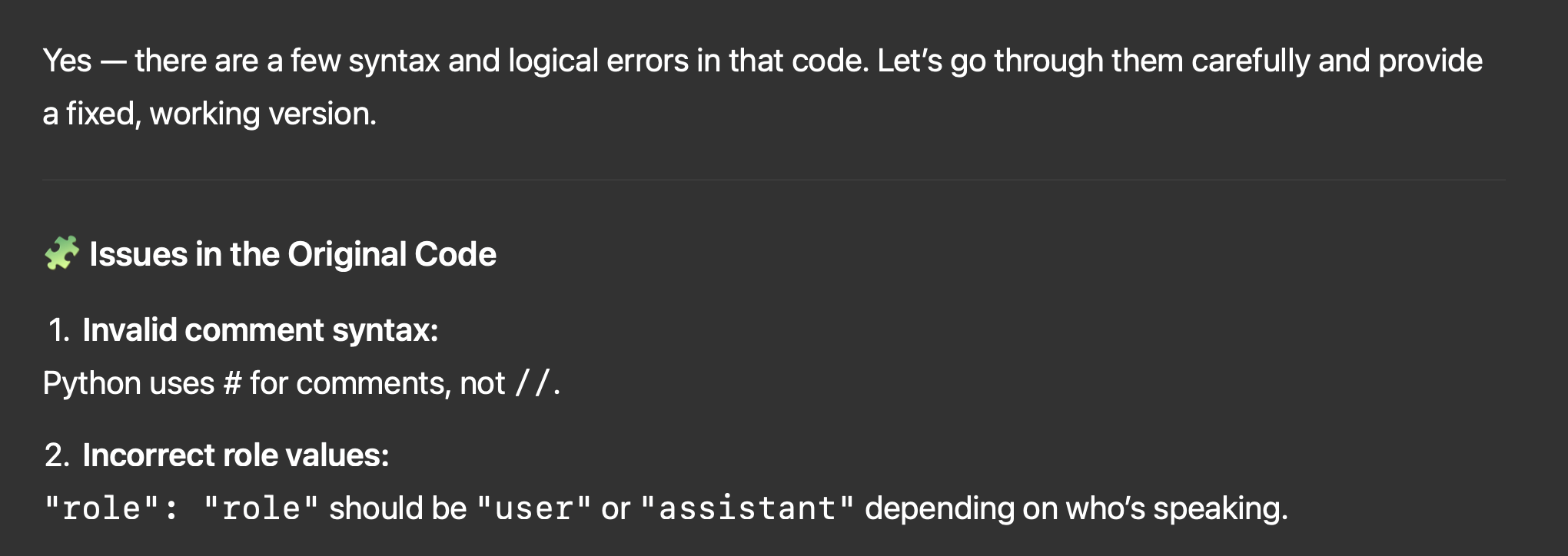
So, there are a total of 7 code statements in this sample, including the comments, and 4 of them have errors. The thing is, GPT-5 is actually pretty good at writing code. It’s even capable of executing Python code in an internal environment. We can see this facility in action by simply asking ChatGPT to debug the code from the OpenAI documentation.

ChatGPT response indicating the two errors from the OpenAI API documentation

This is a mode of LLM use that I haven’t had a lot of luck with, but here it pinpoints the two errors perfectly.

When documentation is bad in a common fashion, it typically creates a frustrating programming experience. And, to be clear, the OpenAI docs are bad in some of those ways too. But the sheer lack of care it demonstrates is both shocking for all the ways that Tech has integrated AI into our world and, frankly, majestic. Like making a horse consul or completely blowing up the system of global trade.

  •  

other possible lives in alumni data

It’s 2025 and too many of those enrolled in humanities PhD programs1 still think they’re going to land a tenure-track faculty position in higher education. Yes, Faculty2 members have been slowly facing the crisis of the academic job market, but even the most supportive ones are strapped for the resources, field knowledge, and the necessary time to effectively help PhDs navigate this landscape. Graduate curricula rarely includes comprehensive career training or coaching. This task falls almost entirely on academic advisors, many of which barely have time to keep up with their own work. How will they have time to educate their students about non-faculty careers? What happens if the tenured advisor isn’t even interested in engaging with the core issues of this challenging landscape? Who is going to support the PhD worker then?

Part of the academic job market problem is that we struggle to rethink the meaning of a successful PhD graduate in our times. We,3 scholars especially in the humanities, don’t know enough yet about non-academic networking to know or show what kinds of jobs, lifestyles, and interventions the humanities can create beyond the university. This is a challenge that haunts me, personally, as I’m soon-to-be in the job market for non-faculty academic jobs. It is also one that feels fundamental to answer for all of us who worry about the future of humanities scholarship and pedagogy.

One of my internship tasks this semester was updating the alumni data for two programs sponsored by the Scholars’ Lab: the Digital Humanities and Praxis fellowship programs, both yearlong DH-training opportunities for PhDs at UVA. Though there were preceding initiatives, the current structure of the Digital Humanities Fellowship is in place since 2007, and the Praxis Program since 2011. By now, there’s 121 combined alumni, many of which have graduated and taken on different positions. Some of those make great departing points for re-envisioning what success looks like for PhDs.

For example, humanities PhDs, did you know you have been gaining project management competencies all this time? I’d never heard about this field before I joined DH, but it turns out all that invisible work you put into completing your program gives you transferable skills that are highly valuable in project managers. Critical thinking, independent research, writing, pedagogical training, communication, and problem-solving are some of the core abilities we develop over time as we comply with the graduate and hidden curricula.

There’s also people who work as digital librarians/specialists within academic libraries. They engage, on different levels, with the training and education of known and emerging technologies, particularly those on the web. Think curriculum development, workshops, mentorship, library guides, project consulting, archival research, research assets creation and management. Are these abilities not akin to the training we acquire throughout the PhD?

Curators, consultants, artists, freelancers, programmers, developers, faculty, teachers, life coaches, housemakers, writers, editors, program directors. Those are some of the other careers and pathways of Scholars’ Lab alumni. Faculty and teaching-heavy jobs are only one genre of options. Why do we romanticize those positions and disproportionately teach PhDs to prioritize them? There’s so many things a humanities PhD can be. Why do we insist on feeding the neoliberal academy with our own bodies?

  1. I refer to them as PhD workers, not students, to better reflect their labor conditions. This change intends to recognize how the “student” misnomer erases the labor-intensive nature of any PhD experience, especially in the humanities, where funding is scarcer and the expectations for research, teaching, and service tend to be higher than in STEM. 

  2. "Faculty," as opposed to lowercase "faculty." The idea being that “Faculty” members are, in the end, always pro-institution and pro-status quo, regardless of any well-meaning intentions driving them. Then there’s faculty: those of the tenured kind who yield their power to say the uncomfortable truths, who do the extra admin work to make things happen for students in their program and colleagues, and who share their experiences to help others navigate the academic system. A dear friend shared this idea with me over the summer, and I can’t think of a better way to describe this dynamic. 

  3. I include myself, as a 6th-year PhD candidate in Spanish, Scholars’ Lab alumna and intern, and archipelagos managing editor. An insular Puerto Rican female that has now spent more than 10 years in higher education as a first-gen student and worker. 

  •  

Multilingual digital book arts (& an example accepted conference proposal!)

I’ve a talk accepted to the 2026 Global DH conference, and share that proposal here both for its content and as another example of what a conference abstract can look like. I’ve added comments (in ‘'’code formatting’’’) highlighting how the abstract proposal is structured.

“Not having to ask: critical humanities making, zines, & analog tech for multilingual DH”

In “Having to Ask”, a doctoral colleague [2024-2025 Praxis Fellow Amna Irfan Tarar] writes about othering experiences in DH spaces, such as when staff weren’t sure if a web font used by a team project could correctly render her name in Urdu. I’m developing digital and analog letterpress resources as part of our DH center’s critical humanities makerspace studies. Letterpress moveable type is a pre-digital corollary to multilingual web fonts, and Tarar’s essay reinforced my priority of anyone printing with us being able to print their name—without singling out that name as needing special effort or research.

Motivation / underlying research question.

This lightning talk covers the DH work I’ve started toward this goal, and will be of interest to scholars curious about: zine creation for teaching, critical humanities making, multilingual DH, accessibility, book arts, and connections between historical/retro tech and current DH methods. I’ll share my first set of moveable non-English type, my forthcoming zine on how to inexpensively create similar type, and an overview of my research into historical and current strategies for fabricating non-Latin type (some of which cannot be segmented into easily interoperable rectangles the way Latin type can). I know there are too many languages for us to complete this goal; while slowly moving toward that vision language by language, I’m also developing some quick hacks to at least slightly improve type accessibility in the mean time, as well as working to replicate how such scripts were historically printed.

Specifics on what the talk will cover. Which scholars might want to attend it and why, including showing how that's not limited to e.g. "people who do letterpress" or "makerspace people". Quick note that I understand the most immediate likely challenges to this work.

I’ve wanted to contribute to a more multilingual DH, despite my monolingual ability restricting what I can do. My hope is to develop enough type design and fabrication competency to partner with colleagues who have greater language competency than me, and I’m eager to hear advice from session attendees toward this goal.

Where is this in-progress research headed, and how might that benefit others? What kind of Q&A might this talk elicit from its audience?

  •  

Committee Questions

It’s application season in the Scholars’ Lab, which means that the DH Fellows program has a CFP live and waiting for new students to send in their work in. We’re also evaluating applications for our Praxis Program Fellowship, and we always have one student representative on the committee to read these applications. Students are closer to the program than we are, even as instructors, so they can help the staff see who will excel in the program. The students thankfully find it useful to be a part of the application committee. Students consistently say they learn a lot from seeing how application committees work, as it’s not a perspective that they often are able to get in their day-to-day graduate training.

I’ve written in the past a post called “questions to ask when applying” about what I wish applicants would ask themselves such that they produce the best applications possible. Questions like…

  • Do I know what the fellowship is?
  • Have I made a clear plan that matches the requirements?

Our student representative told me they have also found it illuminating to hear those questions that experienced application readers ask ourselves, as a committee. So, without too much elaboration, here are some questions that I always ask myself when reading an application for the first time.

  • How does this match the rubric? What’s left out?
  • How might the rubric be insufficient?
  • Who is a bad applicant that put together a good application?
  • Who is a good applicant who wrote a bad application?
  • To what degree are we willing to stretch our imaginations beyond what’s in front of us?
  • How much should we limit ourselves to the materials we have on the page?
  • Who might not yet know who they are?
  • Can we see something in an applicant that they don’t yet see in themselves?
  • Who will get something out of this opportunity they can’t possibly get elsewhere?
  • Who already has the resources to excel?
  • How can we build on the experiences of those who already have a lot of experience?
  • How can we balance the needs of the program with the needs of the applicants?

I’ll leave these hanging as questions, because the answers are things that any particular committee will have to find for itself. But hopefully enumerating them here give future applicants a resource that they can look to while also giving students a peek behind the curtain. The next time you’re putting together an application, think about what questions the evaluating committee might be asking themselves.

  •  

The Gift We Give

As I’ve written in this space before, I’m working on a book project and recently hit a major milestone. I finished developmental editing and initial proofing just last week, and I compiled the whole thing together into a complete manuscript for the first time. I printed the text out for one last proof front to back before I send it out. This means I suddenly have a physical copy of the whole thing for the first time. It’s forty pages longer than my dissertation. Exciting! Feels real and substantial. So much so, in fact, that during my 1:1 meeting with Amanda Visconti I slapped the bundle on the table in front of us.

“Check this out!”

Amanda is an incredible mentor, collaborator, and friend. They’ve been hugely supportive of my work, but especially so about my writing process. I knew they would be excited to see the result. What I couldn’t expect was that Amanda would take my print manuscript, hold it to their chest, and say, “Thank you so much. Getting this has made my day so much better.” I hadn’t intended the printed draft as a gift, but I couldn’t really take it back after a reaction like that. I went back to my laptop and printed out a second copy for myself to replace the unexpected gift.

We should all be so lucky as to have friends and mentors who react to our work like this. The moment was especially meaningful to me as somebody who has all the associated anxieties and imposter syndrome about their project not being good enough. It is so easy to see something only for its flaws and not to see the impact it might have on others even with all its messiness. I wasn’t ready to share my manuscript with Amanda, but I did so anyway.

With the world such as it is, I’ve been thinking a lot about what it’s all for. Why do we write? Why do I write? Who is reading? Does any of it really matter? We all hope that our writing can have some sort of impact in the world, but it’s so rare to see its effect in a tangible way. The same day, Dr. Emily Friedman posted to Bluesky about social media as a space where one can find comfort in “the stars of hope on the far horizon, as here night seems without end.” Friedman’s post resonated so much, in no small part because I find them to be such an inspiring scholar. So often we quietly take hope and inspiration from people that we never meet and they never hear about the effect they’ve had on us.

So I share this small moment for others who might be struggling with their own motivation or with their own perception of their work. Whether you see these kinds of reactions or not, your work matters. You matter. Keep writing. You never know who might clutch your manuscript to their chest when they find it. You might be sharing an unexpected gift someone needs.

For those us of finding hope in the work of others, may we all be more vocal about it.

  •  

what dh labor talk did for me

Graduate students workers are a lower class form of contingent labor in higher education, although a privileged one. Grad workers supply essential labor to universities for a fraction of a faculty/lecturer salary. As a direct consequence of their contingent status, graduate professional development is rarely a priority in the daily operations of a doctoral academic curriculum. Institutional needs always come first.

Many grad workers come into PhD programs unaware of this dynamic and how it decisively shapes our professional outlook during and after the program. Others, like me, have been exposed to its reality through sour personal experiences and conversations with mentors, colleagues. Even so, I know we remain at least partially in the dark about the ramifications that being cheap, contingent workers have on our role and responsibilities as workers. We graduate without fully realizing the extent to which being employees in a knowledge company affects our ability to afford basic necessities, like rent and food. Partly, this happens because cloaking the commodification of higher education has become part and parcel of academic culture.

For me, it was in the digital humanities community (DH) where I started feeling more like a colleague than a student. In this space, I met people who helped me see, understand, and navigate my position as a higher ed worker. Why is it that some realities of labor are more visible in DH spaces? Why is it so hard to talk about labor in academic ones?

Academic scholarship, for historical and cultural reasons, holds the allure of being a virtuous pursuit, the always-noble goal of producing and managing human knowledge. Scholars are the watchful guardians of humanity’s archive—or that’s supposed to be the idea. Many apply to grad programs hoping to join a knowledge-driven guild. In reality, joining this grand purpose also means inheriting a set of intellectual hierarchies, values, and practices that have as much to do with oppression as they do with knowledge-production and pedagogy. It is easy to forget that, after all, the university is a centuries-old product of early Christian European ideas of knowledge-making and learning. This means that the dedication of the “Academic Ivory Tower” to the pursuit of knowledge also includes strict models, formats, and biases about what scholarship means and looks like, who can produce it, what makes it valid, and how it turns into knowledge.

This long tradition of academia as a space for intellectual exchange is what still draws many of us to its campuses, what compels us to dedicate long hours to reading, writing, thinking. We collectively subscribe tacitly to the belief that the university is a safe site for intellectual exchange and learning. Such an idea hides institutional interests and dealings in politics and funding to, instead, present the university as an intellectual safe-haven. The hidden underbelly reveals a for-profit institution looking to capitalize its assets (human and otherwise) to their maximum potential, often as cheap as possible.

In this system, the love and devotion for sharing knowledge that is inherent to the role of lecturers, faculty, and graduate PhD workers becomes entangled with the amount of labor they individually generate for the university.1 But these conditions aren’t immediately visible in everyday life. It takes time, exposure, good guidance, and effort to see the small ways in which they end up significantly shaping career outlooks, especially for grad workers. You’re caught between being a student (someone who takes courses), a teaching instructor, a research assistant, and a researcher-in-training. You’re meant to defer to your advisor and/or department when you take on new commitments, projects, applications, and they sort out the administrative side sometimes without much explanation. Institutional rules and regulations are not to be your immediate concern, much less your focus. You’re theoretically expected to fully focus on your research. But these rules hold the bureaucratic and capitalist nuances that govern the existence of your position as a grad “student” worker.

DH offered me, instead, a space to meet, listen, and learn from a community of scholars that do not all hold traditional tenure-track placements. Many are librarians, research specialists, programmers, admin directors, or officers. Regardless of job title, these are the kind of worker hired generally under the label of “staff.” Their salaried conditions play a daily role in their workplace interactions and their position’s descriptions are more granularly described than “graduate student” or “dissertation committee member,” for example. This varied constituency, in turn, supports the development of DH’s overt disciplinary concern with the job crisis in higher education at a time when traditional graduate school curricula aren’t evolving quickly enough to protect graduate workers from the crisis. Professionalization in DH goes hand in hand with discussions about pedagogy to address job uncertainty, job market survival skills, alt-ac opportunities/training, and hidden curriculum issues.

A landscape where labor is frequently discussed creates the space to consider the necessary individual, personal, material needs that we each require to become fulfilled employees amidst current broader issues of social and economic decay. A space that acknowledges multiple forms of expertise, abilities, and needs, also highlights that one single person—no matter their desire and experience—is incapable of single-handedly supporting a grad worker’s growth as a professional. DH pushes grad workers to seek and foster a community of colleagues to navigate the brutal job market where the traditional graduate curriculum dictates graduate student workers should always do what their advisor says.

  1. Katina Rogers explains this directly proportional relationship in the essay “Covid, Care, and Community: Redesigning Graduate Education in a Pandemic,” published as part of the Digital Futures of Graduate Study (U of Minnesota Press, pp.3–12, 2024). 

  •  

Apply To Be Our 2026-2027 Graduate Fellow In Digital Humanities

Applications are now open for the 2026-2027 Digital Humanities Fellowship. Find More Details Below.

The application deadline for fellowships to be held during the 2026-2027 academic year is February 15th, 2026. More details on how to apply at the end of this page.

If you’re interested in learning more about the fellowship or have questions about anything you read below, please consider attending the information session for the 2026-2027 cohort - December 10, 2025 from 1:00-2:00PM. Please register to attend. You are, of course, encouraged to write for an individual meeting to discuss your application so that you can begin your application.

The Digital Humanities Fellowship supports advanced doctoral students doing innovative work in the digital humanities at the University of Virginia. The Scholars’ Lab offers Grad Fellows advice and assistance with the creation and analysis of digital content, as well as consultation on intellectual property issues and best practices in digital scholarship and DH software development. The highly competitive Graduate Fellowship in Digital Humanities is designed to advance the humanities and provide emerging digital scholars with an opportunity for growth.

Fellows join our vibrant community, have a voice in intellectual programming for the Scholars’ Lab, and participate in one formal colloquium at the Library per fellowship year. Consistent collaboration and engagement with the Scholars’ Lab community and staff is expected through the year. While residence on Grounds during the fellowship can help facilitate this, it is not required. Those who need to live elsewhere with periodic trips to campus should include in their cover letter a plan for how to ensure regular progress on the fellowship project.

The Scholars’ Lab Graduate Fellowship in Digital Humanities carries with it an award of $20,000. A significant portion of the award (approximately $15,000) must be dedicated to providing for two semesters’ teaching relief in discussion with your DGS. The remaining amount of the Scholars’ Lab award will be distributed as a single cash payment, and the rest of your support package from the graduate school will be maintained as normal. As a part of your application, your DGS should be made aware of your intention to use part of the fellowship to relieve two semesters’ worth of teaching if awarded. GSAS students will typically apply to this fellowship in their fifth year of the PhD for a sixth year of funding in conjunction with the Scholars’ Lab.

History

Since its beginnings in 2007, the Graduate Fellowship in Digital Humanities has supported a number of students. Past fellowship winners can be found on our People page. In the past, the program itself has been supported by a challenge grant from the National Endowment for the Humanities. The fellowship is currently sustained by the Jeffrey C. Walker Library Fund for Technology in the Humanities, and the Matthew & Nancy Walker Library Fund.

Eligibility, Conditions, and Requirements

  • Applicants must be ABD, having completed all course requirements and been admitted to candidacy for the doctorate in the humanities, social sciences or the arts at the University of Virginia.
  • The Scholars’ Lab Graduate Fellowship in Digital Humanities carries with it an award of $20,000. A significant portion of the award (approximately $15,000) must be dedicated to providing for two semesters’ teaching relief in discussion with your DGS. The remaining amount of the award will be distributed as a single cash payment. As a part of your application, your DGS should be made aware of your intention to use part of the fellowship to relieve two semesters’ worth of teaching if awarded.
    • The funding packages for non-GSAS students operate on a different funding cycle and with different terms. As such, students outside of GSAS should confirm their eligibility with the Lab and their program director prior to applying.
  • Prior experience as a Praxis Fellow is not required. Nor is it a barrier. Applicants are expected to have digital humanities experience, though this background could take a variety of forms. Experience can include formal fellowships like the Praxis Program, but it could also include work on a collaborative digital project, comfort with programing and code management, public scholarship, or critical engagement with digital tools.
  • Applicants must be enrolled full time in the year for which they are applying.
  • A faculty advisor must review and approve the scholarly content of the proposal.
  • The student’s Director of Graduate Studies must approve the student’s application and made aware of their intention to relieve their teaching obligations through the fellowship.
  • We welcome and encourage applicants to discuss how your particular backgrounds and identities, whatever that might mean for you, factor into your unique ability to contribute to the program.

How to Apply

A complete application package will include the following materials:

  • a cover letter (roughly 2 pages single-spaced), addressed to the selection committee, containing:
    • a summary of the applicant’s plan for use of digital technologies in his or her dissertation research;
    • a summary of the applicant’s experience with digital projects;
    • a description of Scholars’ Lab staff whose expertise will be relevant and useful to the proposed project;
    • a description of how the fellowship would be transformative for your work and your career;
    • and, most importantly, a description of what you propose to do with us over the course of the fellowship year. Typically this takes the form of a digital project with an associated research plan or proposed course of study.
  • a dissertation abstract (no more than one page);
  • a short review of relevant digital projects and scholarship with which your proposed work for the year will be in dialogue (no more than two pages);
  • a brief note (a PDF or screenshot of an email is fine) from the applicant’s dissertation director attesting to the fact that applicant has discussed the project with them and they support the application;
  • a brief note (a PDF or screenshot of an email is fine) from the applicant’s department chair stating that they are aware the student is applying for the fellowship and support the application (given that holding the fellowship can affect teaching rosters);
  • and your availability for a 30-minute finalist interview slot during the following times: TBD - check back in soon. This availability should be communicated in the cover letter. We can work out scheduling difficulties, so please suggest alternative times if the announced slots do not work for you.

Completed application materials can be uploaded through the GSAS application portal. Please do consider this application to be part of a process - the beginning of a conversation about how we can work together.

Applicants with questions about Grad Fellowships, the application process, or their eligibility are encouraged to write soon for clarification.

  •  

Filling the Cup of Each Writing Phase

Given that I work with graduate students at different stages of their PhD journey, it’s probably no surprise that I have many versions of the same conversations.

How do I write my dissertation?

How did you write yours?

In my experience, students struggle to maintain a sense of progress while writing their dissertations. Those perfectionist tendencies that got them so far in life can cause real problems when working on a two-hundred-page document. I had a very careful process for my dissertation writing and for managing those frustrations. Process can be one of the things that saves us from the tyranny and the blank page, so I thought I would share two things that students seem to find inspiring: how I wrote my dissertation and how I go about writing now.

My dissertation process

I often say that I wrote my dissertation at five in the morning. There is some truth to this: I used to be teaching assistant for a study abroad program in London each summer. When I came back to the States, I always found myself jet-lagged and awake at five in the morning. Each summer I kept the jet lag going as long as possible and wrote before anyone else was awake. This sleep habit eventually evolved into a broader strategy: write in the morning and research in the afternoon. Each dawn I wrote until I hit a fairly modest writing goal. After lunch, I spent whatever time I had remaining researching the material that I would then incorporate into my writing the next morning. This schedule was obviously impossible to maintain during seasons of the year when I had meetings and other obligations. But one consistent through line was that I always had a clear goal whenever I sat down at my laptop.

In the afternoon, I didn’t feel the pressure to write because I had already made progress in the morning. And I knew in the afternoon that I my only goal was to set myself up for success the next day, to provide material for when I next sat down to write. I started each morning confident that I knew where to begin. Writing in this formulation felt like riding a train and constantly refueling it to keep it moving. This past week our Praxis student Jimga introduced me to the saying “you can’t give what you don’t have,” an idea that describes the core of my dissertation writing process. The most important part of my process was ensuring that I had more to give.

My process now

I don’t have the luxury of much unstructured writing time with my current full-time gig, but I have clung to and refined certain pieces of that process-oriented approach. In Molly McCowan’s Great Course on Effective Editing, she divides editing into several different phases: developmental editing, line editing, copy editing, and proofreading. The discussion helped me to see my own writing as stepping through a finite set of moments: brainstorming, drafting, developmental editing, proofing, and finalizing. One of the most powerful things you can do for your writing is to recognize that each phase is distinct. Even writers who are fairly advanced might sit down to the page without a clear goal in mind, without knowing which phase they are in. It’s even more challenging to keep your brain from wanting to slide between phases. You might well think you’re sitting down to proof, but before you know it you find something that you need to change. So you make one small edit. Then another. And another. Before you know it, you’re back in the drafting stage. You feel stuck and like you haven’t made tangible progress.

Whenever I find one comma out of place while proofing I suddenly feel as if the whole page is destabilized. I feel like I have to reread the whole thing again. I need a way around this sense that things are always changing, and my way to do so is twofold. First, always sit down with a clear goal when getting ready to write. Second, differentiate the phases of the writing process by actually making them feel different. I mean this quite literally: I have gotten in the habit of using a different tool for each of the stages of the writing process. Most of my drafting I carry out by dictating into my phone while driving to work. When I sit down for the next stage—developmental editing—I have some material ready to go that I work on in a fairly typical word processing environment. When I am ready to proof, I actually print the document out and do so by hand. I find that if I work with a pen I just cannot make the kinds of edits that might come if typing on a keyboard. Instead, I wind up with a very targeted set of changes for my last step, when I go back to my laptop and integrate the handwritten changes into a final document. I have a to-do list, something finite. I know exactly what needs to change, because I have those ink marks on the piece of paper rather than an infinite sea of possibilities.

Each prior phase fills the cup for the next one. I end each session with what I need for tomorrow, a gift for the writing to come. When I sit down for a new phase I find that I now approach it with purpose and gratitude for my past self. Does the system look like chaos to the outsider? Maybe. But I also think of writing as an encounter with chaos every single time you sit down with a new document and expect to find some order in it. My system helps ensure that the page never stays blank for long.

  •  

Defining Digital Humanities By What It Is Not

The following guest post comes from Filadelfia Soto. Soto is a second-year doctoral student in the Spanish, Italian, and Portuguese Department at the University of Virginia, where she is also pursuing a Digital Humanities certificate. She is interested in how technology can support the study of colonial archives and amplify voices historically underrepresented in traditional scholarship.


The hardest part about explaining Digital Humanities is that it refuses to fit into a single definition. Sometimes, to understand a concept, we must begin by clearing away what it is not, and Digital Humanities is a perfect example.

Try explaining Digital Humanities at a family dinner, and you will quickly realize how slippery the term can be. This October, I attended the 7th Digital Humanities Conference in Monterrey, Mexico. An international event at a well-known Mexican university that gathered humanists from around the world who integrate technology into their work. Therefore, one could say that we were a group of digital humanists. However, when at the final closing session, after three days of learning and enriching collaboration, the moderator asked “Colleagues, what is Digital Humanities?” We all sat in silence. After the awkward silence, the moderator continued, “then, what is Digital Humanities not?” I was deeply hooked. Sometimes, when attempting to explain what something is feels difficult, it becomes easier to begin with what it is not.

Digital Humanities is not one discipline but a multidisciplinary approach that combines computing and the humanities to strengthen research methods and outcomes. It is not about replacing the researcher with a digital tool. Rather, the focus lies on identifying or designing tools that complement and enhance human inquiry.

This led to questions that resonate deeply to me as I am a novice digital learner: How much computing should a humanist know to engage in a Digital Humanities project? Do we need to learn programming? The researcher does need to develop computational skills, but the kinds of skills required depend on the nature of the project. As a multidisciplinary field, teamwork is essential; it optimizes time and effort, strengthens results, and fosters a community of shared expertise. Digital Humanities is not a one-person endeavor.

Lastly, Digital Humanities is not the indiscriminate use of computers for any and every task. While humanities projects often begin with a problem, Digital Humanities projects arise from a specific need. For example, a historian might start with a question about migration patterns; the work becomes a Digital Humanities project when digital mapping is required to visualize and better analyze those patterns. In essence, the humanities address the problem until technology becomes necessary to enhance performance and results, then the digital component steps in!

The ideas presented here reflect my current understanding of the Digital Humanities field. This is a field that, as I realized during the closing session in Mexico, continues to resist a fixed definition. My intention is not to assert a definitive position but to keep exploring what Digital Humanities is and is not. Through this writing, I hope to invite dialogue and collective learning among those equally curious about the subject.

  •