阅读视图

Brighter Social Media Skies: Bluesky For Library-Worker (and DH!) Online Community

Social media can help you build professional and social community, find jobs, learn from others, share your work, ask questions, and hear about new ideas and projects. After the implosion of multiple other social platforms, the Bluesky platform has become one of the best options to keep accessing those benefits. This video captures a live webinar from May I gave for the Metropolitan New York Library Council, aiming to help library and archives workers considering trying out Bluesky, or who’ve dipped a toe in but not felt comfortable using it yet.

All the resources mentioned in this talk are listed at tinyurl.com/intro-bluesky. Most useful is my Bluesky for Academics guide at tinyurl.com/DHBluesky, which remains regularly updated and contains both very-quick cheatsheet and incredibly detailed versions of how to get started understanding Bluesky use for DHers, GLAM folks, and other knowledge work folks. At the end of that guide is a sortable list of “starter packs”, feeds, and lists gathering folks to follow on Bluesky around topics like DH, critical tech, expansive making & crafting, queer studies, social justice work, and more.

  •  

(Re)connecting DH on Social Media

Want an overview of what folks have been doing to rebuild DH community online post-Twitter? I wrote a report on the ACH working group “(Re)connecting DH on Social Media”, which was active Fall 2023-Summer 2024 and is now sunsetting. Below, we share what we did toward supporting reconnecting community, as well as our sense of the state of DH social media (which has changed positively between July and October 2024!).

Activities

  • Working plan: public GDoc with
    • suggested hashtag prompts for building conversations and amplifying community members’ work
    • Creation of Bluesky feeds per hashtag, to aid following (none of these ended up taking off)
  • Original working group proposal: public GDoc with
    • explanation of current state of DH social media
    • ideas for improving and (re)connecting folks
  • Quinn and Brandon ran a mutual aid effort gathering and distributing Bluesky invites, and publicizing their availability, while these were still required
  • Amanda continues to maintain an up-to-date guide to Bluesky for academics
  • Quinn and Amanda continued regular contributions to #DHmakes on Bluesky, where that hashtag has enjoyed an improved post-Twitter life!
    • We’re delighted to see its users and use expand, and several pieces of scholarship continue to be built on it (in addition to the past ACH 2023 session, successful mini-conference at DH 2024, peer-reviewed publication in the inaugural Journal of Korean DH (the latter documenting how changes in social media platform use have influenced DH community building, conversation, and scholarship around DH crafting and making).
    • The #DHMakes Methodz Talks series of free, public, chill maker/crafter method zoom talks are a sync community-building offshoot of the #DHMakes hashtag. Several email conversations about current social media use & analysis of what we’re seeing there, among working group

Report

We made contributions toward our goal (above), but didn’t ultimately have the energy—nor find social media platforms/community conducive—to some of the approaches we’d originally envisioned trying. In July 2024, we decided to sunset the group. Anyone is welcome to use our documentation and/or working group name to propose resuscitating the group to ACH (or to do something of your own related to DH social media, without matching what we’ve done here!).

Our assessment of these platforms and their DH use is purely anecdotal, based on personal observation and vibes. We’ve found Bluesky to be the best approximation of our previous Twitter experiences (noting those are not necessarily representative of others’ experiences on any of these platforms). In July 2024, we had found 3 of us use it regularly (daily or multiple times a week) as our primary venue for DH online connection.

Both Bluesky and Mastodon in July 2024 had seemed to have failed yet to approximate Twitter’s size of active posters and readers, frequency of conversations across users, and ability to connect to a variety of communities (e.g. by language; geographic region; personal identity; DH role; non-DH adjacent communities doing work in areas like art, tech, social justice).

We’d found Bluesky to be more active than Mastodon for our particular segments of the DH community, and more active in general; but noted that Mastodon seems to maybe be preferred by other segments such as European DHers and research software engineers.

In October 2024, we’ve seen a large influx of DHy Bluesky users as Twitter/X continued to disintegrate and become an explicit machine for hate and fascist lies. Bluesky now feels similar to “early DH Twitter” (e.g. 2009-2015) to at least one of our working group. Advances in Bluesky features and in bridging between Bluesky and Mastodon are growing the user community.

We’re interested to see what happens with Discord (less accessible as finding and being invited to servers is harder; live chat rather than message posting format) and Threads (has had a more Instagram-y “non-academic use by academics” vibe so far; federation allowing people to read across various platforms including Threads may help?). In July 2024, a few of us had also noticed turning more often to group direct messages on Slacks that we would have put on Twitter DMs or Twitter in the past, including via the Digital Humanities Slack (free platform, so doesn’t keep all messages readable forever) and ACH Exec’s internal private Slack. In October 2024, Bluesky has had individual DMs for a while now and are starting to see use, but the lack of group DMs is an issue.

The group didn’t have bandwidth to continue with formal async or sync work, we are proactively sunsetting so that we can document our work and allow others to build on it or pick it up, rather than letting it linger as something we still semi-committed to doing but aren’t.

Working group members

And their social media handles:

Name Bluesky Mastodon
Amanda Wyatt Visconti @literaturegeek.bsky.social @Literature_Geek@hcommons.social
Quinn Dombrowski @quinnanya.me @quinnanya.mstdn.social
Brandon Walsh @walshbr.bsky.social @walshbr.hcommons.social
José Eduardo González @jose-eduardo.bsky.social @jose_eduardo.mastodon.social
James Cummings @jamescummings.bsky.social @jamescummings@scholar.social

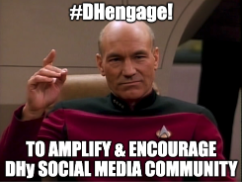
Meme image of Star Trek's Captain Jean-Luc Picard gesturing to "make it so" (or something like that?), with the overlaid custom meme text "#DHengage! To amplify & encourage DHy social media community"

  •  

What is #DHMakes?

This post is by Amanda, Claudia, and Quinn—a few of the many #DHmakes community members, who’ve described the community in a couple places. We’re gathering those descriptions into one post (though a hashtag in use across multiple platforms is defined by its users, so we aren’t the authority, and its use will evolve over time!).

  1. DH = digital humanities (folks using or building digital tools like websites, code, VR to explore humanities areas like culture, history, art, ethics; folks using those kinds of humanities approaches to critique technology)
  2. Makes = craft, making, makerspace types of creative work

We published a peer-reviewed article in the Korean Journal of Digital Humanities,”#DHmakes: Baking Craft into DH Discourse”, if you want to know a lot about the community’s origins, history, and outputs.

If you want a ✨tl;dr✨ though, here’s a FAQ!

Who started this?
We’re digital humanities people who incorporate physical making/art into our work (or do it as a hobby and share it online somewhere)!

Who is this for?
#DHmakes is loosely folks in digital humanities/libraries/academia/learning-work who craft/make (including as non-job hobby), open to anyone interested.

What kinds of things get posted?

  • “I made/am making a thing!”
  • work related to including craft/textile work in making
  • works-in-progress, fails, public figuring-out how to do some method/project
  • explicitly celebrating, amplifying, encouraging neat craft/make work, whether or not the creators are digital humanities people
  • encouraging sharing “this is my hobby, not my job” crafts
  • getting started

What kinds of making/crafting?
All of them? We’re interested in an expansive definition and especially things that have sometimes gotten left out of how people think of makerspaces/making, such as textile art. Other frequent areas of interest tagged #DHmakes include craft/making work related to:

  • history
  • culture & pop culture
  • zines
  • data visualization & embodiment, including personal data
  • queer/feminist/critical tech, social justice
  • play with historical craft practices
  • expansive definitions of making that assert awesomeness of areas like fabric arts, cooking, fashion

For examples, check out Quinn’s Textile Makerspace, Claudia’s and Gabby Evergreen’s “Pockets of Information”, Jacqueline Wernimont’s “Visualizing Energy Data or Visceralizing Energy Transitions”, and Amanda’s Scholars’ Lab “expansive makerspace”-tagged posts page.

Why have I been tagged #DHmakes?
Folks RT/repost cool, relevant craft/making work with the tag so others get to admire them too.

Am I “DH enough” to use the hashtag?
The “DH” in #DHmakes is digital humanities. We’re guessing the other most active hashtag users agree with us: anyone curious about DH (not necessarily “experienced” or in a “DH job”) should participate! Workers, students, hobbyists in areas like gallery/library/archive/museum/learning that are DH or feel adjacent too.

Have you done things beyond using a hashtag?
Yes!

You can follow #DHmakes using a feed of all tagged posts, or a feed of just the #DHmakes posts that include photos.

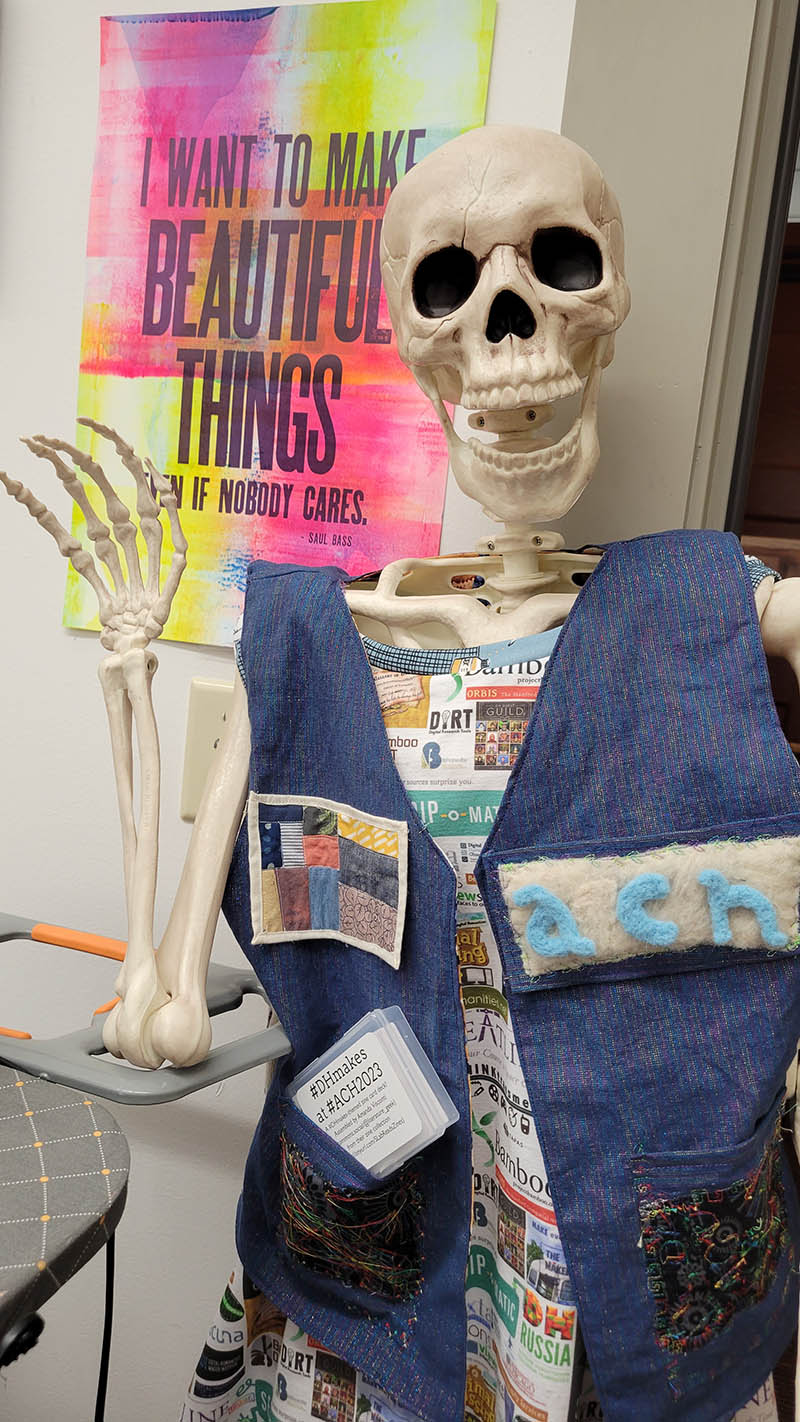
A banner logo image that shows a cartoon of a groovy skeleton wearing sunglasses, holding a laptop in one hand and a ball of yarn and knitting needle in the other, with the #DHmakes hashtag written underneathA logo image that shows a cartoon of a groovy skeleton head wearing sunglasses and a blue knit beanie, holding a ball of pink yarn between its skeletal hands and chomping into it; in the background is blurred-out code text, and the #DHmakes hashtag is written at the topPhoto of a full-size skeleton model, Quinn Dombrowski's "Dr. Cheese Bones", with one hand up waving, wearing a denim vest decorated with various small crafting projects made by multiple members of the #DHmakes community including a felted "ACH" patch and a tiny data visualization quilt patch

  •  

My digital humanities makerspace research

My DH 2024 conference talk on my recent book-adjacent data physicalizations and makerspace research, as part of co-facilitating the #DHmakes mini-conference. What is #DHmakes? Briefly: anyone (you?) DH-adjacent sharing their (DH or not) crafty or making work with the #DHmakes hashtag, getting supportive community feedback. Resulting collaborations have included conference sessions and a journal article. For an in-depth explanation of #DHmakes’s history, rationale, goals, examples, see the peer-reviewed article I recently co-authored with Quinn Dombrowski and Claudia Berger on the topic.

Hey! I’m Amanda Wyatt Visconti (they/them). I’m Director of the Scholars’ Lab at the University of Virginia Library.

My background’s in librarianship, literature and textual scholarship, so a lot of my making is reading- or book-adjacent. I know the ways we do and share knowledge work can take really any format, as can the things that influence our scholarly thinking. I have been informed or inspired by, for example, a literal bread recipe; fictional creative work that explores new possibilities, or conveys an ethos I took back to my research; tutorials, informal discussions, datasets, infrastructural and administrative work, zines, social media posts, and countless other of the ways humans create and share thinking*.
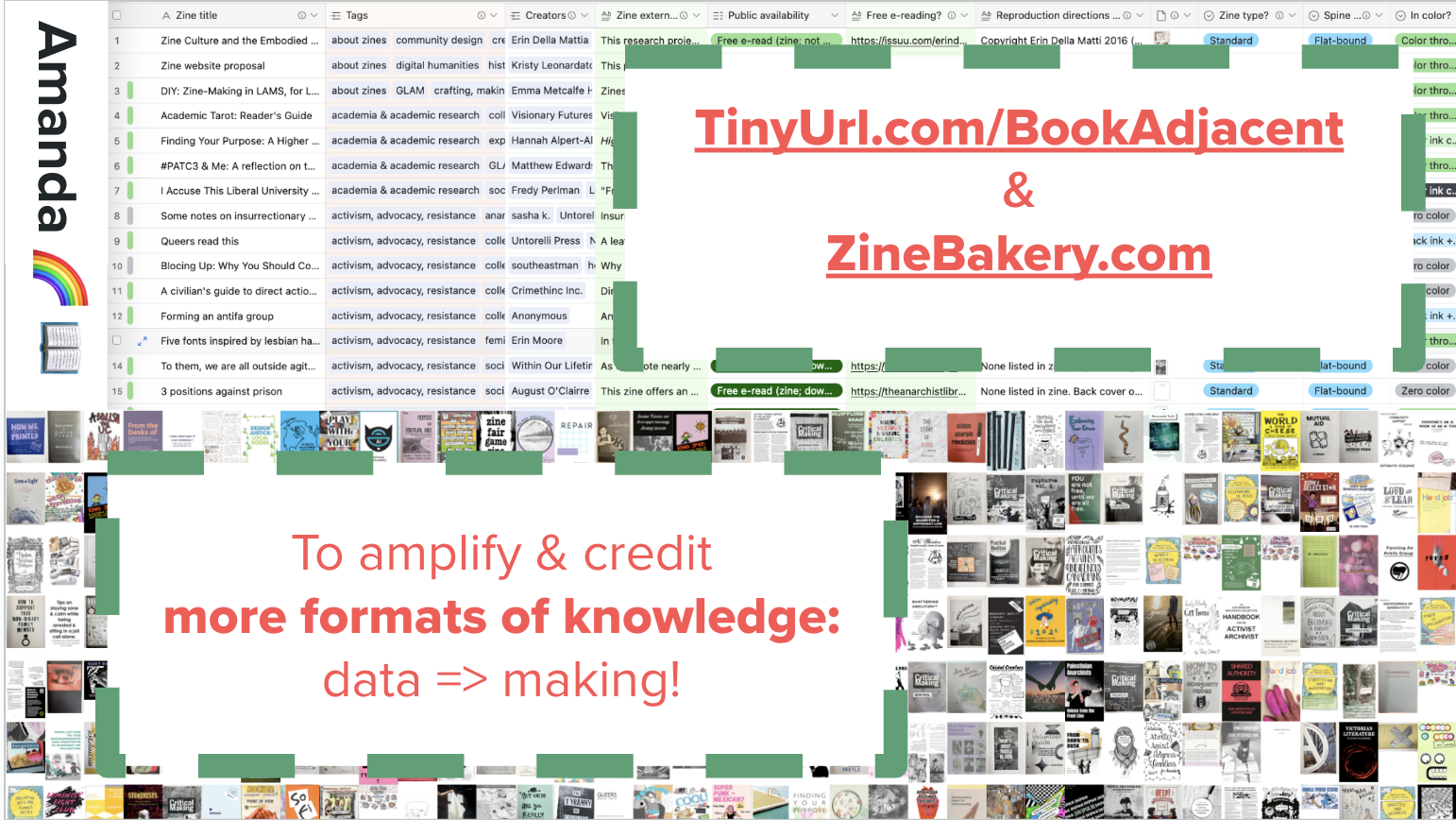
First slide from my DH2024 #DHmakes talk, showing screenshots of my zine grid and zine database, and saying "to amplify & credit more formats of knowledge: data => making!"

Why make book-adjacent prototypes?

“Generous” citation—in whom we cite, and what formats of work we cite—is actually just accurate citation. Academia routinely lags in citing all the emails, attended conference talks, social media posts, elevator conversations, podcasts, reviewer comments, and more that inspire and inform our scholarship. With my particular context of a library-based lab: physical scholarship displays in academic libraries tend to disinclude relevant reads that aren’t in a print scholarly book or journal format.

It’s hard to display many of the formats I just listed, but also many people don’t think of them as worth displaying? This sends a message that some scholarly formats or methods are lesser, or not relevant to the building and sharing of knowledge. We know there’s systemic racism, sexism, and other harms in publishing and academia. Limiting ourselves to displaying and amplifying just some of the most gatekept formats of knowledge sharing—books and journal articles—fails at presenting a welcoming, inclusive, and accurate picture of what relevant work exists to inform and inspire around a given topic.

So, I’ve been using making projects to change what scholarly formats and authors the Scholars’ Lab will be able to amplify in its public space…

Data-driven research making

I started by focusing on collecting and describing a variety of DHy digital and physical zines, though I hope to expand the dataset to other formats eventually. (Briefly, you can think of zines as DIY self-published booklets, usually intended for replication and free dissemination, usually in multiple copies as opposed to some artists’ books being single-copy-only or non-replicable.) In the upper-left of the slide is a slice of my digital “zine quilt”, a webpage grid of zine covers from zines in my collection.
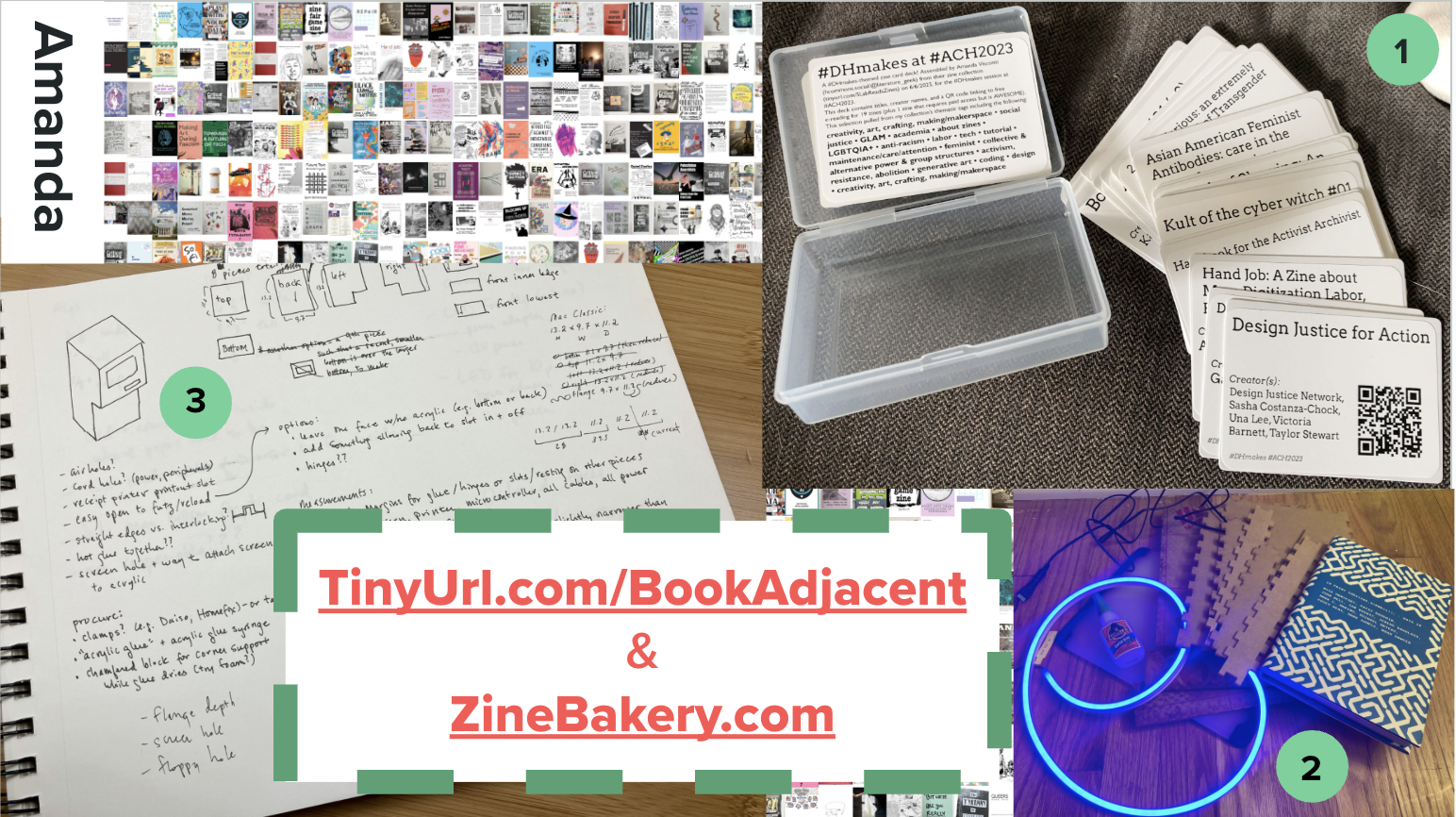
Second slide from my DH2024 #DHmakes talk, showing photos of my digital zine cover grid, themed reading card decks, a notebook open to design drawings, and a pile of makerspace supplies including a neon loop and a book cover

Having a richly described zine-y database I know by heart, because I researched and typed in every piece of it, has opened my eyes to ways data can suggest data-based research making.

I’ve got 3 crafting projects based on this zine database so far:

1st, I created a playing card deck that fits in a little case you can slip into your pocket. Each card has the title and creators of a zine, and a QR code that takes you to where you can read the zine for free online. This lets me hand out fun little themed reading lists or bibliographies, as shuffle-able card decks… or potentially play some really confusing poker, I guess?

2nd, I’m learning to work better with LEDs, sheet acrylic, and glass by reverse-engineering a simple and less gorgeous version of Aidan Kang’s Luminous Books art installation. Kang’s sculptures fills shelves with translucent, glowing boxes that are shaped and sized like books with colorful book covers. I’ve been prototyping with cardboard, figuring out how to glue glass and acrylic securely, and figuring out programmable lights so I can make these book-shaped boxes pulse and change color. I hope to design and print fake “covers” for non-book reads like a DH project or a dataset. This would let me set these glowy neon fake books on our real book shelves, where the colored light might draw people to look at them, and follow a link to interact with the read further.

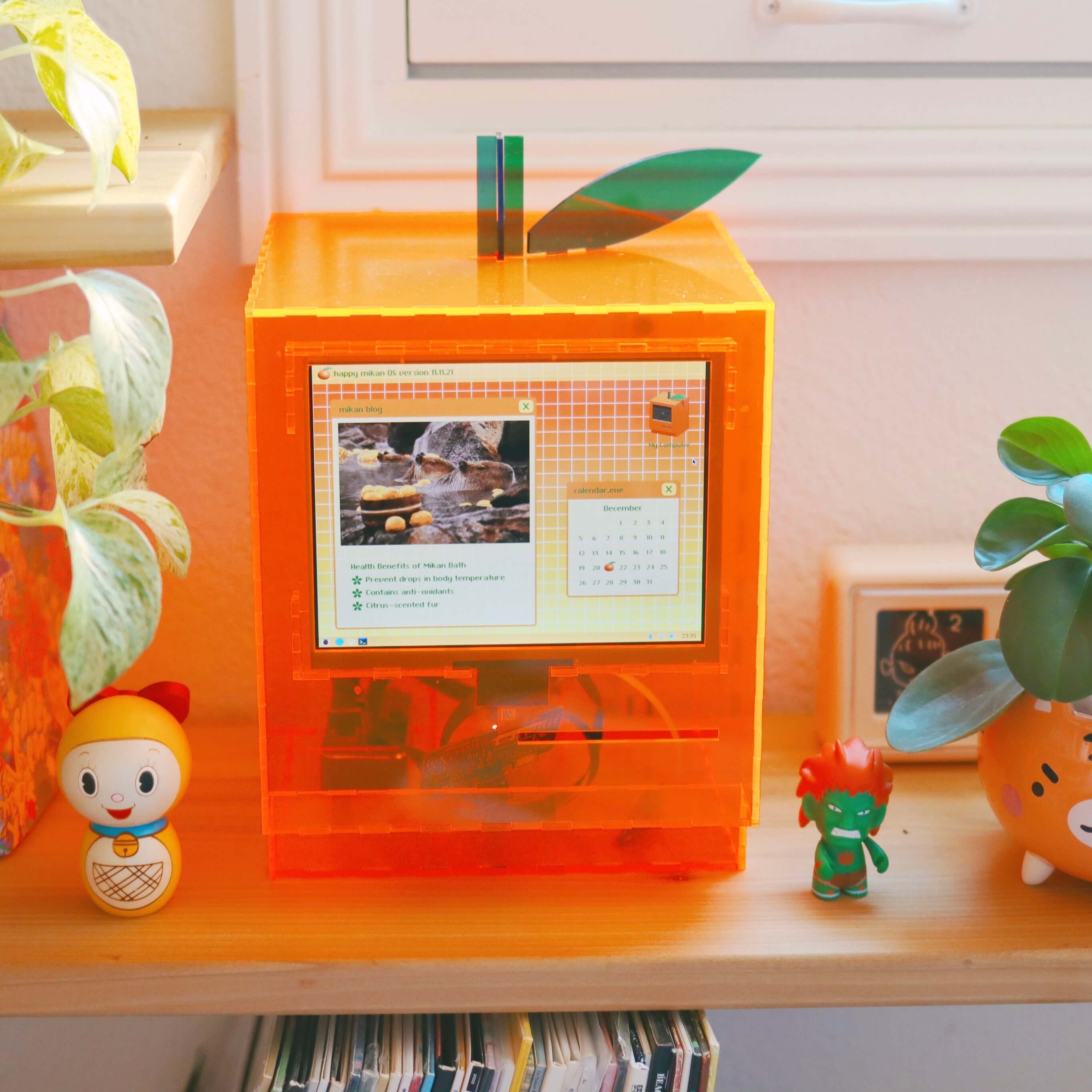
3rd, I’m hooking up a tiny thermal printer, like the ones that print receipts, to a Raspberry Pi and small display screen. I’m hoping to program a short quiz people can take, that makes the printer print out a little “receipt” of reading recommendations you can take away, based on metadata in my reading database. I’d been working to construct a neon acrylic case that looks like a retro Mac to hold the display and printer, again figuring out how to make a simpler approximation of someone else’s art, in this case SailorHg’s “While(Fruit)”. But naming my collection a “Zine Bakery” got me excited about instead hiding the receipt printer inside a toaster, so the receipt paper could flow out of one of the toaster’s bread holes. You can read more about these book-adjacent making projects at TinyUrl.com/BookAdjacent, or the zine project at ZineBakery.com.

Unrelatedly: resin!

Completely unrelated to reading: I’ve been learning how to do resin casting! You can think of resin like chemicals you mix up carefully, pour carefully into molds over multiple days and multiple layers of pouring with various pigments and embedded objects, and carefully try not to breathe. It hardens into things like this silly memento mori full-size skull I made, where I’ve embedded novelty chatter teeth and a block of ramen for a brain. Or for this necklace, I embedded multicolor LED bulbs in resin inside of D&D dice molds.
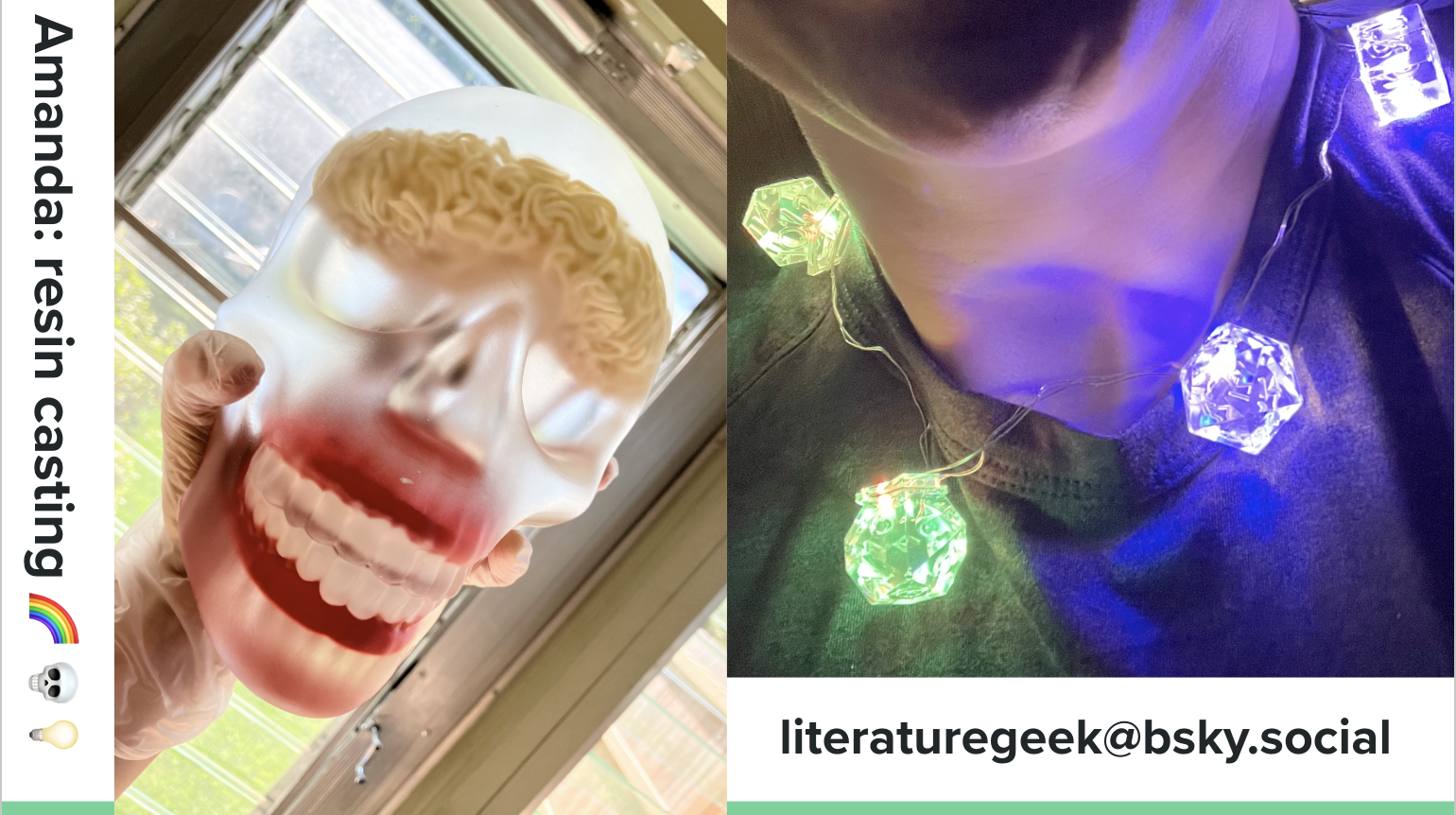
Third slide from my DH2024 #DHmakes talk, showing photos of a translucent frosted resin skull with a ramen brain and chatter teeth, and a light-up D&D dice necklace

(See my recent post on resin casting for more about this work!)

Come #DHmakes with us!

I’ve discovered I really like the experience of learning new crafts: what about it is unexpectedly difficult? How much can I focus on the joy of experimenting and learning, and grow away from frustration that I can’t necessarily make things that are pretty or skillful yet? So I’ve got a weird variety of other things cooking, including fixing a grandfather clock, building a small split-flap display like in old railway stations (but smaller), mending and customizing clothes to fit better, prototyping a shop-vac-powered pneumatic tube, carving and printing linoleum, and other letterpress printing.

To me, the digital humanities is only incidentally digital. The projects and communities I get the most from take a curious and capacious approach to the forms, methods, fields we can learn from and apply to pursue knowledge, whether that’s coding a website or replicating a historical bread baking recipe. #DHmakes has helped me bring more of that commitment to experimentation into my life. And with that comes the joy of making things, being creative, and having an amazing supportive community that would love yall to share whatever you’re tinkering with using the #DHmakes hashtag, so I hope you join us in doing that if you haven’t already!

* Some of the text of this talk is replicated from my Spring 2024 peer-reviewed article, “Book Adjacent: Database & Makerspace Prototypes Repairing Book-Centric Citation Bias in DH Working Libraries”, in the DH+Lib Special Issue on “Making Research Tactile: Critical Making and Data Physicalization in Digital Humanities”.

  •