We are pleased to announce the call for papers, posters, panels, tool demonstrations, and workshops for the 26th annual meeting of the Text Encoding Initiative (TEI). TEI 2026: Creating Connections, Unsettling Practices seeks to bring together scholars, librarians, developers, and students to address the ethical, social, and technical challenges of digital textual editing in the 21st century.
February 19, 2026: Deadline for submissions April 20, 2026: Notification of acceptance and invitation to authors of accepted submissions. Registration opens. June 1, 2026: Presenter final abstracts and early registration deadline. At least one author per accepted submission must register and confirm in-person participation. June 1, 2026: SIG meeting room request deadline July 6, 2026: Final registration deadline
ADHO 산하의 DH 교육 및 훈련 SIG (DH Pedagogy and Training SIG)가 대전에서 열리는 DH2026 사전 행사(Pre-Conference)기간 중 “포스터 슬램(Poster Slam)” 행사를 개최합니다.
이 행사는 7월 27일(월) 혹은 28일(화) 중 하루, 워크숍 세션 시간에 진행될 예정입니다. 기본적으로는 교육용 과제(Assignment)나 강의계획서(Syllabus) 전체를 공유하는 포스터 세션 형식이지만, 본격적인 세션에 앞서 참가자들이 자신의 교육 내용을 120초 동안 압축적으로 소개하는 ‘슬램’ 시간이 먼저 주어집니다. 슬램 이후에는 일반적인 포스터 세션처럼 발표자와 청중이 자유롭게 질의응답을 나누게 되며, 이때 배포용 강의계획서 등을 지참하는 것이 권장됩니다.
주요 사항:
발표 대상: DH 관련 수업의 특정 과제(assignment) 혹은 전체 강의 전체
제출 마감: 2026년 1월 5일 (결과 통보: 2월 5일)
제출 내용: 수업/과제 배경(150단어), 상세 설명(200단어), 강의계획서 또는 과제 파일 업로드
유의 사항: 본 행사는 DH2026 본 회의(Main Conference)의 포스터 세션과는 별도로 진행되는 SIG 워크숍입니다. 형식이 크게 다르지만, 본 회의와 이 워크숍에 중복으로 포스터를 투고하는 것은 가능합니다.
The DH Pedagogy and Training SIG will hold a Pedagogy Poster Slam at the 2026 DH Conference in Daejeon, South Korea. The Pedagogy Poster Slam will take place during the SIG’s reserved slot during one of the conference’s two workshop days, either Monday, 27 July 2026, or Tuesday, 28 July 2026.
Posters will either focus on a) a specific assignment for a DH or DH-inflected course or b) an entire course. During the workshop, participants will first participate in the Slam, where they will have a maximum of 120 seconds to discuss one aspect of their assignment or course.
Once the participants have all spoken, the rest of the workshop will be devoted to a conventional poster session, where attendees can engage with the presenters at their posters. Presenters will be encouraged to bring print copies of their assignment/syllabus to distribute to attendees.
All conference attendees will be welcome to attend the workshop and slam. (Plus, there will be food!)
Call for Proposals The SIG Conveners invite all members of the DH community to submit proposals for the Pedagogy Poster Slam. Proposals will include
150 words or fewer about the context of the assignment, course, or workshop
200 words or fewer about the assignment, course, or workshop
An upload of either the assignment or the course syllabus
Proposals should be submitted via the following Google Form: https://forms.gle/zdkNEHXPDppXQz3E6. Proposals are due by 5 January 2026. Accepted participants will be notified not later than 5 February 2026. Proposals will be peer reviewed by the SIG Conveners.
N.B. Please be aware that posters submitted to the pre-conference SIG Pedagogy Poster Slam are distinct from the DH2026 poster submission category. The Program Committee for DH2026 has indicated that you are welcome to submit posters to both the main conference as well as to this SIG workshop, although the submission format is significantly different.
Depositing Posters Following the Conference, the SIG Conveners will create and curate a collection of the posters and associated pedagogical documents.
Questions Please contact the conveners with any questions you may have. Brian Croxall (brian.croxall@byu.edu), Diane Jakacki (dkj004@bucknell.edu) and Walter Scholger (walter.scholger@uni-graz.at)
The DH2026 organizers announce that the submission deadline for Digital Humanities 2026 proposals has been extended to December 15, 2025 (KST).
Next year’s conference (July 27–31, 2026) will be hosted by the Korean Association for Digital Humanities (KADH) at the Daejeon Convention Center in Daejeon, South Korea. The theme for this conference is “Engagement.” Submissions are welcome in multiple formats, including long and short papers, posters, panels, workshops, and mini-conferences.
Please visit the Call for Proposals on the conference website for more details: https://dh2026.adho.org/cfp.
We invite you to share your work with the global Digital Humanities community.
Call for Papers for the international conference Digital Humanities and Korean Studies: Archiving, Analyzing, and Interpreting Korean Texts in the Digital Age, which will be held on April 17, 2026, at the Center of Korean Research and Studies “Yun Dongju” (CeSK), University for Foreigners of Siena, Italy.
Proposals must be submitted in PDF format by October 31, 2025 to cesk@unistrasi.it.
Notification of acceptance will be sent by November 10, 2025.
Submission guidelines are provided in the attached document.
Digital Humanities (DH) at Michigan State University (MSU) is proud and thrilled to celebrate the 11th Global DH Symposium with a combination of virtual and in-person events over the course of 13-17 April 2026.* This year, GlobalDH is partnering with the Universidad de Monterrey in México (UDEM) to hold an in-person portion of the symposium within their interdisciplinary INQUORUM event series.
We invite work at the intersections of critical DH, that engages with anti-colonial and post-colonial frameworks, that supports feminist and anti-racist praxis, and that crosses political and disciplinary borders. We define the term “humanities” expansively to open up space for a range of issues that encourages interdisciplinary understandings of the humanities
*The in-person symposium at MSU 13 April and at UDEM 17 April will be in English. The virtual symposium 14-15 April supports presentation and attendance in English and Spanish through live interpretation.
This Symposium, which will include a mixture of presentation types, welcomes proposals by the end of the day Wednesday, 15 October 2025 midnight in your timezone.
This year, we especially anticipate and welcome presentations on the following topics, and we are especially interested in hearing about specific practical and theoretical examples from the Global Majority context:
Minimal, material, and sustainable approaches to DH
Global AI practices, opportunities, and challenges in DH
Resilience and collaboration in the face of global crises
Student-centered frameworks and practices in global digital pedagogy
We are always interested to hear about the following topics, and their connections to the digital, as reflected in global research conversations and ethical DH practices across disciplines:
Public and community-engaged digital humanities
Indigeneity, anti-colonialism, and digital cultural heritage
Digital humanities approaches to climate and healthcare
Surveillance, censorship, and/or data privacy in a global context
Disability justice and accessibility
Open data, open access, and data preservation as resistance
Feminist and queer perspectives in DH
Borders, migration, and diasporas with an emphasis on the effects of warfare and conflict
Multilingualism and language justice
DH methods in interdisciplinary and cross-regional research
ACOMS+ 시스템에 접속하여 회원가입 후 논문을 제출해 주시기 바랍니다. 회원가입 절차는 별도의 안내를 참조하시기 바랍니다.
논문 제출 시 연구 데이터도 함께 업로드 혹은 링크를 첨부해 주시기 바랍니다.
심사 과정 및 결과 통보 또한 ACOMS+ 시스템을 통해 이루어집니다.
ACOMS+ 시스템 사용 방법 및 기타 자세한 사항은 KJDH 학술지 레포지토리의 투고 안내 페이지를 참조해 주시기 바랍니다.
『디지털인문학』 제2권 제2호를 통해 디지털인문학 분야의 발전에 기여할 여러분의 탁월한 연구 성과를 기대합니다. 많은 관심과 투고 부탁드립니다.
감사합니다.
『디지털인문학』 편집위원회
The Korean Association of Digital Humanities (KADH) invites manuscript submissions for Volume 2, Issue 2 (November 2025) of the Korean Journal of Digital Humanities.
Key Dates
Submission Deadline: October 1, 2025
Publication Date: November 30, 2025
Submission/Review Fees: None
Journal Performance and Impact
The Korean Journal of Digital Humanities has shown consistent growth since its inception:
Cumulative Statistics as of August 2025: 15,853 visitors, 6,206 views, 4,283 downloads
Volume 2, Issue 1: Successfully published in May 2025 with enhanced accessibility through XML web format
All articles receive DOI assignments and are accessible worldwide through the Open Access Journal System (AccessOn). These metrics demonstrate that research published in our journal effectively reaches both domestic and international digital humanities communities.
Journal Features
1. Data-Driven Research Focus a) Mandatory research data submission during peer review b) Post-publication data sharing for research reproducibility
2. Full Open Access a) Simultaneous XML web and PDF publication b) Free access without subscription fees
3. Diverse Article Formats Welcome a) Traditional research articles b) Data papers c) Humanities data design and construction case studies d) Short papers on digital tools and code e) Educational curriculum development studies
Suggested Topics
Digital methodologies in humanities research
Digital archive construction and utilization cases
Humanities data analysis and visualization
AI and humanities convergence research
Cultural and social studies in the digital age
Digital humanities education innovations
Submission Guidelines
Format: MS Word template (docx) available from ACOMS+ system
Length: Korean – max 150 pages (200-character manuscript paper) / English – max 8,000 words
Language: Korean or English
Submission and Review Process:
All submissions and reviews are processed through the ACOMS+ system
Please register on the ACOMS+ system before submitting your manuscript. Refer to separate guidelines for registration procedures
Research data must be uploaded or linked during manuscript submission
Review progress and results will be communicated through the ACOMS+ system
For detailed instructions on using the ACOMS+ system and other information, please refer to the submission guidelines on the KJDH journal repository.
We look forward to receiving your outstanding research contributions that will advance the field of digital humanities through Volume 2, Issue 2 of the Korean Journal of Digital Humanities.
Thank you.
Editorial Board, Korean Journal of Digital Humanities
The deadline for submissions is 30 September 2025.
Themed issue description
In recent years, the technological and theoretical tools necessary to bridge data-driven methods and narrative studies have developed rapidly, offering new perspectives about the way we structure, interpret, and generate stories across diverse media and cultural contexts. This special issue aims to bring together interdisciplinary research to advance our understanding of narratives through computational methods — from theoretical explorations to empirical studies and creative applications.
Narratives lie at the heart of human experience, shaping communication, cognition, and culture. Computational Narratology is at the crossroads of narratology, digital humanities, computer science, and artificial intelligence, as it employs computational tools to analyze, generate, and model narrative structures and elements. By integrating data-driven methods (e.g., machine learning, natural language processing, and knowledge representation) with long-standing narratological theories, Computational Narratology opens up new possibilities for:
Understanding and interpreting narratives in traditional textual forms and multimodal or interactive media (games, virtual environments, films, and more).
Creating new story-generation frameworks for narrative creativity.
Broadening the scope of cultural and cross-lingual narrative studies, offering empirical insights into global storytelling practices.
Developing real-world applications in education, entertainment, marketing, social science research, and beyond.
We particularly encourage contributions that represent methodological approaches and novel computational techniques. Submissions may address textual, multimodal, or interactive narratives and can explore various languages and cultural contexts.
Topics of interest
We invite submissions on (but not limited to) the following topics:
1. Narrative Structure, Representation and Analysis
Computational modeling of plots, character networks, thematic progression, and focalization
Algorithms for segmenting and annotating narratives, detecting events, and analyzing temporal order
Formal models of plot progression, “story grammars”, and application of narrative schemas
2. Narrative Generation and Evaluation
Automated story generation using language models, symbolic AI, hybrid approaches, or procedural methods
Evaluation methods for generated narratives and their aesthetic or experiential impact
3. Sentiment, Emotion, and Affect
Sentiment analysis and character relationship modeling within narratives
Extraction and evaluation of emotional arcs for narrative modelling
Modeling of human engagement and immersion in stories
Cognitive and psychological dimensions of narrative consumption and interpretation
4. Cross-Cultural and Multilingual Narratology
Comparative computational studies of narrative forms across languages and cultures
Machine translation and its implications for cross-lingual narrative analysis
Universal vs. culturally-specific narrative structures
5. Narratives in Non-Traditional and Multimodal Media
Computational analysis of comics, films, games, interactive and branching narratives
Approaches to studying user-driven, non-linear, and emergent storytelling
Multimodal tools and frameworks that integrate text, audio, and visual data
6. Corpus Development and Annotation
Creation of annotated corpora for narratological research (plot, characters, setting, rhetorical devices, etc.)
Automated and semi-automated annotation tools and frameworks
Best practices and standards for large-scale narrative data
7. Theoretical and Methodological Advances
Integration of classic narratological theories with AI-driven techniques
Ethical considerations in large scale story generation and narrative manipulation
Explorations of narrative ethics, bias, and representational justice
8. Applications of Computational Narratology
Educational tools to enhance learning experiences through story-driven approaches
Real-world applications in journalism, marketing, public policy, and cultural analytics
Human–computer interaction and design for narrative systems.
Guest editors: Javier Cha, Matt Erlin, Susan Schreibman
The Journal of Cultural Analytics was founded a decade ago to advance original arguments about studying culture at scale. In this special issue, we intend to take stock of our progress in this endeavor as well as to open up new perspectives for future research. What have we learned from exploring the relationship between the forest and the trees using computational approaches? To what degree have these insights emerged from evolving theoretical or methodological frameworks in the humanities? To what extent should developments in computer science, especially the rise of transformer-based machine learning, inflect research in the humanities? Looking ahead, what changing paradigms might define the next ten years of cultural analytics? We welcome contributions on any relevant topic but are especially interested in the following areas and questions:
• Specific contributions of cultural analytics within a broader DH framework • Changing notions of scale and the value of studying culture “at scale” • Rethinking the relations among quantitative, qualitative, mixed-methods, and computational approaches. • Cultural analytics as a recuperation of earlier trends in literary and cultural studies • Advances in the study of non-textual materials, i.e. sound, images, 3D, material culture • Cultural heritage preservation, digital archives and counter-archives • Developments in the study of non-English and non-Western languages • Cultural analytics and pedagogy • Cultural analytics in the age of generative AI
Submission Details
The special issue will include two types of submissions. Original research articles aligned with the proposed theme will offer insights into the new and exciting directions that JCA readers can expect over the next decade. Shorter commentaries by those involved in the founding of JCA, as well as scholars representing its expanding purview and diversification of research areas, will reflect on the journal’s developments and how the term “cultural analytics” has evolved in the past ten years.
Abstracts (max. 500 words) for consideration are due to the editors at culturalanalytics10th@gmail.com by September 1, 2025. Please include the title, author name(s), author email, and type of contribution (research article/commentary) in your submission. Full-length articles will be due March 1, 2026.
Important dates
Date of call for issue open: 21 July 2025 Abstracts due: 1 September 2025 Full paper submission deadline: 1 March 2026 Notification of peer-review decision: 1 May 2026 Revision submission deadline: 1 June 2026 Final publication: July 2026
Call for Proposals: Artificial Intelligence for Digital Humanities: Research problems and critical approaches
August 1, 2025
Digital Humanities Quarterly invites authors to submit abstracts for a special issue devoted to the topic of artificial intelligence (AI). Though AI-based approaches to the digital humanities have been a part of the field for decades, recent years have seen an explosion of methodologies utilizing AI. Some methods show great promise, providing new modes of discoverability and analysis. Many raise questions and concerns along ethical and sociotechnical dimensions. There are also conceptual challenges and areas of application that are distinctive to the digital humanities. Given the volume of submissions and inquiries surrounding AI and the digital humanities, the DHQ editors have decided to devote a special issue to this topic in particular.
We are interested in a wide-ranging view of AI in the digital humanities context, including:
Different methodologies and applications, including those that look beyond generative AI
Critical perspectives on AI, including ethical, political, and cultural critiques
Responsible and transparent AI practices and frameworks in DH contexts
Specific use cases that open the door for new DH-relevant possibilities
Case studies within the digital humanities and in GLAM institutions, such as responsible AI frameworks used to operationalize AI
Specific and grounded applications including but not limited to: translation, transcription, OCR correction, summarization, captioning, text to speech, and multi-modal approaches.
Experimental pieces that make use of AI in their creation (These should also include an author’s statement/contextual material commenting on the experiment and why the selected form is essential to the submission.)
Submissions should meet the following requirements:
The submission must have a direct connection to the digital humanities.
The submission should focus on research, rather than pedagogy (a second CFP centered on AI and pedagogy will be forthcoming later this year).
Except for experimental submissions, the submission must be human-authored (AI may only be used for grammar and spell-checking within the writing process).
We are particularly interested in articles that will have continued value for readers over time, rather than those focused on specific technologies that may quickly become dated.
We ask that prospective authors submit 500-word abstracts for review by September 15, 2025. Please send the following to editors@digitalhumanities.org:
An abstract of no more than 500 words
The name(s) and affiliations of the author(s)
Email address for the corresponding author
Authors will be notified in January 2026 and invited to submit full papers by April 2026, which will be peer reviewed. A full timeline will be provided to authors upon the invitation to contribute a full paper.
For questions related to this call, please contact the DHQ editors at: editors@digitalhumanities.org (please use the subject header: “DHQ AI Special Issue”).
Empfehlen Sie kontrollierte Vokabulare für vielfältige Nutzungsperspektiven in den historisch arbeitenden Disziplinen in einem Guide!
Kontrollierte Vokabulare erfüllen heute zentrale Aufgaben bei der Verwendung von Large Language Models, der Anreicherung und Analyse von Massendaten und für die Visualisierung von Quellen. Dennoch sind Anwendungsfelder und Ressourcen für dieses wichtige Arbeitsgebiet der historischen Forschung häufig unbekannt. Wir möchten daher ein Empfehlungssystem für Vokabulare, aber auch Standards im Umgang mit bestimmten Quellen- oder Dateitypen aufbauen.
Gesucht werden daher kompetente Autoren oder Autorinnen für unser Wissens- und Empfehlungssystem für kontrollierte Vokabulare und Normdaten. Entweder einzeln oder als Teams können Sie einen Guide für ein bestimmtes Thema, eine Entität bzw. einzelne Merkmale von Entitäten verfassen, um so Empfehlungen für die Verwendung in der Wissenschaftslandschaft der historisch arbeitenden Disziplinen abzugeben.
Um Ihnen die Erarbeitung solcher Guides zu erleichtern, haben wir in einem umfassenden Workingpaper zentrale Begrifflichkeiten von Vokabularen definiert und wesentliche Relevanz- und Qualitätskritierien unserer Wissenschaftsdisziplinen diskutiert. Gerne können Sie auch diesen Teil des Workingpapers mit uns diskutieren und es kommentieren.
Hier geht es jedoch um die Erarbeitung von einzelnen Empfehlungen, die im Workingpaper ab Seite 28 zunächst allgemein beschrieben und anschließend mit zwei Musterbeispielen illustriert werden. Welche Entität möchten Sie beschreiben und so den Zugang für die Community erleichtern?
Schicken Sie uns Ihren formlosen Vorschlag bis zum 1. Oktober 2025 an die E-Mail: hinfo(at)geschichte.uni-halle.de. Nach einer Aufnahmebestätigung können Sie Ihren Guide bis zum 31. März 2025 einreichen. Sofern er die formalen Kriterien erfüllt, wird der Text einem Peer-Review-Verfahren unterzogen und bei qualitativer Eignung in unser Empfehlungssystem integriert.
Das Empfehlungssystem wird unser Register R:hovono für Vokabulare und Normdaten der historisch arbeitenden Disziplinen erweitern.
On 18th November 2025, the Cheng Kar Shun Digital Hub events programme will host the Emerging Digital Methodologies Conference. This in-person conference is now inviting presenters from any discipline to submit papers on new applications of digital methods; the use case and problems of any digital method; and how digital methodologies are changing their field.
Since the turn of the millennium digital and computational methodologies have become increasingly prolific at the cutting edge of language and humanities research. Utilising digital techniques from other disciplines has allowed historically qualitative fields to rethink key questions, bring new understandings to foundational sources, increase information accessibility, and lead to previously unexplored cross-disciplinary research. This conference invites graduate students and early career researchers applying new digital methodologies to the humanities and related fields to share that research. We are particularly interested in hearing about research involving digital methods being used to rethink established fields, new applications for conventional digital methods, and how digital methodologies are being translated in the cross-disciplinary space.
Presenters from any discipline are invited to submit papers on:
New applications of digital methods
The use case and problems of any digital method
How digital methodologies are changing their field
Submissions can be in any of the following formats:
7-minute lightning talks (especially suitable for early findings or work-in-progress)
The conference will capture a wide range of subject areas across the many communities of scholars utlising digital methods – both from novices and expert practitioners. Papers could include, for example, ‘Problems of LLM’s in the Humanities’, ‘ChatGPT and visual culture’, ‘A Network Analysis of 16c Europe’, ‘Crafting music in the age of AI’, ‘The problems of control-f in the modern age’, ‘Book culture and language models’, or ‘NLP processing of 20c films’.
To apply, please complete the following form with a max 200-word proposal for a paper and a 50-word biography by 5pm (UK British Summer Time) on Tuesday 12 August 2025.
The event is part of the Cheng Kar Shun Digital Hub Programme with support from the Voltaire Foundation and Jesus College Oxford. Tickets for the conference will be £39 per person, including catering and a wine reception (subsidised tickets will be available). More information to follow.
The Hong Kong Association for Digital Humanities (HKADH) is pleased to announce its second international conference, to be organised by the Chinese University of Hong Kong on January 23 – 25, 2026.
Additionally,the New Horizons for AI Research in the Social Sciences and Humanities Conference will be organised by the University of Chicago on January 26 – 27, 2026, at the University of Chicago Francis and Rose Yuen Campus in Hong Kong. Participants are recommended to attend both events.
HKADH 2026 Call for Papers Distant Reading | Viewing | Perceiving in the Age of AI
As the AI Revolution gains pace, practitioners in multiple fields are presented with an array of new opportunities and challenges. This includes ever easier and more powerful tools for analyzing large corpora of texts, images and other data. This has vastly expanded our ability to engage in distant reading, viewing and perceiving (to borrow and build on terms made famous by Franco Moretti, Lauren Tilton and Taylor Arnold). At the same time, there have emerged urgent ethical, epistemological and methodological questions about authorship, authenticity, bias, and the interpretive limits of machine-assisted analysis, some new, others longstanding. This conference will take a kaleidoscopic approach to these and other pressing questions in digital humanities, cultural analytics and related fields in Asia and globally.
Abstracts submitted should be 500 – 1000 words in length in English. Please submit abstracts via the COMS website. Submissions are peer-reviewed on a continuous basis.
한국인 학생과 한국인 학자만의 그룹/개별 Call for Papers를 공지합니다. (Notice 39 를 함께 참조하시기 바랍니다.)
Revised Call for Papers for Host Sessions (Korean Students and Scholars Only)
Host Sessions (Korean Students and Scholars Only)
K1. Group Proposals
K2. Free Individual Proposals
K3. Students Proposals
Deadline: 28 May, 2025: 23:59
Late Registration starts on 31 May, 2025
Guidelines
Proposals for Group Sessions must contain the following: a title, an abstract of the session’s proposed theme and scope, the name(s) of the group session chair(s), the names of any other presenters who have already been included. This should be “closed” to further paper proposals. Individual proposals are permitted to select any of the topics specified for the Congress theme, “Comparative Literature and Technology,” as well as for the sub-theme:
The proposals must be composed in either English or Korean and must contain an abstract, title, and five keywords. Presenting at the Congress necessitates membership in the ICLA: https://www.ailc-icla.org/membership-information/.
The presenters must be members of the ICLA, KEASTWEST, or KCLA. Non-members must choose the ICLA membership option and pay the the membership during the registration process.
반드시 ConfTool에 가입을 하시고 다음의 절차로 초록을 제출하셔야 합니다.
(2025 ICLA Congress의 멤버가 되어 데이터베이스에 등록이 되어야 모든 일이 진행될 수 있습니다.)
가입을 하기 위해서는: (To register) (NOTICE 18 참조)
1. Establish an account: Please log in the Conftool:
The Association for Computers and the Humanities (ACH) will hold ACH 2025, a virtual conference, from June 11-13, 2025.
Conference Focus
Amid rapid societal and technological transformations and historic elections worldwide, ACH fosters dialogue, spaces, and solidarity on equity and justice across local, transborder, and global contexts. ACH 2025 underscores the importance of addressing societal challenges in the digital humanities and beyond, such as racial and gender discrimination, while also highlighting the ramifications of computing and environmental crises. Join us in navigating diverse political milieus and shaping a virtual conference that is just and inclusive.
ACH 2025 values process- and relationship-oriented modes of working over the end result, fostering hope-making, and we seek to prioritize proposals that focus on care, community, and collaboration in diverse contexts. We are especially interested in receiving proposals from participants with a range of expertise and a variety of roles, including alt-ac positions, employment outside of higher education, and graduate and undergraduate students. We further invite proposals from participants who are newcomers to digital humanities.
Conference Scope
As a conference committed to cross-disciplinary engagement, ACH 2025 welcomes interdisciplinary proposals. Areas of digital humanities scholarship that are relevant to the conference include but are not limited to:
Collaborations for Community
Computational Creativity
Critical Making
Digital and computational approaches to humanistic research and pedagogy
Digital cultural heritage
Digital surveillance
Digital humanities tools and infrastructures
Digital librarianship
Digital media, art, literature, history, music, film, and games
Digital public humanities
Environmental humanities & climate justice
Humanistic and ethical approaches to data science and data visualization
Humanistic research on digital objects and cultures
Humanities knowledge infrastructures
Union, Labor and Organization in digital humanities
Machine Learning, including AI and LLMs and their implications
Multilingualism in digital humanities
Multimodal Scholarship
Resource creation, curation, and engagement
Use of digital technologies to write, publish, and review scholarship
Conference Submission Types and Languages
Papers and Panels will be presented through a video conferencing system; Creative Submissions may be presented through a video conferencing system or through Work Adventure.
We welcome the following submission types:
Creative Submissions:
Artwork, posters, data visualizations, installations, performances, demonstrations, workshops, tutorials, and other interventions that engage conference issues, methods, and themes on any relevant topic, project, or tool at any stage of development.
Papers (12-15 minutes):
Dynamic presentations that share experiments, works-in-progress, or sustained reflections on outcomes of more complete projects while engaging a range of participants and fostering connections and dialogue.
Panels (1 hour and 15 minutes):
Engaging sessions that facilitate dialogue between presentations, highlighting connections between projects, methods or themes and reserving a minimum of 15 minutes for discussion with the audience.
Conference Proposal Requirements
Proposals will be submitted using ConfTool. You will need an account to submit your proposal.
Abstracts must be 250-500 words in length. Abstracts should directly address the review criteria: relevance to conference focus; engagement with relevant scholarship; framework and purpose; applicability, significance, and value; and organization and clarity.
List of participants and contact information must be entered directly into ConfTool along with the submission abstract
You will be asked to choose keywords in ConfTool, which will be used to match your submission with reviewers. Please select the most relevant terms that describe your work.
Conference Format and Languages
While our CFP has been released in English, Spanish, Portuguese, French, Italian, and Korean, we welcome proposals for contributions in all languages. Proposals will be reviewed in the language of submission. Presentations may be delivered in the language of the proposal, though we may have limited access to translators. Regardless of the language of your proposal, please ensure that your five keywords are in English to facilitate program scheduling.
Please note that for the purposes of scheduling, we may suggest an alternative submission type or collaboration between related proposals. While there is no limit on the number of submissions, the program committee will schedule at most two presentations from one presenting author.
Alternative Conference Platforms
The ACH virtual conference will take place through traditional video conferencing, as well as through our virtual conferencing platform, Work Adventure, which provides an interactive 2D animated world and the ability to share video, audio, or images via the browser (platform is optimized for Google Chrome). Presentations will include synchronous conversation as attendees “walk up” to the virtual installation/performance room.
Proposal Review and Notification
ACH 2025 proposals will undergo open peer review. Names and affiliations of authors will be known to a proposal’s reviewer, while names and affiliations of the reviewer will be known to the authors. We are adopting open peer review for several reasons: Lack of consensus about how to anonymize submissions, which leads to proposals that are identifiable; the public nature of digital humanities scholarship, which means that anonymized submissions are not, in fact, guaranteed to be anonymous; and the lack of accountability in anonymous peer review, which can promote incivility in the review process.
Therefore, our use of open peer review is intended to mitigate the implicit inequities in the anonymous review process. We recognize, however, that open peer review raises issues with power dynamics, such as concerns that emerging scholars may have about evaluating an established scholar. To address these issues, the Program Committee will carefully and thoughtfully assign reviewers; reviewers will have the right to refuse to review a submission for any reason. We also recognize that open peer review could contribute to increased bias. To mitigate this risk, we encourage reviewers to evaluate their biases and will provide clear guidance for their role in the review process. We remain grateful to DH2020 Program Committee Chairs Laura Estill and Jennifer Guiliano for their work on open peer review, which influenced our approach for DH Unbound 2022, ACH 2023, 2024, and now 2025.
Review Criteria
Our review criteria reflect the commitment to an expansive understanding of digital humanities and the sociopolitical nature of scholarship:
20% – Relevance to Conference Focus: The proposal topic is connected to the themes of care, community, and/or collaboration in the field of digital humanities.
20% – Engagement with Relevant Scholarship: The proposal engages explicitly with relevant scholarship and offers context within the current state of the fields in which it engages. Formal citations (in the proposal writer’s preferred style) are only required when using direct quotation.
20% – Framework and Purpose: The proposal offers a clear theoretical, methodological, or pedagogical framework; concrete statement of purpose; and explicit articulation of the sociopolitical implications of the work.
20% – Applicability, Significance, and Value: The proposal articulates the applicability, significance, and value of the theoretical, methodological, and/or practical contribution to digital humanities generally.
20% – Overall Recommendation: The proposal is organized effectively and offers a clear articulation of presentation content.
The review period will begin on approximately April 1 and end on May 1, 2025.
Notifications about acceptance or rejection are anticipated to end by May 15, 2025. Reviews will also be made available upon notification.
한국디지털인문학협의회(KADH)에서 발행하는 학술지 <디지털인문학(Korean Journal of Digital Humanities)>의 제2권 제1호 원고를 모집합니다. 저희 학술지는 디지털과 인문학의 융합을 탐구하며 새로운 지식의 창출과 공유를 목표로 하고 있습니다.
먼저, 2024년 제1권 1/2호의 성공적인 발행을 알려드립니다 (링크). 현재 전 세계 디지털 인문학 연구자들에게 공개되었습니다. 2025년 3월 현재, 창간호는 7,700명의 방문자를 기록했으며, 3,000회가 넘는 조회수와 2,000회 이상의 다운로드 수를 기록하는 등 큰 관심을 받고 있습니다. 이는 본 학술지를 통해 게재되는 연구 성과물의 폭넓은 파급력을 보여주는 지표라 하겠습니다. KJDH에 논문을 투고하심으로써 여러분의 연구 성과가 국내외 디지털 인문학 학술 커뮤니티에 신속하게 전파될 수 있다고 기대할 수 있습니다.
<디지털인문학> 제2권 제1호는 2025년 5월 31일에 발행될 예정이며, 창간호와 동일하게 다음과 같은 특징이 있습니다:
논문 심사와 데이터 제출: 연구의 투명성과 재현 가능성을 높이기 위해 논문 심사 과정에서 연구 데이터 제출을 요구합니다.
연구 데이터의 공개 및 공유: 논문 게재 후 연구 데이터를 공개하여 학술 커뮤니티 내 지식 공유와 협력을 촉진합니다.
오픈 액세스 발행: 모든 논문은 오픈 액세스로 발행되며, 웹페이지(XML)와 PDF 형식으로 제공됩니다.
다양한 형식의 논문 수용: 인문 데이터 설계 및 구축, 디지털 인문학 연구 툴 및 코드에 대한 소논문 등 창의적인 형식의 논문을 환영합니다.
특히 이번 제2권 제1호부터는 웹페이지에서 바로 논문을 읽을 수 있는 XML 형태로 발행될 예정입니다. 이를 통해 더 많은 독자들이 쉽게 접근하고 읽을 수 있는 환경이 조성될 것으로 기대합니다.
또한 모든 논문에는 DOI(Digital Object Identifier)가 발급되며, 오픈액세스 학술지시스템(AccessOn)을 통해 전 세계 연구자들이 쉽게 찾아보고 인용할 수 있습니다.
주제 예시:
디지털 기술을 활용한 인문학 연구 방법론
디지털 아카이브 구축 및 활용 사례
디지털 시대의 문화 및 사회 연구
인문학 데이터의 분석 및 시각화
디지털 인문학 교육 및 커리큘럼 개발
투고 안내:
투고 마감일: 2025년 4월 15일
발행일: 2025년 5월 31일
투고비 및 심사비: 없음
투고양식: MS Word 기반 양식 (docx) (ACOMS+ 시스템에서 다운로드 가능)
원고분량: (한국어) 최대 200자 원고지 150매 / (영어) 최대 8,000 단어
원고언어: 한국어 혹은 영어
논문 제출 및 심사 과정:
모든 논문의 제출 및 심사는 ACOMS+ 시스템을 통해 진행됩니다.
ACOMS+ 시스템에 접속하여 회원가입 후 논문을 제출해 주시기 바랍니다. 회원가입 절차는 별도의 안내를 참조하시기 바랍니다.
논문 제출 시 연구 데이터도 함께 업로드해 주시기 바랍니다.
심사 과정 및 결과 통보 또한 ACOMS+ 시스템을 통해 이루어집니다.
ACOMS+ 시스템 사용 방법 및 기타 자세한 사항은 KJDH 학술지 레포지토리의 투고 안내 페이지를 참조해 주시기 바랍니다.
<디지털인문학> 제2권 제1호를 통해 디지털인문학 분야의 발전에 기여할 여러분의 탁월한 연구 성과를 기대합니다. 많은 관심과 투고 부탁드립니다.
감사합니다.
<디지털인문학> 편집위원회
Call for Papers: Korean Journal of Digital Humanities (Vol. 2, No. 1)
Dear Digital Humanities Researchers,
The Korean Association for Digital Humanities (KADH) is pleased to announce a call for papers for the upcoming issue of the Korean Journal of Digital Humanities (KJDH), Volume 2, Number 1. Our journal explores the convergence of digital technology and humanities with the goal of creating and sharing new knowledge.
We are happy to report the successful publication of Volume 1, Issues 1/2 in 2024 (link). As of March 2025, the inaugural issue has attracted 7,700 visitors, over 3,000 views, and more than 2,000 downloads, demonstrating the broad impact of research published in our journal. By submitting to KJDH, you can expect your research to be rapidly disseminated throughout domestic and international digital humanities academic communities.
Volume 2, Number 1 will be published on May 31, 2025, with the following features:
Paper Review and Data Submission: Research data submission is required during the review process to enhance transparency and reproducibility.
Research Data Disclosure and Sharing: Research data will be made public after publication to promote knowledge sharing and collaboration within the academic community.
Open Access Publication: All papers are published as open access, available in webpage (XML) and PDF formats.
Acceptance of Various Paper Formats: We welcome creative paper formats, including short papers on humanities data design and construction, digital humanities research tools, and code.
Starting with this issue, papers will be published in XML format, allowing readers to access content directly on the webpage. This is expected to create an environment where more readers can easily access and read the articles.
All papers will be assigned a DOI (Digital Object Identifier) and will be accessible to researchers worldwide through the AccessOn open access journal system.
Example Topics:
Digital technology methodologies in humanities research
Digital archive construction and application cases
Cultural and social research in the digital age
Analysis and visualization of humanities data
Digital humanities education and curriculum development
Submission Guidelines:
Submission Deadline: April 15, 2025
Publication Date: May 31, 2025
Submission and Review Fees: None
Submission Format: MS Word-based template (docx) (downloadable from ACOMS+ system)
Manuscript Length: (Korean) Maximum 150 pages (200 characters per page) / (English) Maximum 8,000 words
Manuscript Language: Korean or English
Paper Submission and Review Process:
All paper submissions and reviews are conducted through the ACOMS+ system.
Please access the ACOMS+ system and register before submitting your paper. For registration procedures, please refer to separate instructions.
Please upload your research data along with your paper submission.
The review process and results will also be communicated through the ACOMS+ system.
For instructions on using the ACOMS+ system and other details, please refer to the submission guidelines page in the KJDH journal repository.
We look forward to your excellent research contributions that will advance the field of digital humanities through Volume 2, Number 1 of the Korean Journal of Digital Humanities. We appreciate your interest and submissions.
Thank you.
Editorial Committee Korean Journal of Digital Humanities
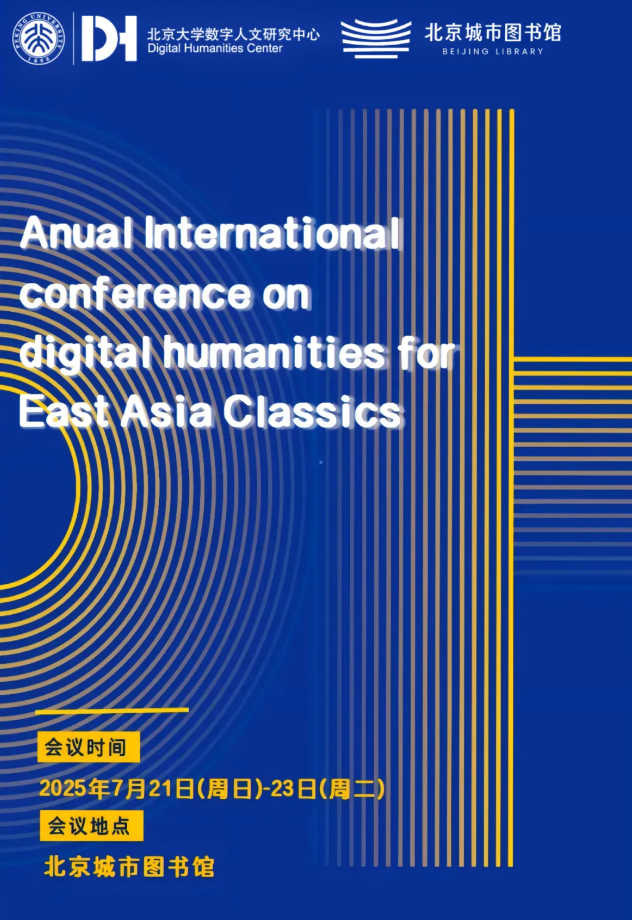
Important Dates Title Submission Due time: March 10, 2025, 23:59 Long Abstract Submission Due Time: May 10, 2025, 23:59 Notification of Acceptance: June 10, 2025 Registration: May 10 – July 10, 2025 Pre-Conference Workshop: July 20, 2025 Conference Dates: July 21 and 22, 2025
Scholars’ Lab, the UVA Library Digital Humanities Center (DHC), and the Data Analytics Center (DAC) are delighted to announce a new fellowship opportunity. The 2025 Data Analytics Center-Digital Humanities Center Fellowship is open for proposals from UVA faculty and graduate students. This is an experimental iteration encouraging the use of high-performance computing resources in the humanities, as well as identifying digital humanities research and teaching that could benefit from support from DHC and DAC. Possible projects might utilize AI, gaming platforms, imaging tools, geospatial technologies, use of new tools, and more.
The team will consist of one faculty and one graduate student collaborating on humanities research in the University of Virginia. We encourage teams and projects that challenge traditional understanding of digital humanities (or even what has been considered humanities research), involve ethical and philosophical issues raised by new technologies, or explore new opportunities for using high-performance computing tools and techniques to better understand the human record.
The award will include guidance and training from DHC and DAC staff and technical expertise and training, along with discussion and planning for the intellectual and technical aspects of the project. At the end of the two-year period, the project team will produce a final report and lessons learned assessment for future collaborations between digital humanities and high-performance computing practitioners. The student will be additionally asked to present a poster of their research at the UVA Research Computing Exhibitions in April 2026 and April 2027 and to prepare a workshop, tutorial, or video on how to use RC resources for research in the Humanities.
Applications are due April 1, 2025. We highly recommend all interested applicants (either individually or as a team) email lb-dac-dhc-fellowship at virginia.edu with any questions and/or set up an appointment to discuss ideas, budget possibilities, and proposed collaborations.

 登录
登录