Are you a Digital Humanities student or early career researcher in Belgium who would like to discuss DH with other early career researchers in the Belgian DH community? If so, you might be interested in joining the DH Virtual Discussion Group for ECRs!
The DH Virtual Discussion Group is a joint initiative organized by individuals at multiple Belgian institutions. We strive to involve speakers from all Belgian institutions and encourage participation from all those who are interested in DH and are located at any Belgian institution. This year, the core organizers are Leah Budke (KU Leuven Libraries Artes), Sara Budts (VUB), Fiammetta Comelli (UGent), Tom Gheldof (KU Leuven, CLARIAH-VL+), and Annerose Tartler-Ostrizek (FedOSC). Over the past years, the series has become a regular event. The fall 2026 edition proudly marks our thirteenth term.
Our sessions this fall will continue the “under-the-hood” format, which entails a volunteer from our community providing a thirty-minute overview of a digital project implementing a given tool, approach, or platform. This is not meant to be a polished research presentation, or to present findings or results, but rather to give our community a behind-the-scenes look at how decisions were made and why specific tools were chosen or developed. The hope is also that this presenter will give attendees some ideas about how to get started implementing a specific tool or workflow, and that they can also answer questions or contribute to a discussion on other projects in our community that might be using similar methodologies or addressing similar issues. This “under-the-hood” session format allows us to have focused discussions around a specific project where we can learn from each other in an informal way. In addition, by implementing this format we can maintain the low threshold for contributing and engaging in the conversations.
The following sessions are on the schedule for the fall 2026 semester (details in this post will be updated as confirmed):
Session 1 Monday 19 October, 15h-16h30 CEST via Teams Speaker(s): Ine De Daele, KU Leuven Title: Making Historical Data Work: The STUDIUM.AI Research Infrastructure Abstract: A surprising amount of historical data already exists in digital form. The challenge is that it is often scattered across library catalogues, research databases, and digitized archival records, each with their own formats, standards, and quirks. One of the main goals of STUDIUM.AI is therefore to bring together diverse digital resources relating to the premodern University of Leuven (1425–1797) within a single research infrastructure.
But how do historical data move from library metadata, research databases and spreadsheets into a shared infrastructure? In this presentation, I will go over the workflows and challenges involved, from my perspective as a historian turned data manager. I will provide a practical overview of processing and importing historical datasets and explain how I document these workflows through some concrete examples. Along the way, I reflect on choosing the right tools for data processing and the importance of reproducibility. In short, this talk reflects the lessons I learned during my first year as data manager at STUDIUM.AI: perfect historical data do not exist, manual intervention is sometimes necessary, and thorough documentation is often as important as the data themselves.
Session 2 Monday 16 November, 15h-16h30 CET via Teams Speaker(s): to be confirmed Title: to be confirmed Abstract: to be confirmed
Session 3 Monday 14 December, 15h-16h30 CETvia Teams Speaker(s):Marie Serisier, ULB Title: to be confirmed Abstract: to be confirmed
There are an increasing number of conferences, workshops, and funding opportunities in DH, and we would like to ensure that you are aware of them. We will start every session with a moment for individuals to share news about upcoming lectures, workshops, seminars, and conferences. We have a corresponding Slack group where we also share these opportunities both during the discussion group meetings and in between. The link to join the Slack group is included in every email sent out to the mailing list, so watch for it there or send us an email to request access.
If you would like to register or invite other colleagues to join, please complete the registration form for the mailing list here. Please note, if you have received emails from us about the Discussion Group in the past, it means you are already on our mailing list. In that case, there is no need to register again—you will receive the emails with the MS Teams link and any additional information on the day of the session. Additionally, you will also receive updates on upcoming sessions including further details about speakers and the “under-the-hood” presentation topics.
Are you a frequent attendee of the DH Virtual Discussion Group and would like a low-threshold way to become more involved in the organization? We are looking for ambassadors to promote the group within their university networks. If this might be a role you would like to take on, get in touch and we can tell you more!
This event is only open to KU Leuven researchers and staff.
The Artes Research team from KU Leuven Libraries Artes and the ABAP council will kick off the new academic year with a special “How Do You Do (It)?” (HDYDI) session dedicated to research data workflows. This special session will coincide with the start of the Digital Scholarship Module taught by the Artes Research team. It will take place on Tuesday 10 November, 14:00-16:30, in the entrance hall and Justus Lipsiuszaal of the Erasmushuis (Leuven).
Everyone is welcome to attend, you do not need to register!
Program
14:00-15:00
To help you through the afternoon slump, we will start with coffee and cookies which will be served in the main entrance hall of the Erasmushuis.
15:00-16h30
We will then move up to the 8th floor (JustusLipsiuszaal) to start the session which will feature talks from researchers at the Faculty of Arts who outline their research workflows: how do they approach their research, what tools do they use, with what kind of data are they working, etc. We will get a behind-the-scenes look from:
Thomas Van Hoey (Quantitative Lexicology and Variational Linguistics)
There will be lots of time for questions and getting to know each other’s workflows.
The event will take place in Leuven, but if you would like to join online you can let us know at artesresearch@kuleuven.be and we will provide you with the link.
Practical details
When: Tuesday 10 November 2026, from 14:00 to 16:30
Where: coffee in main entrance hall and session in Justus Lipsiuszaal (Erasmushuis, Leuven) with online option: if you would like to join online you can let us know at artesresearch@kuleuven.be and we will provide you with the link
The Flanders Training Network for Methodology and Statistics (FLAMES) is an inter-university training network comprised of Ghent University, Hasselt University, University of Antwerp, KU Leuven, and the Vrije Universiteit Brussel.
FLAMES organizes several courses focusing on methodology and statistics throughout the academic year. The level of difficulty ranges from beginner, intermediate, to advanced. The program includes inter-university courses and local events. Inter-university courses are multi-day courses on statistical or methodological topics, that are a collaboration between FLAMES coordinators from at least 3 universities.
Some of the courses offered by FLAMES require a registration fee, but others are free of charge. Find a list of the upcoming courses which are free of charge below and visit the website to see the full course offer.
Some of the courses require a registration fee, but others are free of charge. Find a list of the upcoming courses which are free of charge below
Date: 16 October 2026, 9:00 – 13:00 Location: on-site at OpleidingsCentrum C, ICTS, Willem de Croylaan 52a, 3001 Heverlee or online Pre-requisites: you have followed an introduction to HPC, can work with the bash command line, and have experience with python or R Link: https://www.flames-statistics.com/iu-courses/477/
R Best Practices (on-site)
Date: 22 October 2026, 10:00 – 13:00 Location: OpleidingsCentrum C, ICTS, Willem de Croylaan 52a, 3001 Heverlee Pre-requisites: you will need some experience with R, and a GitHub account. You should also have R, R Studio and Git installed (or a vsc account and access to Open OnDemand). Link: https://www.flames-statistics.com/iu-courses/476/
We’re delighted to announce details of the first webinar of the Autumn/Winter 2026 series of Friday Frontiers. We are pleased to welcome Dr. Emma Clarke and Paula Kelly to present on two case studies from the #DiscussAI project.
The Friday Frontiers webinars allow researchers, practitioners and stakeholders from across the broad DARIAH community, and now beyond, to learn about current research, best practice and social impact, and different tools and methods in digital humanities scholarly practice.
The webinar sessions are all free to attend, but registration is required. Presentations are all recorded and published at a later date on DARIAH-Campus.
The details of the upcoming talk, along with the registration details is below:
Friday 2nd October, 10.30 WEST / 11.30 CEST / 12.30 EEST
Title: Case Studies from #DiscussAI: A National Conversation on Artificial Intelligence in Ireland Speakers: Dr Emma Clarke (Dublin City University) & Paula Kelly (Technical University of Dublin) Registration Link: https://dariah.zoom.us/meeting/register/uSQOL_dAQWCujoTv3jqy7A
Description
As Artificial Intelligence (AI) is increasingly embedded in everyday life, decisions about its development and deployment are often made without meaningful input from the people it affects. Ireland’s national AI strategy, AI – Here for Good, places strong emphasis on citizen involvement. However, public understanding of AI and its societal impact lags behind the pace of technological advances. Many communities, particularly those traditionally underserved by science and technology engagement, remain excluded from the conversation, therefore, AI literacy is essential to enhance inclusion.
The Research Ireland ADAPT Centre launched #DiscussAI in September 2021, establishing a national conversation on AI that equips people across Ireland with the knowledge and skills to critically engage with AI-driven systems and make informed choices. Co-creating dialogue is at the heart of #DiscussAI. This session introduces that approach through two case studies, and explores why participatory, co-created dialogue matters for research and practice on the societal impact of AI.
Case Study 1: Age-Friendly AI
Age-Friendly AI places older adults at the centre of the conversation on AI. The AI training programme builds on dialogue with older people, ensuring that content reflects their real-life experiences and needs.
Case Study 2: The Bigger Picture
An art-science initiative designed to explore public perceptions and misconceptions of AI. Combining public workshops, critical analysis and artist submissions, The Bigger Picture uses creative practice as a route into critical dialogue about AI.
Speaker Biographies
Dr Emma Clarke – Age-Friendly AI Co-Lead
Dr Emma Clarke is the Engaged Research Lead at the Research Ireland ADAPT Centre, based at Dublin City University where she works on ADAPT’s #DiscussAI initiative – a National Conversation on Artificial Intelligence that has engaged over 85,000 citizens in conversations about the societal impact of AI in Ireland since 2021. Emma’s work centres on citizen science, participatory dialogue and multi-stakeholder engagement. She is co-lead of Age-Friendly AI – Ireland’s National Artificial Intelligence Literacy Initiative for Older Adults. Emma has presented her research at international forums including PCST and ECSA. She holds a PhD from the School of Computer Science and Statistics at Trinity College Dublin, specialising in cross-disciplinary knowledge transfer.
Paula Kelly – Age-Friendly AI Lead
Paula is a lecturer and a member of the tPOT research group in the School of Electrical & Electronic Engineering at TU Dublin. She is the team lead on the Research Ireland funded Age-Friendly AI: Ireland’s National Artificial Intelligence Literacy Initiative. Over two years this initiative is fostering a national dialogue on AI with older adults across Ireland, and co-creating and delivering a comprehensive, accessible, and inclusive national AI literacy programme tailored specifically with and for this demographic. Paula is also involved as a volunteer tutor and facilitator in a number of public engagement STEM activities hosted by tPOT and WITU.
These events are only open to KU Leuven researchers and staff
The Open Science Discovery offers an introduction to Open Science as a way to make research outputs available at different stages of the research process. The training combines the expertise of KU Leuven researchers who draw on their own experience with Open Science and the extensive knowledge of research support staff. Through a combination of practical examples and expert guidance, participants will gain valuable insights into how Open Science can enhance and support their own research.
This year’s programme focuses on two key themes. The first theme, scholarly communication, explores current publication practices and introduces the rights retention strategy as a practical approach to managing copyright. The second theme addresses the ethics of data sharing. This part will include a reflection on the opportunities and challenges of data sharing and reuse in the age of AI.
Practicalities
When: October 12, 2026
Discovery session: 9:30 – 12:30
Preregistration workshop: afternoon (exact schedule will follow)
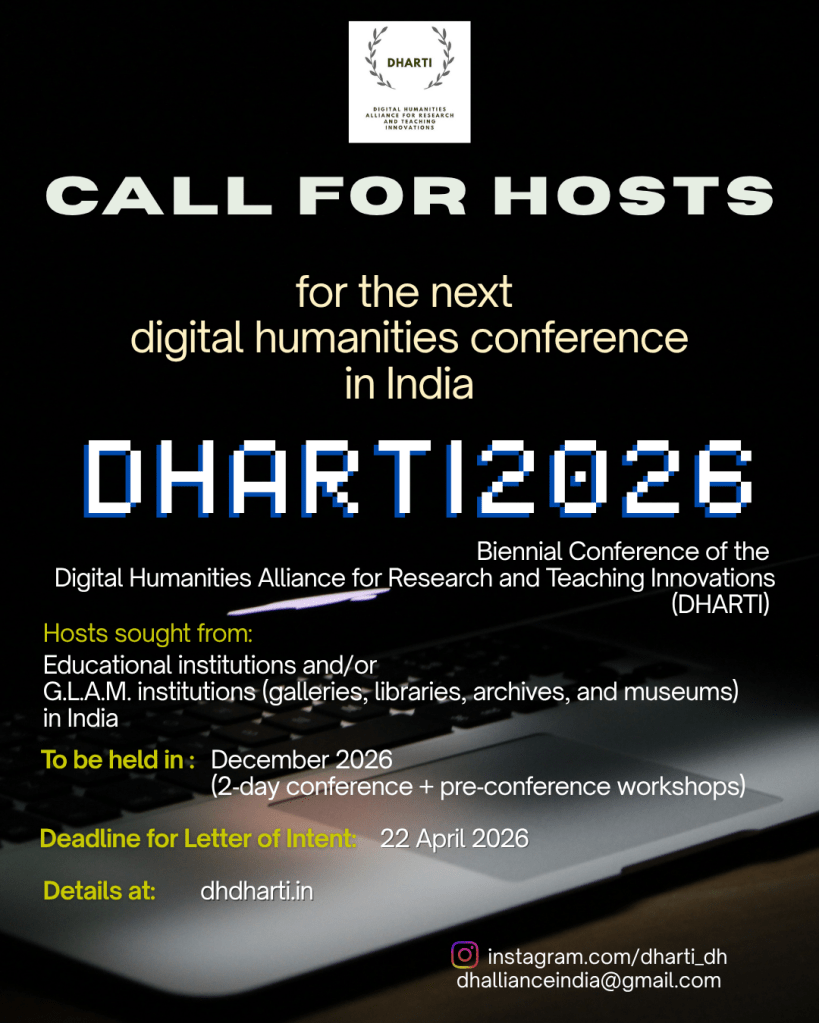
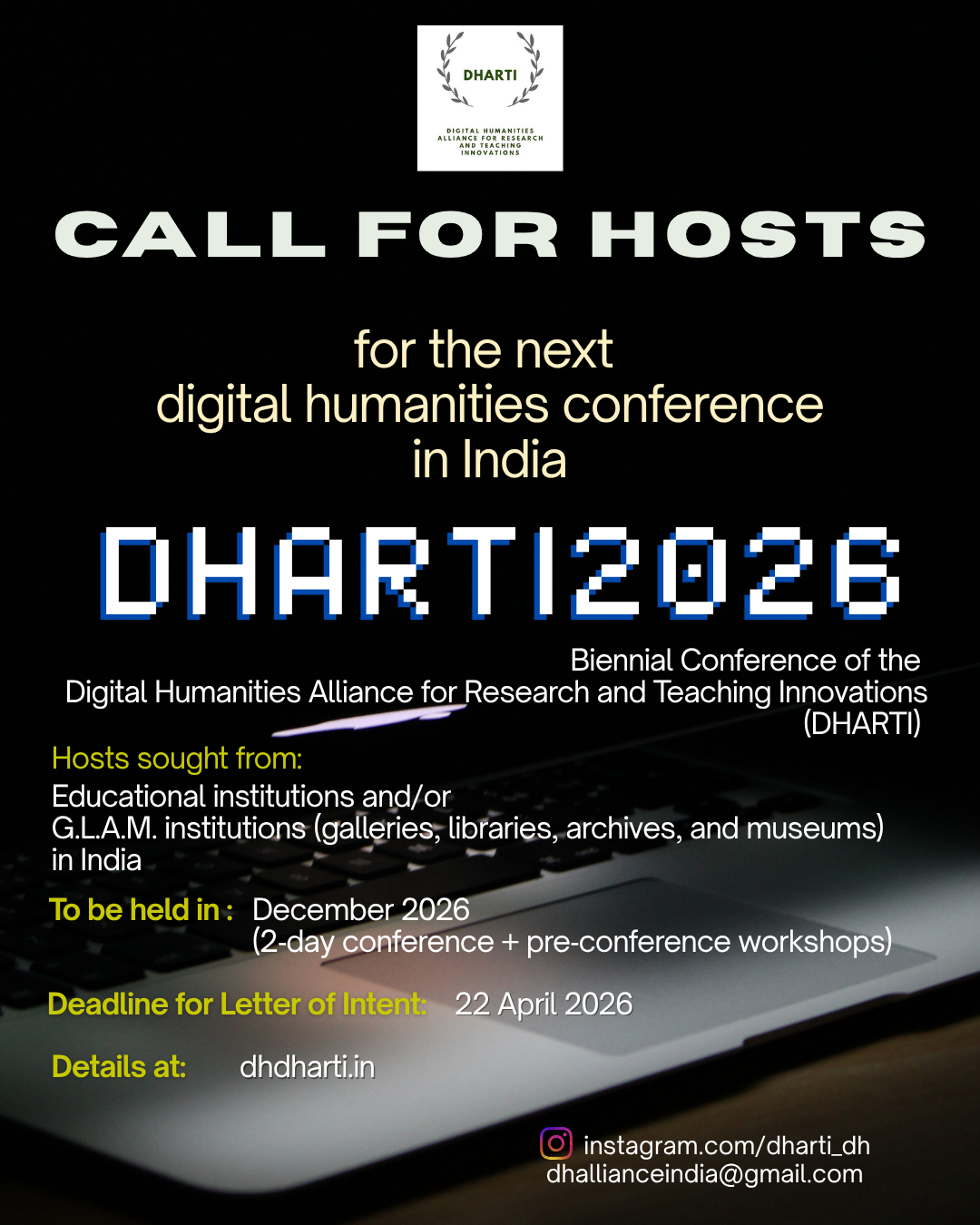
The Digital Humanities Alliance for Research and Teaching Innovations (DHARTI) is seeking proposals from educational institutions and/or stakeholders from the G.L.A.M. [galleries, libraries, archives, and museums ]sector in India to host the DHARTI 2026 biennial conference scheduled to take place in December 2026.
Based on the previous conferences organised under the aegis of DHARTI, DHARTI 2026 will be:
A 2-day conference with multiple parallel sessions
Accompanying pre-conference workshops
A respectful, collaborative platform stimulating debates on past, present, and future of Digital Humanities in India in all configurations
ORGANIZATIONAL CONTEXT AND BRIEF OVERVIEW OF PAST CONFERENCES
The Digital Humanities Alliance for Research and Teaching Innovations or DHARTI, is an initiative toward organizing and facilitating digital practices in arts and humanities scholarship in India, both within and beyond academic institutes. DHARTI is India’s first Digital Humanities Collective and is affiliated as a Constituent Organization of the The Alliance of Digital Humanities Organizations (ADHO) DHARTI, in its previous avatar as the Digital Humanities Alliance of India (DHAI) successfully held its inaugural conference in June 2018 at IIM Indore, which was organized jointly by IIM Indore and IIT Indore. The two-day conference with the theme: “Contestations, Connections and Collaborations” saw participation from more than 50 national and international delegates from 16 Indian states and 5 countries. DHARTI 2020 conference organized as India’s first twitter conference in January 2020 that also saw tremendous participation from DH enthusiasts from across the world.
The second DHARTI 2022 biennial conference was held from February 21 to 25, 2022, with the theme: “The Digital Divides: Discontents, Debates and Discussions” and with the aim to acknowledge the vertiginous divides, celebrate the productive debates, and encourage new models of thinking about humanistic inquiry in a post-Covid digital landscape. Thus far, participation at all DHARTI events has been transdisciplinary with representation from diverse disciplines including (but not limited to) Language, Literature, Visual Art, Performance / Theatre Studies, Media Studies, History, Sociology, Psychology, Language Technologies, Library Studies, Methodologies as well as Software and Critical Computational Studies. These modes of participation are representative of the aims of DHARTI, namely, to provide a methodological commons to promote and accommodate the diverse nature of DH studies within the Humanities, Social Sciences, and beyond through interdisciplinary research and pedagogy. DHARTI also aims to foster connections and associations with fellow DH organizations from the Global South that are similarly committed toward a decolonized praxis of DH.
The third DHARTI 2024 biennial conference was held from 10–13 December 2024 at IIT Jodhpur, with the theme “Digital Subject/ivities in the Global South.” The conference brought together scholars, practitioners, and students to discuss emerging methods, pedagogies, and critical debates in Digital Humanities within Global South contexts.
Besides conferences, DHARTI also conducts workshops and talk series. In July 2020, a DHARTI panel on “Toward a Postcolonial/Decolonial Digital Humanities” for DH2020 was held online, streamed live on YouTube, and archived on the Humanities Commons Portal. In December 2020, DHARTI launched the DHARTI Speaks! Webinar series with a talk on Electronic Literature as DH-Perspectives from Ghana and India. In August and September 2025, the talks on electronic literature and AI were conducted as part of the series and we have an upcoming talk series which will be regularly posted on our website. This online series aims at facilitating a sustained dialogue between Global Voices and/in Local Conversations on the Global South.
We are particularly interested in proposals from institutions/ groups of institutions that:
Have developed or are developing digital humanities communities and organizations
Have not previously hosted a DH conference and/or
Are interested in developing new modes of engagement for DH
Are similarly committed toward a decolonized praxis of DH
Scope of Proposal
The selected educational institution(s) and/or stakeholders from the G.L.A.M. [galleries, libraries, archives, and museums ]sector will be responsible for the following:
Event Planning
Develop the conference website, a comprehensive event plan outlining key milestones, and timelines.
Coordinate with DHARTI functionaries to understand the conference objectives, theme, and target Audience.
The academic aspects of the conference, including overall intellectual direction, will be overseen by the DHARTI Governing Body. The members from the host and DHARTI Governing Body members will be in the programme committee.
Venue Selection and Logistics
Identify and secure a suitable venue that aligns with the conference requirements for Hybrid (if preferred) and offline participation (including room sizes and technical capabilities, hotel, options for student housing, and other accommodations, arrangements for access accommodations
Manage logistics, including audio-visual equipment, catering, signage, and seating Arrangements.
A decision regarding the inclusion of hybrid participation will be made jointly by DHARTI and the host[s]. If hybrid options are adopted, the host[s] must ensure conducive facilities and reliable technical infrastructure for seamless online and offline engagement.
The decided number of participants will be based on the capacity of the host.
Program Development
Collaborate with DHARTI functionaries to create a diverse and engaging conference program.
Source and coordinate speakers, panelists, and workshop facilitators. DHARTI will liaison with the keynote speakers.
Marketing and Promotion
Develop promotional strategies to promote the conference and invite participation.
Create promotional materials, including brochures, banners, and online content.
Registration and Attendee Management
Implement an efficient registration system for participants.
Handle attendee inquiries and manage participant communications.
Sponsorship and Exhibitor Coordination
Secure sponsorships and manage relationships with sponsors.
Coordinate exhibitor logistics, including booth assignments and setup.
Financial structure will be mutually decided.
DHARTI may offer a few bursaries for the presenters.
On-Site Management
Oversee on-site logistics and ensure smooth event execution.
Provide event staff for registration, information, and support.
Post-Event Evaluation
Collect feedback from participants, sponsors, and exhibitors.
Prepare a comprehensive post-event report, including recommendations for future conferences.
Proposal Submission: Interested institutions are invited to submit a letter of intent that addresses their suitability for hosting the conference as well as a few proposed conference themes. Thereafter, a detailed proposal should be submitted.
The proposal should include the following:
Institutional background and experience in conference planning
Suggestions for conference theme and subthemes
Proposed event plan and timeline
Budget estimate, including a breakdown of costs and sources of funding.
Previous experience with similar events and references
Marketing and promotional strategies
Submission of Letter of Intent: 22 Apr 2026 Submission of Detailed Proposal: 8 May 2026 Proposal Submission Address: dhallianceindia@gmail.com
Proposals will be evaluated based on the following criteria:
Access for attendees with disabilities is mandatory at all venues and events associated with the conference. This includes accommodations in presentation rooms for participants who are sight- and/or hearing-impaired. If excursions cannot be made accessible to people with disabilities, this should be clearly noted in the registration materials.
Experience and expertise in conference planning and event management. Proposed budget and cost-effectiveness. References and past performance. Marketing and promotional strategies.
DHARTI reserves the right to reject any or all proposals or to negotiate separately with educational institutions deemed to be the most qualified.
We look forward to receiving your proposal.Sincerely, DHARTI Governing Body dhallianceindia@gmail.com
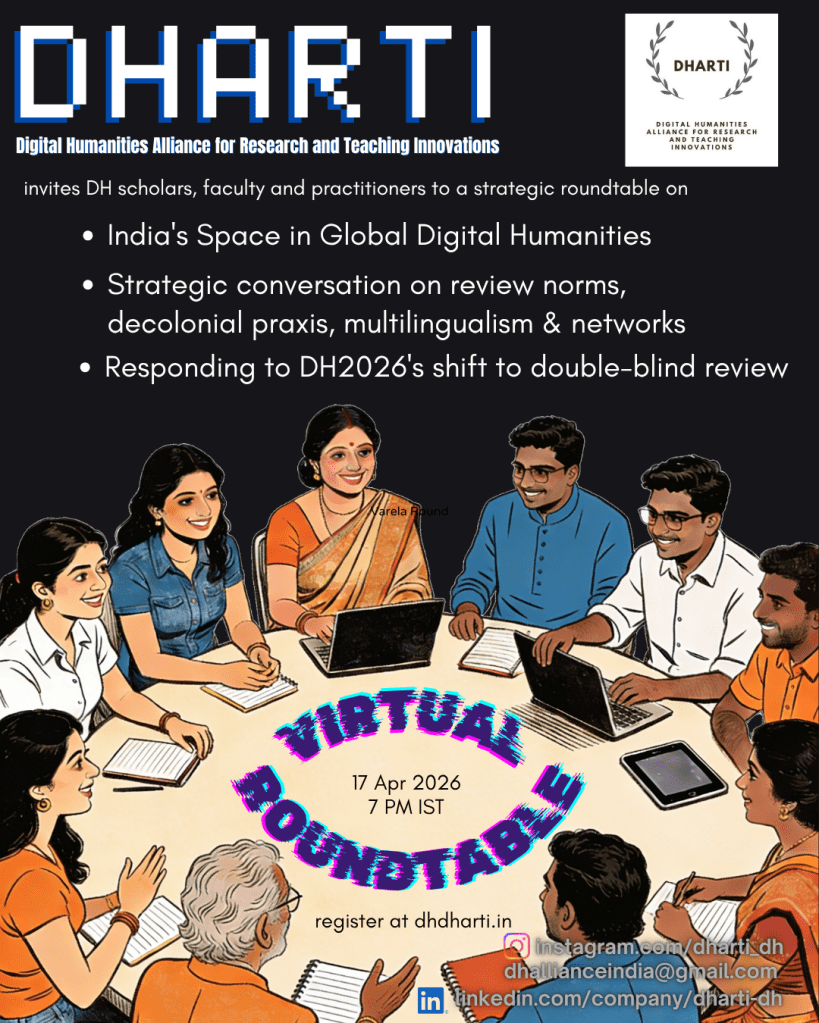
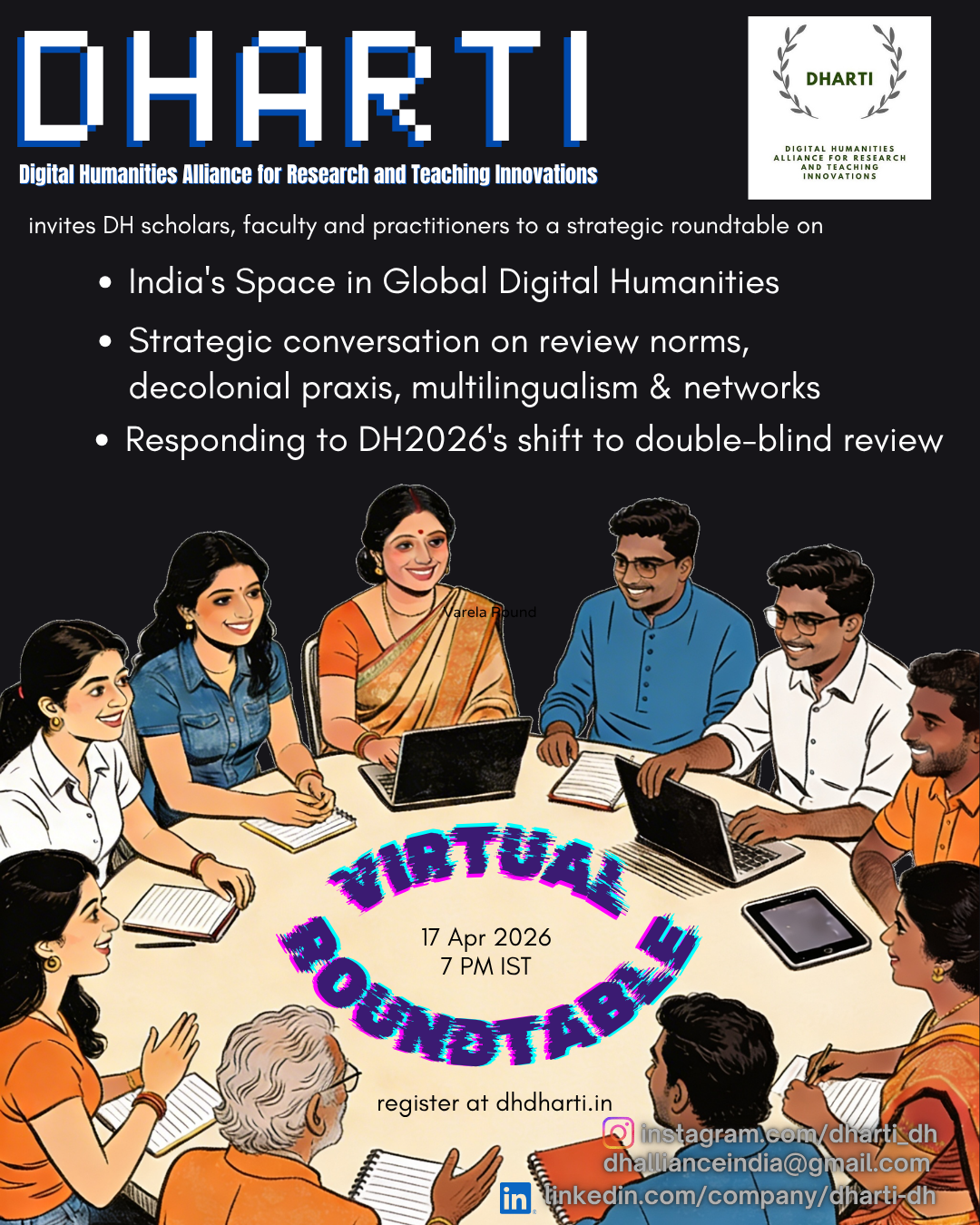
The DHARTI Governing Body invites scholars, faculty, and practitioners to a strategic conversation on India’s evolving role in the international DH community and how DHARTI can deepen digital humanities work across India.
The recent ADHO decision to adopt double-blind review for DH2026 has sparked essential global discussions about fairness, inclusion, and review practices. This is our moment to articulate Indian perspectives on:
What unique contributions can India bring to global DH from the Global South?
How do multilingualism, decolonial approaches, infrastructure needs, and interdisciplinary networks shape our work?
What role can DHARTI play in mentoring, networking, and amplifying Indian DH internationally?
Who should join: Leaders from humanities, social sciences, libraries, and technology shaping DH ecosystems in India.
Concept Note Undergraduate humanities education in India has historically trained students within single-disciplinary silos. The engagement in the field of humanities has transformed with the advent of the digital tools and the interlinked spaces, breaking disciplinary boundaries and connecting, overlapping teaching-learning and research. This summer school proposes to address the possibilities of the ever expanding […]
Have you been meaning to set up an appointment to ask about research data management for your project, an aspect of your research workflow, or a specific DH tool or method? Visit one of our drop-in sessions and we will help you on the spot! No need to make an appointment!
The sessions are designed to support researchers, students, and staff members in all areas of digital scholarship. The initiative is a collaboration between Artes Research, DH-support staff and researchers at the Faculty of Arts, and ICTS at the Faculty of Arts.
Some areas we can help you with:
Providing resources for various DH and RDM tools
Advice on DMPs and Research Data Management in general
Suggesting DH tools or methods for your specific research questions
Relational databases in FileMaker
Social Network Analysis and network visualizations
Computational tools for working with texts
…
Getting started with Zotero or optimizing Zotero use with an existing Zotero library
Advice on scholarly communication
Advice on Lirias
… and much more!
Don’t have a question about any of the above but want to learn more about DH? No problem! Come and use our space for co-working! It’s a great moment to develop digital skills by starting a Programming Historian tutorial, for instance!
Everyone is welcome to attend, you do not need to register!
Stop by on one of the following dates and we will be glad to help you:
24/09/2026: 13:30h -15:30h, Het Salon LETT 00.24, Erasmushuis
22/10/2026: 13:30h -15:30h, Het Salon LETT 00.24, Erasmushuis
10/11/2026: 11:00h -13:00h, Het Salon LETT 00.24, Erasmushuis
10/12/2026: 13:30h -15:30h, Het Salon LETT 00.24, Erasmushuis
DHARTI is pleased to announce that the DHARTI2026 Biennial Digital Humanities Conference will be hosted by Kalinga Institute of Industrial Technology (KIIT), Bhubaneswar, in December 2026.
These events are only open to KU Leuven researchers and staff
Whether you’re new to AI coding assistants or have been using them for a while, you can join this workshop to explore the wide range of these tools available, discuss best practices for using them in your projects, and discover when and how to use them to maximize your productivity. You will not need any more than a basic understanding of programming. Plus, if you’re already comfortable with AI tools, this is a great opportunity to share your experiences and insights with others!
Practicalities
When: June 15, 2026 from 09:30 to 13:30
Where: Collaborative space Geometrica (QDV 01.180) of Quadrivium – Celestijnenlaan 200H, Heverlee. This is an in-person workshop and will not be recorded.
For who: This event is open to KU Leuven staff with a basic understanding of programming
Price and registration: Free but mandatory. You can register here.
The following post was written by Sam Goven, a master’s student in Journalism at KU Leuven. It offers a participant’s perspective on the BiblioTech Hackathon, reflecting on the experience, the creative process, and collaborative spirit that shaped the event.
Participants of the BiblioTech Hackathon 2026 proudly pose on the steps of the University Library in Leuven.
Libraries are often seen as places of preservation rather than experimentation, but the BiblioTech Hackathon turns KU Leuven Libraries into a digital playground. Drawing on rich library datasets, students, researchers, and staff from diverse backgrounds work in interdisciplinary teams to reimagine historical collections through digital tools and collaboration.
The second edition of the hackathon culminated on 26 March in the University Library in Leuven, where seven teams presented their final projects to a jury. Over the course of ten days, materials from the library collection were transformed into innovative digital outputs, ranging from interactive maps and searchable databases to experimental interfaces, which can be explored via the project websites. Team PostScript ultimately claimed both the jury prize and the audience award with an interactive digital archive of Belgian postcards.
By combining technical support, curated library collections, and an emphasis on experimentation rather than competition, the BiblioTech Hackathon demonstrates that digital humanities can be accessible, creative, and collaborative, even for those new to computational approaches.
What is a Hackathon?
During a hackathon, a blend of “hacking” and “marathon”, participants work together in teams on a project against a tight deadline. These projects often have a digital component and can be developed over one or several days, resulting in a website, database, or another form of digital output.
The first edition of the BiblioTech Hackathon took place in 2023, organized by KU Leuven Libraries and the Faculty of Arts. Participants could choose from seven datasets, including the Bible of Anjou and wartime posters. The focus was on exploring documentary heritage from a fresh perspective by transforming it into computational data. The hackathon proved to be a success and led to a second edition in 2026.
Meet the Data, Meet the People
The second edition kicked off on 12 March in Agora Learning Centre in Leuven. As the smell of pizza filled the space, the perfect brain food for sharp minds, the seven teams discovered both the datasets and each other for the first time. In total, 39 enthusiastic participants from a wide range of backgrounds took on the challenge. The hackathon attracted not only master’s students, but also PhD candidates, postdoctoral researchers, and KU Leuven staff. Participants represented a broad variety of disciplines and research fields, including Computer Science, Egyptology, Law, and Economics.
To make the most of this diversity, teams were formed in advance based on digital skills and areas of expertise, ensuring a balanced mix. Each team was supported by a designated team leader to keep the project on track, while technical experts were readily available throughout the hackathon to answer questions and provide assistance. To ensure everyone could get started smoothly, an additional training session on the technical infrastructure and tools was organized the next day.
Following an introduction to the datasets and the available support network, the teams dove into the material. This year’s hackathon offered two datasets: well over 35.000 historical postcards from Belgium and around 300 travel accounts written by European authors describing the destinations they visited. Once again, these historical sources provided ample opportunities for innovative perspectives. Four teams chose to work with the travelogues, while the remaining three focused on the postcards.
The brainstorming phase reflected the exploratory nature of the hackathon. Faced with rich datasets and a wide range of ideas and ambitions, teams took time to explore different directions before narrowing their focus. Working within a limited timeframe required careful consideration of what was both innovative and feasible. This process not only helped shape the projects but also allowed participants to recognize and build on each other’s strengths. Andreas Ketele, a member of the Inked and Stamped team, reflected afterwards: “What I really enjoyed was that process of exploration. We reflected on our ideas and experimented a lot, and that’s exactly what a hackathon is about: discovering possibilities along the way.” (full interview)
Team Julie Verne getting to know each other, and the data, over pizza.
The Final Projects
On 26 March, participants, jury members, and guests gathered in the University Library for the final presentations accompanied by a poster exhibition, marking the culmination of the hackathon and an opportunity for teams to present their work. The evening opened with welcoming words from the organizing team, Demmy Verbeke (Head of KU Leuven Libraries Artes), and Geert Brône (Vice Dean for Research at the Faculty of Arts), who praised the creativity and commitment shown throughout the hackathon.
The presentations were opened by team CaptaCats with their project ShipAdvisor. Loosely inspired by the travel website TripAdvisor, the team developed a web platform that maps maritime routes in the Mediterranean during the 18th and 19th centuries, based on historical travel accounts.
Next, team DH.xml presented their analysis of the postcard dataset. They argued that historical postcards functioned as a form of social media avant la lettre, and used the collection to identify recurring visual trends and patterns.
All Reads Lead to Leuven focused on how 19th-century French travel writers wrote about African languages. Their project resulted in a website featuring Instagram-inspired posts that reveal the vocabulary and framing these authors used when describing linguistic encounters.
Using the postcard dataset, Inked and Stamped built a searchable digital database. Its intuitive interface allows users to explore the collection by location, date, and even the color of the postcards.
Team PostScript adopted a similar approach, but with a specific focus on postcards from Antwerp. In addition to a searchable database, they introduced interactive features such as maps that contrast contemporary photographs with historical images from the collection.
The penultimate presentation came from Team W@nder. Drawing on The Land and the Book, a 19th-century publication by W. M. Thompson, they visualized the author’s travels in the Levant. As with other projects, historical illustrations were juxtaposed with present-day photographs to highlight continuity and change.
The evening concluded with a presentation by Team Julie Verne. They developed an oracle-like search tool based on the travelogues dataset. Through their website, users can query the texts and receive the most relevant responses generated from the corpus.
After a brief deliberation by the jury and a public vote, the awards were announced. The jury consisted of experts in data and digital research: Julie Birkholz (Coordinator CLARIAH VL+), Geert Brône (Vice Dean for Research of the Faculty of Arts), Jo Rademakers, (Head of LIBIS), Fred Truyen (Head of CS Digital), and Katrien Verbert (Program director of the POC Digital Humanities). Team PostScript was awarded both the jury prize and the audience award. As in the 2023 edition, however, each team received recognition, including awards such as Best Research Potential and Best Visualization. The evening concluded with a reception, where teams presented their project posters over food and drinks. To share the creativity and impact of the hackathon with a wider audience, the posters are currently touring across KU Leuven.
Team PostScript poses with their poster at the reception.
A Community Built Through Collaboration
Not only were the results of the hackathon impressive, participants also praised the atmosphere and strong sense of community that developed throughout the event. In post-hackathon interviews, several participants reflected on the collaborative environment that emerged over the course of the ten days. Andreas Ketele described the experience as particularly rewarding: “I’m usually not someone who uses very strong words, but this really was fantastic. […] We were working as a group of highly motivated people. We collaborated very well and benefited enormously from all the support we received along the way.” (full interview)
The diversity of backgrounds and skill levels did not prove to be a challenge, but rather one of the hackathon’s greatest strengths. By bringing together participants with different perspectives, expertise, and levels of technical experience, the hackathon created space for learning from one another. As Roberta Pireddu, team leader of PostScript, explained: “I really think everyone can participate, because there’s a place for everyone in a hackathon, even if you don’t have strong technical skills. Whatever your background or skills, there’s always a way to contribute and find your role within the group.” (full interview)
For many participants, this emphasis on collaboration rather than competition was key. As advice for future participants, Luisa Ripoll Alberola, team leader of CaptaCats, encouraged newcomers not to focus too heavily on the final outcome: “What really matters is not the end product, but the process: working together, learning new things, and enjoying the experience. That’s what makes it valuable.” (full interview)
The second edition of the BiblioTech Hackathon proved once again how working with library data can foster meaningful collaboration across disciplines. By bringing together diverse participants, the hackathon strengthened connections within the academic community and opened up new ways of engaging with humanities collections.
More information about the hackathon, its datasets, and the final projects can be found on the BiblioTech 2026 website. We encourage you to have a look at the project posters and websites to explore the teams’ outputs and discover the creative ways in which KU Leuven’s library collections continue to inspire digital humanities research. We also invite you to explore interviews with participants, offering a personal insight into their experiences during the event.
KU Leuven Libraries has invested in an integrated approach to strengthen the discoverability and accessibility of physical resources through digital access, thereby supporting and stimulating research, education, and heritage activities.
The Digitisation and Enrichment of Collections Service creates, manages, and enriches data through metadata creation, digitisation, and imaging and serve as experts in these fields. Through state-of-the-art infrastructure such as the Imaging Lab and the Scan Hub, both fragile heritage materials and modern documents are digitised. These processes are supported by metadata creation and embedded within a broader policy framework for the preservation and management of physical collections. The team follows the latest developments in the field with regards to technical aspects and concerning digitisation project management and legal matters.
To make this often invisible expertise visible, Digitisation and Enrichment of Collections of KU Leuven Libraries developed the YouTube series “How KU Leuven Libraries Digitises” (in Dutch). Through a seriest of 4 videos you can discover, step by step, how materials are prepared, handled, placed under controlled lightning, scanned, and described. They show the people, equipment, and procedures behind the digitisation workflow. Discover the series below, or directly on Youtube.
If you want to know more about KU Leuven Libraries digitisation process, visit the website.
Friday, April 17, 2026 | 7:00 PM IST | Virtual The DHARTI Governing Body invites scholars, faculty, and practitioners to a strategic conversation on India’s evolving role in the international DH community and how DHARTI can deepen digital humanities work across India. The recent ADHO decision to adopt double-blind review for DH2026 has sparked essential […]
The Digital Humanities Alliance for Research and Teaching Innovations (DHARTI) is seeking proposals from educational institutions and/or stakeholders from the G.L.A.M. [galleries, libraries, archives, and museums ]sector in India to host the DHARTI 2026 biennial conference scheduled to take place in December 2026. Based on the previous conferences organised under the aegis of DHARTI, DHARTI […]
Join us for the Helsinki Digital Humanities Hackathon 2026—an opportunity to collaborate and innovate in an interdisciplinary setting. The application period is open (until 14 April 2026) – apply now to be part of this year’s cohort.
People talk about hackathons, but there is only one Helsinki Digital Humanities Hackathon. #DHH26 is the 11th iteration of our international summer school (aimed primarily at master’s students and beyond), which brings together diverse participants from Finland and across Europe.
In the Helsinki Digital Humanities Hackathon, you will experience an interdisciplinary research project from start to finish within the span of 10 days. For researchers and students from computer science and data science, the hackathon gives the opportunity to test their abstract knowledge against complex real-life problems. For people from the humanities and social sciences, it shows what is possible to achieve with such collaboration. For everyone, the hackathon gives the experience of intensely working with people from different backgrounds as part of an interdisciplinary team, as, during the hackathon, each group develops a digital humanities research project from start to finish. Working together, they formulate research questions with respect to particular data sets, develop and apply methods and tools to address them, and present the work at the end of the hackathon.
Participation in #DHH26 is free for all accepted participants. This year, we also expect to sponsor a limited number of participants from outside Finland with flights and accommodation (decisions on this to be made after the application period).
The event is organised by FIN-CLARIAH—particularly its DARIAH-FI component—in collaboration with HELDIG and the Department of Digital Humanities at the Faculty of Humanities, University of Helsinki, as well as Aalto University. We are supported by CLARIN-EU, HIIT, the Helsinki Centre for Intellectual History, and Marie Curie Training Networks CASCADE & MECANO. 5 ECTS credits may be gained from participating in the hackathon for students, and it also functions as a staff training event for leadership and collaboration across disciplinary borders.
17.3.2026 This year’s themes are unveiled, and the application period starts 14.4.2026 Application period ends 27.4.2026 Registration period ends for #DHH26 for accepted participants 4.5. & 11.5.2026 Two #DHH26 pre-hackathon online preparatory sessions 20.–29.5.2026 #DHH26 hackathon in Helsinki
Please note that we can only accept participants who are able to commit to the full week of intensive work (not just a couple of hours here and there), as well as the preparatory sessions. Thus, if you know that you have other commitments during the hackathon, please consider applying next time when you can make a full commitment.
The hackathon will take place between 20.–29.5.2026. The participants are expected to commit to the hackathon for the whole period; work takes place mainly between 10 AM and 5 PM on weekdays (the weekend is free!). In addition, there are two online pre-sessions on Mondays 4.5. and 11.5., between 2 – 4 PM UTC+03:00 for orientation, group formation and preparation for the intensive hackathon period. The participants are expected to attend also these pre-sessions.
The Australasian Association for Digital Humanities (aaDH) presents Digital Humanities on the Edge. To kickstart 2026, we bring together four speakers to examine topics core to the future directions of DH: Infrastructure, Surveillance, Platforms, and Artificial Intelligence. The panel will consider how these four domains are reshaping not only DH tools, but also the ethical and political conditions under which DH work now takes place. At a moment of considerable disciplinary inflection, aaDH invites you to a discussion on the edge – of methods, histories, theories, and time.
Are you a Digital Humanities student or early career researcher in Belgium who would like to discuss DH with other early career researchers in the Belgian DH community? If so, you might be interested in joining the DH Virtual Discussion Group for ECRs!
The DH Virtual Discussion Group is a joint initiative organized by individuals at multiple Belgian institutions. We strive to involve speakers from all Belgian institutions and encourage participation from all those who are interested in DH and are located at any Belgian institution. This series, the core organizers are Leah Budke (KU Leuven), Tom Gheldof (KU Leuven, CLARIAH-VL+), Paavo van der Eecken (University of Antwerp), and Loren Verreyen (University of Antwerp). Over the past years, the series has become a regular event. The spring 2026 edition proudly marks our twelfth term.
Our first two sessions this spring will continue the “under-the-hood” format, which entails a volunteer from our community providing a thirty-minute overview of a digital project implementing a given tool, approach, or platform. This is not meant to be a polished research presentation, or to present findings or results, but rather to give our community a behind-the-scenes look at how decisions were made and why specific tools were chosen or developed. The hope is also that this presenter will give attendees some ideas about how to get started implementing a specific tool or workflow, and that they can also answer questions or contribute to a discussion on other projects in our community that might be using similar methodologies or addressing similar issues. This “under-the-hood” session format allows us to have focused discussions around a specific project where we can learn from each other in an informal way. In addition, by implementing this format we can maintain the low threshold for contributing and engaging in the conversations.
Our final session will be a special in person session during which members of our community can give an elevator pitch of their DH Benelux contribution.
The spring 2026 schedule will be updated as details about upcoming talks are confirmed. Please check back here or on the website (linked above) for full details. Information about each session will also be circulated via the mailing list.
Session 1 Date: Monday 30 March, 15h-16h30 CEST via Teams Speaker(s): Julie Van Ongeval, VUB Title: The Fall of Antwerp (1585) as a linguistic turning point? Language change from macro- and micro-perspectives. Abstract: The Spanish recapture of Antwerp (1585) during the Eighty Years’ War, known as the Fall of Antwerp, marks a crucial turning point, not only from a historical but also from a linguistic perspective. Historically, the Fall triggered profound social, economic, and demographic transformations. Prior to 1585, Antwerp had flourished as one of Europe’s largest and most prosperous cities, characterized by substantial immigration. In the aftermath of the Fall, however, the city experienced severe socio-economic decline and large-scale emigration, causing its population to decrease by more than half (from 100,000 inhabitants in 1580 to 42,000 in 1589) (De Meester 2011, Lesger 2007). From a linguistic standpoint, the Fall has traditionally been associated with what De Vooys (1970) termed “the decline of the Southern Netherlands”. The event is believed to have shifted the linguistic center of gravity to the Northern Netherlands, slowing down or even halting the ongoing processes of language standardization in the Southern Netherlands and, by extension, in Early Modern Antwerp (Van der Sijs 2020). Yet, these linguistic claims have primarily been based on printed, literary, or explicitly normative texts. Considerably less is known about language use in more informal and everyday contexts (Elspaß 2020).
This study addresses that gap by analyzing informal, handwritten letters preserved in the newly developed Early Modern Antwerp Corpus (1564-1653). Drawing on Dixon’s punctuated equilibrium model (1997), which proposes that significant historical events can accelerate linguistic change, we test an alternative hypothesis: rather than causing stagnation, the Fall of Antwerp may have triggered intensified linguistic variation and change. To assess this hypothesis, we examine six linguistic features that were undergoing change and were relevant to the process of Dutch standardization (clause negation, verbal cluster order variation, schwa apocope, the prefix ge- in past participles, word-final /k/, spelling of /ɣ/ in onset). First, we analyze developments at the community level to identify broader patterns of change. We then adopt a more microscopic perspective, investigating how individual writers respond to the shifting sociohistorical context. This includes both inter-individual variation (e.g. social categories and networks) and intra-individual change across the lifespan. By investigating the linguistic consequences of the Fall of Antwerp from both macro- and micro-level perspectives, this study aims to bridge the three waves of sociolinguistic research, integrating community-level patterns with individual-level variation and change.
Session 2 Date: Monday 20 April, 15h-16h30 CET via Teams Speaker(s): Léa Hermenault, UA Title: The Belgian Historical Gazetteer: (historical) toponyms in a digital era Abstract:My presentation will introduce the Belgian Historical Gazetteer, a project founded by CLARIAH-VL+ and hosted at the University of Antwerp. This project aims to set up a historical gazetteer of toponyms for the whole present-day territory of Belgium, in order to provide researchers with a collection of data that does not stop at Belgian provincial borders and which goes beyond the level of municipalities.
First, I will explain how the gazetteer is constructed using both automatic extraction of text from old maps and manual corrections/additions. Then, I will show how this gazetteer will help researchers deal with place names that appear in their sources. Finally, I will demonstrate the potential of digitized lists of historical place names for both toponymic and landscape studies which make digital gazetteers, aside from their classic function, innovative exploring tools.
Session 3– Special In-Person DH Benelux Session Date: Monday 18 May, 13h30-16h CEST, Location: room 1.01 Gogotte, Hoek 38, Leuvenseweg 38, Brussels (location is within walking distance from the central station) Speaker(s): various members of our community Format: elevator pitches of DH Benelux contributions
There are an increasing number of conferences, workshops, and funding opportunities in DH, and we would like to ensure that you are aware of them. We will start every session with a moment for individuals to share news about upcoming lectures, workshops, seminars, and conferences. We have a corresponding Slack group where we also share these opportunities both during the discussion group meetings and in between. The link to join the Slack group is included in every email sent out to the mailing list, so watch for it there or send us an email to request access.
If you would like to register or invite other colleagues to join, please complete the registration form for the mailing list here. Please note, if you have received emails from us about the Discussion Group in the past, it means you are already on our mailing list. In that case, there is no need to register again—you will receive the emails with the MS Teams link and any additional information on the day of the session. Additionally, you will also receive updates on upcoming sessions including further details about speakers and the “under-the-hood” presentation topics.
Are you a frequent attendee of the DH Virtual Discussion Group and would like a low-threshold way to become more involved in the organization? We are looking for ambassadors to promote the group within their university networks. If this might be a role you would like to take on, get in touch and we can tell you more!
These events are only open to KU Leuven researchers and staff
To support researchers in their use of relational data, CLARIAH-VL+ & Artes Research (partners in DH@rts) are hosting 2 Nodegoat workshops.
Nodegoat is a web-based research environment designed for the Humanities. The platform enables researchers to manage and visualize complex historical data, including vague dates and historical regions, as well as to generate diachronic geographical and social network visualizations.
During the workshop, participants will learn how to use this flexible digital environment for their own projects.
Program
The workshops will be given by Geert Kessels & Pim van Bree (the developers of LAB1100).
The morning session (09:30-12:30) will cover a general introduction to Nodegoat
During the afternoon session (14:00-17:00) the developers will present more advanced Nodegoat features.
You may sign up for just the morning session, just the afternoon session, or both workshops. Just make sure to register for each session individually.
Practicalities
When: April 24, 2026 from 09:30 to 12:30 and from 14:00-17:00
Where: Colloquium (05.28) in the University Library. These are in-person workshops and will not be recorded.
For who: This event is open to KU Leuven researchers working in the Humanities. No prior experience is required. Participants are encouraged to bring their own research questions or datasets to explore within Nodegoat
Price and registration: Free but mandatory. You can register here. You may sign up for just the morning session, just the afternoon session, or both workshops. Just make sure to register for each session individually. Registration deadline is 10 April 2026.
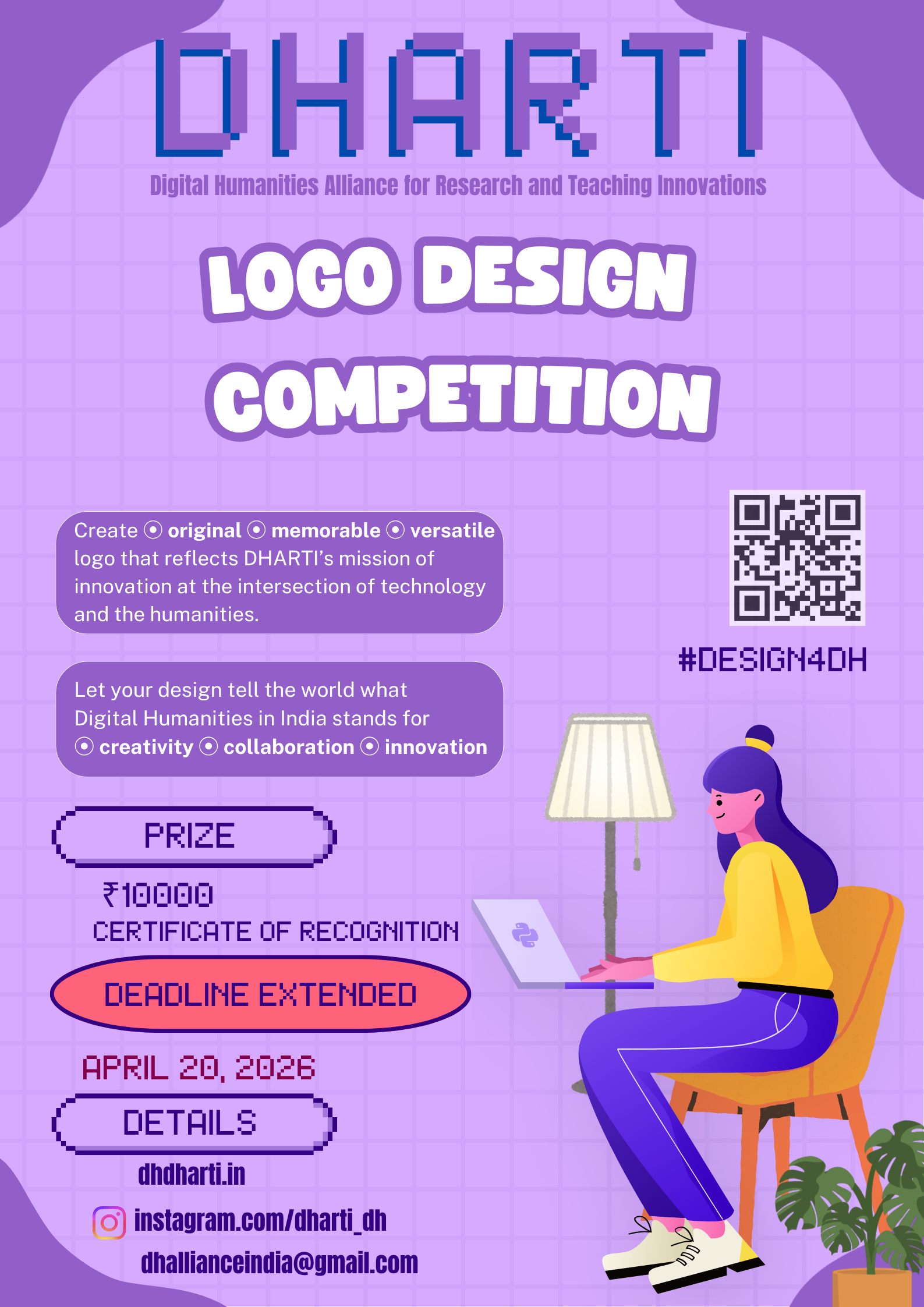
Dharti We are pleased to announce an exciting opportunity to design a distinctive logo that will represent our organization globally. Deadline Extended! About UsDHARTI, a registered Non Profit organisation in India, is an initiative towards enabling and facilitating digital practices in arts and humanities scholarship in India, both within and beyond academic institutes. As an […]

 登录
登录