
阅读视图

Fighting for gender equality in the digital world

The aim of the three-year project ‘Égalité de genre et transformation numérique’ (‘genre/numérique’), which will hold its first conference in Fribourg on 8-9 September, is twofold: to ensure that movements toward gender equality are supported in the digital domain, and to address gender bias in the development and deployment of digital technologies.

Genre/numérique’ is jointly led by the UNIL-EPFL dhCenter, the UNIL and EPFL equality offices, HES-SO (Haute École spécialisée de Suisse occidentale), HEG-FR (School Of Management Fribourg), and the StrukturELLE association, with support from Swissuniversities. It was initiated based on the recognition that issues related to gender equality and the digital transformation must be addressed in relation to one another, rather than separately – as is often the case.

“Our project notably aims to challenge digital biases, such as those developed or reinforced by algorithms, and to support equal access to positions of power in digital enterprises,” explains project team member Héloïse Schibler. She and the genre/numérique team are working on a video series that dives into deeper detail on key issues – such as gender balance and digital education, gender roles on dating apps, and gender bias on Wikipedia – with selected experts.

In addition to opening a transdisciplinary dialogue on these issues, the team plans to evaluate the effects of gender bias and digital transformation, study approaches to promoting gender equality using digital methods, and outline best practices for  supporting women in the digital sector.

Toward gender equality in the digital world?

Genre/numérique is organizing a cycle of three annual conferences, the first of which will be held on September 8-9 in Fribourg. Entitled “Toward gender equality in the digital world?” this event is free and open to all upon registration, and is aimed in particular at participants from academia, digital enterprise, media, and public policy.  This year, a special thematic focus will be placed on issues in digital entrepreneurship, such as women’s participation in and access to tech start-ups (view full program).

“Although there is a great need for these kinds of conversations, to my knowledge, this event is unique in the region. We will have diverse speakers touching on all digital domains, with emphasis on active, hands-on exchanges such as round tables, working group discussions, and networking sessions,” Schibler says.

The proceedings of this and the succeeding two conferences, which will cover themes ranging from digital ethics and public policy to education and training, will be used to develop and publish a white paper of best practices, with the goal of reinforcing the visibility of issues relating to gender and the digital, and offering solutions for a more inclusive digital world.

The post Fighting for gender equality in the digital world appeared first on dhCenter.
  •  

Five questions for new CDH director Frédéric Kaplan

UNIL-EPFL dhCenter member Frédéric Kaplan, who has succeeded Béla Kapossy after four fruitful years as College of Humanities Director, describes his vision for the humanities and social sciences at EPFL.

Frédéric Kaplan has been a professor at EPFL since 2012. In addition to leading the Lab for Digital Humanities, he is also currently the head of Digital Humanities Institute. He took up the post of College of Humanities (CDH) Director for a two-year term on August 1.

Here, Kaplan talks about his plans for humanities research and education at EPFL, and why digital humanities and design both have key roles to play.

1. CDH: What should be the place of humanities and social sciences at an engineering school like EPFL?

Frédéric Kaplan: The scientific discoveries and technological innovations that are being developed at EPFL will enable us to build the world of tomorrow. But outside the laboratory, scientific objects behave differently, and innovations do not always meet their intended audience. Differences in cultural contexts, political and economic forces, and the technological environment itself shape the future of what EPFL researchers discover and invent. For this knowledge to have an effective impact, it is necessary to associate it with knowledge developed in humanities and social science fields.

For the past 20 years, EPFL has been developing an ambitious teaching and research program in the humanities and social sciences, in partnership with the University of Lausanne and several other institutions in the Lake Geneva region. It is now time to intensify this commitment to develop a new form of knowledge capable of giving EPFL innovations an effective impact on the world, and serving as a bridge between this research and society.

2. CDH: What are some obstacles to this convergence of skills from scientific and humanities fields?

FK: The trajectories of these different disciplines bifurcated in the 19th and 20th centuries, when much of the funding in the rapidly growing American higher education system was put toward science and technology, to the detriment of the humanities and social sciences. For example, C.P. Snow argued in 1959 at the “Two Cultures” conference in Cambridge that in order to ensure global peace and prosperity, we needed to train more engineers and fewer historians, philosophers, and literary critics. The result was deep frustration and, paradoxically, claims by some humanities researchers that their work was socially and practically irrelevant.

Today at EPFL, we are trying to demonstrate the crucial importance of knowledge developed in the humanities, and to transform it into something directly usable. We must break the political myth of the “Two Cultures” to bring about a convergence at the crossroads of defragmented disciplines.

3. CDH: What has been the role of digital humanities in this evolution?

FK: The digital humanities first tried to show that certain computational methods, including recent advances in artificial intelligence, could have significant effects when applied to humanities and social science problems. Very promising results have been obtained for the massive processing of archival sources in the history of art, music and science, and urban history.

But above all, the digital humanities have started opening up knowledge. They have initiated a bridge between humanities data and civil society actors who could make relevant use of it, notably through the establishment of large, open databases that allow us to structure representations of the past according to the challenges of the present.

4. CDH What is the role of art and design in the development of this new knowledge?

FK: The place of design is central and the knowledge and methodologies of designers must be more strongly integrated into research and training. Today, design raises questions of the complementarity of physical and digital experiences, and of how to think of objects as services rather than goods. Collaborations between designers and engineers must be strengthened so that knowledge flows in both directions.

When it comes to artistic techniques, one only has to look at contemporary artists – such as those selected for CDH’s Artist-in-Residence (AiR) program or those participating in the EPFL Pavilions exhibitions – to see that the boundaries between art and engineering are becoming increasingly permeable. In these rare moments, where art, science, and technology converge, great discoveries and inventions can take place.

5. How can EPFL offer training that gives students the full range of skills needed to tackle the world’s challenges?

FK: We have excellent specialists in these issues at EPFL, notably at CDH, the College of Management, and the School of Architecture. We must continue to recruit researchers who excel at the intersection of these disciplines and develop absolutely original approaches. We are also fortunate to be surrounded by the University of Lausanne, the University of Geneva, the École cantonale d’art de Lausanne (écal), HEAD (Haute école d’art et de design) Geneva, IMD Business School, and the Geneva Graduate Institute, with whom we have must continue to strengthen our ties.

The challenge of creating a new body of knowledge from the defragmentation of humanities and social sciences is of such societal importance that we also need to develop national and international alliances with major academic institutions.

Above all, we must train engineers with hybrid profiles in both technology and the humanities. We need to help them discover the fun of creating solutions at the crossroads of these fields. If we look at the biographies of those whose ideas change the world, it is common to find this hybridity and holistic vision of knowledge.

This article was originally published on 01.09.2022 by Celia Luterbacher EPFL CDH.

The post Five questions for new CDH director Frédéric Kaplan appeared first on dhCenter.

  •  

WoPoss team releases Latin corpus sample

dhCenter member Francesca Dell’Oro and the WoPoss team has recently published a sample of its annotated corpus for the study of the diachrony of modality in Latin, as well as a user-friendly interface to query it.

The SNSF-funded project, A world of possibilities. Modal pathways over an extra-long period of time: the diachrony of modality in the Latin language (WoPoss) is a digital humanities project formerly hosted by the Section des Sciences du langage et de l’information (Language and Information Science Section) of the University of Lausanne. It is also attached to the Institut des sciences du langage et de la communication (Language Science Insitute, ISLa) of the Université de Neuchâtel.

The project aims to to set up and annotate a balanced corpus of Latin texts from the 3rd century BC to the 7th century in order to study the evolution of lexical and morphological modal markers according to specific guidelines.

A sample of the annotated corpus is now available and the modal passages can be be queried at woposs.unine.ch/form.html. More annotated texts will be made available in the coming months.

The post WoPoss team releases Latin corpus sample appeared first on dhCenter.

  •  

Do we have an unhealthy appetite for pie (charts)?

This article,  originally published on 18.08.22 by Anne-Muriel Brouet as part of EPFL’s Summer Series of articles on student projects, features the EPFL Critical Data Studies class taught by dhCenter members Charlotte Mazel-Cabassse and Semion Sidorenko.

Three university students, as part of their critical data studies class, wrote a light-hearted yet instructive comic strip about perception biases in the presentation of data.

The story starts with two artisan cheesemakers who are hauling their product to market when their carts – one horse-drawn, the other ox-drawn – collide. Raymonde, a 70-year-old woman who witnesses the collision, complains that accidents involving horse-drawn carts, unlike ox-drawn ones, are becoming more frequent. She goes on to back up her premise with pie charts showing the trend is getting worse every year. But Hugues, another bystander from the same age bracket, isn’t so easily convinced. He points out that Raymonde’s pie charts mask the fact that the number of overall accidents is decreasing and that there are fewer and fewer ox-drawn carts on the roads.

The story is told through a skillfully drawn comic strip that’s amusing and instructive at the same time. It was created by a group of three students – two from EPFL and one from the Lausanne School of Visual Arts (Ceruleum) – for their critical data studies class, given jointly by EPFL and UNIL. Nicole Vadot, one of the EPFL students, is pursuing a Master’s degree in physics and has a keen interest in data visualization. In the past few semesters, she has sought to perfect the graphs in her lab reports and has read up on methods for manipulating how data are presented. Zineb Agnaou, the other EPFL student, is pursuing a Master’s degree in applied mathematics; her areas of interest include statistics and techniques for presenting research findings. The Ceruleum student is Blandine Moulin, who “loves drawing little old grannies,” she says. As part of her Bachelor’s degree in illustration and comics, Moulin contributed her artistic talent and non-technical perspective to the project.

The students worked over weekends and school breaks to design three episodes of their comic strip, called AbraDatabra, along with a website https://actu.epfl.ch/news/do-we-have-an-unhealthy-appetite-for-pie-charts-2/(in French only) where it can be viewed online. “With our comic strip, we wanted to shed some light on how charts and graphs can be created and interpreted, so that research results are presented in the best way possible,” says Agnaou. Her colleague Vadot adds: “The idea is to provide tools that just about anyone can use to look more critically at data they’re presented with.” Drawing on equal doses of humor and pedagogy, the comic strip educates readers through examples ranging from toppled cheese carts and magic potions to electoral propaganda.

The group’s website provides details about the charts and graphs they use, whose open-source code is available on GitHub, along with descriptions of the traps to watch out for and tips to avoid getting duped. Such traps include using inverted scales, mixing up absolute and relative values, introducing extrapolation bias, drawing conclusions from small sample sizes, putting forth false correlations, using misleading slopes, omitting data points and excluding information. This all leads back to the key question put forth by the students: do we have an unhealthy appetite for pie (charts)?

The post Do we have an unhealthy appetite for pie (charts)? appeared first on dhCenter.

  •  

EPFL CDH Artist-in-Residence program opens call for second edition

The College of Humanities Artist-in-Residence program (CDH AiR) ‘Enter the Hyper-Scientific’ has launched its 2023 call, which will support up to four artists for three months of research and experimentation connecting art, humanities, science, and technology. This year’s edition will see a new partnership with the City of Lausanne.

Initiated by the EPFL College of Humanities (CDH) and amplified by EPFL Pavilions, the CDH AiR program is open to emerging and established Swiss and international artists interested in the intersection of art, media, science and technology.

Selected artists develop interdisciplinary projects and carry out their research in conjunction with EPFL laboratories, and resulting projects are featured in a public exhibition at EPFL Pavilions.

Following the success of the program’s 2022 edition, this year’s comprehensive residency opportunity welcomes projects in diverse fields, including visual and media arts, film, imaging and digital practices, experimental forms of sound research, experimental design, literature, and critical and speculative writing.

Thanks to a new partnership with the City of Lausanne, the selected artists will benefit from accommodation and working space in the housing cooperative La Meute, located in the new Plaines-du-Loup eco-district. This innovative and collective housing project, which brings together families, cultural figures, students, and asylum-seekers, will foster exchange between the artists and Lausanne’s rich art scene.

Enter the Hyper-Scientific

The goal of the 2023 program, ‘Enter the Hyper-Scientific’, is to explore the scientific landscape at EPFL through artistic works. By facilitating encounters between artists and scientists from different disciplines, the program aims to establish a dynamic, critical, and inspiring platform for propelling aesthetic investigations at the intersection of art, technology, science, and the humanities.

Artists may select one of three tracks:

Open Transdisciplinary. This track invites artists and practitioners from all disciplines to propose projects that investigate the fluid boundaries between art, humanities, science, and technology.

Scientific Imaging. In collaboration with the EPFL Center for Imaging, this track is for artists interested in imaging technologies, CGI, and digital imaging methods. Proposals in the field of data visualization are welcome.

Environmental Transformation. In collaboration with CLIMACT, the joint EPFL-UNIL Center for Climate Impact and Action, this track invites visual artists (including creators active in the performing arts) and designers to engage with themes related to climate change.

Applications (in English) must be received by October 3, 2022. Please visit the program website for full application instructions. A selection committee including senior members of CDH and EPFL Pavilions, plus external jurors from the cultural and artistic sector, will assess each proposal.

For further information, please visit the program website at https://go.epfl.ch/CDH-AiR-call2023, or email info.CDH-AiR@epfl.ch.

The post EPFL CDH Artist-in-Residence program opens call for second edition appeared first on dhCenter.

  •  

Interdisciplinary CROSS program invites proposals on the theme of ‘crisis’

The interdisciplinary Collaborative Research on Science and Society (CROSS) program in EPFL’s College of Humanities is now accepting joint project proposals from researcher at EPFL and the University of Lausanne on the theme of ‘crisis’.

The CROSS program aims to support research projects that deal with current issues in society and technology, and that bring together EPFL and UNIL. Through an annual call for proposals, the program provides competitive grants to support new seed research endeavors that have the potential to grow into full-scale research projects.

The topic for the 2023 CROSS call is: crisis. Up to six grants of up to CHF 60,000 per project will be distributed.

Candidates are invited to apply on the CROSS website by August 25.

Technology to the rescue?

It seems that the word ‘crisis’ appears in media headlines almost daily, whether in reference to the climate and natural disasters, political conflict and humanitarian aid, digital security and privacy, finance and socioeconomics, or even our physical and mental health. When a problem is elevated to the status of a crisis, it is often due to both its extremity and its urgency, necessitating immediate decision-making and action.

Because crises often develop at the convergence of several different factors, an interdisciplinary approach helps to better understand why crises occur, and to develop solutions. The 2023 edition of the CROSS program therefore calls upon researchers at EPFL and the University of Lausanne to submit proposals for joint projects that bring the natural sciences and engineering together with the social sciences and humanities to address some of society’s most urgent challenges.

For example, how can different technologies be used for crisis management, and what are their limits? Do emerging technologies have the potential to create their own crises, and if so, how can we identify and avoid them? How have societies historically resolved crises, and how does this knowledge impact the crises that we are living – and creating – today?

A multi-disciplinary perspective is also key to perceiving the nature of crisis itself: how does a phenomenon go from being a problem to a crisis? How can the incremental nature of scientific research and innovation be reconciled with the urgency of a crisis? How are data and information – or disinformation – about crises produced and disseminated?

Deadline: 25 August 2022.
Notification of results: October 2022.
More information: https://go.epfl.ch/CROSS-2023-en
Contact: cross@epfl.ch

The post Interdisciplinary CROSS program invites proposals on the theme of ‘crisis’ appeared first on dhCenter.

  •  

Call for papers: Historical documents and automatic text recognition

The open access, peer-reviewed Journal of Data Mining and Digital Humanities (JDMDH) is currently inviting paper submissions for its special issue, “Historical documents and automatic text recognition”.

The special issue will bring together in one single volume several experiments, projects and reflections related to automatic text recognition on historical documents.

Many projects now include automatic text acquisition in their data processing chain. The integration of this technology into increasingly powerful processing chains has led to an automation of tasks that affects the role of the researcher in the textual production process. This new data-intensive practice makes it urgent to collect and harmonise the corpora necessary for the constitution of training sets, but also to make them available for exploitation. This issue will be an opportunity to propose articles combining philological and technical questions to make a scientific assessment of the use of automatic text recognition for ancient documents, its results, its contributions and the new practices induced by its use in the process of editing and exploring texts.

To address these issues, the following three axes are proposed:

– Axis 1: Sources, constitution and sharing of training data.

– Axis 2: Machine learning

– Axis 3: Feedback and data exploitation

Submission information

  • The papers are expected to be between 6 and 8 pages for short paper or between 12 and 15 pages for long papers.
  • The articles must present original and previously unpublished work.
  • All submissions must be in english
  • All the articles submitted are subject to blind peer-review in accordance with the journal’s editorial policies.
  • Submission deadline: 1 November 2022.
  • Submissions should be made via the  JDMDH platform.

The post Call for papers: Historical documents and automatic text recognition appeared first on dhCenter.

  •  

EPFL lab to digitize 1,000m2 ‘Swiss national treasure’

Sarah Kenderdine, head of the Laboratory for Experimental Museology, is leading the digitization and valorization of the Panorama of the Battle of Murten – a 100 x 10-meter work created in 1893 by German panorama painter Louis Braun – in an undertaking that promises to yield one of the largest digital images ever produced.

The painting, which depicts the moment that Swiss Confederates gained the upper hand against the Duchy of Burgundy during its 1476 invasion – has never been permanently mounted for public presentation. Following its brief display in Zurich and Geneva in the late 19th century and at the Swiss National Exposition in 2002 (Expo.02), the epic work has spent the last 20 years in a military storage facility – until now.

Thanks to a collaboration between EPFL and the Stiftung für das Panorama der Schlacht bei Murten (Foundation for the Panorama of the Battle of Murten), the painting will be digitized by Kenderdine and her Lab for Experimental Museology (eM+) in the College of Humanities.

The researchers are currently analyzing the panorama for its conservation prior to the digital imaging process. Both activities require a large-scale mechanical platform to hold the conservators working above the painting, and the camera rig that will allow approximately 400,000 images to be taken of its surface.

A 1,600-gigapixel digital twin

The imaging will take advantage of an iXH 150-megapixel camera with a 120mm lens, specifically built for high-resolution digitization projects and provided by camera systems manufacturer Phase One. The process is expected to take four months, and to capture images within and beyond the RGB (red, green, and blue) color spectrum thanks to multispectral imaging.

“As far as any published research has established, this is expected to be the largest single seamless image ever created at 1,600 gigapixels. That’s 1.6 trillion pixels, or picture elements,” Kenderdine explains. “The post-production and data science aspects of handling such a large image for a range of stakeholders are crucial to the research outcomes.”

The imaging process presents a number of challenges, including capturing a flawless 2D picture despite irregularities on the canvas’s surface. The original canvas is also hyperboloid in shape, as it was intended to be displayed in a circle or rotunda. The painting will therefore need to be carefully ‘spooled’ across a substrate to ensure smooth image capture.

Ultimately, the imaging is expected to yield a series of data science and valorization initiatives, as well as an interactive, 360-degree viewing experience for the public. The project partners are planning further fundraising for the panorama’s exhibition. The goal is to create the painting’s digital twin in time for the 550th anniversary of the battle in 2026, and to make Braun’s unique work accessible to all.

“The Murten Panorama is a national treasure, and our project opens us up to a new approach to Swiss history and culture,” says Daniel Jaquet, a military historian and member of the Foundation Committee. “It contains not only highly detailed depictions of a battle, but also very rich sociocultural aspects, through the lens of the late 19th-century worldview. With its digitization, we are set free from the confines of a traditional military history approach.”

The Digital Murten Panorama project is a collaboration between Stiftung für das Panorama der Schlacht bei Murten and the Laboratory for Experimental Museology, Ecole Polytechnique Fédérale de Lausanne.

This project is made possible by the generous support of the Loterie romande, Municipality of Murten, Canton of Fribourg, the Federal Cultural Office and the Association des Amis du Panorama Morat-1476 and Phase One.

This article was originally published on 21.07.2022 by Celia Luterbacher, EPFL CDH.

The post EPFL lab to digitize 1,000m2 ‘Swiss national treasure’ appeared first on dhCenter.

  •  

Call for special issue for the Journal of Digital History: Digital Tools

This special issue of the Journal of Digital History, to be published in the fall of 2023, welcomes contributions that introduce and discuss digital toolkits for exploring historic source materials, be they sonic, textual, visual, or audiovisual, by October 31, 2022.

In line with the journal’s publication standards, the toolkits should be open source and available in Jupyter Notebooks. Preferably, datasets used should also be open and available for being uploaded on the journal’s website. Contributions that take advantage of the journal’s multi-layered structure for narrating and commenting on code, including analytical reflections on the possibilities and limitations of the analytical tools used, are especially welcome. Proposals for methods that combine multiple media modalities—from 3D to text, sound, and moving images are invited. Finally, contributions that provide critical reflections on the role of digital tools in producing new (historic) knowledge, and/or strive to historize the use of digital methods among historians, are encouraged.

Authors should locate proposed submissions in a broader methodological and/or historical context and express a pedagogic interest in explaining, illustrating, and untangling the functionality of the proposed methods. The digital tools do not have to be fully programmed by the authors themselves—extending and reusing existing open-source code is naturally acceptable. However, the particular assemblage of code and scripts in the toolkits should be unique and display a novel level of complexity, with a scientific and/or methodological contextualization.

The topic of contributions may include—but are not limited to:

– Textual, visual, audiovisual and/or sonic toolkits for exploring historic source materials, including discussions on the challenges and opportunities that such tools bring with them.
– New methods of using AI and machine learning to analyze, annotate or extract information from historic sources, including techniques such as natural language processing, speech to text, facial/object detection, etc.
– Toolkits that aim at preparing, organizing, and curating datasets.
– Reflections on the process of (re-)training and adapting machine learning techniques for historic purposes.
– Comparative investigations of the technical workings of different methods for analyzing digitized historic sources.
– The history of the use of digital tools among historians, including hands-on illustrations of the evolution and development of digital tools and techniques.

Abstracts of a maximum of 500 words should be emailed to Pelle Snickars and Maria Eriksson no later than October 31, 2022. Please note that acceptance of an abstract does not ensure final publication since all articles must go through the journal’s usual review process. If you have any questions or want to discuss a proposal, please contact the special issue editors at jdh.admin@uni.lu.

Learn more or submit an abstract here.

The post Call for special issue for the Journal of Digital History: Digital Tools appeared first on dhCenter.

  •  

Bringing cultural archives to life

Whether it’s jazz recordings, concert footage, photographs or interviews, EPFL researchers are applying machine learning and digital museology techniques to archives of cultural data to achieve new artistic and creative experiences.

Though the word ‘archive’ often connotes endless shelves of undisturbed books or film canisters, modern digitization techniques have made cultural archives more accessible as data sources driving research and education. But members of the Living Archive Research Group, which includes EPFL’s Cultural Heritage and Innovation Center (CHC), see even greater potential in cultural archives: they want to harness the power of these data in the name of creativity.

“The Living Archive Research Group is interested in using archives to create new performances and artistic compositions, and to study the impact of such creations on the public,” explains CHC Operational Director Alain Dufaux. “The CHC’s role is to provide archives to valorize them, not only through technology or the social and human sciences, but through artistic creation itself.”

Together with colleagues Christophe Fellay of the Valais School of Art (EDHEA); Didier Grandjean and Carole Varone of the University of Geneva’s Swiss Center for Affective Sciences (CISA); and Irene Hediger from Zurich University of the Arts (ZHdk); Dufaux is working to develop novel creative and artistic experiences driven by the priceless data contained in cultural archives – from recordings of decades of performances at the Montreux Jazz and Verbier Festivals, to the personal audiovisual collections of Swiss astronaut Claude Nicollier.

The research group recently organized a workshop entitled “Archives, A Material for Emotions?” presenting the work of the Living Archive Research Group at this year’s Montreux Jazz Festival. Participants were immersed in a high-resolution acoustic environment while they listened to some of the 5,000 festival recordings preserved as part of the Montreux Jazz Digital Project; a collection that is listed in UNESCO’s Memory of the World Register and supported by the Claude Nobs Foundation as well as the CHC. Participants’ emotions and feelings were recorded as they listened, and the results will be presented and discussed by members of the research group. The workshop follows Montreux Sonic Choreography, which the research group organized at the festival’s 2021 edition.

For a deeper investigation into the relationship between music and emotions, the group is launching a larger study in collaboration with University of Lausanne professor Davide Picca. The researchers aim to evaluate emotions perceived by Montreux Jazz Festival audience members following a live concert, and then compare them to emotions experienced while discovering concert recordings on different types of platforms, including immersive installations.

A new role for archives

The researchers believe that with the development of digital methods in artificial intelligence, virtual reality, and data science, academics and artists alike have a unique opportunity to rethink and reinvent the role of archives as spaces for public engagement with culture, as well as data sources for new forms of artistic creation.

For example, the CHC is currently working with the College of Humanities Laboratory for Experimental Museology (eM+), led by Sarah Kenderdine, as part of a new Sinergia-funded research project that aims to create an immersive platform for displaying archives to the public. This platform will facilitate interactive participation by audience members as well as the integration of musical improvisations by live musicians. The eM+ will also integrate Nicollier’s archives, digitized by the CHC, into the upcoming Cosmos Archaeology exhibition. To be held in September at EPFL Pavilions, the exhibition will use virtual reality and exabyte-sized astronomical datasets to “reveal the Cosmos as a moving living structure”.

Fellay, Grandjean and Dufaux also foresee future projects using new compositions and artistic creations to fill gaps in collections like the Montreux Jazz archive; creating pieces using artificial intelligence; creating performances allowing audiences to virtually participate by adding their own musical elements; and analyzing the emotions of audiences and musicians resulting from such experiences.

Dufaux notes that a paradigm shift is anticipated in the music industry as well as in study of cultural archives, especially in the wake of the pandemic and in the context of evolving technologies like NFTs (non-fungible tokens) and the metaverse. “One of our main goals is to reflect on the form that the production of musical archives should take in the future, based on the needs of artists and the public,” he says.

This article was originally published on 11.07.2022 by the EPFL College of Humanities.

The post Bringing cultural archives to life appeared first on dhCenter.

  •  

Call: Journal of Visual Culture Early Career Researcher Prize

The International Association for Visual Culture and the Journal of Visual Culture are inviting submissions for its Early Career Researcher Prize by November 1, 2022.

The Journal of Visual Culture is an international, refereed journal and is published three times a year – April, August and December – by SAGE Publications. The Journal welcomes provocative, innovative analyses of visual culture, especially those that challenge conventional categories or modes of inquiry. To address the broad interests of its readers, the Journal supports critically informed, original interpretations that both illuminate a specific phenomenon, and yield insights for social, political, philosophical or aesthetic concerns shaping global visual cultures.

For its Early Career Researcher Prize, current doctoral students and recent PhDs (within 5 years of degree) may submit original, unpublished essays of 5000 to 8000 words on any topic related to visual culture. The prize-winning essay/s will be considered for publication in the journal, pending revisions advised by the committee and the journal’s editorial collective.

Submission details:

In addition to an abstract of approximately 100 to 150 words and 5-8 keywords, submissions should include a brief biographical statement (approximately 200 words) indicating graduate institution, degree status, and current contact information. Manuscripts should be submitted in Word or Google Doc format as a single running document (abstract, keywords, biography, essay) by November 1, 2022 to VCEssayPrize@gmail.com. View further details on the IAVC website.

The post Call: Journal of Visual Culture Early Career Researcher Prize appeared first on dhCenter.

  •  

Le Courrier: Refonder politiquement le territoire

Dans cet article du Courrier, publié le 13 juin, le membre du dhCenter Vincent Kaufmann et ses collègues du Laboratoire de sociologie urbaine de l’EPFL expliquent pourquoi les modèles de «quartiers durables» à haute densité développés à la fin du XXe siècle, pourtant étayés par des labels qualitatifs et autres processus «participatifs», ne répondent plus aux enjeux socio-environnementaux en cours.

Lire l’article: Le Courrier. “Refonder politiquement le territoire” (13 juin 2022). Vincent Kaufmann, Luca Pattaroni et Yves Pedrazzini. https://lecourrier.ch/2022/06/13/refonder-politiquement-le-territoire/

The post Le Courrier: Refonder politiquement le territoire appeared first on dhCenter.

  •  

An open discussion on the impacts of the digital

Should students learn to program before they can write? Will we still have newspapers in 50 years? What will museums look like in the future? The inaugural DHdays at EPFL aim to celebrate the diversity of digital humanities innovations, while exploring emerging research questions at the intersection of science and society.

Organized by the College of Humanities and UNIL-EPFL dhCenter in partnership with the Initiative for Media Innovation (IMI), the DHdays will be a unique opportunity for participants to learn about the latest work on how digital innovations the arts, humanities, and social sciences are impacting the world we live in – for better or for worse. This year’s event will address the three key themes of digital humanities (DH) & Media, DH & Education, and DH & Heritage.

“There is so much digital growth happening so fast, we often don’t know what our colleagues are doing, and we don’t yet have an overarching vision of the digital humanities community of practice,” says co-organizer Isaac Pante, dhCenter academic director for UNIL. “The DHdays is an open invitation to create synergies, not only in Lausanne but beyond.”

A place of experimentation

A senior lecturer in digital culture and digital publishing at the University of Lausanne (UNIL), Pante is also the UNIL academic director of the dhCenter. As a strong proponent of the empowerment of students in the social sciences and humanities (SSH) through the development of computational thinking skills, he hopes that the DHdays will bring the digital humanities into an open dialogue with the public via roundtables and a project forum, where visitors will be able to experiment with technologies used in DH research, like video games.

“When SSH students step into computational learning, by developing a video game for example, they have to learn a whole new language. But after studying computational models, there is a feedback effect that allows you to start thinking computationally,” he explains. “The beauty of the digital humanities is that you can then bring an SSH perspective to computational problems: for example, understanding the historical context of a video game’s source code.”

“The future is already here”

An international list of speakers from academia, media, education, and culture will also lead participants on an exploration of how digital tools and methods have transformed research questions and practices in the arts and humanities as well as the social, engineering, and computer sciences.

“For the DHdays, we have tried to bring together the best international experts and local actors,” says co-organizer Béla Kapossy, director of EPFL’s College of Humanities. “For example, the session on the future of the press will feature a dialogue with the former head of R&D of The New York Times, the former director of strategic initiatives of The Washington Post, the editor-in-chief of Le Temps, the head of interactive content of Tamedia, and several researchers working on the history of the press at UNIL and EPFL. IMI’s research projects and the best start-ups in the field will also be presented.”

On the subject of video games, the conference will also notably feature Lancaster University professor Sally Bushell, co-creator of the Minecraft-inspired literature game LitCraft, as well as French video game design pioneer and Adibou co-creator Muriel Tramis.

“These kinds of events are often confined to an expert audience, but we want to open up the discussion on the impacts of the digital, whether it’s video games, media recommendation algorithms, cultural heritage preservation, or digital citizenship,” Pante says.

He emphasizes that the DHdays is intended not as a showcase, but as a celebration of the diversity of DH research. Although it’s clear the two-day event will not cover all DH subjects, it will represent an important opportunity for researchers to make new connections.

“In the words of William Gibson, “the future is already here; it’s just not evenly distributed”. We DH researchers all have strengths and weaknesses that can inform one another. The goal is thus not for everyone to become an expert in everything, but to facilitate a dialogue and fruitful complementarities.”
DHdays – practical details

DHdays – practical details

This two-day bilingual event, to be held at the SwissTech Convention Center, is free and open to the public. Please register to attend in Lausanne, or through our online attendance option. Please visit the event website, dhdays.ch, for the full program and speaker list, and be sure to follow us on Instagram and/or Twitter to receive all the latest updates.

The post An open discussion on the impacts of the digital appeared first on dhCenter.

  •  

Daniel Harasim receives EDDH thesis distinction

The EPFL College of Humanities congratulates Daniel Harasim, also a member of the dhCenter, for earning an EPFL Doctoral Program Thesis Distinction for his PhD research in the Digital and Cognitive Musicology Lab (DCML).

Harasim was awarded the distinction for his thesis, The Learnability of the Grammar of Jazz: Bayesian Inference of Hierarchical Structures in Harmony, which he completed within the framework of the Digital Humanities Doctoral Program (EDDH). His study investigates the prior knowledge required to learn musical grammar inductively from jazz chord sequences, using Bayesian statistical models and computational simulations.

“I had a wonderful experience doing my PhD in the EDDH as part of the DCML,” Harasim says. “The doctoral school facilitated my studies in multiple disciplines like music, data analysis, and machine learning. It was a pleasure working with my colleagues in the DCML’s friendly and constructive atmosphere.”

Harasim received his award during a campus ceremony on June 9th, where he also presented the relationship of his work to transdisciplinary research in digital humanities. Currently a postdoctoral researcher in the DCML, he will complete his EPFL studies at the end of June. In July, he will start developing and implementing algorithms for probabilistic inference problems for tech start-up PlantingSpace.

“I am looking forward to this transition, because I can further broaden my horizons and apply the statistics knowledge and experience that I gained through my PhD studies,” he says.

Each year, distinctions are granted to a selection of very high quality EPFL theses, in order to highlight the doctoral candidates’ research work and their scientific merit. For each doctoral program, nominated graduates are selected on the basis of their oral examination. Then, the program committee evaluates the nominees and rewards the best 8%.

References

The Learnability of the Grammar of Jazz: Bayesian Inference of Hierarchical Structures in Harmony (2020) Harasim, Daniel. Advisor(s) Rohrmeier, Martin Alois, O’Donnell, Timothy John.

This article was originally published on 10.06.2022 by Celia Luterbacher, EPFL CDH.

The post Daniel Harasim receives EDDH thesis distinction appeared first on dhCenter.

  •  

Journal for Digital Legal History: General Call for Contributions

The Journal for Digital Legal History (DLH), a diamond Open Access and peer-reviewed international journal hosted by the Open UGent platform, is inviting contributions from researchers working on legal history with digital, empirical and computational approaches for its first annual issue, to be published in November 2022. The journal welcomes all research questions and outputs at the intersection of legal history, digital humanities and empirical legal studies, broadly defined.

In the field of legal history, digital methods are hardly ever the centrepiece of a publication itself, if not downplayed. In 1997, Richard Evans claimed that: ‘How we know about the past, what historical causation is, how we define a historical fact, whether there is such a thing as historical truth or objectivity – these are questions that most historians have happily left to one side as unnecessary distractions from their essential work in the archives’ (R. Evans, In Defence of History, 1997, p. 9). Nevertheless, in the 21st century, the work of a historian or legal scholar does not stop in the archives. Often, digital or computational techniques are applied in seemingly pedestrian ways such as “searching” full texts, or they are applied in more elaborate methods to transform the historical facts embedded in our precious archival material or legal documents, to answer novel research questions or to explore well-trodden paths from an innovative perspective.

The application of digital techniques to legal history research is often overlooked or omitted from discussions on methodology. Researchers are encouraged to highlight the technical tools or methods that proved effective to your projects, without neglecting all the trials and errors that helped structure your final choice of any particular technique. You are welcome to illustrate your work with all forms of outputs, from notebooks to graphs, networks, maps, diagrams, etc.. If you have developed software, a database or a dataset that others could reuse, feel welcome to publish it here.

General Call for Contributions: continuous call for submissions

Submissions that address legal sources from any historical period and any part of the world are welcome. Collaborative and multi-authored pieces by authors from different countries working across disciplines are actively encouraged.

Publications in English are accepted; those in German, French, Spanish, Italian and Portuguese are also supported, but please contact the editorial board in advance. If you wish to publish in another language than mentioned here, please contact the editorial board.

Topic suggestions

  • Original research articles (up to 10,000 words).
  • Reproduction-pieces: Can the results of classic studies be replicated through DLH-techniques?
  • A dedicated section for your Digital Legal History events: If you are organizing a panel, conference or webinar series that prominently features Digital Humanities performed on legal sources, contact us for a dedicated focus section allowing you to publish the papers or conclusions of your meeting.
  • Shorter focus pieces or provocations (around 5,000 words with fewer footnotes).
    • Conference and seminar reports.
    • Spotlight articles: inspiration from other social sciences fields on the promising benefits of specific Digital Humanities techniques that could be successfully applied to Digital Legal History.
  • Presentations or Reviews of softwares, databases, datasets, websites, and platforms.
    • Tutorials: general presentation, application through a specific study angle (legal linguistics, marginalia analysis).
  • Trials & errors: reflections on the productive role of wandering and errors in abandoned, rejected or substantially modified past projects that could help improve the current methodology (inspired by the Journal of Trial & Error).


Formats

Submissions in traditional and non-traditional formats will be considered: from traditional articles to blog posts, from plain text to linked data or hyperlinked texts, from posters to Notebooks, etc.. Illustrations could be included in the form of notebooks, graphs, diagrams, maps, networks, and images.

Timeline

Contributions should be published within 2-4 months, depending on a positive peer-review. Please send a short abstract of 150 words, including a provisional title, suggested format and up to five keywords. You can find the detailed guidelines for authors on the journal’s website. Please include a short biographical statement for the proposed contributor(s), including the area of expertise, interests, affiliation (if applicable), and any other relevant information. Abstract submissions will receive a response within 14 days (in July and August, this may take a bit longer).

More info: https://openjournals.ugent.be/dlh/

The post Journal for Digital Legal History: General Call for Contributions appeared first on dhCenter.

  •  

EPFL Job: Responsible Digitalization Project Manager

The EPFL Sustainability Unit is seeking applications for a Responsible digitalization Project Manager, for a one-year renewable contract to start as soon as possible. The deadline to apply is June 24th.

This position As part of the EPFL Sustainability Unit, the successful candidate will be responsible for initiating the responsible digital transformation of the school, in collaboration with the EcoCloud Center. The objective is to draw up a general inventory and implement a strategy to reduce the environmental and social footprint of digital technology in the institution.

Main duties and responsibilities include :

  • Define and implement the digital sobriety strategy, in collaboration with the relevant departments and the EcoCloud center (for server, data center and computing system aspects):
  • Contribute to the comprehensive analysis of the environmental impacts of digital technology at EPFL
  • Define and organize the planification of reduction measures
  • Support faculties and services concerned in the implementation of these measures
  • Contribute to the design and deployment of specific measures to extend IT equipment life
  • Monitor the impact reduction through performance indicators (KPIs)
  • Implement awareness campaigns and internal training in digital sobriety for various target publics
  • Monitor and support the concerned departments in their reflection on the videoconferencing optimization
  • Coordinate working groups
  • Ensure that sustainability criteria are taken into account in all processes
  • Participate in the implementation of the laboratory CO2 emissions calculator developed by EPFL and its adaptation to the different research specificities
  • Support laboratories that wish to use the CO2 calculator and implement reduction measures


Profile :

  • University or HES Master’s level, in environmental sciences, sustainability or equivalent
  • At least 5 years’ experience in project management, ideally related to digital issues
  • Strong interest in digital issues
  • Expertise in life cycle assessment (OpenLCA software, Simapro…) and in digital carbon impact assessment a plus
  • Animation of digital collage and climate fresk a plus
  • Excellent writing, analytical and synthesis skills
  • Enjoy teamwork and networking
  • Organized, methodical, autonomous, the person must be able to make proposals
  • Interpersonal skills, ability to listen
  • French and English fluent
  • Ideally, basic knowledge of the typical architecture of cloud systems (AWS, Google Cloud, Microsoft Azure, etc.


Please visit the EPFL website to apply.

The post EPFL Job: Responsible Digitalization Project Manager appeared first on dhCenter.

  •  

L’API de Memobase: Memoriav ouvre son interface de métadonnées

Memoriav, le pôle de compétence pour le patrimoine audiovisuel suisse, ouvre l’accès à certaines métadonnées de son son portail en ligne Memobase.ch grâce à la nouvelle interface RESTful API.

Le portail de recherche national et multilingue Memobase.ch, administré par Memoriav, permet, grâce à la technologie open source, une consultation en ligne centralisée et multi-supports de photographies et d’images animées uniques ainsi que de documents sonores relatifs au patrimoine audiovisuel de la Suisse. L’objectif est de rallier d’autres fonds et institutions de mémoire suisses, afin de rendre plus facilement identifiable le patrimoine audiovisuel de la Suisse.

Selon un communiqué de presse publié le 24 mai, après le remaniement complet et réussi du portail l’année dernière, la médiation et l’étude du patrimoine audiovisuel par d’autres groupes cibles, comme par exemple les digital humanities, deviennent ainsi possibles. L’API RESTful, développée par le département informatique de la Bibliothèque universitaire de Bâle sur mandat de Memoriav, est une nouvelle interface de programmation de Memobase.ch qui permet l’accès automatique à certaines métadonnées de Memobase.ch au format Linked Open Data. Elle offre de nombreuses possibilités de consultation automatisée des métadonnées en vue de leur réutilisation ou de leur traitement par des systèmes externes.

Ainsi, une base de données pertinente pour le patrimoine audiovisuel suisse est proposée, en particulier pour les recherches interdisciplinaires des digital humanities, ce qui élargit les analyses et les conceptions des problématiques de recherche existantes et nouvelles avec des procédés assistés par ordinateur d’un nouveau type de données essentielles.

The post L’API de Memobase: Memoriav ouvre son interface de métadonnées appeared first on dhCenter.

  •  

When doing research is like playing jazz

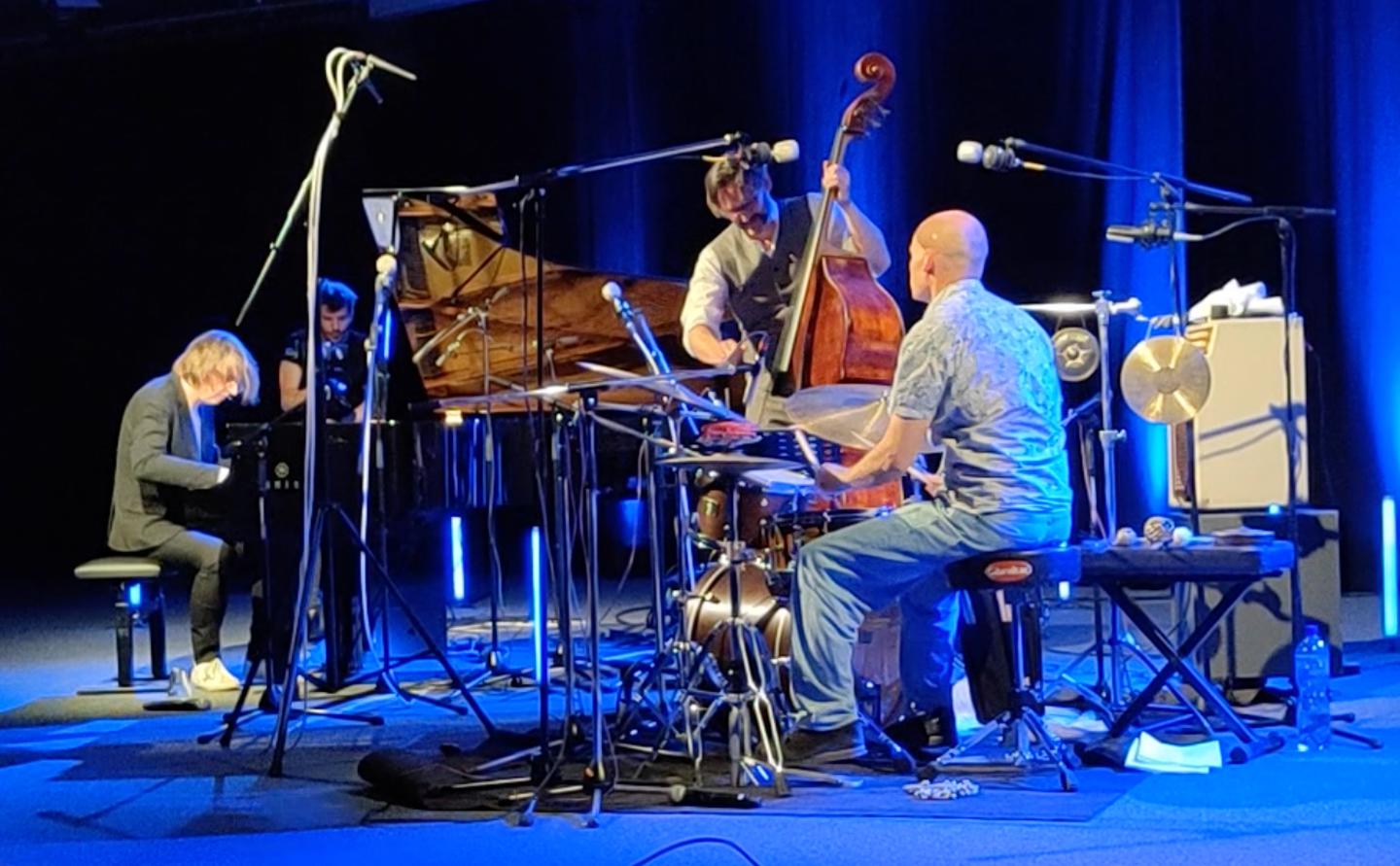
From exploring the nature of creativity to turning a building into an instrument, a unique collaboration between EPFL’s Digital and Cognitive Musicology Lab (DCML) and celebrated jazz pianist Michael Wollny aims to push the boundaries of music theory.

During an animated discussion of Wollny’s artistic residency in the office of DCML head Martin Rohrmeier, it is easy to forget whether the topic of discussion is art or science, but maybe there are fewer differences than we think. For both Rohrmeier and Wollny, their process – whether working on a research project or a jazz composition – starts with creative inspiration followed by problem-solving and mechanical busywork. Along the way, there are unforeseen events and ‘mistakes’…which nevertheless usually turn out to be very useful.

“After a while, you think that a certain path isn’t exciting enough to pursue, but this is dangerous because sometimes, you need to stay on an unexciting path to discover the unexpected,” says Wollny. “Other times, I can feel when it’s time to move on. But even then, the idea is not garbage; in fact, I think most of my pieces I created from the ‘garbage’ of other projects.”

As a scientist, Rohrmeier agrees. “I think a great metaphor can be found in nature: the compost in the garden or the fallen tree in the forest eventually decompose to become new fertile ground. You may hear the tree fall, but not the grass grow; most progress does not come with a bang.”

The Michael Wollny Trio in concert at EPFL on May 11th: Michael Wollny (piano) Christian Weber (bass) Eric Schaefer (drums) © Virginie Martin


“Creativity comes when you have constraints”

The opportunity to examine notions of creativity and intuition and their relation to scientific research was among Wollny’s motivations for accepting the DCML’s invitation as part of the CDH Artist-in-Residence program. As a jazz artist known for his curiosity and imagination, Wollny, who is also a professor at the Hochschule für Musik und Theater Leipzig, hopes that studying music theory with Rohrmeier will create fertile ground for improvisational creativity.

“Many musicians consciously avoid looking too closely at their work, but it’s important to push against boundaries,” he says. “As an improvising musician, being in this space where I don’t know what is going to happen next is sacred, because usually we have a program or an agenda. Paradoxically, looking at things more closely makes me free in the moment to not expect anything.”

Freedom and creativity often come when you have constraints; for example, if you restrict yourself to composing a piece using only four notes, that’s when you get ideas,” Rohrmeier adds.

From algorithms to architecture

As the DCML’s artist-in-residence, Wollny has already given a workshop and concert on the EPFL campus. Further concerts are planned in the coming year, as well as possible academic outputs like a research paper or symposium. Rohrmeier and Wollny notably plan to work together on the identification and characterization of contemporary music trends, like the reappearance of improvisation in connection with the European classical tradition.

“In the 19th century, improvisation was a very important part of classical music that is often forgotten; both Mozart and Chopin improvised parts of their concerts,” Rohrmeier explains. “This stopped at some point and classical pianists no longer produced their own music, but played only what was written on the page. Now, we’re seeing a reintegration of this tradition. We’d like to study this further to understand whether we are witnessing a new form of European contemporary music emerging.”

Another research angle that fascinates Wollny concerns the tools facilitating music creation, whether it’s a piano or a composition algorithm. He even has his sights set on a much larger instrument: the Romanesque chapel located near the EPFL campus in St Sulpice, where he hopes to organize a recording session during his residency.

“Nowadays, computers and algorithms are tools for composers. A tool might also be a piano or the room I play in; the light, reverberation, and acoustics. There are a lot of parameters that are important to any musician, and this church seems like it would be a very interesting instrument to play.”

This article was originally published on 30.05.2022 by Celia Luterbacher, EPFL.

The post When doing research is like playing jazz appeared first on dhCenter.

  •  

Job: Project scientist, Austrian Center for Digital Humanities and Cultural Heritage

The Austrian Centre for Digital Humanities and Cultural Heritage (ACDH-CH) at the Austrian Academy of Sciences is seeking a full-time project scientist for a 22-month contract starting in October 2022.

The successful candidate will work on the Austrian Science Fund project “Auden Musulin Papers: A Digital Edition of W.H. Auden’s Letters to Stella Musulin”.

Tasks
TEI/XML markup of transcripts

Transcription of (additional) edition documents

Historical and biographical research

Review and documentation of previous and ongoing research processes

Participation in project management and team meetings

Participation in conference organisation, preparation of edited volume, and outreach activities

Profile
Masters degree in a humanities subject

Advanced knowledge of TEI/XML

Excellent command of English

Accuracy and reliability; commitment to teamwork; excellent communication skills

Applications are due by June 15. View the full job description (PDF) for application details.

The post Job: Project scientist, Austrian Center for Digital Humanities and Cultural Heritage appeared first on dhCenter.

  •  

Innovative application helps students learn to write

EPFL startup School Rebound has developed a revolutionary application that uses artificial intelligence to help students improve their handwriting in a fun and personalized way. Nearly 15,000 students in Switzerland, France, and Italy are already putting it to work.

Handwriting problems affect nearly 25% of children aged 5 to 12. These problems, if not managed early on, can negatively impact them throughout their school years. EPFL startup School Rebound has provided a concrete solution to this problem by developing an application that uses tablets and artificial intelligence to better detect potential handwriting problems and support children as they learn. The subscription app is called Dynamilis, and can be used by all children learning to write – with difficulties or without – at home or at school. Dynamilis has already been downloaded more than 10,000 times and will be released soon in England and the United States.

While Dynamilis was free during its testing phase, it switched to a subscription model this past March. After a free trial week, parents, therapists, and schools are offered a monthly or annual subscription. Costs depend on the number of children using the application.

L. Boatto, A. Peguet, T. Asselborn, S. Viquerat, P. Dillenbourg © 2022 Dynamilis / Sven Viquerat

Strengths and weaknesses at a glance

School Rebound was founded in 2021 based on the research done by CEO Thibault Asselborn for his PhD thesis at EPFL’s Computer-Human Interaction in Learning and Instruction Laboratory (CHILI). “Some children have handwriting problems that may stay hidden for months. Because the problems are not obvious, parents and teachers may hesitate to consult specialists,” says Asselborn. “During this time, the students can accumulate learning difficulties as these handwriting problems monopolize their concentration and prevent them from developing other skills. This could cause students to lose confidence and develop significant educational blocks.”

As part of his PhD research, Asselborn helped develop an algorithm that can rapidly analyze a child’s handwriting. The child only has to write for 30 seconds on an iPad with an Apple Pencil for the application to establish their handwriting profile. “The tests we ran in the lab lasted about 20 minutes, but they didn’t take certain factors into account, which may reduce the accuracy of the analyses,” says Asselborn. Dynamilis evaluates dynamic aspects of handwriting that the human eye can’t see such as stability, pressure, speed, and angle. “Our app gives detailed analyses about the motor aspects of handwriting. This can give parents an initial indication before determining whether their child has difficulties with handwriting and, if so, to what degree. If the difficulties surpass a certain level, they’re recommended to go see a specialist.”

Learning dressed up like a game

Based on a child’s handwriting profile, the app recommends personalized activities to practice the fundamental aspects of handwriting – all while playing games. “The in-app tests don’t look like medical tests in the strictest sense,” says Asselborn. “It’s important to have an air of fun to avoid making children feel like they’re taking an exam, which can put them on edge.” The playful aspect during the testing phase is crucial for the School Rebound team and their Chairman, Pierre Dillenbourg, also head of CHILI. “While we were developing Dynamilis, our aim was to help children,” says Dillenbourg. “To do that, we knew we had to go beyond a simple handwriting-analysis program and give them activities to support learning and, for the more severe cases, correction. Games are an effective solution for children who are having problems in school because of their issues with handwriting.”

These activities, developed with game-design experts, can be done by children at home to help them improve their handwriting or at school for enhanced learning. For children with handwriting difficulties, the activities can be done with a therapist.

Close collaboration with therapists and schools

“We worked with nearly 50 therapists to develop our app and we received encouraging feedback,” says Dillenbourg. “The alacrity and precision of Dynamilis’ analyses lets them dedicate more time to children during their sessions.” Children may also use the app to continue practicing between sessions, concentrating on certain aspects (like pressure) which are difficult to practice on paper.

School Rebound teamed up with many schools to test the application on students. “We worked with schools in the Geneva, Vaud, and Neuchatel cantons as well as the Bern University of Teacher Education, the University of Applied Sciences and Arts of Southern Switzerland (SUPSI), and the International Schools of Lausanne and Geneva,” says Asselborn. The collaboration with Swiss schools is continuing as a pilot project in 12 Vaud canton schools. “We’ve gotten letters from teachers who’ve seen their students improve leaps and bounds,” he adds. “Some students even come before class to practice.”

Science and ethics council

School Rebound has created a science and ethics council composed of experts in dysgraphia, dyslexia, data science, and education. “Our scientific model and rigor are important, and are what set us apart from other existing applications,” says Dillenbourg. Dynamilis is not alone in its market, “but is the only application that combines a complete handwriting analysis with personalized learning activities.”

This article was originally published on 28.04.2022 by Leila Ueberschlag, EPFL.

The post Innovative application helps students learn to write appeared first on dhCenter.

  •