This discussion is about feminisms, Digital Humanities (DH), stacks, and
archives. We argue for Full Stack Feminism, as a methodological approach,
informed by the successes of previous feminist interventions in DH.
Het Research Software Lab (RSLab) en Florian Kunneman zoeken een student-assistent voor 4 uur per week om te helpen met onder andere het voorbereiden van experimenten en interviews en het testen van een spraakassistent.
Het RSLab ondersteunt onderzoekers door op maat gemaakte softwareoplossingen te ontwerpen. Voor een project waarin wordt onderzocht of een spraakassistent van waarde kan zijn voor mensen die moeite hebben met digitale processen zoeken wij een:
Student-assistent (gemiddeld 4 uur per week, van 1 november 2025 tot 1 februari 2026 met mogelijkheid tot verlenging)
Wat ga je doen?
In kaart brengen van de acties die nodig zijn om een tweetal digitale procedures te doorlopen (waterstand doorgeven en ov-reis plannen);
In kaart brengen van het design van de webinterfaces die gebruikt worden bij dergelijke procedures;
Uittesten van de spraakassistent;
Assisteren bij een pilot studie met de doelgroep, waarbij je de rol van de chatbot speelt;
Voorbereiden van interviewvragen;
Assisteren bij het experiment;
Nalopen van automatische transcripties van interviews;
Annoteren van interacties en interviews.
Wat heb je nodig?
Een inschrijving als student aan een Nederlandse universiteit gedurende de periode van de aanstelling;
Interesse in de combinatie van AI en communicatie;
Interesse in diverse aspecten van onderzoek (ontwikkeling van materiaal, ontwikkeling van meetinstrumenten, analyse);
Een zelfstandig, secuur en planmatig karakter.
Wat levert het op?
Je leert:
werken in een klein team;
eigen verantwoordelijkheid nemen;
ontdekken waar je zelf goed in bent;
methoden en valkuilen in experimenteel onderzoek;
de universiteit vanuit een andere hoek kennen.
Als student-assistent verdien je afgerond tussen de 290,- en 303,- euro bruto per maand als je 4 uur per week werkt (0,1 fte), afhankelijk van je tot nu toe behaalde studiepunten. De functie is in eerste instantie beschikbaar voor 3 maanden vanaf 1 november, met mogelijkheid tot verlenging.
Solliciteren?
Zie jij een functie als onderzoeksassistent als een waardevolle toevoeging aan je studie? Ligt de combinatie AI en communicatie jou, en ben je benieuwd hoe op maat gemaakte software onderzoek kan ondersteunen?
Stuur een email naar dr. Florian Kunneman (f.a.kunneman@uu.nl) met een korte motivatie en een CV voor 26 september.
If your research requires the development of advanced research software, and if you think the research community in general would benefit from that software, then this call is for you.
The Netherlands eScience Center supports researchers from all disciplines by creating tailor-made research software: digital tools that contribute to answering research questions by creating and/or analysing research data and research results.
This call for proposals supports research that has an urgent methodological research challenge: a concrete research problem that requires a digital solution in the form of a software tool (code, scripts, packages, libraries, programmes, etc).
On 4 September there is an online information event to inform interested applicants about the eScience Center and the specifics of this call.
The call is now open, and closes on 13 October at 14:00 hours.
As part of the UU city centre renovation project, the renovation of Janskerkhof 13/13a is due to start in 2026, its completion planned for 2029. ILS Labs are therefore in need of relocation. After careful consideration and examination of several buildings in the city centre, it has been decided that the Labs will be permanently relocated to Drift 10.
While we at the CDH regret that Drift 10 cohabitants Education Support and Student Affairs (OSZ) will need to move to Drift 15 to accommodate this change, we welcome the arrival of the ILS labs into closer proximity with other CDH teams. The relocation is an opportunity to update and future-proof the lay-out of the labs, as well as providing even more opportunities for collaboration between the different CDH teams.
The relocation process will take some time. There is construction work to be done to fortify the floors before the sound-proof booths can be installed: construction is expected to be finished in the first half of 2026. ILS labs will then begin moving gradually from early next year, with labs moving booth-by-booth, experiment-by-experiment. This ensures that currently running experiments can finish up over the next few years, while new experiments can start up in Drift 10.
‘Soe-gi-ta-geu-bu-ti-to-ba-meu…, for ten minutes now I have been listening to a robotic voice, droning on meaningless syllables without intonation or emotion.’
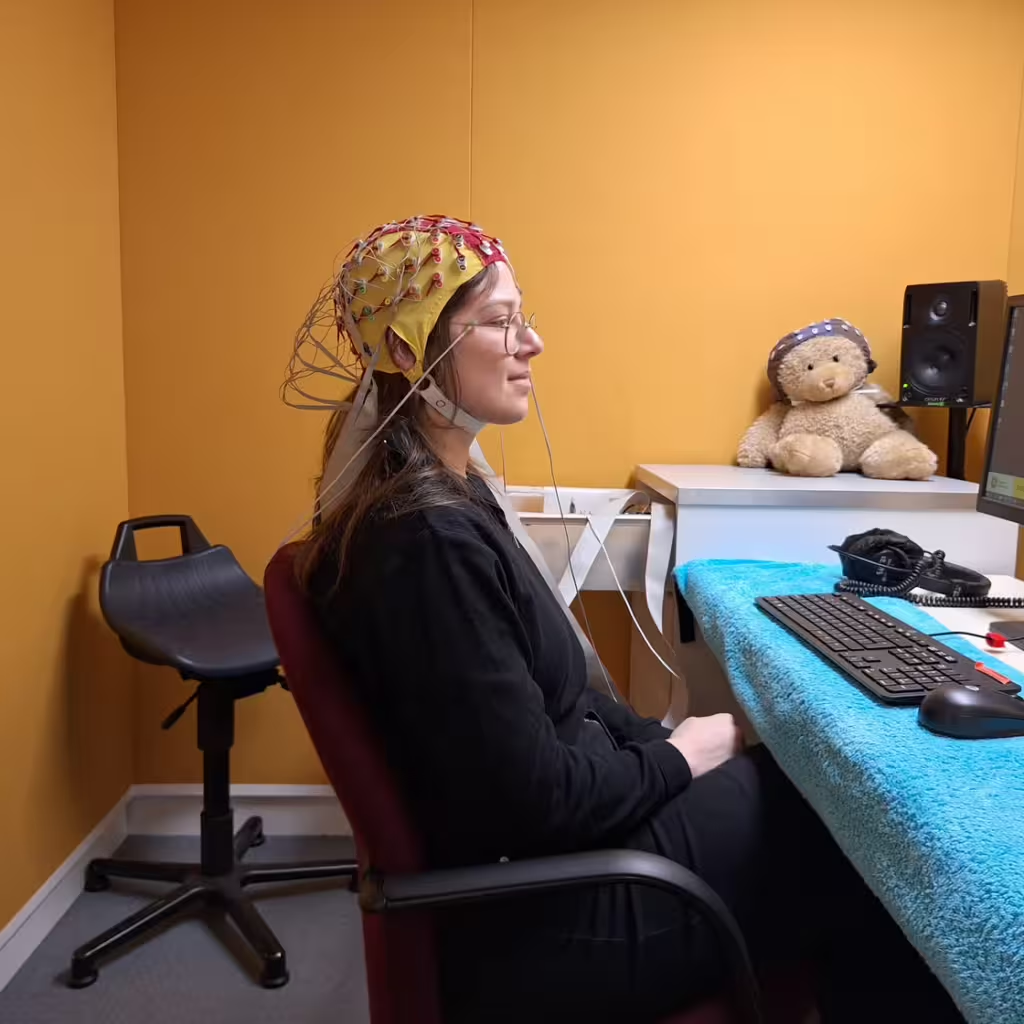
National Geographic reporter Myrthe Prins visited the Institute for Language Sciences (ILS) Labs, part of the Centre for Digital Humanities. Guided by PhD candidate and psycholinguistics researcher Iris van der Wulp, Prins participated in a series of experiments measuring her working memory, vocabulary, sense of rhythm, and ability to learn a non-existent language – all while wearing a EEG cap with dozens of electrodes to monitor her brainwave activity.
Curious whether the ILS Labs could support your research? Or, like Prins, would you like to contribute to science as a participant? Visit the ILS Labs website for more info.
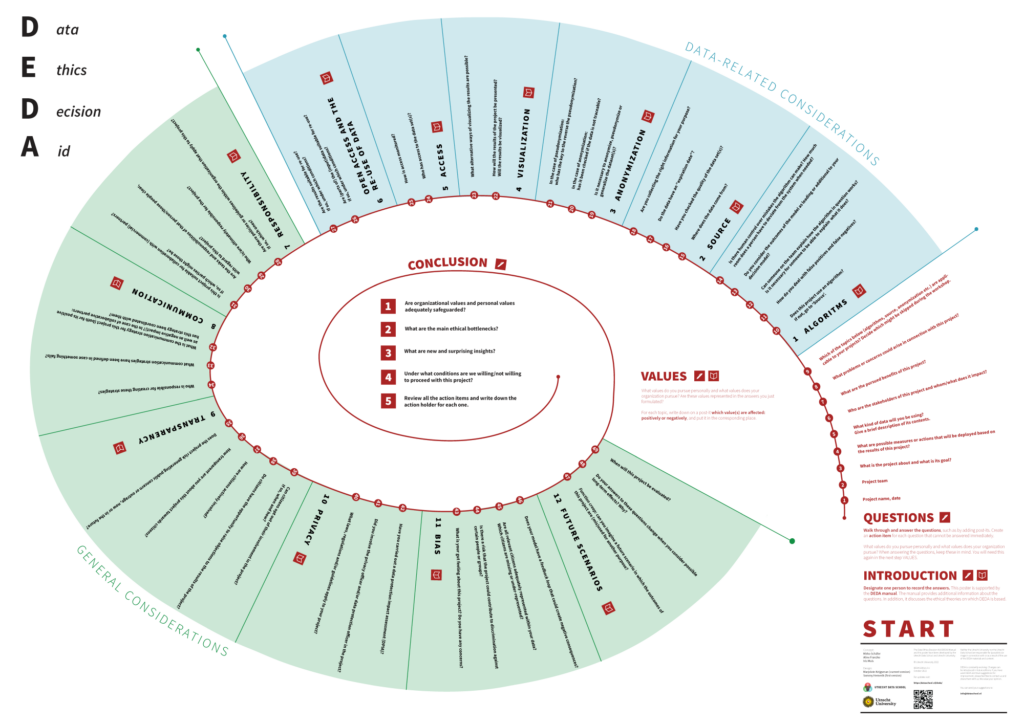
DPG Media and the Utrecht University Data School are jointly developing a ‘Data Ethics Decision Aid for Media (DEDA for Media)’. Starting in 2026, this analogue model will help media companies in recognizing and addressing ethical issues concerning digitalisation, data and AI projects. Development will be completed by the end of this year, after which DEDA for Media will be made accessible to the entire media sector.
When using DEDA, editors, data specialists, developers, legal experts and other stakeholders gather around a large, table-sized poster. Together, they work through an interconnected series of questions designed to prompt reflection on the ethical dimensions of their project. At the end of the session, the group assesses whether the previously defined values are sufficiently safeguarded. Based on this evaluation, they may decide not to proceed with a project, or to make adjustments – such as introducing more human oversight, or increasing transparency towards users on how a system operates and is applied.
With this collaboration, DPG Media underscores the importance of the responsible use of data and AI in a sector undergoing rapid technological transformation. “We are making major advances with AI and data, but in doing so, we encounter many ethical challenges, both in journalism and in our business operations,” says Philippe Remarque, Director of Journalism at DPG Media. “It is our societal responsibility as a publisher, and part of our ESG policy, to approach these with care. We need to ensure, together with all teams involved, that relevant questions are identified and addressed as part of the development process – not afterwards. That requires a professional framework, and this model provides exactly that.”
Researcher Karin van Es, associate professor and project lead for the Data School at UU, is excited about this valuable exchange between academic knowledge and practical experience: “DEDA is already widely used by Dutch and international government organisations. This new collaboration will enable the development of a version specifically tailored to the media industry and its particular use of data and AI.” According to Van Es, explainability and due diligence are essential in working with data and AI: “DEDA helps make the inherent complexity of these technologies more manageable. By documenting the decision-making process, the tool also provides a framework for accountability towards various stake-holders, both inside and outside of an organisation.
DPG Media will not only contribute financially to the development of DEDA for Media, but will also provide expertise and real-world cases to thoroughly test the tool. To this end, stakeholders will be asked to actively contribute to the model’s development by sharing relevant questions, datasets, and use cases.. Once development is completed at the end of this year, DEDA for Media will be made available to the entire media sector.
This article was originally published here at DPG Media (in Dutch).
Utrecht University’s Data School will host its first international DEDA seminar on September 25th, 2024. The deadline for submission is May 31st.
The Data Ethics Decision Aid (DEDA), a toolkit developed by the Data School, maps ethical issues in data projects. It documents the deliberation process and stimulates accountability towards the various stakeholders and the public.
This seminar will bring together researchers, educators and practitioners utilizing DEDA for participatory observation, teaching, or developing value-sensitive design. The seminar is primarily focused on evaluating, exploring and advancing the use of DEDA in academic research and teaching contexts. Aspiring DEDA users are also very much welcome.
During the seminar there will be three rounds of expertise workshops:
Societal impact: Stakeholder engagement with DEDA
Research methods: Participatory observation with DEDA
Education: Teaching data ethics for students and professionals with DEDA
If you work with DEDA or plan to work with it, the Data School would like to hear from you. Your experiences, pitfalls, opportunities, practices, insights and results are invaluable to the advancement of DEDA.
PLoS One. 2015 Feb 12;10(2):e0115035. doi: 10.1371/journal.pone.0115035. eCollection 2015.
ABSTRACT
In this paper we compare two academic networking platforms, HASTAC and Hypotheses, to show the distinct ways in which they serve specific communities in the Digital Humanities (DH) in different national and disciplinary contexts. After providing background information on both platforms, we apply co-word analysis and topic modeling to show thematic similarities and differences between the two sites, focusing particularly on how they frame DH as a new paradigm in humanities research. We encounter a much higher ratio of posts using humanities-related terms compared to their digital counterparts, suggesting a one-way dependency of digital humanities-related terms on the corresponding unprefixed labels. The results also show that the terms digital archive, digital literacy, and digital pedagogy are relatively independent from the respective unprefixed terms, and that digital publishing, digital libraries, and digital media show considerable cross-pollination between the specialization and the general noun. The topic modeling reproduces these findings and reveals further differences between the two platforms. Our findings also indicate local differences in how the emerging field of DH is conceptualized and show dynamic topical shifts inside these respective contexts.
This study sets out to examine the possibility of using African languages as media of teaching and learning in South African schools. Literature is consistent that (a) language is a crucial means of communication and gaining access to important knowledge and skills, and (b) mother tongue is the only language that promotes effective teaching and learning and that any language, which is not a mother tongue, is a barrier to teaching and learning. In South Africa, there are nine African official languages, but English is the media of instruction used by South African learners, which is a barrier to teaching and learning. This study revealed that using one or two African languages may improve teaching, learning, and the academic performance of the learners, but the problem is how to implement because it will be difficult to use many African languages as media of instruction. The use of nine African languages as media of instruction in South Africa will promote tribalism, which was dominant during the apartheid era, and it will be costly to the government. Therefore, this study supports the use of English as a media of instruction because it will promote unity in South Africa, it will not be costly, and it is an international language.
This article reflects a rich array of perspectives on tools criticism, arguing
that we need tools and methods as a basic common ground on how to carry out
fundamental operations of analysis and interpretation within a community.

 登录
登录