阅读视图

Pracovní pozice: 2x postdoktorand/ka v oblasti DH (Masarykova univerzita)

V rámci projektu GAČR Junior Star Socio-Spatial Situatedness of Roman Professions and its Impact on Religion in the Roman Empire: A Formal Modeling Approach se vypisují dvě výběrová řízení pro pozici postdoc (FTE 0.7), jedna pro experta či expertku na geografii, druhá pro experta či expertku na matematiku/statistiku/datovou analýzu. Projekt je afiliován k Centru pro digitální výzkum náboženství na Masarykově univerzitě. Níže naleznete abstrakt projektu a odkazy na výběrová řízení.

Pozice Geografie: https://www.phil.muni.cz/kariera/volna-pracovni-mista/80212

Pozice Matematika: https://www.phil.muni.cz/kariera/volna-pracovni-mista/80213

Příjem přihlášek trvá do 31. ledna 2026.

O projektu:

The SIPROME project will investigate how uncertainties, risks, and variabilities associated with working environments in the Roman Empire impacted the worship strategies of people of profession. By means of formal modeling using a wide array of archaeological and epigraphic data, the project will analyze how and to what extent the exceptionally specialized division of labor in the Roman Empire contributed to the socio-spatial distribution of Roman cults. This mathematical approach, using tools such as spatial proximity analysis, quantitative textual analysis, and predictive modeling, has the significant potential to disentangle the complex interplay between the strongly stratified Roman society, the highly variable physical world it inhabited, and the diverse religious answers that it prompted. SIPROME bridges the gap between the debates on Roman religion and professions that have largely developed independently and it contributes to a major societal topic of risk mitigation strategies from a unique standpoint.

  •  

VII Encuentro de Humanistas Digitales: una comunidad en expansión

VII Encuentro de Humanistas Digitales: una comunidad en expansión

El VII Encuentro de Humanistas Digitales reunió a una amplia comunidad de especialistas, investigadores, docentes, desarrolladores y estudiantes interesados en explorar las intersecciones entre la tecnología, las humanidades y las ciencias sociales...

Continue reading VII Encuentro de Humanistas Digitales: una comunidad en expansión at Red de Humanidades Digitales.

  •  

Ampliado el plazo para el envío de propuestas para el VII Congreso Internacional de la HDH 2025

Ampliado el plazo para el envío de propuestas para el VII Congreso Internacional de la HDH 2025

📍 Universitat de València
📅 22-24 de octubre de 2025
🎯 Tema: «Ad cognoscendum, agendum vel operandum»: compromiso cívico y social de las Humanidades Digitales

La CLO del HDH 2025 ha ampliado el plazo para el envío de contribuciones del 5 de mayo al 31 de mayo.

La Sociedad Internacional de Humanidades Digitales Hispánicas (HDH) anuncia la apertura de la convocatoria de propuestas para su VII Congreso Internacional, que se celebrará en la Universitat de València del 22 al 24 de octubre de 2025. Bajo el lema «Ad cognoscendum, agendum vel operandum»: compromiso cívico y social de las Humanidades Digitales, el congreso explorará el papel transformador de las tecnologías digitales en el ámbito de las humanidades y la sociedad.

El evento, organizado por los departamentos de Filología Española, Filología Inglesa y Alemana, e Historia del Arte de la Universitat de València, contará con el apoyo del Vicerrectorado de Cultura y Sociedad. Inspirado en el pensamiento de Joan Lluís Vives, el congreso busca fomentar el diálogo entre humanidades y tecnología, promoviendo la acción y la creación en el ámbito digital.

Áreas temáticas

Las contribuciones podrán enmarcarse en las siguientes áreas temáticas:

  • Conservación y digitalización: digitalización de archivos, bibliotecas y museos, preservación digital, cartografiado 3D del patrimonio, etc.
  • Análisis y visualización de datos en humanidades: Big Data, minería de datos, PLN, humanidades geoespaciales, etc.
  • Interactividad y nuevos medios: ediciones digitales, arte digital, modelado 3D, web semántica, etc.
  • Estudios críticos y socioculturales: cultura y redes sociales, análisis del discurso, ética de la IA, etc.
  • Música, teatro y otras artes: musicología digital, coreografía digital, transmedia, videojuegos, etc.

Tipos de contribuciones

El congreso admite dos formatos de participación:

  • Comunicaciones (20 minutos) con resúmenes de entre 1500 y 1700 palabras.
  • Pósteres científicos, con resúmenes de entre 500 y 700 palabras.

Las contribuciones aceptadas serán publicadas en acceso abierto en la web del congreso y podrán optar a publicación en revistas académicas o volúmenes colectivos.

Fechas clave

  • Apertura de recepción de contribuciones: 27 de enero de 2025
  • Cierre de recepción de contribuciones: 31 de mayo de 2025
  • Notificación de aceptación: 15 de junio de 2025
  • Apertura de inscripciones: 30 de junio de 2025
  • Cierre de inscripciones: 22 de septiembre de 2025
  • Celebración del congreso: 22-24 de octubre de 2025

📢 Más información y envío de propuestas: https://hdh2025.uv.es/

La entrada Ampliado el plazo para el envío de propuestas para el VII Congreso Internacional de la HDH 2025 se publicó primero en HDH - Humanidades Digitales Hispánicas.

  •  

Abierta la convocatoria de propuestas para el VII Congreso Internacional de la HDH 2025

Abierta la convocatoria de propuestas para el VII Congreso Internacional de la HDH 2025

📍 Universitat de València
📅 22-24 de octubre de 2025
🎯 Tema: «Ad cognoscendum, agendum vel operandum»: compromiso cívico y social de las Humanidades Digitales

La Sociedad Internacional de Humanidades Digitales Hispánicas (HDH) anuncia la apertura de la convocatoria de propuestas para su VII Congreso Internacional, que se celebrará en la Universitat de València del 22 al 24 de octubre de 2025. Bajo el lema «Ad cognoscendum, agendum vel operandum»: compromiso cívico y social de las Humanidades Digitales, el congreso explorará el papel transformador de las tecnologías digitales en el ámbito de las humanidades y la sociedad.

El evento, organizado por los departamentos de Filología Española, Filología Inglesa y Alemana, e Historia del Arte de la Universitat de València, contará con el apoyo del Vicerrectorado de Cultura y Sociedad. Inspirado en el pensamiento de Joan Lluís Vives, el congreso busca fomentar el diálogo entre humanidades y tecnología, promoviendo la acción y la creación en el ámbito digital.

Áreas temáticas

Las contribuciones podrán enmarcarse en las siguientes áreas temáticas:

  • Conservación y digitalización: digitalización de archivos, bibliotecas y museos, preservación digital, cartografiado 3D del patrimonio, etc.
  • Análisis y visualización de datos en humanidades: Big Data, minería de datos, PLN, humanidades geoespaciales, etc.
  • Interactividad y nuevos medios: ediciones digitales, arte digital, modelado 3D, web semántica, etc.
  • Estudios críticos y socioculturales: cultura y redes sociales, análisis del discurso, ética de la IA, etc.
  • Música, teatro y otras artes: musicología digital, coreografía digital, transmedia, videojuegos, etc.

Tipos de contribuciones

El congreso admite dos formatos de participación:

  • Comunicaciones (20 minutos) con resúmenes de entre 1500 y 1700 palabras.
  • Pósteres científicos, con resúmenes de entre 500 y 700 palabras.

Las contribuciones aceptadas serán publicadas en acceso abierto en la web del congreso y podrán optar a publicación en revistas académicas o volúmenes colectivos.

Fechas clave

  • Apertura de recepción de contribuciones: 27 de enero de 2025
  • Cierre de recepción de contribuciones: 31 de mayo de 2025
  • Notificación de aceptación: 15 de junio de 2025
  • Apertura de inscripciones: 30 de junio de 2025
  • Cierre de inscripciones: 22 de septiembre de 2025
  • Celebración del congreso: 22-24 de octubre de 2025

📢 Más información y envío de propuestas: https://hdh2025.uv.es/

  •  

Pracovní příležitosti v DH – Ústav pro českou literaturu AV ČR, v. v. i.

Ústav pro českou literaturu AV ČR vypisuje konkurs na následující pozice
ve výzkumné infrastruktuře Česká literární bibliografie:

– datový specialista
– výzkumník v oblasti digital humanities

Uzávěrka pro podání přihlášek je 5. května 2019, další podrobnosti v naleznete v příloze.

  •  

Clôture du dhCenter UNIL-EPFL / Closing of the UNIL-EPFL dhCenter

La Direction académique du dhCenter UNIL-EPFL et toute son équipe ont le regret de vous annoncer que le Centre a cessé ses activités le 31 décembre 2022.

Le dhCenter a été créé pour soutenir et développer le domaine des humanités numériques en s’ouvrant à l’ensemble du campus UNIL-EPFL. Depuis son lancement le 1er février 2018 et grâce à vous, il a eu à cœur de promouvoir l’interdisciplinarité et l’innovation dans la recherche et l’enseignement en humanités numériques.

Entre 2018 et 2022, le dhCenter a ainsi participé à l’organisation et au financement de plus de 17 événements scientifiques, dont les dhDays. Initiateur de multiples rencontres informelles au sein de nos communautés, producteur de contenu (dont deux séries de capsules vidéo), le dhCenter aura également fait rayonner ses activités et les vôtres bien au-delà de nos deux campus au travers de sa newsletter mensuelle. Autant de résultats salués par l’évaluation externe du dhCenter UNIL-EPFL.

Dans l’attente d’une transition vers une autre plateforme institutionnelle et d’autres annonces y relatives, le site https://dhcenter-unil-epfl.ch/ restera en ligne jusqu’en avril 2024.

Merci à chacun·e pour votre participation aux activités du dhCenter et longue vie aux humanités numériques sur nos deux campus !

Isaac Pante & Karl Aberer
Directeurs académiques & Directeurs exécutifs suppléants
dhCenter UNIL-EPFL

////

The Academic Direction of the dhCenter UNIL-EPFL and its team regret to announce that the Center has ceased its activities on December 31, 2022.

The dhCenter was created to support and develop the field of digital humanities by opening up to the entire UNIL-EPFL campus. Since its launch on February 1, 2018 and thanks to you, it has been committed to promoting interdisciplinarity and innovation in digital humanities research and teaching.

Between 2018 and 2022, the dhCenter has thus participated in the organization and funding of more than 17 scientific events, including the dhDays. The dhCenter has also initiated many informal meetings within our communities and produced content (including two series of video capsules). It has also made its activities and yours known well beyond our two campuses through its monthly newsletter. All of these results were praised by the external evaluation of the dhCenter UNIL-EPFL.

While waiting for a transition to another institutional platform and other related announcements, the https://dhcenter-unil-epfl.ch/ website will remain online until April 2024.

Thank you to everyone for your participation in the dhCenter activities and long live the digital humanities on our two campuses!

Isaac Pante & Karl Aberer
Academic Directors & Deputy Executive Directors
dhCenter UNIL-EPFL


The post Clôture du dhCenter UNIL-EPFL / Closing of the UNIL-EPFL dhCenter appeared first on dhCenter.

  •  

Digital Humanities Certificate Workshops

作者achampag

Spring 2024

The Doctoral Certificate Program in Digital Humanities offers an opportunity to currently enrolled Ph.D. students interested in adding expertise in digital methodologies and techniques to their research portfolio.

The following Spring 2024 workshops count towards the Digital Humanities Doctoral Certificate Program. Please get in touch with Ashley Champagne, Director of the Center for Digital Scholarship, if you’re interested in enrolling in the certificate program: ashley_champagne@brown.edu

A brief description of the workshops is offered below. For more information (including Zoom links), please click the “Register here” link. 

JANUARY

January 30 

12-1pm on Zoom: Writing Data Management and Sharing Plans for a Grant Using the DMPTool

This workshop provides an overview of the DMPTool and recommendations and resources for drafting a data management and sharing plan for sponsored research. 

Instructor: Andrew Creamer

Register here

4:00 pm on Zoom: Copyright and Image Use 

This class will focus on the use of copyrighted images in an academic setting, including teaching, presentations, and publication. We will also discuss how to locate Creative Commons and public domain images and how to obtain permission to publish. Attention will be paid to such topics as dissertations and image use, how to track down copyright owners, and how to make judgment calls based on the principle of fair use.

Instructor: Karen Bouchard

Register here

FEBRUARY

February 13 

4 pm on Zoom:  Copyright and Image Use 

This class will focus on the use of copyrighted images in an academic setting, including teaching, presentations, and publication. We will also discuss how to locate Creative Commons and public domain images and how to obtain permission to publish. Attention will be paid to such topics as dissertations and image use, how to track down copyright owners, and how to make judgment calls based on the principle of fair use.

Instructor: Karen Bouchard

Register here 

February 16

12-1 pm on Zoom: Introduction to the FAIR Principles and Recommended Practices and Resources for Managing Research Data

This workshop provides an overview of the FAIR Principles and recommendation and resources for data management, including trips for selecting file formats, storing and backing up data, documenting data for discovery, interpretation, and reuse, and depositing data in repositories for long-term access.

Instructor: Andrew Creamer 

Register here

February 24

10:15-5 pm: Introduction to GIS with QGIS

This day-long, hands-on workshop provides a thorough introduction to geographic information systems (GIS) using the free and open source software QGIS. You will learn how to navigate a GIS interface, perform geographic analyses, and create thematic maps. Participants must bring a laptop and install the software prior to the workshop day. For more details visit: https://libguides.brown.edu/gis_data_tutorials/intro_qgis

Instructor: Frank Donnelly

Register here

February 29

12-1 pm on Zoom: Writing Data Management and Sharing Plans for a Grant Using the DMPTool

This workshop provides an overview of the DMPTool and recommendations and resources for drafting a data management and sharing plan for sponsored research.

Instructor: Andrew Creamer

Register here

12:30-2pm on Zoom: HTML Basics for Non-Coders

This workshop will introduce those without a programming background to what HTML is and some basic fundamentals, with hands-on exercises and a cheatsheet for reference afterwards. You will be able to apply what you learn to use HTML in platforms like Scalar and Canvas. This workshop will be offered ONLINE ONLY.

Instructors: Elizabeth Yalkut and Tarika Sankar 

Register here 

MARCH

March 1

12:00 pm on Zoom: Copyright and Image Use 

This class will focus on the use of copyrighted images in an academic setting, including teaching, presentations, and publication. We will also discuss how to locate Creative Commons and public domain images and how to obtain permission to publish. Attention will be paid to such topics as dissertations and image use, how to track down copyright owners, and how to make judgment calls based on the principle of fair use.

Instructor: Karen Bouchard

Register here

March 6

10-11 am on Zoom: Welcoming Your Audience: Designing for Accessibility

From universal design principles to customizing user experience, this workshop will cover important considerations to make when designing for accessibility on digital sites and projects. There will be hands-on activities and guidelines for participants to test out accessible designs practices and theories. The event is sponsored by the Center for Digital Scholarship at the Brown University Library. 

Instructors: Elizabeth Yalkut and Khanh Vo

Register here 

2-3 pm in person: Recording, editing, and publishing podcasts

Digital Scholarship Studio, Rockefeller Library

Come to the library’s digital studio to get an introduction to recording, editing, and publishing a podcast in the library’s own recording room (which you are free to book for your own projects). It’s not hard to get started, and in 90 minutes we’ll get you up and running, even if (ESPECIALLY if) you are a complete beginner. The event is sponsored by the Center for Digital Scholarship at the Brown University Library. 

Instructor: Patrick Rashleigh

Register here 

March 8

12-1 pm in person: Creating Oral Histories with TheirStory

Digital Scholarship Lab, room 137, Rockefeller Library

An introduction to conducting, recording and transcribing oral history interviews using the platform TheirStory. This workshop will be offered IN-PERSON only.

Instructor: Tarika Sankar

Register here 

March 13

4-5:30 pm hybrid: Critical AI and Teaching

Zoom and Digital Scholarship Lab https://brown.zoom.us/j/99210630759

This workshop will explore how ChatGPT may be used in the classroom. We will discuss the capabilities of AI tools for research and teaching, how prompt engineering might be leveraged to fine-tune and interrogate results, and examine the critical questions about scholarship that will emerge from using AI.

Instructors: Khanh Vo, Naimh McGuigan

Register here 

March 20

4-5 pm on Zoom: For beginner programmers: using ChatGPT to code Python

Among many things, ChatGPT can generate Python code from plain-English prompts. This is a game-changer for those of us are just starting out in programming. But of course, there are caveats—many, many caveats. Come by for a deep dive into the promises and pitfalls of using A.I. as a programming partner and teacher. This workshop is open to all and counts towards the Digital Humanities Doctoral Certificate

Instructor: Patrick Rashleigh

Register here 

APRIL 

April 4

12-1 on Zoom: Introduction to Wikidata

The Introduction to Wikidata workshop will offer attendees an opportunity to learn about Wikidata—an open platform of structured linked data. This crowdsourced, language-independent knowledge base, stores a wide range of subjects and releases its data under an open license allowing their reuse. The low barrier for interacting with the Wikidata platform makes it a great candidate for linked open data (LOD) representation and facilitates collaboration from the global community of users. This session will provide an overview of Wikidata and its structure as well as a hands-on activity to learn how to edit the knowledge base.

Instructor: Mairelys Lemus-Rojas

Register here.

April 16

2-3:30 on Zoom: Introduction to Digital Archiving 

This workshop will provide an introduction to some options for creating a digital archive, such as Omeka S, Collection Builder, and Wax. We will discuss considerations for choosing the right platform for your project, advantages and disadvantages of each platform, and questions of metadata, audience, and sustainability.This workshop will be held in-person in the Digital Scholarship Lab (room 137) in the Rockefeller Library or on Zoom. 

Instructors: Tarika Sankar and Khanh Vo

Register here 

  •  

Modernist Journals Project

Modernist Journals Project

A digital research collection focusing on Modernist journals and magazines, together with essays, introductions, and biographical sketches.

The Modernist Journals Project publishes fully searchable online editions of the English-language journals and magazines that were important in shaping the modes of literature and art that came to be called “modernist”. Focusing on materials from 1890-1922, this collection is a crucial research tool and point of access to these often rare materials. First begun in 1995 at Brown University, the project is now supported at Brown and the University of Tulsa. The growing collection of materials now includes The New Age, Blast, Poetry, and The English Review, together with supporting materials such as essays on contributors, historical introductions, and biographical sketches.

STG worked with the MJP staff to develop encoding and metadata specifications for the digitized source materials, and in 2006 contributed to the design and implementation of a new user interface. CDS provides ongoing support for the project’s data and publication infrastructure.

The CDI worked with the MJP staff to digitize all the periodicals and to develop metadata specifications. All MJP journals are stored in Brown’s digital repository, and accessed from there by the MJP website.

In 2009, the MJP infrastructure was rewritten by the CDI to take advantage of the SOLR indexing engine, in order to increase efficiency. CDS provides ongoing consulting to the MJP as needed.

Modernist Journals Project is a project of Modern Culture and Media

Contributors to this project include Clifford Wulfman (STG), Mark Gaipa (Project Manager), Andrew Ashton (CDS), Patrick Yott (CDS), Michael Park (CDS), Robert Scholes (Faculty lead), Ann Caldwell (CDS), Elli Mylonas (CDS), Kerri Hicks (STG)

Funding for this project came from NEH

  •  

(Jennifer) HerbUX

HerbUX

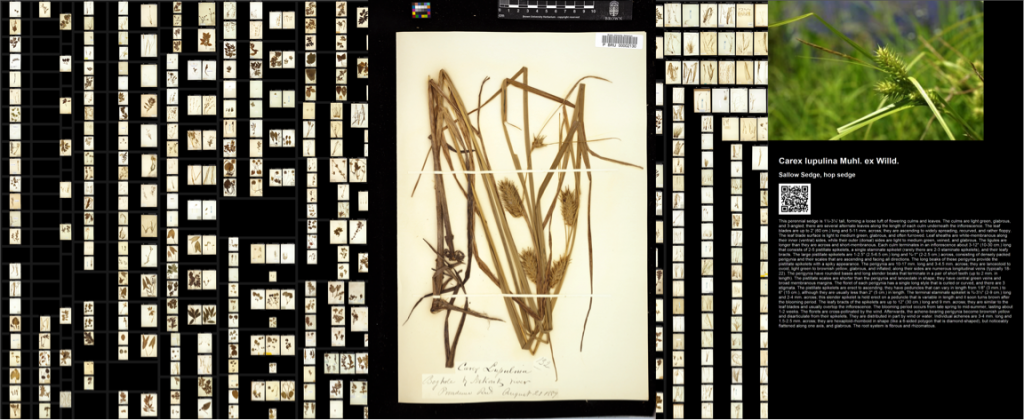
While Herbarium (plant specimen archive) collections have increasingly been digitized and made available online, digitized herbarium collections remain somewhat inaccessible to large portions of the population—in large part because the interfaces to these collections assume the user has specialized knowledge of plants, knows what they are looking for, and is deeply engaged.

Building on previous experimental interface work, the Herbarium User Experience project (HerbUX) seeks to address this problem by generating a user study / needs document by talking to herbarium stakeholders (undergraduate science educators, herbarium staff, and museum professionals), and generating interface proposals based on the findings of the user study.

HerbUX is a collaboration between CDS, the Brown University Herbarium, and the University of Minnesota’s Bell Museum, and is generously funded by a grant from the Institute of Museum and Library Services (IMLS).

Contributors to this project include Patrick Rashleigh (PI, CDS Lead), Rebecca Kartzinel(Co-PI, Herbarium Faculty Co-Director), Tim Whitfeld (Bell Museum Herbarium Collections Manager)

  •