阅读视图
Graduate Student Reflections: AHA Presentations
Clôture du dhCenter UNIL-EPFL / Closing of the UNIL-EPFL dhCenter
La Direction académique du dhCenter UNIL-EPFL et toute son équipe ont le regret de vous annoncer que le Centre a cessé ses activités le 31 décembre 2022.
Le dhCenter a été créé pour soutenir et développer le domaine des humanités numériques en s’ouvrant à l’ensemble du campus UNIL-EPFL. Depuis son lancement le 1er février 2018 et grâce à vous, il a eu à cœur de promouvoir l’interdisciplinarité et l’innovation dans la recherche et l’enseignement en humanités numériques.
Entre 2018 et 2022, le dhCenter a ainsi participé à l’organisation et au financement de plus de 17 événements scientifiques, dont les dhDays. Initiateur de multiples rencontres informelles au sein de nos communautés, producteur de contenu (dont deux séries de capsules vidéo), le dhCenter aura également fait rayonner ses activités et les vôtres bien au-delà de nos deux campus au travers de sa newsletter mensuelle. Autant de résultats salués par l’évaluation externe du dhCenter UNIL-EPFL.
Dans l’attente d’une transition vers une autre plateforme institutionnelle et d’autres annonces y relatives, le site https://dhcenter-unil-epfl.ch/ restera en ligne jusqu’en avril 2024.
Merci à chacun·e pour votre participation aux activités du dhCenter et longue vie aux humanités numériques sur nos deux campus !
Isaac Pante & Karl Aberer
Directeurs académiques & Directeurs exécutifs suppléants
dhCenter UNIL-EPFL
////
The Academic Direction of the dhCenter UNIL-EPFL and its team regret to announce that the Center has ceased its activities on December 31, 2022.
The dhCenter was created to support and develop the field of digital humanities by opening up to the entire UNIL-EPFL campus. Since its launch on February 1, 2018 and thanks to you, it has been committed to promoting interdisciplinarity and innovation in digital humanities research and teaching.
Between 2018 and 2022, the dhCenter has thus participated in the organization and funding of more than 17 scientific events, including the dhDays. The dhCenter has also initiated many informal meetings within our communities and produced content (including two series of video capsules). It has also made its activities and yours known well beyond our two campuses through its monthly newsletter. All of these results were praised by the external evaluation of the dhCenter UNIL-EPFL.
While waiting for a transition to another institutional platform and other related announcements, the https://dhcenter-unil-epfl.ch/ website will remain online until April 2024.
Thank you to everyone for your participation in the dhCenter activities and long live the digital humanities on our two campuses!
Isaac Pante & Karl Aberer
Academic Directors & Deputy Executive Directors
dhCenter UNIL-EPFL
The post Clôture du dhCenter UNIL-EPFL / Closing of the UNIL-EPFL dhCenter appeared first on dhCenter.
Digital Humanities Certificate Workshops
Spring 2024
The Doctoral Certificate Program in Digital Humanities offers an opportunity to currently enrolled Ph.D. students interested in adding expertise in digital methodologies and techniques to their research portfolio.
The following Spring 2024 workshops count towards the Digital Humanities Doctoral Certificate Program. Please get in touch with Ashley Champagne, Director of the Center for Digital Scholarship, if you’re interested in enrolling in the certificate program: ashley_champagne@brown.edu.
A brief description of the workshops is offered below. For more information (including Zoom links), please click the “Register here” link.
JANUARY
January 30
12-1pm on Zoom: Writing Data Management and Sharing Plans for a Grant Using the DMPTool
This workshop provides an overview of the DMPTool and recommendations and resources for drafting a data management and sharing plan for sponsored research.
Instructor: Andrew Creamer
4:00 pm on Zoom: Copyright and Image Use
This class will focus on the use of copyrighted images in an academic setting, including teaching, presentations, and publication. We will also discuss how to locate Creative Commons and public domain images and how to obtain permission to publish. Attention will be paid to such topics as dissertations and image use, how to track down copyright owners, and how to make judgment calls based on the principle of fair use.
Instructor: Karen Bouchard
FEBRUARY
February 13
4 pm on Zoom: Copyright and Image Use
This class will focus on the use of copyrighted images in an academic setting, including teaching, presentations, and publication. We will also discuss how to locate Creative Commons and public domain images and how to obtain permission to publish. Attention will be paid to such topics as dissertations and image use, how to track down copyright owners, and how to make judgment calls based on the principle of fair use.
Instructor: Karen Bouchard
February 16
12-1 pm on Zoom: Introduction to the FAIR Principles and Recommended Practices and Resources for Managing Research Data
This workshop provides an overview of the FAIR Principles and recommendation and resources for data management, including trips for selecting file formats, storing and backing up data, documenting data for discovery, interpretation, and reuse, and depositing data in repositories for long-term access.
Instructor: Andrew Creamer
February 24
10:15-5 pm: Introduction to GIS with QGIS
This day-long, hands-on workshop provides a thorough introduction to geographic information systems (GIS) using the free and open source software QGIS. You will learn how to navigate a GIS interface, perform geographic analyses, and create thematic maps. Participants must bring a laptop and install the software prior to the workshop day. For more details visit: https://libguides.brown.edu/gis_data_tutorials/intro_qgis
Instructor: Frank Donnelly
February 29
12-1 pm on Zoom: Writing Data Management and Sharing Plans for a Grant Using the DMPTool
This workshop provides an overview of the DMPTool and recommendations and resources for drafting a data management and sharing plan for sponsored research.
Instructor: Andrew Creamer
12:30-2pm on Zoom: HTML Basics for Non-Coders
This workshop will introduce those without a programming background to what HTML is and some basic fundamentals, with hands-on exercises and a cheatsheet for reference afterwards. You will be able to apply what you learn to use HTML in platforms like Scalar and Canvas. This workshop will be offered ONLINE ONLY.
Instructors: Elizabeth Yalkut and Tarika Sankar
MARCH
March 1
12:00 pm on Zoom: Copyright and Image Use
This class will focus on the use of copyrighted images in an academic setting, including teaching, presentations, and publication. We will also discuss how to locate Creative Commons and public domain images and how to obtain permission to publish. Attention will be paid to such topics as dissertations and image use, how to track down copyright owners, and how to make judgment calls based on the principle of fair use.
Instructor: Karen Bouchard
March 6
10-11 am on Zoom: Welcoming Your Audience: Designing for Accessibility
From universal design principles to customizing user experience, this workshop will cover important considerations to make when designing for accessibility on digital sites and projects. There will be hands-on activities and guidelines for participants to test out accessible designs practices and theories. The event is sponsored by the Center for Digital Scholarship at the Brown University Library.
Instructors: Elizabeth Yalkut and Khanh Vo
2-3 pm in person: Recording, editing, and publishing podcasts
Digital Scholarship Studio, Rockefeller Library
Come to the library’s digital studio to get an introduction to recording, editing, and publishing a podcast in the library’s own recording room (which you are free to book for your own projects). It’s not hard to get started, and in 90 minutes we’ll get you up and running, even if (ESPECIALLY if) you are a complete beginner. The event is sponsored by the Center for Digital Scholarship at the Brown University Library.
Instructor: Patrick Rashleigh
March 8
12-1 pm in person: Creating Oral Histories with TheirStory
Digital Scholarship Lab, room 137, Rockefeller Library
An introduction to conducting, recording and transcribing oral history interviews using the platform TheirStory. This workshop will be offered IN-PERSON only.
Instructor: Tarika Sankar
Register here
March 13
4-5:30 pm hybrid: Critical AI and Teaching
Zoom and Digital Scholarship Lab https://brown.zoom.us/j/99210630759
This workshop will explore how ChatGPT may be used in the classroom. We will discuss the capabilities of AI tools for research and teaching, how prompt engineering might be leveraged to fine-tune and interrogate results, and examine the critical questions about scholarship that will emerge from using AI.
Instructors: Khanh Vo, Naimh McGuigan
March 20
4-5 pm on Zoom: For beginner programmers: using ChatGPT to code Python
Among many things, ChatGPT can generate Python code from plain-English prompts. This is a game-changer for those of us are just starting out in programming. But of course, there are caveats—many, many caveats. Come by for a deep dive into the promises and pitfalls of using A.I. as a programming partner and teacher. This workshop is open to all and counts towards the Digital Humanities Doctoral Certificate
Instructor: Patrick Rashleigh
APRIL
April 4
12-1 on Zoom: Introduction to Wikidata
The Introduction to Wikidata workshop will offer attendees an opportunity to learn about Wikidata—an open platform of structured linked data. This crowdsourced, language-independent knowledge base, stores a wide range of subjects and releases its data under an open license allowing their reuse. The low barrier for interacting with the Wikidata platform makes it a great candidate for linked open data (LOD) representation and facilitates collaboration from the global community of users. This session will provide an overview of Wikidata and its structure as well as a hands-on activity to learn how to edit the knowledge base.
Instructor: Mairelys Lemus-Rojas
April 16
2-3:30 on Zoom: Introduction to Digital Archiving
This workshop will provide an introduction to some options for creating a digital archive, such as Omeka S, Collection Builder, and Wax. We will discuss considerations for choosing the right platform for your project, advantages and disadvantages of each platform, and questions of metadata, audience, and sustainability.This workshop will be held in-person in the Digital Scholarship Lab (room 137) in the Rockefeller Library or on Zoom.
Instructors: Tarika Sankar and Khanh Vo
Modernist Journals Project
A digital research collection focusing on Modernist journals and magazines, together with essays, introductions, and biographical sketches.
The Modernist Journals Project publishes fully searchable online editions of the English-language journals and magazines that were important in shaping the modes of literature and art that came to be called “modernist”. Focusing on materials from 1890-1922, this collection is a crucial research tool and point of access to these often rare materials. First begun in 1995 at Brown University, the project is now supported at Brown and the University of Tulsa. The growing collection of materials now includes The New Age, Blast, Poetry, and The English Review, together with supporting materials such as essays on contributors, historical introductions, and biographical sketches.
STG worked with the MJP staff to develop encoding and metadata specifications for the digitized source materials, and in 2006 contributed to the design and implementation of a new user interface. CDS provides ongoing support for the project’s data and publication infrastructure.
The CDI worked with the MJP staff to digitize all the periodicals and to develop metadata specifications. All MJP journals are stored in Brown’s digital repository, and accessed from there by the MJP website.
In 2009, the MJP infrastructure was rewritten by the CDI to take advantage of the SOLR indexing engine, in order to increase efficiency. CDS provides ongoing consulting to the MJP as needed.
Modernist Journals Project is a project of Modern Culture and Media
Contributors to this project include Clifford Wulfman (STG), Mark Gaipa (Project Manager), Andrew Ashton (CDS), Patrick Yott (CDS), Michael Park (CDS), Robert Scholes (Faculty lead), Ann Caldwell (CDS), Elli Mylonas (CDS), Kerri Hicks (STG)
Funding for this project came from NEH
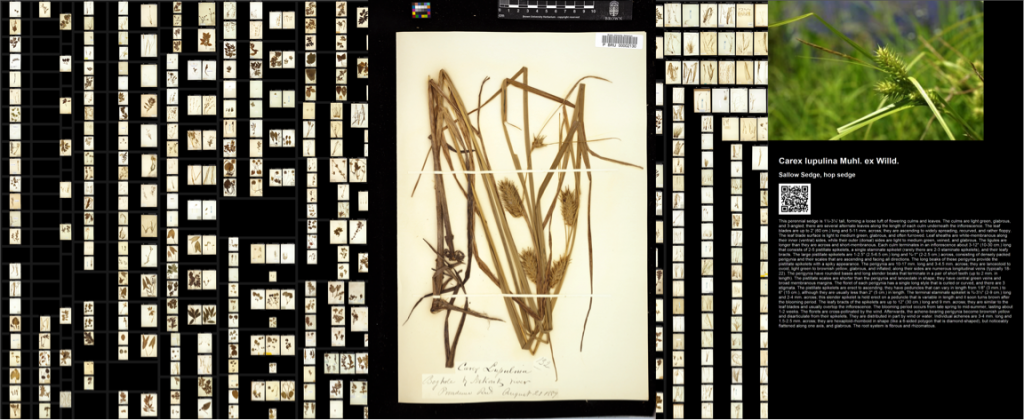
(Jennifer) HerbUX
HerbUX

While Herbarium (plant specimen archive) collections have increasingly been digitized and made available online, digitized herbarium collections remain somewhat inaccessible to large portions of the population—in large part because the interfaces to these collections assume the user has specialized knowledge of plants, knows what they are looking for, and is deeply engaged.
Building on previous experimental interface work, the Herbarium User Experience project (HerbUX) seeks to address this problem by generating a user study / needs document by talking to herbarium stakeholders (undergraduate science educators, herbarium staff, and museum professionals), and generating interface proposals based on the findings of the user study.
HerbUX is a collaboration between CDS, the Brown University Herbarium, and the University of Minnesota’s Bell Museum, and is generously funded by a grant from the Institute of Museum and Library Services (IMLS).
Contributors to this project include Patrick Rashleigh (PI, CDS Lead), Rebecca Kartzinel(Co-PI, Herbarium Faculty Co-Director), Tim Whitfeld (Bell Museum Herbarium Collections Manager)
Voluntary job role (Internal only): UCLDH Associate Director (ECR)
Role Description
Salary: voluntary
Term: 2-year term once renewable
The UCL Centre for Digital Humanities (UCLDH) was founded in 2010 as a cross-faculty research centre that brings together a vibrant network of people who teach and research digital humanities in a wide range of disciplines, in the heart of London. UCLDH is led by a management group: Steven Gray (CASA – Director), Adam Crymble (Information Studies – Deputy Director), and Ulrich Tiedau (Dutch – Associate Director), and coordinated by Lucy Stagg (Institute of Advanced Studies).
We are seeking a new Early Career (ECR) Associate Director of UCLDH to help shape the strategy and direction of UCLDH in its second decade. You will be an early career scholar interested in digital humanities, and based within the UCL community. We define ‘Early Career’ broadly, and include those currently registered on a PhD programme. We particularly welcome expressions of interest from candidates with the following interests or expertise:
- Early career researcher support
- Remote community building
- DH skills and training
- Accessibility in DH
- Multilingual DH
As an active member of the UCLDH Management Group, you will participate in meetings and decisions, and setting the agenda for future activity. Meetings usually take place remotely, approximately six times per year. You are welcome to participate fully or co-lead in the range of activities UCLDH offers, as well as to help establish new ones. As an unpaid leadership role, you will not be expected to contribute to day-to-day tasks that would better be classed as employment, unless you deem them of interest to you and your own career development. The successful candidate will receive mentorship from one of the fellow directors.
UCLDH is committed to a harassment-free space for all members, regardless of gender, gender identity and expression, sexual orientation, disability, physical appearance, body size, race, age, religion, or technical experience. The candidate will be expected to champion these values.
This post is linked to the UCL community and candidates should be a student or member of staff at UCL at the time of application, with at least 12 months remaining on their contract or period of study. If appointed, a candidate can remain in post while at UCL or while on the job search, but will be asked to stand down if they are no longer based at UCL and obtain a substantial post at another university or organisation.
How to Apply
Please send a 1-page cover letter and 1-page CV to lucy.stagg@ucl.ac.uk by 25 September 2023.
Candidates are encouraged to seek the support of their supervisors if relevant, but UCLDH does not need evidence of that support.
Informal Queries
Informal queries can be made to Dr Adam Crymble, Deputy Director UCLDH at a.crymble@ucl.ac.uk
Food for thought: The role of the library catalog in an Open Access world
The common way readers use library catalogs is to find out whether they have access to a particular resource through the library they are using. Catalogs of academic libraries thus provide information about what publications a student or staff member of a particular university has access to, and how they can access it – either by providing details about the location of a physical copy or by providing a link to the electronic version.
But what is the role of the catalog of academic libraries in an Open Access world, especially now that more than half of new journal articles appear in Open Access and more and more scholalry monographs are published openly as well? If the catalog only lists what the library is paying for, then it is no longer doing its job since students and staff members actually have access to a whole lot more than what is in the catalog (namely all Open Access publications as well). If, on the other hand, the catalog lists everything that students and staff members have access too, then it becomes massive, because it should incorporate all Open Access materials as well. It also becomes rather useless since the catalog of let’s say Leuven would not be that different from the catalog of let’s say Leiden – so why would we spend any time and energy keeping separate catalogs?
Of course, if you rethink the catalog of an academic library as a curatorial instrument listing publications which subject specialists have selected as particularly relevant for a specific research community – regardless whether these are publications behind a paywall or not – then they still might make sense. Or maybe we need to think further and conclude that managing a catalog is no longer the way to fulfil the traditional, curatorial role of the library, thus acknowledging that academic libraries’ role in both discovery and fulfillment have diminished and it is high time to focus on other tasks?
Internship Introduction: Hackathons and Promoting Cultural Heritage Materials
My name is Alisa Grishin and I am currently serving as one of the 2022-2023 Artes Research Interns. Currently a Master’s student of Cultural Studies at KU Leuven, my main role will be to support the organization of the BiblioTech Hackathon. For this, I will research the potential that hackathons hold for increasing visibility and fostering engagement with cultural heritage materials. One of the main outputs of this research will be an interactive map of existing hackathons in the academic context and will place the BiblioTech hackathon on this map. I will also be developing a handbook for the organization of future iterations of the BiblioTech Hackathon. Further, I will contribute to the Scholarly Tales blog, enriching both my own knowledge of Digital Humanities and also the collective knowledge the blog offers to readers.

Alisa is expected to graduate in the Summer of 2023. She previously received a B.A. in History with a concentration in Public History and minors in Political Science and Legal Studies from Salem State University.
Prior to coming to Belgium, I grew up and studied in Salem, Massachusetts. With this came exposure to difficult historical reconciliations and complicated understandings of local heritage. As a child, I would regularly act as an afflicted child in Salem Witch Trials documentaries. While at the time it was a fun way to get out of school, eventually there was a certain level of appreciation for my small role in bringing attention to this oft-misconstrued chapter in my nation’s history. Thus began an interest in public history and promoting access to cultural heritage.
Now with a background working at local museums, an art law nonprofit, and other nonprofits in the arts sector, I have grown especially interested in the use of policy to help preserve personal and collective cultural heritage. Greatly attuned to narratives and biases in history, I have found that fair access to (in)tangible heritage and encouraging cross-cultural discourse is instrumental to the development of protection policies. In other words, in order to ensure that local and state governments can preserve heritage-linked places, things, and ideas, we, as students and researchers in the cultural sector, need to do our part to make these elements available to the general public.
Having previously studied history, my relationship with historical materials has always been quite tangible. Although digital heritage is on the radar of many historians, There is still much room for the application of digital humanities methods and tools beyond digitization and the publication of online collections. As technology advances and the world becomes more digital, the potential the application of digital humanities tools and methods holds in the cultural heritage sector only continues to increase.
Museums, libraries, and other cultural institutions often have spent dozens — if not hundreds — of years to build collections, audiences, and reputations. Despite this established history, these institutions must engage with current digital developments to maintain their relevance and impact for the future. The increased access to digitized materials or electronic editions means that cultural institutions must adapt and evolve. This expansion does not just mean that they can no longer rely on the in-person visitation they had in the past; it also means that these institutions have an obligation to meet their audience on the patrons’ own terms. The objectives of digital scholarship help fill this gap — expanding Open Access, improving informational literacy, and digitizing and visualizing collections are just a few examples of the ways Digital Humanities can work with cultural institutions.
Hackathons are a way to extend the internal missions and goals of cultural institutions. Libraries, in particular, can benefit from organizing hackathons as a means of promoting their collections and encouraging education when it comes to their materials, but also when it comes to acquiring digital skills for engagement with and exploitation of those materials. In action, this leaves libraries as either the site of a hackathon or the subject of a hackathon; in the case of BiblioTech, the KU Leuven Libraries is both. This event is therefore an exciting opportunity for not only the libraries as they branch out into more technological initiatives, but also the general public. Events like this make accessing collections and data easier, in turn making the library more relevant and innovative to a twenty-first century researcher.
As we continue the hackathon preparation, I find myself creating mental notes of what I am most looking forward to (apart from the anticipated reward of a successful event). While I have much to learn in regard to the full potential of DH and its many applications, I am excited to observe how it can support the preservation of cultural heritage.
Do you want to know more about the BiblioTech Hackathon? You can visit the hackathon website here!
The Sloane Lab Community Fellowship Round Two (extended)
We are seeking to appoint Community Fellows (ten in total until summer 2024) to contribute to “The Sloane Lab: Looking back to build future shared collections”, led by University College London (UCL) in partnership with the Technische Universität Darmstadt, British Museum (BM) and Natural History Museum (NHM). The fellow will undertake creative, critical, practice and/or research-led projects with the Sloane Lab’s Knowledge Base and data, demonstrating the new forms of analysis and interpretation the project will unlock.
The fellowship comes with an award of £7,500. We welcome applications from outside as well as inside the United Kingdom. The tenure of the fellowship does not require residency in the UK. All fellowships will be hosted remotely online. Applications to the fellowship are particularly welcomed from Global Majority Individuals.
This advertised role offers an exciting opportunity for individuals with an interest in contributing to the Sloane Lab, including but not limited to, digital humanists, artists, computer and data scientists and heritage practitioners (community or institution based). The Fellows will exemplify the research capacity unlocked by the Sloane Lab, engage with its Knowledge Base and data directly by undertaking creative, critical and/or research-led projects with collections as data. Research areas may include but are not limited to local and family history, object biography, critical heritage, Indigenous and devalued knowledge, or the transferability of the technology developed by the Sloane Lab.
Start Date (extended round two): 15th January 2024 or based upon negotiation
End Date: The post is funded for 3 months
Application deadline: 11th September 2023
Application details and the application form
For questions and queries please contact: sloanelab@ucl.ac.uk
The Sloane Lab Community Fellowship Round Two
We are seeking to appoint Community Fellows (ten in total until summer 2024) to contribute to “The Sloane Lab: Looking back to build future shared collections”, led by University College London (UCL) in partnership with the Technische Universität Darmstadt, British Museum (BM) and Natural History Museum (NHM). The fellow will undertake creative, critical, practice and/or research-led projects with the Sloane Lab’s Knowledge Base and data, demonstrating the new forms of analysis and interpretation the project will unlock.
The fellowship comes with an award of £7,500. We welcome applications from outside as well as inside the United Kingdom. The tenure of the fellowship does not require residency in the UK. All fellowships will be hosted remotely online. Applications to the fellowship are particularly welcomed from Global Majority individuals.
This advertised role offers an exciting opportunity for individuals with an interest in contributing to the Sloane Lab, including but not limited to, digital humanists, artists, computer and data scientists and heritage practitioners (community or institution based). The Fellows will exemplify the research capacity unlocked by the Sloane Lab, engage with its Knowledge Base and data directly by undertaking creative, critical and/or research-led projects with collections as data. Research areas may include but are not limited to local and family history, object biography, critical heritage, Indigenous and devalued knowledge, or the transferability of the technology developed by the Sloane Lab.
Start Date (round two): 11th September or based upon negotiation
End Date: The post is funded for 3 months
Application deadline: 15th May 2023
Application details and the application form
For questions and queries please contact: sloanelab@ucl.ac.uk