
阅读视图

UCLDH at 15: Highlights, Milestones & What’s Next

We are delighted to write to you as the new co-directors of the UCL Centre for Digital Humanities. As we step into this role together, we want to take a moment to reflect on the past year, celebrate our achievements, and look ahead to what’s next. Last year marked a major milestone: UCLDH celebrated 15 years as a centre. Since its founding, UCLDH has been a vibrant hub for interdisciplinary research, innovation, and critical engagement at the intersection of technology and the humanities. We’re honoured to carry forward this legacy and excited to shape its next chapter.

Together, we bring complementary perspectives and shared enthusiasm for digital scholarship, inclusive collaboration, and creative experimentation. Whether your work involves cultural heritage, data visualisation, digital archives, critical code studies or something else under the big tent of digital humanities, we hope UCLDH continues to be a space where ideas flourish and boundaries are joyfully crossed.

We’ve had much to celebrate recently:

  • Annual Susan Hockey Lecture UCLDH was honoured to host Professor Julianne Nyhan for the annual Susan Hockey Lecture. Her thought-provoking talk explored the intersections of digital humanities, oral history, and data, sparking lively discussion and reflection across disciplines. We’re grateful for her insights and the opportunity to celebrate the legacy of Susan Hockey through such a compelling and well-attended event.
  • Voices Unbound Seminar Series From October 2024 to January 2025, we co-organised the Voices Unbound online seminar series, which explored emerging technologies in digital oral history. Topics ranged from text mining and linguistic analysis to metadata standards and critical reflections on AI. The series built on our earlier work around historical data and drew an international audience. Collaborators included TU Darmstadt, UCL, C²DH Luxembourg, and the Max Planck Institute for the History of Science. Recordings are available here: https://openlearnware.tu-darmstadt.de/collection/digital-oral-history-exploring-the-state-of-the-art/
  • Hands-on Workshops In Term Two, we hosted two fully booked workshops: one on Automated Text Recognition and another on Text Mining.
    • The first, led by Dr Marco Humbel (UCLDH/TU Darmstadt) and Dr Alicia Hughes (The British Museum), introduced participants to OCR and HTR technologies, including a hands-on tutorial using Transkribus.
    • The second, co-led by Dr Humbel and Dr Jiajie Zhang (UCL DIS), explored tf-idf (term frequency–inverse document frequency) as a method for extracting distinctive keywords from large text corpora. Participants applied the technique to their own datasets using Google Labs Notebooks.
  • Formalising International Collaboration In June 2025, UCLDH and the Chair of Humanities Data Science and Methodology (HDSM) at TU Darmstadt signed a memorandum of understanding to strengthen collaboration between our labs. This agreement promotes shared infrastructure, researcher mobility, joint projects, and sustainable knowledge exchange. While currently focused on UCLDH and HDSM, the initiative lays the groundwork for a broader international network of Digital Humanities Labs.
  • Global Publishing Initiatives We launched the Routledge book series Digital Humanities and Intelligent Computing in collaboration with Wuhan University, with four more titles in the pipeline to celebrate global DH achievements.
  • Celebrating Our People We congratulate our early-career board member Marco Humbel on his new permanent role at The National Archives. We’re proud of his contributions and look forward to future collaborations. We’ll miss him on the management committee—but we look forward to welcoming someone new in his place (please apply if you’re interested)!

As we look ahead, we’re especially eager to connect with new members of the UCL community—PhD students, new staff, and anyone curious about digital humanities. Whether you’re just beginning to explore this space or are already deeply embedded in it, we invite you to join us.

In the coming months, we’ll be:

  • Hosting events and workshops to foster interdisciplinary dialogue
  • Launching initiatives to support early-career researchers and postgraduate students
  • Strengthening partnerships within UCL and beyond
  • Exploring new formats for sharing research and engaging the public

We also want to hear from you. What do you want UCLDH to be? What projects, provocations, or possibilities are you excited about? Let’s build something bold together.

Thank you for being part of this community. We’re excited to work with you, learn from you, and grow UCLDH in ways that reflect our shared curiosity, creativity, and care.

Warm wishes,
Adam Crymble & Jin Gao
Co-Directors, UCL Centre for Digital Humanities
  •  

Job Alert – Lecturer in Data Science for Society

UCL’s Department of Information Studies is seeking a Lecturer in Data Science for Society for a full time academic post. Deadline for applications is 26 February 2023.

“We are seeking an innovative researcher to appoint to a full-time lectureship beginning in August 2023 who can teach and research in the broad field of data science and its role in a well-functioning society. We are particularly interested in applicants who could contribute to ongoing or new research in one or more of the following areas: data-driven research in the humanities, addressing social issues arising from the use of emerging technologies such as artificial intelligence or machine learning, data-driven decision making and social justice, or emerging related interdisciplinary areas. The purpose of the research should be to contribute new interdisciplinary data-driven knowledge of relevance to a humanities or social science discipline.”

Full Details available on the UCL Jobs portal: https://www.ucl.ac.uk/work-at-ucl/search-ucl-jobs/details?jobId=5061&jobTitle=Lecturer%20in%20Data%20Science%20for%20Society


Job Reference: B03-01494

  •  

Job Alert – Lecturer in Digital Archives

UCL’s Department of Information Studies is seeking a Lecturer in Digital Archives for a full time academic post. Deadline for applications is 20 November 2022.

“We are seeking an innovative researcher and lecturer to appoint to a full-time post beginning on January 2023, with a teaching focus of relevance to our MA/MSc Digital Humanities and MA in Archives & Records Management programmes. We are particularly interested in applicants who take Post-Colonial or Non-Western centric approaches and offer one or more of the following: Digitisation; Digital Inequities; Digital Ethics; Anti-Opressive Approaches to Digital Cultural Heritage; Artificial Intelligence and its use in Cultural Heritage; Digital Communities and Activism; the Impacts and Affects of Big Data and Data Modelling, Representation, Visualisation and Simulation and interdisciplinary applications of these areas to other research activities within the Department.”

Full Details available on the UCL Jobs portal: https://atsv7.wcn.co.uk/search_engine/jobs.cgi


Job Reference: 1888211

  •  

Job Alert – Lecturer in Digital Methods in the Humanities

UCL’s Department of Information Studies is seeking a Lecturer in Digital Methods in the Humanities for a full time academic post. Deadline for applications is 20 November 2022.

“We are seeking an innovative researcher to appoint to a full-time lectureship beginning in January 2023. We are seeking applicants who answer research questions of relevance to a humanities discipline, by applying or developing digital research methods in an interdisciplinary way. This may include methods such as but not limited to network analysis, stylometry, computer vision, machine learning, data modelling, text-mining, textual analysis, corpus linguistics, sound or video analysis, or emerging interdisciplinary methodological areas. The purpose of the research should be to contribute new interdisciplinary knowledge to a humanities domain.”

The full details are available online.

https://www.jobs.ac.uk/job/CUI638/lecturer-in-digital-methods-in-the-humanities

  •  

Looking for DH Jobs in London 2022

My postgraduate digital humanities students are working away diligently on their dissertations, but understandably they’ve also got one eye on what might come next. For most of them, that means a transition into the world of work.

With a great set of interdisciplinary skills, the ability to talk tech, and an aptitude for humanistic ways of thinking, there are a lot of pathways a DH graduate might pursue. But going on the job market, particularly if you’re non-local, can be a bit overwhelming. For UCL’s DH graduates, there is a great UCL Careers team who can help support you with the transition, including how to develop key skills around CVs and interviews. If you are a UCL grad, please make them your first port of call.

I also wanted to reflect on some places I might go looking if I was in your shoes, interested in something that can put your new DH skills to use. So I’ve compiled the following non-exhaustive list of ideas aimed at those graduating with an MA/MSc. I hope it proves useful, and please share it with others on the lookout.

  • Guardian Jobs: A job board that is popular with arts & heritage, charities, education, technology, social enterprise, and media companies. You can also set up free email alerts to hear about jobs within your area of interest.
  • Knowledge Quarter: a group of organisations around UCL that are interested in knowledge and culture, many of whom that work at the intersection of DH and other fields. It’s worth checking out their member organisations and exploring opportunities with them. They include organisations such as the British Museum, Charles Dickens Museum, Google, UCL, and the Wellcome Foundation. It’s a great way to get a list of organisations that might like to employ someone with your skillset.
  • Jobs.ac.uk: A job board aimed at the university sector. This includes both jobs that require a PhD, and those that do not, in a wide range of roles such as student support services, marketing, and library services. There are some international opportunities, but most jobs are UK-based. You can set up free email alerts based on your criteria.
  • Big Tech: don’t be afraid to check out the big tech companies, many of which have London offices. Google, TikTok, and many other big companies have a footprint in the UK, and it’s worth keeping an eye on them and offering your skills to their teams.
  • LinkedIn: having spoken to some of our graduates from the previous cohort, they suggested having a good presence on LinkedIn, which can be a great way to find out about job opportunities and connect with people hunting for graduates.
  • Talk to DH Labs: There are a number of universities working in digital humanities and you never know when they’ll have roles available. Sometimes that’s short-term teaching or research support, and sometimes it’s in a range of other capacities, from project management to more technical work. Don’t feel bad about reaching out to your tutors to ask about things coming up, or to send an email to one of the other DH groups in London.

I’m sure there are other ideas that are worth pursuing, but I hope this helps some DH graduates in their search.

  •  

Penultimate DH Longview Seminar

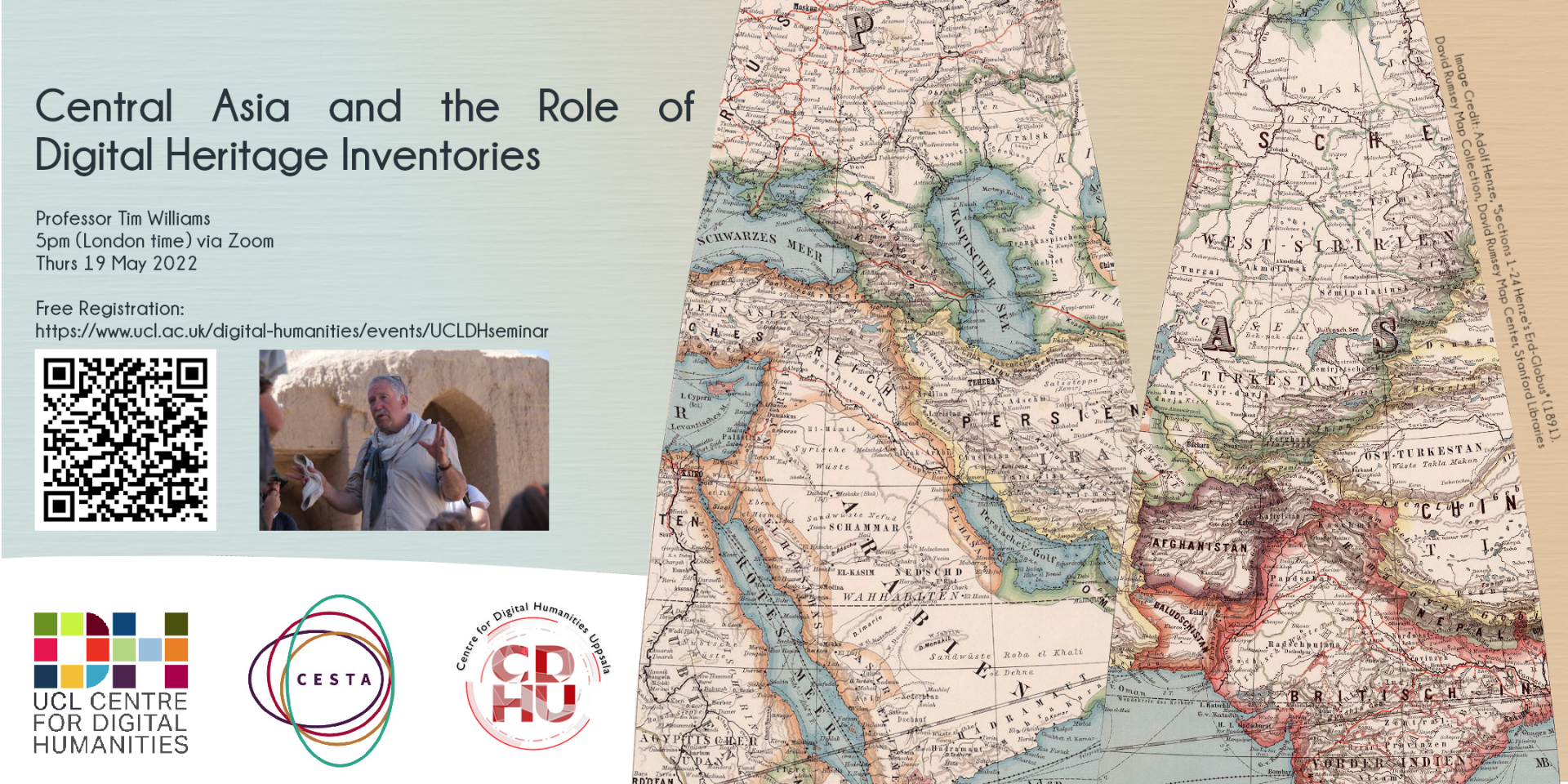
Join us 5-6:30pm Thursday (19 May 2022) via Zoom for our very own Professor Tim Williams (Archaeology), for the next Digital Humanities Longview seminar, which explores digital scholarship and the Silk Road. Professor Williams’ research considers urban archaeology, especially in Roman, Islamic, and Central Asian contexts. He’s the Director of a long-running research project at Merv, Turkmenistan, which has been operating since 2001. This collaboration between the Turkmenistan Ministry of Culture, the Ancient Merv State Park, and the UCL Institute of Archaeology aims to research and conserve the remains of one of the great historic cities of the Silk Roads.

This webinar is open to the public. Registration is free but required: https://stanford.zoom.us/webinar/register/WN_Ko_LDqfrRKeigtE5S4Ci2w

The Digital Humanities Longview seminar is a joint seminar series co-hosted by UCLDH, the Center for Spatial and Textual Analysis (Stanford, USA), and the Centre for Digital Humanities (Uppsala, Sweden).

Promotional flier for Tim Williams seminar 2022


  •