
阅读视图

The Slideshow And The Video Essay

作者leo-palma

In my discipline, art history, the slide show is not only an intrinsic part of teaching, but it shaped the discipline’s methods from its inception. Practices through which art historians are taught to understand art – like visual analysis and comparative analysis– rely on one or more reproductions of artworks to be available to students in the classroom. Photographic slides have been used in art history since the early twentieth century. Then why are most art history sideshows so plain? Why, now that technology has advanced, have the conventions of the art history slideshow stayed largely the same?

Outside of academia, video is one of the main ways people consume information. Currently, this is largely through online video. Online educational programs vary greatly in quality and accuracy, but many educated individuals who operate outside of academia have taken to platforms like YouTube to share their knowledge and their analysis on a variety of topics. Some of my personal favourite video essayists hold undergraduate and graduate degrees in philosophy. They often start their videos by addressing a current topical issue or event as a departing point to present different philosophers’ ideas and concepts. While these videos use some academic practices – like citing sources on the top right of the video, or providing a bibliography in the description – their presentation style is definitely not academic. Their videos contain elaborate costumes, makeup and sets; their presentation style is highly emotive: they use humor, plot twists, and personal experiences to make complex topics more approachable. On Youtube, maintaining viewers’ engagement and retention is paramount for the monetisation of a channel. This is often achieved by favouring material that emotionally, rather than just intellectually, engages the viewer. Video essays can be long, sometimes multiple hours. The audience is almost by definition assumed to be a distracted one. Viewers are doing chores, or cooking, or on their commute. To keep them interested and listening, one needs to find ways to not only make the content relevant to them, but create emotional resonance and construct exciting visuals and sound design to highlight important moments. This highly emotional way of presenting differs from academic rigor, expectations of objectivity, and separation between the self and one’s field of study.

While in certain academic fields – largely feminist, queer, black and other minority studies – this requirement has been challenged, it is still an underlying practice in disciplines like art history. Yet, we all spend years of our life studying and researching this material because we love it, because we find it interesting and relevant. So why is it so difficult to communicate passion and enthusiasm in public facing presentations?

I believe there are at least two practices from the YouTube video essay that could translate to the academic presentation: encouraging emotional engagement, and providing variety. In regard to emotion, for example: Where can I script a joke or acknowledge the humor of an aspect of my research? Where can I leave out a conclusion or some information, to surprise my listener with it later? Where can I reenact a moment of my research when I found out something exciting or unexpected? Where can I peel back the curtain a bit on the process of my research, so that the listener feels involved in the narrative I’m presenting, and not just a passive bystander? Importantly, how can I use the tools at my disposal to create these moments of emotional engagement? Where can I hide something on the next slide, as to not give away my findings before I get to them? Where can I include a photo that brings up a good anecdote from my time in the archive, or at the collection?

Variety and dynamism can also be accomplished through the slides. Why am I the only one talking? Do I have audio or video clips that I can use? Can I call onto someone in the audience to answer a question? I often find it difficult to not sound monotone when I’m presenting. Embedding audio or video or planning for moments of interaction with the audience could help to break up the sound of my voice. There are also ways to make slides more dynamic and visually interesting without making them look unprofessional. If I need to talk over an image for a long time, how can I animate it in some way? Can I zoom in onto details of the painting as they come up in the talk? Can I show Calder’s mobile sculpture move? Can I play a video of the performance with the sound off as I’m talking about it?

The workshop I’m planning in Spring is an attempt to think about emotional engagement and diversity in the slideshow presentation as a group, without being prescriptive on which methods to adopt and when. I am aware that our cohort works in a variety of fields and from multiple identitarian positions that affect how we are perceived in a professional setting. Some of us can take more liberties when it comes to academic speaking and some of us cannot. But I am interested in finding out what people think about this comparison. Which methods of the video essay can apply to the academic presentation with the slideshow? I plan to use clips from videoessays to show some of these techniques. I’ll then play a clip of an academic presentation, and ask the people in the room to draw a storyboard of it. Storyboards, where a drawing of a shot and notes are put side to side, are very similar to the slide and script style of preparing for a talk. However, they force one in the position of the audience member instead of the presenter. They allow us to think in more detail about framing, and movement, and how to direct the attention of the viewer. I hope this exercise will inspire the group to think about some ways in which the slideshow can improve our ability to communicate our research to a variety of audiences.
  •  

Mapping Queer Belonging

作者leo-palma

I want to take this first blog post as a chance to write down some reflections prompted by these first months of the Praxis program. Most notably the conversation with Jeremy about the big “why” of Digital Humanities projects in relation to Frank Chimero’s Shape of Design, Zarif’s and Jess’ presentations on poetry and novels, and Drew’s presentation on GIS.

I have been thinking of creating a digital map of Fiore de Henriquez’s (1921- 2004) artworks in their current location. Fiore was an intersex artist and sculptor from Trieste, my hometown, and I have been researching her works as part of my dissertation. While she received commissions from all over the world, the locations of her artworks are largely unknown and not publicised. I have been wondering whether my mapping of her practice should include the artist’s over-the-top stories about her experience of gender difference, as performative acts through which the artist expressed her view of herself and her work. These tales often contain elements of fiction, but they always take place in highly recognisable and memorable places. Thinking about my “why” for this project, and about what it might look like, I was reminded of Queering the Map.

Queering the Map was created by Lucas LaRochelle in 2017, in effort to re-think how queer geographies of space are usually conceived. It anonymously archives queer experience in relation to place via a pink map with black pins, to which anyone in the world can add their own contribution. This collaboration inevitably results in “something that is fundamentally messy, contradictory, and confusing” (LaRochelle, 2019). Some pins are jokes, some are cryptic, some read as reviews of certain locations, others are confessions, personal and heartfelt. Some are tragic and filled with grief.

Repeating a fairly common sentiment, LaRochelle expresses that his “why” was “to contribute to the life-sustaining force that is queer internet culture”, citing his own life-changing experience in digital queer spaces, which made up for the nonexistence of queer places in rural Ontario, where the author grew up. However, I see this map as doing something else. To me, it complicates the narrative of the digital as a place for queer connection when the local is a place of queer solitude and loneliness. Instead, the digital anonymous character of the map makes visible the multiple, contradicting, sometimes imagined ways a place can be queer. It expands the common reduction of queer spaces to bars, clubs and saunas. Instead, it makes visible the multiple, complicated ways any place, no matter how homophobic or transphobic, can be made queer.

Some comments on the map are clearly not interested in recounting real events at all – some pins in the middle of the ocean include comments like “made out with a mermaid :)”. Even for those that seem earnest, there is no guarantee that the pins have been placed in the actual street where the events narrated took place, nor if the events recounted even happened at all.

Reading random pins on this map, I am reminded of Fiore’s way of telling her life stories as half-made-up tales. They also remind me of a poem by Umberto Saba, (1883-1957). Umberto Saba is the only writer from my hometown, Trieste, that is included in high school textbooks around the country. As an Italian irredentist, he’s one of the few writers from the regions that fits the state’s nation-building narrative. I have studied his poems many times, learning them from memory as early as elementary school. But I was never told he was queer, nor that he thematised his experience of queerness in a number of his poems and novels. Here is one of his most famous poems, titled “Trieste”:

Ho attraversato tutta la città.
Poi ho salita un’erta,
popolosa in principio, in là deserta,
chiusa da un muricciolo:
un cantuccio in cui solo

siedo; e mi pare che dove esso termina
termini la città.
Trieste ha una scontrosa
grazia. Se piace,
è come un ragazzaccio aspro e vorace,

con gli occhi azzurri e mani troppo grandi
per regalare un fiore;
come un amore
con gelosia.
Da quest’erta ogni chiesa, ogni sua via

scopro, se mena all’ingombrata spiaggia,
o alla collina cui, sulla sassosa
cima, una casa, l’ultima, s’aggrappa.
Intorno
circola ad ogni cosa

un’aria strana, un’aria tormentosa,
l’aria natia.
La mia città che in ogni parte è viva,
ha il cantuccio a me fatto, alla mia vita
pensosa e schiva.
I traversed the entire town.
Then I climbed a steep slope,
crowded at first, deserted further up,
closed by a low wall:
a nook where I sit

alone; and it seems to me that where it ends
the town ends too.
Trieste has a surly
grace. If one likes it,
it is like a rascal, harsh and voracious,

with blue eyes and hands too big
to offer a flower;
like a love
with jealousy.
Up from this slope every church, any street

I discover, whether it takes to the huddled beach,
or to the hill where, onto the rocky
top, a house, the last one, clings.
All around
circles all things

a strange air, a tormented air,
the native air.
My town that is in every of its part alive,
has a nook made just for me and my life,
pensive and reserved.

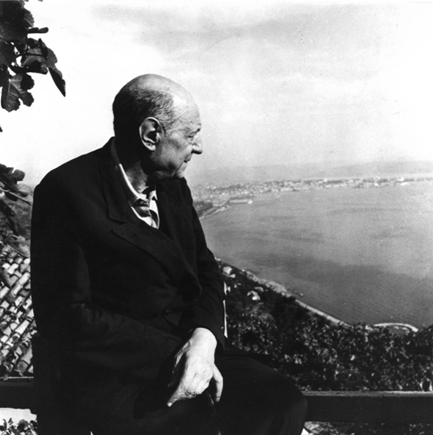
Saba sitting by the bay overlooking Trieste, 1951

Saba sitting by the bay overlooking Trieste, 1951

In this poem the bird’s eye view on the territory allows the poet to see the city in all its contradictions, both crowded and deserted, teeming with life but with quiet, solitary corners. After the difficult ascent to earn such a perspective, the poet finds within these contradictions a sense of belonging. The strange, tormented air is recognised as denoting home. When I studied this poem in school, this sense of belonging was taught as a general one, but I always felt it was queer, even before knowing of Saba’s sexuality. Specifically, the personification of Trieste as a “ragazzaccio” struck me as significant.

Cities are usually personified as female in art and literature. They are to be defended, and protected, they are the “motherland” of the masculine citizen. At the same time, they are also lovers of the presumed male citizen, and the love for one’s hometown needs to be established as a heterosexual one. This is even more explicit in Italian, where they are grammatically gendered female, as in most romance languages. Here however, Trieste is a boy, and a bad boy at that. He’s sweet but rough, he wants to consume and take – he’s voracious – but is unable to be delicate and give anything back, not even a flower. The city is transitioned into an image of an imperfect boy, who the poet cannot help but love in an imperfect way, with jealousy. The poem is queer because it transitions the city in order to make the love between the poet and the city a queer one. I read it as a queer outlook onto the landscape, one that generates a queer sense of belonging and personal peace. Like in Queering the Map, the view from above reveals the multiple, complex, and contradictory ways the landscape is lived in. Among these is the “cantuccio a me fatto”, a small and hidden but safe place for queerness.

These have been some thoughts inspired by these first few months of class. While I have largely used the case of Trieste to work through some of them, I wonder how they might resonate beyond this case study (and I must thank Eleanor for her comments about how they spoke to her own experience). As I am figuring out what my DH project on Fiore will look like, I will keep thinking about Saba and Queering the Map, and whether the digital, with its ability to reunite at a glance such diversity of experience, can make visible how queerness inhabits unlikely places.

Works cited:

  • Chimero, Frank. The Shape of Design. Frank Chimero, 2012.

  • Co-Creation Studio at MIT Open Documentary. ‘Co-Creating a Map of Queer Experience’. Medium, 2 November 2019. Link

  • Queering The Map. ‘Queering The Map’. Accessed 12 October 2025. Link

Poem Translation:

Literaryjoint. ‘Trieste, by Umberto Saba, English Translation’. LiteraryJoint, 6 March 2013. Link

  •