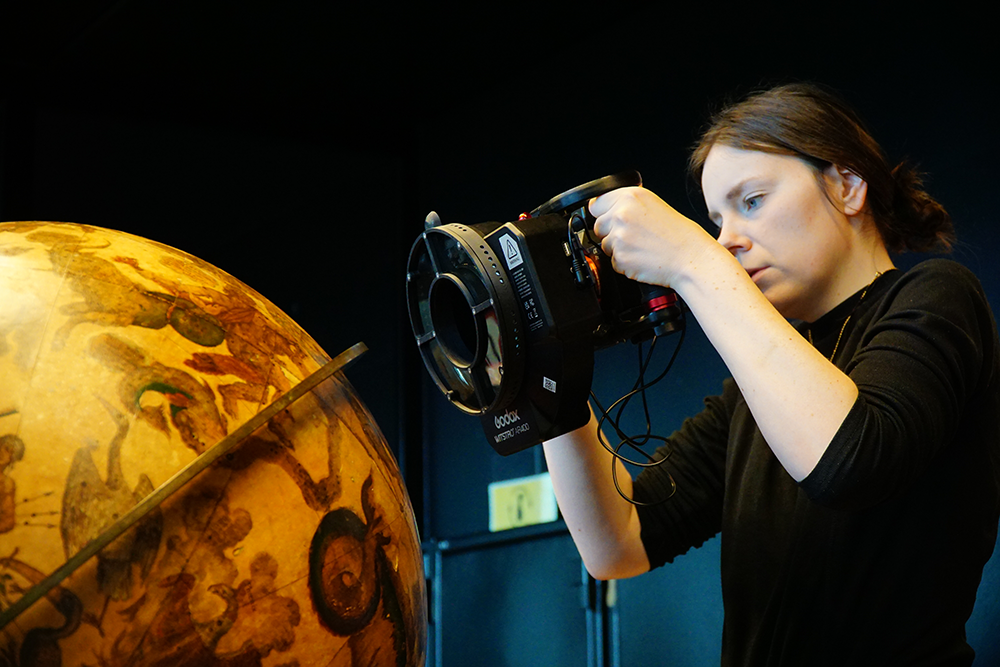
As of January 2026, Utrecht University’s ArtLab will formally become part of the Centre for Digital Humanities (CDH). ArtLab is an academic heritage laboratory that combines advanced imaging and 3D technologies with expertise in material art history.
Its integration into the CDH will support Artlab’s continued growth and enable a broadening towards new digital humanities themes and applications. Bringing together humanities researchers who work with innovative digital methods, creates opportunities for cross-fertilisation and intellectual exchange.
About the ArtLab
At ArtLab, researchers and students work on location using mobile equipment. They develop accessible research applications, provide training for professionals, and collaborate closely with national and international external partners. ArtLab aspires to be the first laboratory in the Netherlands – and beyond – where material objects and digital methodologies are brought together for the study of art and culture.
Data School zoekt voor 16 tot 28 uur een enthousiaste medewerker kennisvalorisatie/teamleider die zich bezighoudt met projectmanagement, business development en het begeleiden van collega’s.
Als tijdelijke medewerker, in verband met vervanging zwangerschapsverlof, zul je in eerste instantie deze positie vervangen en coördineer je lopende projecten van Data School. Er is ruimte voor eigen inbreng en creatieve ideeën in de vorm van business development en acquisitie.
Our brand-new Spring 2026 Training Programme offers a range of exciting new workshops and lectures, including Qualtrics, Small Language Models, and AI & investigative journalism.
Whether you are taking your first steps in the digital humanities or looking to deepen your expertise, our free workshops and lectures provide fresh perspectives and hands-on learning opportunities.
Some sessions are open to all, while others are reserved for staff and students from the Faculty of Humanities and other UU faculties. We look forward to welcoming you in one – or several – of these workshops and lectures.
Do you have a question related to digital humanities? Drop by our weekly walk-in hours every Thursday from 14:00 to 15:00. All humanities staff and students are welcome, whether you are a beginner or working at an advanced level.
Sessions take place in person in room 0.32 in the University Library City Centre, with one exception: on 19 March 2026, the walk-in hour will be online only.
The developers of the CDH Research Software Lab (RSLab) are currently working on a new upload feature for the text search and exploration Textcavator (formerly I-Analyzer). For the final development phase, they are looking for researchers who would like to test this new functionality.
Do you have a dataset you would like to use in Textcavator? Sign up for the pilot and help the RSLab further improve the tool!
What does the new upload feature do?
The upload feature allows researchers to add their own dataset directly to Textcavator. This makes the tool even more accessible and easier to use. The developers are now in the final development stage and would like to test the feature in practice with users.
Who can see my dataset?
You decide. In Textcavator, you can specify for each dataset whether it is:
publicly accessible,
available only within the university,
restricted to a specific group, or
visible only to yourself.
Who can participate in the pilot?
All researchers within the Faculty of Humanities and other faculties at Utrecht University are welcome to participate.
What kind of data can you upload?
Textcavator is designed for collections of texts. You can upload your own research data or an open access dataset you want to use in Textcavator. Both small and large datasets are welcome.
Data must be provided in a CSV or Excel file. The developers can advise you on structuring or cleaning your data if needed.
Aim of the pilot
The RSLab has been developing Textcavator since 2017 for the Faculty of Humanities at Utrecht University. The tool is designed to make text search and exploration as accessible and easy as possible. With the new upload feature, Textcavator will become even more efficient.
The pilot is intended to test this new functionality. The developers are ready to help if anything is unclear or not working properly. Your feedback will be used to further improve the upload feature.
The developers would also love to hear your ideas: which features are missing? What kind of support would be useful? What could be improved?
What’s in it for you?
You can explore your own dataset using all Textcavator’s features.
You make a contribution to a more powerful and user-friendly text search and exploration tool for all researchers at Utrecht University (with a focus on the humanities) and beyond. Unlike many other tools, Textcavator is open source and non-commercial. By joining this pilot, you contribute to an accessible, high-quality research tool developed for and with researchers. Both large and small research projects will benefit from your input.
Sign up
Register for the pilot before 15 February 2026 by emailing cdh@uu.nl. After registering, you will receive further instructions.
I-Analyzer is now called Textcavator, a name that better reflects the flagship tool of the CDH Research Software Lab (RSLab). In addition to the new name, the RSLab is introducing an upload feature for adding your own dataset, as well as several new corpora. The Centre for Digital Humanities spoke with scientific developer Luka van der Plas about the updates.
Why the name change from I-Analyzer to Textcavator?
‘Textcavator better reflects what the tool actually does than the name I-Analyzer,’ says Van der Plas. ‘It is primarily designed for exploring texts, rather than for conducting in-depth analysis. Excavator literally means a digging machine, but it is also used figuratively to mean digging into something. And that is exactly what the tool does: it retrieves information from texts.’
What can you do with Textcavator?
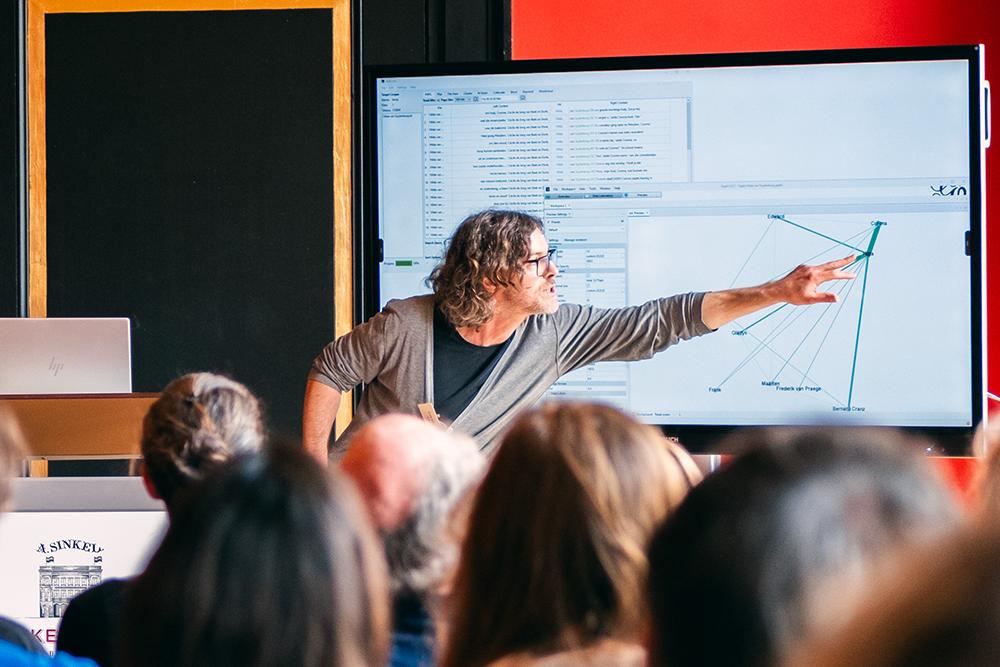
‘At its core, it is a search engine: you can search a dataset using keywords that are relevant to your research. It is a comprehensive tool for finding what you are looking for. That is why we refer to it as a text search and exploration tool, rather than a text-mining tool. Afterwards, you can carry out more extensive analyses yourself—qualitative or quantitative—using the search results you download from Textcavator.’
‘The analysis tools we offer within Textcavator—simple statistics and basic visualisations—are intended to help you search as effectively as possible, not to conduct your actual research. You can filter by time period or category and bookmark documents. We also provide visualisations and statistics to help refine search queries. These show, for example, how a search term is distributed across categories or time periods, or which words frequently appear in its context. Depending on the dataset, we also offer more advanced features, such as Word Embeddings and Named Entity Recognition.’
New logo Textcavator
Many text exploration tools already exist. Why did you choose to develop your own?
‘The RSLab began developing what was then called I-Analyzer in 2017. This allowed us to tell researchers: we already have a working tool. We only need to load your dataset into it and perhaps add a button or two. That way, we can support even small projects with limited funding, which I find very rewarding.’
‘Working open source is also important to us. And because we develop the tool within the university, we are not driven by profit: we are truly here for the researcher. We work closely with researchers to develop Textcavator, although external users can also use it. We wanted a tool that is not overly technical, can accommodate many different types of datasets, and is suitable for all disciplines within the humanities.’
Are all datasets in Textcavator public?
‘No. We prefer to make data public, but that is not always possible. Cultural data is often protected by copyright. That is why, when uploading, you can decide who gets access: everyone, only the university, a specific (research) group, or just yourself.’
Which new corpora have been added?
‘In collaboration with the University Library, we have added several new corpora from the publisher Gale, including nineteenth-century British and American newspapers and magazines such as Punch and Illustrated London News. These are great additions to the newspaper corpora we already offer, such as The Guardian and The Times.’
How do you decide which corpora to add?
‘Many researchers bring their own data—collected or cleaned for their research. In addition to joint acquisitions with the University Library, we also occasionally add public corpora for which there is wide demand, such as the KB newspaper corpus, DBNL, Gallica and Le Figaro.’
Which research projects have used Textcavator?
‘The largest is People & Parliament, a leading project in political history, conducted with the University of Jyväskylä (Finland). They needed an efficient tool to search a vast collection of parliamentary debates from across Europe.’
‘Another example is Traces of Sound, a much smaller project. For this, we built a proof of concept in Textcavator using a small set of sources and annotations related to references to sound. This helped the researcher in submitting a larger grant proposal.’
How accessible is Textcavator for beginners?
‘We specifically focus on researchers with little experience in text and data mining. The tool is designed to be as user-friendly as possible. For those who want more, additional features are available. But even more advanced features, such as Named Entity Recognition, can be used without extensive technical knowledge.’
You are working on an upload feature. What does it entail?
‘The new upload feature allows researchers to add their own datasets directly to Textcavator. Currently, this is always done by us, which makes researchers dependent on our available time. We are now in the final development phase and are therefore organizing a pilot to test the feature together with the research community.’
What do you hope to learn from this pilot?
‘One goal is to identify any bottlenecks. Textcavator is designed for highly diverse data, which can also complicate things. We want to ensure everything works smoothly and clearly before opening the feature to everyone. During the pilot we will receive feedback and can step in immediately if something is unclear or not yet working properly.’
‘We also think it is important that the feature truly aligns with researchers’ needs. For example: how much should be filled in automatically, and how much should users be able to configure themselves? In which file formats would they like to upload their data? Instead of speculating about this behind closed doors, we want to ask users directly.’
Who can participate in the pilot?
‘We are looking for a broad group of researchers. Anyone with data they would like to add to Textcavator can take part. This may be their own research data, but also an open access dataset. A small Excel file with a hundred documents is just as welcome as a large dataset. The only requirement is that you can clean of format the data yourself, if needed.
Which features could be added if there is demand?
‘In the short term, we aim to make the process user-friendly and accessible, focusing on small adjustments such as additional guidance and feedback. In the long term, we are considering larger expansions, such as more file formats, or even manual data entry.’
‘There are also features already in Textcavator that are not yet offered through the form, such as adding images or word embeddings. These could be valuable additions, but they also make the upload process more complex for researchers.’
What have you learned from developing a tool for so many disciplines?
‘The biggest challenge is maintaining clarity for the user. We continue to add new features, but we want to prevent the interface from becoming overwhelming. It is a constant balance between accessibility and technical possibilities.’
‘And what strikes me is how similar the needs of researchers in the humanities and social sciences actually are. You might expect them to require very different tools, but in practice that is not the case.’
The Centre for Digital Humanities (CDH) invites permanent academic staff of the Faculty of Humanities at Utrecht University to apply for the position of CDH affiliate. Affiliates act as ambassadors and liaisons within their departments, supporting the ambitions of the CDH. Currently, we have three openings in the departments History and Art History, Philosophy and Religious Studies, and Languages, Literature and Communication.
About the role
As CDH affiliate, you will help strengthen the connection between your department and digital humanities. You will do this by:
identifying training and educational needs within your department;
contributing to the development and integration of computational components in BA and MA programmes;
advising colleagues on funding applications that include a digital humanities component;
fostering collaboration between researchers and IT specialists;
contributing to community-building activities.
In addition to these core tasks, each affiliate will pursue an individual project as part of the position.
Affiliates meet periodically with the CDH programme team to strengthen collaboration and exchange.
Position details
The position is open to all permanent academic staff;
Appointment is for a maximum term of 3 years;
The workload is 0.1 fte, funded by the CDH and deducted from teaching duties;
Affiliates have access to the CDH infrastructure, a proportionate budget, and support staff for organizing activities.
New candidates will be appointed by April 2026 and will start in the 2026-2027 academic year.
Application procedure
You can self-nominate and apply directly to the CDH. You can apply for a period of 1 to 3 years, depending on the scope of your proposed project.
Your application should include:
A short CV
A maximum one-page application outlining your initial ideas for an individual project and explaining how your expertise and time will contribute to the CDH strategy and ambitions through this project.
Projects may focus on, for example, organising events or workshops, consortium building, developing relevant educational modules, large SSH infrastructure grant applications, or building networks and projects with external parties.
Problem statement (urgency/relevance and ability to tackle a current challenge);
Aims (addressing current challenges and contributing to lasting change);
Feasibility within allocated time and budget.
About the CDH
The CDH aims to empower all Faculty of Humanities staff and students by enriching their digital competencies and fostering an ethical and critical approach to digital humanities and AI. The CDH does this, among other ways, by offering a wide range of tailored courses, grants, consultancy sessions, and walk-in hours; by connecting humanities researchers and DH specialists; and by deploying an in-house team of research engineers with humanities backgrounds.
More information
Do you have questions about the position or application procedure? Please contact cdh@uu.nl.
Looking to develop or strengthen your statistical or programming skills this winter? The UU department of Methodology and Statistics is offering a series of Winter School courses.
The upcoming programme includes introductory and applied courses in R, Python, and/or JASP.
The Utrecht University focus area Applied Data Science (ADS) invites applications for small research grants of €5000 each. These grants support projects that apply data science methods in research fields where these techniques are not yet applied.
Projects must be approved by a UU Special Interest Group (SIG) and must include applicants from more than one faculty.
The UU Virtual Research Environment (VRE) Support Team is looking for a motivated and tech-savvy student assistant to help develop best practices and create clear and user-friendly tutorials for the SURF Research Cloud platform.
As a student assistant, you will write tutorials for the SURF Research Cloud and translate technical workflows into accessible documentation. You should be familiar with open-source research tools such as Python, R, Git, and Bash, and be able to write clear, concise, and user-friendly tutorials/documentation.
Sjors Nab won the 2025 Humanities RMA Thesis Prize for his technical art-historical research on the Master of the Legend of Saint Lucy. Layer by layer, he explored the paintings of this fifteenth-century Flemish painter, whose real name remains unknown. The Centre for Digital Humanities spoke with him about his research and the techniques he used.
Photo KIK-IRPA
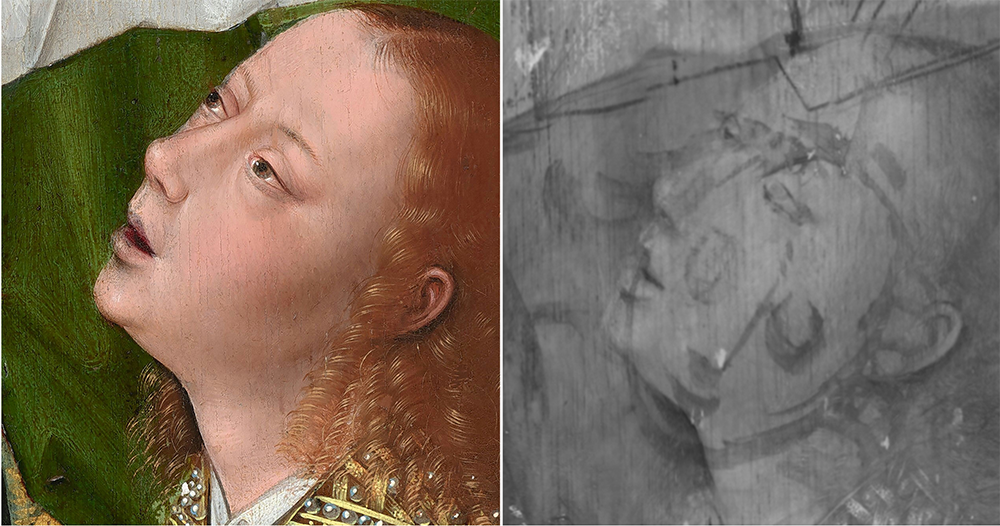
When Sjors Nab was staring at an infrared image of a fifteenth-century painting at three in the morning, he suddenly spotted what looked like a medieval smiley face in one of the underlayers: a simple circle with two eyes, a nose, a mouth, and two big ears. “Someone drew that 550 years ago in the spot where an angel was supposed to be,” Nab laughs. “Later, paint was applied over it. It was never meant to be seen. And suddenly, I’m looking right at it. That’s still amazing.”
A ‘smiley’ as an underdrawing for an angel – IRR (Infrared Reflectography) detail. Master of the Legend of Saint Lucy, Mary, Queen of Heaven, ca. 1485-1500. National Gallery of Art, Washington. Photo and IRR by NGA, Washington.
You call yourself a technical and digital art historian. What does that mean?
“I study paintings using techniques such as infrared and X-ray imaging.” He shows a series of images of the same painting. “Look — here the arch runs slightly higher than in the underpainting, and here the water is painted a bit lower than in the underdrawing.”
You studied the paintings of the Master of the Legend of Saint Lucy. What drew you to him?
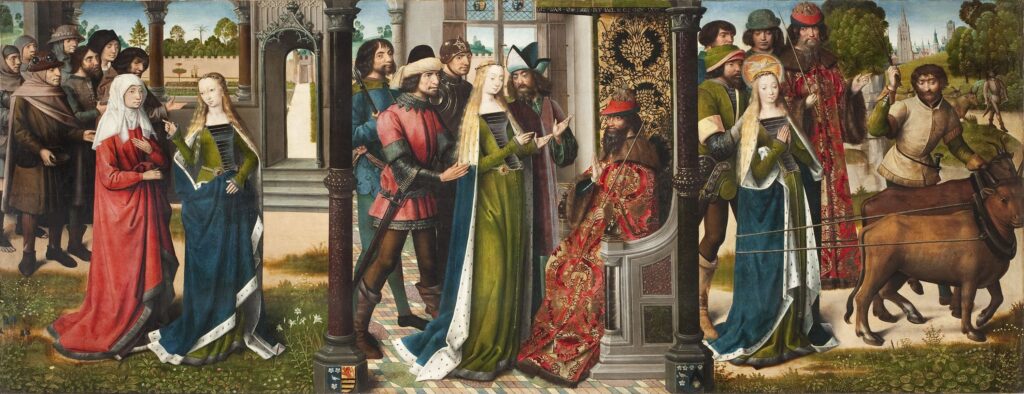
“The Master of the Legend of Saint Lucy — not exactly a name that rolls off the tongue,” Nab laughs, “He’s named after the painting The Legend of Saint Lucy. This master was enormously successful in his day and worked for patrons across Europe. Yet in recent decades he has often been dismissed as a copyist or craftsman, not a true artist.”
Master of the Legend of Saint Lucy, The Legend of Saint Lucy, 1480. Sint-Jakobskerk, Brugge. Photo: KIK-IRPA.
“Van Eyck, Van der Weyden, Bosch, and Bruegel are the big names of fifteenth-century Flemish painting. But I wondered: are they so well-known because they were truly the best, or simply because their names survived? More than three-quarters of the paintings from that period can no longer be linked to a specific painter’s name.”
“Of the ten largest surviving Flemish panel paintings from the fifteenth century, two are by the Master of the Legend of Saint Lucy — or, in short, the Lucia Master. This painter, who hasn’t always been highly regarded in the literature, had a remarkably large production. I wanted to know: do the seventy paintings attributed to him actually belong together? What remains of that corpus if I look purely at the technical aspects of his painting style?”
How did you manage to collect all those works, including the infrared and X-ray images?
“That involved a lot of negotiating and pleading. I spent the first month doing nothing but emailing. Luckily, I had the full support of my thesis supervisor, Daantje Meuwissen, who has a lot of experience with this kind of research. My previous internship at the Royal Institute for Cultural Heritage in Brussels was a key advantage. I had contact with curators at the Prado in Madrid and Museum Boijmans Van Beuningen in Rotterdam. The Prado curator found my research interesting, which meant I could tell other museums: the Prado is already on board! Another advantage was that I was willing to publish my thesis under embargo. In the end, I was surprised by how open most institutions were to collaboration. After all, I was just a master’s student emailing museums around the world.”
What do these techniques reveal?
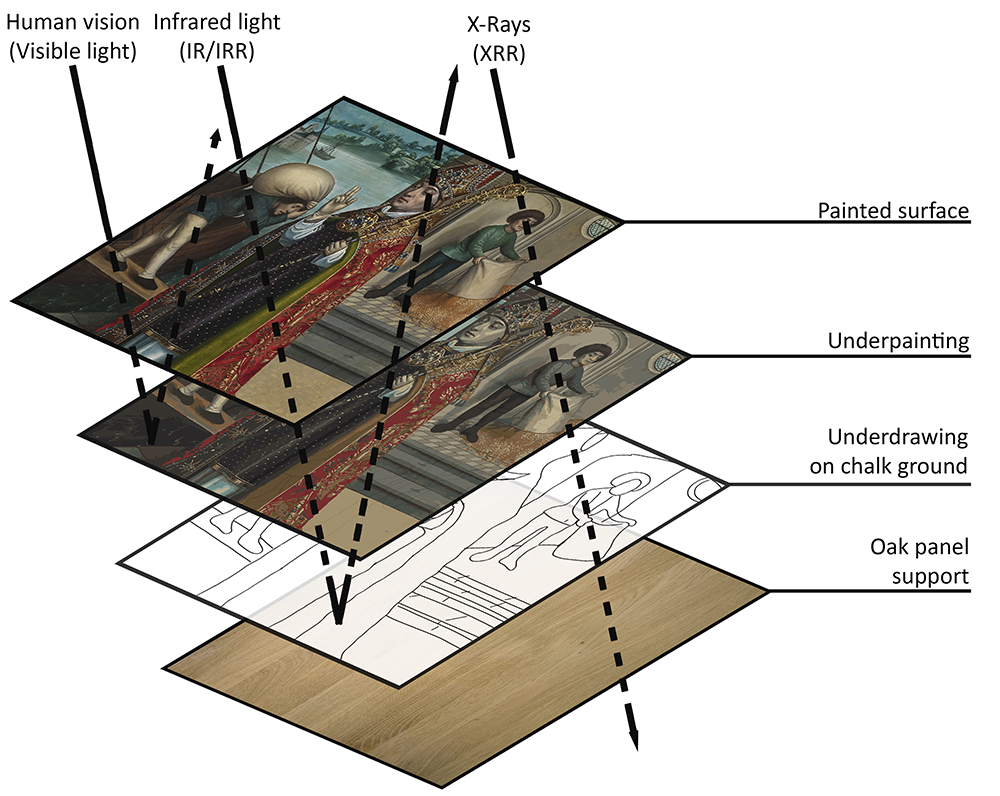
“An X-ray allows you to see through the entire painting, including the wooden panel support. Infrared images show the underdrawing best. I look from back to front: the drawing was made directly on the panel, then came the underpainting, followed by a first layer of paint to define light and shadow, and finally ten to twelve layers of oil paint.”
Different layers visualised by Sjors Nab, based on the St. Nicholas Altarpiece, ca. 1486–1493. Groeningemuseum, Bruges.
“To compare these layers accurately, you need the highest-quality images available. The seventy works I collected varied enormously in quality — from state-of-the-art research photos to a single black-and-white image from 1910. Sometimes you need to draw a few guiding lines. Mostly, it’s a matter of looking for a very long time, comparing all those little squiggles. It’s a kind of guided meditation, really.”
And what have you learned from looking that way?
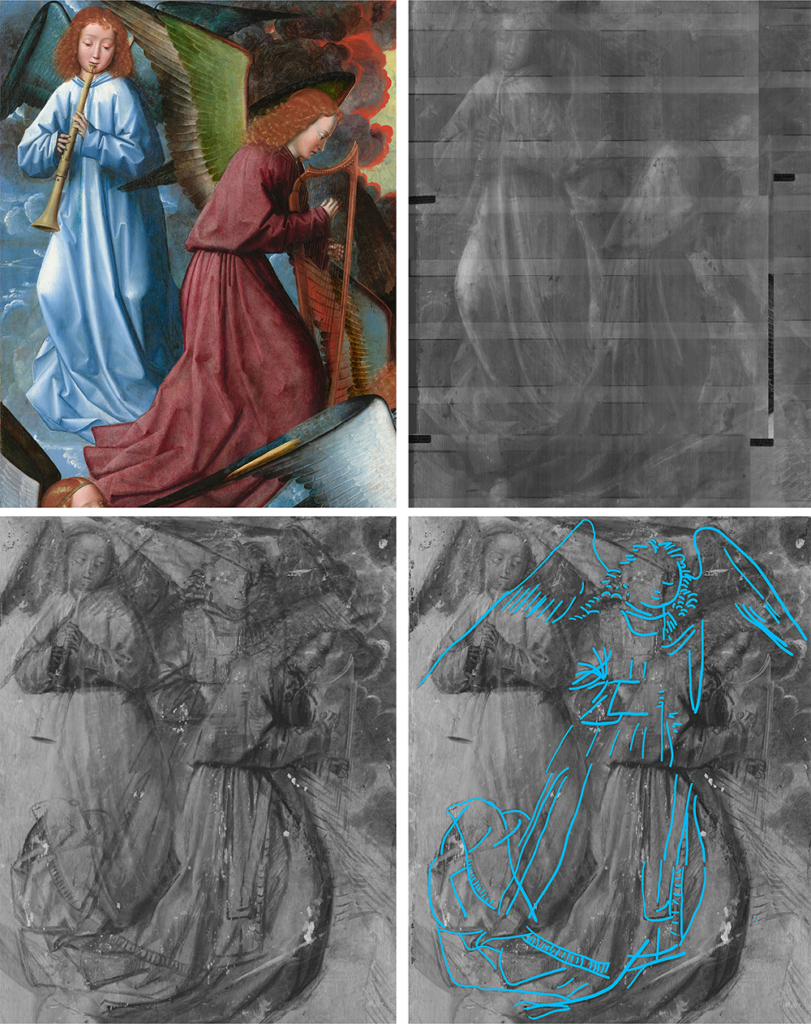
“The changes between layers reveal how a painter worked. Dieric Bouts, for example, we jokingly call the tap-dance master: in his underdrawings you sometimes see eight hundred feet side by side. The Lucia Master, by contrast, followed a very refined process of gradual improvement — an arm becoming slightly thinner with each layer, tiny dots and strokes to indicate shadow. You see continuous small, inventive adjustments. That’s what I call a creative process, not merely copying.”
Where two little angels were eventually painted, only one angel was prepared in the underdrawing – IRR (Infrared Reflectography) and X-Ray detail. Master of the Legend of Saint Lucy, Mary, Queen of Heaven, ca. 1485-1500. National Gallery of Art, Washington. Photo, IRR, and X-Ray by NGA, Washington.
Are all those works rightly attributed to him?
“I now have a good sense of his working method and noticed a technical consistency throughout. You can even see it in his hesitations: the Lucia Master is always fiddling with the little roof above Mary and Child — the arch rises and falls again. So most attributions in art history turned out accurate. But there are two important works that, in my view, don’t fit. Their underdrawings are extensively revised with five or six stages and with endless charcoal reworking. In his other works, there are always just one or two stages. That process is completely different from his other paintings.”
The thesis prize jury wrote: ‘The significance of his study extends beyond this particular painter, because his method within technical art history can also be applied to other oeuvres.’ What does your approach add to existing methods?
“In technical art history, there’s a strong drive toward the newest technologies and highest resolutions. That yields excellent results, but such projects cost millions. I believe you can also achieve a great deal using existing materials if you systematically bring them together and study them consistently.”
What are your next plans?
“I’m going to work as lab manager at Utrecht University’s ArtLab, an innovative research and teaching centre for this kind of study. We’ll be collaborating closely with museums and heritage institutions to tackle their research questions.”
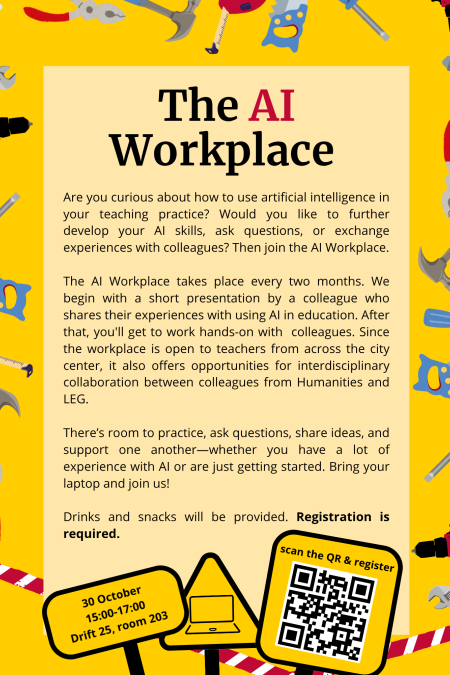
Are you curious about how to use AI in your teaching practice? Would you like to develop your AI skills, ask questions, or exchange experiences with colleagues? Then join the AI Workplace.
The AI Workplace is a new initiative for teachers, co-organized by the Faculty of Law, Economics and Governance (LEG) and the Faculty of Humanities. It focuses on how AI is transforming education and invites teachers to explore the impact of AI in their own teaching practice. By sharing experiences and insights, participants will explore together what is possible – and what works.
What makes this initiative unique is its interdisciplinary character, combining Humanities expertise, such as research on Large Language Models, with insights from social science and law. Vincent Crone, vice-dean of education at the Faculty of Humanities, and Femke van Esch, vice-dean of education at LEG, will be there alternately – to pick up on what is happening.
What to expect
The AI Workplace meets once every two months. Each session begins with a short presentation by a colleague sharing their experiences with AI in education, for example from one of the USO projects on teaching with AI.
After the presentation, participants will get hands-on with colleagues. Since the workplace is open to teachers from across the city center, it creates opportunities for interdisciplinary exchange between colleagues from Humanities and LEG. Each session concludes with informal drinks and snacks.
Whether you are already experienced with AI or just starting out, the AI Workplace offers room to practice, ask questions, share ideas, and support one another. Bring your laptop and join!
Op 4 november 2025 organiseren SETUP en SURF de jaarlijkse Privacyrede in de theaterzaal van de Neude Bibliotheek in Utrecht. Dit jaar staat het thema leerlingvolgsystemen centraal. Scholieren krijgen het woord om zélf te vertellen hoe het is om op te groeien met Magister.
Scholieren over opgroeien in digitale systemen – en wat volwassenen daar niet aan begrijpen.
Met systemen als Magister en Somtoday kunnen ouders het schoolleven van hun kind tot in detail volgen. Die continue zichtbaarheid heeft ingrijpende gevolgen voor de relatie en communicatie tussen ouder en kind.
Tijdens de privacyrede ‘Nooit meer pauze!’ delen scholieren en docenten hun ervaringen, waaronder docent Stijn Uittenbogaard. Hij kwam vorig jaar landelijk in het nieuws met zijn experiment om ouders te weren uit Magister.
Over de Privacyrede
De Privacyrede is een jaarlijks evenement van SETUP en SURF om een podium te bieden aan personen die een vernieuwende blik werpen op de maatschappelijke gevolgen van technologie.
Gratis kaarten
Het CDH stelt 40 gratis kaarten beschikbaar. Wil je erbij zijn op 4 november? Stuur een mail naar cdh@uu.nl. Op = op!
Do you have ideas on how to engage your fellow humanities students with Digital Humanities (DH)? Would you like to organise a student activity that brings DH to life? The Centre for Digital Humanities (CDH) is looking for a Student Ambassador (0.1 FTE) to help involve students in CDH activities.
Humanities researchers, lecturers, and students are increasingly working with digital methods, to study culture, language, media, and history. Skills such as data analysis, visualisation, and digital archiving open up new research possibilities — and are valuable additions to your thesis and CV.
Through the CDH training programme, students can learn to code, work with social media data and AI, and other digital tools — alongside lecturers and researchers. There is also a special grant available specifically for students.
If you have ideas on how to better reach, inspire, and support students within the Faculty of Humanities, then apply now to become a CDH Student Ambassador!
What will you do?
Organise one student-focused activity or event per quarter on a DH-related topic;
Contribute ideas and suggestions for the CDH training programme;
Help promote CDH activities and content through blogs, interviews, and other communication channels.
Who are we looking for?
A third-year Bachelor’s student or (R)MA student in the Faculty of Humanities at Utrecht University;
A proactive person who enjoys developing and realising their own ideas, with practical support from the CDH core team.
Practical information
Appointment: paid student assistant position (0.1 FTE, equivalent to 4 hours per week and approximately €310 per month) for a period of six months, with possible extension;
Start date: 1 February 2026
Work location: flexible workspace at the CDH office on the Drift, or from home.
Interested?
Send your CV and a short plan (400–600 words) outlining what you would like to achieve as a CDH Student Ambassador to cdh@uu.nlby 1 December 2025. Applications will be evaluated based on the following criteria: CV; Alignment with the CDH mission; Feasibility of the proposed plan.
The Centre for Digital Humanities (CDH) has expanded its Small Grants programme, offering support for both teachers and students to engage with digital humanities methods and courses. The programme supports teachers in enhancing their courses with digital humanities methods and developing their own digital skills, and now also includes a new grant specifically for students.
Small grants for teachers
Within the Faculty of Humanities, digital literacy has recently been formally integrated into the bachelor programmes. The Course Enhancement Grant supports teachers who wish to enhance their courses by incorporating digital humanities methods.
The Expanding Teachers’ Digital Skills Grant provides funding for teaching staff who want to develop or expand their digital humanities expertise by taking part in external trainings or courses.
Finally, the DH Activities Grant offers funding for organising activities such as workshops, seminars, or guest lectures that focus on digital humanities topics.
New: Student Grant
A new addition to the programme is the CDH Student Grant. Since 2024, the CDH has been expanding its activities to include not only researchers and teachers within the Faculty of Humanities, but also students. This Small Grant supports students who wish to present their work that includes a substantial digital humanities component – whether in the form of a paper, poster, demo, or other contribution – at a conference, seminar, workshop, or other event.
For more information on the different grant options and application details, visit our Small Grant page.
The Centre for Digital Humanities (CDH), together with five partners, has received NWO funding to establish a new summer school on research software in 2026. The programme will give researchers in the humanities and social sciences the opportunity to deepen their programming skills and learn how to integrate software into their own research projects.
The summer school curriculum is currently being developed by experts from the CDH Research Software Lab and Data School. The programme is open to around 30 participants, ranging from PhD candidates to professors in the humanities and social sciences from Dutch universities and research institutes.
Titled Research Software Summer School: Going Beyond Notebooks, the programme is aimed at researchers with some prior coding experience who want to broaden their programming skills. A defining feature of the programme is that participants will work directly on their own research projects. Rather than receiving generic training, they apply newly acquired software skills and digital methodologies to their specific research questions and source materials. By the end of the programme, they will not only be able to create their own software solutions to research problems, but will also use preceding work by other scholars to develop improved solutions, and even contribute to the open-source software landscape.
Partners
The summer school is organised in collaboration with ODISSEI, KNAW Humanities Cluster, CLARIAH, Tilburg University, and eScience Center, alongside the CDH Research Software Lab and Data School.
Registration
The summer school will run from 29 June to 3 July 2026. To receive a one-time notification when registration opens, send an email to cdh@uu.nl.
This event is part of the project “Daidalos – A Social Sciences and Humanities Training on Research Software” (file no. ICT.TDCC.001.006), funded in part by the Dutch Research Council (NWO) through the Thematic Digital Competence Centre Social Sciences & Humanities (TDCC-SSH).
Our four-day entry-level Python course filled up quickly this Autumn. To acommodate the high interest, we are offering an additional course on four consecutive Wednesdays, from 5 to 26 November 2025.
Het Research Software Lab (RSLab) en Florian Kunneman zoeken een student-assistent voor 4 uur per week om te helpen met onder andere het voorbereiden van experimenten en interviews en het testen van een spraakassistent.
Het RSLab ondersteunt onderzoekers door op maat gemaakte softwareoplossingen te ontwerpen. Voor een project waarin wordt onderzocht of een spraakassistent van waarde kan zijn voor mensen die moeite hebben met digitale processen zoeken wij een:
Student-assistent (gemiddeld 4 uur per week, van 1 november 2025 tot 1 februari 2026 met mogelijkheid tot verlenging)
Wat ga je doen?
In kaart brengen van de acties die nodig zijn om een tweetal digitale procedures te doorlopen (waterstand doorgeven en ov-reis plannen);
In kaart brengen van het design van de webinterfaces die gebruikt worden bij dergelijke procedures;
Uittesten van de spraakassistent;
Assisteren bij een pilot studie met de doelgroep, waarbij je de rol van de chatbot speelt;
Voorbereiden van interviewvragen;
Assisteren bij het experiment;
Nalopen van automatische transcripties van interviews;
Annoteren van interacties en interviews.
Wat heb je nodig?
Een inschrijving als student aan een Nederlandse universiteit gedurende de periode van de aanstelling;
Interesse in de combinatie van AI en communicatie;
Interesse in diverse aspecten van onderzoek (ontwikkeling van materiaal, ontwikkeling van meetinstrumenten, analyse);
Een zelfstandig, secuur en planmatig karakter.
Wat levert het op?
Je leert:
werken in een klein team;
eigen verantwoordelijkheid nemen;
ontdekken waar je zelf goed in bent;
methoden en valkuilen in experimenteel onderzoek;
de universiteit vanuit een andere hoek kennen.
Als student-assistent verdien je afgerond tussen de 290,- en 303,- euro bruto per maand als je 4 uur per week werkt (0,1 fte), afhankelijk van je tot nu toe behaalde studiepunten. De functie is in eerste instantie beschikbaar voor 3 maanden vanaf 1 november, met mogelijkheid tot verlenging.
Solliciteren?
Zie jij een functie als onderzoeksassistent als een waardevolle toevoeging aan je studie? Ligt de combinatie AI en communicatie jou, en ben je benieuwd hoe op maat gemaakte software onderzoek kan ondersteunen?
Stuur een email naar dr. Florian Kunneman (f.a.kunneman@uu.nl) met een korte motivatie en een CV voor 26 september.
If your research requires the development of advanced research software, and if you think the research community in general would benefit from that software, then this call is for you.
The Netherlands eScience Center supports researchers from all disciplines by creating tailor-made research software: digital tools that contribute to answering research questions by creating and/or analysing research data and research results.
This call for proposals supports research that has an urgent methodological research challenge: a concrete research problem that requires a digital solution in the form of a software tool (code, scripts, packages, libraries, programmes, etc).
On 4 September there is an online information event to inform interested applicants about the eScience Center and the specifics of this call.
The call is now open, and closes on 13 October at 14:00 hours.
As part of the UU city centre renovation project, the renovation of Janskerkhof 13/13a is due to start in 2026, its completion planned for 2029. ILS Labs are therefore in need of relocation. After careful consideration and examination of several buildings in the city centre, it has been decided that the Labs will be permanently relocated to Drift 10.
While we at the CDH regret that Drift 10 cohabitants Education Support and Student Affairs (OSZ) will need to move to Drift 15 to accommodate this change, we welcome the arrival of the ILS labs into closer proximity with other CDH teams. The relocation is an opportunity to update and future-proof the lay-out of the labs, as well as providing even more opportunities for collaboration between the different CDH teams.
The relocation process will take some time. There is construction work to be done to fortify the floors before the sound-proof booths can be installed: construction is expected to be finished in the first half of 2026. ILS labs will then begin moving gradually from early next year, with labs moving booth-by-booth, experiment-by-experiment. This ensures that currently running experiments can finish up over the next few years, while new experiments can start up in Drift 10.

 登录
登录