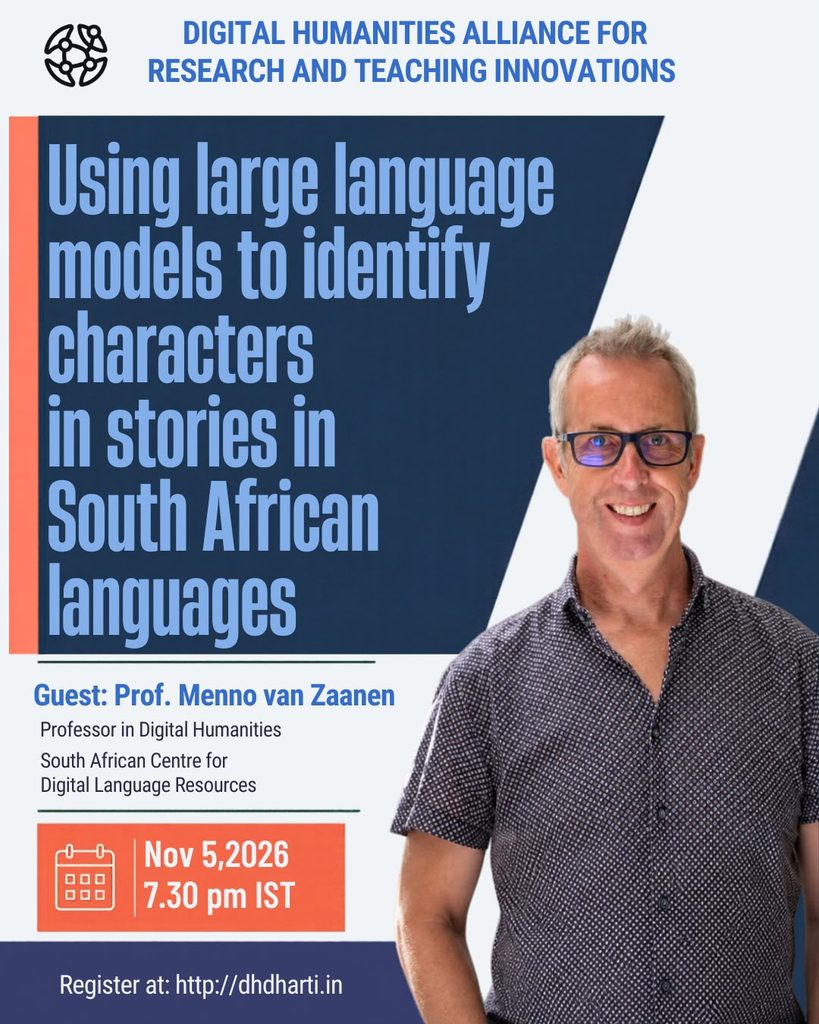
The Digital Humanities Alliance for Research and Teaching Innovations (DHARTI) is pleased to announce the seventh talk in its DHARTISpeaks! series. This session will feature Prof. Menno van Zaanen, Professor in Digital Humanities at the South African Centre for Digital Language Resources.
Titled “Using Large Language Models to Identify Characters in Stories in South African Languages”, the talk will explore the use of large language models (LLMs) for identifying characters in stories written in South African languages. The session will consider how emerging language technologies can contribute to the computational analysis of literary narratives, particularly in multilingual contexts.
Event Details
Date: 5 November 2026 (Thu.)
Time: 7:30 pm (IST) onwards
Speaker: Prof. Menno van Zaanen (South African Centre for Digital Language Resources)
To learn more about the speaker and his work, visit Prof. van Zaanen’s website here.
We invite researchers, students, and anyone interested in digital humanities, computational literary studies, and language technologies to join us for the session.
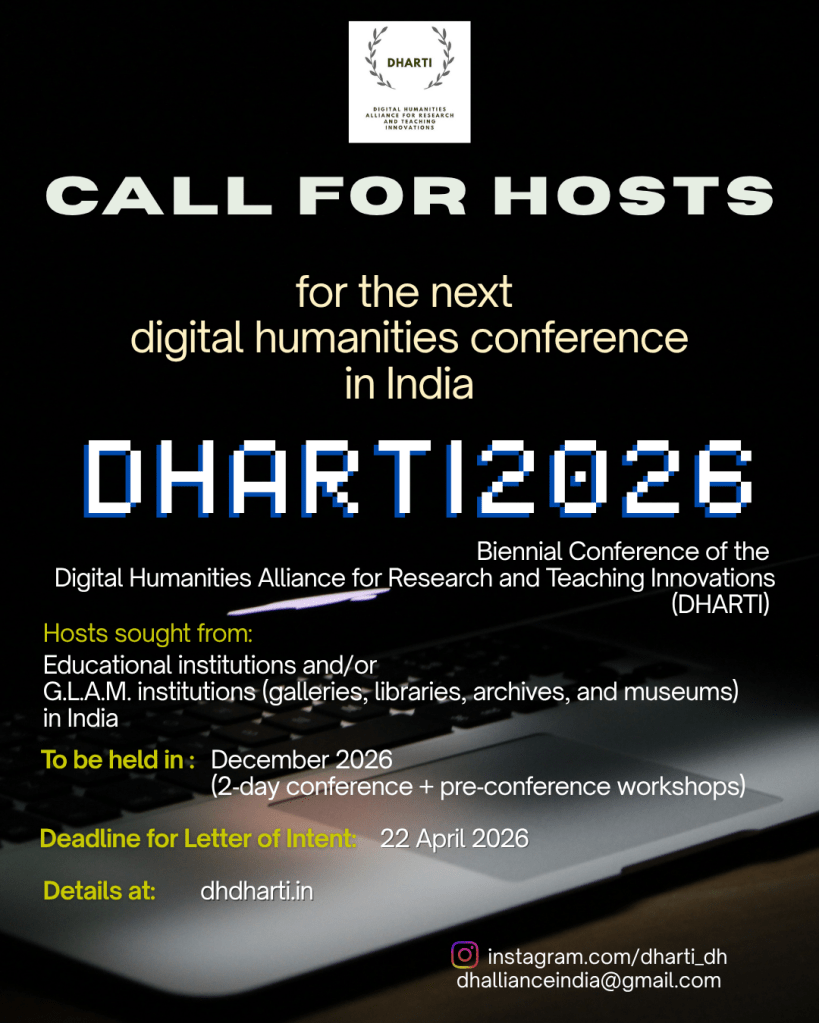
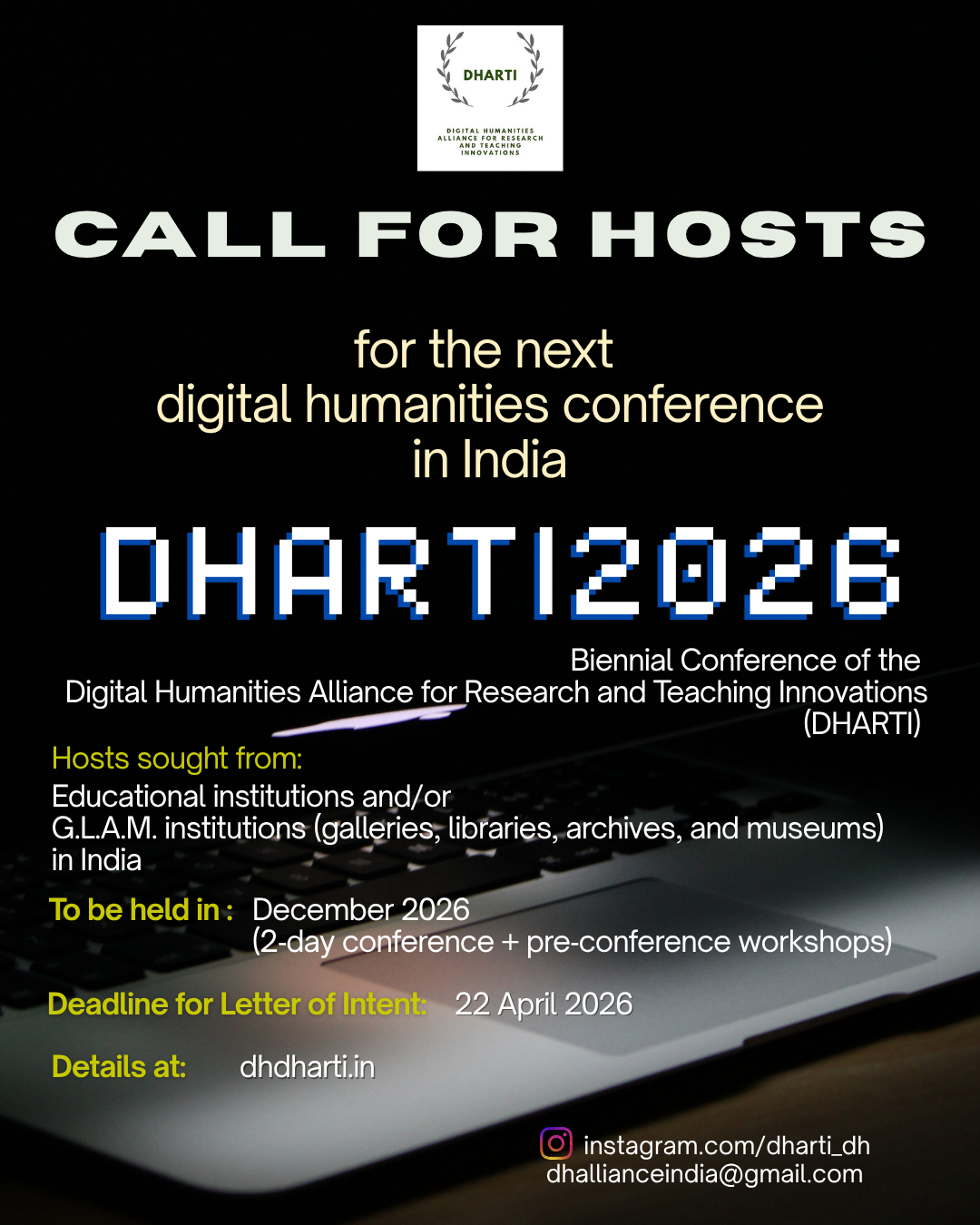
The Digital Humanities Alliance for Research and Teaching Innovations (DHARTI) is seeking proposals from educational institutions and/or stakeholders from the G.L.A.M. [galleries, libraries, archives, and museums ]sector in India to host the DHARTI 2026 biennial conference scheduled to take place in December 2026.
Based on the previous conferences organised under the aegis of DHARTI, DHARTI 2026 will be:
A 2-day conference with multiple parallel sessions
Accompanying pre-conference workshops
A respectful, collaborative platform stimulating debates on past, present, and future of Digital Humanities in India in all configurations
ORGANIZATIONAL CONTEXT AND BRIEF OVERVIEW OF PAST CONFERENCES
The Digital Humanities Alliance for Research and Teaching Innovations or DHARTI, is an initiative toward organizing and facilitating digital practices in arts and humanities scholarship in India, both within and beyond academic institutes. DHARTI is India’s first Digital Humanities Collective and is affiliated as a Constituent Organization of the The Alliance of Digital Humanities Organizations (ADHO) DHARTI, in its previous avatar as the Digital Humanities Alliance of India (DHAI) successfully held its inaugural conference in June 2018 at IIM Indore, which was organized jointly by IIM Indore and IIT Indore. The two-day conference with the theme: “Contestations, Connections and Collaborations” saw participation from more than 50 national and international delegates from 16 Indian states and 5 countries. DHARTI 2020 conference organized as India’s first twitter conference in January 2020 that also saw tremendous participation from DH enthusiasts from across the world.
The second DHARTI 2022 biennial conference was held from February 21 to 25, 2022, with the theme: “The Digital Divides: Discontents, Debates and Discussions” and with the aim to acknowledge the vertiginous divides, celebrate the productive debates, and encourage new models of thinking about humanistic inquiry in a post-Covid digital landscape. Thus far, participation at all DHARTI events has been transdisciplinary with representation from diverse disciplines including (but not limited to) Language, Literature, Visual Art, Performance / Theatre Studies, Media Studies, History, Sociology, Psychology, Language Technologies, Library Studies, Methodologies as well as Software and Critical Computational Studies. These modes of participation are representative of the aims of DHARTI, namely, to provide a methodological commons to promote and accommodate the diverse nature of DH studies within the Humanities, Social Sciences, and beyond through interdisciplinary research and pedagogy. DHARTI also aims to foster connections and associations with fellow DH organizations from the Global South that are similarly committed toward a decolonized praxis of DH.
The third DHARTI 2024 biennial conference was held from 10–13 December 2024 at IIT Jodhpur, with the theme “Digital Subject/ivities in the Global South.” The conference brought together scholars, practitioners, and students to discuss emerging methods, pedagogies, and critical debates in Digital Humanities within Global South contexts.
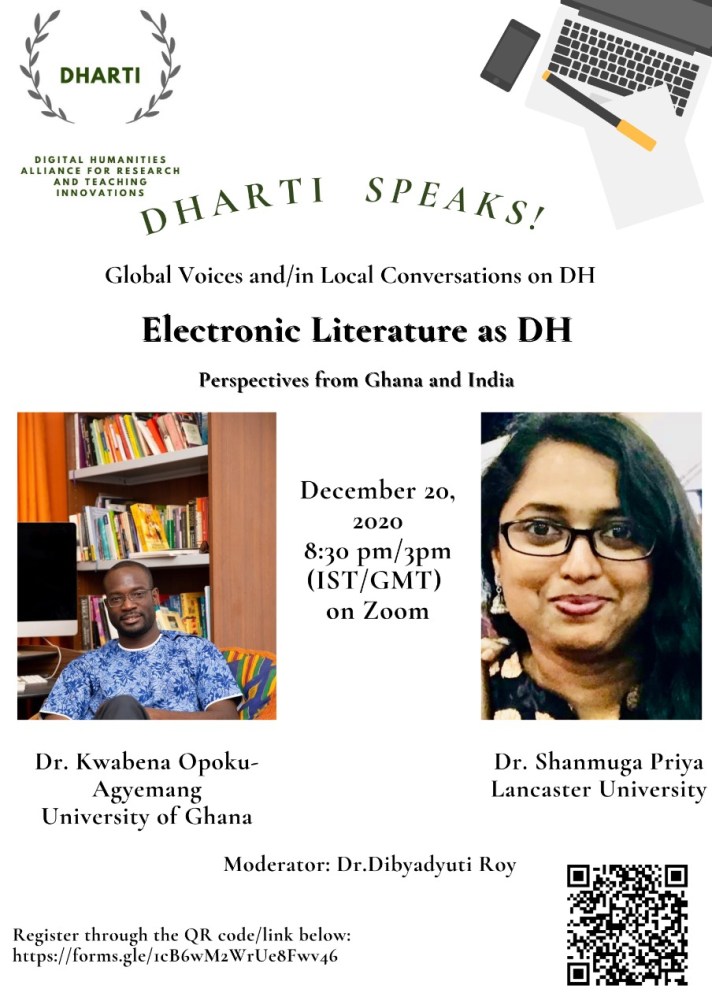
Besides conferences, DHARTI also conducts workshops and talk series. In July 2020, a DHARTI panel on “Toward a Postcolonial/Decolonial Digital Humanities” for DH2020 was held online, streamed live on YouTube, and archived on the Humanities Commons Portal. In December 2020, DHARTI launched the DHARTI Speaks! Webinar series with a talk on Electronic Literature as DH-Perspectives from Ghana and India. In August and September 2025, the talks on electronic literature and AI were conducted as part of the series and we have an upcoming talk series which will be regularly posted on our website. This online series aims at facilitating a sustained dialogue between Global Voices and/in Local Conversations on the Global South.
We are particularly interested in proposals from institutions/ groups of institutions that:
Have developed or are developing digital humanities communities and organizations
Have not previously hosted a DH conference and/or
Are interested in developing new modes of engagement for DH
Are similarly committed toward a decolonized praxis of DH
Scope of Proposal
The selected educational institution(s) and/or stakeholders from the G.L.A.M. [galleries, libraries, archives, and museums ]sector will be responsible for the following:
Event Planning
Develop the conference website, a comprehensive event plan outlining key milestones, and timelines.
Coordinate with DHARTI functionaries to understand the conference objectives, theme, and target Audience.
The academic aspects of the conference, including overall intellectual direction, will be overseen by the DHARTI Governing Body. The members from the host and DHARTI Governing Body members will be in the programme committee.
Venue Selection and Logistics
Identify and secure a suitable venue that aligns with the conference requirements for Hybrid (if preferred) and offline participation (including room sizes and technical capabilities, hotel, options for student housing, and other accommodations, arrangements for access accommodations
Manage logistics, including audio-visual equipment, catering, signage, and seating Arrangements.
A decision regarding the inclusion of hybrid participation will be made jointly by DHARTI and the host[s]. If hybrid options are adopted, the host[s] must ensure conducive facilities and reliable technical infrastructure for seamless online and offline engagement.
The decided number of participants will be based on the capacity of the host.
Program Development
Collaborate with DHARTI functionaries to create a diverse and engaging conference program.
Source and coordinate speakers, panelists, and workshop facilitators. DHARTI will liaison with the keynote speakers.
Marketing and Promotion
Develop promotional strategies to promote the conference and invite participation.
Create promotional materials, including brochures, banners, and online content.
Registration and Attendee Management
Implement an efficient registration system for participants.
Handle attendee inquiries and manage participant communications.
Sponsorship and Exhibitor Coordination
Secure sponsorships and manage relationships with sponsors.
Coordinate exhibitor logistics, including booth assignments and setup.
Financial structure will be mutually decided.
DHARTI may offer a few bursaries for the presenters.
On-Site Management
Oversee on-site logistics and ensure smooth event execution.
Provide event staff for registration, information, and support.
Post-Event Evaluation
Collect feedback from participants, sponsors, and exhibitors.
Prepare a comprehensive post-event report, including recommendations for future conferences.
Proposal Submission: Interested institutions are invited to submit a letter of intent that addresses their suitability for hosting the conference as well as a few proposed conference themes. Thereafter, a detailed proposal should be submitted.
The proposal should include the following:
Institutional background and experience in conference planning
Suggestions for conference theme and subthemes
Proposed event plan and timeline
Budget estimate, including a breakdown of costs and sources of funding.
Previous experience with similar events and references
Marketing and promotional strategies
Submission of Letter of Intent: 22 Apr 2026 Submission of Detailed Proposal: 8 May 2026 Proposal Submission Address: dhallianceindia@gmail.com
Proposals will be evaluated based on the following criteria:
Access for attendees with disabilities is mandatory at all venues and events associated with the conference. This includes accommodations in presentation rooms for participants who are sight- and/or hearing-impaired. If excursions cannot be made accessible to people with disabilities, this should be clearly noted in the registration materials.
Experience and expertise in conference planning and event management. Proposed budget and cost-effectiveness. References and past performance. Marketing and promotional strategies.
DHARTI reserves the right to reject any or all proposals or to negotiate separately with educational institutions deemed to be the most qualified.
We look forward to receiving your proposal.Sincerely, DHARTI Governing Body dhallianceindia@gmail.com
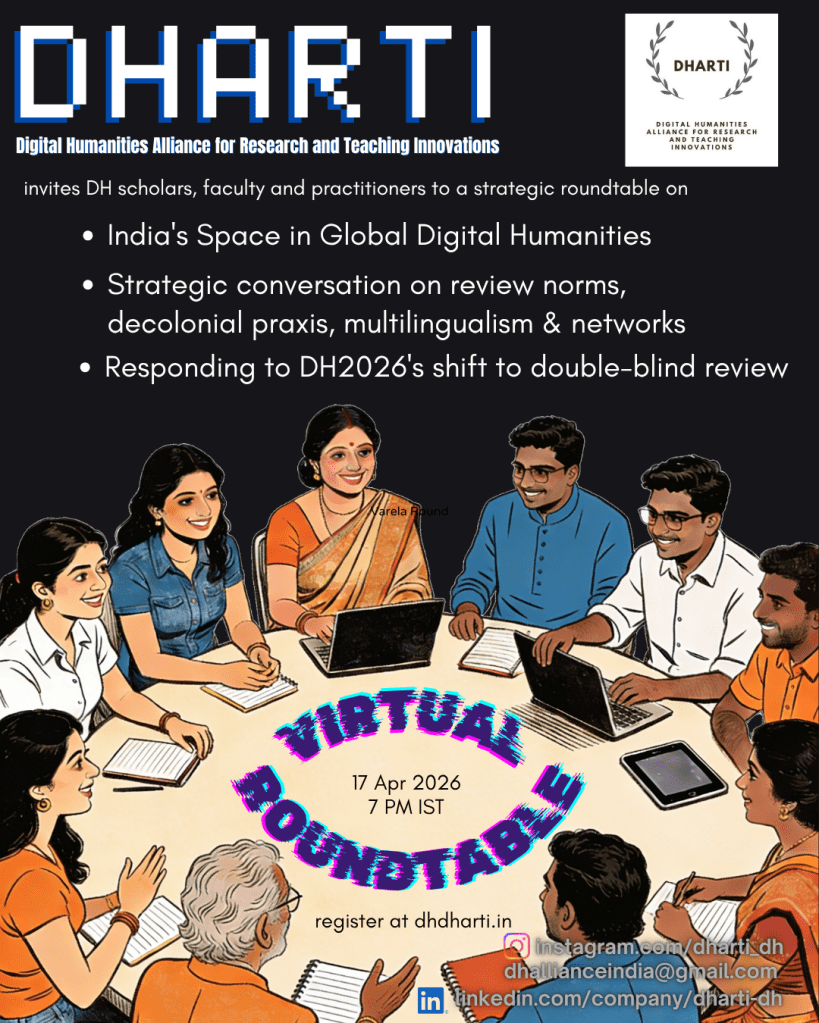
The DHARTI Governing Body invites scholars, faculty, and practitioners to a strategic conversation on India’s evolving role in the international DH community and how DHARTI can deepen digital humanities work across India.
The recent ADHO decision to adopt double-blind review for DH2026 has sparked essential global discussions about fairness, inclusion, and review practices. This is our moment to articulate Indian perspectives on:
What unique contributions can India bring to global DH from the Global South?
How do multilingualism, decolonial approaches, infrastructure needs, and interdisciplinary networks shape our work?
What role can DHARTI play in mentoring, networking, and amplifying Indian DH internationally?
Who should join: Leaders from humanities, social sciences, libraries, and technology shaping DH ecosystems in India.
Concept Note Undergraduate humanities education in India has historically trained students within single-disciplinary silos. The engagement in the field of humanities has transformed with the advent of the digital tools and the interlinked spaces, breaking disciplinary boundaries and connecting, overlapping teaching-learning and research. This summer school proposes to address the possibilities of the ever expanding […]
DHARTI is pleased to announce that the DHARTI2026 Biennial Digital Humanities Conference will be hosted by Kalinga Institute of Industrial Technology (KIIT), Bhubaneswar, in December 2026.
Friday, April 17, 2026 | 7:00 PM IST | Virtual The DHARTI Governing Body invites scholars, faculty, and practitioners to a strategic conversation on India’s evolving role in the international DH community and how DHARTI can deepen digital humanities work across India. The recent ADHO decision to adopt double-blind review for DH2026 has sparked essential […]
The Digital Humanities Alliance for Research and Teaching Innovations (DHARTI) is seeking proposals from educational institutions and/or stakeholders from the G.L.A.M. [galleries, libraries, archives, and museums ]sector in India to host the DHARTI 2026 biennial conference scheduled to take place in December 2026. Based on the previous conferences organised under the aegis of DHARTI, DHARTI […]
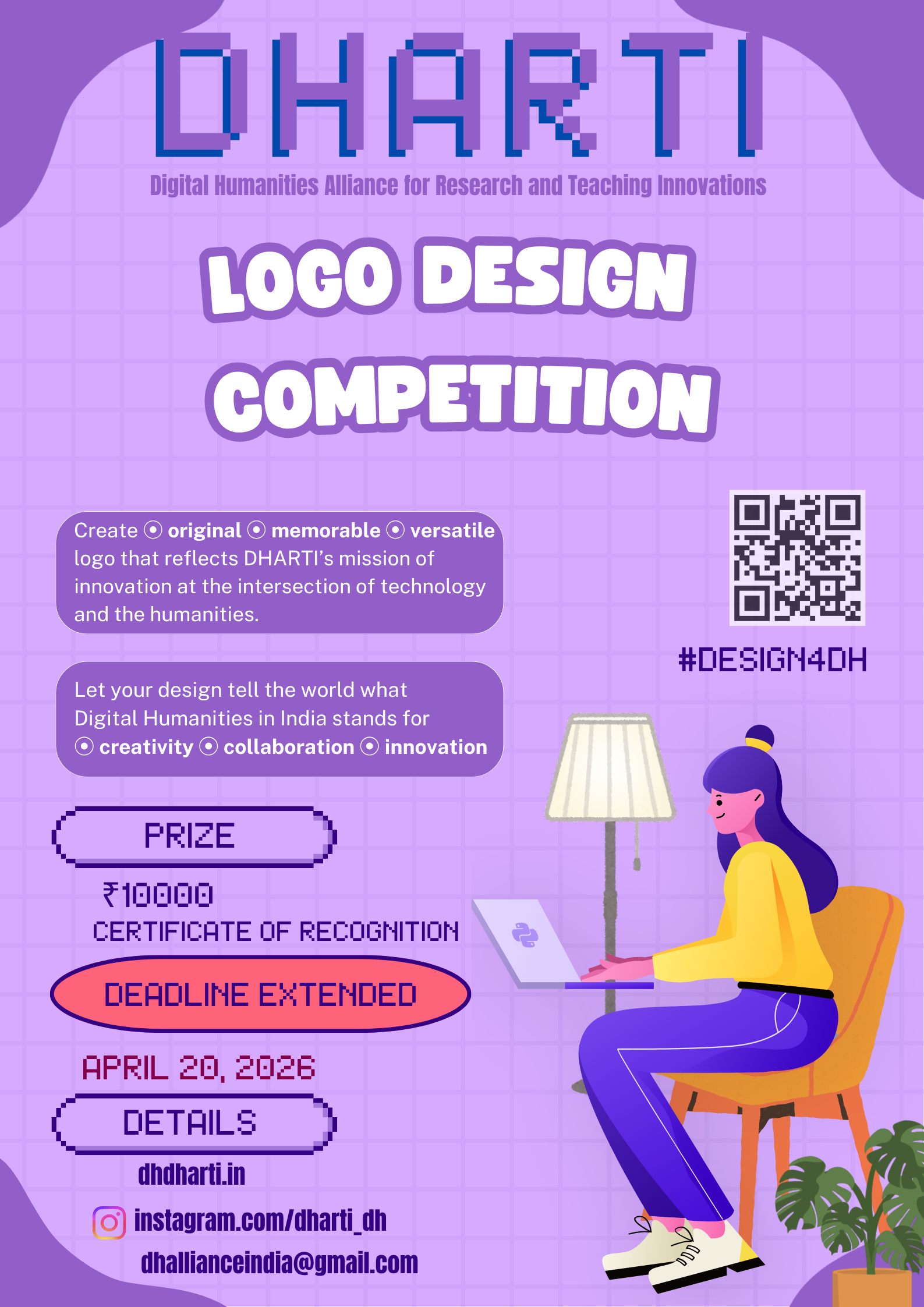
Dharti We are pleased to announce an exciting opportunity to design a distinctive logo that will represent our organization globally. Deadline Extended! About UsDHARTI, a registered Non Profit organisation in India, is an initiative towards enabling and facilitating digital practices in arts and humanities scholarship in India, both within and beyond academic institutes. As an […]
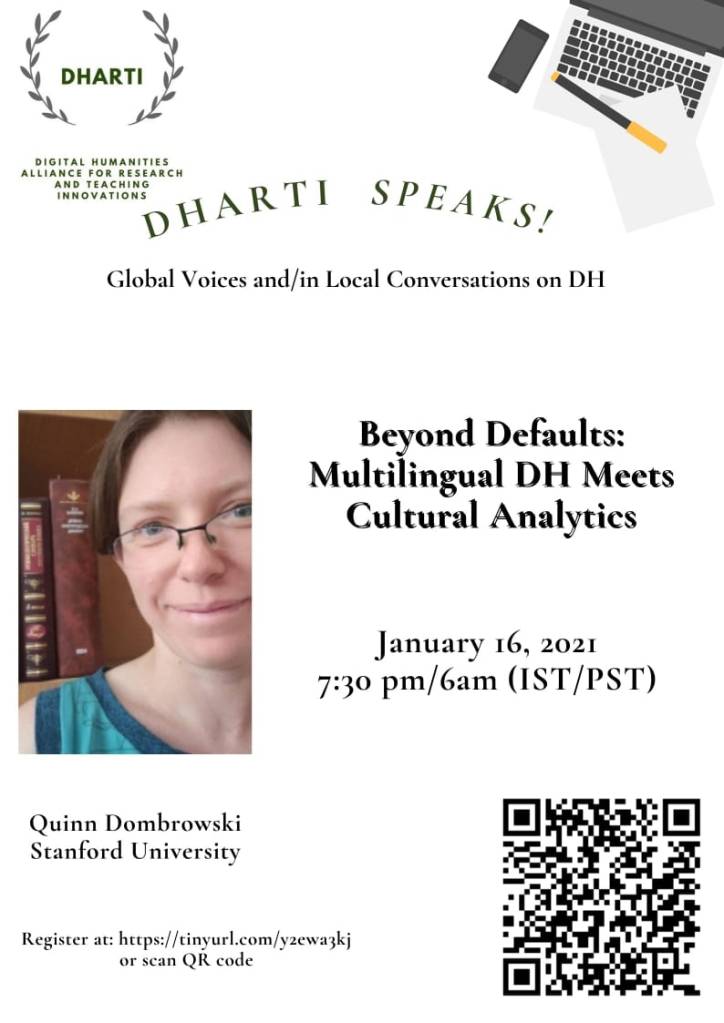
Chapter 2 Digital humanities methods have seen increasing adoption both globally, and in non-textual media. While some DH approaches, such as the creation of digital “archives” (understood in many different ways) and “editions”, have been comparatively easy to translate into different cultural and institutional contexts, computational textual analysis is often seen as a bastion of […]

 登录
登录