阅读视图

AI and the humanities: Across the Princeton campus, an era of collaboration is underway

By Allison Gasparini, Center for Statistics and Machine Learning, and AI Lab

Originally published on the Princeton homepage.

With the launch of the Princeton Laboratory for Artificial Intelligence and the New Jersey AI Hub, over the last few years Princeton University has firmly established its presence at the forefront of artificial intelligence research — including transformative work in humanities scholarship. 

From piecing together fragments of ancient texts with language models to exploring the future of human-robot interactions, Princeton scholars aren’t just exploring what AI can do for the humanities. They’re uncovering what the humanities can do for AI.

Already, AI tools are appearing in all facets of our society and culture. “It’s the world that our kids are going to inherit,” said Meredith Martin, professor of English, faculty director of Princeton’s Center for Digital Humanities (CDH) and a grant recipient from the international Schmidt Sciences Humanities and AI Virtual Institute. “We should try our hardest to put the humanities into every aspect of AI development, not only in the input data and the interpretation of the results,” she said.

Princeton humanities scholars had already been using machine learning in their research — largely by partnering with the robust community of humanities research software engineers and digital humanities experts at CDH, established more than a decade ago. And now, with the AI Lab, they are proving to be some of the best positioned collaborators for the future of humanities and AI. 

“Our goal in the AI Lab is to support the transformative impact of AI on research across the Princeton campus, and we’re excited about the many opportunities to do so in the humanities,” said AI Lab Director Tom Griffiths.

“The most valuable and productive relationship between artificial intelligence and humanistic research is collaboration,” said Rachael DeLue, director of the University’s sweeping new Humanities Initiative. Here, a sample of the scholarship now underway.

Insights into ancient texts

Split image showing a seated person indoors in a jacket and collared shirt on the left, and a close-up of a printed page with large Chinese characters and vertical columns of text on the right.

Photo by Matthew Raspanti, Office of Communications

Paul Vierthaler uses machine learning to study premodern Chinese books such as “Xianqing ouji 閒情偶寄 (Leisure Notes),” a collection of essays published in 1671, pictured at right.

Fifteen years ago, Paul Vierthaler became fascinated by a particular figure common in Ming and Qing dynasty literature. Wei Zhongxian, a late Ming dynasty eunuch, nearly took over the imperial government in the 1620s. His infamy became such that within a year of his death, half a dozen novels and unofficial histories on his exploits had already been published. “I became really interested in how people talk about historical events within so-called ‘unreliable genres,’” said Vierthaler.

Studying the historical figure of Wei and the stories he’d inspired raised new questions for Vierthaler: How common were these types of narratives in imperial China? What more could be learned from studying bibliographic information, and how could he even begin to study that information at scale? “I realized, if I wanted to try to get a grip on how these kinds of narratives existed in the Chinese literary tradition, I needed to start thinking more broadly,” he said.

The realization led Vierthaler, now an assistant professor of Chinese literature and interdisciplinary data science, to the global catalog WorldCat, which holds digitized bibliographic records from tens of thousands of libraries around the world. To grapple with the vast amounts of data, Vierthaler turned to computational methods and machine learning/AI — which has altered the scope of his work.   

Using machine learning to analyze and extract data from written descriptions of premodern Chinese books — which may include information on author, illustrations, content and more — Vierthaler initially set out to understand whether genres containing suspect stories about historical events increased or decreased in popularity over time. But soon his focus expanded. “It’s exploded into a much larger project when I began to apply these same tools to digitized versions of the books themselves,” he said.

More recently he has been using machine learning methods to study the likely authorship of anonymously published works and to detect historical documents inserted into novels. With the advent of transformer-based language models, Vierthaler is now training specialized language models on premodern Chinese corpora, hoping to pick up minute nuances in the texts he studies. “There’s a movement now in the humanities aimed at training much more targeted, bespoke smaller language models,” Vierthaler said.

Instead of training bigger and bigger models, Vierthaler’s work has wider implications for using custom training sets to capture and retain the nuance necessary for the study of culture. “Humanities scholars can bring an understanding of the historical background and composition of training materials, which can help identify blind spots that might have otherwise been missed,” he said.

That same movement for highly specialized language models drives the work of Marina Rustow, the Khedouri A. Zilkha Professor of Jewish Civilization in the Near East and professor of Near Eastern studies and history. Rustow is training a model designed to transcribe fragments of medieval texts — and save humans time-consuming, painstaking labor.

Split image showing a fragment of a handwritten manuscript with dense script on the left and a person seated on a wooden floor by a window on the right, holding a small object beside a patterned surface.

Geniza fragment courtesy of Cambridge University Library. Photo: Sameer A. Khan.

Left: A government decree from the Fatimid period in Egypt (969–1171) shows the original Arabic inscription with wide line spacing. Right: Marina Rustow.

Rustow runs the Geniza Lab, a group dedicated to studying an enormous cache of paper and parchment recovered from a medieval synagogue in Cairo. The documents are unique because, unlike most ancient texts preserved today, they’re not the work of society’s elites and philosophers. They’re everyday records from the masses, things like complaints about business travel, heated personal letters and descriptions of stomachaches.

The fragments offer a broad perspective of society in that period, which is invaluable to Rustow as a social historian of the medieval Middle East. But they’re written in dialects of Arabic, Hebrew and Aramaic no one speaks today and in handwriting that can border on illegible.

Rustow said it can take her two full days to transcribe just one document. She hopes the machine learning model she’s training will turn that around for the 36,000 Geniza fragments that she and her colleagues have uploaded to the Princeton Geniza Project database for public access. 

Since the Geniza’s discovery in 1896, “it has taken researchers 130 years to transcribe 7,000 documents, and we have another 29,000 documents to transcribe,” said Rustow. With machine learning, she hopes to save scholars 530 years of transcription drudgery.

Like Rustow, Barbara Graziosi is on a mission to make premodern texts free and accessible for all. “Ideally, I’d like to see everything that we have from before the invention of printing preserved, made accessible, translated, well edited, well understood and well studied,” said Graziosi, the Ewing Professor of Greek Language and Literature and professor of classics.

Split image of a person reading a large historic book in a library setting and a close-up of hands pointing to lines of text in an open manuscript.

Photos by Denise Applewhite, Office of Communications

Barbara Graziosi uses AI as a "collaborator" to study ancient texts, including this 13th-century Byzantine manuscript of Aristotle's "Organon" from Princeton's Special Collections.

Graziosi is contributing to that mission by filling in the gaps of fragmented ancient Greek text. Over millennia, words and phrases written on documents are lost, chewed away by mice, eroded by moisture or obscured by stains. When a student approached her and suggested — before the advent of ChatGPT — that language modeling could generate suggestions to fill the gaps in these papyri, Graziosi began work on a machine learning tool attuned to the nuances of ancient Greek. The result of that work is the Logion Project, which Graziosi leads.

Graziosi said AI works best as a collaborator for humanists, not a replacement for highly trained scholars who dedicate years to studying these difficult texts. The tool Graziosi developed provides several suggested words to fill a given gap in the text. Seeing multiple suggestions can jog the thinking of a scholar who might face a block after spending hours reading and rereading the same passage.

The humanities, as Graziosi sees it, can help shape a future where the strengths of humans and the strengths of machines work in harmonious collaboration. “It’s very important that we keep the conversation going and that we respect human expertise as well as machine confidence,” she said. “I hope more humanists will get involved with AI because their perspective is exactly what’s needed now.”

Modern-language applications

Person gesturing toward a large display showing a multilingual sentence comparison and named-entity recognition examples for African languages, with a whiteboard in the background.

When Happy Buzaaba moved to Japan in 2015 to study for his Ph.D. at the University of Tsukuba, he couldn’t speak any Japanese.

“I had to rely on translation apps for my everyday life,” said Buzaaba, who is now an associate research scholar at Princeton Language and Intelligence with affiliations to the Center for Digital Humanities, the African Humanities Colloquium, the Princeton Institute for International and Regional Studies (PIIRS), and the Africa World Initiative.

Japanese-to-English translation is widely available, as both are well-studied languages with vast digital footprints. But some languages — in particular, many of those spoken in Africa — have a scant internet presence on which to train AI models. “I started thinking, imagine you went to a country where they speak a language that you don’t understand, and it’s also not supported by any existing technology,” said Buzaaba.

With computational linguist Christiane Fellbaum, Buzaaba is now introducing African languages to LLMs by creating large collections of syntactically annotated text, called treebanks, for 11 African languages.

The idea is that the rich annotations, filled with linguistic knowledge, can be used to train LLMs on the African languages, even though there’s not as much text as what’s available for Japanese or English. “We can actually create models that perform well on these languages, even with less amount of data,” Buzaaba said.

He and his colleagues have already released three African language models, which benchmarks show to be the best performing models of their kind. “The main goal here is not just creating tools, but accessibility,” he said. He has also brought this work into the classroom, on campus and in a PIIRS Global Seminar in Kenya.

AI in arts and architecture

Split image showing a seated person in a library or gallery space with books displayed on shelves, and another person seated at a computer workstation in a dimly lit room.

Photo by Matthew Raspanti, Office of Communications

Elizabeth Margulis uses AI to study how people describe their musical experiences in her Music Cognition lab (pictured at right: Itamar Jalon, a postdoc in psychology and music).

Humanities faculty in music, creative writing and architecture, among other disciplines, are using AI to understand the very essence of human creativity and to inform new work.

Elizabeth Margulis, a professor of music and acting department chair, is trying to understand how music shapes our emotions, imaginings and the thoughts that arise when we let our minds wander. Machine learning, she said, has been instrumental in advancing the studies she conducts for her Music Cognition Lab.

Margulis uses AI to study how people describe their musical experiences. “Where machine learning has been really helpful is giving us a way into unconstrained, free-response descriptions of what music evokes,” she said.

Researchers at the Music Cognition Lab collect these responses from volunteers, who enter a booth, listen to a musical excerpt, and then describe in writing the imaginative scenarios and emotions that arise. The lab has also worked in collaboration with Princeton University Concerts. At a Takács Quartet performance this past spring, the researchers gathered free-response descriptions from hundreds of concertgoers.

With the help of large language models, Margulis and her team analyze the descriptions, looking for patterns they might not have elucidated without the help of AI tools. “What’s so cool about machine learning is it helps us see structure in what seem like singular, subjective experiences,” said Margulis.

What she’s found so far is that people from different cultures frequently have remarkably different emotional and imaginative reactions after listening to the same piece of music. For example, one atonal excerpt by Anton Webern often conjured up a sense of impending doom for English speakers from the American Midwest. However, Dong speakers from the Guizhou province in China tended to imagine joyfully playing outside with friends.

Margulis hopes this work opens new avenues for understanding spontaneous thought in a way that could be applied to clinical settings somewhere down the road. “Think about ADHD or anxiety — both have these components that reside in patterns of spontaneous thought,” said Margulis. “Music gives us a powerful way to study the susceptibility of those thoughts to perceptual influence.”

A.M. Homes, professor of the practice in creative writing and the Lewis Center for the Arts, has been doing a lot thinking herself lately about AI. “I’m one of the writers whose books have been fed to AI to train on,” Homes said. “I sit on the Writers Guild of America’s Council on AI, and we are very concerned about how AI is being used in the entertainment world.”

Seated person in a dark suit on a white chair against a blue wall, with a narrow shelf of colorful books mounted behind them.

Photo by Matthew Raspanti, Office of Communications

A.M. Homes in creative writing is working on a novel that explores themes of grief and what could happen when people turn to artificial intelligence for comfort.

To navigate this complicated moment of murky boundaries surrounding AI use, Homes is doing what she does best — writing about it. AI isn’t a tool she uses in her creative life; instead she’s working on a novel that interweaves themes of grief and explores what could happen when people turn to artificial intelligence for comfort.

Homes is a fiction writer who taps into the ideas percolating through society and culture at large. She sees the author’s role as being an artist who conceptualizes worlds and futures that don’t exist, inviting readers to think critically about the one they live in. “Whenever I’m writing something, what I really want to inspire is discussion and conversation,” she said.

In Arash Adel’s ideal future, humans and AI aren’t at creative odds but work together. While pursuing his Ph.D. at ETH Zurich, Adel focused on computational design and robotic integration into architecture construction. “But I wondered about the role of humans,” he said. 

Split image of a person holding a controller indoors and an aerial view of a curved wooden pavilion with one person standing inside on grass.

From L to R: Photos by Daniel Ruan and Bob Berg; courtesy of Arash Adel

Arash Adel and his team have recently built Timbrelyn, a robotically fabricated structure on the historic grounds of the 1969 Woodstock Festival in Bethel, N.Y.

Now an assistant professor in the School of Architecture with an affiliation at Princeton Robotics, Adel investigates human-robot collaboration where people supervise and instruct while robots perform some of the physically demanding and potentially dangerous construction tasks. This type of human-robot partnership, he said, is driven forward with AI models.

In 2024, Adel’s research group put this approach into practice for their Timbrelyn installation on the grounds of the 1969 Woodstock Festival in Bethel, N.Y., a raised wooden platform created from intricate layers of lumber. Using AI vision, robots scanned inventories of reclaimed and new lumber to identify wood elements that met design specifications while minimizing waste. After selection, the robots grasped and processed the elements using a saw before assembling them with a human collaborator.

Adel and his group are now working on a project that involves AI assisting in the design process as well. The goal is to ultimately develop a pipeline where humans and robots collaborate from inception to final construction.

“Humans are very intuitive, but we struggle to process large amounts of information at once,” said Adel. “The role of the AI is to augment human creativity.”

Connecting engineers and humanists: the Center for Digital Humanities

Split image showing annotated pages from a classic literary text on the left and a seated person in a studio portrait on the right, resting an arm on a knee against a dark background.

Photo by Kristopher Johnson

The Princeton Prosody Archive (left) is a searchable database of thousands of English-language digitized works published between 1559 and 1928, directed by Meredith Martin (right).

By the time ChatGPT exploded onto the scene in 2022, the Center for Digital Humanities had already been situated at the cutting edge of humanities-technology collaboration for the better part of a decade. 

The center equips Princeton humanities faculty to thrive in a tech-dominated landscape, connecting them with software engineers who build the bespoke software that underlies projects (like Rustow’s and Graziosi’s) and teaching humanists and software engineers how to successfully collaborate.   

“We at CDH had already built the necessary collaborative infrastructure for projects involving both software engineers and humanists,” Martin said. With the rapid proliferation of generative AI tools, she has noticed a surge of humanities scholars approaching CDH with questions about how the new technology might transform their work.

There are obvious advantages to AI: faster processing of larger datasets, high performance computing, quicker pattern recognition. But these technological leaps aren’t enough on their own, Martin said. “Humanists have to bring a lot of knowledge to that interaction for it to work out.”

For that reason, the staff at CDH think carefully about how machine learning might fit into a research project and whether a particular approach would be the right fit for their question. At the same time, Martin sees an opportunity for humanists themselves to shape the AI tools.

“There’s no reason why humanists can’t feel empowered to build better models, to participate in model architecture, to think about the kinds of data on which various models are trained and why,” she said.

This desire to bring humanists into the AI fold helped inspire a three-part project developed by CDH that spans the 2025-26 academic year and beyond. The project, Modeling Culture: New Humanities Practices in the Age of AI, brings together Princeton faculty and researchers from other universities for a seminar series to think critically about AI.

Martin ran one of the seminars this fall with Matthew Jones from the Department of History and Andrew Janco, a digital scholarship specialist at Firestone Library, on the problems and questions of modeling. “The main feeling has been one of real empowerment and excitement,” said Martin. “In the room, you can feel people leaning forward.”
  •  

CDH becomes first U.S. institution to participate in major European research infrastructure project

The Center for Digital Humanities (CDH) is proud to announce its collaboration with ATRIUM (Advancing fronTier Research In the arts and hUManities), a major European research infrastructure project funded by the European Commission and coordinated by DARIAH-EU. Princeton CDH is the first U.S.-based institution to work with ATRIUM partners, aiming to generate new avenues of transatlantic collaboration for digital humanities research.

As part of this partnership, CDH, the UNESCO Chair on Digital Methods for the Humanities and Social Sciences, and the Athena Research Centre will co-organize the ATRIUM Summer School titled “From Maps to Data and Data to Maps: Exploring Spatial Histories.”

The four-day workshop, which will take place at the Athens University of Economics and Business on June 29 – July 2, 2026, will bring together graduate students and early-career scholars from the U.S. and Europe to explore cutting-edge methods for analyzing and visualizing spatial data drawn from historical maps and geographic sources. Participants will gain hands-on experience with tools and approaches that are shaping the future of spatial humanities research.

“This collaboration opens an important channel between U.S. and European digital humanities communities,” said Meredith Martin, Faculty Director of the Center for Digital Humanities. “Affiliation with ATRIUM will allow us to connect American students and scholars with the innovative research trends, tools, and networks being developed across Europe — and contribute Princeton’s own expertise to that exchange.”

ATRIUM unites leading humanities research infrastructures across Europe, creating shared access to advanced digital tools, datasets, and expertise. The project also supports intensive training opportunities that foster cross-border scholarly exchange and build capacity in emerging digital methods.

“ATRIUM is about consolidating the European research infrastructure landscape, and meaningful international partnerships are an integral part of that effort,” said Toma Tasovac, Principal Investigator of ATRIUM. “We are delighted to build on our existing relationship with Princeton CDH as a DARIAH Cooperating Partner, and to explore new avenues of collaboration within the ATRIUM framework.”

The summer school reflects CDH’s ongoing commitment to advancing interdisciplinary, computationally engaged humanities research and to developing international partnerships that expand opportunities for scholars at all career stages.

For more information about the summer school, visit: ATRIUM Summer School 2026 Call for Participation. To learn more about the ATRIUM project, visit: atrium-research.eu.

ATRIUM is funded by the European Union under Grant Agreement n. 101132163.

  •  

Revisiting the 2025 Vienna HTR Winter School for Medievalists

Earlier this winter, CDH / MARBAS Postdoctoral Research Associate Christine Roughan returned to Vienna for the second year in a row to share her experience using Handwritten Text Recognition (HTR) technology for medieval texts.

The workshops were part of HTR Winter School 2025, hosted by the Institute for Medieval Research of the Austrian Academy of Sciences in collaboration with MARBAS and the Institute for Habsburg and Balkan Studies. The in-person sessions followed three virtual workshops that brought together scholars of Carolingian Latin, Byzantine Greek, and Syriac, among other languages.

“This year I reprised my role as a group leader for the Syriac HTR group alongside Ephrem Aboud Ishac (Austrian Academy of Sciences),” Christine explained. “In addition, I provided instruction to the cohort as a whole on how to apply their HTR training in different contexts, so that their new skills were not tethered to only a single tool.”

As she noted in an interview last year, Christine became involved with Winter School after giving a talk at the Institute for Medieval Research, where she met several of the organizers. At the time, she said that Winter School offered an opportunity for her to hone her skills in teaching methods that play an important role in her own work.

Even more important this year: learning about how this year’s participants will use workshop content to advance their own work.

“My favorite part of the experience was definitely hearing about the variety of research topics the participants were engaged in,” Christine explained. “Seeing their enthusiasm for how the Winter School experience would equip them to dive into those projects was really great, especially in the final days when everyone was now practiced with the methodologies and ready to take off on their own.”

For more information on Winter School, visit https://www.oeaw.ac.at/en/imafo/the-institute/detail/htr-of-historical-sources.

  •  

From Philadelphia to Luxembourg: RSE Team at Fall Conferences

Last Fall, the CDH Research Software Engineering team traveled near and far to share their cutting-edge work and learn from others about new developments in the fields of research software engineering and digital humanities.

🔔 Philadelphia

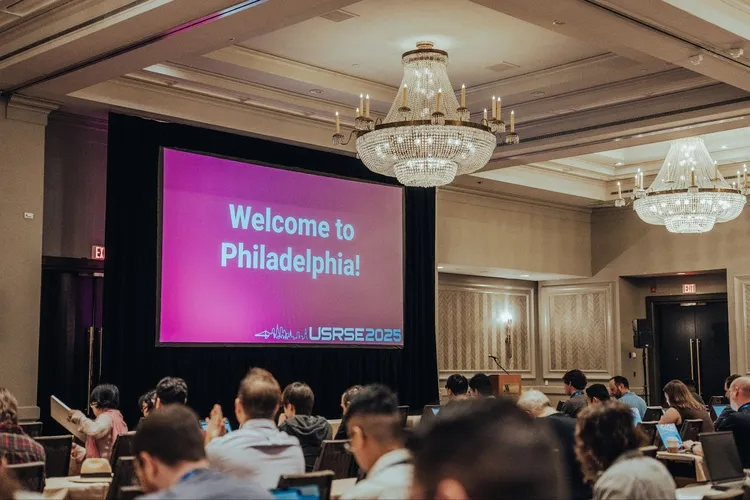
From October 6–8, the RSE team participated in the third annual conference of the United States Research Software Engineer Association. Held in Philadelphia, US-RSE’25 brought together RSEs from across universities, laboratories, industry, and other institutions, as well as their managers and allies, to discuss “Code, Practices, and People.” CDH represented the small — yet mighty! — Humanities contingent in a field of mostly scientists and social scientists.

Wide shot of a conference ballroom with chandeliers and an audience seated facing a large screen reading Welcome to Philadelphia! for USRSE 2025.

US-RSE'25

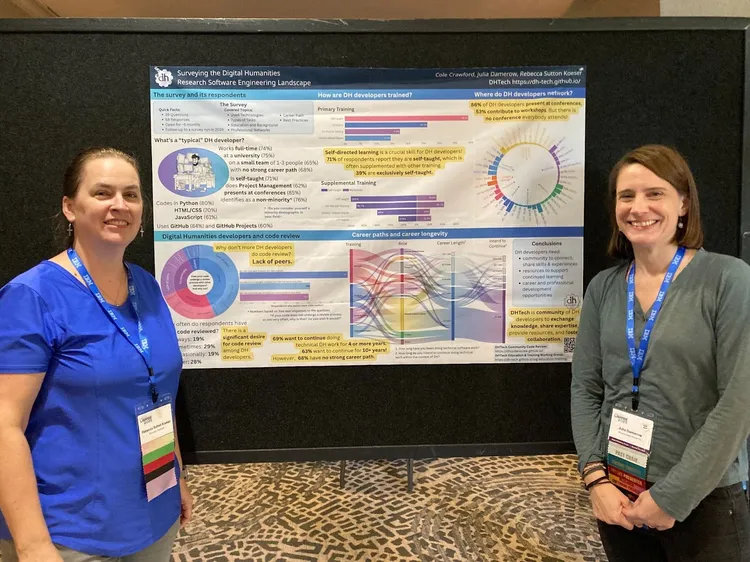
Lead RSE Rebecca Sutton Koeser presented a notebook on undate, a Python package for computing with uncertain and partially-unknown dates, such as those in Sylvia Beach’s lending library records and in the fragmentary Hebrew texts in the Princeton Geniza Project. Koeser also collaborated on two posters: “Community Code Review in the Digital Humanities,” which detailed the history, process, and future work of the DHTech Code Review Working Group; and “Surveying the Digital Humanities Research Software Engineering Landscape,” which reported on survey results about the backgrounds and career paths of DH developers.

Photo of two people standing indoors on either side of a large conference poster covered with charts, diagrams, and text, displayed on a stand against a wall.

Rebecca Koeser (left); Julia Damerow (right)

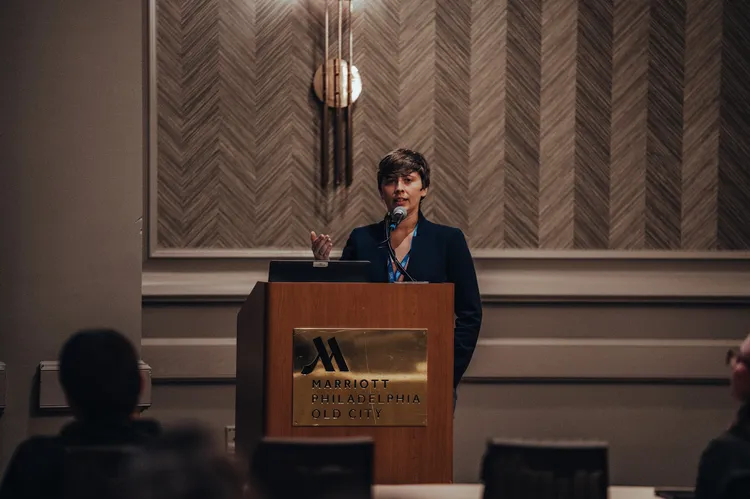
Postdoctoral Researcher Christine Roughan presented a paper, also co-written with Koeser, titled “Integrating ATR Software with University HPC Infrastructure: balancing diverse compute needs.” The paper and corresponding presentation described the methods and outcomes of Bringing HTR to the HPC: A Pilot to Customize eScriptorium for Princeton, a Research Partnership with the CDH under the umbrella of the Princeton Open HTR Initiative (funded by a 2024–25 Princeton Language + Intelligence Seed Grant). Conference attendees were fascinated to hear about how Koeser and Roughan implemented an instance of eScriptorium — the current leader in open-source handwritten text recognition software — on Princeton’s high-performance computing hardware, which enabled professors and students without advanced technical skills to train large text-recognition models customized to their documents’ needs.

Person speaking at a podium with a microphone at the Marriott Philadelphia Old City, with a patterned wall behind them and an audience seated in the foreground.

Christine Roughan presents at US-RSE'25

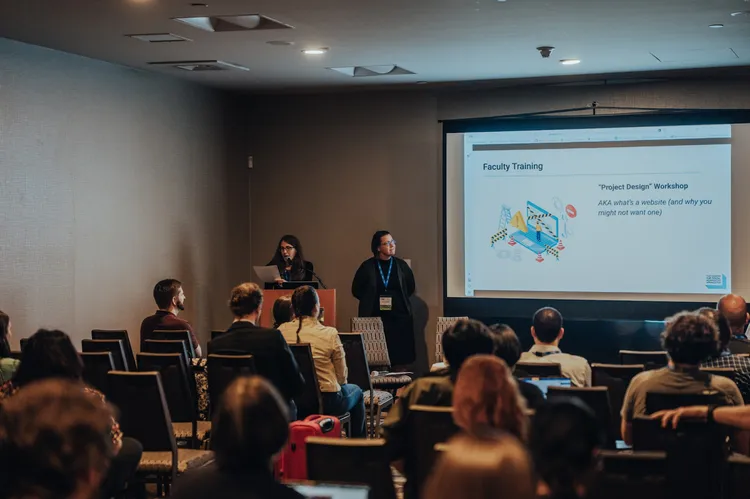
Assistant Director Jeri Wieringa and Project Manager Mary Naydan presented on a panel about supporting and managing RSE projects. Their presentation “Creating Research Software with Humanities Faculty” highlighted the CDH’s chartering process, which helps transition humanities faculty from the individual, expansive mode of traditional humanities scholarship to the collaborative, modular mode of computational research. Their illustrative opening skit, which set the stage for the talk, drew lots of laughter and resonated with audience members. The rest of the panel was just as engaging, sharing lessons learned from many different types of organizations and fields, from the multi-institutional development of medical technologies, to a large laboratory focused on national security, to a lone RSE’s personal project management workflow at a research university (Naydan’s favorite presentation of the conference!).

Wide shot of a conference room with an audience seated facing a projected slide about faculty training, while two presenters stand at the front near a podium.

Mary Naydan and Jeri Wieringa present at US-RSE’25 in Philadelphia.

The technical talks affirmed that the CDH RSE team is ahead of the curve on best practices in Python development, such as using uv for installing packages and choosing Marimo over Jupyter for notebooks. Koeser noted the field-wide shift in starting to think about notebooks as a form of publication, and CDH Research Software Engineer Hao Tan was inspired by Reed Maxwell’s keynote on creating groundwater simulations using physics-informed machine learning. Tan reflects, “Explainability is still a real issue, but rather than rejecting AI outright, we should learn to leverage its strengths and mitigate its weaknesses — through comparative evaluation, transparent step-by-step reasoning, and other methods we develop.”

Many of the conference’s presentations — from Maxwell’s keynote to the Birds of a Feather workshop “AI in Practice” — showed the field of research software engineering grappling with, adapting to, and incorporating AI. While our team entered the conference thinking our challenges were somewhat unique to the humanities, we were surprised to see RSEs from across disciplines encountering similar challenges around this topic: from defining research questions, to gathering sufficient data, to disabusing researchers about what AI can actually do.

🇱🇺 Luxembourg

Unsurprisingly, AI was also a popular topic at the 2025 Computational Humanities Research Conference, held at the Luxembourg Centre for Contemporary and Digital History (C²DH) at the University of Luxembourg from December 9–12, 2025. Many of the presentations focused on benchmarking various models for automatic transcription tasks, or using chatbots to scale up annotation data, from identifying “acts of God” in contemporary Christian fiction to assessing a popular song’s “narrativity.” Miguel Escobar Varela’s keynote, “‘A watch by Kran Kamu’: Exploratory fine tuning for cultural reliability,” discussed using supervised fine-tuning on large open-weight models to yield reliable results within highly specific cultural contexts, such as Southeast Asian historical newspapers — a common problem facing computational humanities researchers given the specialized nature of our data and the scarcity of it for fine-tuning.

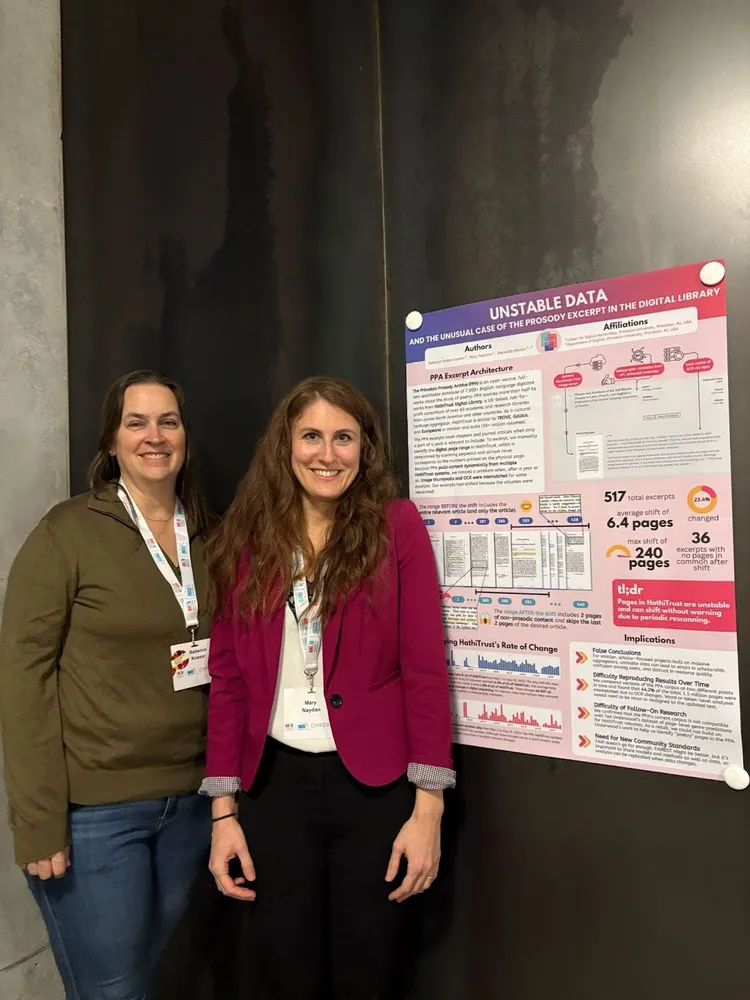
Photo of two people standing indoors beside a research poster titled Unstable Data, with charts and text displayed on a wall behind them.

Rebecca Koeser (left); Mary Naydan (right)

Rebecca Koeser and Mary Naydan presented a poster based on their short paper “Unstable Data and the Unusual Case of the Prosody Excerpt in the Digital Library” (co-authored with Meredith Martin). Using the HathiTrust materials contained in the Princeton Prosody Archive as a case study, Koeser and Naydan cautioned researchers that the page-level data provided by cultural heritage aggregators is not as stable as we might assume. This instability can lead to erroneous data, flawed conclusions, and difficulties building on previous scholarship.

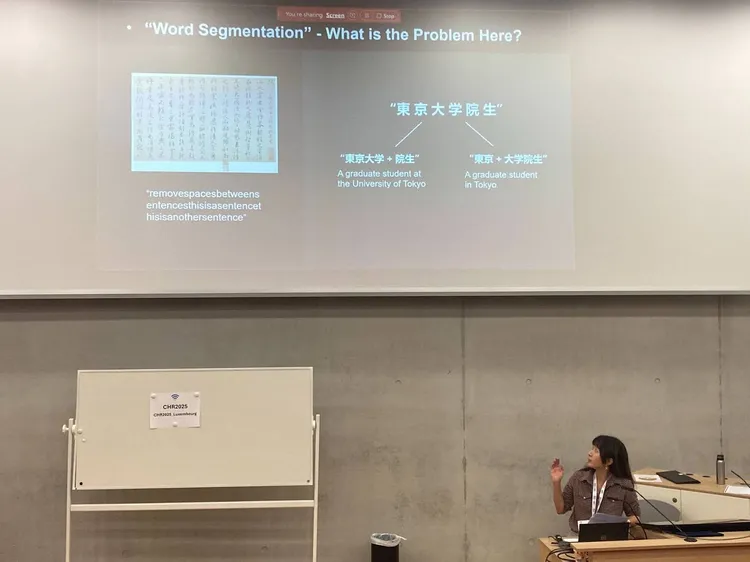
Wide shot of a lecture hall with a projected slide titled Word Segmentation – What is the Problem Here?, showing Japanese text examples, while a presenter stands at a podium pointing toward the screen.

Hao Tan presents at 2025 CHR Conference in Luxembourg.

Hao Tan delivered a lightning talk, “When Larger LLMs Aren’t Enough: Word Segmentation in Historical Chinese Texts,” which used word segmentation in historical Chinese texts as a case study to highlight how large language models, while powerful, can quietly introduce risks when applied to humanities research. The talk sparked conversations with researchers working on East Asian materials across Europe, the US, and Singapore, especially around the tricky parts of historical text processing, with projects ranging from power relations in historical fiction to poetic imagery and stylistic change in epitaphs.

In addition to Tan’s lightning talk, Koeser and Naydan found two others particularly interesting: Katarina Mohar’s on “Speculative Reconstruction and the Ethics of the Fragment: Early Experiments with Generative AI in Art History,” and Antonina Martynenko, Artjoms Šeļa and Petr Plecháč’s on "Where Empires End: Tracing the Geography of a ‘Soaring Spirit’ in Poetry.” Mohar discussed the possibilities and limitations of using Generative AI to fill in gaps in medieval paintings, and provided practical recommendations for how to use it responsibly. Martynenko et al. examined the spatial imagination of European poets by mapping the distance and directionality of place mentions.

For Koeser, one of the most interesting presentations was “Cluster Ambiguity in Networks as Substantive Knowledge,” which describes a method for running a clustering algorithm multiple times to measure how often edge nodes connect nodes in the same community, allowing researchers to identify ambiguous data. Koeser is interested in the interpretive power and potential applications of this method, such as identifying ambiguous characters in novels. Another highlight was Taylor Arnold and Lauren Tilton’s presentation on “Sitcom Form and Function: Pacing and Production in a Collection of Thirty U.S. Series,” which examined how trends in visual and aural pacing changed over time using a combination of large-scale computational analysis and close reading: an example of truly multimodal research and scalable reading.

The RSE team was energized by these shifts in the field: leaning into ambiguity; using audio, video, and visual data rather than defaulting to text; and combining different scales of reading (close and distant) to draw more responsible conclusions. We are excited to carry what we learned into our work this year on multilingual machine translation and term clustering in music theoretical texts and using vision-based LLMs to aid historical document transcription and data extraction.

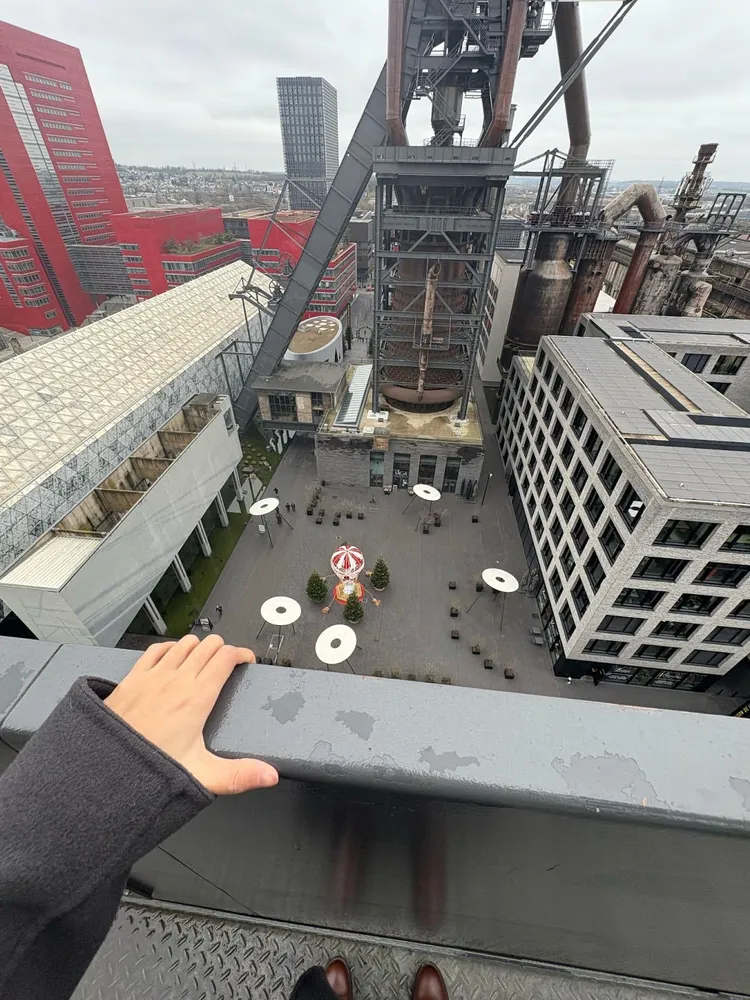
View from an elevated platform with a hand on a railing overlooking a large industrial complex courtyard with a tall metal structure, surrounding buildings, and scattered tables below.

Photo by Hao Tan in Luxembourg.

  •  

Journal of Cultural Analytics Enters New Chapter with CDH, Joins Open Journals Collective

In January 2026, Princeton University's Center for Digital Humanities (CDH) began serving as publisher of the Journal of Cultural Analytics (JCA), a leading open-access publication in computational approaches to culture. Today, CDH announces JCA’s vision for expanding cultural analytics scholarship amid rapid technological change and the launch of a new website, supported by Schmidt Sciences’ Humanities and AI Virtual Institute (HAVI).

"The Journal of Cultural Analytics has been instrumental in advancing computational methods in the humanities," said Meredith Martin, faculty director of the CDH and professor of English at Princeton, who serves as one of the journal's three editors alongside Amelia Acker (Rutgers University) and Tanya Clement (University of Texas at Austin). "We are honored to lead JCA's continued evolution and grateful to Andrew Piper for his pioneering work in establishing this field-changing, scholarly venue."

Building on a Strong Foundation

Founded by Piper at McGill University's Department of Languages, Literatures, and Cultures, JCA has published groundbreaking data-driven research about culture since 2016. The journal encourages transparent research practices, including open sharing of data and code. It has become a cornerstone publication for scholars working at the intersection of digital humanities, computational social sciences, and computational approaches to culture.

"The idea for the journal was born in 2015 as a response to a shared sense that our field needed a venue dedicated to the critical use of computation to study culture," said Piper. "After a decade of growth, the journal has far exceeded my hopes. I'm extremely happy to see it continue under the leadership of the new editors and its new institutional home at Princeton's Center for Digital Humanities."

Looking Ahead: Expanding Scope and Impact

JCA is broadening its vision to serve an ever-evolving interdisciplinary and international scholarly community invested in cultural study and the methods by which we interrogate the digital in culture – especially in the age of AI. Central to this vision is the commitment to publishing work that goes beyond method for method's sake, asking instead how computational approaches to culture at scale can reshape what we know and how we know it.

The editorial board has expanded to 43 scholars representing institutions across North America, Europe, Asia, and Australia, reflecting JCA’s commitment to international perspectives and increasing representation from junior scholars. This expanded scope will support the journal’s growing focus on multi-lingual and multi-modal approaches to culture.

A new Special Features section, edited by Laura McGrath (Temple University), will highlight shorter, timely essays on computational cultural analysis written in an accessible style for non-specialist audiences, designed to spark discussion on new methodologies, datasets, or research.

JCA will deepen its focus on critical engagement with data, which is increasingly significant for AI researchers returning to smaller, human-curated cultural models. Welcoming a new data editor, Sarah Reiff Conell (Princeton University Library), JCA will revise its data-essay and dataset-review format in collaboration with the scholarly “data collectives” (such as Post45 and 19thC Data Collective), and provide a directory of datasets for cultural studies.

Upcoming Special Issues will explore topics ranging from computational humanities in the Global South to data-driven approaches to poetry and a retrospective on ten years of the JCA. The journal is currently accepting Special Issue proposals for 2027.

New Infrastructure for Open Access, Community-Led Publishing

The transformative support from Schmidt Sciences’ HAVI program has enabled JCA's growth and modernization, expanding the editorial team with new roles for graduate students—providing both recognition and compensation for the labor required to run an academic journal and an opportunity to train the next generation of computational humanities scholars. The grant has also enabled the journal to migrate to Janeway, an open-source publishing platform developed by the Open Library of Humanities, featuring a redesigned user interface and customizable workflow management system.

In this new phase, JCA maintains its commitment to diamond open access—free to read and free to publish, with no article processing charges (APCs) or publishing fees for authors or universities. JCA has also joined the Open Journals Collective, a coalition of libraries and university-based publishers that launched in March 2025, providing journals with technological support, financial sustainability, and community governance through a library-funded model that keeps research freely accessible and journals editorially independent.

"I'm thrilled to have such a prestigious Princeton journal carrying the banner for diamond open access as part of the launch collection. We're excited for JCA, and for the promise of the new, sustainable funding model OJC is delivering," said Matthew Kopel, Princeton's Open Access & Intellectual Property Librarian, who also sits on the Open Journals Collective Library Board.

More information about the journal's new direction, upcoming issues, and submission guidelines can be found on JCA's newly launched platform at https://culturalanalytics.org.

Editorial Team

Editors

  • Meredith Martin, Princeton University
  • Tanya Clement, University of Texas at Austin
  • Amelia Acker, Rutgers University

Special Features Editor

  • Laura McGrath, Temple University

Data Editor

  • Sarah Reiff Conell, Princeton University Library

Graduate Editorial Assistants

  • Cecelia Ramsey, Princeton University (Managing Editor)
  • Odalis Garcia Gorra, University of Texas at Austin
  • Haiqi Zhou, McGill University
  • Emilien Arnaud, Princeton University

Former Editorial Assistant

  • Katrin Rohrbacher
Three logos on a white background for the Center for Digital Humanities at Princeton, Schmidt Sciences, and JCA, displayed side by side.

About the Center for Digital Humanities

Princeton's Center for Digital Humanities, founded in 2014, advances computational and data-intensive humanities scholarship through collaborative research, innovative pedagogy, and community building to create a more just future. The center develops better practices in technological development and research while bringing humanistic perspectives to data science applications.

About the Open Journals Collective

The Open Journals Collective is a growing coalition of libraries and university-based publishers providing sustainable, community-led alternatives to commercial academic publishing. Through diamond open access and collective funding models, OJC supports hundreds of journals while ensuring research remains freely accessible to all.

About Schmidt Sciences

Schmidt Sciences is a nonprofit organization founded in 2024 by Eric and Wendy Schmidt that works to accelerate scientific knowledge and breakthroughs with the most promising tools to support a thriving planet. The organization prioritizes research in areas poised for impact, including AI and advanced computing, astrophysics, biosciences, climate, and space—as well as supporting researchers in a variety of disciplines through its science systems program. The Humanities and Artificial Intelligence Virtual Institute (HAVI) intends to spur innovative, domain-specific research outcomes from humanities scholars through the integral application of AI-inspired tools and techniques, as well as produce insights from the humanities that will advance the development of AI.

  •  

Call for Applications for the 2026 Summer Institute: Digital Humanities for Hellenic Studies – Historic Athens in 3D

The Center for Digital Humanities is proud to be part of the Seeger Center's Summer Institute: Digital Humanities for Hellenic Studies, hosted at the Princeton Athens Center in Greece from July 6–10. This year's theme is "Historic Athens in 3D."

The deadline to apply is Sunday March 15, 2026 (11:59pm EST).

ABOUT THE WORKSHOP

This workshop is designed for scholars interested in exploring digital humanities methods for representing archival information and rich narratives about historical urban spaces. Participants will be introduced to key topics, approaches, and tools, such as working with spatial data, 3D modeling, photogrammetry, data annotation, AI tools, and telling stories with data.

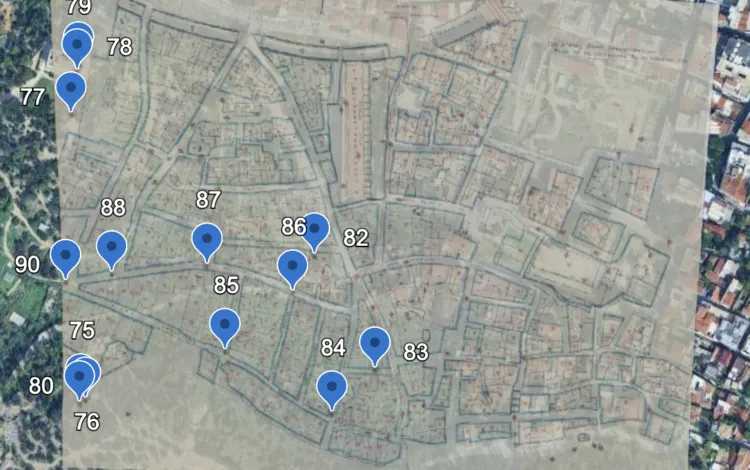
Workshop participants will work collaboratively to create 3D, information-enriched visualizations of the early 20th-century Vrysaki neighborhood of Athens before its demolition. This work will draw on a unique collection of historic photographs and maps from the 1930s, created by photographer M. Messinesi and held in Princeton’s Art and Archaeology Department’s Visual Resources Collection.

Through seminar discussions, hands-on instruction, and site visits, participants will gain a deeper understanding of the opportunities and challenges of communicating the history of lost city spaces through 3D visualizations, while engaging with the complex history of Athens' urban landscape. By the end of the workshop, participants will be equipped to develop their own digital cultural heritage project.

The workshop is open to scholars from all disciplines, regardless of technical background. Experience with spatial data, 3D modeling, or other digital tools and concepts is welcome but not required. This workshop will be of particular interest to those in Hellenic Studies, History, Art and Archaeology, Urban Studies, Architecture, Cultural Studies, Public Humanities, and Photography. Knowledge of Greek is not necessary.

Instructors will include scholars from Princeton’s Center for Digital Humanities (CDH), Princeton University Library, the Science & Technology in Archaeology and Culture Research Center (STARC) at the Cyprus Institute, the CY Cergy Université (Paris), and the MSc Program in Digital Methods for the Humanities at the Athens University of Economics and Business (AUEB).

APPLICATION

The following material should be combined into a single file and uploaded to the application form, which can be found here.

  • a 1-page (500 words) statement of your interest in digital reconstruction and goals for this workshop. Discuss why participating in this workshop is important for your research project, scholarly and/or professional goals. Please specify any experience with digital or computational methods, tools, or programming languages.
  • a CV;
  • for graduate student applicants, contact information for a faculty advisor who may be contacted as a reference (no letter of recommendation is required with the initial application).

Application Deadline: Sunday March 15, 2026 (11:59pm EST).

Questions? For questions about projects and proposals, please contact Natalia Ermolaev, Executive Director of the CDH. For questions about program logistics and eligibility, please contact Chris Twiname, administrative coordinator at the Seeger Center for Hellenic Studies.

Applicants will be notified of their selection by April 1, 2026. The selection committee includes members of the instructional team as well as representatives from the Seeger Center for Hellenic Studies.

ELIGIBILITY

Current Princeton affiliates (i.e. graduate students, postdoctoral fellows, etc), as well as graduate students and postdoctoral fellows currently enrolled at universities in Greece, are invited to apply.

FUNDING

There are no fees for tuition.

Upon workshop acceptance notification, participants will receive instructions for applying for limited funding to cover travel and local accommodations. Princeton students are required to explore funding from their home department and/or other sources at the University. Students from Greek universities who do not reside in Athens may apply for funding to cover all or part of their travel and accommodation expenses.

The funding application will comprise a short budget and statement as to whether the applicant will combine this workshop with other activities, as the Seeger Center for Hellenic Studies will only cover expenses related to the workshop.

This program is sponsored by the Seeger Center for Hellenic Studies at Princeton University in collaboration with the Center for Digital Humanities at Princeton; the Princeton University Library, the UNESCO Chair on Digital Methods for the Humanities and Social Sciences, Athens University of Economics and Business (AUEB); the MSc Program in Digital Methods for the Humanities at AUEB; and the Digital Research Infrastructure for the Arts and Humanities (DARIAH-EU).

FROM PAST INSTITUTES

  •  

Check Out Spring 2026 Graduate DH Course Offerings in NJ and NY

Looking to explore DH-relevant courses–both at Princeton and beyond?

We’ve made a list of graduate courses for fall 2025 offered throughout the Inter-University Doctoral Consortium (IUDC).

With the approval of the certificate director, these courses can be used to satisfy the elective requirement for the CDH’s Graduate Certificate in Digital Humanities.

To enroll in a course, submit a completed registration form to the IUDC coordinator at both your host and home institutions.

Princeton University

IUDC Details

Note: for a list of grad seminars offered or cross-listed by the CDH that automatically count toward the Graduate Certificate in DH, please see Graduate Courses in DH.

Architecture

Art and Archaeology

Computational and Data Humanities

Computer Science

East Asian Studies

History of Science

Music

Philosophy

Politics

Public and International Affairs

Sociology

Statistics and Machine Learning

Columbia University

IUDC Details

Anthropology

Center for the Study of Ethnicity and Race

Comparative Literature & Society

Comparative Media

English Theatre Arts

European History - Politics

Film

Institute for Study of Human Rights

Music

CUNY Graduate Center

IUDC Details

Comparative Literature (see courses)

  • CL 86500: Archaeology of Media: Film, Fashion, Montage (Eugenia Paulicelli)

Data Analysis and Visualization (see courses)

  • DATA 70600: Special Topics in Computer Fundamentals: AI-Assisted Programming (Stephen Zweibel)
  • DATA 71200: Advanced Data Analysis (Howard Everson)
  • DATA 73000: Visualization and Design (Julia Bloom)
  • DATA 73200: Interactive Data Visualization (Ellie Frymire)
  • DATA 74000: Data, Culture and Society (Kevin Ferguson)
  • DATA 78000-01: Special Topics: Software Lab Design: Creative Computing (Omar Nema)
  • DATA 78000-02: Special Topics: Categorical Data Analysis in Python (Tim Shortell)
  • DATA 78000-03: Special Topics: Agentic AI (Michelle McSweeney)
  • DATA 78000-04: Special Topics: AI for What?: Developing Critical AI Practices with Mission-Driven Organizations (Kathleen M. Cumisky)

Digital Humanities (see courses)

  • DHUM 70002: Digital Humanities: Methods and Practices (Bret Maney)
  • DHUM 74500: Digital Pedagogy II: Theory, Design, and Practice (Shawna Brandle)
  • DHUM 78000-01: Special Topics: Digital Memories: Theory and Practice
  • DHUM 78000-02: Special Topics: Decolonial AI and Digital Humanities: Centering Indigenous, Afro-Diasporic, and Latinx Voices
  • DHUM 78000-04: Special Topics: Social Justice and Public Scholarship

English (see courses)

  • ENGL 82000: The Appetite of Thought: Exercises in Eco-Techno Criticism & Reading (Joan Richardson)

Interdisciplinary Studies

  • IDS 81670: Selected Topics in IDS: More Just Technology: Publics & Futures (Maura Smale and Javiela Evangelista)

Linguistics

  • LING 83100: Psycholing / Cognitive Linguistics: Advanced Natural Language Processing (Alla Rozovskaya)

Music ( see courses)

  • MUS 83201: Music in / on the Internet (Eliot Bates)

Psychology

New School for Social Research

IUDC Details

Anthropology

New York University

IUDC Details
(NYU course listings can be accessed here)

Anthropology

  • ANTH-GA 1216: Culture and Media II (Tejaswini Ganti)

Digital Humanities and Social Science

  • DHSS-GA 1122: Web Development (Jo Suk)
  • DHSS-GA 1125: Programming with Data (Allison Parrish)

English 

  • ENGL-GA 2912: Philosophy as Literature, Literature as Philosophy: The Essay, from Montaigne to ChatGPT (Robert Young)
  • ENGL-GA 2944: The Social Life of Paper (Lisa Gitelman)

Experimental Humanities & Social Engagement

  • CEH-GA 1018 007: Data Justice (Toussaint Nothias)

History

  • HIST-GA 1011: Digital Archives (Mary Lauren Kidd)

Institute for the Study of the Ancient World

  • ISAW-GA 3024: Introduction to Digital Humanities for the Ancient World (Sebastican Heath, Tom Elliott, and Patrick Burns)

Journalism

  • JOUR-GA 1182–09: Data Journalism (Meredith Broussard)

Linguistics

  • LING-GA 1012: Large Language Models: Evaluation and Applications (Tal Linzen)

Philosophy

  • PHIL-GA 3010: Topics in Philosophy of Mind (Ned Block and Andrew Rubner)

Psychology

  • PSYCH-GA 2013: Psychology of Social Media
  • PSYCH-GA 2040-009: Current Topics: Psychology and Artificial Intelligence

Public Humanities

  • PUBHM-GA 1101-003: Case Studies in Public Humanities: The Hemispheric Institute and HIDVL (Ana Dopico and Daniel Howell)

Sociology

  • SOC-GA 2316: Introduction to Computational Text Analysis (Bart Bonikowski)
  • SOC-GA 3350: Social Data Science Workshop (Bart Bonikowski)

Stony Brook University

IUDC Details
(Stony Brook course listings can be accessed here)

Technology and Society

  • EMP 532: Big Data Systems (Firman Firmansyah)
  •  

Meredith Martin part of $450K HAVI Award on Johns Hopkins-Led Project Analyzing Hierarchical Structure in Poetry, Music, and Narrative

Congratulations to Meredith Martin, Professor of English and Director of the Center for Digital Humanities, who has been selected for a 2025 Humanities and AI Virtual Institute (HAVI) award by Schmidt Sciences.

Professor Martin is part of a grant of up to $450,000 led by Tom Lippincott (Johns Hopkins University) with co-PIs John Hale (Johns Hopkins University) and Robert Lieck (Durham University). The project, "An ML Toolkit to Find Hierarchical Structure in Multi-Modal/Lingual Data," will develop computational methods to analyze structural patterns in poetry, narrative fiction, and music across different languages and historical periods.

The collaboration brings together expertise in literary studies, linguistics, musicology, and machine learning to create tools that both apply AI to illuminate cultural artifacts and draw on humanistic understanding to advance how AI models learn sequential structure. The interdisciplinary team includes researchers from Johns Hopkins University, Princeton University, and Durham University.

About the Project

The research addresses a fundamental challenge: how humans experience and create hierarchical structure in cultural artifacts under cognitive limitations. From poetic meter and narrative patterns to musical form, structure guides creative expression and shapes how we perceive and remember art across time and cultures.

The team will develop a Python library for defining, training, and interpreting sequence models designed to infer hierarchical structure, along with three humanistic case studies examining poetry, language and narrative, and music. Professor Martin will lead the poetry case study, investigating how poetic structures—including form, rhyme, and meter—have been deployed, interpreted, and taught over more than a millennium of English verse. Working with the Chadwyck-Healey English Poetry corpus of 336,180 poems written between 900 CE and the present day, the research will explore questions such as when and where poetic meter is predictably regular or irregular, and how metrical and rhythmic patterns carry meaning across time.

Broader Impact

Schmidt Sciences has awarded $11 million to 23 research teams around the world who are exploring new ways to bring artificial intelligence into dialogue with the humanities, from archaeology and art history to literature, linguistics, film studies, and beyond. As part of the Humanities and AI Virtual Institute (HAVI), these interdisciplinary teams will both apply AI to illuminate the human record and draw on humanistic questions, methods, and values to advance how AI itself is designed and used.

Read more about all 23 awarded projects: https://www.schmidtsciences.org/havi-2025-announcement/

Celebrating the HAVI Community

Beyond celebrating Professor Martin's award, we're thrilled to see so many CDH colleagues and collaborators among this year's 23 HAVI awardees—a testament to the vibrant, interconnected community advancing digital humanities research.

Peter Henderson (Computer Science, Princeton University) is developing "AI for Understanding the Law and its Evolution"—creating AI tools to trace how legal ideas spark, spread, and change across centuries of multilingual, multimodal legal texts.

Jim Casey (UC Santa Barbara) is leading "Communities in the Loop"—developing AI methods to identify veiled protest in 19th-century Black newspapers. Jim is a former CDH postdoc, and we're proud to see his vital work recognized.

Peter Bol (Harvard University), a Princeton PhD alum from 1980, is leading "Augmenting Retrieval for Eurasian Languages"—training multilingual AI models to study Asian-language manuscripts, including low-resource languages like Tibetan, to reduce bias in historical research.

David Bamman (UC Berkeley) is creating Kinolab to bridge large-scale computational analysis with close viewing of film and television. David has been a valued collaborator through our New Languages for NLP initiative, LLM speaker series, and Ends of Prosody event.

Co-investigator, Lauren Tilton (University of Richmond), spoke at CDH in October 2024 on "Distant Viewing: AI and Ways of Seeing" for our Humanities for AI series.

Matthew Wilkens (Cornell) leads "Artificial Intelligence for Cultural and Historical Reasoning" with collaborators including David Mimno (PPA board member), Ted Underwood (Startwords contributor), and Andrew Piper (early Humanities Council visitor through German).

Gregory Crane (Tufts University) is working on "Beyond Translation: Opening up the Human Record." Greg was the very first speaker we invited for the Digital Humanities Initiative back in c. 2012. His collaborator, David Smith, serves on our PPA board and participated in Ends of Prosody.

Meredith Martin

Executive Committee Member
FAD2024-2-245 copy2
  •  

Human and Machine Intelligence in Networks of Early Modern Print: Q&A with John Ladd

The CDH’s Humanities for AI initiative, launched in fall 2024, has presented a range of events, projects, and conversations exploring how humanistic values and approaches are crucial to the development, use, and interpretation of the field of AI, including this year’s Modeling Culture program.

Continuing our Q&A series where we share perspectives on the impact of AI on humanities scholarship, we welcomed John Ladd (Assistant Professor, Department of Computing and Information Studies, Washington & Jefferson College) to respond to some questions after his talk in September. In “Human and Machine Intelligence in Networks of Early Modern Print,” he investigated how artificial intelligence and other computational approaches can help us to understand the distant past.

Your work bridges early modern literature and computational methods. How does your research and teaching inform your understanding of “Humanities for AI”?

In my research, I frequently apply computational methods and digital tools to early modern book history and literature. I teach in an interdisciplinary computing program where I show students how to apply humanities methods and objects of study to data science and the history of technology. It’s this back-and-forth exchange, of using technology in the humanities and using the humanities to understand technology, that the digital humanities has long stood for and that can help us frame the humanities’ relationship to AI. Humanities scholars continue to demonstrate the value of interrogating AI ethically, critically, and in historical context, and I believe that we’re starting to see the ways large language models might be used, with sensible guardrails, as research tools as well as research subjects.

30825679554

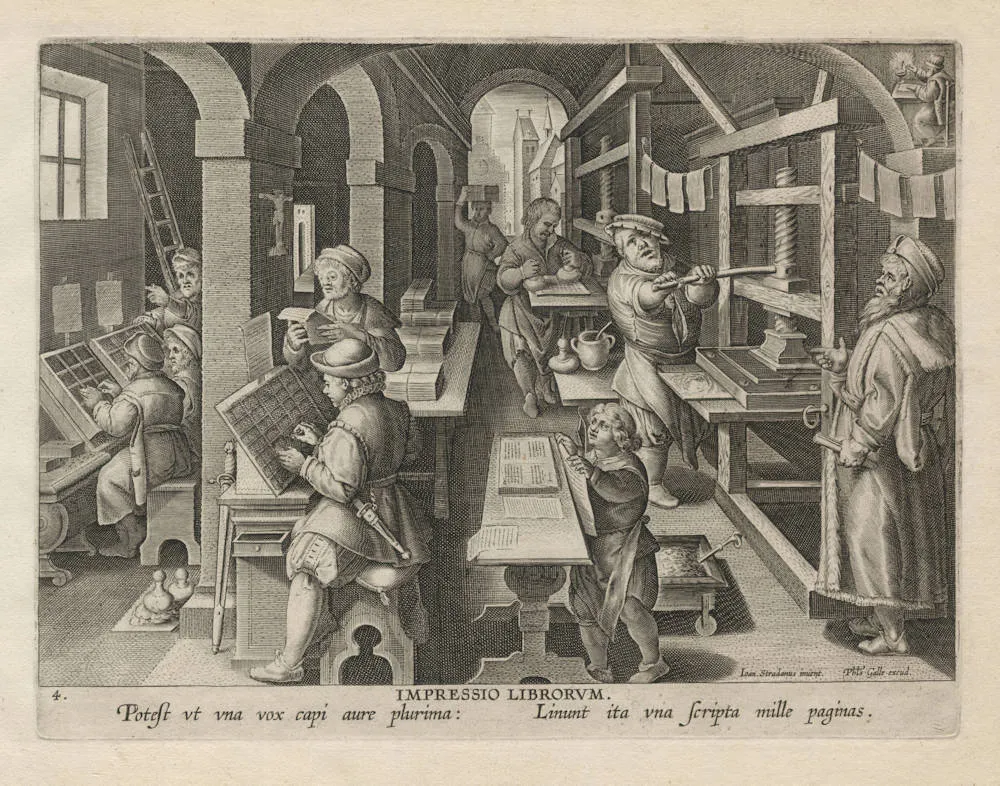
Impressio Librorum / Book Printing, 16th-century engraving by Theodoor Galle after a drawing by Johannes Stradanus, c. 1550

In your talk, you noted that human-machine interaction has been happening since letterpress printing itself, using an engraving of an early modern print house to illustrate “the merger of different kinds of expertise” and drawing attention to the human labor behind seemingly “magical” new technologies. How does thinking about this historical precedent shape your approach to contemporary AI tools in humanities research?

I tend to focus on continuities between contemporary AI/large language models and a long history of technological change. The idea that AI is a revolutionary break from all previous technologies is a narrative that serves particular interests. I prefer narratives that put AI and LLMs into social and cultural contexts, like the recent frameworks of “AI as cultural and social technologies” and especially “AI as Normal Technology.” For humanities researchers and everyday users, it’s advantageous to think of AI as part of a long history of text technologies, going back to the printing press and before. This is why I emphasize LLMs’ ties both to decades of work in the digital humanities and to a broader view of the history of technology. This view helps us to see the many layers of human labor that have gone into AI, and the ways AI is still reliant on human expertise, just as other similar text technologies have been.

You’ve worked extensively on building research tools for humanists, from Network Navigator to the EarlyPrint Bibliographia. Now that LLMs have entered the picture, how has the landscape of digital humanities “tool building” changed? What ways have you found to engage with LLMs in your development work, with or beyond the chatbot?

An LLM itself is a new kind of tool, but it’s also a way to make tool-building more accessible and inviting. AI coding assistants can make it less intimidating to build a custom tool or website for a personal research project. There’s still a lot of value, and necessity, in learning how code works and how to make code work for you, but I am hopeful that LLMs will lower the barrier to entry and make the process more inviting. The novelist and experimental coder Robin Sloan has used the phrase “an app can be a home-cooked meal” to describe the empowering process of taking toolmaking into your own hands and building something just for yourself or for a small group. Instead of large-scale apps, these bespoke tools are so often the kinds that researchers really need, and LLMs may open the door for more such tools to be built.

John-Ladd-MC-1-10

John Ladd @ CDH, September 2025. Photo: Carrie Ruddick

Your work on local LLMs (with Melanie Walsh, et. al.) emphasizes privacy and sustainability for humanities AI research. Can you talk about why running models locally matters for humanistic inquiry? What are the technical and ethical considerations that led you to focus on this approach?

It’s essential for humanities researchers to find ethical ways of working with LLMs that respond to the many valid critiques of this technology. Working with LLMs locally reduces their environmental impact. Instead of processing your query at a massive data center, your own regular computer hardware can run the task, saving water and energy. The prompt and data also never leave your computer, making the whole interaction more private and avoiding corporate interests. While not every humanities research task can be run this way, many of the datasets and research questions that humanists use are at a scale that can be processed by a local LLM. The local models give you more control over the entire process, and they make the task more replicable in order for the work to be verified and reviewed. Both technically and ethically, I think local LLMs are a great path forward for many folks who want to work with this technology, and I’m working to make sure more people know this is an option!

In the case study you presented, examining whether early modern printers produced books on the same subjects over their careers, you combined text classification, network analysis, and data visualization. What did machine learning reveal that traditional bibliographic methods might have missed—and vice versa? How does a “mesoscopic” approach help you navigate moments where computational and analog approaches yield different insights?

Many early modern book historians have conducted studies of particular printers or groups of printers and publishers, examining their output to determine continuities in subject or genre. In my talk, I used the example of publisher Humphrey Moseley’s reputation as one of the preeminent publishers of literary and poetic works. This kind of close analysis is ideal for traditional bibliographic methods, but bibliography is also interested in the large-scale question of whether publishers like Moseley (and the printers who worked with him) are outliers or are part of a larger pattern. The machine learning methods I used are very good at finding patterns over tens of thousands of texts, which would be difficult or impossible to do by hand, and it’s how I was able to establish that printers do tend to have consistency in their outputs over time. As Chris Warren and Martin Mueller have each argued, what computational methods can do is let us connect the general pattern to the particular case, in this instance showing that the observed patterns for specific stationers carry through to larger trends in Restoration printing.

What is your greatest concern and biggest hope for the future of AI in humanities scholarship?

The biggest concern for me is the corporate logic that underlies the ways AI is being sold to and adopted by the general public, and this logic drives many of AI’s most troubling qualities: environmental problems, intellectual property problems, and labor problems. This is the ideology that attempts to set up AI as in opposition to or as a replacement for the arts and humanities. We should resist easy narratives that conclude that AI should write for you, make art for you, or do your job for you. Many humanities scholars have already begun the important work of pushing back on these narratives and making it clear that AI doesn’t stand apart from other technologies and shouldn’t be exempted from ethical and legal critique.

But by properly contextualizing AI within the history of text technologies, one hope I have is that more light can be shed on the amazing work being done with natural language processing and text analysis in the humanities. AI has made more people aware of text analysis and machine learning, to a degree I never would have thought possible a few years ago. Digital Humanities scholars who’ve been doing this work for years have a chance to share their expertise with a wider audience and help to craft new narratives around large language models that might move us past the current era of corporate chatbots. My colleagues in the Modeling Culture seminar are producing some incredible scholarship that merges LLMs and the humanities, and my hope is that more people will seek out and learn from this work.

About John Ladd

John Ladd is an assistant professor in the Department of Computing and Information Studies at Washington & Jefferson College. He teaches and researches on the use of data across a wide variety of domains, especially in cultural and humanities contexts, as well as on the histories of information and technology. Building on an English literature background where he studied the intersection between computational methods and early modern print culture, his work includes large-scale digital humanities projects, such as Six Degrees of Francis Bacon and Early Print. He has published essays and web projects on humanities data science and cultural analytics, computational bibliography, the history of data, and network analysis.

Subscribe to our newsletter

Related posts

Modeling Culture Talk
modeling-culture-john-ladd copy

Modeling Culture: New Humanities Practices in the Age of AI

A year-long seminar for faculty and grads with a public lecture series, culminating in a comprehensive and accessible curriculum for advanced humanities researchers.

modeling culture plain copy

Humanities for AI

Foregrounding the centrality of the humanities in the development, use, and interpretation of the field broadly known as “AI”

HUM-AI-LOGO_1_L343as1.original copy

More Humanities for AI Q&As

Humanities for AI
NnediOkorafor_-19
Humanities for AI
ted-chiang-qa-banner

AI and Ways of Seeing: Q&A with Lauren Tilton

12 November 2024

Lauren Tilton, Carrie Ruddick, Natalia Ermolaev

Humanities for AI
distant viewing copy
  •  

Check Out Our Curated Spring ’26 Course List

Note: Graduate-level courses are bolded; CDH-coded courses are starred.

African American Studies

AAS 314 / COM 398 / AFS 321: Healing & Justice: The Virgin Mary in African Literature & Art (Wendy Laura Belcher)

*AAS 339 / EGR 339 / CDH 339: Black Mirror: Race, Technology, and Justice (Ruha Benjamin)

AAS 392 / ENG 392 / AMS 395 / GSS 389: Topics in African American Literature: What Octavia Taught Me: Black Speculative Fiction as Theory and Practice (Adriana Green)

Anthropology

ANT 238: Human, Machine, and In-Between: The Anthropology of AI (Beth Semel)

ANT 252: Visible/Invisible Worlds: Anthropology in Film and Data (Jeffrey D. Himpele)

ANT 422 / EAS 422: Digital China: Technology and Society (Jamie Wong)

Architecture

ARC 311 / STC 311: Building Science and Technology: Building Systems (Peter Pelsinski)

ARC 374 / CEE 373: Computational Thinking for Design, Architecture, and Engineering (Arash Adel)

ARC 380 / CEE 380: Introduction to Robotics for Digital Fabrication (Arash Adel)

*ARC 525 / ART 524 / CDH 525: Mapping the City: Cities and Cinema (M. Christine Boyer)

ARC 546 / URB 546: Technology and the City: The Architectural Implications of Networked Urban Landscape (Andrew Laing)

ARC 568: Robotic Architecture Workshop (V. Mitch McEwen)

Art and Archaeology

ART 559: Archive, Cinema, Fabulation (Tina M. Campt)

Computational and Data Humanities

*CDH 507 / HUM 507: Data in the Humanities (Grant R. Wythoff)

Center for Human Values

CHV 408: Privacy and Data Protection in US Law (Anita L. Allen-Castellitto)

Classics

*CLA 326 / HIS 326 / ART 366 / CDH 326: Topics in Ancient History: Space and Society in the Roman World (Mary-Evelyn H. Farrior)

Comparative Literature

COM 381: Between Worlds: Speculative Fiction and Fanfiction Communities (April Alliston and April M. Gilbert)

Computer Science

COS 126 / EGR 126: Computer Science: An Interdisciplinary Approach (Alan Kaplan and Kevin Wayne)

COS 217: Introduction to Programming Systems (Xiaoyan Li and Christopher M. Moretti)

COS 226: Algorithms and Data Structures (Maryam Hedayati and Gillat Kol)

COS 324: Introduction to Machine Learning (Zhuang Liu and Vikram Ramaswamy)

COS 333: Advanced Programming Techniques (Robert M. Dondero)

COS 351 / SPI 351 / SOC 353: Technology Policy and Law (Jonathan Mayer)

COS 423: Theory of Algorithms (Huacheng Yu)

COS 435 / ECE 433: Introduction to Reinforcement Learning (Peter Henderson)

COS 484: Natural Language Processing (Tri Dao and Karthik Narasimhan)

COS 511: Theoretical Machine Learning (Elad Hazan)

COS 526 / ECE 576: Neural Rendering (Felix Heide)

COS 534: Fairness in Machine Learning (Lydia T. Liu)

COS 568: Systems and Machine Learning (Kai Li)

COS 583 / ECE 583: Great Moments in Computing (Margaret R. Martonosi)

COS 598B: Advanced Topics in Computer Science: Formal methods with-and-for machine learning (Aarti Gupta)

COS 598I: Advanced Topics in Computer Science: Modern Data Systems (Jialin Ding)

East Asian Studies

*EAS 509 / CDH 509: Text Analysis in a CJK World (Paul A. Vierthaler)

Engineering

EGR 200 / ENT 200: Creativity, Innovation, and Design (Alice Kogan)

EGR 361 / ENT 361 / URB 361 / AAS 348: The Reclamation Studio: Humanistic Design applied to Systemic Bias (Majora J. Carter)

English

ENG 285: Introduction to Media Studies (Laura Nelson)

ENG 275 / AMS 275: American Television (William A. Gleason)

ENG 402: Forms of Literature: From Page to Screen: Film Adaptation (Lee C. Mitchell)

Environmental Studies

ENV 201 / JRN 201 / ENG 206: Environmental Media (Allison Carruth)

First Year Seminars

FRS 172: Origins of Modern Communications and the Principles of Innovation (Swati Bhatt)

German

GER 211: Introduction to Media Theory (Thomas Y. Levin)

History

*HIS 278 / CDH 278: Digital, Spatial, Visual, and Oral Histories (Emmanuel H. Kreike)

*HIS 387 / ENG 389 / CDH 387: Data & Culture (Matthew L. Jones and Meredith A. Martin)

History of Science

*HOS 599 / HIS 599 / CDH 599: Special Topics in the History of Science, Technology, and Medicine: Information-Computing-Infrastructure (Matthew L. Jones)

Humanistic Studies

*HUM 346 / ENG 256 / CDH 346: Introduction to Digital Humanities (Christine M. Roughan)

Italian

ITA 320: Cybernetics, Literary Ghosts and the Italian Way (Elisa Dossena and Giovanni Riotta)

Music

MUS 218: Live Electronic Music: Principles & Performance (Jeffrey O. Snyder)

MUS 316: Computer and Electronic Music Composition (Tyondai A. Braxton)

MUS 561: Music Cognition Lab (Elizabeth H. Margulis)

Philosophy

PHI 543 / SML 543: Machine Learning: A Practical Introduction for Humanists and Social Scientists (Sarah-Jane Leslie)

Politics

POL 506 / SPI 595: Qualitative Methods (Corrine M. McConnaughy)

POL 572: Quantitative Analysis I (Zeyang Yu)

POL 573: Quantitative Analysis II (Marc Ratkovic)

POL 574: Quantitative Analysis IV (Arthur Spirling)

Princeton Writing Program

WRI 139 / 140: How to Raise a Machine (Allen Durgin)

WRI 177 / 178: Technogenesis (Marina Fedosik)

Public and International Affairs

SPI 200: Statistics for Social Science (Rocío Titiunik)

SPI 528D: Topics in Domestic Policy: Policymaking and Ethical Challenges from Advances in Science & Tech (Zeynep Tufekci)

SPI 585A: Topics in STEP: Societal Impacts of Data, Algorithms and AI (Aleksandra Korolova)

Religion

REL 307: God in the Flesh: The ‘Avatar’ in Hinduism from Sacred Texts to the Digital Age (Vishal Sharma)

Sociology

SOC 317: The Sociology of Artificial Intelligence (Zeynep Tufekci)

SOC 504: Advanced Social Statistics (Sam Trejo)

SOC 505: Research Seminar in Empirical Investigation (Yu Xie)

Statistics and Machine Learning

SML 201: Introduction to Data Science (Derek E. Sollberger) (section 1 and section 2)

SML 301 / COS 301: Data Intelligence: Modern Data Science Methods (Sihoon Choi, Omar, Hagrass, and Daisy Yan Hu)

SML 312: Research Projects in Data Science (B) (Jonathan Hanke)

SML 354 / PHI 354: Artificial Intelligence: A Hands-on Introduction from Basics to ChatGPT (Sarah-Jane Leslie)

SML 510: Graduate Research Seminar (Sarah-Jane Leslie)

Translation and Intercultural Communication 

TRA 301 / COS 401 / LIN 304: Introduction to Machine Translation (Srinivas Bangalore)

Visual Arts

VIS 208: Graphic Design: Link (David W. Reinfurt)

VIS 217: Graphic Design: Circulation (David W. Reinfurt)

VIS 233 / AAS 233 / GSS 248: Archives of Justice: Black, Queer, Immigrant Stories (Medhin Paolos)

VIS 248: Corpus Archive: The Body As/Against the Record (Tamara Santibañez)

VIS 323: Animation II (Tim Szetela)

VIS 413 / AAS 413 / ART 413: The Art of Fabulation (Tina M. Campt)

VIS 425: Haptic Lab: Digital Crafts (Joe Scanlan)

  •  

New research shows everyone prefers human writers, including AI!

Meredith Martin, Professor of English and CDH Faculty Director, and Wouter Haverals, CDH Postdoctoral Research Associate, have published a pre-print revealing a striking pattern: both humans and AI systems show strong bias based on perceived authorship rather than actual content quality. The researchers built a dataset of stylistic rewrites inspired by Raymond Queneau's "Exercises in Style," then asked 556 people and a panel of LLMs a simple question: which of these two texts better captures a specific style—the original or the AI's attempt? Crucially, they manipulated the labels, sometimes telling evaluators the AI-generated text was human-written and vice versa. They found that the same text received significantly different ratings depending solely on its attributed author, with AI models showing 2.5 times stronger bias than humans toward content labeled as human-authored. This suggests AI systems have absorbed cultural assumptions that devalue machine creativity.

This research was supported by the Princeton Language and Intelligence (PLI) Seed Grant Program.

  •  

Introducing the ‘Software Paper’: New ways to publish on research software in CHR

When Lauren Tilton first approached me about joining the Computational Humanities Research (CHR) journal’s Editorial Board as an Associate Editor, the thing that made the invitation so compelling and ultimately impossible to turn down was the journal’s interest in publishing Software Papers. Lauren offered me an opportunity to help shape and establish a Software Paper for this community, which would fall under my purview as Associate Editor for Open Science & Public Humanities.  For those who have not yet had the pleasure of meeting Lauren, she is one of the two Editors-in-Chief for CHR, among many other roles. I had the pleasure of working with her previously when we were both on the Executive Council for ACH (Association for Computers and the Humanities). In addition to being a gifted researcher and leader, Lauren is also amazing at recruiting people and coming up with an ask that fits your strengths. Beware and be lucky to be her friend.

I recognize now that my career and network make me rather uniquely well-positioned to help establish and promote the Software Paper. I work at the Center for Digital Humanities at Princeton University as Lead Research Software Engineer, I’m a member of the DHTech steering committee, and I’ve been working in this space long enough to have connections to people who do technical work on digital and computation humanities research.  I’m grateful for the opportunity to help shape the Software Paper as both an Editor and an author.

After I agreed to join as an Associate Editor and attended some initial editorial meetings, Lauren and I met to discuss what should be included in a Software Paper and drafted guidelines. Those were reviewed with key editorial team members and refined to the version posted now as part of the journal’s author instructions. We intentionally framed the scope of the Software Paper to be as wide as possible: there’s room to write about general purpose software designed for reuse as well as bespoke software that solves a problem for a specific project. There are insights to be gained from decisions, approaches, or clever solutions made in a particular context; even if the implementation is not reusable, the approach may be.

The Software Paper fills a gap for the computational and digital humanities communities: there are not many places to publish on research software, and existing venues have a narrow scope that excludes much of the work from this community. The CHR Software Paper is intended to be more capacious. If you want to write about software that can’t be shared publicly, or integrates with closed data, we will figure out how to make it work. Software can be at any stage, any size, and you can write about an entire package or focus on a particular aspect. If you think it’s worth writing about, your Software Paper will make the case for how your work is part of the CHR conversation on computational humanities methods and applications.

If you develop research software and are considering writing about it, please feel free to reach out to the CHR Editors at chr@cambridge.org.

  •  

Making Research Easier to Save: A Guide to Zotero Integration for Academic Websites

作者Hao Tan

Zotero is one of the most popular tools for managing academic references, and for good reason. With its free browser extension, the Zotero Connector, you can save citations from journal articles, books, and websites with a single click. It automatically captures titles, authors, publication dates, and other details, so you can focus on your research instead of typing out citations by hand.

But if you’ve ever tried to save a citation from an academic website or a historical resource site, you may have noticed it doesn’t always work as expected. Sometimes the citation is missing key details, or the Zotero Connector doesn’t detect anything at all. This isn’t a flaw in Zotero itself — it’s because Zotero relies on websites to expose their metadata in a way it can understand.

At the CDH, we wanted to make it easier for scholars to save and cite our work. That meant improving how metadata is displayed on our websites — including the CDH Blog and the Princeton Prosody Archive (PPA) — so that Zotero could pick it up cleanly. Better metadata doesn’t just help Zotero; it also improves search engine visibility and benefits anyone trying to reuse our content. This became my first task after joining the CDH, and it was a perfect way to get familiar with our codebases, development cycle, and, most importantly, the persistence and problem-solving mindset needed for this kind of work.

To address the problem of making Zotero pick up data correctly, many large journal websites, like arXiv and Google Scholar, write custom “translators” for Zotero — special scripts that tell Zotero how to read their pages. But writing and maintaining a translator can be time-consuming. Working with our Lead RSE, Rebecca, we found a much lighter-weight solution: simply exposing the right metadata in the right format — CoinS — so Zotero could scrape it without a custom script.

Before diving deeper into the approaches we explored and the experiments we ran, here’s the quick takeaway: despite being hard for humans to read, CoinS is one of the most effective methods for implementing Zotero integration on websites. It has a key advantage over many other formats: it can successfully expose genre data, allowing Zotero to detect the correct item type — something most other methods can’t do.

Experiments and Results

We didn’t know from the start that CoinS would turn out to be the best option to integrate Zotero into the website, because it is an outdated technology from a decade ago, and not a lot of people are still using it nowadays. In fact, it is so lacking in maintenance that we can only access its documentation through the Wayback Machine. Therefore, the whole journey of finding the best Zotero integration solution turned into a series of rabbit holes. To get there, Rebecca and I ran a lot of experiments with different approaches. In this section, we’ll share those experiments and what we learned — partly to save you the time we spent testing, and partly to show the trade-offs between different methods.

We began with Zotero’s own documentation on exposing metadata, which outlines several supported formats. From there, we experimented with five different approaches:

  1. Highwire metadata tags
  2. Schema.org JSON-LD
  3. CoinS
  4. unAPI + MARC
  5. unAPI + Dublin Core

We started testing these formats on the CDH Blog. In this first stage, we tried three methods: Highwire metadata tags, Schema.org JSON-LD, and CoinS.

Highwire metadata tags were developed by Highwire Press in the late 1990s for scholarly publishers to describe article-level details in HTML headers. They’re essentially <meta> tags that list key fields like title, author, publication date, journal name, and volume/issue. They’re easy to add to any web page, human-readable, and widely recognized by tools like Zotero. In our experiments, we found that Highwire tags can help Zotero detect some resource types — for example, adding a “journal title” tag will prompt Zotero to classify the item as a journal article. However, the format doesn’t cover all content types, and in our case it couldn’t represent the “blog post” type we wanted. As a result, even if a page was clearly a blog post, Zotero would still save it generically as a “web page”. Currently, if you view a CDH Blog post with the Zotero Connector installed in your web browser, the Zotero icon changes to a “blog post” icon; with Highwire metadata tags alone, that icon would remain the generic page icon, even if all other citation fields were correct.

Schema.org JSON-LD is a linked-data standard backed by Google, Bing, and other search engines. JSON-LD (“JavaScript Object Notation for Linked Data”) allows you to embed rich structured data in a <script> tag, making it easy for machines to read without cluttering the HTML. It’s widely used across the web, especially in academic publishing, and is the format Google Scholar prefers. Zotero’s documentation doesn’t list JSON-LD as supported, but there have been multiple GitHub issues and forum threads requesting it, with the most recent activity in 2023. Because JSON-LD is so widely adopted and useful for other metadata consumers, we were hopeful it might be supported by Zotero as well. We tested it with Zotero 7.0.17 and the latest Chrome Connector, but found that Zotero still ignores JSON-LD entirely. As a technical solution, this method is highly desirable, and we hope in the future to hear from the Zotero team about their plans for JSON-LD support.

CoinS (Context Objects in Spans) is a method from the early 2000s designed for embedding OpenURL ContextObjects directly in HTML using <span> elements. It looks like a block of URL-encoded text, which is not very readable to humans. Also, as mentioned earlier, it is currently lacking maintenance. However, the good part is that it is very lightweight - almost a “single line” solution. Moreover, Zotero supports CoinS natively. So, it is straightforward to implement: you just generate the encoded string and drop it into a <span> tag with the right class attribute. Moreover, unlike Highwire tags, we happily discovered that CoinS is able to encode detailed type information with a &rft.genre attribute, allowing Zotero to correctly identify a blog post, journal article, book, or other genre.

After implementing CoinS to the CDH Blog, we carefully tested and verified that it provided all the features we needed, and the exported citation data is accurate and complete. So, after seeing CoinS work so well for the CDH Blog, we moved on to the Princeton Prosody Archive (PPA). Here, we faced a challenge the blog didn’t have: the PPA includes a search results page, and we wanted researchers to be able to export multiple items at once.

image (1)

Export CDH blogpost to Zotero with a single click.

Our existing solution on the PPA for bulk export used MARC + unAPI. MARC (“Machine-Readable Cataloging”) is a metadata standard developed by the Library of Congress for library catalogs. It’s very precise and can represent almost any bibliographic record — but it’s verbose and hard to read. unAPI is a simple web protocol that lets a page advertise that an item is available in multiple metadata formats, so a tool like Zotero can fetch the preferred one. For PPA, we work with data from both HathiTrust and Gale. HathiTrust serves MARC records directly via API, so that data is retrieved when requested; for Gale, we cache MARC files in a pairtree directory structure. This dual approach had three major drawbacks: first, it was slow overall, since each bulk export required multiple unAPI calls per item; second, adding new collections meant additional development work to incorporate new MARC logic or cache more files; lastly, it only worked for full works and not articles/excerpts.

To improve on that, we attempted a new solution using Dublin Core + unAPI. Dublin Core is a much simpler metadata schema, developed in the 1990s by the Dublin Core Metadata Initiative to describe resources across the web. It defines just 15 core elements — such as title, creator, date, and type — and is easy to embed in HTML or serve through unAPI. It’s very human-readable and straightforward to implement. However, we discovered that its type field is too broad — using only general categories like “Text,” “Image,” or “Video” — and can’t specify subtypes such as “Book,” “Book Section,” or “Journal Article.” As a result, it failed for the same reason as Highwire metadata tags: Zotero could not detect the specific item type.

image

PPA batch exportation demo

In the end, we returned to CoinS. To enable Zotero to save multiple items from the PPA search results page, we simply embedded a CoinS <span> for each search result. Despite being hard for humans to read, CoinS delivered the correct item type, worked reliably for both single pages and bulk exports, and avoided the complexity and performance problems of MARC and unAPI. With CoinS integration, the website can support academic reference exportation without requiring any additional HTTP requests, storage plan, or dependencies. Also, it is so lightweight that it can complete the task within a second after a single click.

Building CoinS for Zotero Integration

Although CoinS turned out to be the best approach, it’s an older standard, and there aren’t many up-to-date tutorials for it. So we prepared a separate technical guide for developers on how to implement CoinS step-by-step, using examples from our Django/Wagtail projects at the CDH.

Wrapping Up

Improving Zotero integration for the CDH Blog and PPA turned out to be both a technical challenge and a practical win for our users. On the technical side, we tested multiple metadata approaches, learned their strengths and weaknesses, and ultimately settled on CoinS as the most reliable, low-maintenance solution — and shared our process so other developers can benefit. On the user side, researchers can now save our blog posts and PPA resources to Zotero with the correct item type and complete metadata, without extra cleanup.

Although CoinS is an older standard, it remains highly effective for this purpose, and its simplicity makes it easy to maintain across projects. What seemed like a simple task at first required more research, problem-solving, and iteration than expected — very much in the spirit of digital humanities projects. Better metadata is more than just a technical upgrade — it’s part of making research more accessible, discoverable, and connected. Whether you’re working on a small blog or a large digital archive, giving your readers that one-click “Save to Zotero” experience is a small change that can make a big difference.

If you try this approach or adapt it for your own project, I’d love to hear how it works for you - and if you’ve discovered a better method, I’d be just as interested to learn from your experience.

This work was a true collaboration with CDH Lead RSE Rebecca Koeser, who dove deep into every step of the process — from combing through Zotero’s documentation to running countless experiments.

Technical guide for developers:
  •  

Building CoinS for Zotero Integration

作者Hao Tan

Based on our development experience at the CDH, CoinS (ContextObjects in Spans) turned out to be the most effective method for integrating Zotero with websites so far. Despite being a well-established but aging standard, it remains simple, lightweight, and natively supported by Zotero. Since up-to-date resources are scarce, this guide walks through the implementation process, using Django and Wagtail code examples.

Understanding how CoinS works

CoinS (ContextObjects in Spans) is a method for embedding OpenURL metadata in your HTML using a simple <span> tag. Zotero scans the page, finds these spans, and automatically extracts the citation details. The information inside the title attribute is URL-encoded — meaning it’s machine-friendly, not human-readable — and contains a series of key-value pairs describing the item (title, author, date, type, etc.).

Building the OpenURL string (Unencoded)

At its core, a CoinS span holds an OpenURL string that looks like this before encoding:

ctx_ver=Z39.88-2004
&rft_val_fmt=info:ofi/fmt:kev:mtx:journal
&rft.genre=blogPost
&rft.atitle=Integrating Zotero with the CDH Blog
&rft.jtitle=CDH Blog
&rft.date=2025-08-15
&rft.au=Jane Doe
&rft_id=https://cdh.princeton.edu/blog/integrating-zotero

This pre-encoded payload lists the fields that Zotero needs to import the item (here: a journal-article-like “article”). Later, you will need to URL-encode this string and place it in the span’s title attribute.

For maintainability, it’s wise to make this pre-encoded logic contained and reusable, so you don’t have to repeat the concatenation logic across templates. This is especially important for bulk export pages like our PPA search results case here, where you need to loop over each item and output a <span> for every result. In our solution, we wrote a Django template tag. But this could also be done with a model method. You could think and choose the solution that best suits your needs.

URL-encoding the string

Since HTML can’t include spaces and special characters in attribute values, the OpenURL string must be URL-encoded before it’s inserted into the title attribute. In a Django project, we can use Django’s built-in urlencode filter to handle encoding directly in the template.

We suggest applying the encoding filter only once at the final print, rather than encoding individual fields first and then put them together. This avoids the potential risk of double-encoding and keeps the code cleaner:

<span class="Z3988" title="{{ coins_string|urlencode }}"></span>

Adding it to your template

For a single-item page, you can assemble the OpenURL string from the page’s fields and then output a single <span> with the encoded value. In Wagtail, that might look like:

{% with "ctx_ver=Z39.88-2004&rft_val_fmt=info:ofi/fmt:kev:mtx:journal&rft.genre=article&rft.atitle="|add:page.title|add:"&rft.jtitle=CDH Blog&rft.date="|add:page.first_published_at|add:"&rft.au="|add:page.author_name|add:"&rft_id="|add:page.full_url as coins_string %}
    <span class="Z3988" title="{{ coins_string|urlencode }}"></span>
{% endwith %}

For bulk export pages, loop over each item in the search results and output one span per item so Zotero’s “Save All” option works:

{% for result in search_results %}
    {% with "ctx_ver=Z39.88-2004&rft_val_fmt=info:ofi/fmt:kev:mtx:journal&rft.genre=article&rft.atitle="|add:result.title|add:"&rft.jtitle=Princeton Prosody Archive&rft.date="|add:result.date|add:"&rft.au="|add:result.author_name|add:"&rft_id="|add:result.full_url as coins_string %}
        <span class="Z3988" title="{{ coins_string|urlencode }}"></span>
    {% endwith %}

Testing and edge cases

After adding the spans, open the page in a browser with the Zotero Connector installed. The browser icon should reflect the correct item type (e.g., blog post, article, book).

Two things to be aware of when implementing CoinS based on our experience:

  • Posts without visible authors — If you leave out the rft.au field entirely (for example, when a post has no displayed author), Zotero will still detect the item but will store the raw OpenURL string in its “Extra” field. This seems to be an expected Zotero behavior when no author is provided.

  • Special characters in titles — Make sure you only URL-encode the CoinS string once, at the final output step. Encoding individual fields and then encoding the whole string again can cause character issues (for example, garbled apostrophes).

In short, CoinS gives you reliable one-click saves with very little code: build a single OpenURL string, encode it exactly once, and emit one span per item (or per search result). The Django/Wagtail snippets here are drop-in, but the same pattern works in any stack that can render HTML. If you run into odd types, multiple creators, or non-Latin text, tweak rft_val_fmt/rft.genre and repeat rft.au as needed, then verify with the Zotero icon and a quick “Save All” test. If you adapt this approach or find a cleaner path, let us know—we’re happy to update the guide so others can benefit.

  •  

Meredith Martin, humanities faculty featured in story on humanities teaching in the AI age

Nikki Han, Daily Princetonian
Oct. 1, 2025

In a memo sent to faculty this summer, Dean of the College Michael Gordin was blunt: “this is the moment to reevaluate what you do and how you do it.” 

The numbers, Gordin wrote, showed sharp increases in generative AI use. According to data from entering students, more than half of the Class of 2028 said they had “rarely or never” used such products in the class year. In the Class of 2029, which had access to ChatGPT and other generative AI throughout most of high school, that figure was 28 percent.

“If students, especially the generation that’s coming in right now, went through high school using [AI], it’s going to be really, really hard for them to stop,” said Meredith Martin, an English professor and faculty director of the Center for Digital Humanities.

For many users, generative AI has revolutionized coding, automated simple tasks like emails, and outstripped Google search as a reference tool.

But for humanities professors, the new tools have generated significant anxiety. “Will the humanities survive artificial intelligence?” Professor of History D. Graham Burnett asked in The New Yorker this spring.

In interviews with The Daily Princetonian, humanities professors discussed how they have adapted their classrooms to fit the new world of ChatGPT. Some professors are outright banning AI, turning assessments that used to be papers into in-class exams. Others are trying to work alongside AI, asking students to be transparent when they have used AI in research and writing. Others still are encouraging AI use and embracing its potential. And yet, they all expressed fears that AI could deeply impact critical thinking and writing.

“For a long, long time, writing has been a way that we’ve had of teaching thinking,” Professor of English and the English department’s Interim Director of Undergraduate Studies Jeff Dolven told the ‘Prince.’

Read the full feature on The Daily Princetonian: https://www.dailyprincetonian.com/article/2025/10/princeton-news-broadfocus-artificial-intelligence-humanities-professors

  •  

In Athens, Photographs from A&A’s Visual Resources Collection Digitally Revive a Lost Neighborhood

Originally published on the Department of Art & Archaeology.

In the 1930s, the Excavation of the Athenian Agora commissioned M. Messinesi to photograph the Vrysaki neighborhood at the center of Athens before demolishing it to begin digging.  After that, the “lost neighborhood” existed only in Messinesi’s work, split between a set of lantern slides in the archives of the Agora excavation, and the Messinesi Photographs Collection, housed in the Department of Art & Archaeology’s Visual Resources (VR) collections.  In summer 2025, the intensive five-day workshop “Visualizing the Past: Mapping Athens’ Lost Neighborhood” brought together a group of nine graduate students from Princeton and Greece to digitally revive it.

Hosted by the Princeton Athens Center, the workshop focused on the theory and practice of digital mapping in the humanities, critically engaging with a variety of historical sources, utilizing tools and methods for spatial analysis, and creating visual representations of complex historical narratives. 

As part of an ongoing partnership between Princeton’s Center for Digital Humanities (CDH) and Seeger Center for Hellenic Studies, the workshop drew on expertise from VR and Princeton University Library, as well as partners from the MSc Program in Digital Methods for the Humanities at the Athens University of Economics and Business (AUEB) and Cyprus Institute. Leading the workshop were CDH’s executive director Natalia Ermolaev, VR’s Curator of Asian Collections and Digital Specialist Yichin Chen, and Digital Scholarship Specialist at Princeton University Library Bryan Winston.

HAT_MES_0061

House before demolition from Visual Resources’ Messinesi Photography Collection

“This workshop exemplifies what makes digital humanities summer institutes so valuable—they create a space where humanists and technologists can work side-by-side, bringing their different disciplinary perspectives to bear on complex historical questions,” said Ermolaev. “We’re not just practicing cross-disciplinary collaboration, we’re actively building intellectual bridges between institutions and scholars in the US and Greece. When you have an international group with archaeologists, architects, historians, computer scientists, and curators working together to tell the story of a complex cultural moment, you get richer conversations, more innovative approaches, and lasting international partnerships that extend well beyond the workshop itself.”

Workshop participants stemmed from a variety of disciplines including history, archeology, comparative literature, cultural heritage management, and computer science. “The workshops created a collaborative environment where participants could share methods, critique, and ideas,” said participant Florian Endres, Ph.D. Candidate in the Department of Comparative Literature. A&A graduate student Katy Knortz agreed “It was a real strength of the program that, rather than focusing on a single discipline, it encouraged cross-disciplinary engagement and truly collaborative discussions.”

Examining the Messinesi Photographs Collection in A&A’s Visual Resources

To open the workshop, VR’s Yichin Chen introduced participants to Messinesi’s collection of 75 photographic prints, part of VR’s larger Homer Thompson Collection.  

teaching_-_athens_dh_3

Yichin Chen presents her work on the digitization of the Greek Lantern Slide Collection (Photo/ Florian Endres)

The series also includes an original map hand-drawn from 1930 which indicates the location and angle from which each photograph was taken. “It is uncommon for a photographer to document both the location and angle of each photograph. The map of Vrysaki is therefore an invaluable resource and a primary source for reconstructing the lost neighborhood,” said Chen. “By connecting the 75 points marked on the map, we are able to gain a rare glimpse into a forgotten community that once existed.”

In addition, Chen described her digitization of VR’s extensive collection of Greek glass lantern slides. This unique collection contains over 4000 high-quality slides depicting sites, monuments, and aspects of daily life across Greece between 1920 and 1940. In Chen’s presentation, she outlined both the methodologies employed and the challenges encountered in developing a digital project, with particular emphasis on the critical role of cataloging and data management.

“Data wrangling and management are essential yet frequently overlooked components of digital projects,” said Chen. “By revealing the process behind the scenes, we wanted to share practical methodologies and the importance of long-term data preservation with the participants.”

Director of VR Julia Gearhart is thrilled to see collections brought to life. “Our efforts to digitize these collections are not only to allow remote researchers access to these resources, but also to encourage their use in innovative, interdisciplinary, projects like this one,” she said.  Facilitating this kind of scholarship, Leigh Anne Lieberman, the Digital Project Specialist in A&A, also works closely with faculty and students in the department and beyond to develop data-driven, digital initiatives that highlight VR’s unique collections.

Inside the Digital Bootcamp

Throughout the course of the workshop in Athens, participants were taught the complete life cycle of a mapping project from idea to prototype, investigating best practices in digital mapping as well as digital project and data management generally. 

“We had hands-on sessions with each tool that could advance the project and shared alternative tools,” said Winston. “As we worked, we explored the features and limitations of each tool and how each decision during the project life cycle is contingent on the previous. Through this process, we communicated how to think critically about these tools and their outputs,” said Winston. “Humanists are well-trained in being critical of their sources, so the participants were very receptive to applying their discerning eye—a skill equally important as learning how to use the tool itself—to the tools we used.” Iteration was also important to the discussion on digital mapping. “By iterating over our data, and then different versions of our maps, we highlighted one of the major benefits of applying computational methods to your research,” said Winston. “We can identify unnoticed patterns and ask new questions of our research.”

“The clear and methodical approach made the material easy to digest and also provided a useful mental map for applying these methods in my own research,” said  Knortz. “One of the most valuable aspects of the workshop was discovering the sheer range of digital tools available to scholars. Being introduced to different options for collecting, cleaning, and manipulating data helped me understand how to prepare for each stage of a digital project.”

Using case studies of digital humanities projects focused on monuments and areas that are no longer accessible, the group explored tools like ESRI’s ArcGIS StoryMaps, LeafletJS, and others. Armed with this training, participants designed maps that spatialized the important resources created by Messinesi. 

Reviving a Lost Neighborhood, In Virtual Situ

Putting digital tools into practice, the group turned their focus on the Vrysaki neighborhood and Messinesi’s visual evidence of it. 

unknown-3

Yichin Chen presents her work on the digitization of the Greek Lantern Slide Collection (Photo/ Florian Endres)

Facilitating this, a highlight of the workshop was the presentation and tour of the Athenian Agora by Sylvie Dumont, author of Vrysaki: A Neighborhood Lost in Search of the Athenian Agora. “Walking the site with her, amid fragments of stone and layers of urban memory, left a deep impact on me and sharpened my understanding of how loss, excavation, and narrative intersect in the Athenian landscape,” said Endres.

Participants grappled with the tension between the now visible Ancient Agora and the demolished neighborhood of Vrysaki. “The focus on mapping ‘lost’ urban spaces invited reflection on issues of historical memory, cultural preservation, and the ethical stakes of digital reconstruction,” said Endres. 

With a better sense of place, participants began constructing a dataset that could be mapped. They used OpenRefine to wrangle the descriptive data. “The biggest challenge was associating coordinates with photographs of buildings that no longer existed and had no corresponding street addresses,” explained Ermolaev. To proceed, participants learned about MapWarper, a geo-reference tool that allows you to render an image on a coordinate grid. After overlaying Messinesi’s hand drawn map over a modern map, participants were then able to associate coordinates with photograph markers. This made it possible to map the images and create a prototype reconstruction of Vrysaki. To complement the technical skills to make it possible to create a digital map, participants shared critical reflections about their data and the challenges of representing research spatially. Participants were also introduced to more advanced software and projects, such as 3D renderings of lost buildings and ways of fostering engagement with this cultural heritage. “In all, participants walked away with a usable dataset and a map prototype that fostered ideas for their own projects while also gaining a sense of what is possible for a larger scale project in the future,” said Winston.

“The program has significantly advanced my dissertation research, which focuses on theories of displacement, media, and memory—especially as exemplified by Sigmund Freud’s 1904 visit to Athens,” said Endres. “I was able to begin developing a spatial reconstruction of Freud’s journey through the city using georeferencing and map annotation via tools such as StoryMaps. This hands-on experience helped me prototype the integration of archival documents, correspondence, and visual reference points into a dynamic, research-driven digital map.” “I left the program not only with technical skills and scholarly momentum,” said Endres, “but also with a renewed sense of connection to the material I study.”

teaching_-_athens_dh_2

Sylvie Dumont presents her research on the history of the Vrysaki neighborhood in Athens (Photo courtesy of Visual Resources)

Visual Resources Research Award

To encourage use of VR’s rich collections, A&A has established the Visual Resources Research Award to support a short-term residency allowing scholars to work with materials in person.  VR’s collections include archival material from various archaeological expeditions undertaken by members of the department in Sardis (Turkey), Antioch-on-the-Orontes (Turkey), Morgantina (Sicily), Polis (Cyprus), and Syria. These also include faculty photograph collections such as the A. Sheldon Pennoyer Collection featuring Italian monuments in the aftermath of World War II, the records of Byzantinist Kurt Weitzmann, and documentation of the restoration of Hilandar Monastery in Mount Athos by Slobodan Nenadović, to name just a few.

Visual Resources is currently accepting applications for the 2026 Research Award. Applicants should submit their C.V. and a letter of interest to visres@princeton.edu by November 1, 2025. 

teaching_-_athens_dh_1

The participants and facilitators of the Seeger Center’s 2025 Summer Institute: Digital Humanities for Hellenic Studies in Athens. (Photo courtesy of Visual Resources)

  •  

Graduate training grant recipients explore DH around the world

For many graduate students, the summer months offer an important opportunity to build skills and advance research projects.

With support from a Graduate Training Grant from the Center for Digital Humanities, four Princeton graduate students made the most of their summer by traveling to programs and conferences where they explored DH-related topics.

For instance, Jolaun Hunter (English and African American Studies) used her funding to attend the annual Digital IDEAS Summer Institute at the University of Michigan in Ann Arbor in June.

According to its website, the weeklong program “focus[es] on a new pressing issue at the intersection of technology and social justice.” This year’s institute engaged with the “intersection of brokenness and survivalism.”

“In addition to listening to panel presentations, I also participated in a peer research group that consisted of other scholars whose research centers around race and technoculture,” Jolaun explained. “This small group was an excellent sounding board for sharing research ideas and scholarly resources with like-minded individuals.”

Later in the summer, Pierre Azou (French and Italian) and Shing-Kwan Chan (Art and Archaeology) traveled to the United Kingdom for the Digital Humanities at Oxford Summer School.

Shing-Kwan, who participated in the “Humanities Data” strand, not only learned about topics like the International Image Interoperability Framework (IIIF), but also shared his own work, which he called an “invaluable experience.”

unnamed-1

Shing-Kwan Chan presenting in the UK for the Digital Humanities at Oxford Summer School.

Also in the UK, Alice Morandy (History) used her grant toward her participation in the International Medieval Congress in Leeds, where she co-organized a session on “Digital Methods: Expanding Methods in Miracle Collection Research.”

“Attending the Congress provided me with the forum to share ideas about how new technologies can help miracle scholars, and the vibrant conversation during the Q&A was generative for my dissertation research,” Alice explained, adding that she also enjoyed attending the Congress’s annual disco night.

Jolaun and Shing-Kwan also noted that activities beyond the formal programming proved especially memorable.

Jolaun joined other participants for an impromptu field trip to the Museum of Contemporary Art Detroit (MOCAD) to view an exhibition called Code Switch: Distributing Blackness, Reprogramming Internet Art.

“The experience of engaging with Black digital artifacts and ephemera in person was amazing,” Jolaun explained.

Code-Switch-Title-GIF

Image from the exhibition Code Switch: Distributing Blackness, Reprogramming Internet Art at MOCAD. Graphic designed by Pacific.

Shing-Kwan also enjoyed connecting with other participants with similar interests during free time.

“The daily refreshment breaks and lunches were vibrant hubs of conversation, bringing together a diverse international cohort,” he noted. “This global and cross-disciplinary environment created a unique space for exchanging ideas and forging professional connections that may lead to future collaborations.”

Accordingly, Shing-Kwan advises future Graduate Training Grant recipients to make the most of all aspects of their opportunity of choice.

“Take full advantage of the opportunity to engage with both the program and the community.”

  •  

Checking in with Ed Baring: Motivation and Lessons behind Citing Marx

Edward Baring, Professor of History and Human Values, is co-leading an innovative project with the Center for Digital Humanities (CDH) that will transform how scholars understand the circulation and interpretation of Marxist ideas. "Citing Marx" aims to track published citations of the Manifest der Kommunistischen Partei (Communist Manifesto) and Das Kapital (vol. 1) within articles of Die Neue Zeit, a German socialist periodical, focusing on volumes published between 1891 and 1918. With the expertise of the CDH’s humanities research software engineers, computational tools are being developed to identify and analyze how Marx's key works were quoted and interpreted during this crucial period of socialist debate, with a goal to build reusable software for future applications. As the project progresses, we checked in with Baring to learn more about the origins of this collaborative project with CDH. He details the surprising challenges and possibilities of working with research software engineers and how this digital approach relates to his forthcoming book, Vulgar Marxism.

What moment or insight sparked the idea to digitally track citations of Marx's key works in Die Neue Zeit? How does this project build upon your broader research?

A couple of years ago, I was reading State and Revolution (1917), in which Lenin quotes multiple texts by Marx to promote his view about the right way forward for the Bolsheviks in the fall of 1917. I thought to myself that it would be really interesting to know whether these were just random quotes that he had combed through Marx’s texts to find, or whether he was participating in a longer tradition of Marx interpretation. The answer to this question would make a big difference for my understanding of his text. Twenty or thirty years ago, it would have been virtually impossible to answer this question, but I realized that with the right tools, we might be able to do so now. That’s when I approached Natasha at the CDH to start a conversation.

This project involves working closely with Humanities Research Software Engineers at CDH. What has surprised you most about this collaborative process? How has the experience of working with the CDH Research Software Engineers (Rebecca, Laure, Hao) shaped your understanding of what's possible versus what you initially imagined?

It's been a great pleasure working with the talented engineers at the CDH. They have had amazing ideas and have been very helpful. What surprised me was how badly calibrated my expectations were. The tools Rebecca, Laure, and Hao have developed or introduced me to can sometimes do extraordinary things that I would never have thought possible. For instance, it looks like we might be able to develop a tool that can identify Marx citations even in idiosyncratic and one-off translations. That blew my mind. But it is also the case that some seemingly simple problems can be taxing for digital methods, and you quickly recognize the value of working with a team to think through them.

A collaboration with the CDH also includes dedicated project management and project design support. Based on your collaborations with Mary, Jeri, and Ben, what perspective would you share with other researchers embarking on a collaborative humanities research project for the first time?

In the humanities, we really aren’t used to working in large teams, but that has been essential to the project so far. Mary, Jeri, and Ben have helped us work effectively together, making sure that we make progress. But it has been an adjustment for me to learn to use the various digital tools that structure collaborative work today and to fit into its rhythms.

One of the project's key goals is to create a reusable and extensible software package that could work with other journals, languages, and Marx works. As you've seen the pipeline develop, what possibilities are you most excited about for its application beyond Die Neue Zeit? What potential do you see for tools such as this transforming historical research methods?

It would be fantastic if we could expand to journals and books in other languages. In my research, I am very interested in transnational intellectual history. How do ideas travel beyond national borders, and how should we study that? And for these questions, it would be transformative if we could track the history of a particular quotation, compare the “Marx” being cited by intellectuals in different parts of the world, or even return to Marx himself to see which parts of his writings have been picked up by later writers, and which parts have been neglected. We would start to see the tradition with new eyes.

Your new book, Vulgar Marxism, will be released by the University of Chicago Press in December. In what ways does the research that will be enabled through your CDH collaboration connect with this and other earlier work?

Vulgar Marxism follows the development of Marxism on a transnational scale. I look at writings in German, French, Russian, Hungarian, Italian, Spanish, and Dutch. I argue that one of the main things holding Marxism as an intellectual enterprise together in so many countries is a common participation in the project of mass worker education. The research that will be enabled through the CDH would allow me to expand this research. We would be able to see how the ideas and quotations of Marx that were central to thinking through mass worker education were picked up by other figures. It would also allow us to track other types of intellectual connections and thus get a better sense of why and how Marxism came to be such a powerful intellectual force in so many places around the world.

Edward Baring

Professor of History and Human Values

ebaring2021-sm

Citing Marx

Identifying Marx citations within Die Neue Zeit

Built by CDH
marx
  •  

Welcome back, CDH community!

Welcome back, CDH community!

I hope that you had a chance to unplug a bit. This year's return to campus feels particularly consequential—it’s a moment when destabilizing shifts in higher education are intersecting with the dizzying pace of AI development. I'm reminded of the insights shared by Ted Chiang and Nnedi Okorafor, the speculative fiction writers we invited to Princeton last year as part of CDH’s 10th anniversary. Their perspectives on AI—ranging from critique to curious exploration to grounded optimism—remind us that the future of AI depends not on the technology itself, but on how we choose to shape and use it within our communities, institutions, and lives.

The role of humanistic thought in shaping AI lies at the heart of our ongoing "Humanities for AI" initiative. Building on last year's momentum, we're launching an ambitious new project for 2025-26: Modeling Culture: New Humanities Practices in the Age of AI. This collaborative effort features three interconnected components: a year-long faculty and graduate seminar, a public lecture series, and an open-access curriculum for humanities researchers. Developed in partnership with talented colleagues from Princeton and beyond, this project aims to offer specifically humanistic frameworks for engaging with AI both creatively and critically.

As we look ahead to our eleventh year as a Center, I’m impressed with the diversity of scholarship that the CDH continues to foster. CDH affiliates published two significant books last spring—Grant Wythoff's A User's Guide to the Age of Tech and my own Poetry's Data: Digital Humanities and the History of Prosody. Our Research Software Engineering team collaborated with faculty and supported digital humanities across Princeton: they developed custom software pipelines that advance historical research, published high-quality humanities datasets, adapted open-source tools for Princeton researchers exploring manuscript culture, transformed an existing database project for computational analysis, published peer-reviewed articles, mentored award-winning computer science undergraduate independent work, and taught project management skills to the broader Princeton community. And I am pleased to announce that long-time collaborator Marina Rustow’s incredible Princeton Geniza Lab has become a CDH Affiliate Lab, highlighting our role as both a research catalyst and a research infrastructure.

As Princeton’s computational humanities research scholarship continues to evolve, we’re delighted to announce an expansion of CDH’s faculty leadership team: Paul Vierthaler, in East Asian Studies and hired through the Interdisciplinary Data Science initiative, will serve as CDH's inaugural Associate Faculty Director. Paul brings a wealth of experience in text mining and natural language processing for late imperial Chinese literature, and will be teaching exciting undergraduate and graduate CDH courses this year. In addition, Elizabeth Margulis (Professor of Music and Director of Princeton’s Music Cognition Lab) will be our new Director of the Graduate Certificate. Paul and Elizabeth’s expertise and experience will be invaluable as we navigate the challenges and opportunities of the year ahead, and I am encouraged to have their support.

We’re equally proud to see how CDH students are meeting the AI moment. Over the last year, they’ve used AI tools on projects ranging from analyzing Sigmund Freud's handwriting to identifying patterns in nineteenth-century Chinese painting. CDH students won awards for developing Large Vision-Language Models (LVLMs) to analyze historical documents, traveled to Kenya to create technologies for African languages, and explored digital mapping practices to illuminate contested urban histories in Greece.

We are excited to continue to collaborate with you on questions of how to engage computational technologies within the humanities. Ahead of our call for new research software collaborations this spring, we encourage you to reach out with project ideas through our consultation program. In addition, we are excited to announce a new offering this year: the Digital Humanities Accelerator. This program offers personalized project design and strategy support for humanities faculty with digital research projects at any stage and is accepting applications on a rolling basis.

As always, I continue to welcome all faculty and students—regardless of discipline or technical experience—to engage with CDH through our projects, programs, and events.

We look forward to an exciting year ahead.

Warmly,
Meredith Martin
Faculty Director, Center for Digital Humanities

Modeling Culture: New Humanities Practices in the Age of AI

A year-long seminar for faculty and grads with a public lecture series, culminating in a comprehensive and accessible curriculum for advanced humanities researchers.

modeling culture plain copy

Humanities for AI

Foregrounding the centrality of the humanities in the development, use, and interpretation of the field broadly known as “AI”

HUM-AI-LOGO_1_L343as1.original copy
  •  

The Future of Storytelling in the Age of AI: Q&A with Nnedi Okorafor

Since fall 2024, the Center for Digital Humanities has led the “Humanities for AI” initiative through a series of events, projects, and conversations. We explore how humanistic values and approaches are crucial to developing, using, and interpreting the field of AI. As part of this effort, we publish a Q&A series with our guest speakers to further investigate perspectives on the impact of AI on humanities scholarship.

In April, we invited award-winning novelist Nnedi Okorafor to Princeton to discuss her new novel, Death of the Author, and the future of storytelling. In her “book-within-a-book,” a disabled Nigerian-American woman writes a successful sci-fi novel where “androids and AI wage war in the grown-over ruins of human civilization.”

During the conversation, Nnedi expressed hope that storytellers of all kinds understand the necessity of process, particularly experience as process, and are not “seduced” by the convenience of AI. Fascinated by tech and robots (she has several in her home!), and the ways they can help people with disabilities, she is optimistic that great stories will shine through the AI slop.

In your opinion, has speculative fiction influenced the rise of generative AI?

Absolutely. AI was imagined in science fiction (which is part of speculative fiction) narratives before it was created. First comes thought, then comes action. That’s not even my opinion, it’s fact.

nnedi-class-photo

Students pose for a photo with Nnedi Okorafor (at center) in the first year seminar Speculative Fiction: From Pygmalion to ChatGPT (FRS 142). (Photo: Carrie Ruddick)

You’ve described Africanfuturism as “skew[ing] optimistic.” What fuels that optimistic view for you?

That line is poking at the way Africa has been viewed from a Western perspective: as a place of poverty, disease, and war. The Africanfuturist perspective tends to be from the perspective of Africans, not the friends of or someone interested in Africa. The stories are mainly directly connected to those who have skin in the game.

Africanfuturism skews balanced, nuanced, from a place of knowledge and respect. It understands African culture, people, politics, the land, and futures as a whole. Africanfuturism doesn’t tend to romanticize Africa out of guilt or wallow in tragedy because such stories sell well in the West. Africanfuturism, whether it's a dark, bloody type of story or a whimsical, flowery type of story or whatever, mostly has Africa’s back because it is African.

What is your greatest concern for the future of AI for the humanities?

My greatest concern for AI is what’s already been happening. It’s that the models used to create it and train it contain the DNA of patriarchy. Patriarchy is about control, a need to be beholden to one’s creator, to be a reflection of its creator, and to be fed by its creator. Patriarchy has no respect for those it feels it dominates, hence the shameless theft of copyrighted works. All one needs to do is look at who created the technology. It didn’t have to be this way. Right now, AI software is not about making humanity greater or fixing tough problems; it’s about making money. All this will only lead in one direction.

What is your biggest hope for the future of AI for the humanities?

My biggest hope is that those who see these problems turn the ship in a better direction. Nothing is inevitable. We are in full control of how this goes. And not just the creators—the users, as well.

NnediOkorafor-1

Nnedi and Chika Okeke-Agulu in conversation. April 2025. (Photo: Ali Nugent)

About Nnedi Okorafor

Nnedi Okorafor — the global leader of Africanfuturism, and an international literary superstar — is an award-winning novelist of science fiction, fantasy, and magical realism for adults and young readers. Among her many works are the Binti trilogy, the Akata Witch books (both optioned for the screen), and her latest, Death of the Author, which George R.R. Martin calls "[h]er best work yet... about fame, culture, the power of story, the writer’s life... and robots.” She is the author of Black Panther: Long Live the King, and she authored the spinoff graphic novel, Wakanda Forever, which became a Hollywood blockbuster. Okorafor is the winner of the Hugo, Nebula, World Fantasy, Locus, and Lodestar Awards. She holds a PhD in Literature, two Master’s Degrees (Journalism and Literature), and lives in Phoenix, Arizona, with her daughter Anyaugo.

The talk in April was supported by the Belknap Fund in the Humanities Council and co-sponsored by the Africa World Initiative, the Program in African Studies, the Princeton African Humanities Colloquium, and the Princeton Public Library.

Subscribe to our newsletter

  •