We’re delighted to announce details of the first webinar of the Autumn/Winter 2026 series of Friday Frontiers. We are pleased to welcome Dr. Emma Clarke and Paula Kelly to present on two case studies from the #DiscussAI project.
The Friday Frontiers webinars allow researchers, practitioners and stakeholders from across the broad DARIAH community, and now beyond, to learn about current research, best practice and social impact, and different tools and methods in digital humanities scholarly practice.
The webinar sessions are all free to attend, but registration is required. Presentations are all recorded and published at a later date on DARIAH-Campus.
The details of the upcoming talk, along with the registration details is below:
Friday 2nd October, 10.30 WEST / 11.30 CEST / 12.30 EEST
Title: Case Studies from #DiscussAI: A National Conversation on Artificial Intelligence in Ireland Speakers: Dr Emma Clarke (Dublin City University) & Paula Kelly (Technical University of Dublin) Registration Link: https://dariah.zoom.us/meeting/register/uSQOL_dAQWCujoTv3jqy7A
Description
As Artificial Intelligence (AI) is increasingly embedded in everyday life, decisions about its development and deployment are often made without meaningful input from the people it affects. Ireland’s national AI strategy, AI – Here for Good, places strong emphasis on citizen involvement. However, public understanding of AI and its societal impact lags behind the pace of technological advances. Many communities, particularly those traditionally underserved by science and technology engagement, remain excluded from the conversation, therefore, AI literacy is essential to enhance inclusion.
The Research Ireland ADAPT Centre launched #DiscussAI in September 2021, establishing a national conversation on AI that equips people across Ireland with the knowledge and skills to critically engage with AI-driven systems and make informed choices. Co-creating dialogue is at the heart of #DiscussAI. This session introduces that approach through two case studies, and explores why participatory, co-created dialogue matters for research and practice on the societal impact of AI.
Case Study 1: Age-Friendly AI
Age-Friendly AI places older adults at the centre of the conversation on AI. The AI training programme builds on dialogue with older people, ensuring that content reflects their real-life experiences and needs.
Case Study 2: The Bigger Picture
An art-science initiative designed to explore public perceptions and misconceptions of AI. Combining public workshops, critical analysis and artist submissions, The Bigger Picture uses creative practice as a route into critical dialogue about AI.
Speaker Biographies
Dr Emma Clarke – Age-Friendly AI Co-Lead
Dr Emma Clarke is the Engaged Research Lead at the Research Ireland ADAPT Centre, based at Dublin City University where she works on ADAPT’s #DiscussAI initiative – a National Conversation on Artificial Intelligence that has engaged over 85,000 citizens in conversations about the societal impact of AI in Ireland since 2021. Emma’s work centres on citizen science, participatory dialogue and multi-stakeholder engagement. She is co-lead of Age-Friendly AI – Ireland’s National Artificial Intelligence Literacy Initiative for Older Adults. Emma has presented her research at international forums including PCST and ECSA. She holds a PhD from the School of Computer Science and Statistics at Trinity College Dublin, specialising in cross-disciplinary knowledge transfer.
Paula Kelly – Age-Friendly AI Lead
Paula is a lecturer and a member of the tPOT research group in the School of Electrical & Electronic Engineering at TU Dublin. She is the team lead on the Research Ireland funded Age-Friendly AI: Ireland’s National Artificial Intelligence Literacy Initiative. Over two years this initiative is fostering a national dialogue on AI with older adults across Ireland, and co-creating and delivering a comprehensive, accessible, and inclusive national AI literacy programme tailored specifically with and for this demographic. Paula is also involved as a volunteer tutor and facilitator in a number of public engagement STEM activities hosted by tPOT and WITU.
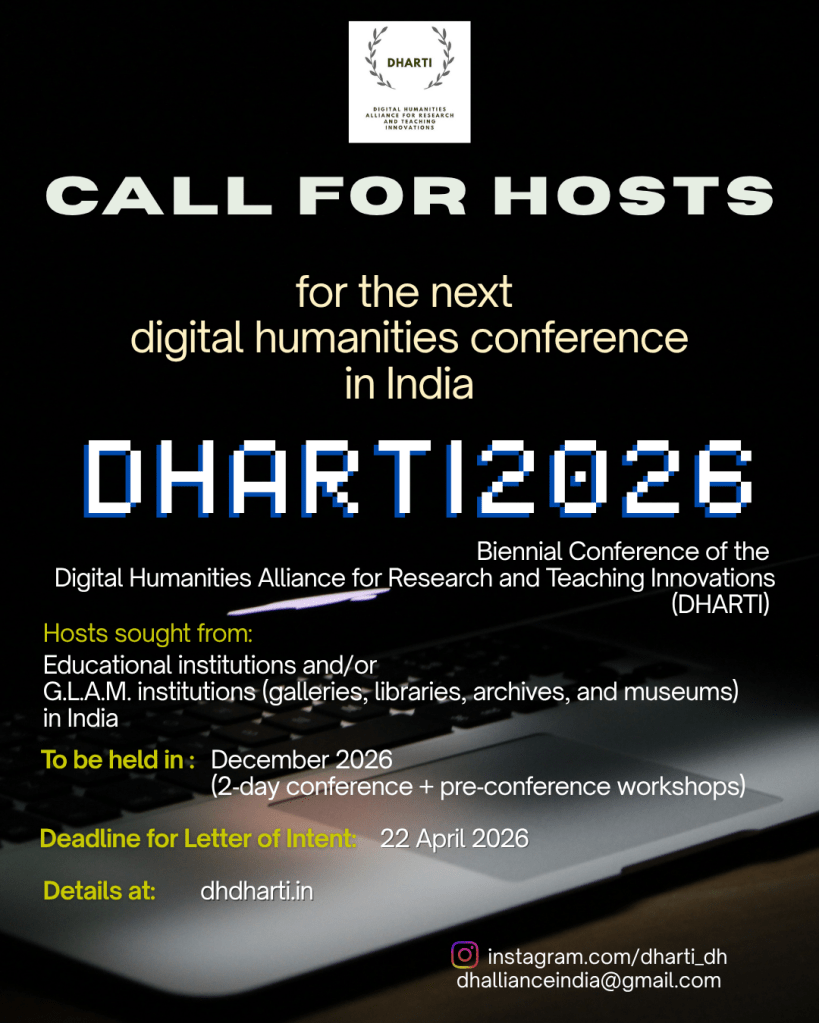
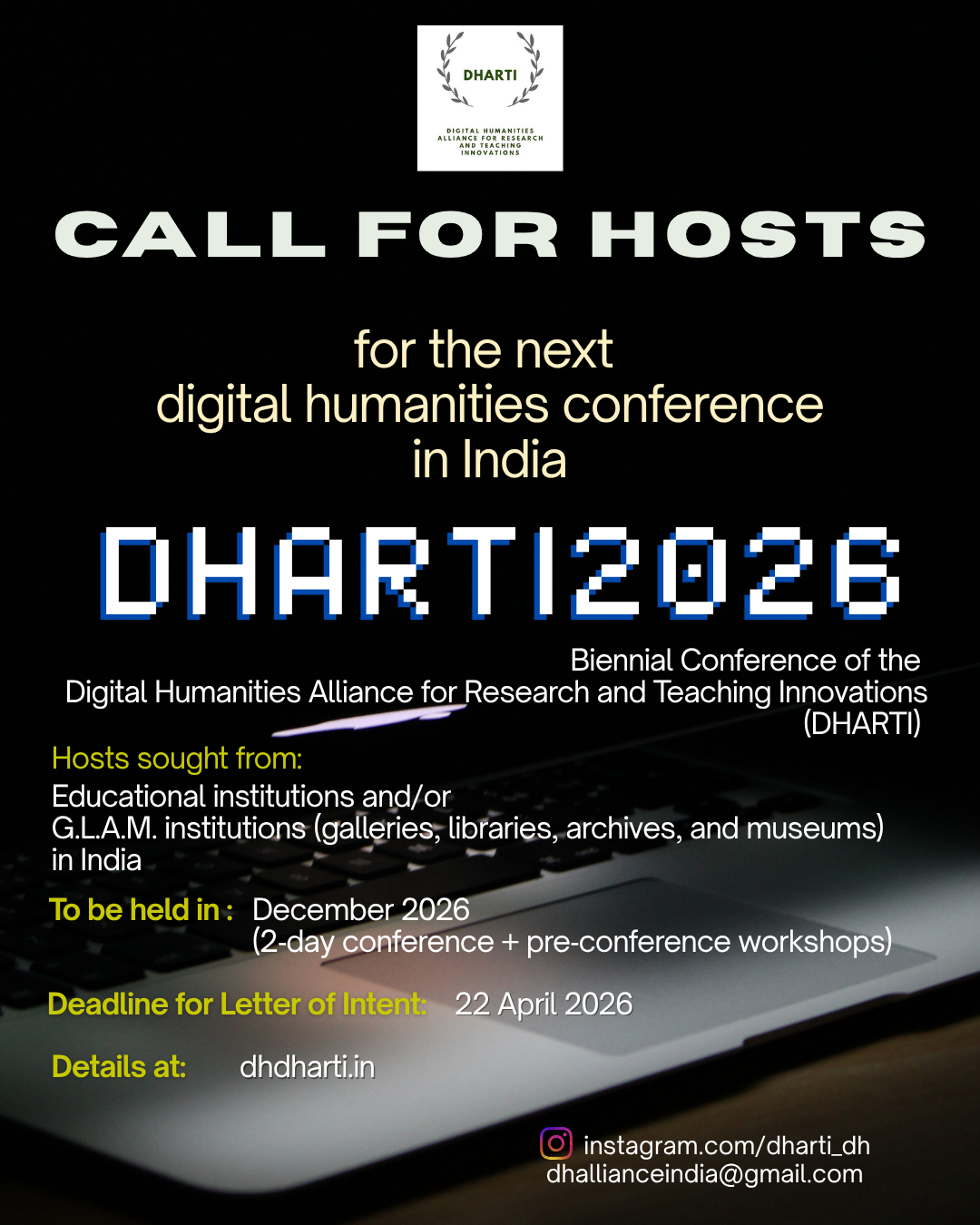
The Digital Humanities Alliance for Research and Teaching Innovations (DHARTI) is seeking proposals from educational institutions and/or stakeholders from the G.L.A.M. [galleries, libraries, archives, and museums ]sector in India to host the DHARTI 2026 biennial conference scheduled to take place in December 2026.
Based on the previous conferences organised under the aegis of DHARTI, DHARTI 2026 will be:
A 2-day conference with multiple parallel sessions
Accompanying pre-conference workshops
A respectful, collaborative platform stimulating debates on past, present, and future of Digital Humanities in India in all configurations
ORGANIZATIONAL CONTEXT AND BRIEF OVERVIEW OF PAST CONFERENCES
The Digital Humanities Alliance for Research and Teaching Innovations or DHARTI, is an initiative toward organizing and facilitating digital practices in arts and humanities scholarship in India, both within and beyond academic institutes. DHARTI is India’s first Digital Humanities Collective and is affiliated as a Constituent Organization of the The Alliance of Digital Humanities Organizations (ADHO) DHARTI, in its previous avatar as the Digital Humanities Alliance of India (DHAI) successfully held its inaugural conference in June 2018 at IIM Indore, which was organized jointly by IIM Indore and IIT Indore. The two-day conference with the theme: “Contestations, Connections and Collaborations” saw participation from more than 50 national and international delegates from 16 Indian states and 5 countries. DHARTI 2020 conference organized as India’s first twitter conference in January 2020 that also saw tremendous participation from DH enthusiasts from across the world.
The second DHARTI 2022 biennial conference was held from February 21 to 25, 2022, with the theme: “The Digital Divides: Discontents, Debates and Discussions” and with the aim to acknowledge the vertiginous divides, celebrate the productive debates, and encourage new models of thinking about humanistic inquiry in a post-Covid digital landscape. Thus far, participation at all DHARTI events has been transdisciplinary with representation from diverse disciplines including (but not limited to) Language, Literature, Visual Art, Performance / Theatre Studies, Media Studies, History, Sociology, Psychology, Language Technologies, Library Studies, Methodologies as well as Software and Critical Computational Studies. These modes of participation are representative of the aims of DHARTI, namely, to provide a methodological commons to promote and accommodate the diverse nature of DH studies within the Humanities, Social Sciences, and beyond through interdisciplinary research and pedagogy. DHARTI also aims to foster connections and associations with fellow DH organizations from the Global South that are similarly committed toward a decolonized praxis of DH.
The third DHARTI 2024 biennial conference was held from 10–13 December 2024 at IIT Jodhpur, with the theme “Digital Subject/ivities in the Global South.” The conference brought together scholars, practitioners, and students to discuss emerging methods, pedagogies, and critical debates in Digital Humanities within Global South contexts.
Besides conferences, DHARTI also conducts workshops and talk series. In July 2020, a DHARTI panel on “Toward a Postcolonial/Decolonial Digital Humanities” for DH2020 was held online, streamed live on YouTube, and archived on the Humanities Commons Portal. In December 2020, DHARTI launched the DHARTI Speaks! Webinar series with a talk on Electronic Literature as DH-Perspectives from Ghana and India. In August and September 2025, the talks on electronic literature and AI were conducted as part of the series and we have an upcoming talk series which will be regularly posted on our website. This online series aims at facilitating a sustained dialogue between Global Voices and/in Local Conversations on the Global South.
We are particularly interested in proposals from institutions/ groups of institutions that:
Have developed or are developing digital humanities communities and organizations
Have not previously hosted a DH conference and/or
Are interested in developing new modes of engagement for DH
Are similarly committed toward a decolonized praxis of DH
Scope of Proposal
The selected educational institution(s) and/or stakeholders from the G.L.A.M. [galleries, libraries, archives, and museums ]sector will be responsible for the following:
Event Planning
Develop the conference website, a comprehensive event plan outlining key milestones, and timelines.
Coordinate with DHARTI functionaries to understand the conference objectives, theme, and target Audience.
The academic aspects of the conference, including overall intellectual direction, will be overseen by the DHARTI Governing Body. The members from the host and DHARTI Governing Body members will be in the programme committee.
Venue Selection and Logistics
Identify and secure a suitable venue that aligns with the conference requirements for Hybrid (if preferred) and offline participation (including room sizes and technical capabilities, hotel, options for student housing, and other accommodations, arrangements for access accommodations
Manage logistics, including audio-visual equipment, catering, signage, and seating Arrangements.
A decision regarding the inclusion of hybrid participation will be made jointly by DHARTI and the host[s]. If hybrid options are adopted, the host[s] must ensure conducive facilities and reliable technical infrastructure for seamless online and offline engagement.
The decided number of participants will be based on the capacity of the host.
Program Development
Collaborate with DHARTI functionaries to create a diverse and engaging conference program.
Source and coordinate speakers, panelists, and workshop facilitators. DHARTI will liaison with the keynote speakers.
Marketing and Promotion
Develop promotional strategies to promote the conference and invite participation.
Create promotional materials, including brochures, banners, and online content.
Registration and Attendee Management
Implement an efficient registration system for participants.
Handle attendee inquiries and manage participant communications.
Sponsorship and Exhibitor Coordination
Secure sponsorships and manage relationships with sponsors.
Coordinate exhibitor logistics, including booth assignments and setup.
Financial structure will be mutually decided.
DHARTI may offer a few bursaries for the presenters.
On-Site Management
Oversee on-site logistics and ensure smooth event execution.
Provide event staff for registration, information, and support.
Post-Event Evaluation
Collect feedback from participants, sponsors, and exhibitors.
Prepare a comprehensive post-event report, including recommendations for future conferences.
Proposal Submission: Interested institutions are invited to submit a letter of intent that addresses their suitability for hosting the conference as well as a few proposed conference themes. Thereafter, a detailed proposal should be submitted.
The proposal should include the following:
Institutional background and experience in conference planning
Suggestions for conference theme and subthemes
Proposed event plan and timeline
Budget estimate, including a breakdown of costs and sources of funding.
Previous experience with similar events and references
Marketing and promotional strategies
Submission of Letter of Intent: 22 Apr 2026 Submission of Detailed Proposal: 8 May 2026 Proposal Submission Address: dhallianceindia@gmail.com
Proposals will be evaluated based on the following criteria:
Access for attendees with disabilities is mandatory at all venues and events associated with the conference. This includes accommodations in presentation rooms for participants who are sight- and/or hearing-impaired. If excursions cannot be made accessible to people with disabilities, this should be clearly noted in the registration materials.
Experience and expertise in conference planning and event management. Proposed budget and cost-effectiveness. References and past performance. Marketing and promotional strategies.
DHARTI reserves the right to reject any or all proposals or to negotiate separately with educational institutions deemed to be the most qualified.
We look forward to receiving your proposal.Sincerely, DHARTI Governing Body dhallianceindia@gmail.com
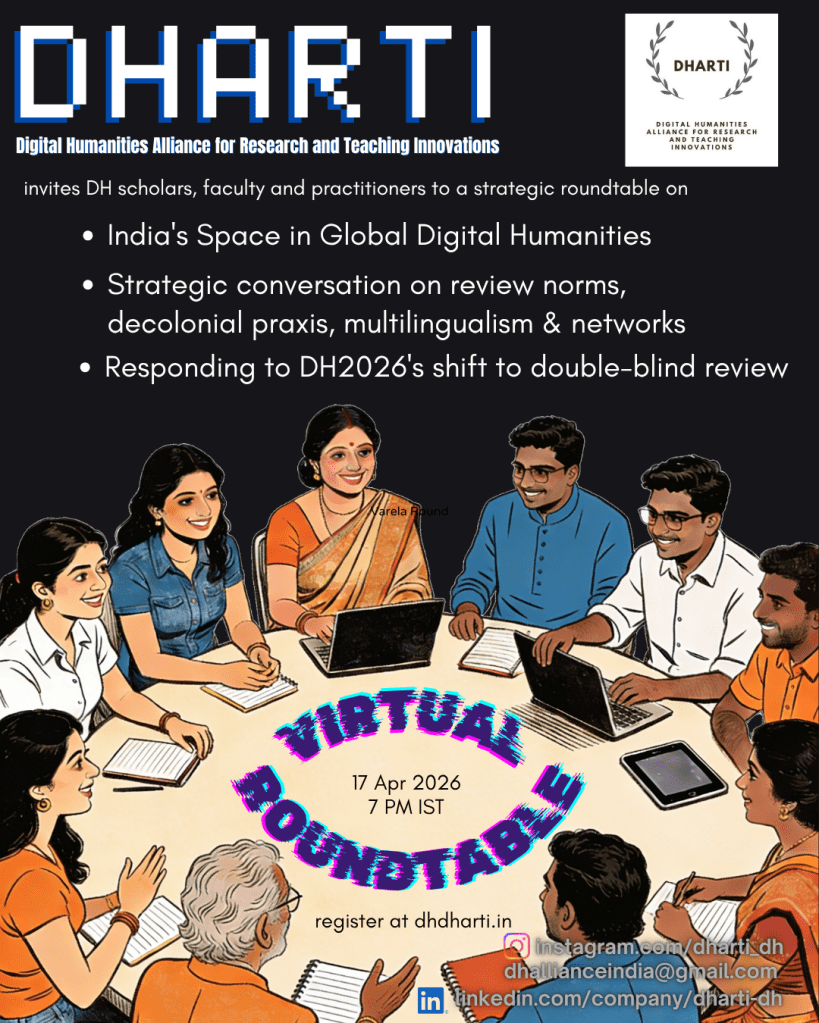
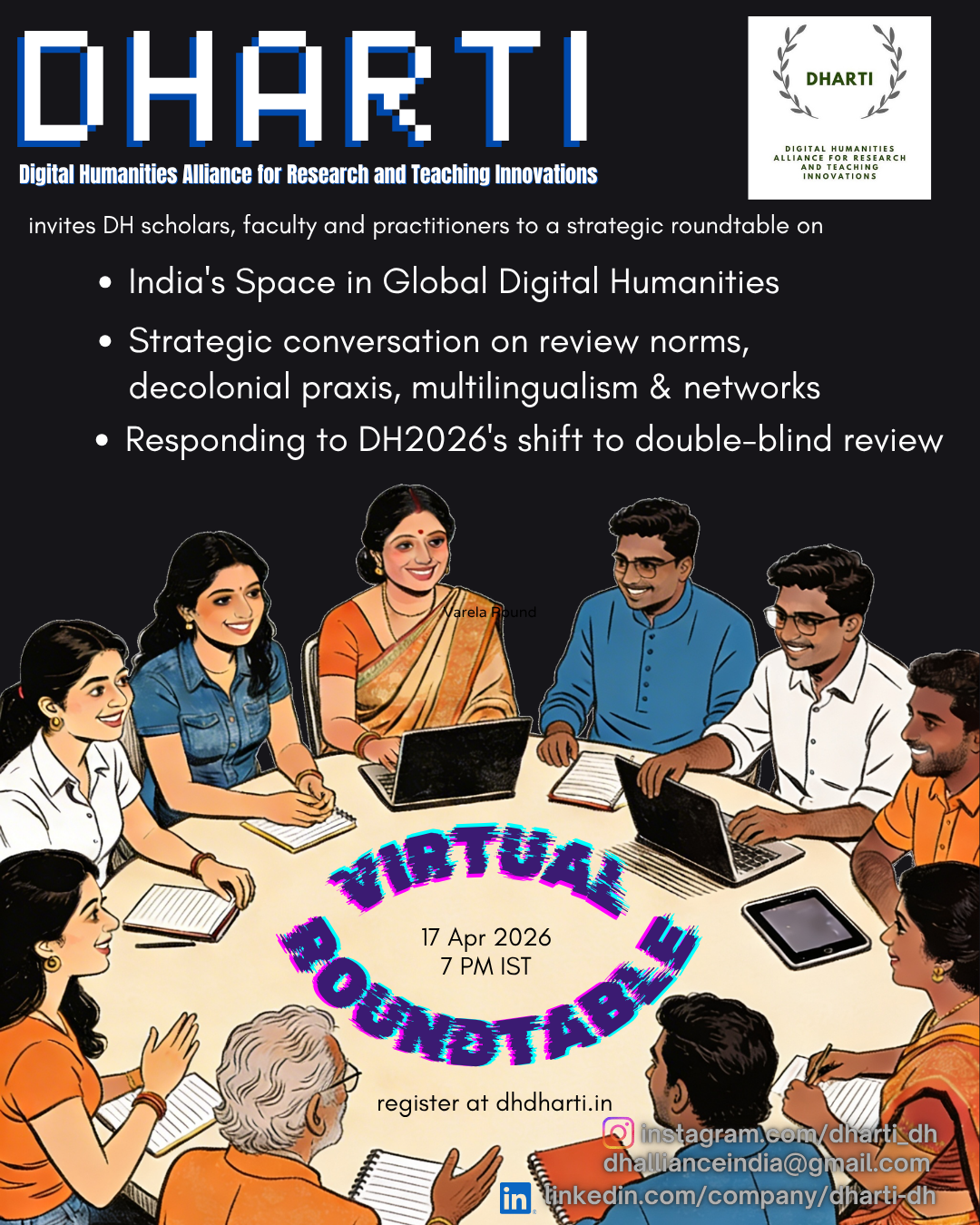
The DHARTI Governing Body invites scholars, faculty, and practitioners to a strategic conversation on India’s evolving role in the international DH community and how DHARTI can deepen digital humanities work across India.
The recent ADHO decision to adopt double-blind review for DH2026 has sparked essential global discussions about fairness, inclusion, and review practices. This is our moment to articulate Indian perspectives on:
What unique contributions can India bring to global DH from the Global South?
How do multilingualism, decolonial approaches, infrastructure needs, and interdisciplinary networks shape our work?
What role can DHARTI play in mentoring, networking, and amplifying Indian DH internationally?
Who should join: Leaders from humanities, social sciences, libraries, and technology shaping DH ecosystems in India.
Concept Note Undergraduate humanities education in India has historically trained students within single-disciplinary silos. The engagement in the field of humanities has transformed with the advent of the digital tools and the interlinked spaces, breaking disciplinary boundaries and connecting, overlapping teaching-learning and research. This summer school proposes to address the possibilities of the ever expanding […]
DHARTI is pleased to announce that the DHARTI2026 Biennial Digital Humanities Conference will be hosted by Kalinga Institute of Industrial Technology (KIIT), Bhubaneswar, in December 2026.
Friday, April 17, 2026 | 7:00 PM IST | Virtual The DHARTI Governing Body invites scholars, faculty, and practitioners to a strategic conversation on India’s evolving role in the international DH community and how DHARTI can deepen digital humanities work across India. The recent ADHO decision to adopt double-blind review for DH2026 has sparked essential […]
The Digital Humanities Alliance for Research and Teaching Innovations (DHARTI) is seeking proposals from educational institutions and/or stakeholders from the G.L.A.M. [galleries, libraries, archives, and museums ]sector in India to host the DHARTI 2026 biennial conference scheduled to take place in December 2026. Based on the previous conferences organised under the aegis of DHARTI, DHARTI […]
Join us for the Helsinki Digital Humanities Hackathon 2026—an opportunity to collaborate and innovate in an interdisciplinary setting. The application period is open (until 14 April 2026) – apply now to be part of this year’s cohort.
People talk about hackathons, but there is only one Helsinki Digital Humanities Hackathon. #DHH26 is the 11th iteration of our international summer school (aimed primarily at master’s students and beyond), which brings together diverse participants from Finland and across Europe.
In the Helsinki Digital Humanities Hackathon, you will experience an interdisciplinary research project from start to finish within the span of 10 days. For researchers and students from computer science and data science, the hackathon gives the opportunity to test their abstract knowledge against complex real-life problems. For people from the humanities and social sciences, it shows what is possible to achieve with such collaboration. For everyone, the hackathon gives the experience of intensely working with people from different backgrounds as part of an interdisciplinary team, as, during the hackathon, each group develops a digital humanities research project from start to finish. Working together, they formulate research questions with respect to particular data sets, develop and apply methods and tools to address them, and present the work at the end of the hackathon.
Participation in #DHH26 is free for all accepted participants. This year, we also expect to sponsor a limited number of participants from outside Finland with flights and accommodation (decisions on this to be made after the application period).
The event is organised by FIN-CLARIAH—particularly its DARIAH-FI component—in collaboration with HELDIG and the Department of Digital Humanities at the Faculty of Humanities, University of Helsinki, as well as Aalto University. We are supported by CLARIN-EU, HIIT, the Helsinki Centre for Intellectual History, and Marie Curie Training Networks CASCADE & MECANO. 5 ECTS credits may be gained from participating in the hackathon for students, and it also functions as a staff training event for leadership and collaboration across disciplinary borders.
17.3.2026 This year’s themes are unveiled, and the application period starts 14.4.2026 Application period ends 27.4.2026 Registration period ends for #DHH26 for accepted participants 4.5. & 11.5.2026 Two #DHH26 pre-hackathon online preparatory sessions 20.–29.5.2026 #DHH26 hackathon in Helsinki
Please note that we can only accept participants who are able to commit to the full week of intensive work (not just a couple of hours here and there), as well as the preparatory sessions. Thus, if you know that you have other commitments during the hackathon, please consider applying next time when you can make a full commitment.
The hackathon will take place between 20.–29.5.2026. The participants are expected to commit to the hackathon for the whole period; work takes place mainly between 10 AM and 5 PM on weekdays (the weekend is free!). In addition, there are two online pre-sessions on Mondays 4.5. and 11.5., between 2 – 4 PM UTC+03:00 for orientation, group formation and preparation for the intensive hackathon period. The participants are expected to attend also these pre-sessions.
The Australasian Association for Digital Humanities (aaDH) presents Digital Humanities on the Edge. To kickstart 2026, we bring together four speakers to examine topics core to the future directions of DH: Infrastructure, Surveillance, Platforms, and Artificial Intelligence. The panel will consider how these four domains are reshaping not only DH tools, but also the ethical and political conditions under which DH work now takes place. At a moment of considerable disciplinary inflection, aaDH invites you to a discussion on the edge – of methods, histories, theories, and time.
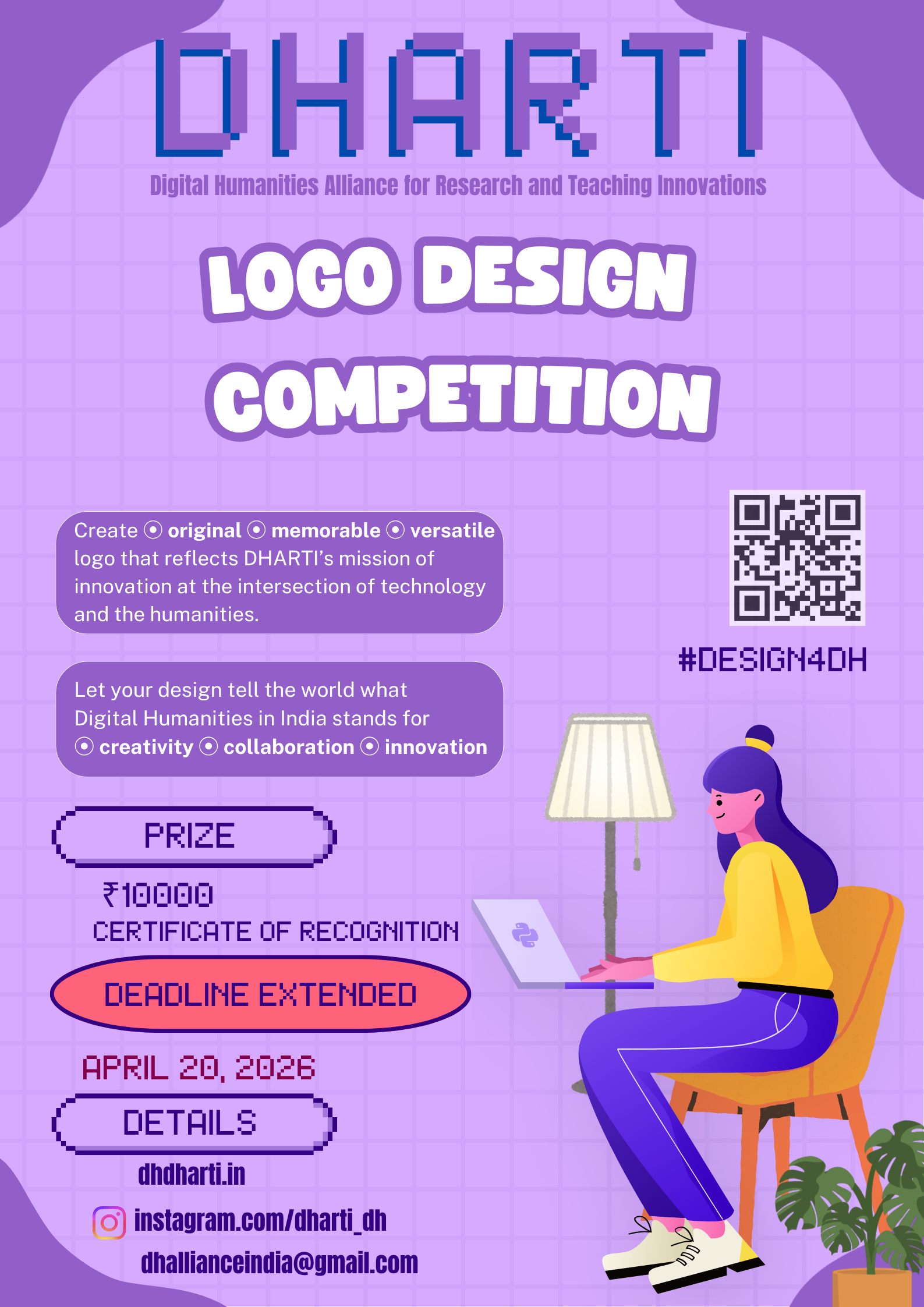
Dharti We are pleased to announce an exciting opportunity to design a distinctive logo that will represent our organization globally. Deadline Extended! About UsDHARTI, a registered Non Profit organisation in India, is an initiative towards enabling and facilitating digital practices in arts and humanities scholarship in India, both within and beyond academic institutes. As an […]
We’re delighted to announce that the registration for the Spring 2026 series of Friday Frontiers is now open. The Friday Frontiers webinars allow researchers, practitioners and stakeholders from across the broad DARIAH community, and now beyond, to learn about current research, best practice and social impact, and different tools and methods in digital humanities scholarly practice.
The webinar sessions are all free to attend, but registration is required. Presentations are all recorded and published at a later date on DARIAH-Campus.
The details of the upcoming talks, along with their registration links are below:
Friday 6th March 2026, 11.30am CET
Title: “Can this be done?” New research tools for studying human interaction
Speakers: Stefan Lindgren & Carolina Larsson, Lund University
This presentation aims to demonstrate a new workflow for using motion capture to study human movement and interaction. The workflow arose from a collaboration with Riksteatern Crea, a theatre group in Sweden that creates stage productions in sign language designed for deaf, hard-of-hearing, and hearing audiences alike. They asked whether it is possible to transfer the complex movements of a sign-language performer to a digital avatar that could be projected onto a stage and interact in real time with both the audience and live actors. The answer was yes. Here we outline the development of a simplified, more efficient workflow for researchers studying human interaction through body movement and gesture using motion capture devices of different kinds and a free game developing software called Unreal Engine.
About the speakers:
Stefan Lindgren
Stefan Lindgren is a research engineer at Lund University Humanities lab, a multiuser research infrastructure that provides tools and knowledge to conduct research about human behavior, communication, cognition and culture. He is acting technical manager for the lab and has a background in computer technology with a special interest in 3d-data and 3d-visualisations. He has been involved in a large number of research projects helping out with 3d-documenation all over the world. His expertise includes 3d-scanning, photogrammetry, motion capture and 3d-visualisations.
Carolina Larsson
Carolina Larsson is a systems developer at Lund University Humanities lab, a multiuser research infrastructure that provides tools and knowledge to conduct research about human behavior, communication, cognition and culture. Carolina is an expert in 3d-modelling and is proficient in Blender, a 3d-software that covers most aspects of 3d-modelling. She has a solid experience in working with and manipulating 3d-data from any kind of 3d-acquisition. She has been working with 3d-documentation, motion capture and animations in research projects in areas such as medicine, archaeology, linguistics, historical reconstructions and museology.
Games create worlds made of many different elements, but also of rules, systems and structures for how we act in them. So how can we make sense of them? Mytholudics: Games and Myth lays out an approach to understanding games using theories from myth and folklore. Myth is understood not as an object or a kind of story, but as a way of expressing meaning, a way in which we produce a model for understanding the world and things in it. This talk lays out this approach and how it can help you analyse and conceptualise gameworlds. The framework helps to see games and their worlds in the whole. Stories, gameplay, systems, rules, spatial configurations and art styles can all be considered together as contributing to the meaning of the game.
About the speaker:
image credit: Eivind Senneset, UiB
Dom Ford is a postdoctoral researcher at the Center for Digital Narrative at the University of Bergen, as part of the LEAD AI programme. His current project looks at nonplayer characters in games with AI-generated dialogue, how players respond to the use of this technology and how this use may challenge ideas in the philosophy of fiction like intentionality. He is also an editor for Eludamos. Previously he was a postdoc at the University of Bremen, part of the Media and Religion lab in the ZeMKI Centre for Media, Communication and Information Research, where he was also the managing editor for gamevironments.
His first book, Mytholudics: Games and Myth, proposes a method for analysing games both as conduits of mythologies within society and as mythological structures in themselves. It’s out now and published by De Gruyter.
He wrote his PhD at the IT University of Copenhagen’s Center for Digital Play between 2019 and 2022, supervised by Hans-Joachim Backe.
Friday 8th May 2026, 11.30am CEST
Title:Feminist Digital Humanities: Intersections in Practice
Speakers: Monika Barget (University of Maastricht), Jenny Bergenmar (University of Gothenburg), & Susan Schreibman (University of Maastricht)
In April 2025 Feminist Digital Humanities: Intersections in Practice was published by The University of Illinois Press. It is an edited collection (which is available open access and can be downloaded here) divided into three main sections: Readings, Infrastructures and Pedagogies. The thread that runs through this collection is a theorisation of feminist DH practice as sites of possibility for exploring, exposing, and revaluing marginalized forms of knowledge production through new modes and processes of meaning making. Each chapter also reflects on what it means to be a feminist and a technologist through definitions of feminisms that are brought into conversation with DH scholarship. Feminist DH practices are presented as sites of possibility for exploring, exposing, and revaluing marginalized forms of knowledge production by enacting new modes and processes of meaning making. An overriding focus of the collection is to demonstrate how feminist lenses attuned to issues of intersectionality and gender can uncover structural inequities and present opportunities for social and intellectual change.
This talk will have a three-part focus. The first part will reflect on the collection as a whole, and how it intersects with current feminist thought and DH practice. The second part will explore the Readings section through the chapter Feminist DH: A Historical Perspective Excavating the Lives of Women of the Past by Monika Barget and Susan Schreibman which explores how the Irish digital humanities project Letters 1916–1923 adopted a feminist approach to surface marginalized women’s voices in a heterogeneous historical collection of letters dominated by male voices. The third part will focus on Jenny Bergenmar’s co-authored chapter Infrastructures for Diversity: Feminist and Queer Interventions in Nordic Digital Humanities from the Infrastructures Section, which explores how DH infrastructures in institutional frameworks can make space for feminist, queer, and activist perspectives, methods, and collaborations.
About the speakers:
Monika Barget is an early modern historian and digital humanist specializing in the political history of the eighteenth century, visual cultures, and spatial history. From 2017 to 2018, she contributed to the Letters 1916–1923 and Ignite projects at the National University of Ireland, Maynooth. Following postdoctoral work in Mainz, she joined the History Department of Maastricht University as an assistant professor in August 2021.
Jenny Bergenmar is a professor of comparative literature at the University of Gothenburg, Sweden. She is a literary history scholar who has previously worked with digital scholarly editing and archival materials through digitization and crowdsourcing. She is currently principal investigator of the research infrastructure project QUEERLIT database: Metadata Development and Searchability for LGBTQI Literary Heritage (2021–2023).
Susan Schreibman is a professor of digital arts and culture at Maastricht University and a Co-Director of DARIAH. Her current research projects include: PURE3D2.0 and Contested Memories: The Battle of Mount Street Bridge.
The Social Sciences and Humanities Open Marketplace is a discovery portal which pools and contextualises resources for Social Sciences and Humanities research communities: tools, services, training materials, datasets, publications and workflows.
The Marketplace highlights and showcases solutions and research practices for every step of the SSH research data life cycle.
Training Series Learning objectives
Understand Open Science, FAIR and CARE principles in practice Participants will be able to explain the Open Science paradigm and the FAIR and CARE principles, and assess their implications for responsible research data management across the full data lifecycle in the arts and humanities, social sciences, language sciences, and GLAM-related research.
Navigate and critically use the SSH Open Marketplace Participants will be able to confidently navigate the SSH Open Marketplace to discover, evaluate, and select relevant tools, services, datasets, workflows, and training materials for their research needs.
Integrate digital resources into research workflows Participants will be able to incorporate SSH Open Marketplace resources into discipline-specific research workflows, enhancing transparency, reproducibility, and efficiency in arts and humanities, social sciences, language sciences, and GLAM-related research.
Contribute to and curate resources Participants will be able to contribute their own communities’ high-quality resources to the SSH Open Marketplace by applying editorial guidelines, metadata standards, and best practices for documentation, interoperability, and reuse, as well as reuse Marketplace resources to support reproducible and transparent research practices.
Apply domain-specific standards, resources and research practices Participants will be able to document, share, and reuse domain-specific research workflows, data, and tools within arts and humanities (DARIAH), social sciences (CESSDA), language sciences (CLARIN), cultural heritage contexts, thereby fostering interoperability, FAIR compliance, and sustainable knowledge exchange within national and European research infrastructures
Leverage the SSH Open Marketplace for community-specific applications Participants will be able to design and implement customized application scenarios by utilizing the SSH Open Marketplace to create, curate, and disseminate tailored resource lists or complex catalogs that meet the specific needs and standards of their respective research communities.
Overview of sessions and learning objectives per session
Training session
Learning objectives
20 February: FAIR, CARE & Open Science Principles
1. Explain the core principles of Open Research and their relevance for SSH research practices. 2. Distinguish between FAIR and CARE principles and understand their complementary roles in data governance. 3. Identify key FAIR-compliant research infrastructures relevant to SSH research. 4. Assess the implications of Open Science requirements for data management planning and project design. 5. Apply FAIR and CARE principles to a concrete research use case or project scenario.
20 March: Introduction to SSH Open Marketplace
1. Describe the purpose, scope, and added value of the SSH Open Marketplace for SSH research. 2. Navigate the SSH Open Marketplace interface to locate resources (tools, services, datasets, training materials, and workflows). 3. Use search and filtering functions to identify relevant resources for a specific research question. 4. Understand how the Marketplace connects community use-cases to European SSH research infrastructures. 5. Select appropriate resources from the Marketplace for early-stage or exploratory research tasks.
17 April: Making the most of the SSH Open Marketplace
1. Explore and differentiate advanced resource types such as workflows. 2. Integrate Marketplace resources into existing research workflows. 3. Evaluate the quality, relevance, and reuse potential of Marketplace entries using metadata and relations. 4. Enrich existing Marketplace records by adding metadata, links, and contextual information. 5. (Re)use Marketplace resources to support reproducible and transparent research practices.
15 May: Contributing to the SSH Open Marketplace
1. Understand the role of community contributions in sustaining the SSH Open Marketplace. 2. Add new tools, datasets, workflows, or training materials to the Marketplace. 3. Apply editorial guidelines and quality standards for resource curation. 4. Use metadata schemas and controlled vocabularies to improve interoperability and discoverability. 5. Critically review and improve existing Marketplace entries to enhance reuse and FAIRness. 6. Understand programmatic access and re-use of marketplace material via API and WordPress plug-ins.
19 June: Thematic Art and Humanities
1. Identify DARIAH services and workflows relevant to arts and humanities research. 2. Understand how arts and humanities research workflows are represented in the SSH Open Marketplace. 3. Apply DARIAH tools and workflows (e.g. ATRIUM) to concrete research scenarios. 4. Integrate heterogeneous data types typical of arts and humanities research into FAIR-aligned workflows. 5. Share and document arts and humanities workflows for reuse within the SSH community.
18 September: Thematic GLAM institutions
1. Understand the specific characteristics and challenges of cultural heritage and GLAM data. 2. Identify relevant tools, standards, and services for GLAM data in the SSH Open Marketplace. 3. Apply FAIR principles to digitised and born-digital cultural heritage data. 4. Integrate GLAM datasets into interdisciplinary SSH research workflows. 5. Promote reuse and sustainability of cultural heritage data through documentation and sharing practices.
16 October: Thematic language data
1. Identify CLARIN services and standards for managing and analysing language data. 2. Understand FAIR and legal/ethical challenges specific to language data (e.g. sensitive or personal data). 3. Use the SSH Open Marketplace to discover language resources, tools, and workflows. 4. Integrate CLARIN tools into linguistic research workflows. 5. Prepare and document language datasets for reuse within national and European infrastructures.
20 November: Thematic Social sciences
1. Identify CESSDA services, standards, and tools relevant to social science research. 2. Understand best practices for managing, documenting, and sharing social science data. 3. Use the SSH Open Marketplace to locate CESSDA-related datasets and services. 4. Apply FAIR and ethical principles to quantitative and qualitative social science data. 5. Connect social science research workflows to European data services and infrastructures.
The training series are conceptualised following the FAIR-by-design methodology developed in skills4EOSC (Filiposka et al. 2024), which consists in taking a systematic approach for conceptualizing each training session, e.g. defining the target audience, the learning objectives and the means to achieve them in each training session, publishing the materials and guides about how to use them, among others. FAIR learning materials enable the reuse of the materials both by learners and by trainers.
Target audience
The workshop series is aimed at a broad audience with links to the social sciences and humanities – from beginners to experienced researchers and practitioners who want to contribute their perspectives or benefit from the experiences of others.
a discovery portal, to foster serendipity in digital methods
an aggregator of useful and well curated resources
a catalogue, contextualising resources
an entry point in the EOSC for the Social Sciences and Humanities researchers
The SSH Open Marketplace is not:
a repository. Nothing is hosted in the SSH Open Marketplace. Workflow content type can be hosted, but this is an exception.
a data catalogue. The goal is not to collect all the SSH datasets, but selected datasets are indexed to support the contextualisation (dataset mentioned in a publication or used in a training material for example).
a commercial Marketplace. There is nothing to sell in the SSH Open Marketplace. Commercial software/services can be referenced
The DARIAH Annual Event 2026 will take place on May 26th to May 29th in Rome, Italy. Our host for this year’s event is CNR: Consiglio Nazionale delle Ricerche. May 26th will be a day for DARIAH internal meetings, followed by the main conference on May 27th to May 29th.
This year’s event will explore the topic of Digital Arts and Humanities With and For Society: Building Infrastructures of Engagement.
The theme of DARIAH’s 2026 Annual Event is to explore digitally-enabled research through a public and participatory lens, focusing on who our research is for, what are its social and public benefits, and how research can serve to create new dialogues within the public sphere. We seek to foster exchanges on how digital infrastructures, networks and collaborative methods can enable and sustain forms of scholarship that are open, flexible and socially responsive. A way to frame this is through the concept of hybridity: an intermingling of ‘disciplines, technological and cultural practices’ which embed within them the goal of connectivity. This may be connectivity of the university or memory institutions with society through collaborative and joint engagements, or it might be providing alternative spaces for/where people can connect and interact through a hybrid network of physical and technology-mediated encounters to co-construct knowledge.’
Whether through scholarly reflections, concrete case studies, theoretical contributions, or policy considerations, this year we seek to explore how digital, social and institutional infrastructures can support engaged research, and nurture generosity, participation and shared creativity in the digital arts and humanities.
We welcome contributions on a variety of topics, including but not limited to:
Infrastructures of engagement: designing open, inclusive, collaborative, and sustainable platforms
New models of collaboration across academia, memory institutions, and society
Pedagogies of engagement and public-facing (digital) humanities education
Mapping engagement: Evaluating and evidencing public value and impact in digital research
Preservation, stewardship, and resilience in digital knowledge infrastructures
Co-creation, citizen science, public and participatory humanities, and community-driven, engaged scholarship
Policy and governance frameworks for sustaining participatory infrastructures
Creative and artistic practices as forms of public engagement and dialogue
The role of digital archives and participatory practices in shaping collective memory and identity
Ethical and sustainable approaches to participatory digital-enabled research
Implementing CARE: Designing digital infrastructures that foster trust, diversity, inclusion, and accessibility
Intercultural and transnational perspectives on public digital humanities
Research infrastructure as critical Infrastructure – strategies to build resilient infrastructure for engagement and public good
Policy and governance frameworks for sustaining participatory infrastructures
Keynote speaker
We are happy to announce that Andreas Fickers, director of the Luxembourg Centre for Contemporary and Digital History (C²DH), 3rd Interdisciplinary Center at the University of Luxembourg and head of its Digital History Lab, will give a keynote speech on “Multimodality as a means for multivocality? Transmedia storytelling and the challenges of shared authority in digital public humanities” at the DARIAH Annual Event 2026.
Important dates
(Extended)Deadline for Call for Papers:December 22, 2025January 8, 2026 Registration opens: February 15, 2026 Notification of acceptance: Late February, 2026
DARIAH-EU is proud to announce a new initiative titled “DARIAH Beyond Europe”, a curated series of online presentations aimed at highlighting the work of our valued extra-European Cooperating Partners and fostering new synergies within the DARIAH community. The series will take place throughout the academic year 2025-2026, with each session dedicated to a current extra-European Cooperating Partner.
DARIAH Beyond Europe: Center for Digital Humanities at Princeton University Thursday, October 30 at 14:00-15:30 CET
Our first session, highlighting our longstanding partnership with the Center for Digital Humanities at Princeton University, will be held on October 30th from 14:00 Central European Time (9:00 Eastern Daylight Savings Time). It will be presented by the Center’s Executive Director, Dr. Natalia Ermolaev and Dr. Bryan Winston, Digital Scholarship expert at the Princeton University Library. The CDH has been a DARIAH Cooperating Partner since January 2021, and since 2023 has been co-organising a series of summer workshops with DARIAH-EU and Athens University of Economics and Business.
Sessions will last 90 minutes, with time for an introduction from DARIAH, a presentation from our Cooperating Partner, followed by discussion and questions. The Cooperating Partner will have the opportunity to introduce their institution and research activities, particularly its work in the field of digital arts and humanities, and lay out how they are already collaborating, or hope to collaborate more deeply, with DARIAH members and stakeholders. Future sessions are in the process of being scheduled and will be announced in the coming weeks.
The goal of the “DARIAH Beyond Europe” series is to provide a platform for mutual exchange and to enhance the visibility and integration of our non-European collaborators within the broader DARIAH family.
Please register to join our meeting and learn more about our extra-European Partners, and how DARIAH can help build meaningful scientific collaboration across borders!
A day of talks and discussion to explore the future of digital research infrastructure for the arts and humanities.
Date and time
Friday, November 7 · 9am – 5pm GMT
Location
Edinburgh Futures Institute, The University of Edinburgh
Room 2.55 1 Lauriston Place Edinburgh EH3 9EF United Kingdom
About this event
On 7 November 2025, UK DARIAH Day 2025 will gather researchers and practitioners in the Digital Humanities to explore experiences, insights, and challenges related to working with the UK’s digital research infrastructure (DRI). We will consider how closer alignment with the European Digital Research Infrastructure for the Arts and Humanities (DARIAH) can strengthen these initiatives in the UK, and explore what a future UK DRI might look like.
Throughout the day, posters, panels and presentations will showcase projects and other practical engagements with UK DRI.
We invite contributions to our our Lunchtime Showcase from projects,networks and infrastructures in Digital Humanities. Please indicate whether you are interested in contributing when you register.
The event will conclude with a networking reception open to all attendees.
The event is organised by the UK cooperating partners of DARIAH: the Universities of Brighton, Edinburgh, Exeter and Leeds; Kings College London; and the School of Advanced Study, University of London.
9.45 – 10.45: Infrastructure as Service or asMeitheal? Observations on a Decade (or Two) of DARIAH-IE.Prof Jennifer Edmond (Trinity College Dublin)
10.45 – 11.15: Coffee
11.15 – 12.00: Panel 1
Imagining DARIAH-UK: an exploration of potential infrastructural models. Sally Chambers (British Library / DARIAH)
CCP-AHC: A collaborative vision for access to large-scale compute for arts, humanities, and culture research in the UK. Eamonn Bell (University of Durham)
Towards a National Research Software Engineering Capability in Arts and Humanities Research. Andre Piza (The Alan Turing Institute)
12:15 – 13.00: Panel 2
DISKAH: Building skills for DRI-driven approaches to arts and humanities research. Karina Rodriguez Echavarria (University of Brighton)
Embedding arts and humanities research on responsible AI within industry and policy settings: lessons from the Bridging Responsible AI Divides programme. Gavin Leuzzi (Fellowships Lead, BRAID)
Title TBC, William Nixon (RLUK)
13:00 – 14:00: Lunch and Showcase
14:00 – 14:30: DRI operating models and opportunities: an AHRC perspective
14:30 – 17:00:Imagining Digital Infrastructure Futures Workshop. Jen Ross & Melissa Terras (University of Edinburgh)
How can we get a better understanding of current priorities, concerns and hopes about infrastructure, by imagining and collectively scrutinising possibilities? The workshop hosts from the University of Edinburgh have developed a set of research-informed, speculative scenarios to explore imagined futures for digital cultural heritage. This workshop will build on insights from responses to the scenarios to date, engage imaginatively with them, and facilitate strategic discussions about digital infrastructure futures.
We’re delighted to announce that the registration for the Autumn 2025 series of Friday Frontiers is now open. The Friday Frontiers webinars allow researchers, practitioners and stakeholders from across the broad DARIAH community, and now beyond, to learn about current research, best practice and social impact, and different tools and methods in digital humanities scholarly practice.
The webinar sessions are all free to attend, but registration is required. Presentations are all recorded and published at a later date on DARIAH-Campus.
The details of the upcoming talks, along with their registration links are below:
Friday 3rd October 2025, 10.30am WEST / 11.30am CEST / 12.30pm EEST
Title: Fostering Data Sharing in the Humanities with Open-source software: archeoViz and the archeoViz Portal for Spatial and Statistical Exploration of Archaeological Data
Incentives and advocacy of open science principles have spread for more than two decades in the social sciences and humanities. Although there have been obvious improvements during this period, the current situation is far from satisfying. In archaeology, for example, despite the long-standing interest in this field for database-systems, recent literature highlights several barriers to the availability of field data: 1) the absence of user-friendly tools, 2) a lack of data management training, 3) limited time to prepare data for publication, and 4) insufficient recognition of data publishing efforts. To address these issues, the “archeoViz” application offers a solution as an open-source stand-alone application for visualising and statistically exploring spatialised archaeological data. It is complemented by the “archeoViz Portal”, an interactive catalogue of “archeoViz” use-cases (https://analytics.huma-num.fr/archeoviz/home). Ultimately, the “archeoViz” ecosystem facilitates data sharing and the visual restitution of archaeological findings, benefiting scientists and the general public alike.
In this presentation, taking archaeology as a case study, the underlying principles of the “archeoViz” ecosystem will be presented and illustrated, to fuel a more general discussion about the advocacy of open science principles in the social sciences and humanities.
About the speakers
Sébastien Plutniak (PhD in sociology, Master in archaeology) is a full-time research scientist at the CITERES lab (Tours, France) and a former member of the French School in Rome. His research revolves around computational methods in the humanities and the social sciences, which he investigates: 1) in a sociohistorical perspective, 2) in a practical way, developing methods and software tools for archaeological research.
Élisa Caron-Laviolette is a postdoctoral researcher in archaeology at the TEMPS lab (Nanterre, France), specialising in the spatial analysis of prehistoric domestic spaces. Her work combines field recording, GIS, and other digital and computational tools to investigate the organisation and use of space in hunter-gatherer campsites, with particular attention to material culture such as stone tools. She also engages with comparative perspectives, including occasional studies of sedentary groups.
Friday 7th November 2025, 10.30 WET / 11.30 CET / 12.30 EET
Title: AI-Human Synergy: Enhancing Cultural Knowledge Through Ethical and Inclusive use of Large Language Models (LLMs)
Recent advancements in artificial intelligence (AI), particularly large language models (LLMs), offer exciting possibilities for digital humanities research, specifically within computational literary studies. However, integrating these technologies responsibly and inclusively remains a critical challenge. This seminar introduces projects on Irish literature where the implementation of technical methods and discussions, in particular Retrieval-Augmented Generation (RAG) and AI workflow, can expand the scope of literary historiography and enhance close reading by introducing a machine-human synergy.
The talk will detail how RAG can contribute to existing trauma literature theories, reshape literary historiography, and engage in the discussion of digital hermeneutics by interacting with archival information. By examining poetry from Northern Ireland’s Troubles, this session also explores how LLMs enhance rather than replace traditional close reading methods, informed by Josephine Miles’ early quantitative literary critical approaches.
Last but not least, central to this exploration is the ethical dimension of AI, notably in relation to indigenous languages and cultures. Using examples from Indigenous Gaelic languages, the presentation highlights critical considerations including epistemological diversity in AI training, preserving endangered languages, and respecting data sovereignty.
About the speaker
Dr. Jenny Kwokis Research Assistant Professor of the Faculty of Arts, University of Hong Kong, where she also serves as the Lab Coordinator of the Arts Technology Lab. Dr. Kwok’s research advances AI workflows for literary analysis, focusing on Irish conflict literature. She develops retrieval-augmented generation (RAG) systems to contextualise the ambiguity of Troubles-era poetry within historical archives, and fine-tunes LLMs for semantic analysis of Irish literary corpuses. Her methods prioritise sociopolitical sensitivity and literary nuances, countering AI’s tendency to flatten contested narratives.
Her forthcoming work proposes frameworks for democratising AI in the humanities, emphasising explainable AI (XAI) tools. This aligns with her reinterpretation of pre-digital methodologies (e.g., Josephine Miles’ concordance work) as blueprints for hybrid human-machine interpretation.
Dr. Kwok holds fellowship at the Cambridge Digital Humanities (2025) and is Gale Scholar Asia Pacific, Digital Humanities Oxford (2026).
Friday 5th December 2025, 10.30 WET / 11.30 CET / 12.30 EET
Title: Building corpora of digital early music editions: challenges and opportunities.
Speakers: Esperanza Rodríguez (Universidad Complutense de Madrid), Frans Wiering (Utrecht University), David Lewis (University of Oxford), Anna Plaksin (Paderborn University).
This presentation shows results from the project CORSICA (Creation of Early Music Corpora). This initiative, growing from the COST action EarlyMuse, is directed by Frans Wiering (Universiteit Utrecht), with the participation of researchers from Spain, the Netherlands, the UK, Germany, Austria, and Sweden. The project sprang from the need to create a large corpus of early music data, coherently encoded and curated data that could be used for computer analysis, facilitating big-data studies. Hence, the research aims to improve the number of available corpora of Renaissance music by devising protocols to create collections of digital editions and, equally important, to facilitate the reuse of a sizable number of editions produced by a myriad of “citizen scientists” without much systematisation.
About the speakers
Esperanza Rodríguez is a “Ramón y Cajal” researcher at the Music Department of the Universidad Complutense de Madrid. She received a PhD at The University of Manchester (2010). Since then, she has worked at research institutions in the UK, Portugal, and France. Primarily a cultural musicologist specialising in Renaissance music, she has added an interest in digital musicology, especially in the field of musical analysis (CRIM-Project) and the recreation and dissemination of musical heritage (project ‘Experiencing Historical Soundscapes: the Royal Entries of Emperor Charles V in Iberian Cities’).
Frans Wiering is an Associate Professor at the Music Information Computing group of the Department of Information and Computing Sciences of Utrecht University (Netherlands). He received a Ph.D. in Musicology from the University of Amsterdam (Netherlands) in 1995 for his dissertation “The Language of the Modes” on the richness and variety of modality in 16th- and 17th-century music. The three main areas of his current research are music information retrieval, computational musicology, and interactive technologies, which he combines in his ongoing work on the use and acceptance of new technologies in musicological research. He is the founder of the Thesaurus Musicarum Italicarum, a corpus of online music treatises by Gioseffo Zarlino and his contemporaries (https://tmiweb.science.uu.nl/). He co-chairs the International Musicological Society’s Study Group on Digital Musicology.
David Lewis is a researcher at the University of Oxford e-Research Centre in Oxford and Lecturer in Computer Science at Goldsmiths, University of London, where he teaches Digital Humanities. He studied historical musicology at King’s College London and has since worked on a wide range of digital musicology and digital humanities projects, including lute tablatures, medieval and early modern music treatises, arrangements of concert works for domestic settings, and composer work catalogues.
Anna Plaksin is currently a professor of Digital Methods in Music and Media Editing at KreativInstitut.OWL (Paderborn University). After studying musicology, media education, and philosophy in Mainz (Germany), was awarded her PhD in 2020 by the Technical University of Darmstadt for her dissertation “Models for the computational analysis of mensural music traditions. Empirical text studies in the context of phylogenetic methods”. She worked previously on the research projects “Interpreting the Mensural Notation of Music” (Royal Birmingham Conservatoire, Birmingham City University), “Corpus Musicae Ottomanicae” (Max Weber Foundation, Bonn), and “Virtual Research Infrastructure for the Humanities” (Johannes Gutenberg University Mainz). Her research focuses on music encoding, corpus building, the development of software tools for interactive music scores, and the development of analytical methods for musical corpora.
Call for Papers: 5th DARIAH-HR International Conference Digital Humanities & Heritage Theme:Rethinking Heritage across STEM, Humanities, and Arts Date: 22–24 October 2025 Location: Josip Juraj Strossmayer University of Osijek – Academy of Arts and Culture in Osijek and Faculty of Agrobiotechnical Sciences Osijek
We are pleased to announce the Call for Papers for the 5th DARIAH-HR International Conference Digital Humanities & Heritage, which will take place from 22 to 24 October 2025 in Osijek, Croatia.
Organisers:
Institute of Ethnology and Folklore Research / DARIAH-HR, Josip Juraj Strossmayer University of Osijek – Academy of Arts and Culture in Osijek and Faculty of Agrobiotechnical Sciences Osijek
The aim of the conference is to foster collaboration across science, technology, the humanities, and the arts, and to create space for critical reflection on digital technologies in the context of cultural heritage, research, and artistic practice.
Main thematic areas include:
· STEM + Humanities: New Interdisciplinary Solutions · Creative Synergies: Art and Technology · Cultural Heritage in the Digital Age · Cultural and Creative Industries as a Bridge between Science and Art
For more information about the conference and the submission process, please refer to the full Call for Papers.
How to participate?
We invite you to submit an abstract for a presentation or poster (up to 500 words), accompanied by a short biography (up to 200 words) and a photo, no later than 15 June 2025 via the online form: https://forms.gle/Eyt3N3iy5o9ikiXv6
Authors of selected contributions will be invited to publish in a peer-reviewed conference proceedings volume.
Presentations and posters will be delivered on-site only.
Participation in the conference is free of charge.
Important Dates:
Abstract submission deadline: 15 June 2025 Notification of acceptance: 27 June 2025
DHA 2025 will take place from 3-5 December 2025 held in the Canberra on the lands of the Ngunnawal and Ngambri people at the Australian National University. It will be hosted by the HASS Digital Research Hub and the College of Arts and Social Sciences.
This call for papers closes on Friday 6th June 11.55pm (AoE)
The DHA2025 theme is Digital Archipelagos. The Australasian region is home to myriad archipelagos with deep significance, from the Kulkalgal Nation islands in the middle of Torres Strait to the Wharekauri (‘Misty Sun’) archipelago in the Pacific Ocean, east of Aotearoa’s South Island. Diverse, sacred, and yet increasingly under threat, these sites offer powerful examples of how land and sea are woven into cultural knowledge systems, social relations, and identities.
Archipelagos also serve our conference as a metaphor to spark dialogue about new directions and approaches in the Digital Humanities. They inspire us to conceptualise the fragmentation, clustering, dispersion, and interconnection of data in the Digital Humanities in discussions that prioritise local experiences and networks to challenge dominant narratives. In an age of algorithmic ubiquity, we aim to examine how seemingly isolated ‘islands’ of knowledge can remain distinct but intricately connected across evolving global contexts.
Like the diverse archipelagos that inspire our theme, we seek to engage the DH community around new topics and pathways, with papers and workshops from the wider arts, humanities, social sciences. We welcome contributions from scholars, librarians, archivists, artists, writers, practitioners, performers, activists, and others engaged with the intersections of Digital Humanities, sustainability, and social justice. We especially encourage submissions that propose novel, interdisciplinary frameworks and methods in DH and cognate fields.
We invite contributors to address the conference theme through the following three themes:
1. AI-Enhanced Humanities Research
AI and artistic practice, cultural value, and labour
Policy and consent in the automation of cultural data
AI and/in humanities pedagogy and education
Emerging AI tools and cultures in DH
Critiques of computational tools and methodologies
Responsible AI as Public Humanities
2. Digital Cultural Stewardship
Data connections, silos, fragmentations, bridges, and clusters
Digital narratives and situated, embodied storytelling
Metadata, data schema, data architectures
Collections-as-Data
Co-design in the Digital Humanities
New approaches in GLAM (e.g. collaboration with researchers)
Research Software Engineering (RSE) roles & responsibilities
Mapping, geospatial tools, and language networks
Collaborative research projects & Critical Infrastructure Studies (CIS)
Digital curation and stewardship
3. Data Ethics and Inclusive Practice
Decolonial DH, engagement, and inclusiveness principles
Climate, cultural heritage, and responsible digital preservation
Indigenous/community data protocols
Frameworks for cultural care
Data justice, digital empowerment, resistance
Geography and fieldwork in DH
Environmental Digital Humanities
Cultural flows, diasporic communities, trans-oceanic exchange
We welcome the following types of submissions
Posters, papers and panels
Poster: present work on any relevant topic or summarise projects, tools, methods, artwork, visualisation, or software demonstrations at any stage of development
Short papers (10 minutes): present work in progress or new methods, tools or ideas in the early stages of development. Short paper sessions will run for 90 minutes and include 5 short papers
Long papers (20 minutes): present completed, substantial research (either published or unpublished) or report on the development of significant projects, digital resources, or detailed theoretical, speculative, or critical discussions. Long paper sessions will run for 90 minutes and include 3 long papers
Panel proposals (90 minutes): present a single, focused topic comprising 4-6 speakers OR 3 long papers. Panel proposers should be attentive to panel diversity and scope in their selection of panel topics and presenters.
Workshops & Birds of a Feather
Workshop proposals (half day): present introductions to a specific software approach, method, or theoretical framework/approach. (NB. Abstracts for workshops should be 500 words and include a proposed structure/outline of the session)
Birds of a Feather (BoF) (60 minutes): an informal discussion devoted to a specific topic, new idea, or conceptual/theoretical theme. Participants have a shared interest in exploring a theme, without any formal agenda
Abstracts are to be submitted via ConfTool by Friday 6th June 11.55pm (AoE)
Notifications of acceptance will be communicated by Friday 11th July
Note: For the allied event on 2-3 December “Re-Defining Open Social Scholarship in an Age of Generative ‘Intelligence’” please see the CFP for the Canadian-Australian Partnership for Open Scholarship (CAPOS). Submissions for the CAPOS event should be submitted separately.
Join us to celebrate the 10th anniversary of the award-winning Helsinki Digital Humanities Hackathon 2025—an exciting chance to collaborate, innovate and push your own boundaries. Apply and be part of this milestone event!
As a CLARIN and DARIAH summer school, Helsinki Digital Humanities Hackathon #DHH25 is truly international, welcoming applications from all over Europe and beyond! This year we are prepared to sponsor a dozen or more participants from outside Finland with flights and accommodation (see Practicalities for details). Participation in #DHH25 is free to all accepted participants.
The Helsinki Digital Humanities Hackathon is a chance to experience an interdisciplinary research project from start to finish within the span of 10 days. For researchers and students from computer science and data science, the hackathon gives the opportunity to test their abstract knowledge against complex real-life problems. For people from the humanities and social sciences, it shows what is possible to achieve with such collaboration.
For both, the hackathon gives the experience of intensely working with people from different backgrounds as part of an interdisciplinary team, as, during the hackathon, each group develops a digital humanities research project from start to finish. Working together, they formulate research questions with respect to particular data sets, develop and apply methods and tools to answer them, and present the work at the end of the hackathon. For information on what the hackathon was like in previous years, see #DHH24, #DHH23, #DHH22, #DHH21, #DHH19, #DHH18, #DHH17, #DHH16 and #DHH15.
5 ECTS credits may be gained from participating in the hackathon for students at the University of Helsinki and other universities.
Themes
This year, the hackathon groups are organised around the following four themes:
Parliaments and legislation
Holocaust oral history
Social media
Early modern newspapers
Application schedule for #DHH25
13.3.–12.4.2025 Application period 16.4.2025 Applicants informed of acceptance 16.–23.4.2025 Registration to #DHH25 for accepted participants 29.4. & 6.5.2025 Two #DHH25 pre-hackathon online preparatory sessions 14.–23.5.2025 #DHH25 hackathon in Helsinki
Please note that we can only accept participants who are able to commit to the full week of intensive work (not just a couple of hours here and there), as well as the preparatory sessions. Thus, if you know that you have other commitments during the hackathon, please consider applying next time when you can make a full commitment.
Venue
Minerva Plaza, Siltavuorenpenger 5 A (see on map) University of Helsinki Finland
Practicalities and Timetable
The hackathon will take place between 14.–23.5.2025. The participants are expected to commit to the hackathon for the whole period; work takes place mainly between 10 AM and 5 PM on weekdays (the weekend is free!). In addition, there are two online pre-sessions on Tuesdays 29.4. and 6.5., between 2 – 4 PM UTC+03:00 for orientation, group formation and preparation for the intensive hackathon period. The participants are expected to attend also these pre-sessions. For more details, see the detailed timetable and further information on practicalities (including prerequisites and credits for students, sponsorship of travel and accommodation for international participants).

 登录
登录